This guide is independent and contains no paid placement. Beach, heritage and golf-path rules can change with seasons, events and conservation work, so treat the official signs on the day as the final word.
Base yourself within walking distance of the centre, give West Sands the long walk of the day at low tide, use East Sands and the harbour for shorter harbour-side outings, keep dogs on a short lead around the cathedral precinct, the castle and any path that crosses golf ground, and always check the latest official guidance before you travel. St Andrews rewards an early start: beaches, streets and cafes are all calmer before the day-trip crowds and tee times build.
Three compass points: sand, stone, fairways
Most dog-friendly towns ask you to choose between beach, history and countryside. St Andrews stacks all three into a square mile, and that compression is both the pleasure and the planning problem. You can stand on West Sands in the morning with nothing but dunes and sea in front of you, be picking your way through medieval streets by lunch, and finish the day on a cliff path above the North Sea — yet between those moments you will cross golf ground, pass a ruined cathedral, negotiate a working harbour and share narrow pavements with students, visitors and golfers carrying bags. A dog who copes well here is not necessarily the dog who runs furthest; it is the dog whose owner has sequenced the day sensibly.
Start by picturing the town as three zones. To the north-west lies West Sands, a beach roughly two miles long backed by dunes and the famous links courses. In the centre, three historic streets — North Street, Market Street and South Street — run roughly parallel, lined with independent shops, cafes, university buildings and closes that reward slow wandering. To the east and south-east sit the oldest stones of all: the cathedral precinct, St Andrews Castle on its rocky headland, the harbour and East Sands beyond. Almost everything a dog owner needs sits within a twenty-minute walk, which means you rarely need the car once you have arrived, but it also means there is no quiet back door if your dog finds crowds difficult. Timing becomes your main tool.
Build each day around one anchor walk rather than three medium ones. West Sands at low tide can easily absorb two hours once you add dune paths, paddling and the walk back along the beach or the path beside the courses. The coastal path towards Kingsbarns is a half-day commitment in its own right. Trying to bolt both onto a busy old-town afternoon usually produces a tired, overstimulated dog in a crowded cafe — the exact combination that makes staff and other customers less welcoming to the next dog. Choose the anchor, add one gentle extra, and leave margin for weather, because Fife coastal weather can turn a plan inside out between breakfast and midday.
Finally, set expectations about leads. St Andrews is not an off-lead town in the way an empty rural beach elsewhere might be. Beaches offer the most freedom when they are quiet, but streets, heritage grounds, harbour areas, coastal-path pinch points and every path near golf require close control or a lead. Pack a standard lead for town, a longer line for suitable beach sections if your dog's recall is still a work in progress, and treats that still work when there are seagulls, other dogs and the smell of fish and chips competing for attention. Our wider guide to dog-friendly beaches in the UK and their rules explains how local restrictions vary from place to place and why the sign at the entrance always wins.
West Sands: the big beach, done well
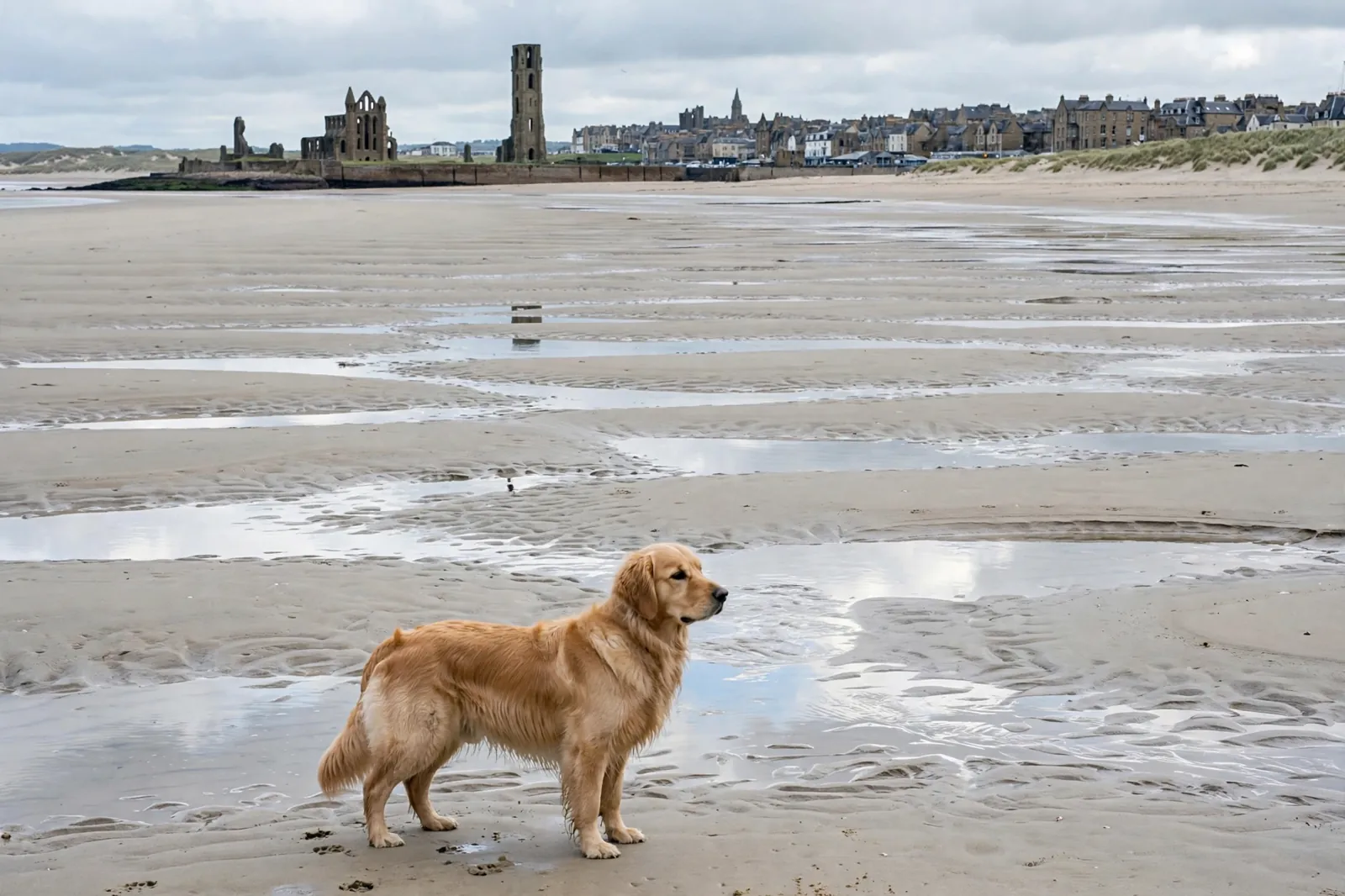
West Sands is the beach in the famous opening sequence of Chariots of Fire, and in person it earns the reputation honestly. At low tide the sand opens into a vast, firm, pale plain with shallow pools, channels and long views north towards the Angus coast and south into town. For many dogs this is the single best run of a Fife holiday: space to stretch out, water to splash in and, away from the busiest section near the town end, room to breathe even in summer. At high tide the picture changes completely — the usable sand shrinks towards the dunes, routes narrow, and a walk that felt boundless two hours earlier becomes a careful pick along the top of the beach. Tide times are therefore not a detail here; they are the timetable.
Dogs are generally welcome on West Sands throughout the year, but that welcome comes with the usual Scottish beach responsibilities and with local controls that can change. Clean up immediately, keep dogs away from any marked conservation or wildlife areas, and respect temporary signage for events, maintenance or nesting birds. The town-end section near the aquarium, the golf museum area and the main access points is naturally the busiest, with families, kite flyers, horse riders at permitted times and plenty of other dogs. If your dog needs space, keep walking north: the beach almost always thins out after the first ten minutes, and the return walk gives nervous dogs a familiar route home rather than a new challenge at the point of tiredness.
Access and parking deserve a plan. The main approach runs past the golf courses along West Sands Road, with parking near the beach that fills quickly on sunny weekends and during major golf events. Arriving early solves most problems at once: a space, a quieter beach and softer light for the dog's paws on warm days. Facilities cluster at the town end, so carry water for the dog if you intend to walk the full length — there is no tap halfway to the estuary. Wind is the other constant. West Sands is exposed, and even a mild day inland can feel sharp on the beach. A drying coat, a towel in the car and a plan for sand removal matter more than they sound: wet sand works into coats, cars and holiday cottages with impressive efficiency, and a quick freshwater rinse and towel at the car saves an evening of grit.
Watch the water with the same care you would anywhere on this coast. Shallow channels can deepen quickly as the tide turns, soft sand and mud can appear near the estuary end, and cold water plus wind chills a wet dog faster than owners expect. Keep dogs out of any area where currents, signage or local advice suggest caution, recall them well before the water's edge if they are determined swimmers, and end the session with a proper warm-up walk rather than a straight line from sea to car park. If you are combining West Sands with golf spectating or a town lunch, rinse, dry and settle the dog first — a damp, sandy dog under a cafe table helps nobody.
East Sands, the harbour and the pier
East Sands is West Sands' smaller, more workaday sibling, and for many stays it becomes the more useful beach. Tucked below the East Scores and beside the harbour, it offers a shorter loop, a closer relationship with the town and a completely different atmosphere: fishing boats, creels, gulls, students, swimmers and families rather than open horizons. Dogs are generally welcome here too, subject to the same need to read entrance signage and follow any seasonal or temporary controls — check the latest official guidance before you travel, and then check the boards again when you arrive, because harbour and beach management can change around events, works and busy periods.
The pleasure of East Sands is how easily it combines with other things. A morning circuit might start with coffee in the centre, drop down to the harbour for a lead walk along the quay, continue onto the sand for a controlled play if conditions and signage allow, and finish with a climb back through the lanes near St Leonard's and the cathedral. None of it is long, which makes it ideal for older dogs, puppies building up distance, or the last evening of a trip when nobody needs an expedition. The trade-off is stimulation: harbour smells are intense, dropped food appears around seating and takeaway spots, and working areas bring vehicles, ropes, nets and slippery surfaces. Keep the lead short on the quay, keep dogs clear of working boats and equipment, and never let a dog drink harbour water or scavenge around bins and fish waste.
The pier adds a classic St Andrews ritual — walking out for the view back to the cathedral, castle and town roofs — but judge it honestly for your dog. Piers are narrow, exposed and busy at weekends, with anglers, tripod photographers and other dogs in close proximity. Confident town dogs usually enjoy it; reactive or nervous dogs may find the lack of passing space stressful, and wet stone can be slippery under paws. Go early, keep to one side, be ready to turn back, and treat the view as a bonus rather than an obligation. On very windy or rough days, skip it entirely: spray over the pier is not a photo opportunity, it is a reason to stay on shore.
Swimming and paddling need extra caution around East Sands and the harbour mouth. Boat movements, submerged structures, algae blooms in warm weather and sudden depth changes all argue for keeping dogs on a lead near harbour water and choosing only clearly suitable, signposted bathing areas for any water play. If your dog has been in the sea, rinse salt and sand from the coat afterwards, check paws for cuts from shells and stone, and watch for the classic after-beach overexcitement that turns a calm walk home through the East Scores into a pulling contest. A short settle on a bench, water offered from your own bottle and a boring five minutes before re-entering busy streets resets most dogs remarkably well.
Cathedral, castle and the old town
St Andrews Cathedral was once the largest church in Scotland, and even in ruin it dominates the east end of town: the great precinct wall, the surviving gables, St Rule's Tower and ranks of carved stones in a setting that feels part churchyard, part open-air museum. St Andrews Castle, a short walk away on its headland, adds bottle dungeons, mine and countermine tunnels and sea views. For dog owners the headline is simple and often misunderstood: heritage interiors, ticketed areas, exhibitions and enclosed grounds operate under their own admission rules, and dogs — other than assistance dogs — are commonly not admitted inside, or are admitted only under specific conditions that can change. Do not build a day on the assumption that your dog can tour either site with you.
That still leaves a great deal to enjoy without crossing a ticket barrier. The streets and public paths around the cathedral precinct, the Scores and the castle headland give you the architecture, the views and the atmosphere with your dog on a short lead beside you. Walk the precinct boundary, pause at viewpoints rather than gateways, and keep dogs well away from fragile stonework, memorials and other visitors who may be reading, sketching or simply standing quietly. Graveyard and memorial areas anywhere deserve particular respect: leads short, no allowing dogs onto graves or monuments, and immediate clean-up if an accident happens. If one member of your party wants the full interior visit, split the group — one person tours while the other takes the dog to East Sands or a cafe — rather than tying a dog outside an entrance, which is stressful for the dog and unwelcome at busy heritage sites.
The wider old town follows the same pattern of generous pavements in some places and tight squeezes in others. Market Street at midday in term time or during a golf championship is a river of people; a large or anxious dog will do better on North Street or South Street, in the quieter closes, or in the green spaces around the university quads viewed from public paths. Many university buildings, chapels, museums and the public library operate assistance-dog-only policies indoors, so treat every doorway as a question, not an entitlement: look for signage, ask staff, and accept a no gracefully. Our guide to visiting English Heritage sites with dogs covers a different organisation south of the border, but its core method — check the individual site page, separate grounds from interiors, and plan a split visit — transfers perfectly to historic sites in Scotland too.
Two practical details elevate a town day. First, water and rest stops: carry a collapsible bowl, because not every cafe provides one and stone streets offer little shade in summer or shelter in a Fife haar. Second, paws: old setts, gravel, hot pavement in a rare heatwave and grit in winter all take a toll, so check feet at every cafe stop, rinse if needed, and keep at least one short, grassy toilet route in mind — the green areas near the harbour and the Lade Braes walk both help. The Lade Braes itself, following the Kinness Burn through a leafy corridor from the centre towards the edge of town, is the local secret for a shady, lower-stimulation walk when beaches are busy and streets are full, though leads are sensible near roads, cyclists and wildlife throughout.
Fife Coastal Path links in both directions
St Andrews is a natural staging post on the Fife Coastal Path, the long-distance route that threads the whole Fife coastline. For a holiday based in town, you do not need to walk the entire trail — you need two or three well-chosen sections, honest distances and a return plan that does not depend on a tired dog managing one more cliff-top mile. The path is well waymarked in most places, but surfaces vary from pavements and promenades to grassy cliff paths, steps, gates and short road sections, and conditions change with weather. Check the latest official guidance before you travel for route closures, diversions and livestock notices, and carry a map or offline route rather than relying on a phone signal holding out around every headland.
Heading south-east from the harbour and East Sands, the path climbs onto the cliffs and works its way towards Kingsbarns, then on to Crail and the East Neuk fishing villages of Anstruther, Pittenweem and St Monans. This is the classic direction: dramatic rock formations including the Rock and Spindle sea stack, seabird colonies in season, golf ground again near Kingsbarns, and villages where fish and chips and harbour walks reward the effort. It is also the direction that demands the most respect. Cliff edges are unfenced in places, paths can be narrow and muddy, fields hold livestock, and retreat options are limited once you are committed between access points. Dogs belong on a lead around livestock, near cliff edges and wherever signs require it — full stop — and a long line has no place on a narrow cliff path. Choose a turnaround point in advance, ideally a village or road access with bus or taxi options, and remember that the walk back into a headwind takes longer than the walk out.
Heading north and west, the gentler links run towards Guardbridge and along the Eden estuary side, with connections inland towards Strathkinness and the quieter lanes behind the town. These routes suit dogs who need distance without cliff exposure, and they combine well with estuary birdlife, riverside paths and a more local, less visited feel. Estuary mud deserves the same caution as harbour water: keep dogs out of deep mud and tidal channels, watch tide times so you are not cut off or forced onto unsuitable ground, and rinse paws and legs thoroughly afterwards. For a fuller route-by-route breakdown of this coastline, including the sections beyond St Andrews in both directions, see our dedicated Fife Coastal Path with a dog guide before you commit to a long day.
Whichever direction you choose, kit and timing decide whether the day is remembered fondly. Start early enough to finish in daylight with margin, carry water for dog and humans because sources are unreliable between villages, pack a basic paw and first-aid kit, and tell someone your plan if you are walking a remote section alone. Buses along the East Neuk and back towards St Andrews can be dog-friendly at the driver's discretion and vary by operator, so check current policy before relying on one as your bail-out, and keep a local taxi number saved as plan B. A dog who has walked eight happy miles and rides home is a success story; a dog dragged for fourteen because the return was never planned is not.
Golf-course paths: safety and etiquette
You cannot separate St Andrews from golf, and with a dog you should not try. The Old Course and its neighbours sit between the town and West Sands, public paths thread around and in places across golf ground, and the Swilcan Bridge end of the Old Course is one of the most photographed spots in sport. Walking near the courses is part of the town's pleasure — watching play, crossing the famous fairways on a quiet Sunday when tradition often rests the Old Course, feeling the scale of the links — but it is also where a relaxed holiday mistake becomes a genuine safety incident fastest. A loose dog on a fairway is not a charming photo; it is a danger to the dog, a ruined shot for players who may have waited years for a tee time, and the fastest way to make path users unwelcome.
The rules are straightforward and non-negotiable. Stay on marked public paths and recognised crossing points. Keep your dog on a lead whenever a path crosses, skirts or shares ground with a course, and shorten it further at crossing points. Never walk on greens, tees or in bunkers, and keep dogs off them even for a quick photograph. If golfers are preparing to play, stop well back, keep the dog still and quiet, and wait for a clear signal or a safe gap before crossing. If a ball lands near you, do not touch it, do not let your dog pick it up — a dog retrieving a ball in play creates exactly the argument nobody needs — and simply move away along the path. If you hear a shout of fore, protect your head, turn away from the direction of play if you can judge it, and keep hold of the dog rather than diving for cover and dropping the lead.
Understand the weekly rhythm before you plan. Tournament weeks, including major championships and the autumn links events, transform the town: paths close or divert, crowds line fairways, security fencing changes familiar routes, and accommodation and parking come under severe pressure. During those periods, base dog walks on West Sands away from the course end, East Sands, the Lade Braes and the coastal path, and treat any course-side stroll as opportunistic rather than planned. On ordinary weeks, Sunday traditionally sees no regular play on the Old Course and walkers enjoy wider access to its ground, but this is a tradition and a managed arrangement, not a permanent right — check local information on the day, follow any signage and staff directions, and keep dogs controlled even when the fairways feel like a public park, because practice play, maintenance vehicles and other walkers are still part of the picture.
Finally, think about your dog's specific triggers. Golf brings sudden movements, swinging clubs at a distance, small white balls rolling enticingly, applause, buggies and, at events, loudspeakers and helicopters. A ball-obsessed dog may find a whole day beside fairways genuinely hard work, constantly scanning and lunging, and will be happier with the beach as the main event and only a short, well-managed course crossing. A sound-sensitive dog should avoid tournament perimeters altogether. None of this diminishes the experience: watching evening light over the links from a lawful path, dog settled on a lead beside you, is St Andrews at its best — it is simply the version where everyone, players included, gets home with the day intact.
Cafes, pubs and refuelling with a dog
St Andrews eats and drinks well, and dog owners are better served here than in many historic towns — provided they ask the right question in the right way. The pattern to expect is variety rather than uniformity: some cafes welcome dogs throughout, some restrict them to a ground-floor area, a snug or an outdoor terrace, some provide water bowls and treats at the door, and others — particularly small bakeries, delis with open food counters and formal dining rooms — operate assistance-dog-only indoors. Policies also change with ownership, season and how busy a venue is, so treat any list, including this guide's general picture, as a starting point. Look for the sign in the window, ask at the door before settling, and check the latest official guidance before you travel if a particular venue is central to your plan.
Geography helps you choose. Around Market Street and the centre you will find the densest choice of coffee shops, sandwich stops and pubs for a town day, with the trade-offs of queues and tight tables. South Street tends to feel a touch calmer and suits a longer lunch. Near the harbour and East Scores, smaller cafes and takeaways pair naturally with an East Sands walk, while the West Sands end offers seasonal and golf-adjacent options that are perfect after a beach session if you have dried the dog first. In every case, the venues that work best with dogs share practical features: a table away from the main door swing and the counter queue, floor space big enough for a dog to lie fully down without blocking a gangway, staff who bring water without being asked twice, and a floor surface that forgives wet paws. If your allocated table offers none of those, a polite request to move beats an hour of your dog being stepped around.
Etiquette is the currency that keeps this welcome alive, and St Andrews — with its mix of students revising, golfers celebrating and families on day trips — tests it thoroughly. Bring a mat or settle blanket so your dog has a defined place, keep leads short and out of walkways, and never allow a dog onto chairs or banquettes unless a venue explicitly invites it. Dogs should not be fed from the table in venues that serve food to others, and a dog who barks persistently at every arrival needs a walk and a reset outside, not a battle of wills at the table. Muddy beach dogs are the local flashpoint: rinse and towel a West Sands dog before expecting any indoor welcome, and be ready to choose the terrace or a takeaway instead on the wettest days. Our national round-up of dog-friendly cafes across the UK goes deeper on reading venue policies and cafe manners that transfer to any town.
For self-catering stays, the town's independent food shops, bakeries and supermarket options make dog logistics easier, because breakfast and one main meal at base remove the pressure to find a dog-welcome table three times a day. Plan one cafe or pub meal as the day's treat, cook or assemble the rest, and keep a reserve plan for the evening your first choice is full: a fish-and-chip supper eaten carefully on a harbour bench, dog settled and gulls firmly ignored, has ended many St Andrews days very happily indeed — just bin every scrap, because a town this visited stays welcoming only while visitors leave it clean.
Where to stay and the practical checklist
Accommodation in St Andrews spans grand golf hotels, family-run guest houses, university-linked stays in season, self-catering flats and cottages in the centre and the East Neuk villages, plus caravan and holiday-park options a short drive away. Dog policy varies as widely as price. Some hotels accept dogs in designated rooms only, often ground-floor or garden-access rooms that book out first, with a nightly or per-stay fee and clear rules about restaurants and bars. Guest houses may accept one small dog by direct arrangement but not advertise it. Self-catering gives the most control — your own door, easier night-time toilet trips, space to dry kit — but check garden security honestly, because a low Fife cottage fence and a determined spaniel are a known combination. Wherever you book, confirm in writing: number and size of dogs accepted, total fee, which areas are off-limits, whether dogs may be left alone and for how long, and what happens about cleaning charges.
Location choices trade charm against convenience. Staying in the centre means beaches, cafes and the coastal path all begin at your door, but parking is limited, streets are lively late into the evening in term time, and a noise-sensitive dog may settle better a few streets back or in a nearby village with a short drive or bus ride in. Staying towards West Sands suits beach-first trips and golfers; staying near the harbour suits coastal-path walkers and anyone who loves the morning light on the East Scores. During major golf events, prices rise sharply and dog-friendly rooms disappear months ahead, so book early or choose different dates — the town in a quieter week is a better dog holiday at half the stress. If you are touring Fife more widely, St Andrews also works as a two or three-night base rather than a single night, because dogs settle, you learn the tide and street rhythms, and one wet day no longer ruins the trip.
Run through the practical checklist before you leave home. Veterinary cover: identify the nearest practice and its out-of-hours arrangement and save both numbers, because a paw cut on a Sunday cliff walk is not the moment to start searching. Tides and daylight: note low-tide windows for West Sands for each day of the trip and plan anchor walks around them. Weather layers: Fife can deliver four seasons before lunch, so pack a dog coat or drying robe, a spare towel that lives in the car, and footwear that handles wet grass, sand and old stone in a single day. Transport: if you arrive by train, the nearest station is Leuchars, a short bus or taxi ride away — check the current dog policy for the connecting service and book taxis that accept dogs in advance rather than hoping at the rank. And paperwork: microchip details up to date, a tag with a holiday contact number, insurance documents accessible on your phone, and any medication packed with margin for a delayed return.
Leave the town as you would wish to find it. That sounds like a slogan, but in a place that receives the whole world for golf, hosts a university and still functions as a small Fife community, it is the operating principle that keeps dogs welcome on beaches, paths and pavements. Clean up everywhere, including beaches and cliff paths. Respect every sign, including the temporary one that spoils your plan. Thank the cafe that found you a corner table and the golfer who waited while you crossed. St Andrews has been receiving visitors for centuries; a well-managed dog is simply the newest kind of guest, and the town — sand, stone and fairways alike — repays the courtesy generously.
More east-coast towns north and south of St Andrews
The Fife and Lothian coast rewards stringing towns together, and three more now have full guides in the same style as this one: North Berwick with a Dog across the Forth for its beaches and the Bass Rock, Dunbar with a Dog for harbour and cliff walking, and Berwick-upon-Tweed with a Dog further south for its Elizabethan walls and the Tweed estuary.
Practical questions
Before you go
Are dogs allowed on West Sands and East Sands all year?
Both beaches are generally open to dogs throughout the year, but local restrictions, seasonal signage and temporary controls can change, especially around busy summer areas, events and wildlife protection zones. Keep dogs under close control near other beach users, clean up immediately, and check the latest official guidance before you travel, including any notices posted at the beach entrances on the day.
Can dogs go into St Andrews Cathedral and Castle grounds?
Dogs are commonly restricted inside ticketed historic interiors, exhibitions and enclosed areas, while outdoor grounds policies vary by site and can change. The safest plan is to enjoy the cathedral precinct and castle surroundings from the public paths and viewing areas, keep your dog on a short lead near stonework and other visitors, and check the latest official guidance before you travel for the current grounds and assistance-dog rules.
Is it safe to walk a dog near the golf courses in St Andrews?
Yes, if you stay on marked public paths, keep your dog on a lead where paths cross or run beside fairways, and stay alert for play. Never walk across greens, tees or bunkers, never let a dog chase or retrieve a golf ball, and pause well back if golfers are about to play a shot. If a ball lands nearby, leave it alone and move away on the path.
Where can I walk from St Andrews on the Fife Coastal Path with a dog?
From the harbour and East Sands side you can follow the Fife Coastal Path south-east towards Kingsbarns, Crail and the East Neuk villages, while routes to the north and west link towards Strathkinness and Guardbridge. Sections include cliff paths, steps, stiles, livestock fields and road crossings, so check distances, tide times and livestock notices in advance and keep dogs on a lead around livestock and cliff edges.
Are there dog-friendly cafes and places to stay in St Andrews?
Yes. St Andrews has cafes, pubs and bakeries that welcome dogs in all or part of the premises, plus hotels, guest houses, self-catering cottages and caravan options that accept dogs, often for a fee and sometimes in designated rooms only. Policies change, so confirm indoor access, maximum dog numbers, fees and whether dogs can be left alone before you book or sit down.