This guide is independent and contains no paid placement. If affiliate links are added later, they will be clearly marked and will not change our editorial checks.
Base yourself near a large park, walk Arthur's Seat early, treat Edinburgh Castle as a split visit because only assistance dogs go inside, and use the Water of Leith, Calton Hill, Inverleith and the Meadows for the rest of the day. In August, walk early and late and keep the Royal Mile short.
Plan in loops, not lists
Draw a circle on the map before you draw up an itinerary. Edinburgh looks compact, and on paper the castle, the Royal Mile, Arthur's Seat and Leith can appear to fit into a single ambitious day. With a dog, the hills, cobbles, crowds and weather turn that plan into a series of compromises. A better method is to build each day around one anchor walk and one neighbourhood, connected by a loop you can shorten without spoiling it. One day might be Holyrood Park and the Old Town. Another might be Stockbridge, the Water of Leith and Inverleith. A third might be the Meadows, Bruntsfield and a cafe lunch, with Calton Hill at sunset if energy remains.
That loop approach solves three Edinburgh-specific problems at once. First, it limits hill repetition: the city is built on ridges and valleys, and a route that looks flat on a map can involve repeated climbs between the Old Town ridge and the streets below. Second, it keeps a toilet walk, water and shade within reach, which matters on Arthur's Seat where there is almost no shelter. Third, it gives you an exit. If wind closes in on the summit paths, if festival crowds fill the Royal Mile, or if your dog has simply had enough of cobbles and bus brakes, you can cut the loop short and still have had a complete day.
Choose accommodation by the morning walk, not by the postcard view. A flat ten minutes from Holyrood Park, Inverleith Park or the Meadows will serve most dogs better than a grand hotel room on a busy central street with nowhere practical to go at 7am. Check the exact after-dark toilet route as carefully as the room itself: a well-lit park edge or a quiet residential street is workable, while a multi-lane road crossing or a pub queue spilling across the pavement is not. The same test applies in reverse at night — Edinburgh is generally well lit in the centre, but park interiors are dark in winter, so know your lit return route before you need it.
Finally, set expectations for pace. Allow roughly twice the time you would allow without a dog for the Royal Mile and the castle esplanade area, not because the distance is long but because stopping, weaving through tour groups and finding breathing space takes time. Dogs that cope well in other British cities can still find the combination of bagpipes, crowds, steep closes and sudden pigeons demanding. Short, successful exposures beat one heroic sightseeing day that leaves everyone frazzled.
Arthur's Seat: choosing a route
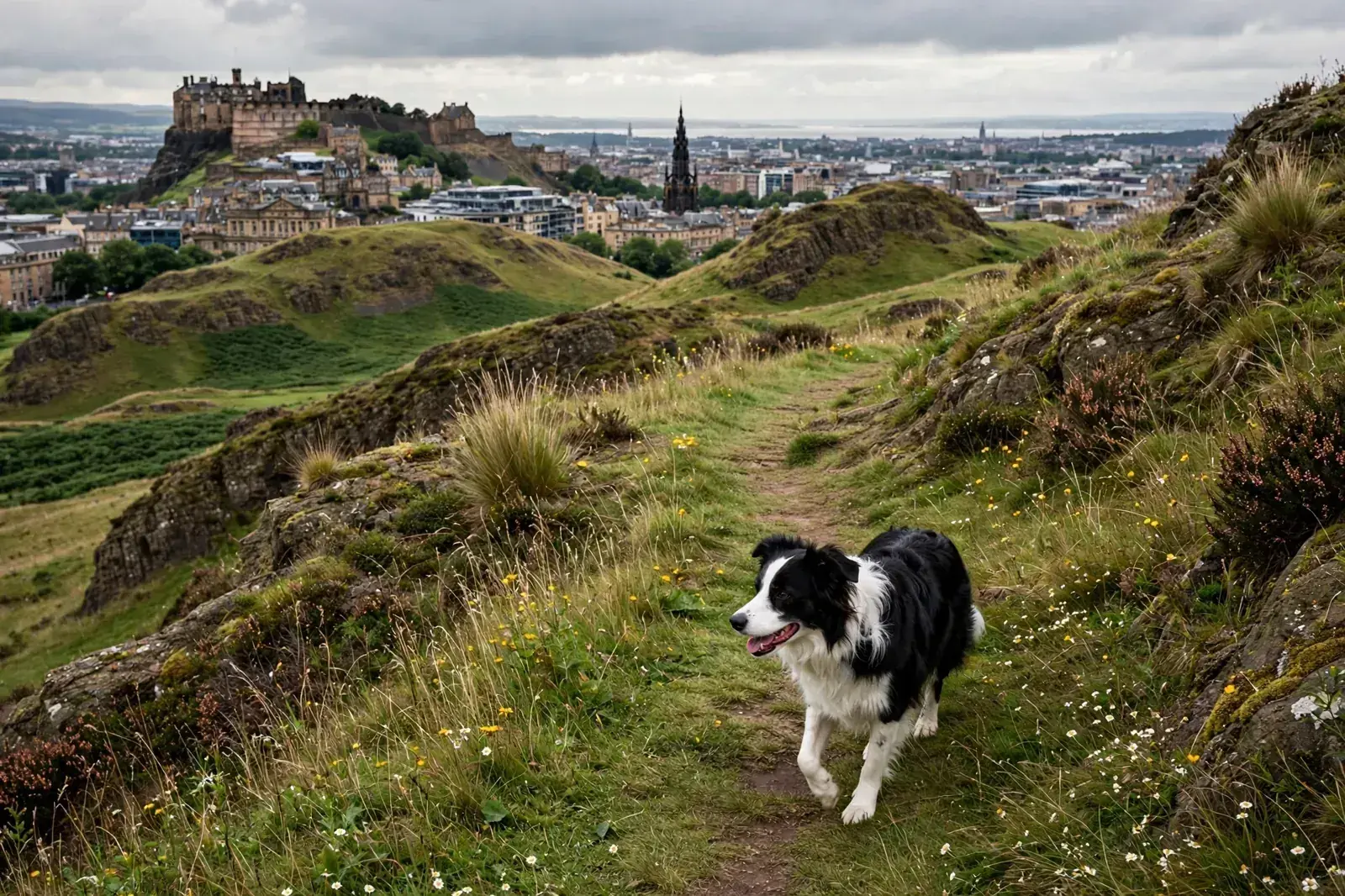
Arthur's Seat, the 251-metre summit of an ancient volcano in Holyrood Park, is the defining walk of an Edinburgh dog trip. There is no single route, and choosing the right one for your dog matters more than reaching the top. The most straightforward ascent follows the broad path from near Dunsapie Loch round the back of the hill — a steadier gradient, better underfoot in most conditions, and the usual recommendation for older dogs, younger dogs and anyone walking in changeable weather. The direct routes from Holyrood itself, including the steeper paths up the front of the hill and the Radical Road side below the Salisbury Crags, are shorter but rougher, with rocky steps, exposed edges and sections where a pulling dog can unbalance a handler.
Conditions decide more than fitness does. The summit is fully exposed, and wind that feels moderate in the city can be strong enough on top to worry nervous dogs and make loose leads, coats and maps hard to manage. In ice, frost or after heavy rain, the polished rock near the summit and the steeper grass slopes become genuinely slippery; turning back or choosing a low-level Holyrood circuit instead is the correct call, not a failed day. In summer heat, start early: there is no shade and no water supply on the hill, the dark rock holds warmth, and the full round trip from Holyrood Palace side commonly takes one and a half to two and a half hours depending on route and stops. Carry water for the dog as well as yourself, plus a collapsible bowl, and plan a rest in the park afterwards rather than a second major walk immediately after.
Lead judgement needs honesty here. Much of Holyrood Park is open and many dogs enjoy off-lead time on the lower slopes, but the summit cone, the crags and any section near roads, car parks or the lochs with swans and other waterbirds call for a lead or a long line. Sheep do not graze Arthur's Seat in the way they graze many British hills, yet deer are not the concern here either — the real hazards are edges, other dogs appearing suddenly on narrow paths, cyclists and runners on shared sections, and birds that tempt a chase toward a drop. A harness is kinder than a collar on steep ground, and a short lead gives better control on rocky steps than an extending lead, which is a poor fit for this hill in any weather.
If your dog cannot manage the summit, the walk is not lost. The loop around the hill at lower level, taking in St Margaret's Loch with its swans, the ruins of St Anthony's Chapel above it, and the broad grassland below the crags, is a substantial and beautiful walk in its own right. Many owners judge it the better dog walk of the two: more sniffing, more space, fewer bottlenecks, and the summit in view the whole way round.
Holyrood Park beyond the summit
Holyrood Park deserves time even if Arthur's Seat is not on your plan. Managed as a royal park beside the Palace of Holyroodhouse, it combines open grassland, two lochs, the Salisbury Crags and the Hunter's Bog valley into a landscape that feels startlingly wild for a city centre. Dogs are welcome across the park, and for a dog staying near the Old Town or Abbeyhill it can serve as the main daily exercise ground rather than a one-off excursion. Early mornings are the quietest and, in summer, the coolest; evenings bring local dog walkers and a friendly, unhurried atmosphere on the lower paths.
Know the water rules before your dog discovers the lochs. Dunsapie Loch, high on the hill road, and St Margaret's Loch, the ornamental loch near the St Anthony's Chapel path, both hold swans and other birds for much of the year. Keep dogs out of the water and on a lead close to the banks where birds are nesting or feeding, and never let a dog chase swans — they defend themselves, and the encounter helps nobody. Elsewhere in the park, watch for the road that loops through Holyrood: parts of the Queen's Drive route have traffic at weekends and are closed to vehicles at certain times, a pattern that has changed in recent years, so check the latest official guidance before you travel and keep dogs on a lead near any open road section regardless.
The Salisbury Crags path, running along the top of the long cliff on the park's western edge, gives the classic postcard view over the Old Town and castle without the full summit climb. It is still an exposed cliff-top path, however, with drops on one side and a surface that ices in winter. Confident dogs on short leads manage it well in calm weather; dogs that lunge, pull or startle easily are better on the Radical Road path below the crags or on the valley floor. Whichever level you choose, the combination of Holyrood in the morning and the quieter streets of Duddingston, on the park's far side, makes a satisfying half day — Duddingston Loch and the surrounding area are also bird-sensitive, so leads near the water apply there too.
Facilities in the park itself are minimal, which is part of its appeal and part of the planning. There are no cafes inside the park and water points are not guaranteed, so arrive supplied. The nearest practical stops for coffee, water refills and toilets are around Holyrood, Abbeyhill and Duddingston village. In wet weather the lower grassland holds water and the valley paths muddy quickly; a drying coat and a towel at the door of your accommodation will earn their packing space after almost every Holyrood walk from October to April.
Edinburgh Castle: the split visit
Edinburgh Castle is the one major attraction where honesty saves disappointment: only assistance dogs are admitted inside. Pet dogs cannot tour the castle, enter its museums and exhibitions, or accompany owners through the ticketed grounds. That policy is common to many comparable historic sites, and it is applied consistently, so do not arrive hoping for an exception at the gate. Check the latest official guidance before you travel, because special events, military ceremonies and security arrangements can also affect the esplanade and surrounding streets on the day.
The workable solution for two adults travelling together is the split visit, and Edinburgh makes it unusually enjoyable. One person books a castle entry slot — timed booking is the norm and peak dates sell out, so reserve ahead — while the other takes the dog on a proper walk rather than a waiting-room loiter. The best nearby options are Princes Street Gardens below the castle rock, where dogs on leads can enjoy the lawns and paths in the shadow of the walls their partner is exploring, a loop through the Grassmarket and Greyfriars Kirkyard area, famous for the Greyfriars Bobby story, or a coffee stop at a dog-welcoming cafe in the Old Town. Allow ninety minutes to two hours for a castle tour, then swap roles or reunite for lunch. Solo travellers have a harder choice: either skip the interior and enjoy the esplanade views and the Old Town from outside, or arrange trusted local dog care for the visit window. Leaving a dog alone in unfamiliar accommodation or in a car is not an acceptable substitute, especially in summer.
Even from outside, the castle area needs crowd management with a dog. The esplanade and the top of the Royal Mile are among the busiest pedestrian spaces in Scotland, dense with tour groups, street performers and, during the festival and at Hogmanay, event barriers and closures. Many dogs do better approaching via the Grassmarket and the quieter closes, visiting early in the morning, and treating the esplanade as a viewpoint to pass through rather than a place to linger. If you are also planning other heritage visits, read our guide to assistance dog access rights in the UK to understand how assistance dog access differs from pet dog policies, and expect a similar assistance-only pattern at the Palace of Holyroodhouse interiors and many gallery and museum spaces — always verify each venue individually before setting out.
Calton Hill and the New Town
Calton Hill is Edinburgh's easy viewpoint: a short, steep climb from Waterloo Place or Regent Road to a grassy summit scattered with monuments, including the Nelson Monument and the unfinished National Monument, and a panoramic view across the Old Town, Arthur's Seat, the Firth of Forth and, on clear days, to Fife. For dogs, it works best as a purposeful short outing — twenty to forty minutes including photographs — rather than a main exercise walk. The summit grass suits a lead walk and a sit in good weather, but there is little space for off-lead running, the edges and monument steps need supervision, and the hill is a popular sunset and Hogmanay gathering point when it becomes far too crowded for most dogs.
Pair Calton Hill with the New Town rather than the Old Town for a calmer half day. The Georgian streets around Calton, Broughton and the eastern New Town are broader and quieter than the Royal Mile, with a good supply of independent cafes, many of which welcome dogs — confirm individually, as policies change. Regent, Royal and Carlton Terraces Gardens and the other New Town private gardens are, however, generally for key-holding residents only, so admire them from the pavement and plan your dog's exercise for the public spaces instead. A practical loop runs from Calton Hill down through Broughton for coffee, then along to Stockbridge and the start of the Water of Leith, turning a viewpoint into the beginning of the city's best linear walk.
On the other side of the centre, Princes Street Gardens fills a similar short-walk role beneath the castle. Dogs are welcome on leads in much of the gardens, the paths are well surfaced for wet days, and the Ross Fountain and floral clock area make a pleasant central pause. The gardens host major seasonal events, including the Christmas markets period and Hogmanay celebrations, when sections close and crowds peak; at those times the Meadows or Inverleith will give your dog a better hour. As with every Edinburgh green space, follow the signage on the day — event fencing can reroute familiar paths overnight.
Water of Leith Walkway
If Arthur's Seat is Edinburgh's spectacular walk, the Water of Leith Walkway is its most useful one. The path follows the river for roughly twelve miles from Balerno, on the city's south-western edge, through Colinton, Slateford, Dean Village and Stockbridge to Leith and the shore. You do not need to walk it all. The central sections — Stockbridge to Dean Village, or Dean Village onward to the Gallery of Modern Art area and Murrayfield — are the sweet spot for most visiting dogs: tree-lined, mostly level, rich in smells, and punctuated by cafes and exit points back to street level whenever you have had enough.
Dean Village, with its mills and the river running beneath Dean Bridge, is the section most visitors remember, and it earns the attention. Go early if your dog is unsettled by narrow paths and photo stops, because the prettiest stretches are also the most popular. Keep dogs on a lead or close control where the path narrows, where cyclists pass, and near the weirs and fast water after rain; the river looks gentle in summer and runs high and powerful in winter, so swimming should be a cautious, local-knowledge decision rather than an automatic one, and out of the question in spate conditions. Herons, dippers and other wildlife reward a dog that can walk past without lunging — another reason a long line beats an extending lead here.
The walkway also solves a transport problem. It links neighbourhoods that are awkward to connect by road, so you can walk out along the river and return by bus from a different point, building one-way routes that keep the walk fresh. Stockbridge at the eastern end of the central stretch is one of Edinburgh's strongest dog neighbourhoods, with the Sunday market area, independent shops and several dog-welcoming cafes and pubs; Leith, at the river's end, adds the Shore's waterside pubs and a bracing continuation along the promenade toward Portobello for dogs that still have miles in them. For more waterside ideas within easy reach of the city, see our East Lothian dog beaches guide, which covers year-round coastal walks a short drive or train ride away.
After prolonged rain, expect mud, puddles across the path and occasional local closures for repairs or fallen trees. Sturdy footwear for you and a plan to rinse paws afterwards will keep the walk enjoyable rather than merely endured. In autumn the tree cover makes this the most beautiful walk in the city; in high summer it is the coolest, which for thick-coated dogs may be the deciding factor.
Inverleith, the Meadows and local parks
Beyond the headline landscapes, Edinburgh's neighbourhood parks are where a dog holiday actually succeeds day to day. Inverleith Park, beside the Royal Botanic Garden in the north of the city, is the connoisseur's choice: a large, well-kept park with open grass for proper exercise, a small pond, allotments, tennis and sports areas, and one of the finest ground-level views of the castle and Old Town skyline across the city. It suits off-lead play for dogs with reliable recall in its open areas, lead control near the pond, play area and sports pitches, and a relaxed local crowd. The Botanical Garden itself, next door, does not admit pet dogs — only assistance dogs — so, like the castle, it is a split-visit candidate, with Inverleith providing the dog's half of the bargain immediately outside.
The Meadows, the broad historic park south of the Old Town, plays the equivalent role for stays in Bruntsfield, Marchmont and the university area. This is social Edinburgh dog walking: wide grass, tree-lined avenues, tennis, cricket and football in season, and in good weather a festival of picnics, students and other dogs. That sociability is its strength for confident dogs and its challenge for reactive ones — visit at quieter hours, use the park's size to keep distance, and keep dogs on leads around picnic groups, sports in progress and the play areas. In March the crocus displays draw photographers and crowds together, and during festival season parts of the Meadows host venues and food stalls, which changes both routes and noise levels.
Fill the gaps with smaller local spaces rather than repeating the same walk three times a day. Harrison Park along the Union Canal in Polwarth, the canal towpath itself toward Ratho, Bruntsfield Links beside the Meadows, Leith Links in the north-east, and the Pentland Hills beyond the city boundary for a bigger hill day all reward exploration. The Pentlands in particular deserve a place in a longer stay: a regional park of reservoirs, heather hills and grazing livestock, where leads around sheep and cattle are essential and the weather deserves the same respect as on Arthur's Seat. Wherever you walk, Edinburgh's rules are the standard Scottish ones under the Land Reform (Scotland) Act access tradition balanced by the Scottish Outdoor Access Code — responsible access, dogs under proper control, and extra care around livestock and wildlife. When in doubt, lead on: it costs nothing and prevents almost every problem.
Where to stay with a dog
Edinburgh has dog-welcoming accommodation at every level, from large hotels that accept dogs in selected rooms to self-catering flats, aparthotels and guest houses in the residential neighbourhoods. The decision that matters is rarely luxury; it is geography plus ground rules. Pick the neighbourhood by its morning walk — Holyrood and Abbeyhill for the park, Stockbridge and Comely Bank for the Water of Leith and Inverleith, Bruntsfield and Marchmont for the Meadows, Leith for the shore and a more local feel — then interrogate the property's dog policy as precisely as you would anywhere. Our national guide to dog-friendly hotels in the UK sets out the booking questions in full; the Edinburgh edition adds cobbles, stairs and festival pricing to the usual list.
Ask, in writing where possible: which rooms or flats actually accept dogs, and are they on the ground floor or up tenement stairs? Edinburgh's beautiful converted townhouses and tenements often involve several flights with no lift, a genuine issue for older dogs, large dogs and anyone carrying luggage and a dog up worn stone steps. What is the per-dog fee, per night or per stay, and is there a size or number limit? Are dogs allowed in the bar or breakfast room, or is there a separate arrangement — and can the dog be left alone in the room at all, a rule that decides your castle and restaurant plans? Self-catering usually gives dogs the easiest stay, with hard floors, a door routine you control and space for a familiar bed, but confirm the stair count, the nearest grass and whether the courtyard or garden, if any, is genuinely enclosed.
Book festival and Hogmanay dates far ahead and expect prices to reflect it; August in particular can double standard rates in central areas, and the best-located dog-welcoming rooms go first. If August prices or crowds do not appeal, the same city in May, June or September offers long daylight, open gardens and a calmer Royal Mile at noticeably lower cost. Wherever you stay, bring the settling kit that makes any room familiar quickly: the dog's own bed or blanket, a chew for the first evening, poo bags in every coat, and a towel stationed by the door, because Edinburgh weather will test it.
Cafes, pubs and eating together
Eating with a dog in Edinburgh is generally straightforward, provided you verify each venue rather than assuming. Independent cafes in Stockbridge, Bruntsfield, Marchmont, Leith and the Old Town's quieter corners are the most reliably welcoming, many offering water bowls and a warm corner; pubs with a traditional bar area are often more dog-positive than formal dining rooms, and a number of the city's pubs have built a genuine reputation among local dog owners. Chain venues vary by branch. The pattern matches the rest of Britain, and our UK dog-friendly cafes guide covers the etiquette that keeps welcomes warm: a settled dog under the table, no dogs on seats, leads short and out of walkways, and a walk and toilet break immediately before you sit down.
Timing is the Edinburgh variable. At lunchtime in festival season, the most popular dog-welcoming places fill and queue, and a dog that copes at 11am may not cope at 1pm in a packed room. Eat early or late, choose the larger venues with space between tables, and in good weather favour gardens and terraces — the Grassmarket's outdoor seating, Stockbridge's cafe fronts and Leith Shore's waterside tables all work well with a dog at heel. In winter the calculation flips: a fireside pub after a Pentlands or Arthur's Seat walk is one of the great pleasures of an Edinburgh dog trip, and arriving before the evening rush secures the corner seat that suits a tired dog best.
Carry a small contingency kit and most outings go smoothly: a portable water bowl, a long-lasting chew for waits, a lightweight mat that marks the dog's place and protects floors, and bags for the inevitable. If your dog cannot settle in busy indoor spaces, build the trip around takeaways, bakeries and park picnics instead — Edinburgh's delis and markets make that a pleasure rather than a compromise, and the Meadows, Inverleith and Holyrood all picnic beautifully in season. Checking a venue's current policy on its own website or by phone the day before remains worthwhile; dog policies change with refurbishments and management, and check the latest official guidance before you travel applies to private venues too in spirit, even if the source is the venue itself.
Festival season with a dog
August transforms Edinburgh. The Edinburgh Festival Fringe, the International Festival, the Art Festival, the Book Festival in its season and the Royal Edinburgh Military Tattoo at the castle together turn the centre into one of the busiest cultural spaces in the world — and one of the most challenging environments in Britain for a dog. None of this makes August impossible; it makes August a different trip, planned around the crowds rather than through them. Owners who accept that bargain, and who may be in the city partly for the festivals themselves, can still give a dog an excellent week. Owners who wanted quiet sightseeing should simply choose another month.
The working strategy has five parts. First, invert the day: walk Arthur's Seat, the Water of Leith or Inverleith early, when the city is calm and cool, and treat the late morning and afternoon as rest time at the accommodation or in the quieter neighbourhoods. Second, ration the Royal Mile: cross it, dip into a single show or street moment if your dog is genuinely crowd-proof, and leave — do not drift its full length at peak hour with a dog at ankle height among thousands of legs, flyers and dropped food. Third, use the green refuges deliberately: Holyrood Park, the Meadows away from venue clusters, Calton Hill early in the day and the canal towpath all stay usable when the centre does not. Fourth, plan the split-visit pattern for anything indoors, including Tattoo nights, which combine castle crowds, late hours and fireworks-like effects that many dogs dislike; a dog that dislikes bangs should be well away from the castle area, settled indoors with familiar sounds, before the Tattoo's evening performance begins. Fifth, book everything — accommodation, dog-welcoming restaurants, any dog care — well ahead, because August demand strips out the flexibility that rescues plans in other months.
The same principles apply, scaled down, at Hogmanay, when the centre hosts street parties with ticketed zones, fireworks over the castle and road closures, and during major rugby weekends at Murrayfield, when the Water of Leith's western sections and the Haymarket area fill with supporters. In each case the dog-friendly version of the event is the early walk, the neighbourhood base and the green space, with the spectacle sampled briefly or watched on a screen from a warm room — a trade most dogs would choose themselves.
Practical details that save the day
Getting around: Edinburgh is walkable at its core, and most owners will cover the centre on foot. For longer hops, dogs are generally carried on Lothian Buses and Edinburgh Trams at staff discretion, on a lead and off the seats — travel off-peak, keep aisles clear, and check the latest official guidance before you travel. Taxis and private hire vary by operator and driver, so state the dog at booking, not at the kerb. If you arrive by train at Waverley, know that the station is large, busy and set in a valley between the Old and New Towns, with steps and ramps to street level; a nervous dog may prefer Haymarket, the smaller western station, or a calm pause in the station before tackling Princes Street at rush hour. Drivers should note the central low-emission and congestion arrangements, limited central parking and the park-and-ride options, all of which favour leaving the car at the edge and using the city's legs-and-trams rhythm.
Weather and kit: Edinburgh's weather is famously changeable within a single walk, and the wind on Arthur's Seat and Calton Hill runs colder than street level in every season. Pack layers for the dog as well as yourself where appropriate — a waterproof coat for thin-coated or older dogs, paw balm or boots if you will walk gritted winter streets and rocky paths, and always more water than the short distances suggest. Cobbles and setts in the Old Town are slippery when wet for paws and shoes alike, and the steep closes between the Royal Mile and the streets below are best taken slowly on a short lead, or avoided with a dog that pulls, in favour of the broader main streets.
Health and backup: save the details of a local veterinary practice near your accommodation and the out-of-hours service before you need them, and carry your own vet's number and insurance details as you would anywhere. Ticks are present in the Pentlands and other rough ground around the city in season, so check legs, ears and belly after countryside-style walks and use your usual prevention. Blue-green algae can occur in still waters in warm weather, including park lochs — another reason the no-swimming default at Dunsapie and St Margaret's Lochs is wise. Finally, build one unplanned half day into every Edinburgh itinerary. The city rewards wandering — a new close, a quiet garden square, a stretch of canal you had not intended to walk — and a schedule with slack in it is what turns a well-researched trip into a holiday your dog enjoys as much as you do.
East Lothian day trips from Edinburgh
Edinburgh is the obvious launch point for the East Lothian coast, and the three towns closest to the city each have a full guide: Haddington with a Dog for a riverside market town, North Berwick with a Dog for beaches and the Law, and Dunbar with a Dog for harbour walks and cliff paths. All three are reachable by train or a short drive, and all three explain the seasonal beach rules before you go.
Practical questions
Before you go
Can dogs go inside Edinburgh Castle?
Only assistance dogs are allowed inside Edinburgh Castle. Pet dogs cannot enter the castle buildings or grounds beyond the ticketed area, so travelling pairs often split the visit, with one person touring while the other walks the dog in Princes Street Gardens or around the Old Town, then swapping. Check the latest official guidance before you travel, as event days can change access arrangements.
Are dogs allowed on Arthur's Seat and in Holyrood Park?
Yes, dogs are welcome in Holyrood Park and on Arthur's Seat, and this is one of the best large walks in the city. Keep dogs under close control, use a lead near roads, car parks, swans on Dunsapie and St Margaret's Lochs, and during busy periods, and take care on steep, rocky and exposed sections in wind or ice. Carry water, as there is little shade or supply on the hill itself.
Where can dogs go off lead in Edinburgh?
Many Edinburgh parks allow off-lead exercise where a dog is under reliable recall, including large areas of the Meadows, Inverleith Park and Holyrood Park away from roads and wildlife. Always follow local signage, keep dogs on a lead near play areas, sports pitches in use, roads and waterbirds, and use a long line if recall is not secure around other dogs, joggers and picnics.
When is the best time to visit Edinburgh with a dog?
Late spring and early autumn usually give the best balance of daylight, milder weather and manageable crowds. August festival season brings the fullest programme but also the busiest Royal Mile, higher accommodation prices and crowded pavements that many dogs find stressful. Winter visits can work well for hill-hardy dogs, but short days, ice on Arthur's Seat and Calton Hill, and Hogmanay closures need planning.
Are dogs allowed on Edinburgh buses and trams?
Dogs are generally carried on Lothian Buses and Edinburgh Trams at the driver's or staff member's discretion, provided the dog is on a lead, well behaved and does not block aisles or sit on seats. Travel off-peak where possible, board with space for other passengers, and check the latest official guidance before you travel, as conditions can change.