This guide is independent and contains no paid placement. If affiliate links are added later, they will be clearly marked and will not change our editorial checks.
Kirkcudbright rewards a slow, on-foot visit with a dog: the harbour and riverside paths are the heart of the town, the gallery streets are compact and easy to wander, and the Solway coast is minutes away. Keep the dog on a lead around the quayside and the harbour, check tide times before coastal walks, and confirm gallery and cafe dog rules at the door.
Start at the harbour, where the painters stood
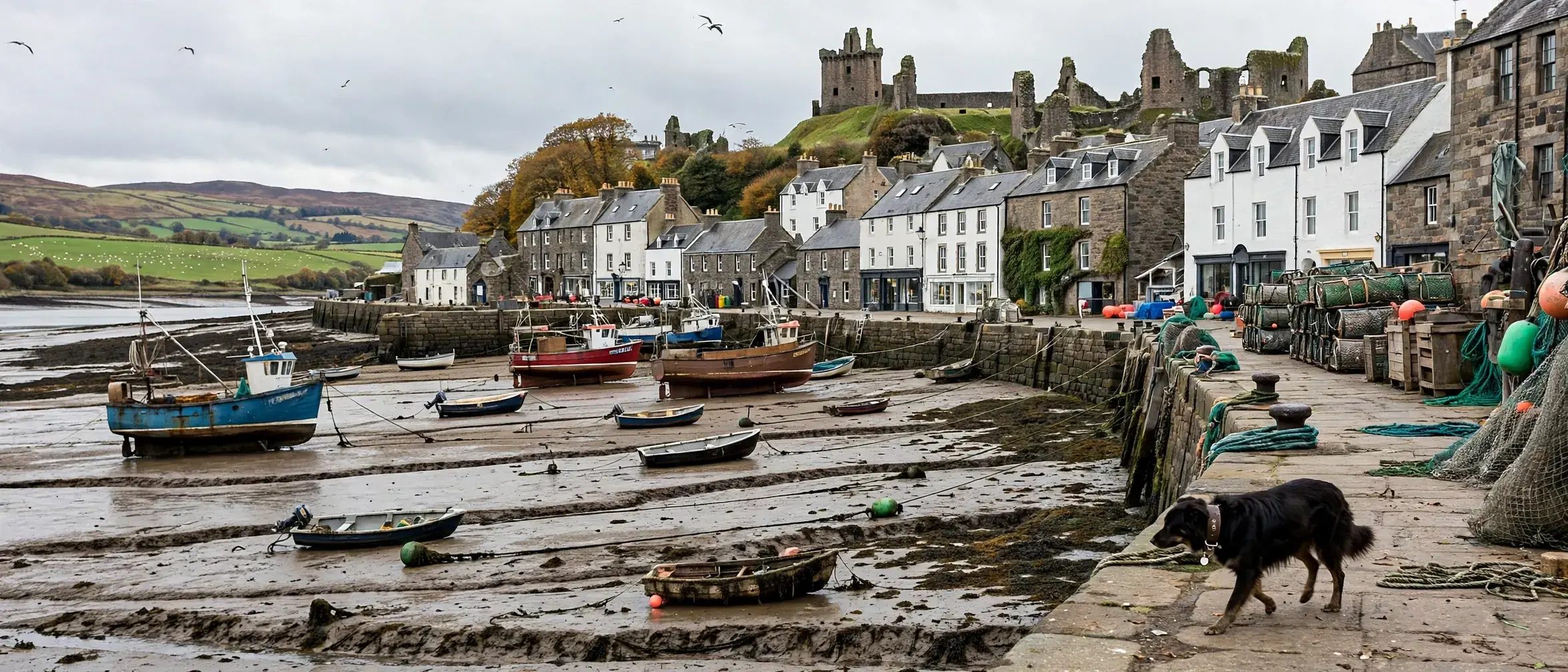
On a bright morning in Kirkcudbright, the first thing you notice is the light. It bounces off the water of the River Dee estuary, off pale stone walls and whitewashed cottages, and off the masts of boats that sit on the mud when the tide is out. It is easy to see why painters came here and stayed. More than a century ago, artists drawn by that same clear, changeable light set up studios in this small harbour town, and the place has carried the name of the Artists' Town ever since. The harbour is still the natural starting point, for them and for you.
Arrive early and the town feels like a working place rather than a museum. Fishing boats and pleasure craft rest on the quayside, gulls circle overhead, and the first dog walkers of the day are already out along the river. The air smells of salt and damp stone. Your dog will pick up a hundred scents before you have finished your first circuit of the harbour: rope, fish boxes, seaweed, the bakery warming up on the High Street. That is the whole point of starting here. Kirkcudbright is a town best understood on foot, at a dog's pace, with time to stop and look.
The harbour sits at the edge of the town centre, so you are never far from a cafe, a gallery or a bench with a view. A first loop of the quayside takes perhaps twenty minutes at a stroll, and it tells you most of what you need to know about the place: which way the river runs, where the boats lie at low water, where the light falls in the morning, and where the town's streets begin to climb away from the water. From here you can plan the rest of the day around your dog's energy rather than a timetable.
One thing to settle before you go further is the lead. The quayside is a working harbour with vehicles, mooring ropes, ladders and drops to the water, and it is not a place for a dog to run free. Keep the lead short and the dog on the town side of the quay edge, especially at low tide, when the mud below looks solid but is not. A long line is useful on the open riverside paths further out, but around boats, bollards and other people's fishing gear, a short lead and a calm dog make the morning easier for everyone.
If the tide is in, the harbour looks its prettiest, with reflections doubling the boats and the cottages. If the tide is out, it looks its most honest: mud, wading birds, ropes and the everyday business of a small port. Both are worth seeing, and the difference between them is one of the pleasures of a stay here. Check the tide times before you travel if you want to catch the harbour at its fullest, and remember that the same tide shapes the coastal walks later in this guide.
Why artists settled here — and what that means for a dog walk
Kirkcudbright's reputation as an artists' town is not a recent marketing idea. In the late nineteenth and early twentieth centuries, painters including E. A. Hornel and Jessie M. King were drawn to the town by its light, its harbour and its relatively low cost of living, and a genuine artists' colony grew up around them. Studios opened in former warehouses and cottages, painters sketched the harbour from the same quayside you will walk with your dog, and the town's identity shifted from a quiet fishing port to a place where art was part of everyday life.
That history still shapes the streets you walk today. The High Street and its side lanes hold galleries, craft shops and studios in buildings that were once sail lofts, granaries and fishermen's cottages. The Tolbooth, the town's old civic building, now holds an art centre. Kirkcudbright Galleries, a larger public gallery, tells the story of the artists' colony and shows work by local and visiting artists. The effect is a town centre that feels creative without feeling precious: paint is sold next to fishing tackle, and a gallery can sit two doors from a bakery.
For a dog owner, the practical consequence is a town centre that is small, flat and easy to explore on foot. You can walk from the harbour to the far end of the High Street in about ten minutes, and most of the galleries and studios are within a few streets of each other. That matters when you are planning around a dog that needs a rest, a drink or a toilet break: you are never more than a short walk from the riverside path, the harbour green or your car.
It also means the town rewards looking up and looking twice. Painted signs, window displays of local work, small sculptures and the occasional easel set up on the pavement are part of the streetscape. Dogs, of course, look at ground level, and at ground level Kirkcudbright is equally interesting: doorways that smell of other dogs, cobbles that are easy on paws when dry and slippery when wet, and the occasional cat watching from a window. Walk slowly, let the dog sniff, and the town gives up its details.
The artists' connection also gives you a useful way to structure a visit. Instead of trying to see everything, pick one theme for the morning — the harbour and its light, or the galleries and studios — and leave the rest for the afternoon. A dog that has had a good harbour walk and a rest will cope far better with an hour of gallery streets than one that has been marched from sight to sight without a break. Kirkcudbright is a town for lingering, and lingering suits dogs.
A word on the light that the painters loved: it changes fast. The Solway coast is famous for wide skies, and a morning that starts grey can turn bright within the hour, or the other way around. If you are hoping to photograph your dog on the quayside, the early morning and late afternoon give the softest light, and the low sun across the estuary can be spectacular. Keep the camera ready, but keep the dog's comfort first — a cold wind off the water is no fun for a short-coated dog standing still while you frame a shot.
The harbour walk, step by step
The simplest and best walk in Kirkcudbright starts at the harbour and follows the water. Begin at the quayside near the marina, where boats are moored and the river opens towards the Solway Firth. Walk along the waterfront with the water on your left as you head away from the town centre, and the town gradually gives way to open riverside, fields and the wide estuary. The path is mostly level, which makes it a good choice for older dogs, puppies building up their stamina, and owners who would rather look at the view than climb.
Allow at least an hour for the out-and-back, longer if your dog likes to stop and sniff every post. The first stretch is the busiest, with other walkers, cyclists and the occasional vehicle near the harbour. After that the path quiets down, and you will share it mostly with dog walkers, birdwatchers and the wading birds that feed on the mudflats at low tide. Curlews, oystercatchers and herons are common here, and a dog with a strong chase instinct should stay on a lead or a long line — the birds are easily disturbed, and the mud is not a safe place for a dog to follow them.
Underfoot, expect a mix of pavement, compacted path and grass. After rain the riverside sections can be muddy, so waterproof footwear and a towel in the car are worth packing. In summer the grass is firm and the path is easy; in winter it can be soft and slippery, and the wind off the estuary cuts through a thin coat. A drying coat for the dog and a spare towel will earn their place in the car boot on most visits.
There are a few practical points to watch. The harbour area has no fence between the path and the water in places, so keep a close eye on a dog that likes to jump in — the drop to the water and the tidal current are not something to test. Mooring ropes and fishing gear lie across the quayside at times, and a trailing lead can tangle quickly. Carry water for the dog, because there is no guarantee of a dog-friendly tap along the quieter stretches, and bring bags for waste: there are bins near the harbour, but fewer further out.
The return leg is the same path, which is a genuine advantage with a tired or older dog: you know exactly how far it is back, and there are no surprises. If the dog is flagging, turn around at any point — the view back towards the town, with its rooftops and church tower, is as good as the view out. Finish the walk at the harbour green or a quayside bench, give the dog water and a rest, and you have had the best of Kirkcudbright before lunch.
For a longer outing, the riverside walk can be combined with the lanes behind the harbour and a loop back through the town centre, which adds gallery windows and cafe smells to the route. Keep the total distance modest on the first day and build up: a dog that is new to the area will be tired by new smells and sounds as much as by miles, and a relaxed afternoon in the town is worth more than an exhausted evening.
Galleries, studios and the Tolbooth
Kirkcudbright's galleries are the reason many visitors come, and they deserve a considered plan when you have a dog with you. The town's main public venues include Kirkcudbright Galleries, which presents the story of the artists' colony alongside changing exhibitions, and the Tolbooth Art Centre, housed in the town's historic tolbooth building. Around them, a scattering of independent galleries and working studios shows paintings, prints, ceramics and jewellery, often with the artist present. Policies on dogs vary from venue to venue, so check the official guidance before you travel and ask at the door rather than assuming.
As a general rule, small independent galleries and studios are more likely to welcome a well-behaved dog, especially outside the busiest hours, while larger public galleries and museums commonly allow only assistance dogs indoors. That is not a hard rule, and it changes with exhibitions, staffing and the season, so the only reliable approach is to ask. A polite question at the door, a dog that can settle quietly for a few minutes, and a willingness to take turns with your companion will open more doors than any assumption.
Taking turns is the practical answer for couples and families: one person looks around while the other waits outside with the dog, then you swap. The town centre is compact enough that the waiting person is never far from a bench, a cafe terrace or the harbour, and the dog gets a change of scene rather than a long wait in a doorway. If you are travelling alone with the dog, plan gallery visits for the quieter hours, keep them short, and be ready to skip a venue that does not admit dogs — there are enough windows, studios and outdoor displays to enjoy the town's art from the street.
The Tolbooth itself is worth a look from the outside even if you do not go in. It is one of the town's oldest buildings, a reminder of Kirkcudbright's history as a royal burgh, and it sits close to the harbour in the heart of the old town. Nearby, MacLellan's Castle, a ruined sixteenth-century tower house, stands as another piece of the town's past; the grounds around it make a pleasant short stop on a walk, though you should check the official guidance before you travel for current access and dog rules at historic sites.
When you are browsing studios, remember that they are working spaces as well as shops. Wet paint, fragile ceramics, low shelves and open doorways to back rooms are all part of the environment, and a wagging tail at shelf height can do real damage. Keep the dog close, on a short lead, and do not let them nose at displays. Most artists are delighted to meet a calm dog; none of them wants to repaint a canvas because a lead caught an easel.
If you buy a print or a piece of pottery, ask the gallery to wrap it securely for the journey home and keep it in the car rather than carrying it around the town with a dog on a lead. A flat print in a tube is easy; a ceramic vase is not. And if you are tempted by a painting of the harbour at low tide, take a photograph of the label and the artist's details first — you can always order later, once the dog is settled at home.
The Galloway coast from Kirkcudbright
Kirkcudbright sits close to some of the quietest and most rewarding stretches of the Solway coast, and the shoreline is the natural next step once you have explored the town. The coast here is not about bucket-and-spade beaches and amusement arcades; it is about wide sandy bays, rocky headlands, salt marsh and the enormous skies that the Solway is known for. That makes it ideal for dogs that like space, but it also means you need to plan around tides, weather and wildlife rather than simply turning up.
The most important check before any coastal walk is the tide. Parts of the Solway shore are cut off or narrowed at high water, and the mudflats that look inviting at low tide are treacherous underfoot and dangerous in a rising tide. Always check tide times before you travel, tell someone where you are going if you are walking alone, and build in time to get back well before the water returns. A walk that is easy at mid-tide can become a scramble an hour later, and a dog that has run ahead onto the flats will not understand the urgency.
Nearby bays within a short drive include the sands around Kippford and Rockcliffe, and the longer beaches further along the coast towards Sandyhills and Brighouse Bay. Each has its own character: some are sandy and open, good for a long run when they are empty; others are rockier, with pools and seaweed that reward a slow sniffing walk. Seasonal dog restrictions apply on some beaches, so check local signs at the entrance and the official guidance before you travel rather than relying on memory or a guidebook. Our guide to dog-friendly beaches in Scotland covers the seasonal rules, tides and beach-day kit in more detail.
On the coast, the usual countryside rules apply with extra emphasis. Keep the dog on a lead near cliffs, where the edge can be undercut and the drop is sudden, and near livestock, which graze the coastal fields and marshes. Nesting birds use the shore and the dunes in spring and early summer, and a loose dog can destroy a nest in seconds without meaning to. If your dog has a reliable recall and the beach is empty, an off-lead run is one of the great pleasures of the Solway — but the decision should be made fresh each time, based on who and what is around you, not on habit.
Pack for the coast as you would for a proper walk, not a stroll. Water for the dog is essential, because seawater is not a substitute and there may be no fresh water at the beach. A towel, a spare lead and a lead for the car journey home will all be used: a dog that has rolled in seaweed or paddled in a rockpool is not a dog you want loose in the car. Check paws after a rocky walk, rinse off salt water when you get back, and watch for cuts from sharp shells or barnacles.
The light on the Solway is the other reason to go. On a clear evening the sun sets over the water to the south-west, and the whole estuary turns gold. It is the same light that brought the painters to Kirkcudbright, and it is best enjoyed with a dog that has already had its run and is happy to sit beside you while you watch it fade. Bring a warm layer for yourself and a coat for the dog if the wind is up — the Solway breeze is bracing even on a sunny day.
Where to eat and drink with your dog
Kirkcudbright's eating scene is small but good, and it suits a dog-friendly day out better than a large town's. The High Street and the streets around the harbour hold cafes, bakeries, pubs and restaurants that cater to walkers and visitors, and several of them welcome dogs, particularly in outdoor seating areas, on terraces and in bar areas. As with galleries, policies change with the season and the individual business, so check before you travel and confirm at the door.
Cafes are the easiest option for a mid-morning or lunchtime stop with a dog. Outdoor tables in the warmer months are the most reliably dog-friendly spots, and many cafes will bring a bowl of water without being asked. In colder weather, ask whether dogs are allowed inside — some cafes welcome them in a particular area, others only outside. A dog that can settle under a table on a mat will be welcome almost anywhere; a dog that barks at every passing plate will not, and no amount of asking will change that.
Pubs in the town are often the most relaxed option in the evening, particularly those with a bar area where dogs are welcome to lie by the fire in winter. Order at the bar, settle the dog first, and keep the lead short so that staff carrying food and other customers can pass safely. If you are planning a full evening meal, book ahead and mention the dog when you book — a table near the door or in a quiet corner is easier for everyone than a table in the middle of a busy dining room.
A few practical habits make cafe and pub stops work. Bring a mat or a familiar blanket so the dog has a defined place to lie down; a dog with its own spot settles far faster than one expected to lie on a cold floor. Bring a chew or a stuffed toy for the wait, and a small portion of the dog's own food if the stop will be long. Avoid the busiest lunch hour, roughly noon to two, if your dog is nervous in crowds, and choose a table where the dog is not in a walkway. And always ask before offering the dog anything from the kitchen — many cafe foods contain ingredients that are not suitable for dogs.
For self-catering, the town has shops where you can pick up supplies for a picnic or a meal back at your accommodation. A takeaway eaten on the harbour green or a bench by the river is a perfectly good Kirkcudbright lunch, and it suits dogs far better than a formal restaurant. Bring bags for waste and take everything away with you; the harbour is a working place and a shared one, and litter is noticed quickly.
Staying overnight with a dog
Staying in Kirkcudbright with a dog is straightforward, but the town is small and the best dog-friendly options are limited, so book early — particularly for summer weekends and the school holidays. The town offers a mix of small hotels, guesthouses, bed and breakfasts and self-catering cottages, and the surrounding countryside adds farm stays, caravan sites and cottages within a short drive. Check the dog policy for the specific room or property you are booking, not just the business as a whole: some places accept dogs only in selected rooms or ground-floor units.
When you enquire, give the full picture of your dog: how many dogs, their size and breed, and whether they are used to staying away from home. Ask about any pet fee and what it covers, whether there is a charge per dog or per stay, and whether dogs may be left alone in the room — many places prohibit this outright, and you should plan as if the answer is no. Ask where the dog can be exercised last thing at night and first thing in the morning, and whether there is a secure garden or an enclosed area.
Self-catering cottages are often the easiest choice for a dog-friendly stay in and around Kirkcudbright. A cottage with an enclosed garden gives the dog a safe place to stretch its legs, a kitchen makes feeding simple, and you are not bound by hotel meal times. Look for a ground-floor property if your dog struggles with stairs, and ask about the garden boundary — a low wall or a hedge with gaps is not the same as a secure fence. Our wider guide to Dumfries and Galloway with a dog covers forest stays, coastal bases and dark-sky nights across the region if you want to combine Kirkcudbright with a longer Galloway trip.
If you are camping or caravanning, there are sites in the wider area that welcome dogs; our guide to camping with a dog in the UK covers choosing a site, tent setups and the packing list that makes a first camping trip with a dog relaxed rather than chaotic. Whichever type of stay you choose, confirm the dog policy in writing with your booking confirmation, and keep that confirmation with you — a verbal promise at the time of booking is hard to rely on if the staff on duty have not been told.
On arrival, settle the dog before you unpack. Walk the garden or the nearest toilet area, check gates and fences, move cleaning products and anything chewable out of reach, and set up the dog's bed in the place where it will sleep. A familiar blanket, the usual food and the usual routine will do more for a good first night than any amount of sightseeing. Kirkcudbright is a quiet town in the evening, which suits most dogs — but fireworks, harbour noise or a neighbouring dog can unsettle a sensitive one, so ask your host about anything unusual expected during your stay.
Practical planning: parking, vets and seasons
Kirkcudbright is a small town, and practical planning is mostly a matter of knowing where things are before you need them. Parking is available in and around the town centre, including car parks near the harbour, but spaces fill on summer weekends and during events, so arrive early or be prepared to walk a few minutes from a quieter spot. Do not leave a dog in a parked car, even on a mild day — a car heats up fast in sun, and a dog left alone in a strange town is stressed even before the temperature rises.
Before you travel, save the number of a local vet and an out-of-hours emergency vet, and know roughly where they are. The nearest practices are in Kirkcudbright itself and in nearby Castle Douglas and Dumfries, but opening hours vary and rural practices can be some distance away. Carry your dog's vaccination record and any regular medication, and keep the vet's number in your phone rather than relying on a search when you are already worried.
The best time to visit depends on what you want from the trip. Late spring and early autumn are often the sweet spot: the light is good, the town is quieter, the coastal paths are at their best, and many summer dog restrictions on beaches have lifted by October. Summer brings the liveliest town, the longest days and the most visitors, along with the need to book accommodation and restaurants ahead. Winter is quiet and atmospheric, with low light across the estuary and a real chance of a bracing walk followed by a pub fire — but daylight is short, some businesses reduce their hours, and the wind off the Solway is cold, so pack warm layers for both of you.
Weather on the Solway coast changes quickly, and the forecast for the coast can differ from the forecast inland. Check the forecast the morning you travel and again before a coastal walk, and carry a waterproof for yourself and a drying coat for the dog. Midges are less of a problem on the coast than in the forests inland, but they can still be a nuisance on calm summer evenings — our regional guide notes the midge season in Galloway Forest Park, so check the official guidance before you travel if you plan to combine a town stay with forest walks.
Finally, remember that Kirkcudbright is a working town as well as a visitor destination. Fishing boats, farm vehicles, delivery vans and local traffic use the same streets and quayside as visitors, and the harbour is a place of work. Give working people and their equipment space, keep the dog out of the way of vehicles, and leave gates as you find them on the paths out of town. A little courtesy goes a long way in a small community — and it is what keeps a town like this welcoming to dogs.
Easy day trips with the dog
Kirkcudbright makes a good base for exploring the wider region, and the day trips below all work as a half-day or full-day outing with a dog, with a drive of under an hour in most cases. The common thread is that they are all low-key, outdoor and dog-shaped: no long queues, no crowded attractions, just coastline, forest and small towns.
Castle Douglas, about twenty minutes' drive away, is known as the food town of Galloway, and its wide High Street and surrounding lanes are easy to explore with a dog. It is a useful stop for supplies, a cafe lunch and a change of scene, and the town sits on the edge of Carlingwark Loch, where a level lochside walk suits a gentle morning. Check local signs for dog rules around the loch, and keep the dog on a lead near the water and the road.
Gatehouse of Fleet, a little further west, is a small town with a river, woodland walks and a relaxed feel that suits a slow afternoon. The surrounding countryside offers forest tracks and riverside paths, and the town itself is compact enough to explore on foot. It pairs well with a drive along the coast road, which gives views across the Solway to the hills of the Lake District on a clear day.
For a longer day, the Galloway Forest Park is one of the great dog-walking landscapes in Britain: miles of forest trails, lochs and viewpoints, and the dark-sky status that makes it special after sunset. Go prepared — forest walks are longer and more remote than the harbour path, so carry water, food, a map and a charged phone, and check the official guidance before you travel for trail conditions and any seasonal restrictions. Our regional guide to Dumfries and Galloway covers the forest trails and the practical details of a forest day in more depth.
Closer to town, Dundrennan Abbey, a ruined Cistercian abbey a few miles from Kirkcudbright, makes a short and atmospheric stop. The abbey's stonework and setting are worth a look, and the surrounding lanes are quiet for a walk. As with any historic site, check the official guidance before you travel for current opening arrangements and dog rules, and do not assume that a dog can go everywhere a person can.
Whichever day trip you choose, the rule is the same as in town: start with the dog's needs, not the destination. A dog that has had a good morning walk, a rest and a drink will enjoy a new place; a dog that has been driven from stop to stop without a break will not. Kirkcudbright's greatest gift to a dog owner is that it is a place to slow down — and the day trips are best enjoyed in the same unhurried spirit.
Practical questions
Before you go
Is Kirkcudbright a good base for a dog-friendly holiday in Galloway?
Yes, it is one of the most practical bases in the region. The town is compact and walkable, the harbour and riverside paths are close to the centre, and the wider Dumfries and Galloway coast and forest are within easy driving distance. Book dog-friendly accommodation early in summer, because the town is small and the best options fill quickly.
Can dogs go into the galleries in Kirkcudbright?
It depends on the venue. Some small independent galleries and studios welcome well-behaved dogs, while larger public galleries and museums may only allow assistance dogs indoors. Ask at the door or check the venue's own guidance before you travel, and plan to take turns looking around if one of you needs to stay outside with the dog.
Where can my dog run off lead near Kirkcudbright?
Quiet stretches of the Solway coast and some open riverside paths suit off-lead running when they are empty and your dog has a reliable recall, but always check local signs first. Seasonal dog restrictions apply on some beaches, livestock and nesting birds are a real consideration on the coast, and the harbour quayside itself is a place for leads, not free running.
Are there dog-friendly places to eat in Kirkcudbright?
Several cafes and pubs in the town welcome dogs, particularly in outdoor seating areas and on terraces. Policies change with the season and the individual business, so check before you sit down, bring a mat for your dog to settle on, and avoid peak lunch hours if your dog is unsettled by crowds and clattering plates.
What should I check before walking the coast path from Kirkcudbright?
Check the tide times, the weather forecast and the route length before you set out. Parts of the Solway shore are muddy or cut off at high tide, and the light changes fast in winter. Carry water for the dog, keep them on a lead near cliffs, livestock and other walkers, and have a plan for turning back early.
Is Kirkcudbright easy to reach by public transport with a dog?
It is reachable by bus from Dumfries, where the nearest mainline station is, but services are infrequent and a car makes the area far easier to explore with a dog. If you travel by bus, check the operator's dog policy and the timetable before you travel, and allow generous time for connections.