This guide is independent and contains no paid placement. If affiliate links are added later, they will be clearly marked and will not change our editorial checks.
Base yourself in one small town — Newton Stewart for the forest, Kirkcudbright for the coast, or Wigtown for books and birdlife — and work outwards in short drives. Walk forest trails early, keep Solway beach visits tightly tied to tide times, and save clear evenings for dark skies. Distances look small on the map but lanes are slow, so one good walk and one town visit a day is the right pace with a dog.
Why the south-west suits dogs
Most visitors to Scotland drive straight through Dumfries and Galloway on their way to the Highlands, which is precisely why it works so well for a dog holiday. The region keeps the ingredients people travel north for — lochs, upland views, empty beaches and small harbour towns — but at a gentler density. Car parks are quieter, forest trails are rarely crowded, and you can often find a cottage with a secure garden without the prices or the booking pressure of the better-known glens. For a nervous or older dog, that lower background noise matters as much as the scenery.
Geography helps you plan. The region runs roughly east to west: Dumfries itself in the east, Castle Douglas and Kirkcudbright in the middle, Newton Stewart and the Machars peninsula in the west, and Stranraer and the Rhins at the far end. Galloway Forest Park sits inland in the north-west of the region, while the Solway Firth shapes the entire southern edge. Driving from one end to the other takes much longer than the mileage suggests because many roads are single-carriageway A-roads or narrow lanes, so resist the urge to stay in one place and day-trip everywhere. Pick a base that matches your priority and accept that you will not see all of it in one short break — returning for the other half is a feature, not a failure.
Expect a working landscape rather than a theme park. Sheep and cattle graze close to paths, forestry operations close trails at short notice, and coastal villages still revolve around fishing boats and farming rather than visitors. That means lead discipline, closed gates and respect for signs are part of the deal every day, not occasional extras. It also means a warm welcome in many pubs and cafes, because dogs are part of everyday life here rather than a marketed add-on. If your dog settles well in quiet pubs and copes with livestock-aware walking, this region will feel easy. If your dog needs off-lead running several times a day, plan those opportunities carefully on beaches at low tide and on suitable forest trails rather than assuming open access means free running everywhere.
Galloway Forest Park trails
Galloway Forest Park is the walking heart of the trip: a large area of forest, lochs and open hill managed by Forestry and Land Scotland, with visitor centres at places such as Glentrool, Kirroughtree and Clatteringshaws — check the latest official guidance before you travel for current opening, charges and trail closures. Each centre works as a trailhead with parking, toilets and waymarked routes of different lengths, which makes planning with a dog straightforward: start from a centre, follow a colour-coded loop, and you know roughly how long you will be out and what the surface will be.
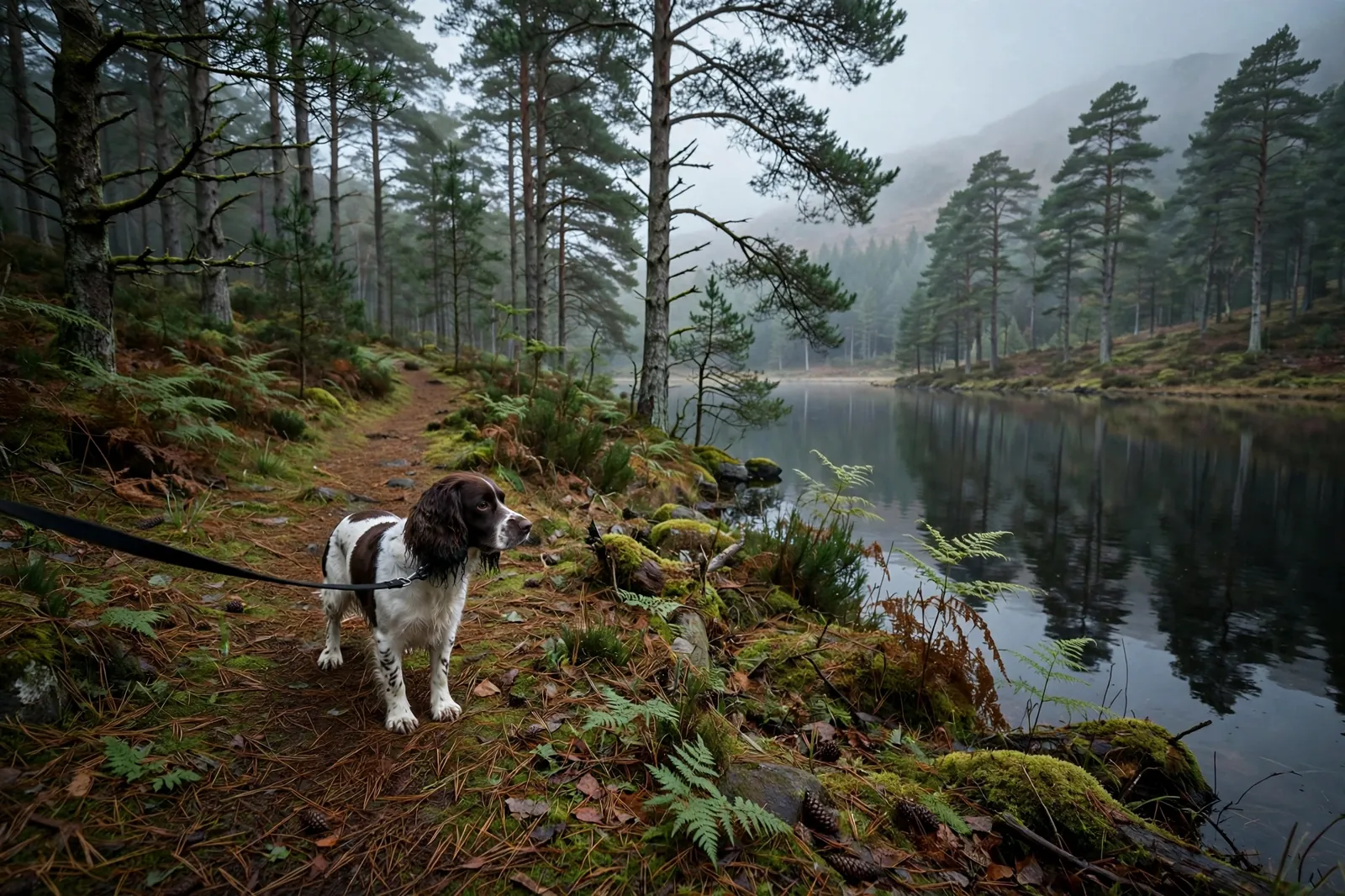
For most dogs, the lochside and riverside loops are the sweet spot. Routes around Loch Trool and along the Water of Minnoch offer water views, picnic spots and plenty of scent without serious climbing, while trails at Kirroughtree suit families and dogs that prefer shorter circuits with the option to extend. Forest roads and firm paths stay usable after rain far better than open hill paths, but puddles, mud at gateways and fallen leaves can still make descents slippery in autumn and winter. Take a long line only where visibility is good and there is no livestock; in dense forest a short lead is safer, because deer can cross a trail silently and a dog that vanishes into commercial forestry is hard to follow or hear.
Wildlife awareness shapes good behaviour here. Red deer, roe deer and red squirrels are part of the appeal, and ground-nesting birds use open ground in spring and summer. Keep dogs close on moorland edges and heather, and give deer a wide berth in the autumn rut and when young are hidden in summer. Forestry work is the other practical factor: harvesting and haulage lorries operate on weekdays on some forest roads, so obey closure signs even if the trail looks clear, and keep dogs on a lead near car parks, visitor centres and mountain-bike trail crossings, where bikes can arrive fast and quietly. Finish every forest walk with a tick check and a paw check — grit, pine resin and small cuts from stony tracks are common. Our guide to ticks on dogs in the UK covers removal and what symptoms to watch for after woodland walking.
Dark-sky nights with a dog
Galloway Forest Park is internationally recognised for exceptionally dark skies, and a clear night here is a genuine highlight: the Milky Way can be clearly visible to the naked eye away from town lights when conditions allow. You do not need a telescope or expertise to enjoy it with a dog. You need a clear forecast, warm layers for both of you, a red-light torch if you have one (it preserves night vision better than a white beam), and a plan that keeps the dog settled rather than standing shivering in a car park for an hour.
The dog-friendly way to do it is in short sessions from close to where you are staying. Check the forecast during the day, walk the dog properly before dark so a last short outing is all that is needed, then step outside for fifteen or twenty minutes once it is fully dark rather than driving to a remote viewpoint late at night with a restless dog in the car. If you do visit a designated dark-sky viewpoint or a visitor centre event, confirm in advance whether dogs are allowed at that specific event and keep yours on a short lead, well away from telescopes and cables — trip hazards multiply in the dark. Let eyes adjust for at least fifteen minutes without phone screens, sit on a bench or blanket so the dog can settle against you, and leave if the dog is unsettled by owls, deer moving in the trees or other visitors arriving; the sky will still be there tomorrow night.
Season matters more than equipment. Winter offers the longest darkness and the best chance of a long clear window, but also ice on minor roads, very early nightfall that compresses walking hours, and accommodation with real heating costs to check. Summer nights in this latitude never get fully dark for long, so stargazing is weaker — but summer evenings are perfect for a slow harbour walk instead. Shoulder seasons often give the best compromise of dark evenings, walkable days and fewer midges. Whichever season you choose, never leave a dog in a cold or hot car while you stargaze nearby, and take a reflective lead or light-up collar for roadside verges and car parks: drivers on unlit rural roads do not expect pedestrians after dark.
Kirkcudbright, the artists' town
Kirkcudbright — pronounced roughly kir-koo-bree — is the coast base most dog owners will love: a small working harbour town on the River Dee estuary with a long association with artists, colourful terraced houses, independent galleries and a castle ruin in the middle of town. The harbour is the natural centre for a dog walk, with fishing boats, gulls and the comings and goings of a real port, but keep dogs on a lead around the quayside: edges are unfenced, ladders drop straight to the water or mud at low tide, and fish crates, ropes and bait are all tempting and all best left alone.
Structure a town day around short, varied walks rather than one long march. A morning circuit of the harbour, the castle grounds (check current access and dog rules for the castle itself, as historic sites vary — check the latest official guidance before you travel) and the riverside paths gives a dog plenty to sniff without overdoing distance. Many galleries and independent shops welcome a calm dog or are happy for one person to browse while the other waits outside with the dog in the shade; rotate rather than assuming. Cafes and pubs change their dog areas from time to time, so ask at the door, choose a table away from the main thoroughfare, and bring a settle mat if your dog struggles to switch off on hard floors. If you are continuing along the coast afterwards, our Ayrshire coast guide pairs naturally with this trip, since the two coasts share the same pattern of harbour towns, links grass and tide-aware beach walks.
Just outside town, the coastal paths and small beaches towards the Dee estuary reward an extra hour, but this is estuary walking, not open-sand walking: mud, channels and fast tides dominate, so apply the Solway rules in the section below even for a short stroll. In town, parking fills on market and summer days; arrive earlier, park once, and walk — Kirkcudbright is compact enough that a dog will be happier on foot than being loaded in and out of the car between stops. Finish with a practical note: stock up on dog food and any medication here or in Castle Douglas, because shops get sparser the further west and north you go into the forest.
Wigtown, the book town
Wigtown, Scotland's designated book town, sits above Wigtown Bay on the Machars peninsula and offers a completely different dog day: a large market square lined with bookshops, slow browsing, and wide estuary views. Bookshops are the main event, and dog policies differ shop by shop — some welcome dogs throughout, some limit them to part of the shop, and some ask you to leave the dog outside because space is tight and stock is valuable. None of this is unfriendly; it is simply a town where asking first is the local etiquette. A short lead, a dog that will lie quietly while you browse a shelf, and a willingness to take turns outside will get you into most places you want to see.
Balance browsing with proper exercise so the dog is not asked to be patient all day. The harbour and the paths towards Wigtown Bay Local Nature Reserve give flat, open walking with big skies and, in season, significant birdlife — which is exactly why control matters here. Waders and wildfowl feed and roost on the saltmarsh and mudflats, and a dog coursing through them wastes their energy and can breach reserve rules. Keep dogs on a lead or at close heel on the merse (saltmarsh), stay on established paths, and give flocks a wide berth, especially in winter when birds are conserving energy and in spring when breeding begins. The flooded, grassy character of the merse also means wellies or waterproof boots after rain and a thorough paw wash afterwards, because saltmarsh mud is sticky and brackish pools are not drinking water.
Wigtown works well as a half-day combined with a forest or coastal walk, or as a wet-weather anchor day when hill and beach plans wash out — bookshops, a cafe lunch and a short harbour walk still feel like a holiday. Check opening patterns before you rely on it, though: small-town businesses often close on particular weekdays or run shorter winter hours, and check the latest official guidance before you travel if you are visiting for a specific festival or event, when the town is busier, parking is tighter and some venues restrict dogs for crowd reasons. Dogs that find busy pavements stressful will prefer Wigtown on an ordinary weekday morning to a festival Saturday.
Solway coast and mudflat safety
The Solway Firth gives this region its light, its birdlife and its one non-negotiable safety rule: respect the tide and the mud. This is a shallow, fast-moving estuary with a large tidal range. Water advances quickly across flat sand and mud, fills channels behind walkers, and can isolate sandbanks and causeways in minutes rather than hours. Beaches that feel vast and safe at low water become a very different proposition as the tide turns. Check tide times from a reliable source for the specific place and day, plan to be heading back well before the incoming tide reaches the area you are walking on, and never try to beat the water across a channel — check the latest official guidance before you travel and follow local warning signs on the day.
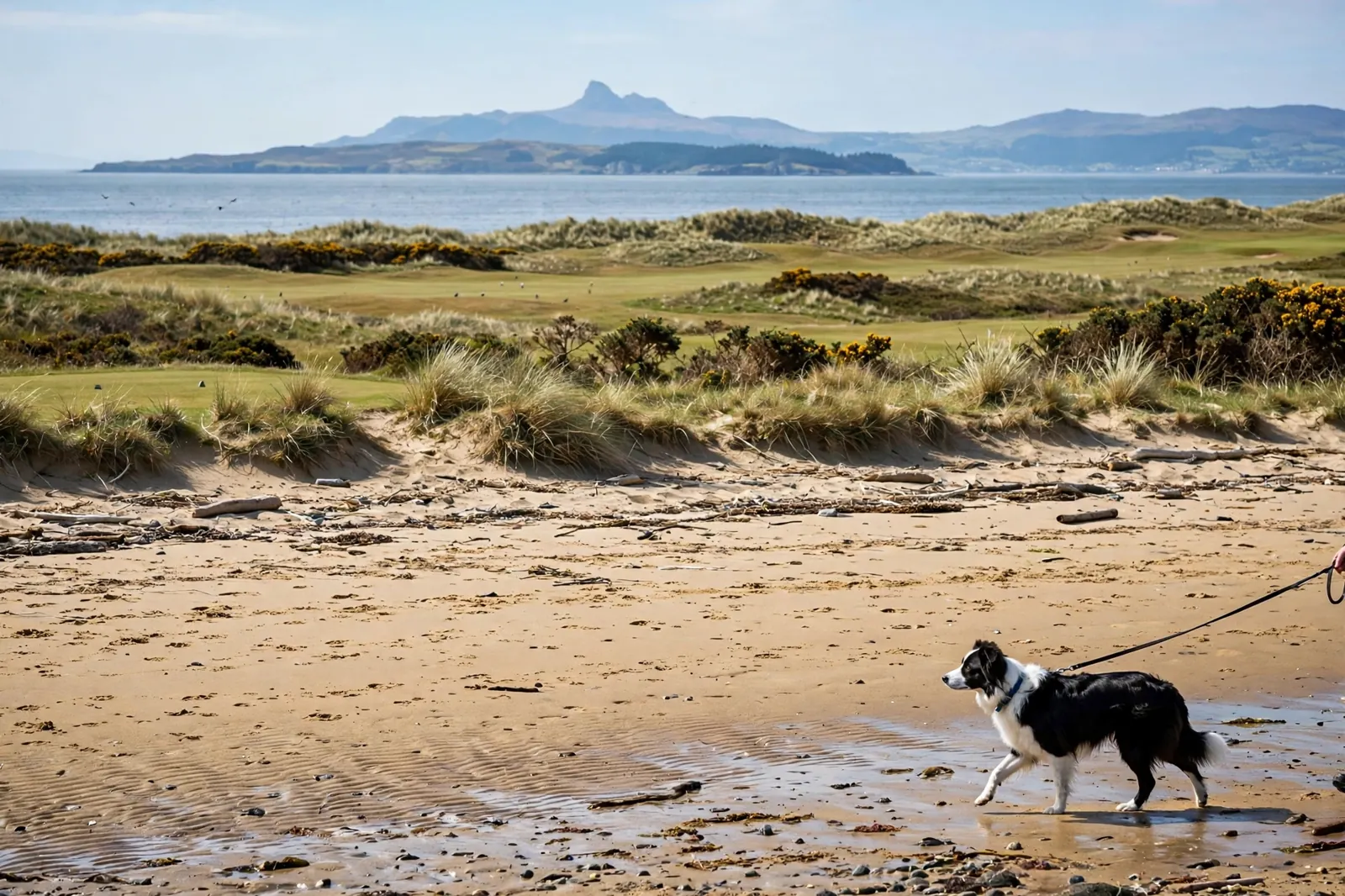
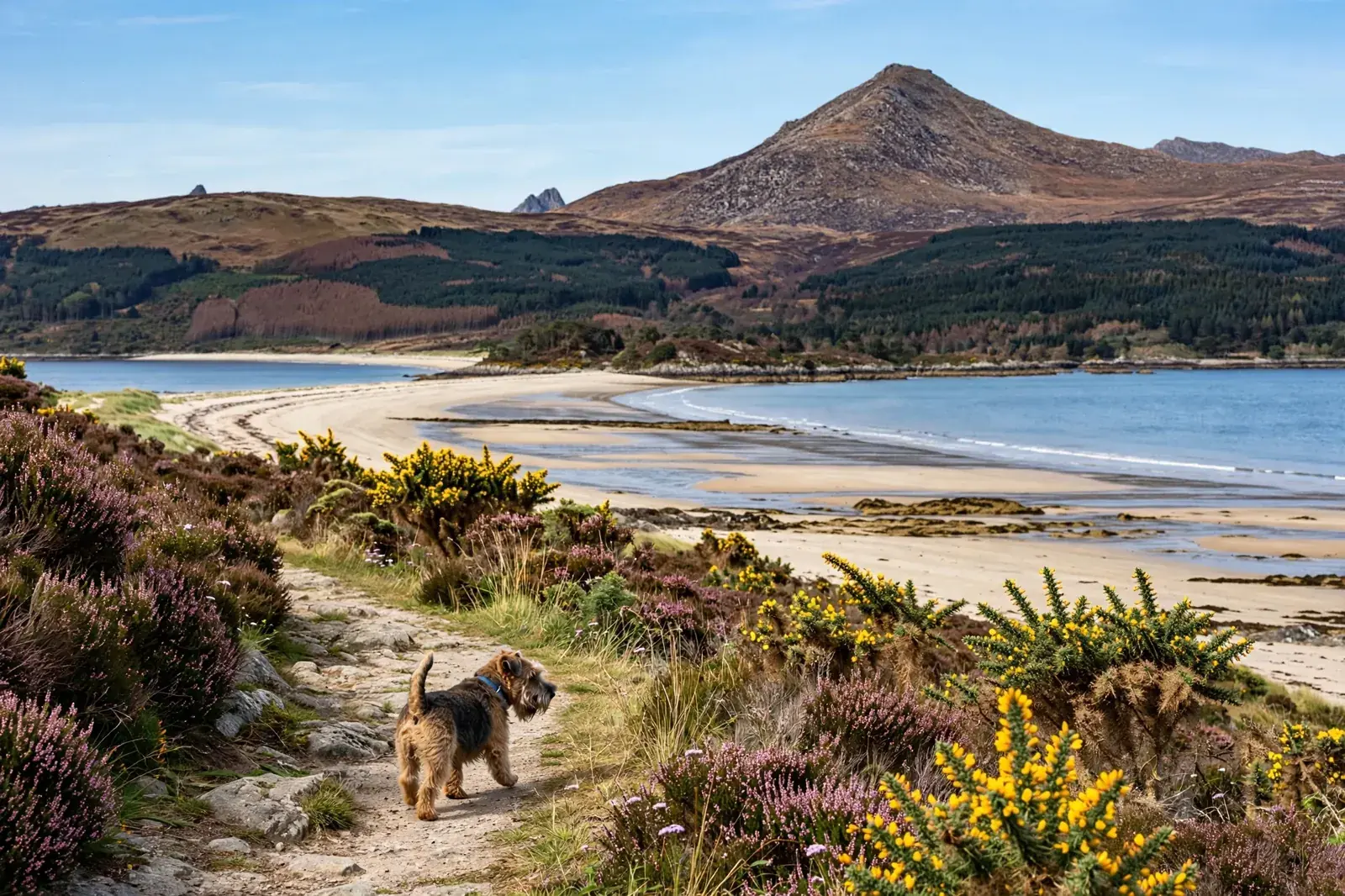
Choose the right kind of beach for a dog. Firmer sandy beaches around places such as Sandyhills, Rockcliffe and Kippford, and stretches near Southerness and Powillimount, are the classic dog-walking choices in the eastern and central Solway, with rockpools, dunes and village facilities nearby — but even here, soft patches, hidden channels and seasonal requests to protect nesting birds or avoid disturbance apply, so read the signs at the access point. Mudflat-dominated shores, including much of Wigtown Bay and the inner estuary, are for looking at from a path, not for walking a dog across: mud can be deep and clinging, dogs panic when they sink, and owners who wade in to rescue them become casualties themselves. If a dog does become stuck, keep calm, keep the dog as still as possible, and call the emergency services and coastguard rather than entering the mud. Our UK beach rules guide explains bans, fines and seasonal restrictions, and our dog swimming safety guide covers currents, cold water and what to do if a dog gets into difficulty — both are worth reading before any Solway beach day.
After every Solway walk, rinse paws, legs and belly with clean water. Salt, estuary mud and agricultural run-off are skin irritants, and dogs lick them off if you do not wash them off. Discourage drinking from brackish pools and creeks, carry fresh water even on short winter walks, and check between toes for small shells, grit and cuts from oyster or mussel beds. Finally, think about what is under the surface in summer: hot sand is rarely the issue here, but sharp cockle beds, slippery algae on rocks and harbour steps, and jellyfish washed up on the strandline all deserve a lead and a watchful eye rather than off-lead oblivion.
Forest drives and slow touring
Two signposted forest drives help you see a lot of the forest without demanding a long walk at every stop, which suits older dogs, mixed-ability groups and wet days. The Raiders' Road Forest Drive follows the Black Water of Dee with picnic and riverside stops including the Otter Pool, while the Queens Way route links Newton Stewart towards New Galloway past Clatteringshaws Loch and forest viewpoints. Both are seasonal and may charge for entry or parking, and surfaces, opening dates and facilities change — check the latest official guidance before you travel rather than relying on an old leaflet or a previous visit.
Use the drives as a string of short experiences, not a windscreen tour. Stop every thirty to forty minutes for a leg-stretch, a drink and a toilet break, choose one stop a day for a proper waymarked walk, and keep dogs on leads in every car park and picnic area: other visitors, children, food, and dogs arriving in neighbouring cars make these the highest-distraction places of the day. Never leave a dog in a parked car at a sunny viewpoint while you walk a viewpoint loop — forest car parks offer little shade and temperatures rise quickly even in Scotland. Take all litter and dog waste to a bin or home with you; bins are sparse on forest routes, so carry a sealed waste bag in the car as standard kit, not as an afterthought.
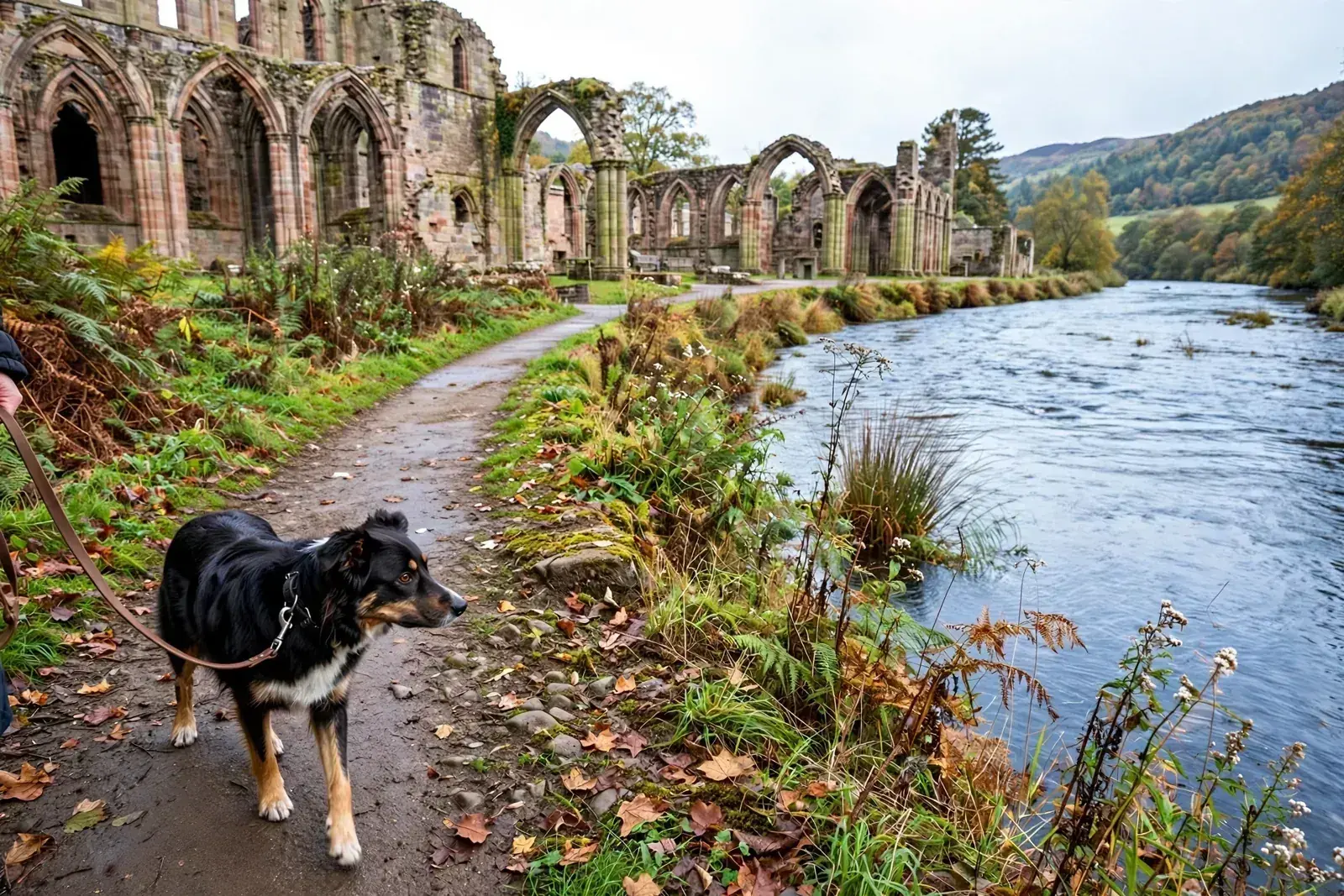
Beyond the forest drives, slow touring by car is how the whole region fits together: Castle Douglas for supplies and a lochside walk, Gatehouse of Fleet for a quiet overnight and woodland paths, Creetown and Carsluith along the Cree estuary, and the Rhins peninsula if you extend west towards Stranraer and Portpatrick's harbour and cliff paths. Keep daily driving modest — an hour each way is plenty with a dog that needs stops — and build in a no-drive day in the middle of a week. If you are combining this trip with the Borders, our Scottish Borders dog walks guide covers abbeys, rivers and border towns that link naturally via Dumfries on your way home.
Where to stay: cottages and small towns
Self-catering cottages are the default choice here and usually the best fit for dogs: space to dry wet gear, a garden for first and last outings, and no hotel corridor noises at night. The questions that matter are specific. Is the garden genuinely enclosed, with a fence or wall a dog cannot push under or jump, and a gate that latches? Is the garden shared with another cottage or with livestock in the next field? Inside, are stairs steep or open-tread, are floors slippery for an older dog, and is there a utility or porch where muddy paws can be dealt with before they reach carpets? Ask for recent photographs of the boundary, not just the view, and confirm the number of dogs, any size or breed conditions, and the total pet charge in writing before you pay.
Choose your town by rhythm. Newton Stewart puts you closest to the forest park trailheads and the Queens Way, with practical shops for a week. Kirkcudbright suits coast lovers who want harbour walks and eateries on the doorstep. Wigtown is quietest, ideal for a reading-heavy, low-key stay with estuary walks. Castle Douglas, a designated food town, is a strong all-rounder for supplies, lochside walks and day trips in several directions. Small hotels, inns and bed-and-breakfasts exist in all of them, but dog rooms are limited and ground-floor access varies — confirm whether the dog can join you at breakfast or whether a separate residents' area applies, and whether the dog may be left alone in the room at all. Many owners here quite reasonably say no to unattended dogs, so plan meals around pubs and cafes where the dog can come too.
Book the drying system as carefully as the bed. A cottage with an outside tap, a hose, a covered porch and hard flooring by the door will save you daily stress in a wet week, which in this region is a realistic week. Pack two drying coats or large microfibre towels, a spare lead and collar (a lead lost in the forest should not end the holiday), a long line for suitable open spaces, poo bags in every jacket and car door, and a familiar blanket that makes any cottage smell like home on the first night. Arrive in daylight if you can, walk the garden boundary with the dog on a lead before letting them explore it, and locate the nearest vet and out-of-hours cover on the first evening — rural practices cover large areas, so save the number and the postcode before you need them in the dark and rain.
Practical planning: seasons, midges and getting around
There is no single best season, only trade-offs to match to your dog. Spring brings lambs in fields beside paths (leads on, no exceptions), nesting birds on the coast and forest floors, longer days and generally fewer midges. Summer offers the fullest opening hours and festivals in the book and artists' towns, but also the worst midges on calm, damp mornings and evenings near water and trees, busier car parks, and the need for shade and water planning even in northern latitudes. Autumn is many locals' favourite for dogs: quieter trails, fungi and autumn colour in the forests, the deer rut to watch from a respectful distance, and improving darkness for stargazing. Winter is peaceful and dark-sky-friendly but demands daylight discipline, warm and waterproof kit for dog and owner, and checks for seasonal closures and storm damage on trails.
Midges deserve honest planning rather than dread. They are most active at dawn and dusk in still, humid conditions from roughly late May to September, and they trouble people far more than most dogs, though short-coated dogs can be bitten around the belly, ears and muzzle. Walk in the middle of the day or in a breeze on the coast when midges are bad, use human repellent on yourself (never apply human insect repellent to a dog unless a product is specifically labelled for dogs and your vet agrees), and choose accommodation with a mesh or a breezy garden if summer evenings outside matter to you. Ticks are present in woodland and bracken for much of the year, so daily checks and prompt, correct removal are routine here, not an emergency response.
Finally, plan for limited signal and long gaps between services. Mobile coverage is patchy in the forest park and in glens, so download maps and tide information before you set off, carry a paper backup or a saved offline route, and tell someone your plan if you are walking remotely. Fuel, dog food and pharmacies cluster in the towns, so top up when you pass them rather than assuming the next village will have what you need. Keep a simple in-car kit — water and a bowl, towel, spare lead, waste bags, a first-aid kit for dogs and people, and a torch — and every drive becomes easier. With that preparation done, Dumfries and Galloway rewards exactly what it asks of you: slowness, attention to tides and weather, and a dog who comes home smelling of pine needles and sea air.
Practical questions
Before you go
Are dogs allowed on Galloway Forest Park trails?
Yes, dogs are generally welcome on forest trails and around visitor centres, but keep them under close control, on a short lead near livestock, wildlife areas, car parks and other visitors, and follow any temporary signs for forestry operations or nesting birds. Clear up after your dog everywhere, including on remote paths, and check the latest official guidance before you travel for closures or diversions.
How do I keep my dog safe on Solway mudflats and beaches?
Check tide times before every visit, stay on firm sand and marked paths, and never let a dog wander onto soft mudflats or follow channels out towards the water. The Solway tide moves quickly across flat ground and can cut off banks and causeways. Keep dogs on a lead near mud and sinking sand, recall them well before the tide turns, and wash paws afterwards. If a dog gets stuck in mud, do not wade in — call for help.
When is the best time to visit for dark skies without bad midges?
Late autumn, winter and early spring give the longest dark nights for stargazing and usually far fewer midges, which are worst on calm, damp days from late May to September. The trade-off is shorter daylight for walking, colder nights and some seasonal closures. For a balance, late September to October and March often work well, but check the latest official guidance before you travel for visitor centre hours and weather warnings.
Are dogs welcome in Kirkcudbright and Wigtown shops and cafes?
Many independent shops, galleries, bookshops, pubs and cafes in both towns welcome well-behaved dogs in at least part of the premises, but policies vary by business and can change, and food areas are often restricted. Look for a sign in the window, ask at the door before going in with a wet or muddy dog, and keep your dog on a short lead settled beside your table or under a chair.
When must my dog be on a lead in Dumfries and Galloway?
Use a lead or keep your dog at heel under close control near livestock, on farmland, around ground-nesting birds in spring and summer, near roads, in towns and at busy visitor sites. Scotland's outdoor access code requires dogs to be under proper control and never to worry sheep or cattle. Lambing, calving and local signs may require a lead in specific places, so follow on-site notices and check the latest official guidance before you travel.