This guide is independent and contains no paid placement. If affiliate links are added later, they will be clearly marked and will not change our editorial checks.
Launceston is the town where Cornwall begins: a Norman castle on a steep grassy hill, two rivers at its feet, a working market square and quiet lanes that suit dogs far better than the county's crowded coast. Climb to the castle grounds with the dog, walk the Kensey Valley or the Tamar towpath, then finish in a dog-welcoming cafe on the square.
The gateway town: where Cornwall begins
Every county has a place that feels like a threshold, and in Cornwall that place is Launceston. Drive west from Devon on the A30 and the town appears on its hill long before you reach it, the dark stone tower of the castle standing above a jumble of red roofs. This was once the county town of Cornwall, the seat of its courts and its assizes, and the place where travellers, traders and drovers crossed into the far west. For a dog owner, that history matters less than what it left behind: a compact town that can be crossed on foot in twenty minutes, two rivers close enough to walk to from the centre, and open grassy ground around the castle where a dog can stretch its legs before the day properly starts.
Launceston works as a destination in its own right and as a base. Unlike the coastal resorts an hour further west, it never feels overwhelmed by visitors, even in August. The streets stay quiet enough for a nervous dog, parking is straightforward, and the cafes and pubs that welcome dogs do so because they genuinely like having them, not because a seasonal trade demands it. It is also a sensible first or last stop on a longer Cornwall trip: arrive the evening before, walk the dog along the river, sleep well, and head for the coast the next morning without the stress of a long drive after a ferry or a flight.
The town sits on the eastern edge of Cornwall, just a few miles from the River Tamar, which forms the county boundary with Devon. The other river, the Kensey, runs through the valley below the castle and joins the Tamar to the south. Between them they give Launceston its two best dog walks, both starting within a short stroll of the town centre, and both very different in character. The Kensey is the gentle one: a small river through meadows and light woodland, with a surfaced path and plenty of places for a dog to paddle. The Tamar is bigger and wilder, a border river with a long-distance trail, old quays and the sense that you are walking along the edge of two counties at once.
What follows is a practical guide built around that geography. It starts at the castle, because that is where every visit should start, then works down to the rivers, into the town centre, and out into the countryside beyond. It covers where dogs are welcome and where they are not, which walks suit which dogs, where to eat and drink with a dog at your feet, and how to use Launceston as a base for the Dartmoor edge and the north Cornish coast. Where rules or opening times may have changed, the guide says so and asks you to check the official guidance before you travel.
One practical note before you set off: Launceston is hilly. The castle stands on a steep mound, the town centre slopes down towards the river, and even the short walk from the car park to the keep will test an older dog's knees. Plan the day in stages — castle first while everyone is fresh, river walk second on flatter ground, town centre last when the dog is ready to settle under a cafe table — and the hills become part of the pleasure rather than a problem.
Launceston Castle with a dog: the climb and the rules
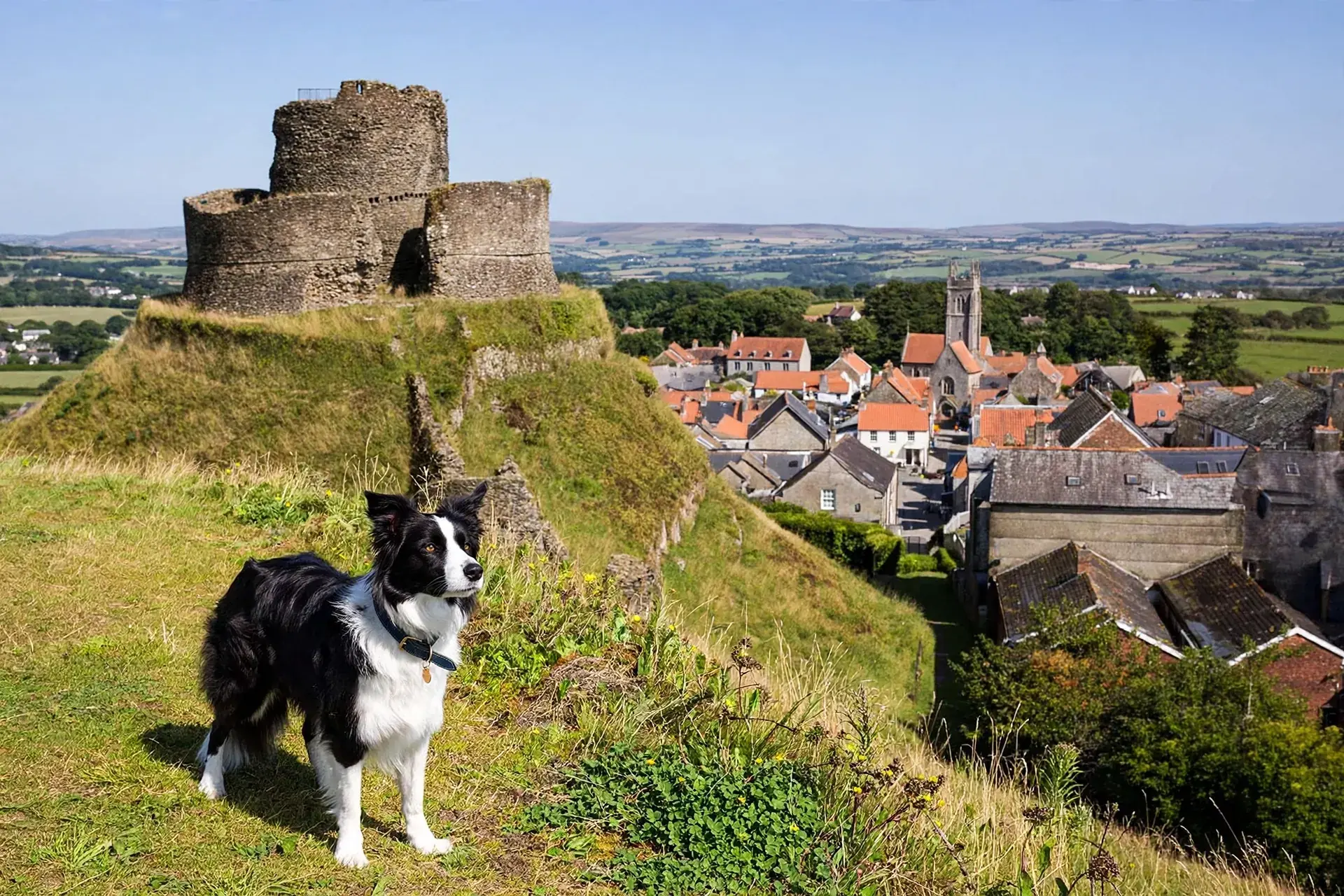
Launceston Castle dominates the town in every sense. Built by the Normans after the Conquest, its great stone keep stands on a high artificial mound, and the grassy slopes that fall away from it are the town's natural viewpoint and its best open space. On a clear day you can see across the rooftops to the rolling farmland of east Cornwall and, to the east, the dark edge of Dartmoor. For a dog owner, the castle grounds are the single most useful place in Launceston: somewhere to let the dog sniff, stretch and settle before the day's walking begins.
Dogs on leads are welcome in the castle grounds, and the grounds are where most dog owners will spend their time. The keep itself is a different matter: dogs are not usually allowed inside the tower, and the narrow spiral stair and small chambers would be a poor fit for most dogs anyway. The practical answer is to visit as a pair and take it in turns — one person climbs the keep while the other stays in the grounds with the dog — or to enjoy the outside of the castle properly and skip the interior altogether. The views from the grassy slopes are nearly as good as the views from the top, and the dog will not feel it has missed anything.
The climb to the castle is short but steep. From the town centre, the route up Castle Street and through the castle gate takes about ten minutes at a dog's pace, with the gradient easing once you reach the grounds. Older dogs, very small dogs and dogs recovering from injury may struggle with the final slope, so take it slowly and let the dog set the pace. In wet weather the grass on the mound can be slippery, particularly on the steeper sections, so keep the lead short and choose the worn paths rather than cutting across the slope. In summer, the same grass bakes hard and the stone walls throw back heat, so bring water for the dog and use the shade of the trees at the foot of the mound.
Opening times and admission for the castle are managed by English Heritage, and they can change with the seasons and for special events. Check the official guidance before you travel, particularly if you are visiting out of season, when the keep may be open on reduced hours or closed on some weekdays. The grounds themselves are generally accessible during opening hours, and there is usually a small shop and visitor facilities near the entrance. If an event is on — a re-enactment, a concert, a school holiday activity — expect more people, more noise and more dogs, and decide whether your dog will enjoy that or would rather be on the river path instead.
The castle grounds reward a slow visit. Walk the full circuit of the mound rather than heading straight for the top: the lower slopes have the best shade, the south side catches the afternoon sun, and the views change with every few steps. Let the dog sniff the hedgerows and the stone walls, which are full of the small smells that make a new place interesting. Bring a long lead rather than a flexi lead here, because the slopes are shared with other visitors and a dog that suddenly pulls towards a squirrel can unbalance its owner on the grass. A well-fitted harness helps on the descent, when an enthusiastic dog can pull hard downhill.
After the castle, the natural next step is down towards the town or the river, and the route matters. The streets immediately below the castle are narrow and cobbled in places, with parked cars and the occasional delivery van, so keep the dog close. The walk down to the town centre takes only a few minutes, and it is worth pausing at the church of St Mary Magdalene, whose carved granite exterior is one of the finest in Cornwall — dogs stay outside, of course, but the churchyard is a calm place for a breather before the bustle of the square.
The Kensey Valley walk: the gentle river
The River Kensey is Launceston's gentlest walk and the best first walk for a dog that has just travelled. It runs through the valley to the south and east of the town, and the path that follows it is mostly flat, mostly surfaced and mostly shaded — the three qualities that matter most on a warm day or after a long car journey. You can reach the valley from the town centre in about fifteen minutes on foot, which means the walk can start without loading the dog back into the car.
The classic route follows the Kensey from the town towards the point where it meets the Tamar, a round trip of roughly three to four miles depending on where you turn back. The path is a mix of riverside meadow, light woodland and short stretches of quiet lane, with the river always close by. Dogs that like water will find shallow places to paddle, particularly in summer when the river runs low and clear; dogs that prefer to stay dry can stick to the path, which stays well above the water for most of its length. After heavy rain the Kensey can rise quickly and the meadow sections become muddy, so wear proper boots and be ready to turn back if the path floods — the river is not a place for a dog to swim when it is in spate.
What makes the Kensey walk work for dogs is its variety in a small space. There are open meadows where a dog with reliable recall can run, wooded stretches where the ground stays cool in summer, and quiet field edges where a reactive dog can see other walkers coming from a long way off. You will meet other dog walkers, joggers and the occasional horse rider, so keep the dog under control at path junctions and put it back on the lead whenever the path narrows or passes through a gateway. Livestock graze some of the adjoining fields, and the fences are not always dog-proof, so watch for gaps and keep the dog out of fields with sheep or cattle.
The walk is also a good way to read the landscape. The Kensey valley is a working landscape of small fields, hedgerows and old stone bridges, and the river itself was once important to the town's mills and tanneries. Look for the stone bridges and the remains of old leats as you walk, and for the kingfishers that flash along the river in the early morning. In spring the valley floor is full of wild garlic and bluebells in the wooded sections; in autumn the hedgerows are heavy with blackberries and the path is carpeted with leaves. Each season changes the walk enough that regular visitors find something new on every visit.
For dogs that need a shorter outing, the Kensey can be walked in sections. A twenty-minute out-and-back from the town edge gives a young puppy or an older dog a proper walk without overdoing it, and the flat ground suits dogs with stiff joints. For fitter dogs, the valley path links into longer routes towards the Tamar, and a strong walker can build a half-day circular walk of six or seven miles that takes in both rivers. Whatever length you choose, carry water in summer — there are no shops or taps along the valley — and take a towel for the car, because a dog that has paddled in the Kensey will come back muddy in winter and wet in summer.
The Tamar riverside: the border river
The River Tamar is a bigger, wilder proposition than the Kensey, and the walk along it feels like a different kind of day out. The Tamar forms the boundary between Cornwall and Devon for most of its length, and the Tamar Valley, where the two rivers meet below Launceston, is a landscape of steep wooded slopes, old quays and the remains of a mining and shipping past. The long-distance Tamar Valley Discovery Trail runs through this country, and the sections nearest Launceston make an excellent dog walk — longer, rougher and more rewarding than the Kensey, and best saved for a dog that is fit and used to uneven ground.
The most accessible Tamar walking from Launceston is around the old quays and the valley floor to the south of the town, where the river is wide and slow and the paths follow the water through woodland and meadow. The going underfoot is mixed: surfaced towpath in places, muddy woodland track in others, and short climbs where the path leaves the river to cross a hillside. A dog that is comfortable on rough ground will love it; a dog that struggles with steps or steep banks will find it hard work. Allow two to three hours for a proper Tamar walk, and take a map or a downloaded route, because the valley paths branch and loop in ways that are not always obvious on the ground.
The Tamar is also a river to respect. It is deeper and faster than the Kensey, and after rain it can rise several feet in a day. Dogs should not swim in the Tamar except in the calmest summer conditions and only where the bank gives easy access in and out — a steep, muddy bank with a fast current is a genuine danger. Keep the dog on a lead near the water's edge where the bank is high or undercut, and be particularly careful where the path runs close to the river with no fence. In summer, check the water for blue-green algae before letting a dog paddle, and if the water looks green or scummy, keep the dog out entirely and check the official guidance before you travel for the latest advice.
Wildlife is part of the Tamar's appeal and part of its discipline. Herons, egrets and kingfishers work the river, and the wooded slopes are home to deer, badgers and a rich variety of birds. A dog with a strong chase instinct will need to stay on a lead through the woodland sections, and all dogs should be kept out of the reed beds and the quieter backwaters where birds nest in spring and early summer. The Tamar Valley is a designated Area of Outstanding Natural Beauty, and the same care that keeps the landscape special is what keeps a dog walk there enjoyable for everyone.
History is close to the surface along the Tamar. The old quays below Launceston once loaded copper and tin from the mines of the valley onto barges bound for the sea, and the remains of lime kilns, quays and warehouses still stand among the trees. The river was also a working waterway for the market gardens and orchards that supplied the towns on both banks. Walking the Tamar with a dog is a reminder that this quiet valley was once an industrial highway — and that the paths you walk were first made by people earning a living from the river, not by people out for a stroll.
If you want a longer Tamar day, the valley links south towards the villages and quays downstream, and a car shuttle or a circular route can turn a riverside walk into a full day out. The simplest approach is to drive to a parking spot on the valley floor, walk upstream or downstream for an hour, and return the same way — an out-and-back that keeps navigation simple and lets the dog enjoy the same smells twice, which most dogs regard as a bonus rather than a repetition. Our guide to Dartmoor dog walks covers the moorland country to the east of the Tamar, which pairs naturally with a Launceston stay.
Market square, independent shops and cafes
Launceston's town centre is built around its market square and the streets that run off it, and it is one of the most dog-friendly town centres in Cornwall precisely because it is still a working town rather than a resort. The square hosts a regular market, and on market days the town fills with stalls selling local produce, plants, crafts and hot food — a sensory overload for a dog, and a good test of its town manners. If your dog is new to markets, visit early when the stalls are still setting up and the crowds are thin, and build up to the busier mid-morning hours on a later visit.
The streets around the square are lined with independent shops rather than chain stores, and many of them welcome dogs. Butchers, bakers, bookshops, gift shops and outdoor stores sit side by side with cafes and pubs, and the shopkeepers tend to know their regular canine customers by name. The practical rule is to ask before entering with a dog, keep the dog on a short lead, and be ready to wait outside if a particular shop prefers it. A dog that can settle on a mat by the door while you browse is worth its weight in gold in a town like this, and the training pays off in every other town you visit afterwards.
Cafes and pubs are where Launceston really earns its reputation with dog owners. Several venues around the square and on the streets leading off it welcome dogs inside, often with water bowls by the door, a biscuit jar on the counter and staff who will make a fuss of a well-behaved dog. Policies vary, and a venue that welcomes dogs on a quiet Tuesday may ask them to stay on the terrace on a busy Saturday, so always check before you settle in. Bring a mat or a blanket so the dog has its own place to lie, keep the lead short enough that the dog cannot wander between tables, and order something for the dog — a bowl of water, a plain biscuit — as well as for yourself. Our guide to dog friendly cafes in the UK explains how to check a venue's policy before you go and how to handle the etiquette once you are inside.
The town's food shops are worth a visit in their own right. Launceston has a proper butcher, a bakery and a delicatessen within a few minutes' walk of the square, and the market stalls sell Cornish produce that is hard to find further east. If you are staying in a cottage or a holiday let nearby, stock up here rather than at a supermarket on the edge of town: the food is better, the dog can come along for most of the shopping, and the money stays in the town. For a longer stay, the market is also the place to ask about local walks — stallholders and shopkeepers know the paths, the muddy spots and the best places for a dog to swim, and their advice is usually more current than any guidebook.
Architecture rewards a slow wander. The church of St Mary Magdalene, with its intricately carved granite exterior, stands just off the square, and the streets around it hold a mix of Georgian townhouses, Victorian shopfronts and older timber-framed buildings. The town's museum, in the former church of St Mary Magdalene's neighbourhood, tells the story of Launceston from its Norman beginnings to the present day — dogs stay outside, so visit it in turns if you want to go in. The pleasure of the town centre is not any single sight but the way the streets fit together: a castle on a hill, a market square below it, and quiet residential streets where a dog can walk calmly on a loose lead.
One caution for town-centre walking: Launceston's streets are narrow, and the pavements are narrow too. Keep the dog on the inside, away from the road, and be ready for delivery vans, cyclists and other dogs appearing suddenly around corners. The town is busiest on market days and on Saturday mornings; if your dog finds crowds difficult, visit the centre early or late in the day, and do the river walks when the town is at its busiest. The rhythm of a good Launceston day is castle in the morning, river at midday, town in the late afternoon — and that rhythm suits dogs as well as it suits people.
Countryside and Dartmoor edge day trips
Launceston's greatest strength as a base is what lies within an hour's drive in every direction. To the east is Dartmoor, to the west is the north Cornish coast, to the south is the Tamar Valley and to the north is the rolling farmland of north Devon. A dog owner staying in Launceston can have a different landscape every day of the week without ever driving more than forty minutes, and the town itself is quiet enough that coming home each evening feels like a rest rather than a return to the fray.
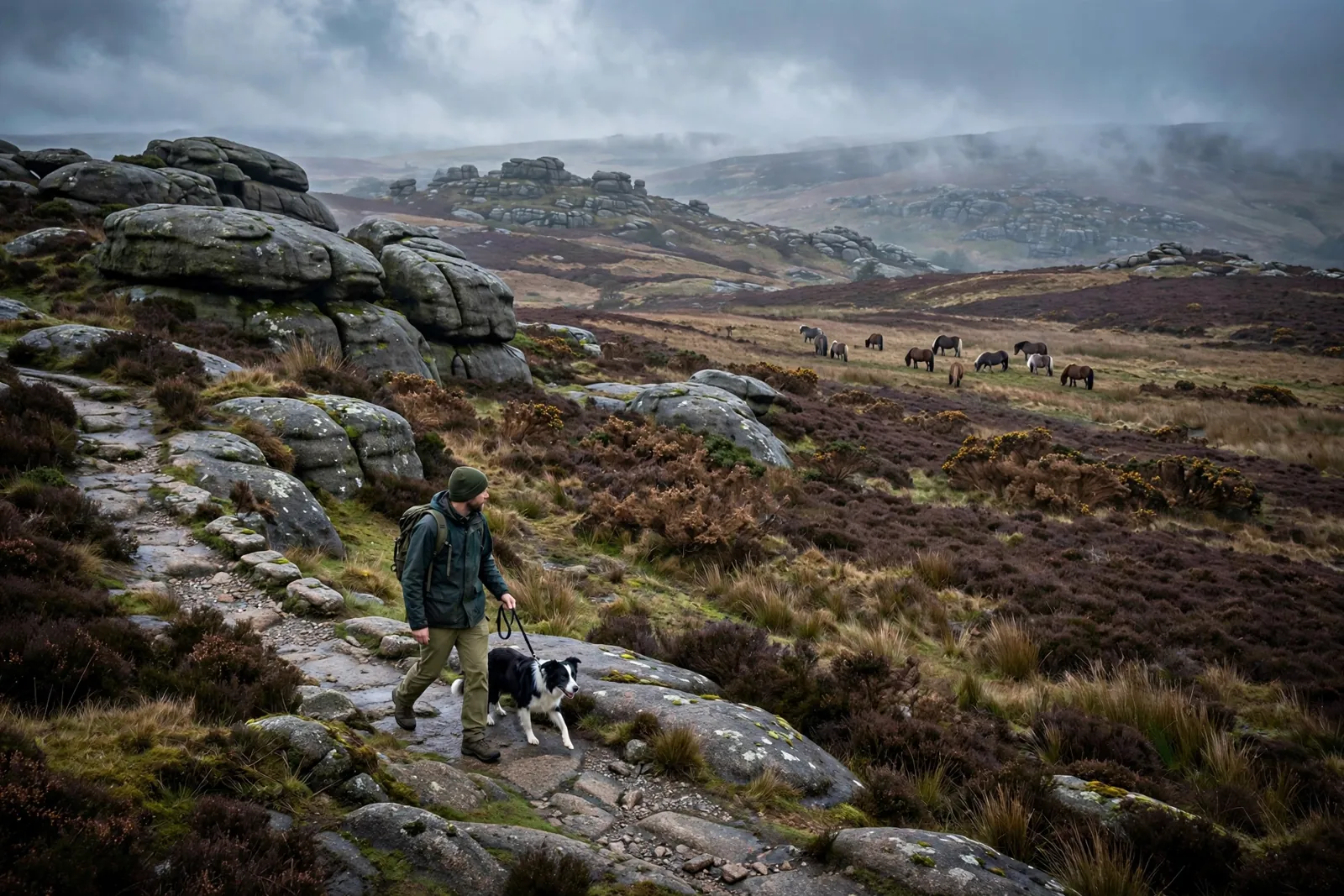
Dartmoor is the obvious first day trip, and the western edge of the moor is the closest part of it to Launceston. The moor's granite tors, open grassland and wild ponies are a world away from the Kensey's gentle meadows, and the walking is correspondingly bigger: long open ridges, river valleys, and the sense of space that makes Dartmoor so addictive. Dogs must be kept on a lead near livestock at all times, and during the bird nesting season from 1 March to 31 July dogs must be on a lead on the open moor. Wild ponies are not tame and can kick, cattle can be protective of calves, and the moor's weather can change in minutes — take a map, a compass, waterproofs and more water than you think you need. Our Dartmoor guide covers tor routes, pony rules, firing times and river safety in detail.
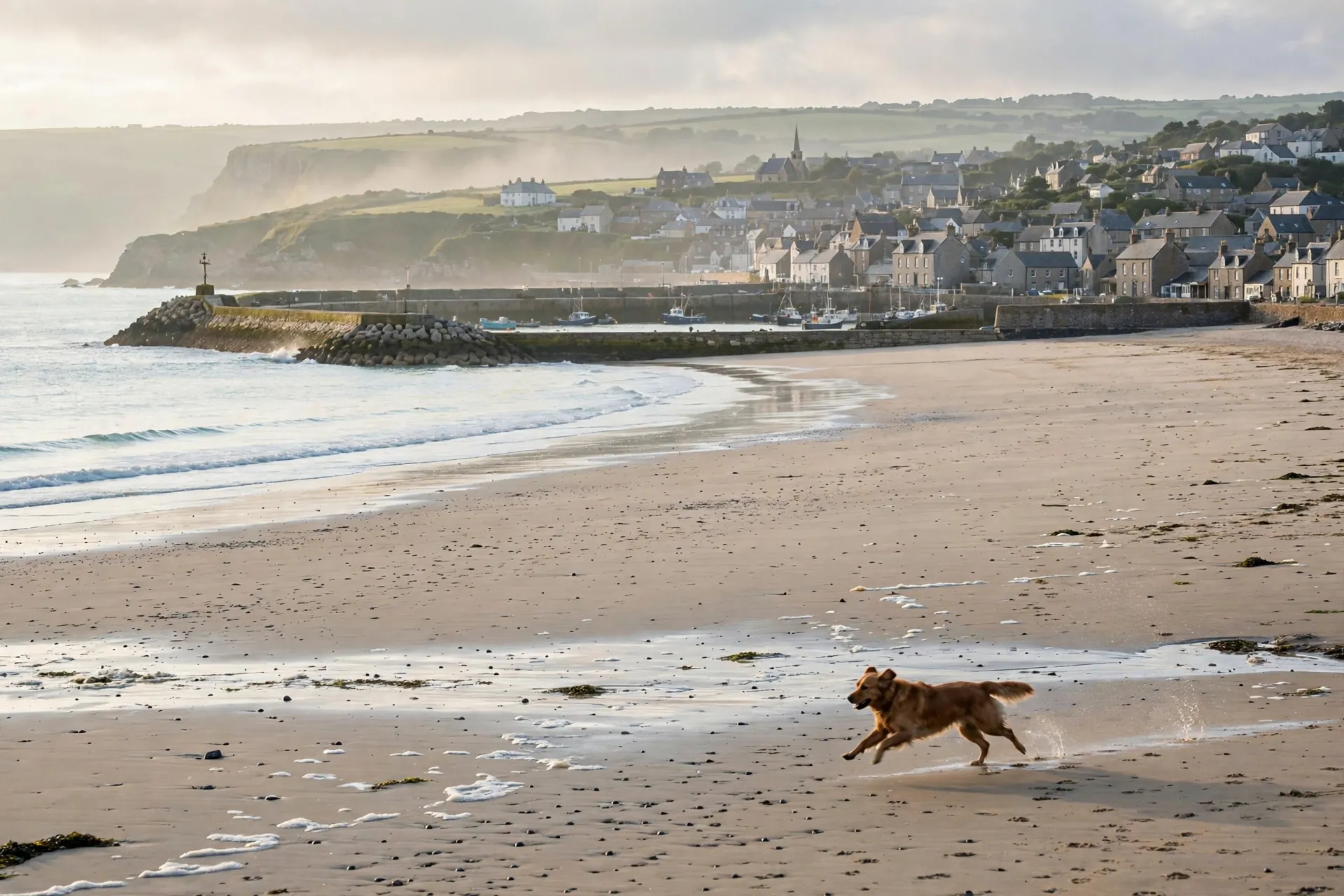
The north Cornish coast is the second obvious day trip, and Launceston is well placed for it. Bude with a dog is the closest resort, about half an hour's drive, with wide sandy beaches, a canal towpath and a seafront that suits dogs outside the summer restrictions. Further west, the coast grows wilder and the beaches more dramatic, but the summer dog bans on the busiest beaches mean you need to plan carefully: check the beach rules before you travel, aim for the beaches that welcome dogs year-round, and visit early or late in the day when the sand is quieter. The coastal path is magnificent walking for a fit dog, but the cliff edges demand a lead and the ascents and descents are steep, so build up to a full coastal day rather than attempting it on your first visit.
South from Launceston, the Tamar Valley deepens into a landscape of wooded hills, old mine workings and quiet villages. The valley's gardens, country houses and riverside pubs make a gentler day trip than Dartmoor or the coast, and the walking is mostly on surfaced paths and quiet lanes that suit older dogs. Cotehele, the National Trust house and gardens on the Tamar, welcomes dogs in its grounds and on the riverside walks, though dogs are not allowed inside the house itself — check the official guidance before you travel for the current rules. The valley's orchards and market gardens also mean good farm shops and cafes, many of which welcome dogs in their gardens.
North and east, the countryside of north Devon offers a quieter alternative to the coast: rolling farmland, wooded valleys and small market towns that see few visitors. The walking here is on public footpaths through farmland, which means stiles, gates and livestock — a dog that is good with stiles and calm around sheep will enjoy it, while a dog that chases livestock should stay on a lead throughout. The lanes are narrow and the traffic, though light, can be fast, so keep the dog close on the road sections and use the verges where they exist.
Whatever direction you choose, the day-trip rule for Launceston is the same: leave early, walk in the cool of the morning, eat lunch with the dog at a pub or cafe that welcomes dogs, and be home in time for a short evening walk along the Kensey. The town's position means you are never more than an hour from somewhere spectacular, and never more than a few minutes from somewhere quiet when the dog has had enough.
Stays and parking: the practical information
Launceston has a good range of dog-friendly places to stay, from hotels and bed and breakfasts in the town to cottages, farm stays and campsites in the surrounding countryside. The town-centre options suit visitors who want to walk to the castle and the river without driving; the countryside options suit dogs that need a garden, a field or a quiet lane outside the front door. Whichever you choose, confirm the dog policy in writing before you book: how many dogs are allowed, whether there is a pet fee, whether the dog can be left alone in the room or the cottage, and whether there is an enclosed garden or a safe area for the dog to toilet at night.
Pet fees in and around Launceston are usually modest — a common pattern is £10–£25 per dog per stay in a hotel or bed and breakfast, and £25–£50 per dog per week in a cottage — but they vary, and some places charge per night rather than per stay. Ask for the all-in total before you pay the deposit, and check whether the fee covers cleaning, damage or both. A cottage with an enclosed garden is worth paying more for if your dog is a wanderer or a digger, and a ground-floor room is worth asking for if your dog struggles with stairs. If you are staying for a week, ask about a mid-stay clean and whether the owner is happy for you to use the washing machine for muddy dog bedding.
Parking in Launceston is straightforward by Cornish standards. There are several public car parks within a short walk of the town centre, including a large car park near the castle and others on the edge of the centre, and on-street parking is available on the quieter streets. Charges are modest compared with the coastal resorts, and some car parks offer longer stays that suit a full day of walking. Park in the shade in summer and never leave a dog in a car on a warm day — even with the windows open, a car heats up fast, and the castle car park has little shade. In winter, the car parks can be icy in the morning, so take care on the walk to the castle.
For campervans and motorhomes, Launceston is a useful overnight stop rather than a destination in itself: there are sites nearby that welcome dogs and vans, but the town-centre car parks are not designed for overnight stays, so check the official guidance before you travel and book a proper site. For tents, the campsites around the town offer a good base for the river walks and the Dartmoor edge, but check whether the site allows dogs off the lead and whether there is a dog-walking field — a campsite without one can be frustrating for a dog that needs to run first thing in the morning.
Arriving and leaving are worth planning around the dog. The A30 runs past Launceston and gives fast access from Exeter and the east, but the road is busy and the town's approach roads are narrow, so allow extra time on summer weekends and bank holidays. If you are arriving late, tell your host in advance and ask for the key arrangements and the nearest place to walk the dog on arrival — a tired dog that has travelled for hours needs a toilet walk and a drink before anything else. On departure day, plan a short morning walk along the Kensey, then a calm drive home, and leave the castle climb for a day when you are fresh rather than a day when you are already tired.
Planning the practical bits: seasons, kit and safety
Launceston is a year-round destination, but each season changes the dog's experience. Spring brings lambs in the fields, nesting birds on the moor and the first bluebells in the Kensey woods — a beautiful time to walk, but also a time when leads matter most, because livestock and ground-nesting birds are at their most vulnerable. Summer brings long evenings, warm grass on the castle slopes and the chance of a paddle in the Kensey, but also heat, midges on the river and the busiest weekends. Autumn brings blackberries, fallen leaves and the first frosts, and the valley paths become muddy after rain. Winter brings short days, cold wind off the moor and the chance of frost on the castle slopes, but also the quietest town and the clearest views.
Kit for a Launceston trip is straightforward but worth getting right. Pack a lead and a long line, a harness that fits well, a water bottle and a collapsible bowl, a towel and a drying coat for the river walks, poo bags and a holder, and a mat or blanket for cafes and pubs. In summer add a cooling mat or a damp towel for the car, and in winter add a dog coat for a short-coated or older dog. A first-aid kit for the dog — tick remover, antiseptic wipes, bandages and the number of the nearest vet — is worth carrying on the longer walks, particularly on Dartmoor where the nearest vet may be half an hour away.
Ticks are a real consideration in the Kensey valley and on the Dartmoor edge, particularly from spring to autumn. Check the dog after every walk through long grass or woodland, remove any ticks promptly with a tick remover, and talk to your vet about tick prevention before you travel. Adders are present on Dartmoor and occasionally in the rough grassland of the Tamar Valley, though they are rarely seen and prefer to avoid people and dogs; keep the dog on the path in sunny, rocky areas and seek veterinary help immediately if you suspect a bite. Blue-green algae in the rivers is a summer risk: if the water looks green, blue-green or scummy, keep the dog out and report it if you can.
Finally, a word about the dog's temperament and the town's pace. Launceston rewards a dog that can settle — on the castle grass, under a cafe table, in a cottage garden — as much as a dog that can walk for miles. If your dog is reactive, anxious or new to towns, the quiet streets and the river paths are a good training ground, but build up slowly: a short walk and a coffee on the first day, a longer walk and a market visit on the second. The town will still be there tomorrow, and a dog that has had a calm first day will enjoy the second day far more than a dog that was pushed too hard on the first.
One last practical point is worth planning before you need it: what to do if the dog gets loose. Launceston's river paths and moorland are open country, and even a well-trained dog can bolt after a deer, a rabbit or another dog. Make sure the dog is wearing a collar with an up-to-date ID tag and that its microchip details are current before you travel, and keep a recent photograph of the dog on your phone. If the dog does run off, stay where you last saw it rather than chasing — most dogs circle back to a familiar point — and ask other walkers for help, because a loose dog in a valley is usually spotted quickly by someone else. The local vets, the town's dog walkers and the community noticeboards are all worth knowing about in advance, and a quick note of the nearest vet's number in your phone takes thirty seconds and can save a frantic search later. Prevention is simpler still: a long line on the open moor, a short lead near roads and livestock, and recall practice before the trip are the three habits that keep a Launceston holiday relaxed for everyone.
A two-day Launceston itinerary with a dog
A single day in Launceston gives you the castle, one river and the market square, but two days let the town show its slower side — the side that makes dog owners come back. The itinerary below is built around the dog's energy rather than a sightseeing checklist: a busy morning, a restful middle of the day, and a gentle evening walk. It assumes you are staying in or near the town, and it can be shortened to a single day by dropping the second morning's Dartmoor trip.
Day one starts at the castle. Arrive at the castle grounds in the morning, when the grass is still cool and the light is at its best, and give the dog a full hour to explore the slopes, sniff the hedgerows and watch the town wake up below. One person climbs the keep while the other stays with the dog, then swap if you both want the view. From the castle, walk down into the town centre for a late breakfast or an early lunch at a dog-welcoming cafe on or near the market square, and spend an unhurried hour browsing the independent shops while the dog rests under the table. The afternoon belongs to the Kensey: a two-hour riverside walk at the dog's pace, with time to paddle, sniff and sit on the bank doing nothing at all. Finish the day with a short evening stroll around the quieter streets near your accommodation and an early night.
Day two is the bigger day. Drive east to the Dartmoor edge in the morning, while the moor is cool and the light is clear, and walk one of the shorter tor routes — two to three hours of open moorland, with the dog on a lead near ponies and livestock and a picnic or a pub lunch afterwards. The moor is at its best before midday, when the wind is lighter and the paths are quiet, and a morning on Dartmoor makes the afternoon back in Launceston feel like a proper rest. Return to the town for a late lunch, then spend the afternoon on the Tamar: a shorter riverside walk, a visit to the old quays, or simply a long sit by the water with the dog asleep at your feet. The evening is for the market square again — a pub that welcomes dogs, a quiet dinner, and a final walk along the Kensey as the light fades.
If the weather turns, the itinerary bends rather than breaks. Rain suits the Kensey valley, where the trees give shelter and the river is at its most dramatic, and it suits the town centre, where the cafes, the museum and the shops give you somewhere dry to be with the dog. Dartmoor in heavy rain or thick fog is a walk to postpone, not to endure: the moor's paths become hard to follow, the wind cuts through waterproofs, and a wet dog in a cold car is a miserable end to a day. Swap the moor for a longer Tamar walk in the trees, or for a slow day in town, and save Dartmoor for the next visit. The town will still be there, and the moor will be better for the wait.
For a longer stay, the same pattern repeats with new directions: a coast day at Bude, a Tamar Valley day to the south, a north Devon day to the north, each one followed by a quiet evening in Launceston. The town's role in all of this is the same — a calm, dog-friendly base where the dog can rest properly between adventures, where the walks start from the front door, and where the castle on the hill is a reminder each morning that you are in a place with a history worth walking through. That is the real reason to spend two days here rather than one: Launceston is not a place to tick off, but a place to settle into, and a dog settles into it faster than almost anywhere else in Cornwall.
Whatever shape your visit takes, the best souvenir from Launceston is not a photograph of the castle but a dog that comes home calmer than it left: tired in the good way, used to settling under cafe tables, confident on river paths and comfortable with the small routines of a town that still works. That is what a gateway town does best — it lets you arrive gently, and it sends you onward ready for the rest of Cornwall.
Practical questions
Before you go
Can dogs go into Launceston Castle?
Dogs on leads are welcome in the castle grounds, where they can explore the grassy slopes and enjoy the views. Dogs are not usually allowed inside the keep itself, so plan for one person to stay outside with the dog while the other climbs, or take it in turns. Check the official guidance before you travel, as rules can change for events.
Is Launceston a good base for a dog-friendly holiday in Cornwall?
Yes. Launceston sits just inside Cornwall on the Devon border, so it works as a base for both the Cornish coast and the western edge of Dartmoor. It has river walks from the town, a compact centre with independent shops and cafes, and several dog-friendly places to stay nearby. It is quieter and cheaper than the busiest coastal resorts, which suits dogs that find crowds stressful.
Where can I walk my dog off the lead near Launceston?
The riverside paths along the Kensey and the Tamar have open stretches where a well-behaved dog with reliable recall can run, but keep the dog on a lead near roads, livestock, other walkers and cyclists, and anywhere the path narrows. On Dartmoor, dogs must be kept on a lead near livestock and during the bird nesting season from 1 March to 31 July. Always check local signs before letting a dog off the lead.
Are dogs allowed in Launceston's cafes and pubs?
Several cafes and pubs around the market square and the town centre welcome dogs, often with water bowls and treats, but policies vary by venue and can change. Ask before you settle in, keep the dog on a lead and under the table, and bring a mat so the dog has its own place to lie. Our guide to dog friendly cafes in the UK explains how to check a venue before you go.
How long should I allow for a day trip to Launceston with a dog?
Allow at least half a day: an hour or two at the castle grounds, a riverside walk of one to two hours, and time for the market square and a cafe stop. A full day lets you add a longer valley walk or a drive to the Dartmoor edge. If you are staying overnight, Launceston also makes a calm first or last night for a Cornwall trip, with easy road access in both directions.