This guide is independent and contains no paid placement. If affiliate links are added later, they will be clearly marked and will not change our editorial checks.
Lincoln works best as a two-level trip: do the flat Brayford Waterfront and river paths first, then tackle Steep Hill once, slowly, to reach the cathedral and castle quarter at the top. Well-behaved dogs on leads are generally welcome inside the cathedral, while the castle admits pet dogs mainly on advertised dog-friendly days, so check the official guidance before you travel.
Steep Hill in practice: the climb that shapes the whole trip
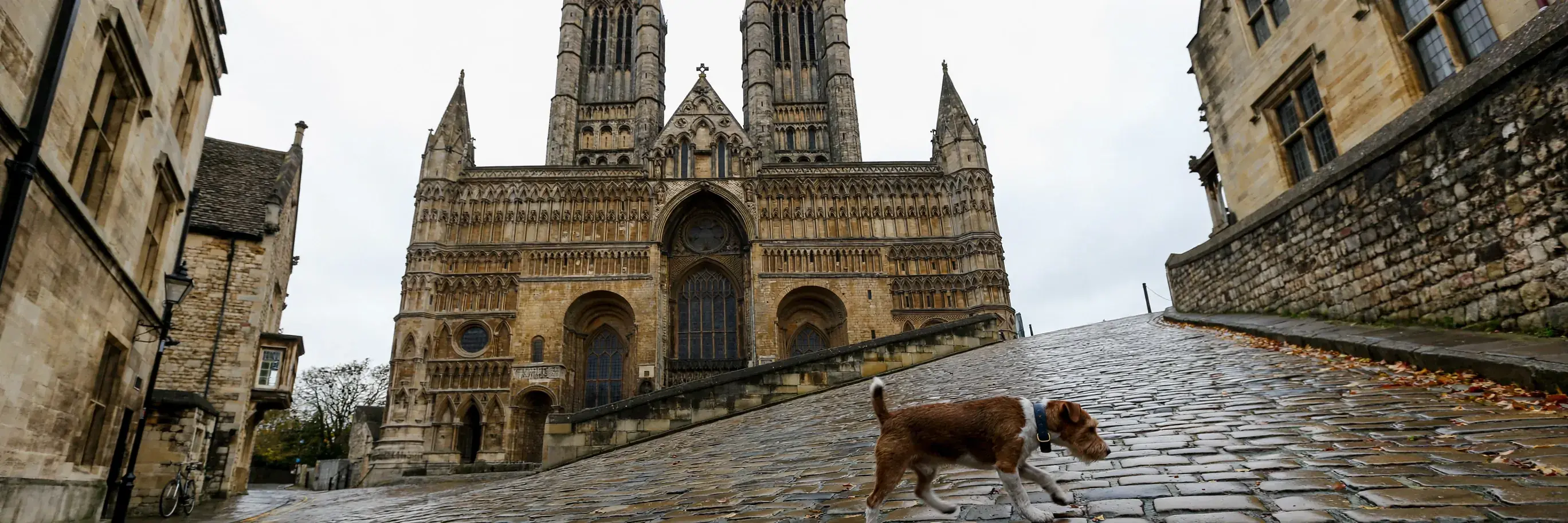
Stand at the bottom of Steep Hill and look up, and the whole logic of a dog trip to Lincoln becomes clear in a single glance. The street rises in a direct, unapologetic line from the lower city to the cathedral quarter, its cobbles and stone flags climbing past independent shops, tea rooms and pubs until the great west front of Lincoln Cathedral fills the sky at the top. It is a short street, not a mountain pass, and that is exactly what catches people out: the distance looks manageable, the gradient does not. The hill is often described as one of the steepest streets in England, and whether or not a visitor cares about the ranking, the practical effect is the same. A fit adult feels it in the calves within a minute. A dog feels it in the paws, the breathing and the willingness to keep going, and a dog that is old, overweight, arthritic, very small, brachycephalic or simply unfit will tell you plainly that this is not a casual stroll.
That is why the first decision of any Lincoln trip with a dog should be about the hill, not about the cathedral. Decide before you arrive whether your dog will climb it at all, and if so, when and how. The sensible default is to climb it once, in the coolest part of the day, with no deadline waiting at the top. Go slowly, in stages, and treat each shop front, doorway and patch of shade as a legitimate resting point. Keep the lead short but not tight, so the dog can choose its footing on the cobbles without being pulled off balance. Let the dog set the pace on the way up and be ready to stop altogether: a dog that plants its feet, pants hard, lags behind or starts to limp is not being stubborn, it is giving you information. Offer water at the bottom and again at the top, not only when the dog looks thirsty, and remember that a dog that has climbed in summer heat will need longer to cool down than you will. A damp towel, a shaded bench and ten quiet minutes at the top are worth more than any photograph taken in a hurry.
The surface matters as much as the slope. Steep Hill is paved with cobbles and worn stone in places, and wet cobbles are slippery for paws and for human shoes alike. After rain, after frost, or on a morning when the stone is still damp, the hill needs extra care and a slower pace. In icy weather it is better avoided on foot altogether. Dogs with sensitive paws, recent nail trims, or joint problems will feel every uneven flag, so check paws at the top and again at the bottom, and carry a small towel to wipe grit and salt from between the toes in winter. A harness that spreads pressure across the chest is kinder than a collar on a steep pull, and a long line is a poor choice here: it tangles around legs, shop displays and other pedestrians on a narrow pavement. Keep the lead at a length that lets the dog sniff a doorway without stepping into the road, and no longer.
The good news is that the hill is entirely avoidable, and avoiding it is not a failure. Lincoln has buses that serve the uphill quarter, and there are car parks at the top as well as at the bottom, so a dog that should not climb can still reach the cathedral, the castle and Bailgate without ever setting a paw on the slope. If you do decide to walk up, plan the return as carefully as the ascent. Walking down a steep, cobbled hill is harder on a dog's shoulders, elbows and nails than walking up it, and a dog that bounded up happily can come down stiffly. Some owners prefer to climb up and take the bus or a taxi down, or to drive up, park, explore the quarter on the flat, and then drive down again. There is no rule that says a good Lincoln trip must include the full climb in both directions. The hill is a feature of the city, not a test of your dog.
Timing the climb changes the experience completely. Early morning, before the shops fill and the tour groups arrive, is the calmest time: the stone is cool, the pavements are clear, and a nervous dog has room to move without being crowded. Midday in summer is the worst combination of heat, crowds and reflected warmth from the stone, and it is the time most likely to produce a hot, stressed dog and a frustrated owner. Late afternoon, when the light softens and the crowds thin, can be lovely, but leave enough time to get back down before dark if your dog is unsure on the cobbles. If you are staying overnight, consider splitting the hill across two days: climb once for the cathedral and castle quarter, and spend the other day entirely on the flat around Brayford and the river, where the dog can walk properly without any gradient at all. That split is the single most useful piece of planning advice in this guide, and it is the one most first-time visitors wish they had followed.
The Uphill historic quarter: Bailgate, Castle Square and the streets around the top
Once you reach the top of Steep Hill, Lincoln changes character. The Uphill quarter, centred on Bailgate, Castle Square and the cathedral green, is the oldest part of the city, and it rewards the slow, sniffing pace that suits a dog far better than any checklist of attractions. The streets here are narrow, the buildings are a mixture of Georgian fronts, medieval stone and timber-framed shops, and the traffic is lighter than in the lower city. That makes it a good place to wander without a fixed route: turn down a side street, pause at a garden wall, let the dog investigate a doorway while you look at the stonework above it. The quarter is compact enough that you can cross it on foot in a few minutes, yet dense enough that an hour can pass pleasantly without covering much ground at all.
Bailgate is the main street of the quarter, running north from Castle Square past independent shops, cafes, pubs and small galleries. It is the natural place to start an uphill walk, because it is relatively flat once you are up there, and because it gives the dog a chance to settle after the climb before you ask for anything more demanding. Keep the dog on a short lead here, not because the street is dangerous, but because the pavements are narrow, the shop doorways are close together, and a dog that wanders across a pavement can block the way for everyone else. Most of the shops are small, and not all of them welcome dogs inside, so check the door or ask before you step in with a dog, and be ready to take turns waiting outside if one of you wants to browse. That is normal in a historic shopping street, and it works best if you agree the plan before you arrive rather than negotiating it in a doorway with a dog pulling in the other direction.
Castle Square, between the cathedral and the castle, is the open heart of the quarter and the best place to pause. It is paved, with benches and room to stand back and look at both buildings at once, and it is where the scale of Lincoln finally makes sense: the cathedral on one side, the castle on the other, and the city falling away below you to the south. For a dog, the square is a chance to rest in the open air after the enclosed climb, to drink, to watch people pass, and to get used to the sounds of a busy historic site before you go any further. For the owner, it is the place to decide the order of the next few hours. If the cathedral is open for visiting, go there first while the dog is still fresh and calm. If a service or an event is in progress, walk the quieter streets first and come back later. The square is also the place to check the practical details: where the nearest water tap or cafe is, where the toilets are, and which way the wind is blowing, because an exposed hilltop in Lincolnshire can feel several degrees colder than the sheltered waterfront below.
North of Bailgate, the quarter continues towards Newport Arch, a Roman gateway that still carries traffic and still marks the northern edge of the old Roman city of Lindum Colonia. The walk to the arch is flat, quiet and worth doing with a dog, because it takes you away from the busiest part of the quarter into streets where the houses are older, the gardens are walled, and the pace slows down. The arch itself is a good reminder of how long Lincoln has been a city: founded as a Roman fortress and colonia, later a Norman stronghold, later a medieval wool town and cathedral city, it has been continuously inhabited for nearly two thousand years. A dog will not care about any of that, but a dog will appreciate the quieter pavements, the grass verges and the chance to walk without being jostled. Turn back at the arch or continue into the residential streets beyond it, then loop back to Bailgate by a different route so the return walk feels new to the dog as well as to you.
South of the square, the streets fall away towards the city walls and the steep lanes that lead back down. These are worth exploring in small doses, but they are not the place for a tired dog. The lanes are narrow, the steps are uneven, and the views down over the lower city are distracting enough that it is easy to forget how far you have walked. If you want a view, the cathedral green and Castle Square give you the best of it without the extra descent. If you want a quieter walk, the residential streets to the east of the cathedral, around the old city walls and the gardens, are gentler and less visited. Wherever you walk uphill, keep the dog on a lead, carry bags for waste, and remember that this is a residential area as well as a tourist quarter: people live behind those doors, and a dog that barks at every passer-by or relieves itself in a front garden will not be welcome for long.
Cathedral and castle: what dogs can actually do at Lincoln's two great buildings
Lincoln Cathedral and Lincoln Castle face each other across Castle Square, and together they are the reason most visitors come to the city. They are also the two places where dog owners most need accurate, up-to-date information, because the rules are different for each building and they change with events, services and the time of year. The short version is encouraging: Lincoln is unusually welcoming to dogs at its cathedral, and the castle is welcoming on specific advertised days. The longer version, which follows, is the one to plan around, and it is worth reading in full before you promise anyone in your party a particular visit.
Lincoln Cathedral is one of the great Gothic cathedrals of England, and its history is part of the reason it dominates the city. The present building was begun in the late eleventh century, rebuilt in Gothic style after an earthquake in 1185, and completed over the following centuries with the great west front, the transepts, the chapter house and the famous towers. For a period in the fourteenth century, when its central spire stood complete, it was said to be the tallest building in the world, and even without the spire the towers remain a landmark visible for miles across the flat Lincolnshire landscape. Inside, the cathedral is a working church, not a museum: services take place daily, the choir sings, visitors come to pray as well as to look, and that working character shapes how dogs are welcomed. Well-behaved dogs on a lead are generally welcome inside during normal visiting hours, which is a rare and generous policy for a building of this importance, and it is one that dog owners should treat with care. Keep the dog close, keep it quiet, and be ready to step outside if it becomes restless, barks, or needs the toilet. The cathedral is a place where a calm dog can lie quietly at your feet while you look up at the vaulting, and where a restless dog will quickly feel out of place.
There are limits, and they are sensible ones. Dogs are not admitted to clearly marked restricted areas, which include the historic libraries and the Learning Centre, and access can be limited where food is being served. Most paid concerts and theatrical events are assistance-dog only unless they are specifically advertised as dog-friendly, and services and special events can alter visitor access on any given day. Admission times and ticket arrangements can also change, so check the official guidance before you travel rather than relying on a time remembered from a previous visit or a third-party listing. Dogs are admitted without an additional charge, but the human visitor arrangements still apply, and you should allow time to queue, to pass through the entrance, and to find a quiet corner where the dog can settle. The stone floor is hard and cold, so a small mat or blanket for a dog that will lie down for a while is a kindness, and a chew or a settled routine is better than a toy that squeaks in a silent nave. Look for the Lincoln Imp, the small carved figure high above St Hugh's Shrine, if you want a detail to remember, but do not expect the dog to share your interest: for the dog, the cathedral is a large, cool, echoing room full of new smells, and the best visit is a short, calm one.
Lincoln Castle, directly opposite, is a different proposition. Built by William the Conqueror in 1068 on the site of the Roman fortress, it is one of the few Norman castles in England that still has its two mottes, its curtain walls and its Victorian prison largely intact, and it holds one of the four surviving original copies of Magna Carta from 1215. The grounds are free to enter and enjoy, and the walls, the prison and the Magna Carta vault are the paid parts of a visit. On an ordinary day, pet dogs are not routinely admitted to the castle, and only assistance dogs are generally allowed inside the buildings. That is the rule to plan around, and it catches out visitors who assume that because the cathedral welcomes dogs, the castle must do the same. It does not, and the distinction is important: the castle is a scheduled historic site with narrow wall walks, steep steps, prison cells and a vault, and those spaces do not suit dogs on a normal visiting day.
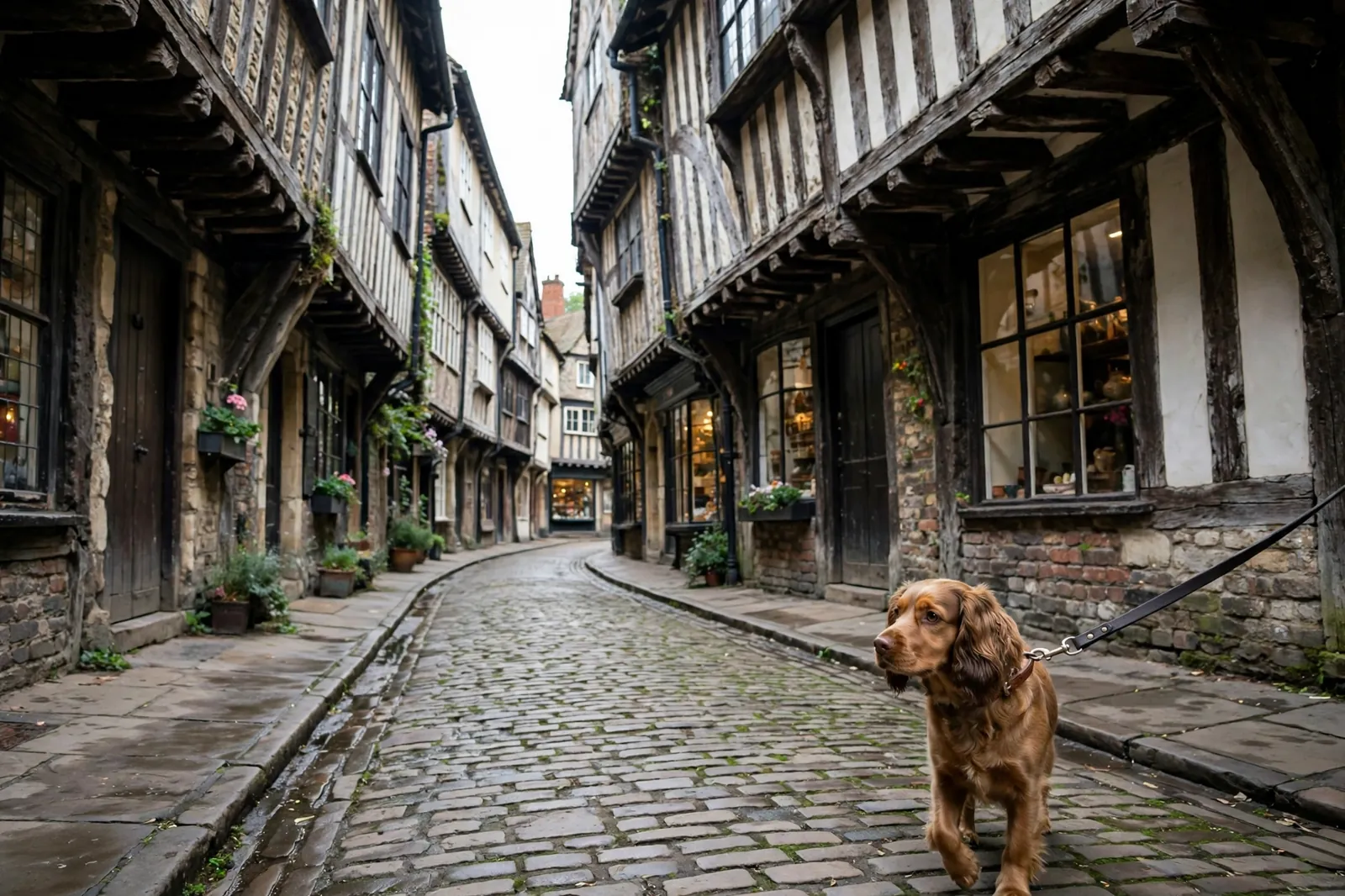
The exception is worth knowing about, because it changes the trip for anyone who can plan around it. The castle runs advertised dog-friendly days, usually on selected weekends, when dogs on leads can explore the grounds, the medieval walls and the prison areas, with the vault normally excluded. On those days the castle becomes a genuinely dog-friendly attraction rather than a building to admire from outside, and the atmosphere is different: more dogs, more owners, more patience from everyone, and staff who expect dogs rather than being surprised by them. If you can time a Lincoln trip to coincide with one of those days, it is worth doing, but do not build a whole weekend around a dog-friendly day without confirming the date, the hours and the conditions first, because the calendar changes and a day that was advertised for one month may not repeat the next. Check the castle calendar before you travel, and if the date does not work, enjoy the castle from Castle Square and the surrounding streets, where the walls, the gates and the scale of the place are still impressive from outside. Lincoln rewards the same slow, flexible approach as York with a dog, where the walls, the Minster and the riverside each need their own plan rather than a single rushed circuit.
If one person in your party wants to go inside the castle on a non-dog day while the other stays with the dog, that is a practical solution, and it works better if you plan it in advance. Take turns, agree a meeting point and a time, and use the waiting time for a proper walk rather than standing in Castle Square with a bored dog. The cathedral, which welcomes dogs, can be the shared visit, and the castle can be the split visit. That division keeps everyone happy and avoids the common mistake of leaving a dog tied up outside a historic building, which is stressful for the dog, unfair on passers-by, and in some places not permitted at all. Never leave a dog unattended outside the cathedral or the castle, even for a few minutes, and never leave a dog in a car while you go inside. If the dog cannot go in, one person stays with the dog, every time.
Downhill and Brayford Waterfront: the flat city, the river and the easy half of Lincoln
Downhill Lincoln, the lower city around Brayford Pool and the River Witham, is where a dog trip becomes easy again. The ground is flat, the pavements are wide, the river is always nearby, and the distances between a car park, a cafe, a shop and a bench are short enough that a dog can walk properly without any gradient at all. If the uphill quarter is the reason to visit Lincoln, the downhill city is the reason the visit is comfortable, and a well-planned trip will spend at least as much time down here as up there. Start at Brayford Waterfront, the modern quayside around Brayford Pool, where the River Witham widens into a small lake at the edge of the city centre. The waterfront is lined with bars, restaurants, the university buildings and the Brayford Pool, and it is a natural meeting point: flat, open, with water on one side and buildings on the other, and with enough space for a dog to walk without being crowded.
The Brayford walk is the simplest and most useful walk in the city. Follow the water's edge from the waterfront towards the Brayford Pool and along the River Witham, and you will find a level, surfaced path that suits every dog, from a puppy on its first city walk to an older dog that can no longer manage hills. Keep the dog on a lead near the water, because the edge is not fenced everywhere, the water is deep in places, and swans, ducks and other waterfowl are present throughout the year. A dog that loves water will be tempted, and a dog that has never seen a swan may be startled, so a short lead and a watchful eye are the right combination. The path is also a cycle route in places, so keep the dog to one side, do not let a long lead trail across the path, and step aside for cyclists rather than expecting them to slow down for you. The same care applies to the Fossdyke canal, which joins the Witham at Brayford and runs west out of the city: the towpath is flat and pleasant, but it is narrow, and a dog that pulls towards the water or towards a passing boat can cause a problem in seconds.
From Brayford, the lower city spreads out in several directions, each worth a short, flat walk. The High Street runs south from the waterfront through the main shopping area, and it is a useful route for practical errands: pet supplies, a pharmacy, a supermarket, a cafe, a bench. It is busier than the waterfront, and the pavements are narrower, so it is better for a short, purposeful walk than for a long, relaxed one. The Waterside area, around the Waterside Shopping Centre and the river, is more open, and the streets around the station and the Cornhill Quarter have been redeveloped in recent years with wider pavements, new seating and a more pedestrian-friendly layout. The Cornhill is a good place to pause with a dog, because it is open, level and close to the station, and because the cafes and bars around it are used to dogs sitting quietly at an outdoor table. The Collection, Lincoln's museum and gallery on Danes Terrace, is a short walk from the waterfront, and its building and grounds are worth a look from outside even if you do not go in. The museum itself has its own access rules for dogs, so check the official guidance before you travel if you hope to take a dog inside, and plan on the assumption that the visit will be an outdoor one unless the guidance says otherwise.
The lower city also holds the practical heart of a Lincoln trip: the places where you buy food, fill a water bottle, find a toilet, or shelter from rain. The High Street and the Waterside have the shops, the station area has the transport links, and the waterfront has the open space. For a dog, the lower city is where the day starts and ends: a morning walk along the river before the climb, a lunchtime rest on the waterfront after the climb, and an evening stroll along the Witham when the light is low and the water is calm. That rhythm, flat in the morning, uphill in the middle of the day, flat again in the evening, is kinder to a dog than a single long uphill outing, and it gives the owner time to see the city properly rather than rushing from one attraction to the next. If you have only one day in Lincoln, spend the morning downhill, the middle of the day uphill, and the late afternoon downhill again, and you will have seen both halves of the city without exhausting the dog.
One more downhill feature deserves a mention, because it is easy to miss and easy to enjoy: the small green spaces and churchyards tucked between the shopping streets. St Benedict's Square, the churchyard of St Mary le Wigford, and the gardens around the lower city are not large, but they are quiet, level and shaded, and they give a dog a chance to rest away from the main shopping crowds. Use them as rest stops, not as destinations, and keep the dog on a lead and under control, as you would in any churchyard or formal garden. The lower city is also where you will find the most dog-friendly pubs and cafes at pavement level, without steps or steep entrances, which matters for an older dog or a dog in a pushchair. Ask at the door, look for a water bowl, and choose a table where the dog can lie out of the way of the main foot traffic rather than in the middle of it.
Riverside and park walks: Brayford, the commons, the Arboretum and the countryside beyond
Lincoln is a city that rewards a dog owner who looks beyond the centre, because the best walks are not in the cathedral quarter or on the High Street, but on the commons, along the river, and in the country park on the edge of the city. The city has two great commons, West Common and South Common, and they are the closest thing Lincoln has to open countryside within walking distance of the centre. West Common, to the west of the city, is a large area of open grassland and marsh, once used as a racecourse, now a place for walking, running and dog exercise. It is wide, flat and exposed, with views back towards the cathedral that are at their best at sunset, and it is popular with local dog walkers for good reason: there is room to walk for an hour without repeating a route, and the ground is varied enough to interest a dog without being difficult underfoot. Keep the dog on a lead here, because horses graze on the common and are a regular presence, and because the marshy areas can be wet underfoot after rain. The rule is simple: a dog that chases horses is a danger to itself, to the horse and to the rider, and the common is not the place to find out whether your dog will chase.
South Common, to the south of the city, is larger and wilder, and it feels more like open countryside than a city park. The walk across South Common can be extended to six kilometres or more, and it links with Cow Paddle, a smaller area of grassland and woodland nearby, to make a longer loop for a fit dog. The ground is uneven in places, the paths are not all surfaced, and the area is less visited than West Common, so it suits a dog that is comfortable off the beaten track and an owner who is comfortable with a map. Take water, take a lead, and take care near the roads that cross the common, because the open ground can make a dog forget that a road is nearby. Both commons are best in dry weather, when the grass is firm and the paths are easy to follow, and both are at their most beautiful in late spring and early autumn, when the light is low, the grass is green, and the cathedral is visible on the horizon.
Closer to the centre, the Arboretum is a Victorian park on the eastern side of the city, with formal gardens, a duck pond, mature trees and a cafe. It is a smaller, more contained walk than the commons, and it suits a dog that prefers a short, structured walk to a long, open one. Dogs are welcome on a lead, and the park is a good choice for a morning or evening walk from a city-centre stay, or for a restful hour between the uphill and downhill parts of the day. The duck pond is the main attraction for dogs and the main reason to keep them on a lead: ducks are present year-round, and a dog that lunges at them will disturb the wildlife and annoy other visitors. The Arboretum is also a reminder that Lincoln's parks are historic in their own right: laid out in the nineteenth century as a public park for the growing city, it still serves the same purpose today, and it is one of the few places in the centre where a dog can walk on grass under mature trees without leaving the city.
For a longer, greener outing, Hartsholme Country Park, about three miles south-west of the city centre on Skellingthorpe Road, is the best choice. The park is a Green Flag award-winning country park of around two hundred acres, formed around a Victorian landscaped estate with a large lake, woodlands, meadows and a visitor centre, and it adjoins the Swanholme Lakes Local Nature Reserve. The circular walk around Hartsholme Lake takes about forty minutes, and longer routes through the woodlands and around the lakes can extend to three miles or more. Dogs are welcome on the trails, and there are extensive areas for off-lead exercise in the woodlands and parkland, but dogs should be kept under control, especially near the lakes with their waterfowl, near the play area and the cafe, and in the nature reserve, where dogs on leads are not permitted in some areas. Check the official guidance before you travel, and keep the dog on a lead where the signs ask for it, even if other dogs are off lead nearby. The park has a car park, a cafe, a visitor centre, toilets and dog waste bins, and it is a good place to spend half a day with a dog, especially in summer when the city centre is hot and crowded.
Beyond the city, Lincolnshire opens up into the flat, open countryside that surrounds Lincoln on every side: the Lincolnshire Wolds to the east, the Trent valley to the west, and the flat fenland to the south. The Wolds, designated as a National Landscape, offer rolling chalk hills, quiet lanes and long-distance paths such as the Viking Way, which runs for 147 miles from the Humber to Rutland Water and passes through the Wolds. The Viking Way is a serious long-distance route, not a city walk, but short sections of it make excellent day walks with a dog, provided the dog is fit, the weather is kind, and you have planned transport back to the start. The countryside around Lincoln is also home to market towns such as Market Rasen, Horncastle and Louth, each with its own dog-friendly pubs and walks, and to the coast at Cleethorpes and Skegness, where the beach rules change with the season. If you are planning a longer Lincolnshire trip that includes the coast, read our guide to dog-friendly beaches in the UK and the 2026 rules, bans and fines before you go, because the seasonal restrictions on many beaches are strict and the fines for breaking them are real. For a Lincoln city break, however, the commons, the Arboretum and Hartsholme are enough: they give a dog open grass, woodland, water and wildlife without a long drive, and they are the reason many Lincoln dog owners never need to leave the city at all.
Staying and eating with a dog: where to sleep, where to eat, and how to ask well
Lincoln has a good range of dog-friendly places to stay, from city-centre hotels and guesthouses to self-catering cottages, bed and breakfasts and holiday parks on the edge of the city, and the choice you make will shape the trip as much as any walk or attraction. The most useful question to ask is not whether a place accepts dogs, but how it accepts them: how many dogs, what size, what charge, what rooms, what rules, and what happens if the dog is left alone. A hotel that accepts one small dog in a ground-floor room is a different proposition from a cottage that accepts two large dogs with an enclosed garden, and the price, the location and the rules will all be different. Ask for the answers in writing before you pay, and check them again when you arrive, because a policy that was clear on a booking site can become vague at check-in, and a dog that is welcome in one room may not be welcome in another.
Location matters more in Lincoln than in many cities, because the hill divides the city into two halves. A stay uphill, in or near Bailgate, puts you close to the cathedral, the castle and the historic quarter, and it means the dog never has to climb Steep Hill at all. A stay downhill, near Brayford or the station, puts you close to the flat river walks, the shops and the transport links, and it means the dog has an easy morning and evening walk from the door. A stay on the edge of the city, near Hartsholme or the commons, gives you open space and quiet, but it means a drive or a bus ride into the centre for every visit. There is no single best choice: an older dog will be happier downhill or uphill with no climb, a young, fit dog will be happy anywhere, and a dog that is nervous in traffic will be happier away from the High Street. Choose the location that fits the dog you have, not the location that looks prettiest in the photographs.
Pet fees and conditions vary widely, and they are worth checking in detail. Some hotels charge a flat fee per stay, some charge per night, some charge per dog, and some include the fee in the room rate. A common range in the UK is £10 to £25 per dog per night, or £25 to £75 per dog per week in self-catering accommodation, but the exact figure matters less than the total: ask for the all-in price, including the pet fee, any cleaning charge, any damage deposit, and any charge for extra towels or bedding. Ask whether the fee covers one dog or two, whether there is a size or breed limit, and whether the dog is allowed in all rooms or only in selected ones. Ask whether the dog can be left alone in the room, and for how long: many places prohibit unattended dogs outright, while others allow it only if the dog is crated and quiet. If you plan to eat out in the evening, that rule will decide whether you can go out at all, or whether you need to find a restaurant that welcomes dogs so the dog can come with you. If you are comparing self-catering options and holiday parks, our guide to dog-friendly holiday parks in the UK explains the questions to ask about boundaries, fees and small print before you book.
Eating out with a dog in Lincoln is generally straightforward, and the city has a good number of dog-friendly pubs, cafes and tea rooms, especially in the uphill quarter and around Brayford. The Wig and Mitre, on Steep Hill, is a well-known dog-friendly pub with a historic interior and a warm welcome for dogs, and it is a natural stopping point on the climb or at the top. Bells Tea Shop, also on Steep Hill, welcomes well-behaved dogs inside, with water and treats available, and it is a good place for a rest and a cup of tea after the climb. The Magna Carta pub, on the waterfront, and the pubs and cafes around Bailgate and the Cornhill Quarter also welcome dogs, and many of the independent cafes in the uphill quarter have a water bowl by the door and a dog biscuit on the counter. That said, policies change, and a pub that welcomed dogs last year may have changed its policy, or may welcome dogs only in one room, or only outside, or only at certain times. Check the official guidance before you travel, or ask at the door, and be ready to choose another place if the answer is no. Never assume that a dog-friendly sign on the door means the dog can go everywhere inside: the bar, the restaurant and the garden may all have different rules.
How you behave in a pub or cafe matters as much as whether dogs are allowed. Choose a table where the dog can lie out of the way, ideally in a corner or against a wall, rather than in the middle of the room or across a walkway. Keep the lead short and under the table, not trailing across the floor where a server can trip over it. Bring a mat or blanket for the dog to lie on, because a cold stone or tiled floor is uncomfortable for a dog that has to lie there for an hour, and because a mat signals to the dog that this is a place to settle, not a place to explore. Bring water, or ask for a bowl, and bring a quiet chew or a stuffed Kong rather than a squeaky toy. Order food that you can eat without dropping scraps on the floor, and do not feed the dog from the table, because a dog that begs at one table will beg at every table, and a pub that tolerates one begging dog will not tolerate many. If the dog barks, whines, or becomes restless, take it outside for a short walk and a toilet break, and be ready to leave early if it does not settle. A good pub visit with a dog is a quiet one, and the best compliment a pub can pay you is to forget the dog is there at all.
Self-catering and picnic options are worth considering for a Lincoln trip, because they give you flexibility and because the city has good places to eat outdoors with a dog. Buy supplies from a supermarket or a market on the High Street, pack a picnic, and eat it on West Common, in the Arboretum, or by the lake at Hartsholme, where the dog can be part of the meal rather than waiting under a table. Take bags for waste, take water for the dog, and take the picnic rubbish home with you, because a beautiful common is only beautiful if everyone leaves it as they found it. If you are staying in self-catering accommodation, ask where the dog can be fed and watered, where the dog can sleep, and where the nearest practical toilet walk is after dark. A cottage with an enclosed garden is worth paying more for, because it gives the dog a safe place to stretch its legs first thing in the morning and last thing at night, without a lead, a road or a stranger to worry about.
Getting there, parking and getting around: trains, cars, buses and the hill
Lincoln is well connected by train, and for many dog owners the train is the easiest way to arrive. Lincoln Central station, in the lower city near Brayford, is served by direct trains from London King's Cross via Newark, from Sheffield, from Nottingham, from Leicester and from Doncaster, and the journey from London takes around two hours. Dogs travel free on UK trains, without a ticket, provided they are on a lead or in a carrier and do not occupy a seat, and they are generally welcome in the station and on the platform. The station is level, with lifts to the platforms, and it is a short, flat walk from the station to Brayford Waterfront, to the High Street and to the lower-city hotels. That flat arrival is a gift for a dog that has just spent two hours on a train: it can stretch its legs, drink, and relieve itself on level ground before you ask it to do anything else. Book a seat in a quiet carriage if you can, bring a mat for the dog to lie on, and avoid the busiest peak-hour trains, when the aisles are crowded and the dog has nowhere to settle.
If you arrive by car, the parking decision is the same as the Steep Hill decision: park at the top if you want to explore the uphill quarter, and park at the bottom if you want to explore the waterfront and the lower city. There are car parks at both levels, and the choice you make will save the dog a climb or a long walk in the wrong direction. The car parks near Brayford and the station are the most convenient for the lower city, and the car parks near the cathedral and the castle are the most convenient for the uphill quarter, but the exact names, charges and opening hours change, so check the official guidance before you travel rather than relying on a car park remembered from a previous visit. Check the height limit if you have a roof box or a tall vehicle, check whether the car park is open late enough for your return, and check whether you can pay by card or by phone, because some Lincoln car parks are pay-and-display and some are pay-on-exit. Never leave a dog in a parked car, even for a few minutes, and never leave a dog in a car in warm weather, even with a window open: a car can reach a dangerous temperature in minutes, and a dog left in a car is at risk of heatstroke, theft, or distress.
Getting around Lincoln with a dog is mostly a matter of walking, and the city is compact enough that most of the centre can be covered on foot. The walk from the station to Brayford is a few minutes, the walk from Brayford to the bottom of Steep Hill is a few minutes more, and the walk from the top of Steep Hill to the cathedral and the castle is a few minutes after that. The only part that is not a short walk is the climb itself, and that is where the bus is useful. Local buses serve the uphill quarter, and dogs are generally allowed on buses in Lincoln at the driver's discretion, provided they are on a lead, well-behaved, and do not occupy a seat. Check the bus company's policy before you travel, because the rules can vary by operator and by route, and be ready to wait for the next bus if the driver decides the bus is too crowded for a dog. Taxis are another option, and many Lincoln taxi firms will carry a dog, but it is polite and practical to mention the dog when you book, to bring a blanket for the seat, and to ask whether there is an extra charge. A taxi from the station to an uphill hotel is a short ride and a sensible one for a tired dog, a heavy suitcase, or a rainy arrival.
For a longer stay, or for a trip that includes the countryside, a car is useful, but it is not essential for a city-centre break. The commons, the Arboretum and Hartsholme are all reachable by bus or by a longer walk, and the train can take you to market towns and villages in Lincolnshire for a day out. If you do drive, remember that Lincoln's historic streets are narrow, that some streets in the uphill quarter are one-way or restricted, and that the city centre can be congested at peak times. Drive slowly, watch for pedestrians and dogs on the pavements, and do not try to drive up Steep Hill unless you are sure the route is open to traffic and you are comfortable with the gradient: the hill is a pedestrian-friendly street for most of its length, and the last thing a dog walker needs is a car trying to pass on a narrow, cobbled slope. Park once, walk everywhere, and use the bus or a taxi for the hill, and the city will feel much smaller and much kinder than it looks on a map.
Before you travel, save the practical numbers you might need. Find the nearest veterinary practice to your accommodation and save its number, and find the nearest out-of-hours emergency vet as well, because a city-centre practice may close in the evening and a rural practice may be twenty minutes away. Lincoln has several veterinary practices in and around the city, including practices in the lower city and on the edge of the city near Hartsholme, but the exact opening hours and emergency arrangements change, so check the official guidance before you travel and save the numbers in your phone before you need them. Carry a basic first-aid kit for the dog: a bandage, a tick remover, a spare lead, a muzzle if your dog has ever needed one, and any medication the dog takes regularly. Know the signs of heatstroke, of a cut paw, of a swallowed foreign object, and of a dog that has eaten something it should not have, and know when to call a vet rather than waiting to see if the problem goes away. A well-planned Lincoln trip is a safe one, and a safe trip is one where the boring practical details were sorted before the fun started.
Seasons, weather and a practical checklist for Lincoln with a dog
Lincoln is a year-round city, but it is a different city in each season, and the season you choose will change the walk, the clothing, and the dog's comfort. Spring, from March to May, is one of the best times to visit: the days are lengthening, the commons are green, the Arboretum is in flower, and the weather is cool enough for a dog to walk comfortably. The hill is at its best in spring, when the stone is dry and the crowds are still thin, and the cathedral and castle are quiet enough to enjoy without queuing. Summer, from June to August, is the busiest season, and it is the season that needs the most care for a dog. Lincolnshire can be hot in summer, the stone of Steep Hill and Castle Square reflects the heat, and the city centre can feel several degrees warmer than the countryside. Walk early in the morning and late in the evening, avoid the middle of the day, carry water at all times, and never leave a dog in a car. Summer is also the season when the city hosts events, festivals and outdoor concerts, which can mean crowds, noise and fireworks, so check the events calendar before you book if your dog is noise-sensitive.
Autumn, from September to November, is often the sweet spot for a Lincoln dog trip. The crowds have thinned, the light is low and golden, the leaves in the Arboretum and at Hartsholme turn colour, and the weather is cool enough for long walks without the summer heat. The commons are at their best in autumn, when the grass is firm and the views are clear, and the pubs are at their most welcoming, with fires lit and dogs welcome inside. Bonfire Night, on 5 November, and the fireworks season around it, are the main autumn caution: if your dog is frightened by fireworks, check whether there are displays in Lincoln during your stay, and plan a quiet evening indoors with the curtains drawn and the television on. Winter, from December to February, is the quietest season, and it has its own rewards: the cathedral is beautiful in winter light, the Christmas market, if it is running, brings the uphill quarter to life, and the city is calm enough to enjoy without crowds. Winter is also the season when the hill is most difficult: wet, icy or frosty cobbles are slippery, the wind on the hilltop is cold, and the days are short. Dress the dog warmly if it needs a coat, dry its paws after every walk, and plan for shorter walks with more indoor time.
Lincolnshire weather is changeable, and a Lincoln trip needs a packing list that covers rain, wind, sun and cold in the same day. Pack a waterproof coat for the dog if it has a short coat or is older, pack a drying towel and a spare towel for the car, pack a water bottle and a collapsible bowl, and pack a lead, a spare lead, and a harness that fits well. Pack poo bags, and pack more than you think you will need, because a city walk with a dog always uses more bags than a countryside walk. Pack any medication the dog takes, pack its food in the usual brand and the usual amount, and pack a familiar bed or blanket so the dog has a smell of home in a strange room. Pack a torch for evening walks on the commons, where there is little lighting, and pack a high-visibility jacket or collar for the dog if you will be walking near roads after dark. Pack a phone charger, because a phone with a dead battery is no use for maps, for vet numbers, or for calling a taxi, and pack a paper copy of your accommodation address and the vet's number, in case the phone fails.
Dog etiquette in Lincoln is the same as dog etiquette anywhere in Britain, but it is worth stating plainly because the city is compact and the streets are narrow. Keep the dog on a lead in the cathedral quarter, on the waterfront, in the shops, and near livestock, horses, waterfowl and traffic. Pick up after the dog, every time, and use the bins provided, or take the bag home with you if there is no bin. Do not let the dog jump up at strangers, children or other dogs, and do not let it relieve itself in a churchyard, a formal garden, a shop doorway or a front garden. Keep the dog under control around other dogs, and ask the other owner before you let the dogs greet each other, because not every dog wants to be greeted. Be honest about your dog: if it barks, if it is reactive, if it is nervous, choose quieter routes, quieter times and quieter places, and do not put it in a situation where it is likely to fail. Lincoln is a friendly city for dogs, and it will stay friendly if dog owners behave as if they are guests in a historic place, which they are.
Finally, plan the trip in the order that works for the dog, not in the order that works for a guidebook. Day one, arrive, walk the flat waterfront, settle into the accommodation, and let the dog learn the new smells and sounds. Day two, climb Steep Hill once, slowly, visit the cathedral, walk Bailgate and Castle Square, eat in a dog-friendly pub, and come down again before the dog is tired. Day three, choose a long walk: West Common, South Common, or Hartsholme, depending on the weather and the dog's energy, and finish with a quiet evening by the river. If you have only one day, do the waterfront in the morning, the hill in the middle of the day, and the river again in the late afternoon, and you will have seen Lincoln properly. If you have a week, add a day in the Wolds, a day on the coast, and a day doing nothing at all, because a dog that has a day to rest is a dog that will enjoy the next day's walk. Lincoln is not a city to rush, and it is not a city to tick off: it is a city to walk slowly, with a dog, in the right order, and at the right pace.
- Before you go: confirm the cathedral visiting hours and the castle dog-friendly calendar, check the official guidance before you travel, and book dog-friendly accommodation in writing with the pet fee itemised.
- On the hill: climb once, slowly, in the cool of the day, with water and a short lead; consider the bus or a taxi for the return, especially for an older or small dog.
- On the flat: use Brayford Waterfront and the River Witham paths for easy daily walks, and West Common, South Common or Hartsholme for longer, greener outings.
- At the table: choose a dog-friendly pub or cafe, pick a corner table, bring a mat and water, and be ready to leave early if the dog does not settle.
- In an emergency: save the nearest vet and the out-of-hours emergency vet numbers before you travel, and carry a basic first-aid kit, a spare lead and any regular medication.
Practical questions
Before you go
Can dogs go inside Lincoln Cathedral?
Well-behaved dogs on a lead are generally welcome inside Lincoln Cathedral during normal visiting hours, except in clearly marked restricted areas such as the historic libraries and the Learning Centre, and at most paid concerts or events, which are usually assistance-dog only. Services and special events can change access, so check the official guidance before you travel.
Can dogs visit Lincoln Castle?
On an ordinary day, pet dogs are not routinely admitted to Lincoln Castle, and only assistance dogs are generally allowed inside. The castle runs advertised dog-friendly days when dogs on leads can explore the grounds, the walls and the prison areas, with the vault normally excluded. Check the castle calendar before you plan a visit around it.
Is Steep Hill too steep for an older or small dog?
It can be, especially in wet or icy weather. The hill is short but genuinely steep, with cobbles and uneven stone in places. Older, arthritic, very small or brachycephalic dogs are often better carried, driven or bussed to the top, with the climb saved for a fit dog on a cool, dry day. Take it in stages, with water and shade breaks.
Where is the best easy walk with a dog in Lincoln?
Brayford Waterfront and the River Witham paths give the easiest flat walk in the city centre, while West Common and South Common offer wide open grassland. For a longer, greener outing, Hartsholme Country Park, about three miles south-west of the centre, has lake and woodland trails. Keep dogs on a lead near horses, livestock, waterfowl and busy roads.
Where should I park in Lincoln with a dog?
For the uphill quarter, park at the top if you can, so the dog does not have to climb Steep Hill twice. For the waterfront and the lower city, use a central car park near Brayford and walk from there. Check opening hours, height limits and charges before you travel, and never leave a dog in a car in warm weather.