This guide is independent and contains no paid placement. If affiliate links are added later, they will be clearly marked and will not change our editorial checks.
Ludlow works best as a slow day rather than a race between sights. Walk the castle grounds on a lead, browse the market early, then take the flat riverside loop to Whitcliffe Common. Everything is close together, the streets are mostly level, and the dog can come to most of the day.
Why Ludlow suits a dog break
Ludlow is a small market town in south Shropshire, close to the Welsh border, built on a bend of the River Teme. It has a population of around 10,000 people, a Norman castle on a hill at one end of the town, and a market square at the other, with a tangle of medieval streets between them. That shape is exactly what makes it easy with a dog: the whole centre can be crossed on foot in about fifteen minutes, nothing needs a car once you have parked, and the best parts of the town are outdoors.
The town is often called a food town, and the label is earned. Ludlow has a long market tradition, a September food festival that draws producers from across the Marches, and a high number of butchers, bakers, delis and pubs for a town of its size. For a dog owner that matters in a practical way, not just a greedy one: a town that feeds people well usually has pubs with water bowls, cafes with terrace tables, and shops where a dog waiting at the door is a normal sight rather than a problem to solve.
The other reason Ludlow works is the river. The Teme runs around the south and east of the town, and the paths along it give a dog a proper walk without leaving the town at all. The classic loop to Whitcliffe Common takes about an hour, stays mostly flat, and ends back in the centre in time for lunch. Longer routes head out into the Shropshire Hills from the same starting point, so a short-break dog and a long-distance dog can both be happy on the same weekend.
None of this needs a complicated plan. Ludlow rewards a simple rhythm: arrive, park once, walk the castle and the market in the morning, take the riverside loop in the afternoon, and eat somewhere the dog is welcome in the evening. The rest of this guide fills in the details that make that rhythm work — where the lead stays on, where the ground gets slippery, where the crowds build, and what to do when the river is high.
Ludlow Castle with a dog
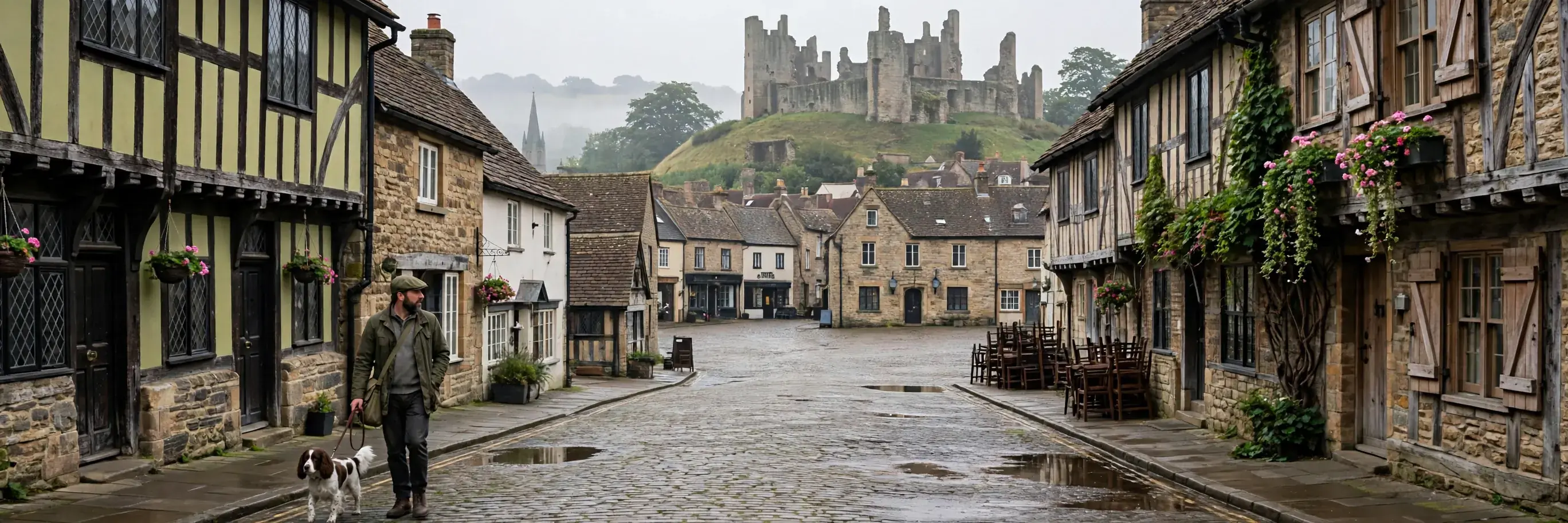
Ludlow Castle dominates the town from its hill above the Teme. It was founded in the late eleventh century by the Norman lord Walter de Lacy, and it grew into one of the great Marcher castles of the Welsh border — a fortress, a palace and an administrative centre in one. Its most famous resident was Prince Arthur, the eldest son of Henry VII, who lived here with his young wife Catherine of Aragon and died at the castle in 1502 at the age of fifteen. Later it became the seat of the Council of the Marches, the body that governed Wales and the border counties, before the Civil War left it the ruin that stands today.
Dogs on leads are welcome in the castle grounds and the outer ward, which is where most of the visit happens anyway. The outer ward is a large grassed enclosure with views across the Teme valley, the town rooftops and the hills beyond. It is a good place for a calm dog to settle on a rug while the humans look at the walls, and there is enough space to keep a sensible distance from other visitors and their dogs. The inner buildings and the keep are a different matter: dogs are not allowed inside them, so plan a split visit if your group wants to climb the tower. One person stays outside with the dog while the other goes in, then swap — the tower views are worth it, but they are not worth leaving a dog tied up alone.
Approach the castle with the lead short. The walk up from Castle Square is steep and cobbled in places, and the entrance area funnels visitors through a narrow passage where dogs meet nose to nose. The ground inside is a mix of grass, gravel and uneven stone, so older dogs and small dogs may find the keep steps and the wall-top surfaces hard going. In wet weather the stone is slippery underfoot, and in summer the grassed ward offers little shade, so carry water and use the shaded corners by the walls for a rest.
Admission is charged for the castle, and opening times change with the season, so check the official guidance before you travel rather than assuming the hours from a previous visit. The castle also hosts events through the year — food festivals, medieval weekends and open-air performances — and those days are much busier, louder and harder for a nervous dog than an ordinary weekday. If your dog is sound-sensitive or crowd-shy, pick a quiet morning outside festival dates and treat the event weekends as days to walk the river instead.
A useful way to think about the castle visit is as a one-hour stop, not a half-day expedition. Walk the grounds, take the views, let the dog sniff the walls, and move on. The town below is where the rest of the day happens, and a dog that has already had a good sniff around the castle will settle far better in a pub or a cafe later.
The market square and medieval streets
Castle Square sits at the top of the town, in front of the castle gates and the great parish church of St Laurence, often called the cathedral of the Marches for its size and its stained glass. On market days the square fills with stalls under striped canopies, and the whole town seems to drift up the hill towards it. The general market runs on Mondays, Wednesdays, Fridays and Saturdays, with a farmers' market and specialist stalls on some of those days — but check the official guidance before you travel, as days and stall mixes change around festivals and public holidays.
Dogs are welcome around the open-air market, and many stallholders keep a biscuit tin behind the counter. The best time to bring a dog is early, in the first hour after the stalls open, when the square is busy enough to be interesting but not yet packed. By late morning on a Saturday, especially in summer and during the September food festival, the square can be shoulder to shoulder, and a dog on a lead becomes a trip hazard for everyone. A reactive dog is better walked through the quieter side streets at that point, or left to enjoy the river loop while the humans shop.
Keep the lead short and your dog close to your leg at the stalls. Market squares concentrate everything a dog finds exciting and everything that worries one: dropped food, hot cooking smells, children at face height, other dogs passing in opposite directions, and stallholders calling out. A short lead and a clear path through the crowd work better than a long lead and constant corrections. If your dog lunges at food smells, walk the outer edge of the square rather than threading between the stalls, and skip the hot-food stalls altogether.
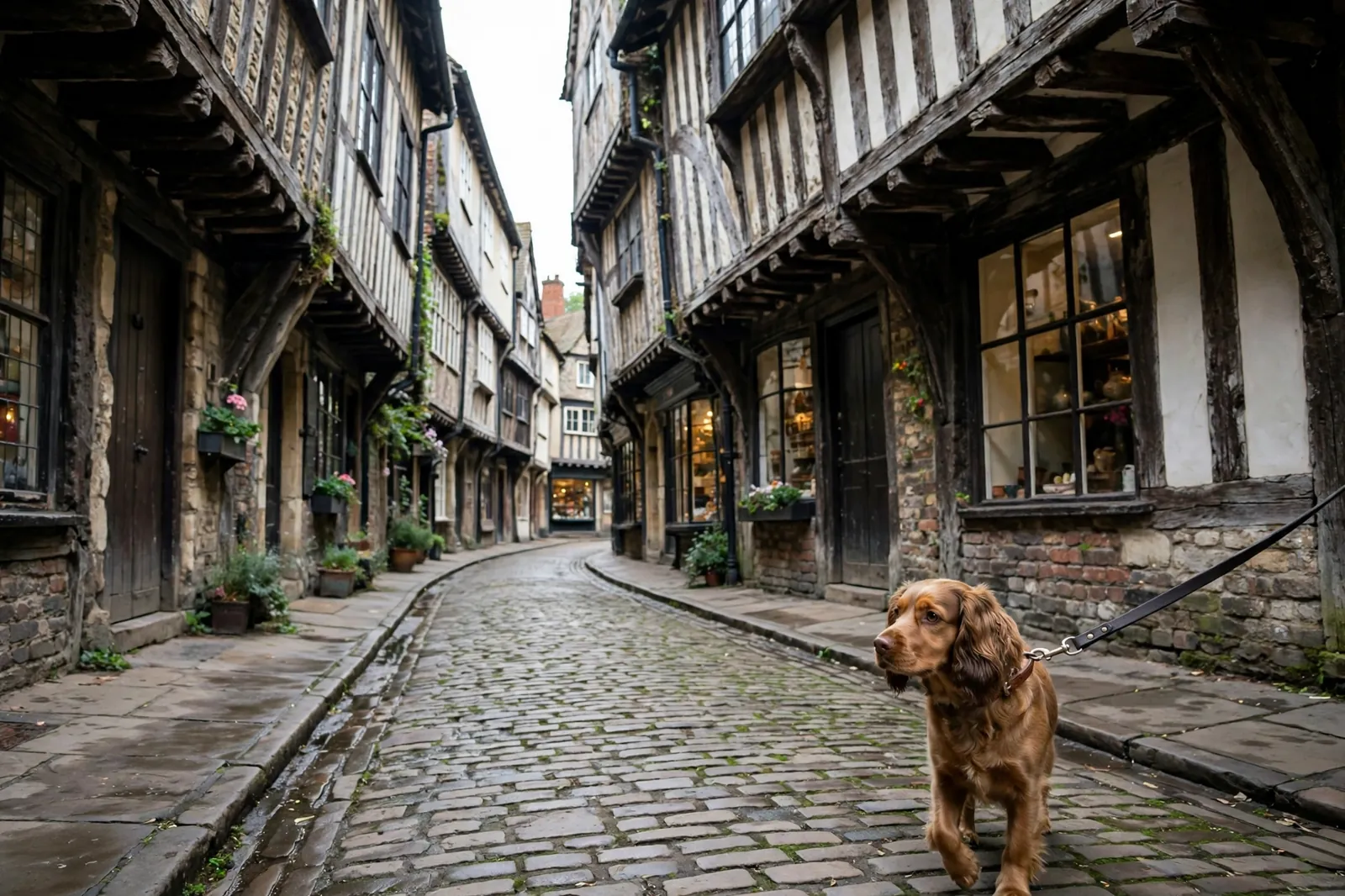
Beyond the square, the town is worth a slow wander. Broad Street runs down from the castle to the river, lined with timber-framed and Georgian buildings, and it is often described as one of the finest streets in England. King Street, Bull Ring, Old Street and Lower Corve Street carry the same mix of black-and-white fronts, small shops and narrow pavements. The pavements are narrow in places, so walk single file with the dog on the inside, away from the road, and step into a doorway to let pushchairs and other dogs pass rather than squeezing through.
St Laurence's Church stands at the top of the town beside the market, and its tower is a landmark from the river paths. Dogs are not generally taken inside churches, and Ludlow is no exception, so treat the church as a view from the square rather than a stop with the dog. The same applies to the small museums and indoor attractions in the town: check the rules for each one before you go, and plan split visits where the dog cannot go in.
Shopping with a dog in Ludlow is mostly a matter of manners and timing. Many independent shops welcome a calm dog, especially the food shops, but the decision is the shopkeeper's and the space is often small. Ask at the door, keep the dog off the displays, and do not take a wet dog into a shop full of clothes or soft furnishings. If the dog is tired after the morning, the kindest choice is to leave the shopping for another trip and head for the river.
Riverside walks along the Teme
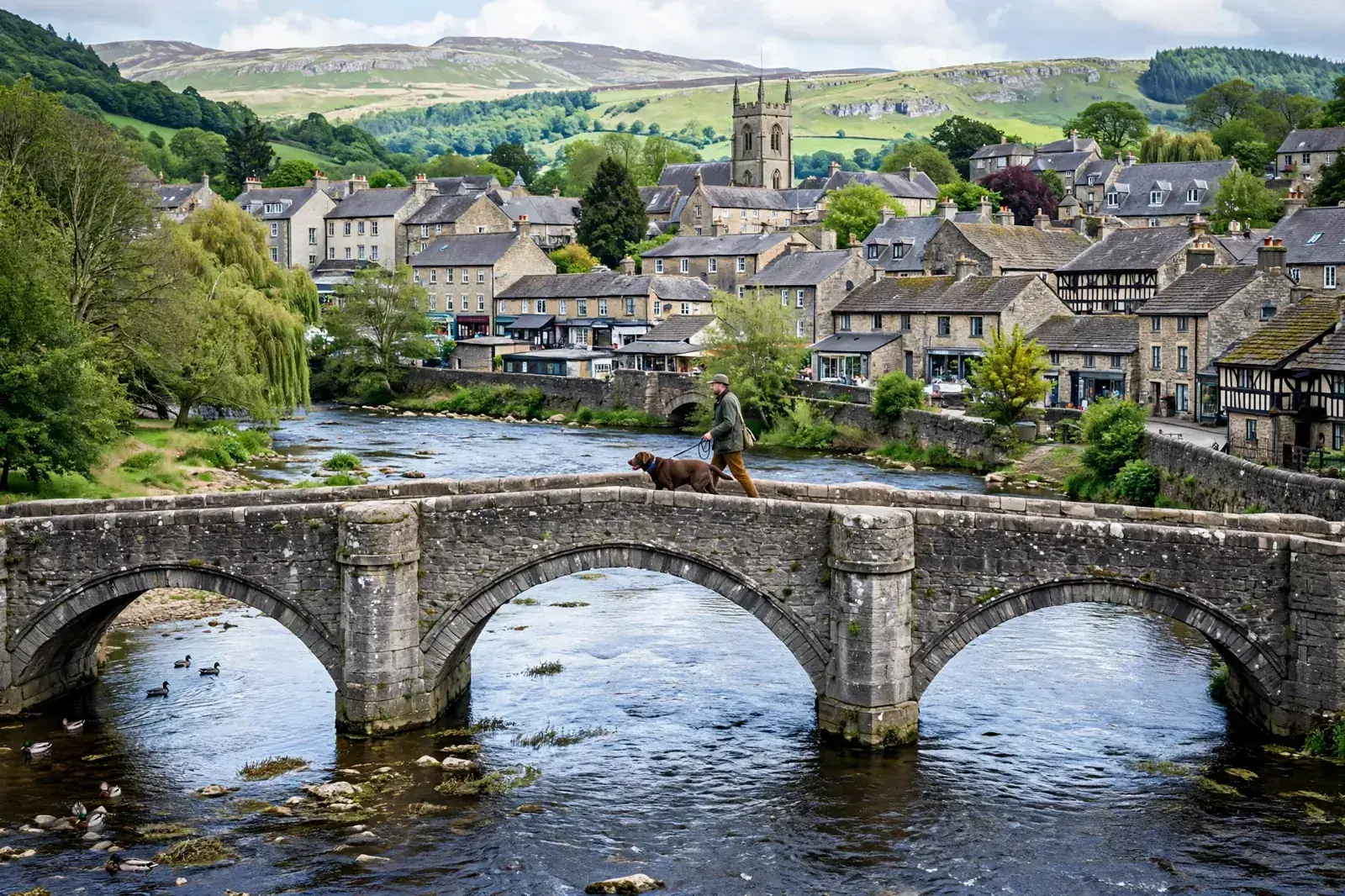
The River Teme is the best walk in Ludlow, and it starts five minutes from the market square. The classic loop begins at Dinham Bridge, the cast-iron bridge that carries the road across the river at the foot of Broad Street. Cross the bridge, turn along the river on the Bread Walk, and follow the path upstream with the castle above you on the left and the water on the right. The path is mostly flat, shaded by trees, and busy with ducks, kingfishers and the occasional heron, so it suits a slow sniffing walk as well as a brisk one.
The Bread Walk takes its name from the days when bread was carried along it, and it is still one of the most pleasant stretches of river path in the Marches. Keep the dog on a lead for the first section: the path runs close to the water, the bank is steep in places, and the weir below the bridge is dangerous for a dog that jumps in. There are a few places where a confident swimmer can paddle at the edge in summer, but check the current and the depth first, and never let a dog swim near the weir or in fast water after rain.
From the Bread Walk the route crosses to Whitcliffe Common, the open common land on the far bank. Whitcliffe is a broad, grassy hill with scattered trees, wide views back to the castle, and space for a dog to run on a long line or, where it is safe and legal, off the lead. It is also grazed at times, so keep a close eye out for livestock and put the dog back on a lead if sheep or cattle are in the field. The common is exposed to wind and rain, so it is a better walk in the morning than in a wet afternoon, and the ground can be muddy after rain.
The full loop — down Broad Street, across Dinham Bridge, along the Bread Walk, around Whitcliffe Common and back over the bridge — takes about an hour at a sniffing pace, or a little longer if you stop for the views. It is mostly flat apart from the climb back up Broad Street, which is a steady pull rather than a scramble. For a shorter outing, walk out along the Bread Walk for twenty minutes and turn back the same way; for a longer one, continue past Whitcliffe towards the hamlet of Bromfield, where the river path carries on through quieter meadows.
After heavy rain the picture changes. The Teme rises fast when rain falls in the Welsh hills upstream, and the Bread Walk and the low meadows by Dinham Bridge can go under water. If the river is high, stay on the upper paths, keep the dog on a lead, and do not try to cross flooded sections. Check the Environment Agency flood warnings on the day, and check the official guidance before you travel if you are planning a riverside walk after a wet week.
Two small details make the riverside walk easier. First, there are few bins along the river path, so carry poo bags and take them back to the bins in town rather than leaving them on a fence post. Second, the riverbank is a popular spot for picnics in summer, so keep the dog away from other people's food and watch for discarded chicken bones and barbecue remains, which are a real hazard for a scavenging dog.
Longer walks from the town
Ludlow is a good base for longer walks because two waymarked trails start or pass through the town. The Mortimer Trail runs for about 30 miles (48 kilometres) from Ludlow to Kington in Herefordshire, following the border country of the medieval Mortimer family through wooded hills, quiet lanes and open ridges. The Shropshire Way, the county's long-distance path, also passes through the town. You do not need to walk either trail end to end: both are easy to sample as a half-day out-and-back from Ludlow, which is how most dog walkers use them.
A practical half-day option is to follow the Mortimer Trail north from the town for two or three hours, then turn back along the same route. The first sections climb gently out of the Teme valley through woods and farmland, and the views open up quickly towards the Clee Hills. The paths are a mix of field edges, woodland tracks and quiet lanes, so a dog needs to be on a lead through the farmland sections and wherever livestock is present. Carry water, because there are few reliable streams on the higher ground in dry weather, and take a map or a downloaded route — phone signal is patchy on the ridges.
The Clee Hills themselves, to the east of Ludlow, offer a wilder day out. Brown Clee Hill, the highest point in Shropshire at 540 metres, and Titterstone Clee Hill, with its old quarry workings, are both within a short drive. Both are open moorland with big skies, rough grass and stone tracks, and both are exposed to wind, so they suit a fit dog in settled weather rather than a first outing for a puppy or an older dog. Keep the dog on a lead near the quarry edges and the old mine workings on Titterstone Clee, and watch for sheep on the open hill.
For a gentler long walk, the river path downstream towards Bromfield and the National Trust property at Stokesay is flatter and more sheltered. Stokesay Castle, a fortified medieval manor house south of Ludlow, sits in the same river valley, and the lanes and paths around it make a pleasant half-day loop. Check the official guidance before you travel if you plan to visit the property itself, as dog rules for the house and gardens are separate from the public paths around it.
Whatever route you choose, the same ground rules apply. Keep dogs on leads around livestock, close gates, and stay on the marked path through crops. Shropshire farmland is working land, and a dog running through a field of lambs or a newly sown crop causes real damage. Carry more water than you think you need, take a towel for a muddy dog, and plan the walk so the hardest climb comes early, while the dog is fresh.
If you enjoy this kind of town-and-trail combination, our guide to York with a dog covers a bigger city version of the same pattern — historic streets in the morning, riverside paths in the afternoon — while our Bakewell with a dog guide follows a Peak District market town with a river, a Monday market and long trails from the town centre.
Eating out with a dog
Ludlow has more good places to eat per head than most towns its size, and several of them welcome dogs. The usual pattern is that dogs are allowed in the bar area, on the terrace or in a designated dog-friendly room, while the main dining room stays dog-free. That distinction matters when you book: a table in the bar with a dog is a different experience from a table in the restaurant, and the menu may differ too. Always mention the dog when you book, ask where dogs are allowed, and check whether the rule changes at busy times.
Weekend lunches are the pinch point. Ludlow is popular with visitors from Birmingham, the West Midlands and Wales, and the best-known pubs fill up by midday on Saturdays, especially in summer and during the food festival. Book ahead, arrive on time, and settle the dog before you order. A dog that has already had a river walk and a toilet stop will lie down and sleep through lunch; a dog that has been in the car all morning will not, and the whole table will feel it.
Terraces are the easiest option in good weather. Several pubs and cafes in the centre have tables outside, and a dog on a lead under a terrace table is usually welcome without a booking. Bring a mat or a blanket for the dog to lie on, because stone and flagstone pavements are cold and hard, and ask for a water bowl when you order. In winter, the bar area is warmer but busier, so pick a quiet corner away from the door, where the dog is not in the path of everyone coming in from the cold.
Food shopping is part of the Ludlow experience, and dogs fit into it more easily than into a formal meal. The market, the delis and the bakers are all worth a visit, and a dog can wait at the door or come in if the shop allows it. Buy something the dog can share in small amounts — a piece of plain bread, a dog biscuit from a stall — and keep the rest for the picnic. A riverside picnic is one of the best meals in Ludlow: bread, cheese and something from the market, eaten on the grass by the Teme with the dog beside you.
Finally, remember that a food town is a town full of smells, and smells are hard work for a dog. A young or excitable dog may find a market morning and a pub lunch in the same day too much stimulation. If the dog is getting restless, cut the day short, take the river loop, and eat something simple. The town will still be there tomorrow.
Where to stay with a dog
Ludlow has a good range of dog-friendly places to stay for a town of its size: hotels and inns in the centre, bed and breakfasts on the edge of town, self-catering cottages in the town and the surrounding villages, and holiday parks and farm stays a short drive away. The right choice depends on the dog more than on the budget. A dog that settles quickly and sleeps through the night will be fine in a hotel room; a dog that paces, barks at corridor noises or needs a garden at midnight needs a cottage with its own outside space.
Ask the same questions wherever you book. How many dogs are allowed, and is there a charge per dog per night or per stay? Is there a size or breed condition? Can the dog be left alone in the room, and for how long? Is there a garden or a toilet area, and is it enclosed? Is the dog allowed in the breakfast room or the bar, or only in the bedroom? Get the answers in writing with the booking, because "dog-friendly" on a listing can mean anything from "dogs welcome everywhere" to "one small dog in one room, never left alone".
Centre-of-town stays have one big advantage: the river walk and the market are on foot, so the dog never needs to be left in a car. A cottage or a bed and breakfast on the edge of town may be quieter, but it means a drive for every walk and every meal. If you stay outside the town, pick somewhere with a walk from the door — a field edge, a lane or a river path — so the first and last toilet trips of the day are easy.
Self-catering cottages suit many dogs best. A cottage gives the dog a familiar routine: its own bed, its own food bowl, a door to a garden, and no strangers passing the room at night. Look for an enclosed garden, a hard floor that is easy to clean after a muddy walk, and a cottage that states its dog rules clearly rather than burying them in the small print. A cottage that welcomes two dogs is worth more than a cottage that allows one dog grudgingly.
For longer stays, a holiday park or a farm stay outside Ludlow can work well, with more space and easier parking. Our guide to dog-friendly holiday parks in the UK explains how to compare pet fees, boundaries and site layouts before you book, and the same questions apply to a park near Ludlow as to one anywhere else. Whatever you choose, confirm the dog details before you pay the deposit, and keep the confirmation with the booking.
Seasons, weather and river levels
Spring is the easiest season for a dog trip to Ludlow. The town is quieter than in summer, the market is in full swing, the river paths are drying out, and the hills are green without the heat. April and May are good months for longer walks, and the spring food festival brings extra stalls to the town without the crowds of September. Lambing season runs through the spring on the surrounding farms, so keep dogs on leads in fields and watch for ewes with lambs on the paths out of town.
Summer brings the biggest crowds and the warmest days. The September food festival is the town's flagship event, and it fills the castle grounds, the square and the streets with visitors. It is a wonderful day out for people and a hard day for a nervous dog, so plan around it: visit the festival early, keep the dog on a short lead, and take the river loop in the late afternoon when the crowds thin. On hot days, walk the river in the morning and the evening, rest in the shade at midday, and carry water for the dog at all times. The stone streets and the castle ward hold the heat, and a dog can overheat faster than its owner notices.
Autumn is many regulars' favourite season in Ludlow. The summer crowds have gone, the trees along the Teme turn colour, and the market is full of game, apples and pumpkins. October and early November are good walking months, with cool air and firm paths. The days shorten quickly, so plan the riverside loop for the middle of the day and carry a torch for the walk back to the car if you stay out late. Fireworks around early November can unsettle noise-sensitive dogs, so check whether any displays are planned near your stay.
Winter in Ludlow is quiet and atmospheric, with frost on the castle walls and mist on the river. The town is much less crowded, the pubs are warm, and the walks are short and sharp. The trade-offs are mud, short days and the river. The Teme is at its highest in winter, and the riverside paths can be closed or flooded after heavy rain. Some smaller attractions and cafes reduce their hours, so check the official guidance before you travel and do not assume a summer opening time still applies.
Whatever the season, pack for Shropshire weather rather than for the forecast. A waterproof coat for the dog, a towel, a spare lead and a torch cover most surprises. Check the river level before a riverside walk after rain, and have a town-based backup plan — the market, the shops and a pub lunch — for a day when the paths are under water.
Arriving, parking and getting around
Most visitors arrive by car, and Ludlow is easy to reach from the A49, the main road that runs through Shropshire from Shrewsbury to Hereford. The town centre is compact, but its streets are narrow and partly one-way, so it pays to park once and walk rather than driving between sights. The main long-stay car parks are on the edge of the centre, within a few minutes' walk of the market square and the castle, and there is also shorter-stay parking closer to the shops. Check the signs and the charges on arrival, as tariffs and time limits change, and check the official guidance before you travel if you need a space for a larger vehicle or a motorhome.
Arrive early if you can. On market days, and especially on Saturdays and during the food festival, the central car parks fill up by late morning, and the later you arrive the further you will walk with a dog and a bag of shopping. An early arrival also gives the dog a quiet first walk before the town gets busy, which sets the tone for the whole day. If you arrive after midday on a busy Saturday, expect to park on the edge of town and walk in along the river or through the lower streets.
Ludlow has a railway station on the Welsh Marches line between Shrewsbury and Hereford, with trains to Birmingham, Manchester and Cardiff via connections. It is a practical option for a car-free break, and the station is a short walk from the town centre. Dogs travel free on trains in the UK when they are on a lead or in a carrier, but check the operator's rules before you travel, as conditions differ between operators. A car-free trip works well in Ludlow because the town is small and the walks start from the centre, but it limits the longer walks into the hills unless you use a taxi or a bus.
Getting around the town itself is straightforward on foot. The centre is mostly level apart from the climb from the river to the castle, and the pavements are usable, if narrow in places. A dog that pulls on the lead will find the downhill stretch of Broad Street exciting, so keep the lead short and the dog on the inside, away from the road. Wheelchair and pushchair access is reasonable in the centre but uneven on the cobbles and the riverside paths, so check step-free routes in advance if that matters for your group.
One last transport note: do not leave a dog in a parked car in Ludlow, in any season. A car in the sun warms up fast even on a mild day, and a car in a quiet car park is no place for a dog while the owners spend an hour in the market. If the dog cannot come with you, change the plan so it can, or leave the dog at your accommodation.
A practical checklist for Ludlow
Before you set off, run through the basics. The dog's identification tag and microchip details should be up to date, the lead and harness should be in good repair, and the car should carry water, a bowl, poo bags, a towel and a spare lead. Ludlow has a veterinary practice in the town and others in the surrounding area, but save the number of the nearest practice and an out-of-hours emergency vet before you need it — a rural practice may be a twenty-minute drive away and may close early.
On the walk, the rules are simple. Keep the dog on a lead in the castle grounds, on the market square, on the town streets and near the weir. Use a long line on Whitcliffe Common only when there is no livestock in sight and the ground is clear. Close every gate, pick up every mess, and carry the bag to a bin in town. The riverside paths have few bins, so do not leave bags on fence posts or in hedges — take them with you.
Watch for the hazards that are specific to this landscape. The Teme is fast after rain, and a dog that swims in it can be swept towards the weir. Sheep and cattle graze the common and the surrounding fields, and a dog that chases livestock can cause serious harm and put itself in danger. Adders live on the sunny banks and dry hillsides of Shropshire in the warmer months, so keep a dog out of long grass and bracken on hot days and know the signs of a bite. Ticks are common in the woods and long grass from spring to autumn, so check the dog after every walk and carry a tick remover.
Food is the other hazard. Market days leave dropped food on the square, pub gardens leave bones and scraps under tables, and the riverbank collects picnic waste in summer. A scavenging dog can pick up cooked bones, corn cobs and chocolate in seconds, so keep the lead short in those places and teach a reliable "leave it" before the trip if you can.
Finally, build slack into the day. Ludlow is a town to linger in, not to rush through. Leave an hour unplanned between the castle and lunch, and another between lunch and the river walk. A dog that has time to sniff, rest and settle will enjoy the town far more than a dog that is marched from sight to sight, and the humans will enjoy it more too.
Practical questions
Before you go
Can dogs go into Ludlow Castle?
Yes, dogs on leads are welcome in the castle grounds and the outer ward, where you can walk the walls' base, look across the Teme valley and sit on the grass. Dogs are not allowed inside the castle buildings and the keep, so plan a split visit if your group wants to climb the tower: one person stays outside with the dog while the other goes in, then swap.
Is Ludlow a good town for a dog on a lead?
Yes. The centre is compact, the streets are mostly level, and the castle, the market square and the riverside are all within a short walk of each other, so a dog can cover the highlights without a car. Keep the lead short on market mornings and on Broad Street, where pavements are narrow and footfall is heavy, and give a reactive dog space on the castle approach.
Where can I walk my dog by the River Teme in Ludlow?
The classic loop starts at Dinham Bridge, follows the Bread Walk along the river, crosses to Whitcliffe Common and returns over the bridge. It takes about an hour at a sniffing pace and is mostly flat. Keep dogs on a lead near the weir and the road sections, and check the official guidance before you travel if the river is high after rain.
Can I take my dog to Ludlow market?
Dogs are welcome around the open-air market in Castle Square, and many stallholders keep a biscuit tin behind the counter. Go early, before the crowds build, keep the lead short, and skip the stalls selling hot food if your dog lunges at smells. The general market runs on Mondays, Wednesdays, Fridays and Saturdays, but check the official guidance before you travel, as days change around festivals.
Where can I eat with my dog in Ludlow?
Several pubs and cafes in the town centre welcome dogs, usually in the bar area, on the terrace or in a designated dog-friendly room, and some keep water bowls and treats by the door. Always ask at the door rather than assuming, because rules differ between the dining room and the bar, and a few places only take dogs at quieter times. Book ahead for weekend lunches and mention the dog when you book.
What should I do if the River Teme is in flood?
Stay off the riverside paths and the low meadows, keep your dog on a lead, and use the higher town streets instead. The Teme rises fast after heavy rain in the Welsh hills, and the Bread Walk and the fields by Dinham Bridge can go under water. Check the official guidance before you travel and the Environment Agency flood warnings on the day, and never let a dog swim in a flooded or fast-flowing river.