This guide is independent and contains no paid placement. If affiliate links are added later, they will be clearly marked and will not change our editorial checks.
Mallaig works for dogs because it is small, flat around the harbour, and built around three things dogs can actually join: the Jacobite steam train from Fort William, CalMac ferries to Skye and the Small Isles, and long sandy beaches a few minutes south. Book the train and any island ferry early, keep your dog on a lead around the working quay, and plan on two or three nights rather than a rushed stopover.
A working harbour first
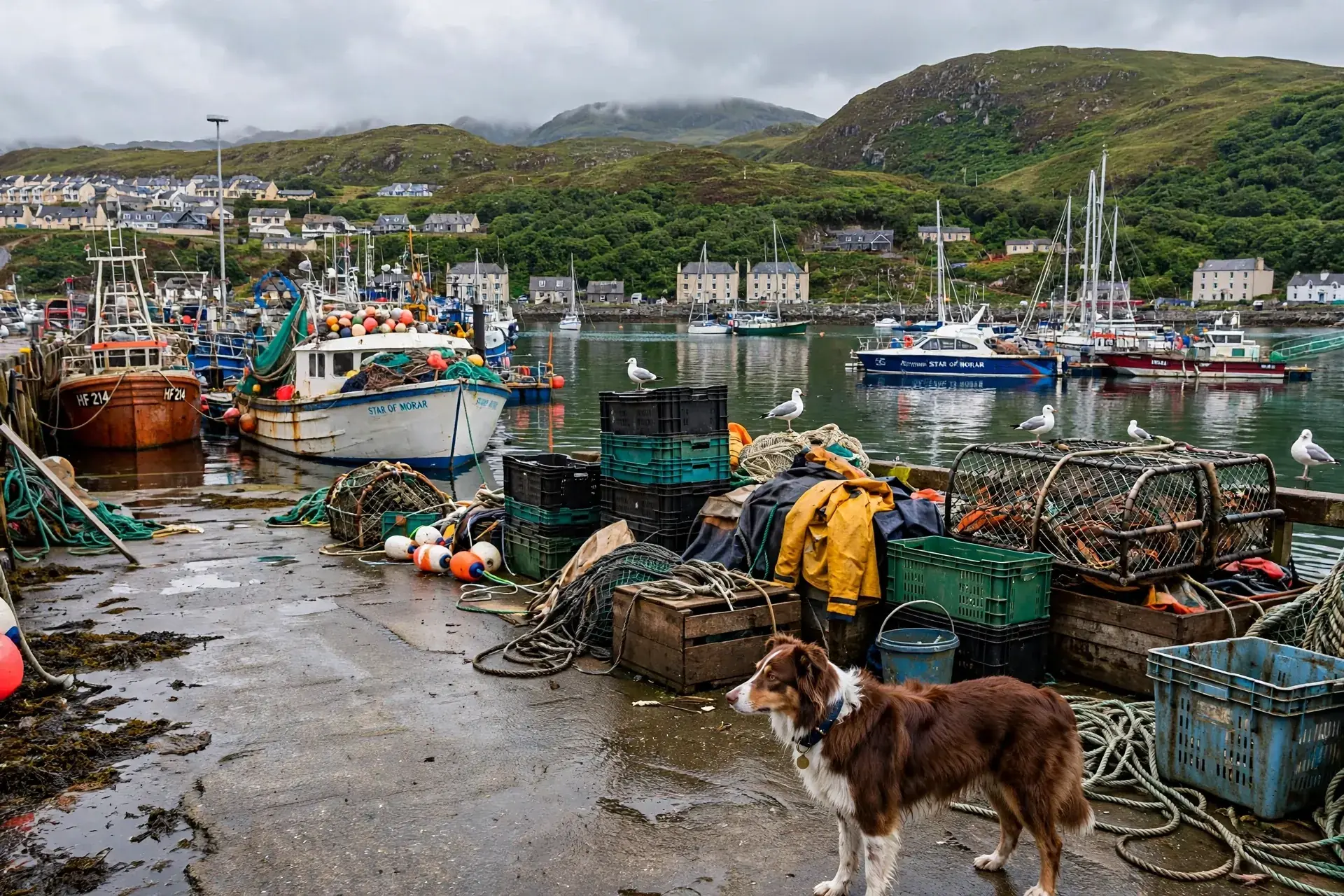
Stand on the quayside at Mallaig on a weekday morning and the first thing you notice is that this is not a seaside resort dressed up as a fishing village. It is a fishing village that happens to have visitors. Trawlers tie up alongside the pier, crates of langoustines and scallops are stacked on the concrete, gulls circle the fish market, and forklifts cross the quay with the confidence of vehicles that were here long before any tourist. The smell is salt, diesel and fresh fish. A dog on a lead fits into this scene easily — the harbour is flat, the distances are short, and nobody expects your dog to behave like a show animal — but the scene also sets the rules for the whole visit. This is a working port, not a park, and the dog that does best here is the one that can walk calmly past machinery, ignore fish crates, and settle while you wait for a boat.
That working character is exactly what makes Mallaig worth a stay rather than a drive-through. The village sits at the end of the Road to the Isles, the A830 from Fort William, on the west coast of Lochaber in the Scottish Highlands. The railway ends here too, at a small station that shares the quayside with the ferry terminal. Within a few hundred metres you can watch a trawler unload, board a steam train, and catch a ferry to an island. Very few places in Britain compress that much movement into such a small space, and for a dog owner that compression is practical gold: you can base yourself in one spot and reach a steam train, two island ferry routes, a string of sandy beaches and the start of the road to the Isles without ever loading the dog into the car for a long drive.
The village itself is compact — a population of roughly 800 people, a main street of shops, cafes and seafood shacks, a harbour, a station and a ferry terminal, all within a ten-minute walk. That scale matters more than it sounds. A dog that has spent five hours in a car or on a train does not need a forty-minute hike to the first toilet spot; it needs grass, water and a quiet corner within minutes of arrival. Mallaig delivers that. The quayside walk, the small green by the harbour, and the short path out towards the headland all work as arrival walks, and the longer coastal routes start from the edge of the village rather than from a car park miles away.
It also helps to understand what Mallaig is not. It is not a beach resort, and on a grey November Tuesday it can feel quiet to the point of empty. Shops and cafes run shorter hours outside summer, and some places close altogether in winter. That is not a reason to avoid it — winter Mallaig with a dog, when the harbour is working and the crowds are gone, is one of the calmer Highland experiences you can have — but it is a reason to check opening times before you travel rather than assuming summer hours. The village rewards the visitor who plans around its working rhythm instead of fighting it: arrive, let the dog settle, eat seafood, watch the boats, and use the place as the springboard it was built to be.
One more thing to fix in your head before you arrive: Mallaig is a gateway, and gateways have timetables. The steam train runs on a seasonal schedule, the ferries run to fixed sailings that can be disrupted by weather, and the last boat to the islands does not wait for a dog that dawdled over a scent. The sections below are organised around that reality — first the harbour, then how you get here, then the train, then the ferries, then the walks, food, stays and practical details — so that by the time you finish reading, the timetable is the thing you control rather than the thing that controls you.
Getting to Mallaig with a dog
There are three sensible ways to reach Mallaig with a dog — train, car and bus — and the train is the one this guide recommends first, because the journey is part of the trip and because dogs travel well on it. The West Highland Line runs from Glasgow Queen Street to Mallaig via Fort William, and the final stretch from Fort William to Mallaig is one of the most celebrated railway journeys in the world, crossing the Glenfinnan Viaduct and running beside lochs and through moorland that looks, from the window, like a film set. Dogs travel free on ScotRail services, which removes the usual arithmetic of pet fares, and the carriages are spacious enough for a medium or large dog to lie at your feet. Book a seat on the right-hand side heading north from Fort William if you want the best of the viaduct and loch views, and bring a blanket or mat so your dog has a defined place to settle for the two hours or so from Glasgow to Fort William and the further hour and a half on to Mallaig.
The practical details of the train journey deserve more attention than the romance. The service from Glasgow to Fort William takes around four hours, and the onward leg to Mallaig adds roughly another hour and twenty minutes, so a dog that has not travelled by rail before is facing a long day. Feed a light meal before departure rather than a full one, walk the dog properly at Glasgow or at Fort William if you change trains, and carry water and a collapsible bowl — the onboard facilities are limited and the summer carriages can get warm. If your dog is noise-sensitive, be aware that the line is single track in places, the tunnels are short but dark, and the stations are small and exposed to Highland weather. A dog that settles on trains will love this journey; a dog that paces and whines for four hours will not, and you will know which one you have after the first hour. There is no shame in breaking the journey at Fort William for a night if the dog needs it — the town has dog-friendly accommodation and a proper walk along the loch, and an unhurried arrival in Mallaig beats a stressed one.
Driving to Mallaig means the A830, the Road to the Isles, from Fort William — roughly 40 miles of single-carriageway road that winds through Glenfinnan, past Loch Eilt and Loch Ailort, and into the village. It is a beautiful drive and a slow one: allow at least an hour and a half from Fort William, more in summer when caravans and campervans slow the route, and more again if you stop at Glenfinnan for the viaduct viewpoint. For the dog, the drive is straightforward but needs the usual care — a secure restraint or boot guard, ventilation, and a stop at Glenfinnan or Lochailort for a leg stretch and a toilet break. Parking in Mallaig is limited and the harbour area fills early on summer days, especially when the steam train is in and a ferry is about to sail. Arrive before mid-morning if you want a straightforward space near the village, and be ready to walk a few minutes from the car parks on the edge of the village. Never leave a dog in a parked car in warm weather, even briefly — the Highland sun through a windscreen is stronger than the latitude suggests, and the harbour car parks offer little shade.
Buses run along the Road to the Isles as well, connecting Mallaig with Fort William and the villages in between, and they are a workable option if you are travelling light. The catch is the dog policy: bus operators set their own rules, and a policy that allows a small dog on a lap is not the same as one that welcomes a large dog on the floor. Check the operator's dog policy before you travel, and have a backup plan — usually the train — if the answer is no. Coaches and tour buses are a different matter again and generally do not take dogs, so if you are joining an organised day trip from Fort William, assume the dog stays behind unless the operator says otherwise in writing.
Whichever way you arrive, build the first hour in Mallaig around the dog, not the itinerary. Get to your accommodation, find the nearest toilet spot, offer water, and take a short flat walk along the quayside before you do anything else. The harbour walk is ideal for this: it is level, it is interesting enough to hold a dog's attention without overstimulating it, and it lets you read the village — where the ferry terminal is, where the station is, where the seafood shacks are — while the dog reads the smells. Only after that first walk should you start thinking about timetables.
The Jacobite steam train with a dog
The Jacobite is the reason many people come to Mallaig at all, and it is worth understanding what it is before you book. It is a steam-hauled passenger service that runs between Fort William and Mallaig in the summer season, over the same West Highland Line that the regular ScotRail service uses, and it is famous for two things: the Glenfinnan Viaduct, which film audiences know from the Harry Potter films, and the sheer theatre of a steam locomotive working hard through Highland scenery. The journey takes about two hours each way, with a stop of around an hour and a half in Mallaig before the return leg. That stop is your window: enough time for a harbour walk, a seafood lunch and a look around the village, but not enough to be casual about it if your dog needs a slow settle.
Dogs are generally welcome on the Jacobite, usually in the standard-class carriages, but the exact rules can change between seasons and the number of dogs per train may be limited, so check the official guidance before you travel and tell the operator when you book that you are bringing a dog. Book early in any case — the service is popular and the summer dates sell out weeks ahead, especially the morning departure from Fort William. If you are staying in Mallaig rather than doing the round trip from Fort William, you have a useful alternative: ride the Jacobite one way from Mallaig to Fort William in the morning and come back on the regular ScotRail service, or vice versa. That gives you the steam experience without the pressure of the short Mallaig turnaround, and it lets the dog travel on a quieter ordinary train for one leg of the journey.
Whether your dog will enjoy the Jacobite is a separate question from whether dogs are allowed, and it deserves an honest answer. A steam train is loud, it vibrates, it smells of coal smoke, and the carriages are full of excited people leaning out of windows with cameras. A confident, noise-tolerant dog that settles on trains will take it in its stride and may even enjoy the attention. A nervous dog, a dog that is frightened by loud noises, or a puppy on its first rail journey will find it a lot, and the two-hour duration means there is no easy exit if it goes badly — the train does not stop between Fort William and Mallaig except at Glenfinnan. If you are unsure, try a short journey on an ordinary train first, or ride the regular ScotRail service over the same route instead: you get the same viaduct, the same lochs and the same scenery, on a quieter train, at a lower price, with the freedom to get off at Glenfinnan and walk back.
If you do take the Jacobite, pack for it like a long train journey with a dog. Bring a mat or blanket so the dog has a defined space, a chew or a long-lasting treat for the stretches between the exciting bits, water and a bowl, and poo bags for the Mallaig stop. Keep the dog on a lead at all times on the platform and at the station — steam, crowds and a working railway are not the place for an off-lead dog. At Glenfinnan, if the train pauses, keep the dog inside or on a short lead on the platform; the viaduct viewpoint is a short walk from the station and is best visited separately, on foot, on a day when you are not tied to a timetable. And when you arrive in Mallaig, resist the urge to rush straight to the seafood shacks: give the dog ten minutes on the quayside first, let it stretch and empty, and then enjoy your lunch with a settled dog rather than a restless one.
Ferries to Skye and the Small Isles
Mallaig's ferry terminal is the village's other great asset, and it is the reason a dog-friendly stay here can stretch into a proper island-hopping holiday. CalMac operates the services, and from Mallaig you can sail to three distinct destinations: Armadale on the Isle of Skye, Lochboisdale on South Uist, and the Small Isles of Rum, Eigg, Muck and Canna. Each route has a different character, a different crossing time and a different dog arrangement, so it is worth understanding them separately rather than treating "the ferry" as a single thing. Check the official guidance before you travel for current timetables, fares and dog rules, because sailing times change with the season and weather can disrupt services at short notice.
The Mallaig to Armadale crossing is the shortest and most popular, taking around thirty minutes to the south of Skye. It is the natural way to combine a Mallaig stay with Skye: sail across in the morning, spend the day on the island, and sail back in the evening, or continue over the Skye Bridge at the end of a longer trip. For dogs, the short crossing is a kindness — thirty minutes is manageable for almost any dog, and the vessel has outside deck space where a dog on a lead can stand in the wind and watch the water. Foot passengers with dogs generally stay on the outer decks, while dogs travelling in vehicles usually remain in the car for the crossing. Book the car in advance in summer, because the Armadale service is busy and vehicle spaces sell out; foot-passenger tickets are more flexible but still worth booking ahead on a fine day. Our guide to the Isle of Skye with a dog covers what to do once you land, from the single-track roads to the lead rules at the Storr and the Fairy Pools, and it is the natural companion to this section.
The Small Isles sailings are the more adventurous option, and they reward the dog owner who is prepared to plan. The ferry calls at Rum, Eigg, Muck and Canna on a rotating schedule, and the crossing times are longer — from around an hour to Eigg to several hours for the full round trip, depending on the day's route. These are small islands with small populations, limited facilities and, on some of them, no cars at all beyond a handful of island vehicles. That is precisely the appeal for a dog: quiet beaches, open moorland, and walks where the main hazard is a curious sheep rather than traffic. The practicalities matter more here than on the Skye crossing. Bring everything the dog needs for the day — water, food, a bowl, poo bags, a lead and a towel — because there may be no shop when you land, and check the return sailing time before you wander off, because missing the boat on a small island means an unplanned overnight. Some islanders keep livestock, so keep the dog on a lead near sheep and follow any local signs. If you are unsure which island suits your dog, Eigg is a good first choice: it has a mix of beach, hill and village, and the walking is varied without being punishing.
The Lochboisdale service, to South Uist in the Outer Hebrides, is the longest crossing from Mallaig, at around three and a half hours, and it suits a longer trip rather than a day out. It is worth knowing about because it turns Mallaig into a genuine Hebridean gateway: from Lochboisdale you can drive north through the Uists and on to Harris and Lewis, with their vast dog-friendly beaches. For the dog, a three-and-a-half-hour crossing needs planning — confirm where the dog will spend the crossing, whether there is a pet area or outside deck access, and whether you can visit the car during the sailing. On longer CalMac routes the arrangements vary by vessel, so do not assume the rules from the Armadale crossing apply here; check the official guidance before you travel. Our full guide to dogs on UK ferries compares operators, pet cabins, kennels and deck rules across the country and is worth reading before you book any longer sailing.
There is also a smaller, quieter ferry worth knowing about: the passenger service from Mallaig to Inverie, on the Knoydart peninsula. Knoydart is roadless — the only way in is by boat or on foot over the hills — and Inverie is home to what is often described as Britain's most remote pub. The crossing takes around thirty minutes and the village is small, walkable and dog-friendly in the practical sense that matters: open ground, a shore path, and a pub garden where a tired dog can settle. It makes an excellent half-day trip from Mallaig, and it gives your dog a genuine adventure — a boat, a remote peninsula, and a walk with no traffic — without the commitment of a full island day. As with all the ferries, check the timetable in advance, because the Inverie service is a lifeline service for residents as well as a visitor route, and its times are set around the community's needs rather than tourists' convenience.
A few general ferry rules apply across all of these routes. Keep your dog on a lead from the moment you enter the terminal until you are back on dry land; terminals are busy with vehicles, and a loose dog near a loading ramp is a danger to itself and to others. Bring a blanket or mat if the dog will be on deck, because steel decks are cold and slippery even on a warm day. Carry water, because fresh water is not always available on the outer decks. And have a plan for seasickness: most dogs are fine on the short Armadale crossing, but a dog that has never been on a boat may be unsettled on a longer sailing in rough weather, so feed lightly before departure and keep the dog in fresh air on deck rather than below. If the weather turns and a sailing is cancelled, do not take it personally — the west coast of Scotland cancels ferries for good reasons, and the village has enough to fill a day without a boat.
Walks around the harbour and the sands
The best walking around Mallaig splits into two kinds: the short, flat harbour and village walks that suit arrival days and older dogs, and the bigger coastal and beach walks a few miles south that justify a longer stay. Both are worth doing, and the mistake is to treat Mallaig as a place with only one kind. Start with the harbour itself. A loop around the quayside, out past the ferry terminal and back along the main street, takes twenty to thirty minutes at a dog's pace and gives you the lay of the land: the station, the pier, the fish market, the seafood shacks and the small green where dogs can have a sniff and a stretch. Keep the dog on a lead throughout — this is a working harbour with moving vehicles, mooring ropes and fish crates, and the water's edge is unguarded in places. The harbour walk is best in the early morning, when the trawlers are coming in and the village is waking up, or in the evening, when the light on the water is at its best and the day's visitors have gone.
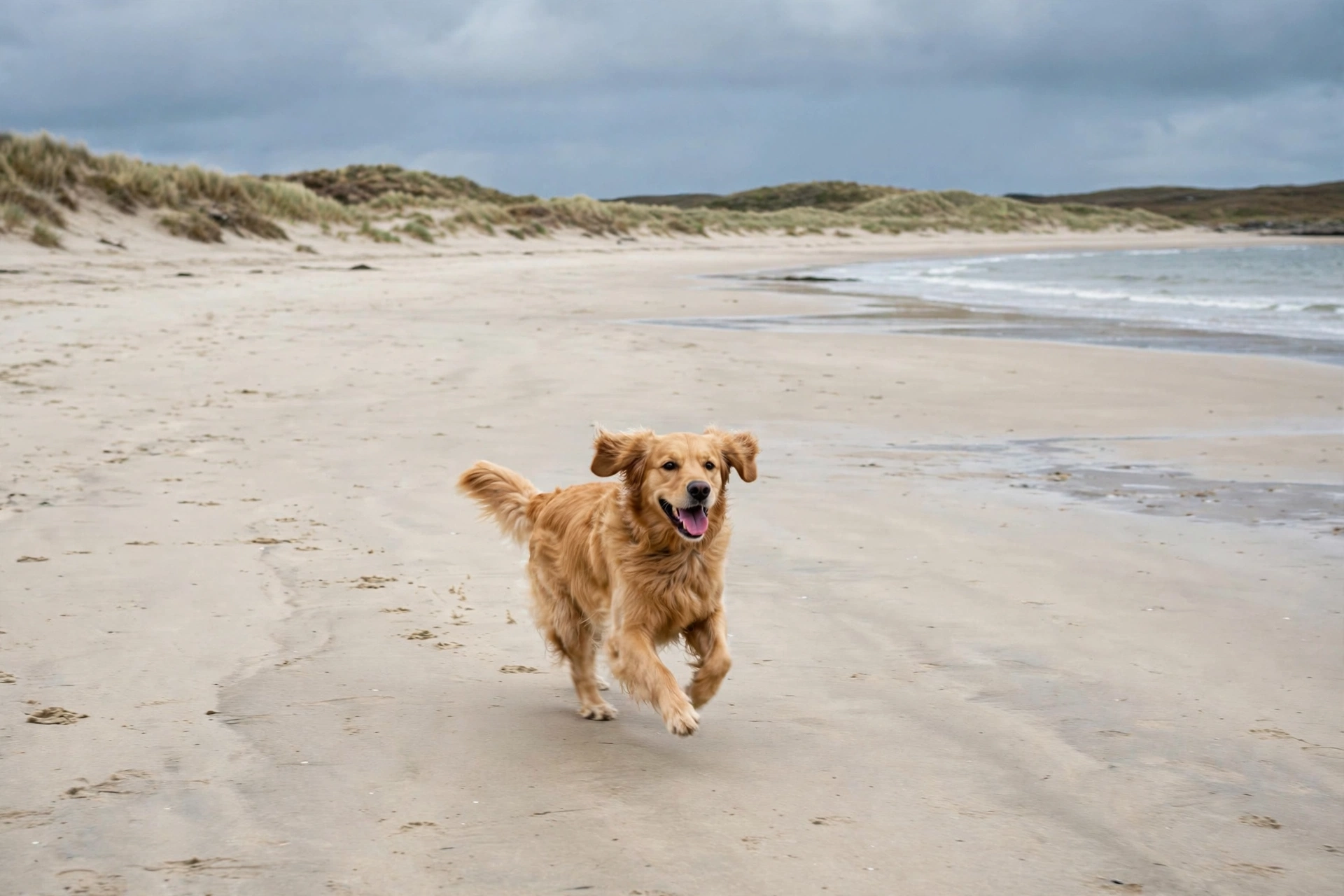
For a longer walk, head south along the coast towards Morar. The road from Mallaig to Morar is about four miles, and the coastal path and quiet lanes along it offer one of the gentlest and prettiest walks in the area. The reward at the end is the Morar sands: a string of wide, silver-white beaches — Camusdarach, the Traigh sands and the smaller coves between them — that are among the most beautiful in Scotland and, crucially for this guide, generally dog-friendly all year. Camusdarach in particular is a superb dog beach: a broad sweep of sand backed by dunes, with views across to Rum and Eigg, and room enough for a dog to run properly without bothering anyone. There are no seasonal dog bans on these beaches at the time of writing, but check the official guidance before you travel, keep the dog under control around other beach users and nesting birds, and check the tide times before you walk out onto the sands — the tide comes in fast across the flat sands at Traigh, and the channels that look shallow at low water can cut you off from the shore. Our guide to dog-friendly beaches in Scotland has the full picture on seasonal rules, tides and beach-day kit, and it is worth reading before you plan a beach day anywhere on this coast.
If you want height rather than sand, the walk up to the viewpoint above Mallaig gives you the village, the harbour and the islands laid out below, and it is a short, steep climb that suits a fit dog. The paths are rough in places and the ground can be boggy after rain, so wear proper boots and keep the dog on a lead near the road at the start. For a longer hill day, the hills around Loch Morar — Britain's deepest freshwater loch — offer remote, quiet walking, but this is serious Highland terrain: pathless in places, exposed to weather, and a long way from help. Only attempt it with a fit dog, proper navigation, and a realistic turnaround time, and never let a dog off lead near the loch's steep banks. A simpler and very rewarding option is the walk along the shore of Loch Morar from Morar village: flat, sheltered, and full of the kind of scents that keep a dog happily occupied for an hour.
Whatever walk you choose, the Highland basics apply. Carry water for the dog — burns and streams look tempting but are not always safe to drink from, especially near farmland. Watch for sheep and keep the dog on a lead whenever livestock are in sight; the law and the local farmers agree on this, and a dog chasing sheep can be shot. Midges are a real factor from late spring to early autumn, particularly in the evening and in still, damp air — they bother dogs less than people, but they will drive you indoors, so pack repellent and plan the longer walks for the middle of the day or a breezy spell. And carry poo bags everywhere, including on the beaches and the hill paths: the west coast is beautiful precisely because people look after it, and a bag left behind on a remote beach is worse than one left on a city pavement.
Eating seafood with a dog
Mallaig is a fishing port, so the food worth eating here comes out of the water and, very often, out of a shack on the harbour. The village's seafood shacks and takeaways are the most dog-friendly eating in Mallaig, for the simple reason that you eat outside, with a view of the boats, and the dog sits beside you on the quayside. Langoustines, scallops, smoked salmon and fish and chips are the staples, and the quality is high because the boats land the catch a few metres from the kitchen. A takeaway eaten on the harbour wall, with the dog settled on a mat at your feet, is not a compromise — it is the best version of eating in Mallaig, and it is the one this guide recommends first.
The cafes and restaurants along the main street are more mixed. Several welcome dogs, most reliably on outdoor terraces and in the more informal spots, and some allow dogs indoors, but policies vary from place to place and can change with the season or with a change of management. The rule is to ask before you sit down, not after: a quick "is it all right if the dog comes in?" at the door saves an awkward moment at the table. Bring a settle mat and a chew so the dog has something to do while you eat, and choose a table at the edge of the room or on the terrace where the dog is out of the main flow of people and food. If the dog is restless, take the food away rather than trying to force a long sit — a takeaway eaten well beats a restaurant meal endured badly, for everyone including the dog.
A few practical points about eating with a dog in a fishing village. First, fish: dogs love the smell of fish, and a harbour full of it is a powerful distraction. Keep the dog on a lead near the fish market and the shacks, and do not let it scavenge from crates or bins — fish bones, hooks and discarded bait are all hazards, and a dog that has eaten something sharp from a harbour bin is a vet visit waiting to happen. Second, the gulls: Mallaig's gulls are bold, experienced and entirely unafraid of dogs. They will snatch food from a table or from a hand, so keep food covered and do not leave a plate unattended, even for a moment. Third, the weather: the terrace that is perfect at noon can be miserable by three o'clock when the wind gets up, so have a takeaway fallback in mind and a dry place to eat it. Finally, the shops: Mallaig has a small supermarket and a handful of food shops where you can buy supplies for self-catering, which is often the simplest option for a multi-night stay with a dog — cook in, eat out once a day, and keep the dog's routine steady.
Where to stay with a dog
Mallaig has a good range of dog-friendly places to stay for a village of its size, and the choice comes down to how much independence you want. The bed and breakfasts and small hotels along the main street and above the harbour are convenient — you are steps from the station, the ferry terminal and the seafood shacks — but they vary in how they handle dogs: some welcome dogs in selected rooms only, some charge a small nightly pet fee, and some ask that dogs are not left alone in the room. Ask the specific questions before you book: which rooms take dogs, what the fee is, whether the dog can be left alone briefly, and where the nearest toilet spot is. A room with a ground-floor entrance and a door straight onto the street is worth more than a sea view when you have a dog that needs out at midnight.
Self-catering cottages and flats are the other main option, and for a stay of two or three nights they are often the better one. A cottage gives you a kitchen, a garden or yard, and the freedom to come and go on the dog's schedule rather than a hotel's. Look for an enclosed garden or a secure yard — it makes the first and last outings of the day easy and gives the dog somewhere safe to be while you unpack. Check the pet fee and the cleaning terms in advance, and read the house rules about dogs on furniture and in bedrooms; a cottage that allows dogs is not the same as a cottage that allows dogs on the sofa, and the difference matters if your dog sleeps on the bed at home. Book early for summer weekends and for the weeks when the Jacobite is running at its busiest, because the dog-friendly places are the ones that fill first.
There are also hostels and bunkhouses in and around Mallaig, which can work well for walkers with a well-behaved dog, and campsites and campervan pitches for those travelling that way. The campsite option deserves a note: the ground around Mallaig is often wet, the midges are real in summer, and a dog in a tent needs the same care as a dog anywhere else — a dry bed, water, and a lead at night. Whatever you choose, confirm the dog policy in writing before you pay a deposit, and keep that confirmation with your booking. "Dog-friendly" on a listing site is a filter, not a contract, and the details — how many dogs, what size, what fee, which rooms — are what decide whether the stay works.
Practicalities: weather, midges and vets
The weather is the single biggest practical factor in a Mallaig trip with a dog, and it deserves a section of its own. The west coast of Scotland is wet, windy and changeable, and Mallaig is no exception: four seasons in a day is not an exaggeration here, and the rain can arrive horizontally off the sea with very little warning. Pack for the dog as well as for yourself. A waterproof dog coat is worth its weight for a short-coated dog or an older one, and a drying coat or a couple of microfibre towels will save your accommodation from the smell of wet dog. Bring a spare lead and a spare towel in the car or the day pack, because the first set will be soaked by lunchtime on a wet day. And plan your days with the weather in mind rather than against it: do the beach walk in the morning's dry spell, eat indoors when the rain sets in, and treat a wet afternoon as a reason to ride the train or visit the heritage centre rather than a ruined day.
Midges deserve a straight answer. From late May to September, and worst in June, July and August, the Highland midge is a genuine nuisance in still, damp, windless conditions, especially at dawn and dusk and near standing water and bracken. They bother people far more than dogs — a dog's coat protects it, and dogs do not seem to react to midge bites the way people do — but they will drive you indoors, which affects the dog's walks. The practical advice is simple: walk in the middle of the day or when there is a breeze, avoid still, sheltered spots at dusk, and carry a reputable midge repellent for yourself. The ferry decks and the open beaches are usually midge-free because of the wind, which is one more reason to plan your days around the sea rather than the glens. Ticks are also present in the bracken and long grass of the Highlands, so check your dog after walks, especially around the ears, armpits and groin, and remove any ticks promptly with a tick remover.
Vets and emergencies are the kind of thing you hope never to need and regret not knowing. The nearest veterinary practices are in Fort William, around 40 miles away, so before you travel, save the number of a Fort William vet and note their opening hours, and check whether there is an out-of-hours service that covers the Mallaig area. Mallaig has a small community hospital, but it is for people, not dogs, and it is not a substitute for a vet. Carry a basic dog first-aid kit — saline for eyes, a bandage, tick remover, and any regular medication with a day or two to spare — and know your dog's microchip number and your own vet's phone number. If your dog eats something from the harbour, swallows a fish hook, or cuts a paw on broken glass or a shell, the drive to Fort William is an hour and a half, so do not wait to see if it gets better: call the vet first and drive while you talk.
A few last practical notes. Mobile signal in and around Mallaig is variable — usable in the village, patchy on the roads and beaches — so download offline maps and save your ferry and train times before you leave the village. Cash is useful: some of the smaller shacks and island shops are card-only these days, but others still prefer cash, and a card machine that cannot get a signal is a real thing on the islands. The village has a post office, a small supermarket and a fuel station, but the nearest large supermarket is in Fort William, so stock up there if you are self-catering for several days. And finally, the rubbish: Mallaig is a small community with limited facilities, so take your dog's waste home or use the bins provided, and never leave a poo bag on a beach, a path or a wall. The village looks after its harbour, and visitors are expected to do the same.
A two-day Mallaig plan with a dog
Day one is the arrival and the harbour. If you come by train, you will arrive in the early afternoon; if you drive, aim to be in the village by mid-morning. Settle into your accommodation, take the short harbour loop, and then spend the rest of the day slowly: watch the boats, visit the heritage centre if it is open, and eat seafood on the quayside. If the weather is kind, walk out along the coast towards the headland for the evening light. The point of day one is not to cover ground but to let the dog learn the village — the smells, the sounds, the route to the toilet spot — so that day two starts with a confident dog rather than an anxious one. A tired, settled dog sleeps well; a dog that has been rushed from train to ferry to beach does not.
Day two is the big day, and you have two good options. Option one is the Jacobite: catch the morning steam train from Mallaig to Fort William, spend a couple of hours in Fort William with a walk along the loch, and come back on the regular service in the afternoon. Option two is the ferry: take the morning sailing to Armadale, spend the day on Skye — a walk at the southern end of the island, a look at the harbour at Armadale, a quiet beach — and sail back in the evening. Either way, book the transport in advance, pack the day bag the night before, and build in a margin: if the train is delayed or the ferry is cancelled, you want the afternoon free to fall back on the Morar sands rather than a missed connection ruining the day. The Morar beaches are the perfect fallback and the perfect finale: an hour on Camusdarach at low tide, the dog running on an empty beach with the Small Isles on the horizon, is the memory you will take home from Mallaig.
If you have a third day, use it for the Small Isles or Knoydart. A day trip to Eigg gives you a proper island walk and a beach, and the Inverie ferry gives you a remote peninsula and a pub garden, and both are the kind of trip that makes a Mallaig stay feel like an adventure rather than a stopover. On the third day, let the dog set the pace: a slow morning, a long beach walk, a late lunch, and a last look at the harbour before the train home. Mallaig rewards the visitor who stays long enough to see it working — the boats coming in, the train pulling out, the ferry crossing to the islands — and a dog that has had three days to learn the village will be sorry to leave it.
Planning onward from Mallaig? The island is the obvious next step — our Isle of Skye guide covers roads, walks and stays once you land at Armadale, and our ferry guide explains the dog rules for every crossing in more detail.
Practical questions
Before you go
Can dogs travel on the Jacobite steam train?
Yes, dogs are generally welcome on the Jacobite steam train, usually in the standard-class carriages, but numbers may be limited and rules can change between seasons. Book early, tell the operator you are bringing a dog, and check the official guidance before you travel, because a summer steam service is a busy, noisy environment and not every dog will enjoy it.
Can dogs go on the CalMac ferries from Mallaig?
Yes. Dogs are allowed on CalMac services from Mallaig, but where they travel depends on the vessel: some routes keep dogs in the car, some have a designated pet area or outside deck space, and foot passengers usually keep dogs on a lead on the outer decks. Check the official guidance before you travel, because arrangements differ between the Armadale, Lochboisdale and Small Isles sailings.
Are dogs allowed on the beaches near Mallaig?
Yes, the wide sandy beaches south of Mallaig around Morar, including Camusdarach and the Traigh sands, are generally dog-friendly all year, with no seasonal bans in place at the time of writing. Keep your dog under control around livestock and nesting birds, check tide times before you walk out onto the sands, and check the official guidance before you travel.
Where can I eat in Mallaig with a dog?
Several places in Mallaig welcome dogs, most reliably on outdoor terraces and in the harbour-side takeaway spots where you can eat with a view of the boats. Indoor dog policies vary from place to place and can change with the season, so ask before you sit down, bring a settle mat, and treat the seafood shacks by the pier as your most reliable option.
How do I get to Mallaig with a dog if I do not drive?
Take the train: the West Highland Line runs from Glasgow Queen Street to Mallaig via Fort William, and dogs travel free on ScotRail services. The journey is one of the most scenic in Britain, passing the Glenfinnan Viaduct. Buses also run along the Road to the Isles, but check the operator's dog policy before you travel, as it can differ from the train.
Is Mallaig a good base for a dog-friendly holiday, or just a stopover?
Both, but it works best as a two- or three-night base. A single night gives you the harbour, the steam train and a beach walk; a longer stay lets you add a day trip to Skye or one of the Small Isles, the Morar sands and the quieter walks around Loch Morar without rushing the dog.