This guide was put together independently, without payment from any business named in it. Should affiliate links be introduced at a later date, they will be labelled clearly, and they will not alter the checks behind the advice given here.
Mevagissey earns its living from the sea, and that working character shapes a visit with a dog: lead-on wandering around two harbour basins and steep fishermens lanes, cliff walking east toward Gorran Haven, a wooded valley route west to the sands at Pentewan, and supper from the morning catch. The tide decides how the harbour looks, the lanes climb sharply, summer crowds pack the quays, and the smaller beaches follow seasonal rules, so timing matters as much as route choice.
Begin at the working harbour
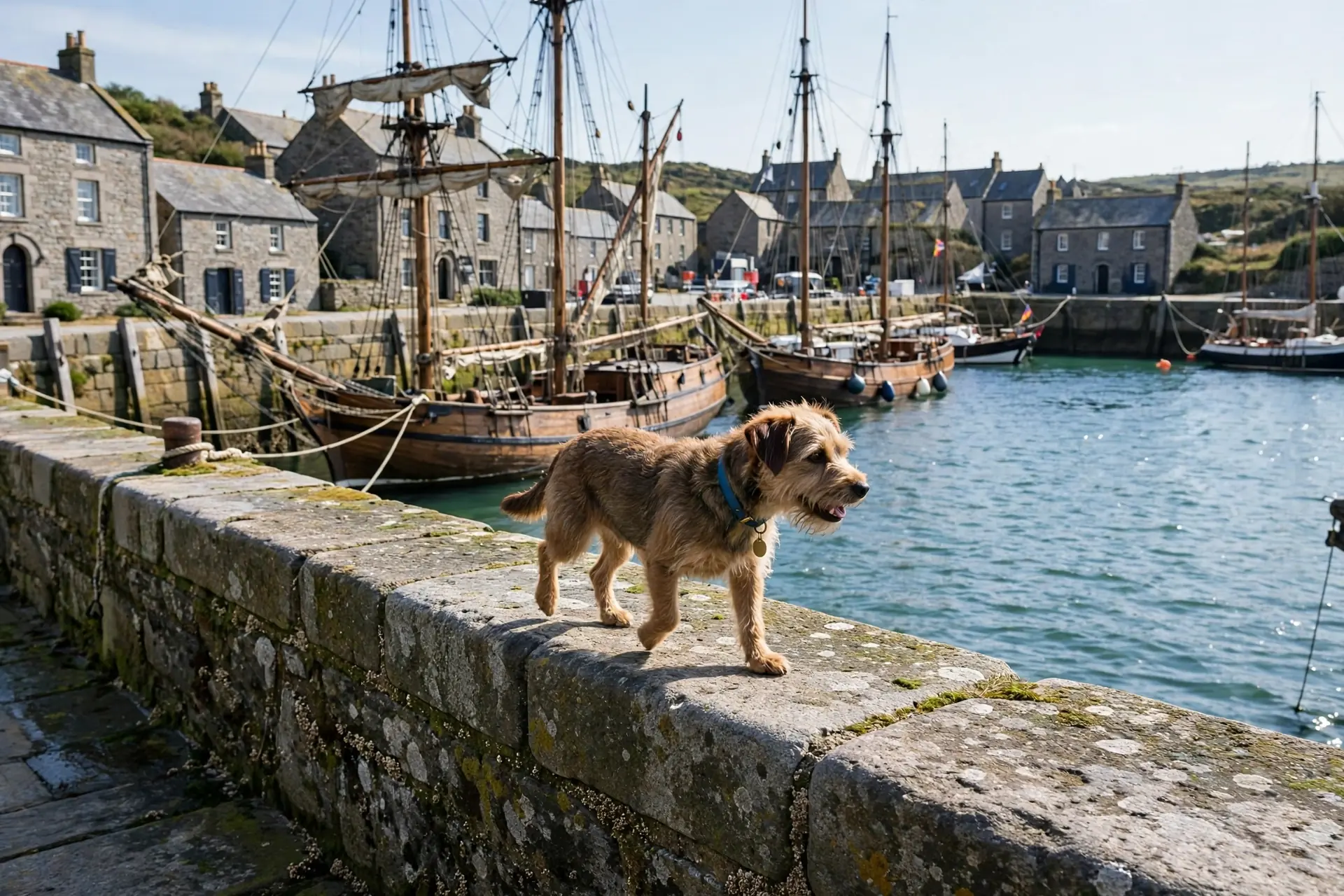
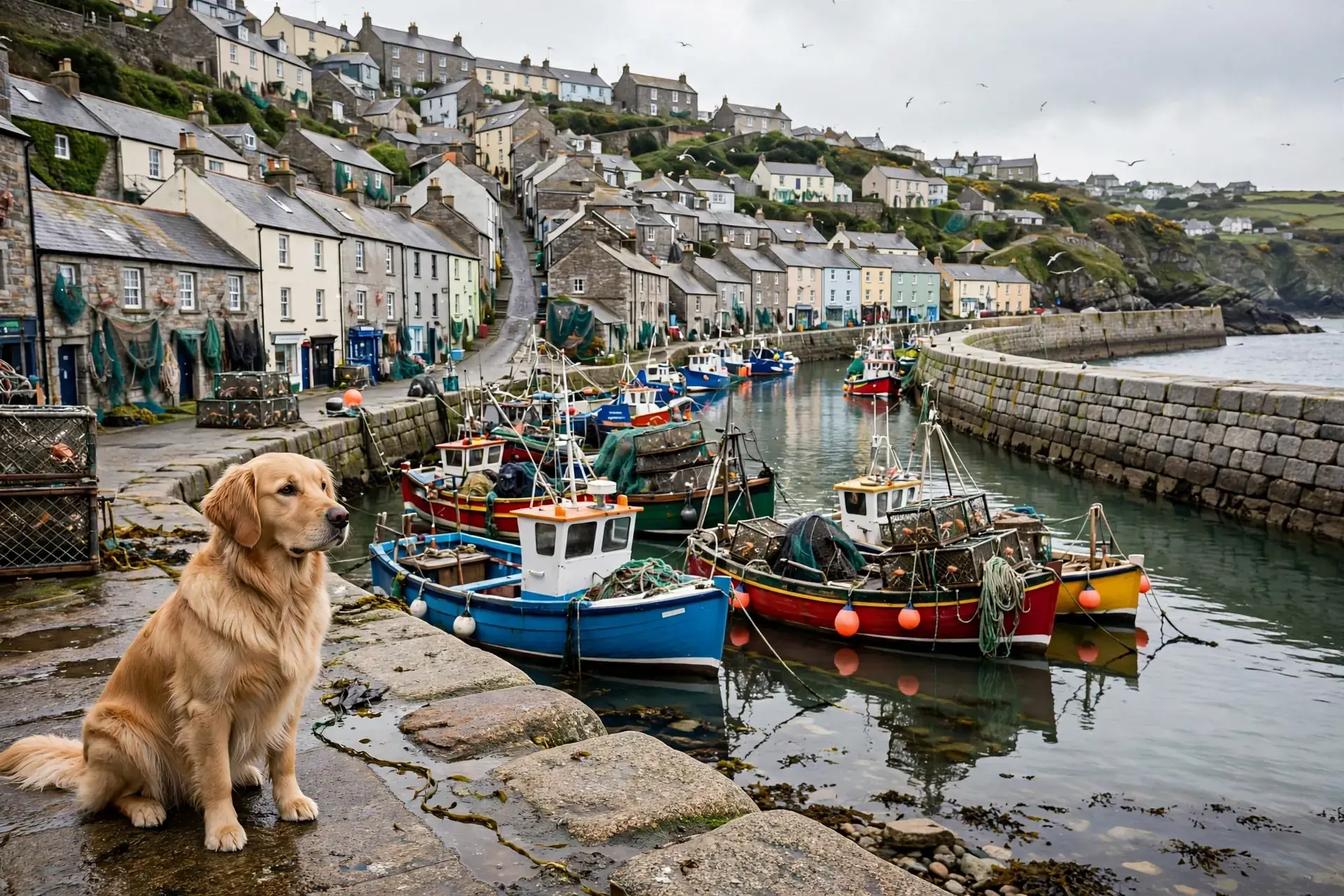
Arrive expecting a workplace rather than a stage set, and Mevagissey makes immediate sense. Crates of shellfish and day-boat fish come ashore on the quay, crews mend nets in the open, gulls circle the moored boats, and the air carries salt, diesel and fresh catch in the same breath. A dog meets that harbour first through its nose: weed on wet stone, rope, fish scales, bait buckets, and the churned scent of a quay that has been hosed down after landing. The trade-off is that holiday freedom gives way to harbour discipline. Hold a short line, steer clear of lifting gear and moving vans, and treat every quiet stretch of stone as somewhere a boat or a forklift may need within minutes.
Morning suits the harbour best, when landing is under way. Two basins sit behind stone piers: the inner basin, where smaller craft tie up close enough for a watcher to see sorting and stacking, and the outer basin, opening toward the sea and the long breakwater. A slow loop past both takes around twenty minutes without stopping, and nearer an hour once benches, boats and the view across the bay toward the Dodman have had their due. At high water the boats ride level with the quay; at low water they rest on the bottom and the whole place turns into a yard of mud, weed and exposed stone. Either state repays a pause, and the change between them is the villages cheapest spectacle.
From the quay, lanes climb in steps and sharp slopes between fishermens cottages, small shops, galleries and eating places. An older dog will feel those gradients in its legs, and a visitor pushing a pram will feel them too, so plot a route that climbs once rather than doubling back up the steepest pitch. The centre is compact enough to cover in about an hour at a lead-on stroll, yet the lanes narrow to the point where cars pass with difficulty, and delivery vans still thread through them. Keep to the wall side, watch blind corners, and favour early morning or evening in high summer, when day visitors thin out and the lanes return to residents, fishermen and their dogs.
The reason Mevagissey feels unlike the glossier villages further along this coast is that fishing still pays the bills here. Boats go out, catch comes in, and people live above the shops they work in, so dogs belong to the ordinary street scene: waiting outside a cafe, trotting beside a crew member, dozing by a doorway while owners discuss the landing. That lived-in quality brings rough edges with it, and the rough edges are the attraction. Wet stone, stacked fish boxes, gulls overhead and the low-tide smell of the harbour are not flaws to be tidied away; they are the village itself, and a dog tends to grasp that before its owner does.
Ropes coiled on the stone, chains, and squat iron bollards all sit at nose height for most dogs, while harbour walls drop straight into deep water and wet slabs turn treacherous underfoot. A short line and a wide gap from the edge handle most of that risk. Quay puddles are not drinking water: they can carry fuel, fish waste and cleaning chemicals, so steer a thirsty dog toward a bowl you brought. A strong swimmer must not be allowed to jump in here either. Between moored boats, high walls and shifting craft, hauling a soaked animal back onto the quay is far harder than it looks from above, and the beaches further down this guide are the right place for a swim.
Tides, boats and the harbour routine
Tide governs almost everything in Mevagissey, including what a visitor actually sees. Full water fills both basins, sets boats afloat beside the quay, and laps the stone in a way that makes the village feel afloat. Ebb leaves craft settled on the harbour floor, exposes weed and mud, and turns the quays into a working yard. Look up the tide table the night before, because it fixes the look of the harbour, the hours when boats move, and whether the little patch of sand and shingle at the foot of the village is beach or bare stone. Seeing both states in one day is easy here, and the contrast explains more about the place than any information board.
Landings happen early, and early is the kindest hour for a dog. Shellfish and day-boat fish come ashore in crates, buyers gather on the open quay, and the lanes are still empty enough for a dog to settle and watch without being jostled. Give the working areas a wide berth, and steer a curious nose away from fish boxes and bait, where hooks and sharp shells hide. Gulls work the harbour all day, and a dog that lunges at them will draw a sharp word from a crew member, so a short line and a close heel matter more here than on an open beach. Once the morning landing is done, the quays quieten, and the village shifts toward shops, cafes and walkers.
Seasonal boat trips leave from the harbour, and most scheduled passenger cruises do not take dogs, so treat a trip as a humans-only outing unless the operator states otherwise on its own current information. A practical split works best: one person sails while the other walks the dog along the quays or up the first stretch of coast path, then meet back at the harbour for food. Short bay cruises and longer fishing trips both operate in season, with times that follow weather and demand, so confirm the current position on the operators own pages before setting out rather than relying on a timetable printed months earlier. The coast paths start almost from the quay, which makes a harbour morning and a cliff afternoon easy to join together.
History is written into the harbour stone and the buildings behind it. Mevagissey grew from a small medieval fishing settlement into one of Cornwalls important ports, built on pilchards, and the thick-walled warehouses, narrow lanes and wide doorways built for barrels still show that trade. The pilchard fishery faded, the fleet shrank and specialised, and the harbour adapted rather than closing. A visitor who reads the boards around the quay and glances at old photographs in the museum, when it is open, will spot the shift: craft that once chased shoals now work pots and day lines. A dog cares nothing for that story, but an owner who knows a little of it will read the quays differently, and will understand why local people guard the working harbour so closely.
Wind deserves the same checking as tide. A still morning among the cottages can become a stiff breeze on the exposed cliff tops, and summer sea mist can roll in during an afternoon and drop the temperature sharply. Glance at the harbourmasters board and a coastal forecast before choosing a route, and treat rough-sea days with extra respect near cliff edges. Small and short-coated dogs feel that wind first: a hound comfortable in the sheltered lanes may shiver on a headland, so carry a coat and be ready to shorten the walk. The harbour stays put as a fallback, and a brief walk in kind weather beats a long one fought against a gale.
East on the coast path to Gorran Haven
Eastward, the South West Coast Path climbs out of Mevagissey toward Gorran Haven, and it is the pick of the short cliff walks on this stretch of the south coast. Roughly two and a half miles each way, it takes most walkers between an hour and ninety minutes per leg, depending on stops. The route is waymarked, yet it is a genuine cliff path: steep pitches, stone steps, uneven ground, and stretches where the drop to the sea sits close and unfenced. Gorran Haven waits at the far end, a cluster of cottages around a small harbour wall and a beach of sand and shingle, with a cafe as a natural turning point. Beyond it, the path continues toward the Dodman, but that longer, harder leg deserves its own day and kinder weather.
On that eastern leg, a line stays attached for the full distance. Cliff edges are real, the path narrows in places, and grazing animals work the coastal fields, so a short tether is the rule near any drop, stile or livestock, with a longer line only on the flatter, open stretches. After rain the descents into Gorran Haven turn muddy and slick, so boots with grip and unhurried footing matter. Summer sun hits the exposed cliff top for long spells with little shade, so carry water for the dog as well as yourself, watch for heavy panting, drooling or a sudden wish to flop in the shade, and favour an early start or a late-afternoon return when the light softens and the path empties.
The views unfold in stages on the way east. First the path rises above the harbour and looks back over boats, cottages and the bay, a good spot to pause before the proper climb. Then it runs along the cliff top with sea on one side and fields on the other, opening toward the Dodman, the great headland that dominates this coast. Dips into small valleys break the climb, hedgerows offer sniffing, and Gorran Haven appears suddenly below, its cottages grouped around the harbour wall. The descent is the steepest part of the whole walk, so take it slowly, especially with a stiff-legged dog. At the bottom, the cafe, the beach and the wall give a place to rest, drink and decide whether to turn or push on.
Seabirds give the eastern walk much of its character. Fulmars, kittiwakes and cormorants work the cliffs, gulls trail the fishing boats, and on calm days dolphins and porpoises sometimes show from the cliff tops. Spotting them rewards patience: stop, sit, and watch the water rather than marching on. Ground-nesting birds on the cliff tops are easily disturbed, so keep a dog close and do not let it chase. Where fields hold cattle or sheep, use gates and stiles as intended, shut gates behind you, and never lift a dog over a fence to shortcut a field boundary.
Retracing the route takes just as long, because the climbs back toward Mevagissey bite hardest on tired legs, and the descents that felt easy on the way out demand care on the way home. Slow the pace, pause at the viewpoints you rushed past, and let a flagging dog set the tempo. Cutting the walk short carries no penalty: an outing that finishes with a bright-eyed dog and a wagging tail is worth more than a heroic march that leaves sore paws and a stiff gait the next morning. Before leaving the village, glance at the coast path authoritys current notices, since cliff falls and repair work can close a stretch overnight and send walkers on a detour far longer than the original path.
West to Pentewan: beach and valley
Westward, the mood changes completely. Instead of cliffs, a wooded valley follows a stream down from Mevagissey to Pentewan, and the walk suits older dogs, young dogs and anyone who wants gentle ground underfoot. About two miles each way, mostly level and partly surfaced, it runs in tree shade for much of its length, which makes it the better choice on a hot day and a sheltered one when wind batters the cliffs. After heavy rain the valley floor can turn muddy, and the stream invites paddling, so expect wet paws and a dog that comes home dirtier than it left.
Pentewan Sands sits at the valley mouth, a long flat beach that gives this walk its payoff. The sand is privately owned yet open to the public, and it has a long-standing reputation as the most dependable dog beach near Mevagissey, with dogs generally welcome throughout the year, a rarity on this coast. Confirm the position on the notice board at the entrance on the day, because rules can shift, but local dog owners treat Pentewan as their default when other beaches close to dogs. At low water the firm flat sand stretches wide and the sea stays shallow a long way out, giving a dog room to run properly. A car park, a cafe and a holiday park sit close by, so driving there is simple for anyone who would rather skip the valley.
Take the valley itself slowly. The stream runs beside the path, small bridges cross it, and the canopy closes overhead, so the walk feels a world away from the harbour within minutes. Dogs can paddle in shallow stretches, and the path draws local walkers, which means other dogs appear around bends; hold a line until you can see what is ahead, and step aside on the narrow parts. Cyclists use sections of the route too, so listen for bells and keep to one side. Wild garlic and bluebells fill the valley in spring, and autumn turns the canopy, so the walk changes its colours with the seasons in a way the cliff path never does.
Pentewan village is small and quiet, and the beach does most of the talking. Facing south-east, it catches morning sun and shelters from the prevailing south-westerly wind, so calm days leave the water flat and inviting. Dogs that love swimming will be happy here, yet the tide needs watching: low water leaves a vast expanse of sand, high water narrows it sharply, and the sea returns quickly across the flat. Rinse a swimmer with fresh water where you can, check paws for shell fragments and stones, and dry the dog before the valley walk back. Driving visitors will find the car park close to the sand and the cafe handy for a drink before the return journey.
A longer day can extend west from Pentewan along the coast, but that rougher, more exposed ground works better as a separate outing. A pleasant rhythm for a stay is to alternate: cliffs east one day, valley and beach west the next, and a harbour day between, when the dog rests and the village gets a proper look. The valley also doubles as the wet-weather standby for the whole area: trees shelter the path while the cliff route turns windswept and muddy, so keep it in mind for a rainy morning rather than forcing the headland in a storm.
Beaches and the seasonal rules
Some visitors arrive expecting a broad sandy beach in Mevagissey itself, and the village does not have one. What it has is a small harbour beach at the foot of the lanes, a patch of sand and shingle that shows at low water and vanishes at high water. Dogs paddle there happily when the tide is out, yet it is small, it sits beside a working harbour, and it cannot carry a whole beach day. Real beach time from Mevagissey means a short walk or a short drive, and the rules on those beaches are worth learning properly, because Cornwalls seasonal controls differ from cove to cove and the penalties for ignoring them are real.
Pentewan Sands, described above, is the most dependable choice: long, sandy, and generally open to dogs through the year. Gorran Haven keeps a small sand-and-shingle beach below the village that is generally dog-friendly outside the busy season, though its size limits a long stay and its rules can change, so read the entrance board before unclipping a line. Portmellon, a cove just east of Mevagissey on the coast path, has a shingle shore popular with local walkers and generally open to dogs, but the approach is steep and there are no facilities, so it suits a brief stop rather than a full afternoon. The guide to Cornwalls beach rules explained sets out how summer bans and protection orders operate, and how to verify a beach before setting out, and it is worth reading before any summer trip to Cornwall, because the entrance board on the day is the final word.
Across Cornwall the seasonal pattern is broadly the same, though dates and boundaries move from beach to beach. Popular resort beaches commonly restrict dogs during daytime in the warmer months, often from around Easter or the start of May through to the end of September, with the restriction covering the main stretch while quieter ends or neighbouring coves stay open. Cornwall Council sets the detail for each beach, so a cove that welcomed dogs last summer may run different dates this year. Read the board at the entrance, look at the councils own pages, and never lean on a guidebook, an old blog post or a memory from a previous visit; the person who reads the board is the person who avoids a fine.
On these shores, safety starts with the cliffs. Undercut rock at the base can shed stone without warning, and the path above the sand runs close to unfenced edges, so keep a dog well back from both. Swimming needs the same caution: stay out of fast-moving water and away from rocks, and treat even gentle-looking surf as strong enough to knock a small dog off its feet. The sand itself hides hooks, broken glass and dead fish, each of which a dog will try to eat, and too much swallowed seawater brings vomiting, diarrhoea and unusual tiredness that call for veterinary help. Finish the day by rinsing the dog in fresh water, inspecting paws for nicks, shaking sand from ears, and drying the coat properly before the drive back.
Around Mevagissey, tide shapes the beach day more than on the north coast, because the coves are small and the rise and fall is large. At the bottom of the tide Pentewan spreads into a vast plain of sand and Gorran Haven becomes a proper beach; near the top, both shrink to a narrow strip, and the sea hurries back across the flat. Aim to arrive while the tide is still on its way out for the widest sand, and never throw a ball toward deep water or across water that is already rising. The harbour beach is the most changeable of all, present when the water is low, gone when it is high, with the steps back to the quay cut off if a dog plays there at the wrong hour. Watch the tide table, read the board, and these beaches are among the most forgiving in Cornwall for a dog.
Fish suppers, cafes and pubs
Food in Mevagissey starts with the morning landing, and the village eats what the boats bring in. Fish and chip shops, cafes, pubs and small restaurants cluster around the harbour and the lanes, and many of them welcome dogs, particularly in outdoor seating and on terraces above the quay. The result is that an owner can eat a proper fish supper, drink a good coffee and browse the shops without shutting the dog in the vehicle or tethering it to a railing outside. That is not true of every Cornish village, and it is worth appreciating while it lasts.
Fish and chips suit a bench by the harbour. More than one shop in the village serves them, and the best use the days catch, which is the whole point of eating fish where it is landed. Takeaway eaten beside the boats, with the dog settled at your feet, is one of the classic Cornish dog days. Hold a short line while eating, keep bones and hot fat out of reach, and take litter away with you, because gulls will snatch anything left unattended and the quay is a workplace that needs no extra rubbish. Eating indoors is a different question: ask first whether dogs are welcome inside, because the answer varies, and a takeaway eaten outside is often the simpler and more enjoyable choice anyway.
Pubs form the other half of eating out here. Mevagissey keeps traditional Cornish pubs that welcome dogs, and a lunch or an evening drink after a coast walk is one of the pleasures of staying in the village. Gardens and terraces make the easiest seats for a larger dog, and where the weather turns, ask about the bar area: many pubs admit dogs in the bar while keeping the restaurant dog-free, and the position can differ between lunch and dinner. A dog that can lie quietly under a table on a familiar blanket gets invited back; a dog that wanders between tables does not. Policies shift, especially in peak season, so look at each pubs own current listing or telephone ahead when a particular pub matters to the evenings plan.
Cafes reward a proper look too. The ones that truly welcome dogs in Mevagissey tend to show it before you sit down: a bowl of water waiting by the entrance, biscuits within reach of the counter, staff who speak to the dog first, and tables arranged so an animal can lie underneath without blocking the way through. A bowl left outside usually signals a warm welcome, and asking costs nothing when unsure. Outdoor seats work best in summer, and several harbour terraces suit a dog well. Inside, choose a table by the door or tucked in a corner, lay down a mat brought from home, and order promptly so the dog can settle. The order of the day matters: walk first, then eat. A dog fresh off the cliff path will often doze through lunch, while one that has waited in the car all morning will fidget through it.
For a longer stay, food becomes a genuine reason to base a break in Mevagissey rather than pass through it. Shops in the village sell local produce, a bakery covers mornings, and fresh fish is available to cook, so a self-catering week can mix eating out with cooking at home. A workable pattern is fish in the village one night, a home-cooked meal the next, and a drive to a larger town for a change of scene on the third. The guide to St Austell with a dog covers the nearest larger town, with the Eden Project, Charlestown harbour and more places to eat, and it pairs naturally with this guide for a week-long stay. Feed the dog before going out, carry water and a portable bowl, bring a mat that marks the dogs place, and when the dog is unsettled, choose takeaway or an outdoor table instead of pressing on: a fish supper eaten on a harbour bench suits a restless dog far better than a crowded dining room.
Staying over and parking
Mevagissey works as a base for a longer stay because it is practical as well as pretty. Shops, a pharmacy, cash machines, eating places and the harbour all sit within a few minutes of each other, so a self-catering week can run without constant driving: park once, walk to the shops, cook dinner, stroll the dog around the harbour in the evening, and repeat the next day. For owners, that compact convenience counts for as much as any view, especially after a muddy cliff walk when the last thing anyone wants is a long drive for milk.
Sleeping options in and around the village span hotels and bed and breakfasts in the lanes, self-catering cottages and flats, holiday parks in the surrounding countryside, and farm stays a short drive away. Dog-friendly choices exist in each category, yet the small print varies widely and the small print is what matters. Confirm that dogs are welcome in the exact room or cottage being booked, not merely somewhere in the property. Find out how many dogs are permitted, what charge applies, whether it is charged per dog or per stay, and whether size or breed conditions attach. Enquire about the garden as well: is it fenced all round, how tall is the fence, and can a determined dog push a gate open? Find out whether dogs may be left alone, and for how long, because the answer decides whether dinner out is possible. Flooring matters too: hard floors forgive muddy paws, pale carpets do not, and a ground-floor room suits a stiff older dog better than a room up a flight of stairs. The guide to Cornwall holiday-park guide looks at the park option in detail, including layout, beach rules and August driving times.
Self-catering often suits a Mevagissey dog stay best, because it gives a kitchen, a garden or terrace, and freedom to follow the dogs timetable rather than a hotels. Seek out a cottage with a fenced garden, laundry facilities for muddy towels, and a position within walking distance of the quay: a village cottage with a direct path to the harbour is worth more than a prettier one that needs a car journey for every outing. Holiday parks and campsites near the village can also suit families well, but run the same checks on dog limits, charges, enclosed space and unattended-dog rules. In a caravan or lodge, test the steps and the decking first, because a dog that finds steps difficult will face that difficulty every single time it needs to go outside.
Parking in Mevagissey needs a plan. The centre holds very little of it, the harbour streets are narrow, and turning a larger vehicle in them is awkward. The workable answer is the main car parks on the village edge, including the large car park above the harbour, which leaves a short walk down to the quays and the lanes. Charges and time limits apply and they change, so look at the councils current parking pages before setting out. Arrive early in summer, on bank holidays and on market days, when the village fills quickly and the car parks nearest the harbour are full by mid-morning. Anyone staying in the village should ask the accommodation about parking before booking, because some cottages hold a space and others have none, and that gap matters more here than in most Cornish villages. On a sunny afternoon a shut vehicle heats up fast, so plan the day so the dog is never waiting inside one.
A few closing practical points round out a stay. Know where the nearest vet practice sits before you need it, and save its number in your phone on arrival. A supermarket and pet suppliers a short drive away stock dog food, so an empty bag need not ruin a holiday. Mobile signal is generally good in the village yet patchy on the remoter stretches of coast path, so download an offline map before setting out. In winter, confirm that cafes, pubs and attractions are open, because several shorten their hours outside summer and the coast path can stay quiet and muddy after heavy rain. A little planning goes a long way here, and Mevagissey rewards the visitor who plans around tide, harbour and coast path in that order.
Practical details: vets, weather and packing
The nearest vet practice to Mevagissey sits in St Austell, a short drive away, and the route is worth learning before an emergency makes it urgent. Save the practice number on arrival, and save the number for after-hours emergency cover as well, because rural practices close early and emergency treatment may sit in a different town. Dogs on regular medication should travel with more than the trip needs, plus prescription details in case a replacement is required. For a condition that can flare up, such as a sensitive stomach, a skin complaint or a joint that stiffens in cold, bring the usual treatment from home and a note of the warning signs. A dog that scavenges fish waste, dead crabs or seaweed on the beach can turn sick quickly, so watch what it picks up on the harbour and the shore, and carry the vets number on every walk.
Weather on this coast changes fast and often differs from the forecast inland. A sunny morning in the village can turn into a Cornish downpour by lunch, a calm day in St Austell can be windy on the exposed path, and sea mist can roll in on a summer afternoon and drop the temperature several degrees. Dogs feel it too: a short-coated dog comfortable in the lanes may shiver on a headland, and a dog happy in sunshine may be miserable in driving rain with no shelter. Pack a coat for small or short-coated dogs, carry a towel for the car, and keep a plan for cutting a walk short if conditions turn. The valley walk to Pentewan is the best wet-weather option in the area, because trees give shelter, and the village cafes are a genuine fallback rather than a consolation prize.
Packing for Mevagissey means packing for harbour, cliffs and beach in one bag. Bring a short line and a longer one, a harness that fits well, and a spare line in case one breaks or gets muddy. Bring water and a collapsible bowl, because long stretches of the coast path hold no water for dogs. Pack a towel for drying, a coat for the dog, and a blanket to protect the car seats. Bring more poo bags than seems necessary, plus a way to carry them, because bins stand at the harbour and the main access points but not along every mile of the path. Bring a coat for a short-coated dog in wind or rain, and sunscreen for a pale nose or thin coat in summer sun. Bring the dogs normal food and any medication, and keep the vets number and the insurance details where they can be found quickly.
The village changes character through the day, and shaping a day around that rhythm pays off. Early morning belongs to dog walkers, fishermen and gulls, with the harbour and lanes at their quietest. Mid-morning brings day visitors, and by lunchtime the quays are at their busiest, cafes full and the harbour flowing in both directions. Late afternoon is the golden hour here in every sense: light on the water turns warm, crowds thin, and the village becomes a local place again rather than an attraction. An early start, a coast walk, a long lunch and a slow evening stroll around the harbour give the best of Mevagissey with the least friction, and the dog gets its walks at the hours it enjoys most.
A sample weekend shows how the pieces join. Arrive on Friday afternoon, park in the main car park, and take a short evening loop around the harbour so the dog can learn the smells of the place before dark. Saturday opens with an early start on the coast path east to Gorran Haven, lunch at the far end, and a slower return in the afternoon once the path has quietened. Sunday brings the valley walk to Pentewan for a beach morning at low tide, then a fish supper back in Mevagissey, and a final slow circuit of the harbour before driving home. That pattern gives the dog a cliff walk, a beach day and a harbour day, with different scenery each day and never more than a few miles of driving. If weather turns, swap the days around: the beach works best on a calm dry morning, the valley is the best sheltered walk when rain arrives, and the harbour cafes are a genuine fallback. Nothing here is far away and no single plan has to work perfectly, which is exactly the kind of flexibility a dog trip calls for.
Practical questions
Before you go
Can dogs walk around Mevagissey harbour?
Yes. Dogs on a short line are welcome around the quays, the moored boats and the village lanes. Hold the dog close to you near the harbour edge, fish boxes and working vehicles, and watch for wet stone and ropes underfoot. This is a working port, so give the crews and their equipment plenty of space, and keep clear while a landing is under way.
Which beaches near Mevagissey allow dogs all year?
Pentewan Sands, a short drive west, is the most dependable year-round dog beach near the village. Gorran Haven keeps a small beach that is generally dog-friendly outside the busy season. Mevagissey itself has no large sandy beach, and its harbour beach is small and tidal, appearing at low water and disappearing at high water. Read the board at each beach entrance on the day, and confirm the current position on the councils own pages before setting out, because seasonal rules can change.
Is the South West Coast Path from Mevagissey suitable for dogs?
Yes, with care. The eastern leg to Gorran Haven is a moderate cliff walk with steep pitches, steps and exposed edges, so hold a short line near drops and livestock. The western route through the valley to Pentewan is gentler and mostly level. Carry water, wear boots with grip, and look at the coast path authoritys current notices before leaving for closures or diversions.
Can I take my dog into pubs and cafes in Mevagissey?
Many pubs and cafes in Mevagissey welcome dogs, particularly in outdoor seating and on terraces above the harbour, and several admit dogs inside in the bar area. Each venue sets its own position, and positions can shift with the season, so look at the venues own current listing or telephone ahead before going.
Where is the best place to park in Mevagissey with a dog?
The main car parks on the village edge, including the large car park above the harbour, are the most practical choice, because the narrow harbour streets hold very little parking and suit larger vehicles badly. Park there and walk down into the village with the dog. Look at the councils current parking pages before setting out for charges, and never leave a dog waiting in a shut car on a warm day.