This guide is independent and contains no paid placement. If affiliate links are added later, they will be clearly marked and will not change our editorial checks.
St Austell works best as a base, not as a single attraction: dogs cannot go inside the Eden Project, but the town puts you within a short drive of Charlestown harbour, the Clay Country trails and the coast path to Pentewan. Split the day — people visit Eden while the dog rests or walks nearby — and the plan holds together.
St Austell as the Eden gateway
Most people arrive in St Austell because of the Eden Project, and that is exactly the right way to think about the town. St Austell is a working Cornish market town, not a polished resort, and its value to a dog owner is position: Eden sits in a former clay pit just outside the town, Charlestown harbour is a short drive or bus ride to the south, the Clay Country rises to the north and west, and the south coast path runs within easy reach. If you try to treat St Austell as a pretty seaside town in its own right, you will be disappointed; if you treat it as a practical base with a supermarket, a railway station, car parks and a choice of cafes, it does the job well.
The town grew on china clay, and that history is still visible everywhere once you know what to look for. White spoil heaps — the locals call them the Cornish Alps — rise on the skyline, the harbour at Charlestown was built to ship clay out, and the Eden Project itself occupies a worked-out pit. That gives a dog holiday here a shape that other Cornish towns do not have: a morning among the biomes for the humans, an afternoon on a harbour wall or a clay trail with the dog, and an evening in a town-centre pub. Plan around that split from the start and nobody in the party feels short-changed.
Arriving by train is straightforward, because St Austell station sits on the main line between Plymouth and Penzance, with local services towards Truro and beyond. Dogs travel on trains under the usual rules, and the walk from the station into the town centre is short, although the roads around the station are busy, so keep your dog on a short lead until you reach a pavement you trust. Drivers should expect the A390 through the town to be slow at peak times, especially in school holidays, and should build in extra time for the Eden approach road, which can queue on busy mornings. A realistic arrival plan — park once, walk the town, then drive to one attraction — beats trying to tick off three places before lunch.
The other thing to settle early is the shape of your days. St Austell rewards a two-centre day: one half for the people, one half for the dog. Eden, the Lost Gardens of Heligan and a town-centre morning are people-first activities where the dog needs a plan of its own. Charlestown, the coast path, the Clay Country trails and the beaches at Pentewan and Porthluney are dog-first activities where the humans simply come along. Write the week as alternating halves rather than alternating days, and you will use the town properly. Families with children and a dog do especially well here, because the distances are short and the fallback options — a cafe, a park, a shorter walk — are always close.
The Eden Project with a dog
The single most important fact about the Eden Project and dogs is also the simplest: dogs are not admitted to the Eden Project site itself, apart from assistance dogs. That rule surprises first-time visitors, because the site is largely outdoors and feels as though it ought to suit a dog, but it is the rule, and building your day around it rather than arguing with it is the only sensible approach. Check the official guidance before you travel, because visitor rules and seasonal arrangements can change, and the Eden Project website is the authoritative source on the day you go.
So what does a dog-owning household actually do? The most common workable pattern is to split the party. One adult visits Eden while the other walks the dog on the paths around the site and in the surrounding countryside, then you swap, or the Eden visit becomes a half-day while the dog's main walk happens before or after. Eden visits are long — most people spend three to five hours inside — so a full-day visit with a dog waiting in a car is not an option at any time of year, and never in warm weather. If your dog cannot settle alone at your accommodation, book a local dog sitter or a doggy day-care place well ahead, especially in school holidays, or choose a shorter Eden visit and accept that you will see less.
Parking at Eden deserves its own thought. The main car parks are large and well organised, but they are car parks, not dog facilities: there is no shaded dog waiting area, and the walk from the car park down into the pit is steep in places. Arrive early in peak season, because the approach road and the car parks fill up, and a late arrival with a dog in the car adds stress nobody needs. If you are splitting the party, agree the meeting point and the timing before anyone goes through the entrance, and keep a phone charged, because mobile signal in and around the pit can be patchy.
The area immediately around Eden is worth a walk in its own right. The lanes and footpaths around the site cross farmland and wooded valleys, and the Clay Country trails described later in this guide start not far away. A sensible dog walk while the other half of the party is inside Eden is a loop on quiet lanes and public footpaths, on lead where livestock is present, with water carried in summer. Do not assume you can walk the dog into the Eden entrance area or the outdoor gardens: the boundary is the boundary, and the staff will enforce it. A calm, unhurried walk nearby, followed by a rest in the car in shade with ventilation or back at the accommodation, is a far better outcome than a tense attempt to bend the rules.
Season matters at Eden. Summer brings the biggest crowds, the longest queues and the hottest car parks, which is the worst combination for a dog left waiting anywhere. Spring and autumn are kinder: cooler walking weather, shorter queues and easier parking. Winter visits can be quiet and atmospheric, but the outdoor areas are exposed and the pit can be windy, so dress the dog as well as yourselves — a drying coat and a warm layer for a short-coated or older dog are worth packing. Special events, including evening sessions and seasonal installations, change opening hours and crowd levels, so check the official guidance before you travel and plan the dog's day around the event timetable, not the other way round.
One more practical point: Eden is a full-day attraction for many visitors, and that changes how you should book accommodation. A cottage or holiday park where the dog can be left settled and safe for a few hours is worth more than a slightly cheaper room where the dog cannot be left at all. Ask the accommodation directly, in writing, whether the dog may be left unattended, for how long, and under what conditions, before you book. That single question decides whether an Eden day is relaxed or a logistical scramble, and it is far better asked in advance than discovered on the morning.
Charlestown harbour and beach
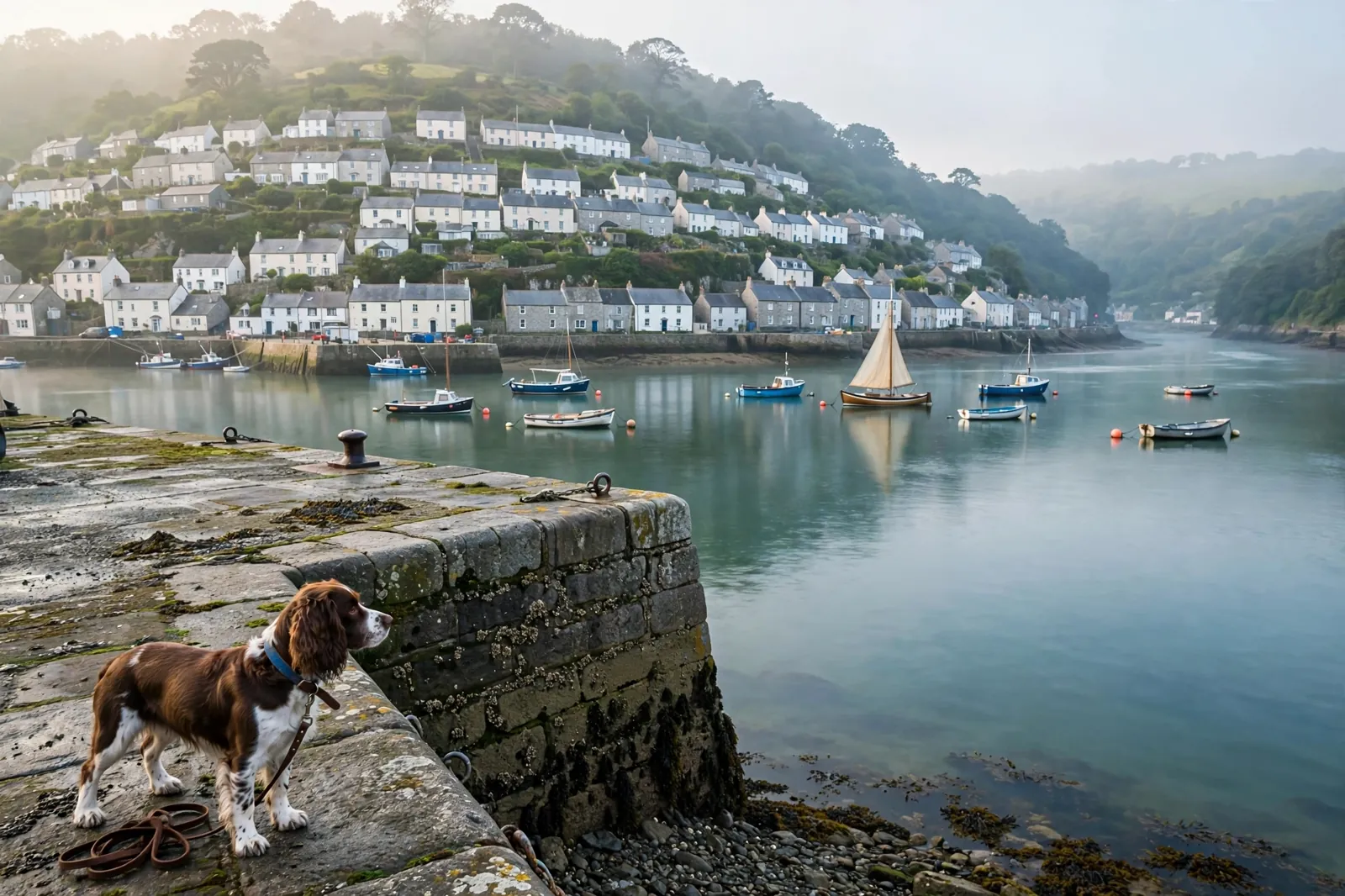
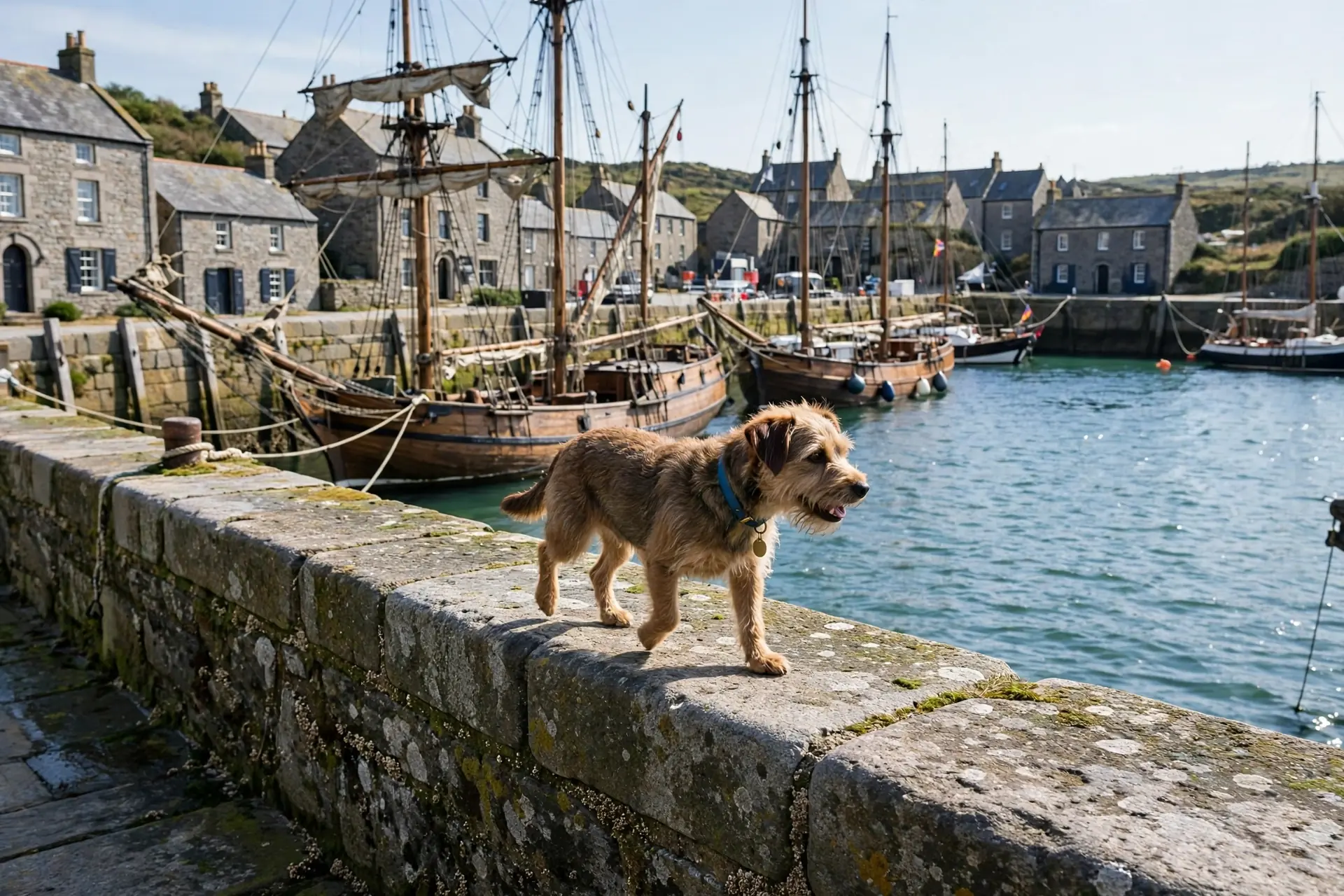
Charlestown is the prettiest part of the St Austell area and the part your dog will probably enjoy most. The harbour was built in the late eighteenth century to ship china clay, and it still feels like a working harbour rather than a theme park: tall ships are moored in the inner harbour, stone warehouses and cottages line the quay, and fishing boats come and go. The television series Poldark filmed here, and the harbour's atmosphere — grey stone, white cottages, masts against the sky — is the reason many visitors make the short trip from St Austell at all.
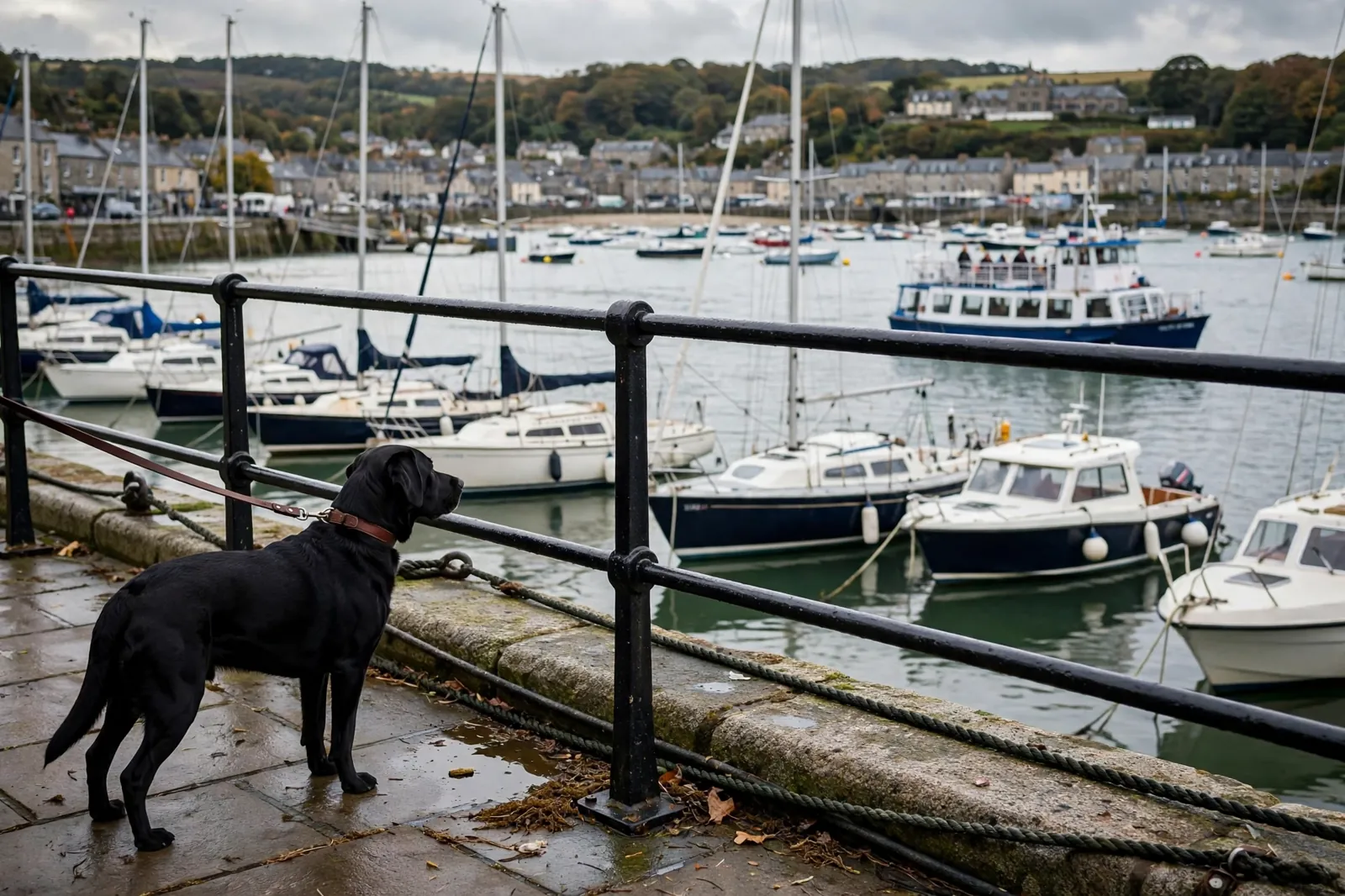
Walking a dog around Charlestown needs care, because it is a working harbour first and a visitor attraction second. Keep your dog on a lead on the harbour walls and the quay, where there are drops into the water, mooring ropes, vehicles and other visitors to navigate. The stone surfaces are uneven and can be slippery when wet, and the harbour steps down to the water are not a place for an off-lead dog. That sounds restrictive, but in practice a lead walk around the harbour, with time to sit on a bench and watch the boats, is exactly the right pace for Charlestown. The village is small, and an hour of slow wandering, including a drink at a harbourside pub, covers it well.
The beach at Charlestown is a small shingle cove tucked beside the harbour, and it is not a big open dog beach. Dog rules there can change with the season and with local orders, so check the signs at the harbour and the official guidance before you travel rather than assuming year-round access. Many Cornish beaches restrict dogs during the summer months, and Charlestown's size means that a restriction matters more here than on a long open beach. If dogs are restricted when you visit, treat the harbour walk as the activity and head to Pentewan or another nearby beach for the dog's run. Our guide to dog-friendly beaches in the UK explains how seasonal bans and public space protection orders work, and how to check a beach before you go.
Charlestown rewards a slow visit. The Shipwreck Treasure Museum sits on the quay, the harbourside pubs welcome walkers, and the coast path leaves the village in both directions. Parking is limited in the village itself, especially in summer, so arrive early or use the larger car parks and walk in. If you are staying in St Austell without a car, the bus to Charlestown is short, but check the timetable for the return journey before you set off, because services thin out in the evening. A dog that has walked the harbour, sniffed the fishing boats and settled under a pub table has had a proper Charlestown morning — there is no need to force a longer day out of a small village.
Photographers and television fans should also manage their expectations. Charlestown is at its best early in the morning or late in the afternoon, when the light is low and the harbour is quieter. Midday in August, the quay is busy, the tall ships are hemmed in by visitors, and a nervous dog will find the crowds harder than the scenery is worth. Time your visit for the quieter hours, keep the dog close on the narrow stretches, and you will see why the harbour has been filmed so often.
Clay Country trails and viewpoints
North and west of St Austell lies the Clay Country, a landscape shaped by two centuries of china clay extraction, and it is the most distinctive walking country near the town. The white spoil heaps, the flooded pits turned turquoise, the winding clay trails and the big skies give it a character unlike the coast or the farmland further inland. Several waymarked trails cross the area, including the Clay Trails network, which links St Austell with the surrounding villages on paths that were once clay tramways and haul roads. These are proper walking routes, not manicured park paths, so expect uneven surfaces, gradients and exposed stretches.
The best-known viewpoint is the area around the Wheal Martyn Clay Works, a museum that tells the story of the industry, with trails leading out into the worked landscape. Dogs are welcome on many of the outdoor trails, on lead, but the museum buildings themselves have their own rules, so check the official guidance before you travel if you plan to go inside. A walk that takes in the museum area, a stretch of clay trail and a viewpoint over the white peaks gives a dog a satisfying mix of smells, surfaces and open ground, and gives the humans a sense of the scale of the industry that built the town.
Walking the Clay Country with a dog takes a little more preparation than a coast path stroll. There is little shade on the open trails, and the white clay surfaces reflect heat and light in summer, so carry water for the dog and for yourselves, and avoid the middle of the day in a heatwave. The ground can be dusty in dry weather and slippery after rain, and some pits and flooded workings are fenced off for safety — respect the fences and keep your dog on a lead near any open water or steep edge. Livestock grazes on parts of the surrounding farmland, so a lead is essential where animals are present, and the usual countryside rules about closing gates apply throughout.
Choose your route by fitness, not by ambition. The Clay Trails include shorter, flatter sections suitable for older dogs and families, and longer, hillier loops that suit fit walkers. A good first outing is a there-and-back stretch from a village car park, with a clear turning point, rather than a long circular route with no easy exit. Check the route on a map before you set off, note where the nearest road or village is at each stage, and carry a phone, because the trails cross open ground where help is not immediately to hand. In autumn and winter, the trails can be muddy and the wind can be sharp on the exposed ridges, so a drying coat and a towel in the car make the return journey far more comfortable.
The Clay Country also connects naturally with the Eden Project story. Eden occupies a former pit, Wheal Martyn explains the industry, and the trails show the working landscape in between. Visiting all three across two days gives a visit a coherence that a single attraction cannot, and the dog is part of the outdoor two-thirds of that story. If you only have time for one clay walk, pick the trail with the best viewpoint and the easiest parking, walk it slowly, and let the landscape do the work rather than chasing distance.
Coast walks from Charlestown and Pentewan
The South West Coast Path runs through Charlestown, and the stretch towards Pentewan is the best single coastal walk from St Austell with a dog. It is a cliff-top path with harbour views behind you and the beach at Pentewan ahead, and it can be walked as a there-and-back route, which suits dogs and families who want a clear turning point. The path is well waymarked, but it is a real cliff path: keep your dog on a lead on the narrow and exposed sections, keep children close to the edge, and do not let a dog chase birds or scramble down to the rocks. Check tide times and the official guidance before you travel, because the beach at Pentewan and the conditions on the path change with the tide and the weather.
Pentewan itself is a wide sandy beach at the mouth of a wooded valley, with a village, a car park and a cycle trail inland along the old tramway. The beach has seasonal dog rules, like most Cornish beaches, so check the signs and the official guidance before you travel rather than assuming access. When dogs are welcome, Pentewan is a far better beach for a run than Charlestown's small cove, with room to throw a ball and space to get away from other visitors. The Pentewan Valley Trail, a flat traffic-free path along the river to the village, is a good alternative for older dogs, puppies and anyone who wants a gentle walk without cliffs.
Other coastal options within a short drive include Porthluney near Caerhays, with its wide beach and castle backdrop, and the coast path towards Mevagissey, a working fishing village with narrow streets and a harbour that rewards a slow wander. Mevagissey is close enough for a half-day trip from St Austell, and its harbour pubs and cafes are used to walkers with dogs, although the streets are narrow and busy in summer, so a short lead and a patient dog help. If you are planning a wider Cornish tour, our Fowey guide covers the quay, the Bodinnick ferry and the Hall Walk on the next stretch of coast to the east, and pairs well with a Charlestown morning.
Coast walking with a dog in Cornwall needs the same kit every time: water and a bowl, a lead and a long line for the beach, poo bags, a towel, and a first-aid basics kit. The coast path has few water sources, and the sun and wind together dehydrate dogs faster than a shaded woodland walk. In summer, check the ground temperature on paths and harbour walls before a long walk, and watch for adders on warm, sunny banks in spring and summer — keep your dog on the path and away from dense bracken. In winter, the path can be muddy and the wind can be strong, so a shorter loop and a warm car at the end are a better plan than a long exposed crossing.
Markets, cafes and pubs in town
St Austell town centre is a working high street rather than a visitor showcase, and that is part of its usefulness: you can do the practical jobs — supermarket, pharmacy, pet supplies, a vet if needed — and then sit down for coffee without driving anywhere. The market and the shops around the town centre are busiest on market days, when the streets fill up and a nervous dog will find the crowds harder going. If your dog is not comfortable in crowds, do the town-centre errands early, keep the dog on a short lead, and save the relaxed cafe stop for a quieter street or a terrace.
Cafes and pubs in St Austell and Charlestown vary in their dog policies, and the honest advice is to ask before you sit down. Several pubs welcome dogs in the bar area and on the terrace, and some cafes keep water bowls by the door, but policies change with new management, with the season and with the time of day — a pub that welcomes dogs at lunchtime may be less keen on a busy Saturday evening. Bring your own water bowl and a mat for the dog to settle on, keep the dog on a lead under the table, and be ready with a takeaway or a terrace back-up if a venue is full or has changed its rules. A dog that can settle quietly under a table will be welcomed back; a dog that barks at every passer-by will not, however friendly the landlord is.
Food shopping with a dog takes a little planning, because dogs cannot go into supermarkets. Split the party, use click-and-collect, or shop in the morning while the dog rests at the accommodation. The same logic applies to the market: one person browses while the other walks the dog around the quieter streets, then you swap. This sounds like a compromise, but it is really just how a dog holiday in a working town functions, and it is far less stressful than trying to take a dog into a crowded indoor market.
The town also has green space for a short dog walk between errands. The parks and the quieter residential streets around the centre give a dog a chance to stretch its legs without a drive, and the walk up towards the higher ground on the edge of town gives views back over the rooftops towards the Clay Country. These are not destination walks, and they do not need to be: their job is to break up a day of driving and visiting, and to give the dog a routine it recognises. A twenty-minute sniffy walk on a long line in a park does more for a holiday dog than an hour of being dragged around shops.
Evenings in St Austell are quieter than in the resort towns, and that suits many dog owners. A pub dinner with the dog settled under the table, a takeaway eaten at the accommodation, and an early night before a coast walk the next morning is a perfectly good Cornish evening. If you want livelier nightlife, Truro and Falmouth are both within reach, but both involve a drive and a late return, so weigh the evening against the next morning's walk before you commit. Our Falmouth guide covers harbour walks, the St Mawes ferry and the beaches on the Fal estuary if you do decide to head further west for a day.
Staying over and parking
Accommodation around St Austell ranges from town-centre hotels and bed and breakfasts to cottages, caravan parks and campsites in the surrounding villages, and the right choice depends on how much time the dog will spend alone. If you plan an Eden day, a self-catering cottage or a holiday park where the dog can be left settled is worth far more than a hotel room where the dog cannot be left at all. Ask directly, in writing, whether dogs may be left unattended, for how long, whether there is a charge, and whether there is a secure garden or a nearby toilet area. Our guide to dog-friendly holiday parks in Cornwall covers the questions to ask about fees, boundaries and shared areas before you book.
Location matters as much as the property. A cottage in a village near Charlestown or Pentewan puts the coast path on your doorstep, while a town-centre stay puts shops and the station within walking distance. A rural cottage with a garden sounds ideal, but check the fencing: a low wall or a hedge with gaps is not a secure garden for a determined terrier, and a garden that backs onto livestock needs a lead even at home. Ask for the exact boundary, the gate arrangements and the nearest practical toilet walk after dark, because those details decide whether the stay is relaxing or a series of small anxieties.
Parking in St Austell itself is straightforward if you arrive with a plan. The town-centre car parks serve the shops and cafes, while the larger car parks near Eden and Charlestown serve those visits, so you are not walking a dog along busy roads carrying shopping. Arrive early in school holidays, note the payment method and the maximum stay before you leave the car, and keep the ticket or the payment confirmation with you. Never leave a dog in a parked car in warm weather, even with the windows open — a car heats up far faster than most people expect, and a shaded car park in the morning can be a sun trap by midday. If you need to leave the car for a while, take the dog with you or go back to the accommodation first.
Booking ahead is essential in school holidays and for the busiest weekends. Dog-friendly accommodation in Cornwall sells out early, and the properties that genuinely suit dogs — enclosed gardens, ground-floor rooms, nearby walks — go first. Book the accommodation before the Eden tickets, because the accommodation decides what kind of Eden day is possible. If you are travelling without a car, check the bus routes from your accommodation to Eden, Charlestown and Pentewan before you book, because rural bus services can be infrequent, and a taxi with a dog needs to be booked in advance.
Finally, know where the nearest vet is before you need one. Save the number of a local practice and an out-of-hours emergency vet in your phone on arrival, along with the address of your accommodation for a taxi or an emergency call. Rural practices can be a drive away and may close early, and a dog that has eaten something on a beach or cut a paw on a harbour wall needs help promptly. A small first-aid kit — tweezers, saline, bandages, a muzzle for a painful dog — is worth carrying on every walk, not just the long ones.
A practical day plan and packing list
A good St Austell day with a dog has a shape, and it is worth writing it down the night before. Start with the dog's walk, not the attraction: a morning on the coast path or a Clay Country trail, when the dog is fresh and the paths are quiet, sets the day up. Then split for Eden or a town-centre morning, with the dog resting at the accommodation or walking with one adult. Finish with a harbour wander at Charlestown and a pub stop, when the light is softer and the village is calmer. That order — dog first, people second, shared evening — keeps everyone happy, and it is the pattern that works most often in practice.
Packing for St Austell is packing for changeable Cornish weather and for three different landscapes in one day. Bring a lead and a long line, a harness that fits well, poo bags, water and a collapsible bowl, a towel and a drying coat, a warm layer for a short-coated or older dog, and a mat for pub and cafe stops. Add sun protection for a pale-nosed dog, tick removal tools in spring and summer, and a basic first-aid kit. Keep a spare lead and a spare towel in the car, because the one you need will be the one that gets wet or muddy first.
Seasons change the plan more than the place. Spring brings lambs, nesting birds and adders on sunny banks, so leads stay on and dogs stay on paths. Summer brings heat, crowds and seasonal beach restrictions, so walk early, carry water and check the beach signs daily. Autumn brings mud, wind and quieter paths, which many dogs prefer, but also brings shorter days, so start earlier than you think you need to. Winter brings storms, closed facilities and exposed coast paths, so check the weather forecast and the official guidance before you travel, and have an indoor back-up — a cafe, a shorter walk, a drive to a sheltered valley — ready. Whatever the season, the rule is the same: the dog's needs set the pace, and the itinerary bends around them.
If you have more than a weekend, St Austell makes a good base for a wider south Cornwall tour. Fowey is a short drive east, with its quay, ferry and Hall Walk; Mevagissey and the Roseland Peninsula lie to the south-west; and the Lost Gardens of Heligan, near Pentewan, is a people-first garden visit that pairs with a dog walk in the valley. Plan these as separate half-days rather than a single grand tour, and the driving stays short and the dog stays happy. A week based in St Austell, with two Eden-side days, two coastal days and a rest day, is a realistic and enjoyable shape for a dog holiday in Cornwall.
Practical questions
Before you go
Can dogs go into the Eden Project?
No, dogs are not admitted to the Eden Project site itself, apart from assistance dogs. Plan your visit so one person stays with the dog outside, use the car park and the paths around the site for a walk, or leave the dog at your accommodation if it settles happily alone there. Check the official guidance before you travel, because rules and seasonal arrangements can change.
Is Charlestown beach dog-friendly all year?
Charlestown has a small shingle beach beside the harbour, and dog rules there can change with the season and with local orders. Many Cornish beaches restrict dogs in summer, so check the signs at the harbour and the official guidance before you travel, keep your dog on a lead around the working harbour, and have a back-up walk ready, such as the coast path towards Pentewan.
Where can I park in St Austell with a dog?
Use the town-centre car parks for shopping and cafes, and the larger car parks near the Eden Project and Charlestown for those visits, so you are not walking a dog along busy roads with shopping. Arrive early in school holidays, note the payment method and maximum stay before you leave the car, and never leave a dog in a parked car in warm weather.
Are dogs welcome in St Austell pubs and cafes?
Several pubs and cafes in St Austell and Charlestown welcome dogs, especially in bar areas and on terraces, but policies vary by venue and can change. Ask before you sit down, keep your dog on a lead under the table, bring water and a mat, and have a takeaway or terrace back-up in mind in case a venue is full or has changed its policy.
What is the best dog walk near St Austell if we only have one morning?
For one morning, walk the South West Coast Path from Charlestown towards Pentewan and back, which gives harbour views, cliffs and a beach at the far end without a long drive. Check tide times and the official guidance before you travel, keep your dog on a lead on cliff sections and near livestock, and carry water, because there is little shade on the open coast path.