This guide is independent and contains no paid placement. If affiliate links are added later, they will be clearly marked and will not change our editorial checks.
Montrose gives a dog two completely different days in one small town: three miles of open beach where dogs are welcome all year, and the 750-hectare tidal Basin, where dogs walk on a lead past tens of thousands of wild geese. Add a harbour statue of a Second World War hero dog, a lighthouse loop and two more great beaches a short drive away, and it works as a day trip or a weekend base.
Why Montrose suits a dog break
Montrose sits on a narrow strip of land between two rivers, the North Esk to the north and the South Esk to the south, with the North Sea on one side and the Montrose Basin — a vast tidal estuary — on the other. It is the northernmost coastal town in Angus, about 37 miles south of Aberdeen and a similar distance north-east of Dundee, which puts it within easy reach of both cities without feeling like a suburb of either. The town itself is compact and walkable: the station, the High Street, the harbour and the beach are all close enough to link on foot with a dog, and the flat ground suits older dogs and short legs as well as fit ones.
What makes Montrose different from most Scottish seaside towns is the pairing of its two landscapes. The beach is a proper running beach — three miles of firm golden sand stretching north towards the River North Esk, backed by grass and a promenade, with Scurdie Ness Lighthouse in view to the south. The Basin is the opposite kind of walk: slow, quiet and full of birds, where the dog stays on a lead and the entertainment is watching pink-footed geese arrive in their thousands. A dog that needs a hard run in the morning and a calm sniff in the afternoon gets both without anyone getting in a car.
Montrose is also a working town rather than a resort, which changes the feel of a visit in a good way. The harbour still handles shipping, the streets are lined with ordinary shops rather than souvenir stalls, and the town's history — from its time as a Royal Burgh to its role in the Second World War — is visible in statues and museums rather than staged for visitors. For dog owners that matters practically too: there are vets, pet shops, supermarkets and takeaways within a short walk of most places you would stay, and you are not dependent on a single seasonal cafe being open.
This guide works through the town in the order a dog owner actually needs it: the beach first, then the Basin, then the town walk and the lighthouse loop, then the two day-trip beaches, and finally the practical questions of food, stays, travel, seasons and packing. Where a rule can change — a cafe policy, a museum's opening hours, a seasonal closure — the guide says so and asks you to check the official guidance before you travel rather than guessing.
Montrose Beach: three miles of sand
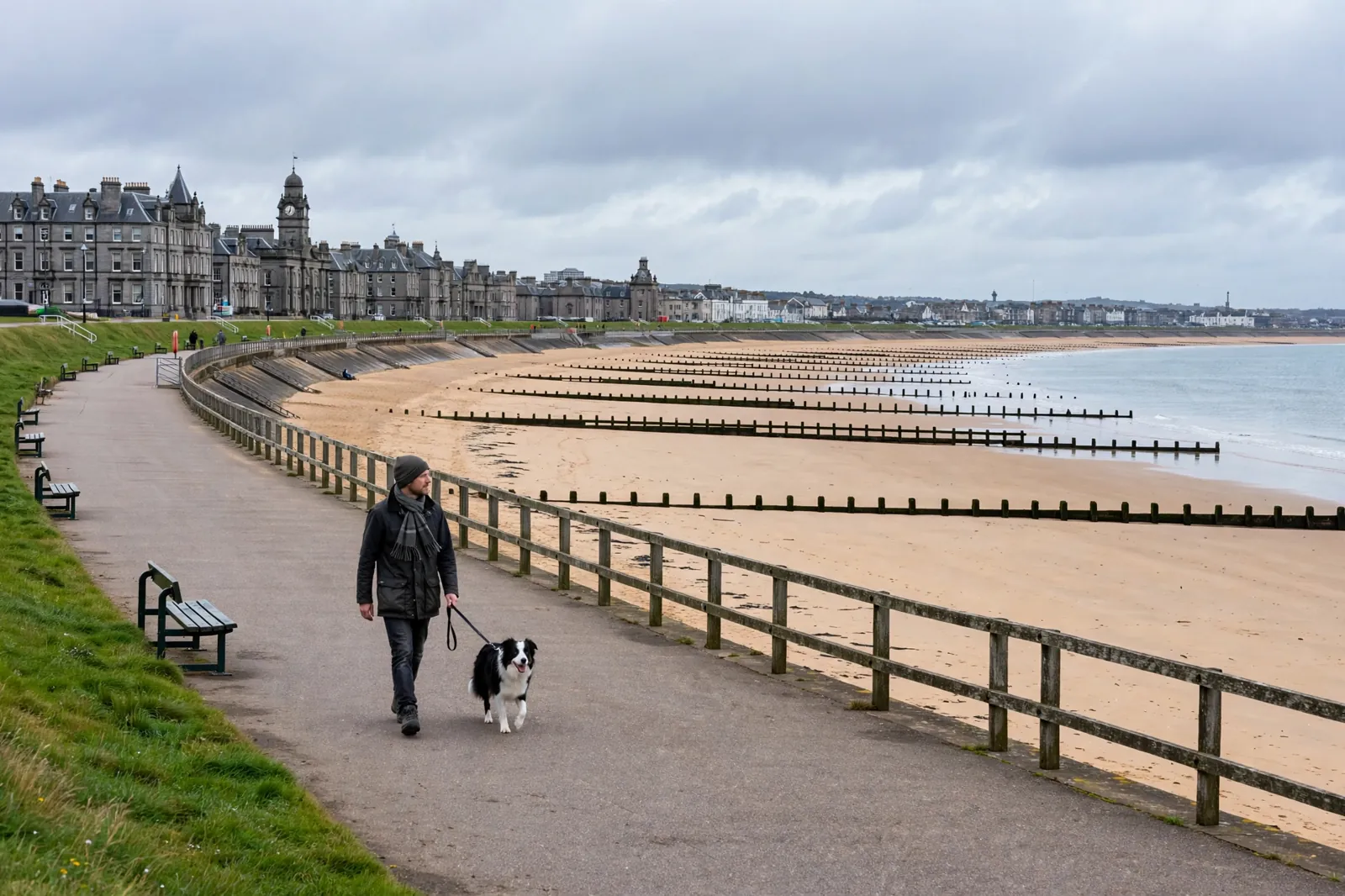
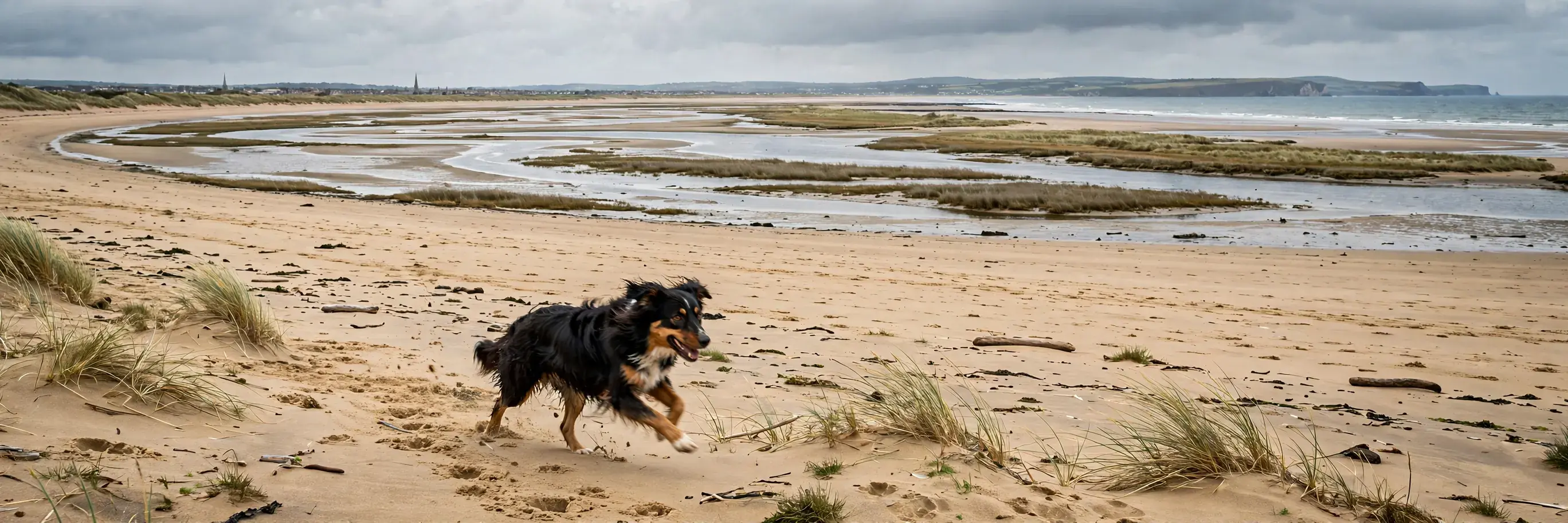
Montrose Beach is the reason most dog owners come, and it earns its reputation. Around three miles of golden sand run north from the seafront at Traill Drive towards the mouth of the River North Esk, with grassy areas and a promenade behind the southern end and open dunes further north. At low tide the sand is wide and firm enough for a proper run, and the sheer length means you can walk away from the busy stretch by the promenade and find space even on a sunny weekend. Views run south to Scurdie Ness Lighthouse and north along an almost empty shoreline, which is part of the pleasure: this is a big-sky beach, and a dog can be a small figure in a large landscape rather than one of fifty dogs in a cove.
Dogs are welcome on Montrose Beach all year round, which is the headline rule and the one most visitors rely on. There is one qualification worth knowing before you go: Keep Scotland Beautiful, which runs the Scotland's Beach Award for the seafront, lists a dog restricted area at the award beach, so look for the signs near the promenade when you arrive and keep your dog out of any marked zone. The rest of the beach is open to dogs, and the practical approach is to walk a few minutes north, away from the award area and the busiest stretch, before letting your dog off the lead. Rules can change, so check the official guidance before you travel and always follow the signs on the day.
The beach is a designated bathing water, monitored by SEPA from 15 May to 15 September, and its classification for 2026 is Excellent. That is good news for dogs that swim, but it comes with the usual cautions. SEPA warns that heavy rainfall can cause short-term pollution from sewer overflows, and advises against bathing during and for one to two days after heavy rain. The same applies to a dog that drinks from the sea or swallows water while swimming, so after a wet spell it is worth keeping your dog to the sand and the shallows. The harbour mouth at the south end of the beach carries strong currents where the South Esk meets the sea, and dogs should be kept well back from rough water there in any conditions.
Access is straightforward. The main car park is at Traill Drive by the seafront, close to the promenade, the beach and the public toilets. One visitor report notes that the Traill Drive car park now has a height restriction barrier, so motorhome and tall-van drivers should check the official guidance before you travel rather than assuming they can park there. Public toilets at the seafront are seasonal and close from mid-October to 31 March, which matters more than it sounds on a cold day with a dog and a long walk planned — use the facilities in town before you set out in winter. The Traill Pavilion, a seafront building that opened in 1913, is a useful landmark for meeting up and for orienting yourself at the southern end of the beach.
On the sand itself, a few habits make the visit better for everyone. Keep your dog under close control near other people, children and other dogs, and put the lead back on as you approach the promenade and the car park. The dunes behind the beach are fragile and hold nesting birds in spring and summer, so keep your dog out of them and off the dune grass. Pick up after your dog every time: the beach is a bathing water, and waste left on the sand is a direct problem for water quality as well as for the next family to arrive. In summer, remember that dogs feel the heat on pale sand too, and that the walk back along the promenade in full sun is hotter than the walk out was — carry water, offer shade breaks, and watch for a dog that goes quiet or starts lagging.
If your dog's recall is unproven, start on a long line rather than letting them loose into three miles of open space with gulls, other dogs and the smell of the sea all competing for attention. A long line on firm wet sand still gives a dog a real run, and it lets you test recall with a safety net before you trust it. The north end of the beach, towards the North Esk, is usually the quietest stretch and the best place for that first off-lead session, while the southern end near the harbour is the place to keep a lead on and enjoy the view instead.
Montrose Basin: wildlife on a lead
The Montrose Basin is the town's other great landscape, and it could hardly be more different from the beach. It is a large enclosed estuary of the River South Esk, covering about 750 hectares of tidal mudflats, saltmarsh, reedbeds and grassland, and it is one of the most important wildlife sites on Scotland's east coast. In autumn and winter more than 100,000 migratory birds use the Basin, including huge flocks of pink-footed geese that arrive from Iceland and Greenland, along with wigeon, shelduck and waders. In summer the Basin holds breeding birds instead. The Scottish Wildlife Trust runs the reserve and its visitor centre, and the whole place has the feel of a working piece of nature rather than a park: tides, mud, wind and birds, with people very much as guests.
Dogs are welcome on the reserve walks, and that is the good news. The conditions are straightforward and worth respecting. Dogs must be kept on a lead on the walks, and they are not allowed inside the visitor centre — only assistance dogs are permitted indoors. That means planning a Basin visit as an outdoor walk rather than a museum trip: one person can stay outside with the dog while the other goes in, or you can simply enjoy the outdoor viewpoints and the bird hides and skip the centre altogether. The centre, on the south side of the Basin at Rossie Braes on the A92, has panoramic windows, telescopes and binoculars, a gift shop and hot drinks, and it is the best first stop for current information about what is being seen and where to go.
There are four or five waymarked walks around the reserve, each with bird hides, ranging from short strolls to longer routes. The Trust's walks leaflet is the best guide to them, and the visitor centre can point you to the right one for the time you have and the birds that are in. A useful longer option is the walk from Bridge of Dun, about three miles from Montrose, following the River South Esk downstream to the Basin — roughly three miles or five kilometres of flat, low-level walking on a defined footpath and quiet country roads, with the House of Dun, a National Trust for Scotland mansion, on the way. Dogs are on a lead at the Trust's request on that route, and cattle graze part of it, so it suits a dog that is steady around livestock.
Three warnings matter more at the Basin than anywhere else in this guide. First, the mudflats are dangerous to walk on: at low tide the Basin looks like an invitation to cross, but the mud is deep, soft and tidal, and both people and dogs should stay on the paths provided. Second, there is no circular walk around the Basin because of the tides, so plan your route as an out-and-back or a linear walk with a car at each end rather than assuming you can loop round. Third, the walks cross working farmland, with the exception of the Goose Hide walk, and cattle may be present in summer while nesting birds are present on all walks from spring — keep your dog on a lead, close to you, and well away from both.
The Basin rewards patience, and that is a different kind of dog walk. Bring binoculars if you have them, dress for wind — the Basin is wide open and the wind off the sea is cold even on a bright day — and time your visit around the tide if you can: the birds feed on the mud as the tide falls and gather in huge numbers as it rises. October is the classic month, when the pink-footed geese arrive in force, but a winter morning with wigeon whistling and the geese flighting overhead is just as memorable, and a summer evening brings breeding birds and long light. If you are combining the Basin with the beach, do the Basin first while the dog is fresh and the light is good, and save the beach run for afterwards.
A town walk: Bamse, harbour and museum
Montrose has one of the best dog stories in Britain, and it is told in bronze at the harbour. Bamse was a St Bernard from Norway whose name means "teddy bear" in Norwegian. He came to Montrose with his owner, Captain Erling Hafto of the Norwegian Navy, serving as a registered crew member on the minesweeper Thorodd during the Second World War. Bamse became a familiar figure around the town, breaking up fights between sailors, escorting men back to their ships and riding the bus to the pub, and when he died on the Montrose dockside in 1944 he was buried with full military honours. His statue stands by the harbour, and his grave, marked by a white cross, is nearby. For a dog owner it is a genuinely moving stop, and it is worth building the town walk around it.
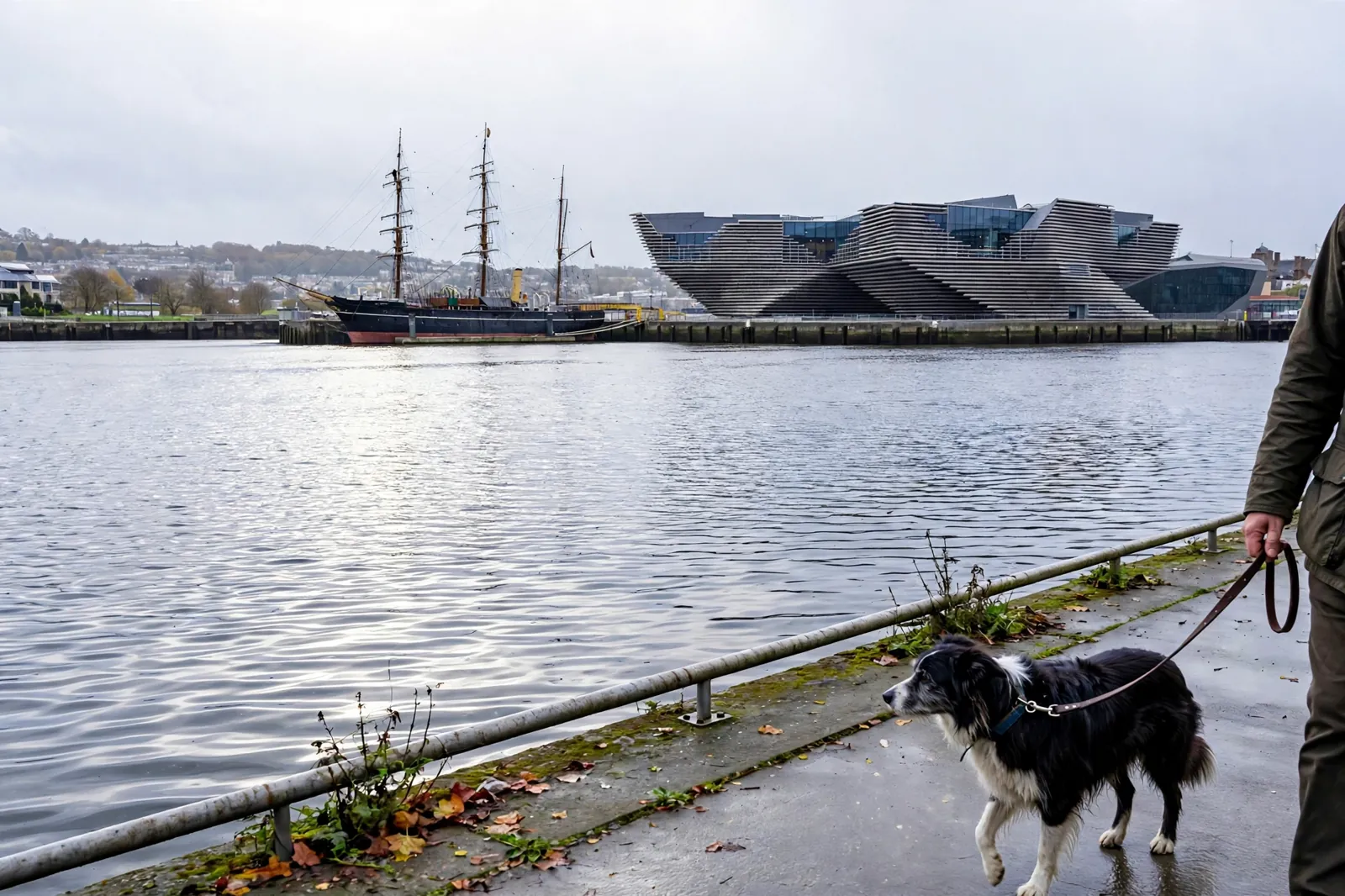
Start at the harbour and the Bamse statue, then follow the waterfront past the Seafarer sculpture by William Lamb, a memorial to local seamen and fishermen, and the working port with its ships and cranes. The harbour is a working place, so keep your dog on a lead and close to you, and keep well back from the water's edge and from any loading areas. From the harbour it is a short walk into the town centre, where the High Street runs past the town's statues — Robert Burns, Joseph Hume and James Graham, the 1st Marquess of Montrose — and the Gothic tower of the Old and St Andrew's Church. The streets are flat and the pavements are wide enough for a dog on a lead, and the town's red sandstone buildings, including the public library, give the walk a distinct character that is very different from the beach.
Montrose Museum and Art Gallery, a columned building in the town centre, is listed by the local visitor guide as welcoming well-behaved dogs, which makes it one of the more dog-friendly museums in Scotland. The policy can change, so check the official guidance before you travel, and keep your dog on a short lead, close to you and with all paws on the floor if you do go in. If the museum is not taking dogs on the day you visit, the building itself and the surrounding streets are still worth the walk, and the dog will not mind missing the display cases.
The Montrose Air Station Museum, at Waldron Road in Broomfield on the north side of town, is another worthwhile stop and explicitly dog-friendly: well-behaved dogs are welcome on a lead. The museum stands on the site of Britain's first operational military air station, established in February 1913, and tells the story of the men and women who served there until it closed in 1952, including the animals at war — Bamse, the war horse Vic and the carrier pigeon Winkie. It is a seasonal attraction and closes over the winter, with a published reopening date of Saturday 20 February 2027, so check the official guidance before you travel and do not plan a winter visit around it. The buildings are single-storey with ramps where needed, and there is an accessible toilet at reception.
A town walk also gives you the practical stops a dog break needs: supermarkets and takeaways on and around the High Street, a vet in town if anything goes wrong, and benches and grassy areas for a rest. The churchyard and the grass near St Mary's and St Peter's Episcopal Church make a shady pause on a warm day, and the walk back towards the seafront along the streets behind the promenade is quieter than the High Street itself. Keep your dog on a lead through the town, watch for traffic at the junctions near the harbour and the station, and remember that a town walk after a beach run is a good way to tire a dog out gently rather than adding a second hard session.
Scurdie Ness and Ferryden
South of the South Esk, across the water from the town, stands Scurdie Ness Lighthouse, and the walk to it is one of the best short coastal loops in Angus. The lighthouse was built in 1870 by David and Thomas Stevenson, the father and uncle of Robert Louis Stevenson, and its white tower rises 39 metres above a rocky headland at the mouth of the river. It is a striking sight from the beach, and a better one close up, with views back across the harbour mouth to Montrose and out to the North Sea.
The usual route is a circular walk of about 5.3 kilometres from the old fishing village of Ferryden, on the southern bank of the South Esk, out to the lighthouse and back through Usan, taking a little over an hour at a comfortable pace. It is generally graded easy, with fine views over the Port of Montrose and the mouth of the river, and it is quiet: you are unlikely to meet many other people, which suits a dog that prefers space. Dogs are welcome on the route, but this is a walk for a lead rather than a free run. Cattle are typically encountered at one point on the loop, the path runs close to the water in places, and the ground can be rough underfoot, so keep your dog under close control and on a lead near livestock and at the headland.
Ferryden itself is worth a slow look. It is an old fishing village of stone cottages and narrow lanes, with a very different atmosphere from Montrose across the water, and the walk out of the village towards the lighthouse passes the harbour and the river mouth before opening out to the coast. At the lighthouse, keep your dog away from the cliff edges and the rocks, which are slippery when wet, and do not let a dog swim at the river mouth, where the currents are strong. The return leg through Usan and the farmland behind the coast is the part where livestock is most likely, so this is the stretch to have the lead short and the dog close.
This loop pairs well with the beach: do the beach in the morning, cross to Ferryden for the lighthouse walk in the afternoon, and you have two very different coastal walks in one day without driving anywhere. If you are short on time, the lighthouse is also worth seeing from the Montrose side — from the southern end of the beach and the harbour, the white tower is a clear landmark — but the walk itself, with its mix of village, river, headland and farmland, is the better experience for a dog that enjoys a varied route.
Day trips: Lunan Bay and St Cyrus
Montrose works as a base for the Angus coast because two of Scotland's best dog beaches are a short drive away in opposite directions, and both are worth a half day. South of Montrose, about three miles down the coast, is Lunan Bay: two miles of golden sand below the ruins of Red Castle, between Arbroath and Montrose, with cliffs and dunes at either end and the Lunan Water running into the sea at the southern end. Dogs are welcome on the beach, and the bay has a reputation as one of Scotland's finest stretches of sand — wide, clean and usually quiet, with room for a long walk and a proper run. The main car park is free and a short walk from the sand by a wooden walkway, and the Lunan Bay Cafe by the beach is dog-friendly, with visitors praising its food and its welcome for dogs as well as people. Keep your dog under close control by the river, the dunes and the farmland, and away from resting shore birds, and check the cafe's current arrangements before you travel.
A good Lunan Bay walk is the Red Castle and Lunan Bay circular, a loop of about 3.9 miles that takes in the beach, the castle ruins and the cliffs. Dogs are allowed on the trail but must be kept on a lead, which is the right call on a route that mixes beach, cliff tops and farmland. The beach itself is best at low tide, when the sand is at its widest, and the bay is exposed to the North Sea, so check the weather and the tide before you set out and do not let a dog swim in rough water. Agates and red jasper can be found among the pebbles at the edges of the bay, which gives the walk a treasure-hunt element for anyone who likes beachcombing — just keep an eye on the dog while you look down.
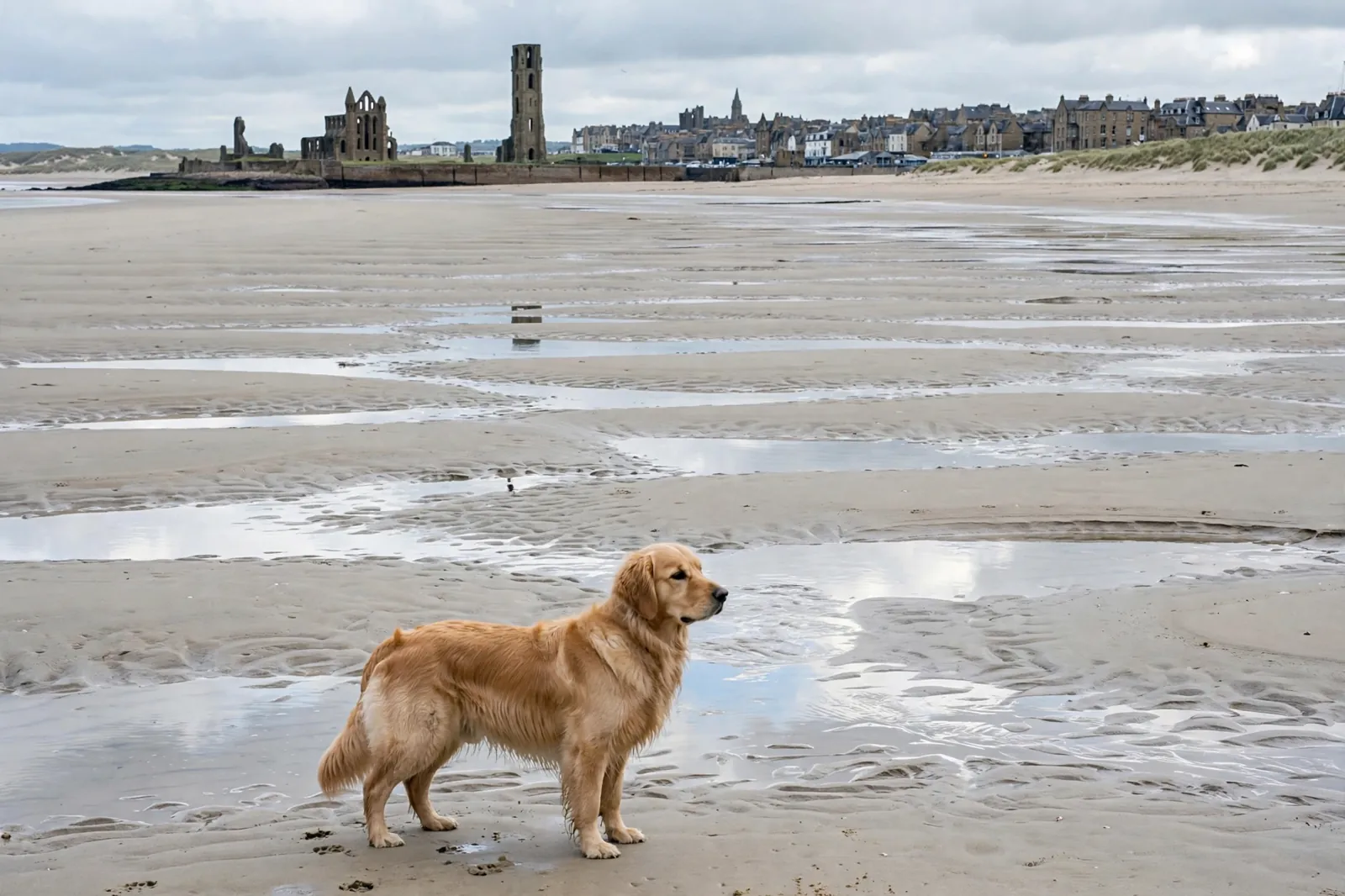
North of Montrose, about four miles up the coast, is St Cyrus, the sandy shoreline of the St Cyrus National Nature Reserve. It is a big, open beach of golden sand backed by cliffs, with views back across the bay to Montrose, and it is consistently rated one of the best dog beaches in Scotland. The rules here need more attention than at Montrose Beach. There are no beach restrictions in winter: dogs are allowed on the whole beach from 1 September to 31 March. In summer, the southern part of the nature reserve is closed to visitors from 1 April to 31 August while birds nest, and dogs should be kept on a lead or close at heel on the way down to the beach in that period. The visitor centre is open daily from April to October and Monday to Friday from November to March, and the reserve trails are worth walking with a dog under close control, especially in the nesting season. Check the official guidance before you travel, because the exact boundaries and dates can change.
Further afield, the Angus coast continues in both directions. Arbroath, about 17 miles south, has its own harbour, abbey and cliff walks, and the coast path between Arbroath and Auchmithie is a classic walk — though the cliff sections are not for every dog, and the lead stays on. Our guides to Dundee with a dog and Aberdeen with a dog cover the two cities at either end of this coast, both under an hour's drive from Montrose, and both with beaches, parks and waterfront walks of their own. Dundee, to the south-west, has the Tay waterfront, Broughty Ferry beach and Camperdown Park, while Aberdeen, to the north, has its long beach and boulevard, Duthie and Hazlehead parks and the Deeside road out to the Cairngorms. If you are planning a longer Angus and Aberdeenshire trip, our dog-friendly beaches in Scotland guide sets out the rules beach by beach around the whole coast.
Eating out with a dog
Montrose is a working town, so eating out with a dog follows the usual Scottish pattern: ask first, favour terraces and cafes that clearly welcome dogs, and have a takeaway plan for the days when nothing quite works. Dog policies in cafes and pubs change often and are rarely written down anywhere reliable, so check the official guidance before you travel — or, more practically, phone ahead on the day and ask whether dogs are welcome inside, on the terrace only, or not at all. A place that says yes on the phone is a place you can plan around; a place that says "we'll see" is a place to have a backup for.
A few principles make eating out easier with a dog in Montrose. First, time it around the dog's walk rather than before it: a dog that has had a beach run and a toilet stop will settle under a table far more easily than one that has been waiting all morning. Second, bring a mat or blanket for the dog to lie on, a water bowl and a chew or a stuffed Kong, and choose a table at the edge of the room rather than in the middle of the traffic. Third, keep the dog on a lead and out of the way of staff carrying hot food, and be ready to step outside if the dog gets restless — a short break outside is better than a scene inside.
The Lunan Bay Cafe, a short drive south, is the most consistently praised dog-friendly stop on this coast, with visitors describing it as welcoming to dogs as well as people and its breakfast rolls and homemade cake as worth the trip. In Montrose itself, the seafront and High Street cafes vary, and the honest advice is to check on the day rather than relying on a list that will be out of date within months. Takeaway is always a reliable fallback: fish and chips, a bakery lunch or a supermarket picnic eaten on a bench by the seafront or on the grass behind the beach works well with a dog, and a picnic also lets you eat at the dog's pace rather than the restaurant's. If you do picnic, take everything home with you, including food waste — gulls are bold on this coast, and a dog that chases them across a crowded seafront is a problem for everyone.
For an evening meal, the same rules apply with one addition: book ahead and say you have a dog when you book, not when you arrive. A restaurant that has agreed in advance will have a suitable table ready; one that is surprised at the door may say no even if it would have said yes with notice. If your accommodation has a kitchen, an evening in with a takeaway is often the best option after a long day on the beach, and it lets the dog dry off and sleep while you eat in peace.
Where to stay with a dog
Montrose has a mix of dog-friendly stays — self-catering cottages and flats, bed and breakfasts and small hotels, and caravan and holiday parks in the surrounding area — and the right choice depends more on your dog than on the view. A cottage with an enclosed garden near the beach suits a dog that needs a safe toilet area at night; a flat in the town centre suits a dog that is happy on a lead and likes people; a caravan or lodge on the edge of town suits a dog that needs space and quiet. Before you book anything, ask the specific questions that matter for your dog rather than relying on a "dog-friendly" label, and get the answers in writing with your confirmation.
The questions that matter most are the same ones that matter anywhere, but they have local answers in Montrose. Is there a pet fee, and how much is it per dog per stay? Is there a maximum number of dogs, and does the limit apply to your booking? Is the garden genuinely enclosed, and how high is the fence — a low wall that a spaniel can clear is not an enclosed garden. Can the dog be left alone in the property, and if so for how long and under what conditions? Is there somewhere to wash a sandy dog, and is there an outdoor tap? And how far is the first walk that needs no car — from a cottage near Traill Drive the beach is minutes away, while from a cottage on the Basin side the first walk is a lead walk along a road before you reach open ground.
Location within the town is worth thinking about. Staying near the seafront puts the beach on your doorstep and makes the early-morning and late-evening toilet walks easy, but it also puts you closest to the gulls, the wind and the weekend crowds. Staying near the Basin puts you close to the wildlife walks and the visitor centre, but further from the beach and the town's shops. Staying in the town centre puts you close to everything but means lead walks through streets for every outing. There is no wrong answer, only a wrong answer for a particular dog: a reactive dog is better away from the busy seafront, while a sociable dog that loves people will be happy anywhere.
Book early for summer weekends and for the October goose season, when the town is at its busiest with birdwatchers as well as beach visitors. In winter, many smaller places close or reduce their opening, so confirm that your chosen stay is actually open on your dates rather than assuming it is. And whatever you book, read the cancellation terms before you pay: illness, yours or the dog's, is the most common reason a trip changes, and a booking that can be moved is worth more than a slightly cheaper one that cannot. Check the official guidance before you travel for the current rules of any park or site you plan to use.
Getting there and getting around
Montrose is easy to reach, which is part of its appeal as a dog break. By train, the station is on the main Aberdeen to Edinburgh line, with regular services in both directions, and the town centre, beach and harbour are all walkable from the station. Dogs are generally allowed on trains in Britain, usually free of charge, but the exact conditions — how many dogs, whether they need to be on a lead or in a carrier, and whether a reservation is needed — vary by operator, so check the official guidance before you travel. A dog that is comfortable on a train will find the journey straightforward; a dog that is not should travel by car instead, because a stressed dog on a busy train is miserable for everyone in the carriage.
By car, Montrose is reached from the south on the A92 from Dundee and Arbroath, and from the north on the A92 from Aberdeen and Stonehaven. The drive from Dundee takes under an hour, from Aberdeen a little over an hour, and from Edinburgh around two hours depending on traffic. Parking is available at Traill Drive by the beach, at the Basin visitor centre, in the town centre car parks and on the streets around the harbour, but the Traill Drive car park has a height restriction barrier, so check the official guidance before you travel if you are in a motorhome or a tall van. In summer, arrive early for the seafront car parks, which fill up on sunny weekends.
Once you are there, the town is best explored on foot. The centre, the harbour, the beach and the Basin visitor centre are all within a short walk or a short drive of each other, and the flat ground makes walking easy. For the day trips in this guide — Lunan Bay to the south and St Cyrus to the north — you will want a car or a taxi, as the bus services along the coast are infrequent and not every service is convenient with a dog. If you are travelling without a car, base yourself near the seafront and treat Lunan Bay and St Cyrus as optional extras rather than the core of the trip; the beach, the Basin and the town walk are all reachable on foot and will fill a weekend on their own.
One practical note for drivers: the roads around the Basin and the coast are rural, with single-track sections, farm traffic and livestock, so drive slowly and expect a dog on a lead or a horse around the next bend. And if you are walking from a car park to a beach or a trail, keep the dog on a lead until you are on the open ground — car parks are where dogs get excited, slip their collars and run into traffic, and a lead for the first hundred metres costs nothing.
Seasons, tides and weather
Montrose changes with the seasons more than most seaside towns, because it has two natural calendars running at once: the beach calendar and the Basin calendar. Spring brings nesting birds to the Basin and the dunes, which means dogs on leads near the reserve and out of the dune grass, and it brings the first warm days on the beach. The St Cyrus nesting closure runs from 1 April to 31 August, and the same instinct applies everywhere on this coast in spring: keep the dog close, keep it out of the long grass, and give ground-nesting birds a wide berth.
Summer is the busiest season on the beach and the easiest season for a dog break in most ways. The days are long, the sea is at its warmest, the toilets and cafes are open longest, and the SEPA bathing water monitoring runs from 15 May to 15 September. It is also the season when the beach is most crowded, the sun is strongest and the car parks fill earliest, so arrive early, carry water and shade, and walk the dog in the morning and evening rather than at midday. The Basin in summer is quieter for birds but still worth walking, with breeding birds and long evenings, and the Air Station Museum is open.
Autumn is the season many regulars prefer. The crowds thin, the light softens, and the pink-footed geese arrive at the Basin in October in their thousands — one of the great wildlife spectacles in Britain, and one that a dog can watch from a lead on a path while the sky fills with birds. The beach in autumn is often at its best: empty, windy and dramatic, with firm sand and long walks. The trade-off is the weather turning, the toilets closing from mid-October, and the Air Station Museum closing for winter, so check the official guidance before you travel and plan around what is actually open.
Winter in Montrose is quiet, cold and beautiful, and it suits a particular kind of dog break. The beach is empty, the Basin holds its wintering birds, and the town is calm. But the days are short, the wind off the North Sea is bitter, and the rain is horizontal as often as not, so pack for it: a drying coat for the dog, waterproofs for you, a torch for the early-dark evenings, and a warm place to dry off afterwards. The tides matter in every season, but most of all in winter, when a high tide can cut off the walk you planned and a storm can throw waves over the promenade. Check the tide times and the weather forecast before every walk, and if the sea looks rough, walk the Basin or the town instead and save the beach for a calmer day.
Packing for the Angus coast
Packing for Montrose is packing for two different walks in one bag, and the list is worth getting right. The essentials are the same as for any British coastal break: a lead and a long line, a harness that fits properly, poo bags — more than you think you need — a water bottle and a collapsible bowl, towels, and a drying coat or two for a dog that swims or gets caught in the rain. Add a dog first-aid kit with tick removers, because the Basin walks cross farmland and long grass where ticks are present, and check your dog for ticks after every walk in the warmer months.
For the beach, add a few specific items. A long line is more useful than a second lead, because it lets you give a dog a real run while you test recall on three miles of open sand. A towel that lives in the car for sandy paws, and a brush for sand in a long coat, will save your accommodation's floors. A ball or a toy that floats is better than a stick: sticks splinter and can injure a dog's mouth, and the beach has driftwood that tempts every dog. And a spare lead in the car is cheap insurance, because leads get lost on beaches more often than anywhere else.
For the Basin, the extra items are binoculars, a windproof layer and a pair of shoes with grip for muddy paths. The Basin is exposed and windy, and the paths can be muddy after rain, so a dog that comes back filthy is a dog that needs a towel and a wash before it gets into the car. A lead that clips short is useful here, because the Basin is a place for a close lead rather than a trailing long line, and a dog that lunges at geese needs to be held close rather than given six metres of rope.
For the town and the evenings, pack a mat or blanket for the dog to settle on in a cafe or a holiday cottage, a chew or a stuffed Kong for settling, and the dog's usual food in the usual quantities — a change of food on a trip is a reliable way to ruin a night. Bring the dog's vaccination and vet records on your phone, and save the number of a local vet before you travel, so that a cut paw or a swallowed stone does not turn into a search for a phone number in a panic. And pack for the weather you will actually get, not the weather you hope for: on the Angus coast in any month, that means a waterproof for you and a drying coat for the dog.
A one-day and a weekend plan
If you have one day in Montrose with a dog, start at the beach. Arrive early, park at Traill Drive, and walk north along the sand while the beach is quiet and the light is good. Give the dog a proper run — an hour on the sand, with a swim if the dog swims and the water is calm — then walk back along the promenade and into town for a late breakfast or an early lunch, with the dog settled on a mat under the table. After lunch, walk to the harbour for the Bamse statue and the Seafarer sculpture, then through the town centre past the statues and the museum, and finish the afternoon with a Basin walk from the visitor centre, timing it so the dog is on a lead and the birds are active as the tide turns. That is a full day: a run, a town walk, a statue with a story and a wildlife walk, and the dog will sleep all the way home.
With a weekend, the plan opens up. On Saturday, follow the one-day plan above, but take the beach walk further north towards the North Esk and give the Basin walk more time — two hours rather than one, with binoculars and a slow pace. On Sunday, drive south to Lunan Bay for the morning, walk the beach and the Red Castle loop, and have lunch at the cafe, then drive north to St Cyrus for the afternoon beach walk, remembering the nesting-season rules if you are visiting between April and August. Two days, four beaches, a lighthouse, a statue and a basin full of geese — and every walk is a different kind of walk, which is what keeps a dog interested across a whole weekend.
For a longer stay, add the Scurdie Ness and Ferryden loop on a third day, and use the extra days for the wider coast: Arbroath and its cliff walks to the south, or a day in Dundee or Aberdeen, both covered in our guides to Dundee with a dog and Aberdeen with a dog. The pattern that works is to alternate the hard days and the easy days: a beach day, then a Basin and town day, then a day trip, then a rest day with short walks and a long sleep. A dog that is tired in the right way — exercised, interested and then rested — is a dog that enjoys the whole trip, and Montrose gives you the variety to do that without ever driving far.
Practical questions
Before you go
Are dogs allowed on Montrose Beach all year?
Yes. Dogs are welcome on Montrose Beach all year round. Keep Scotland Beautiful lists a dog restricted area at the award beach near the promenade, so read the signs where you enter and keep your dog out of any marked zone. Keep your dog under control, clear up after it, and stay well back from the harbour-mouth currents at the south end.
Can dogs go into the Montrose Basin Visitor Centre?
No. Dogs are welcome on the reserve walks around the Basin, on a lead, but only assistance dogs are allowed inside the visitor centre. Plan for one person to stay outside with the dog while the other looks around, or enjoy the outdoor viewpoints and hides instead.
Is Montrose a good base for a weekend with a dog?
Yes. The town is compact and walkable, the beach is three miles long, the Basin gives a completely different wildlife walk, and Lunan Bay and St Cyrus are both a short drive away. Arrive by train on the Aberdeen to Edinburgh line or drive in on the A92, and book dog-friendly stays early for summer weekends.
Where can I walk my dog off the lead near Montrose?
Montrose Beach is the obvious place: three miles of open sand with room to keep well away from other people. Use a long line first if your recall is unproven, keep your dog away from the dunes and from resting birds, and put the lead back on near the promenade, the harbour mouth and anywhere livestock or nesting birds are present.
What should I watch out for at the Basin at low tide?
The mudflats are dangerous to walk on, so stay on the marked paths and keep your dog on a lead and out of the mud. There is no circular walk around the Basin because of the tides, and some paths cross working farmland where cattle may be grazing in summer. Check the tide times and the official guidance before you travel.
Can I reach Montrose by train with a dog?
Yes. Montrose station is on the main Aberdeen to Edinburgh line, and dogs are generally allowed on trains in Britain, usually free of charge. The town centre, beach and harbour are all walkable from the station. Check the official guidance before you travel for the current rules and any booking conditions.