This guide is independent and contains no paid placement. If affiliate links are added later, they will be clearly marked and will not change our editorial checks.
Base yourself near the seafront or the River Dee and Aberdeen becomes an easy dog city: a long, generally year-round beach for the big daily walk, Duthie and Hazlehead parks for green space, on-lead dolphin watching at Torry Battery, cobbled lead walks in Old Aberdeen, and the A93 west for a Royal Deeside day trip. Pack for North Sea wind in every month.
Two cities in one visit
Aberdeen is best understood as two overlapping places. The first is the working Granite City: silver-grey terraces and civic buildings cut from local stone, a busy commercial harbour, and a long seafront built for a Victorian and Edwardian resort crowd. The second is the older, quieter Aberdeen up the hill to the north — a former separate burgh of cobbles, a medieval cathedral and a university founded in the fifteenth century, folded into green river ground along the Don. A dog experiences these two cities very differently, and a good itinerary uses both rather than picking one.
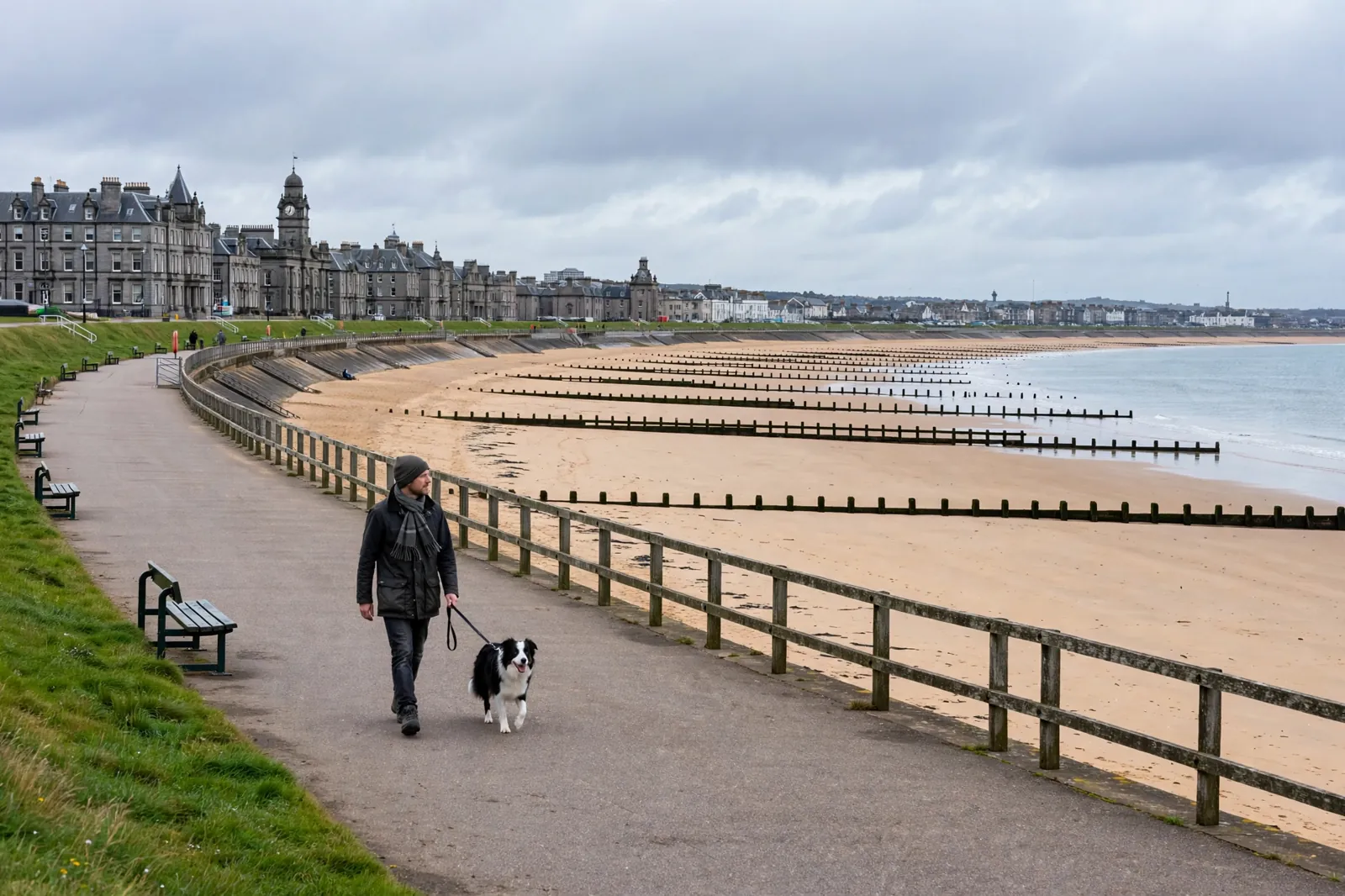
The seafront city is where the mileage is. The beach and its boulevard run for roughly two miles between the mouths of the Dee and the Don, giving a dog a proper leg-stretch without a car journey at either end. The parks city sits just inland: Duthie Park on the north bank of the Dee, Hazlehead Park out to the west, and a chain of smaller green spaces that break up the granite streets. Old Aberdeen, at the northern end, is the lead-walk city — slower, prettier and more fragile, where the dog's job is to be unobtrusive rather than exercised.
Plan the day in that order and most problems disappear. Give the dog its main run early on the beach or in Hazlehead, while energy is high and the sand is quiet. Save Old Aberdeen and the cathedral quarter for later, on a lead, when a settled dog can amble the High Street without pulling towards every gull. Use the harbour mouth at Torry Battery as a destination in its own right rather than an add-on, because dolphin watching rewards patience, and a dog that has already had its big walk is far more likely to sit through it.
Distances inside the city are kind. The seafront, the city centre and Duthie Park form a loose triangle that most fit dogs can cover on foot across a day, with buses and taxis as backup for tired legs. What Aberdeen asks in return is respect for weather. This is one of the most exposed city coasts in Britain: the wind off the North Sea can turn a mild forecast into a genuinely cold walk, sand blows across the boulevard on gusty days, and sea haar — the cold coastal fog of the north-east — can arrive within the hour. Build every plan with a windproof layer for the humans and a drying plan for the dog, and check the latest official guidance before you travel for anything time-sensitive such as events, closures or changes to local orders.
The beach and the boulevard: rules that actually apply
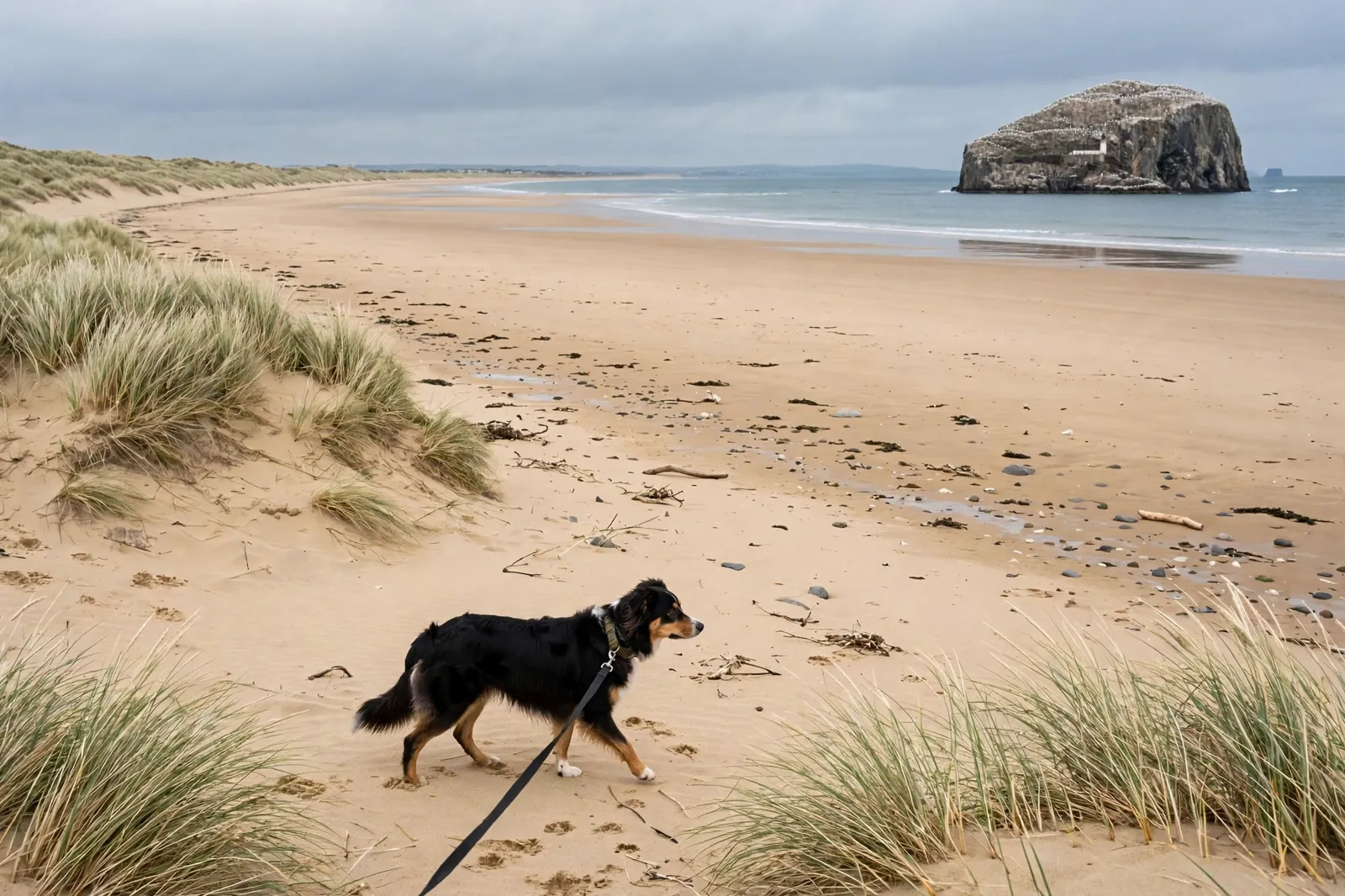
Aberdeen beach is the city's great dog asset: a long, broad sweep of sand running north from the harbour and Footdee, the old fishing village at the Dee mouth, up towards the Bridge of Don. Unlike many British resort beaches, the main city beach is generally open to dogs throughout the year rather than closing to them for a summer season, which is one reason Aberdeen suits an off-peak break so well. That general position is not a blank cheque. Local orders, event arrangements and the rules of individual facilities along the front can change, signs at each access point carry the current detail, and the sensible habit is to read the sign where you step onto the sand rather than assuming yesterday's rule still holds — check the latest official guidance before you travel.
Divide the front into three working zones. The southern stretch, near Footdee and the harbour, is the busiest and the most urban: narrower at high tide, popular with surfers, swimmers and promenade walkers, and the place to keep a dog closest. The middle stretch, opposite the leisure buildings and cafes of the boulevard, is the social centre — expect families, joggers, cyclists and other dogs in steady numbers. The northern stretch towards the Don mouth is usually the quietest and widest, the natural choice for a dog that needs space, a long line, or a calmer first experience of a city beach. Walking the full length and back makes a substantial outing of around four miles on flat ground, with the boulevard's hard surface as an all-weather alternative when the sand is soft or the tide is in.
Tide awareness matters more here than the dog rules do. At high water the usable sand narrows considerably on parts of the front, and a dog walked far along the beach on a rising tide can find the return route squeezed against the sea wall. Check tide times before setting out, walk the long version on a falling or low tide, and keep dogs out of the water near the harbour mouth, where currents around the Dee entrance are strong and unforgiving. Further north the sea is a more reasonable proposition for a paddling dog in calm conditions, but the North Sea stays cold in every month, and a full swim is a decision for a fit, water-confident dog — never an assumption. Our wider explainer on UK beach dog rules, seasonal bans and fines covers how local orders and fixed penalties work if you are combining Aberdeen with other beaches on the same trip.
Boulevard etiquette is straightforward and mostly about the mix of users. The promenade is shared with cyclists, runners, mobility scooters and children heading for the leisure facilities, so a short lead on the hard surface is the right default even where the sand itself allows more freedom. Cross to the sand for off-lead play, choose a spot away from the access ramps where everyone funnels through, and recall before your dog reaches other people's picnics, balls and towels. Bins run along the front; use them, because a two-mile beach generates a long walk back with a bag in hand if you miss one. Finally, respect the gulls without feeding the drama: Aberdeen's herring gulls are bold around food, so eat with the dog settled beside you rather than roaming, and keep snacks in closed bags.
Torry Battery and the dolphins: watching wildlife with a dog
Cross the Dee to Torry, on the south side of the harbour, and climb to Torry Battery — a nineteenth-century artillery fort whose grassy headland overlooks the harbour entrance. This is one of the most reliable shore-based dolphin viewpoints in Britain. The bottlenose dolphins of the Moray Firth regularly work the harbour mouth, chasing salmon and fish pushed in by the tide, and on a good watch they surface close enough to follow with the naked eye. Grey seals are regulars too, and the headland is also a migration watchpoint, so expect to share it with birders, photographers and people carrying serious optical equipment.
Dogs are part of this picture only on a lead, and a short one. The headland is exposed on every side, the ground is uneven in places with old military structures and drops towards the water, and the whole point of the outing is sustained quiet attention — the opposite of what an under-exercised dog wants to provide. Arrive with the big walk already done, pick a spot back from the edges and away from tripods and telescopes, settle the dog on a mat with water available, and be ready to leave cheerfully if barking starts. One noisy dog can clear a headland of both watchers and wildlife goodwill, and nobody at Torry Battery will thank you for testing that. Scotland's outdoor access principles and the general law point the same way: our guide to dogs on leads and the law in the UK explains where lead control is a legal requirement and where it is simply the condition of being welcome.
Timing improves the odds more than optimism does. Dolphins are reported most often around a rising tide, when fish move in towards the river mouth, and calm, overcast conditions make fins and splashes easier to pick out than bright glare on choppy water. There is no booking, no ticket and no guarantee: treat a sighting as a bonus on top of a good headland walk rather than the sole purpose of the trip, especially with children. Facilities at the Battery itself are minimal, so carry everything — water for the dog, a layer against the wind, and a bag for waste — and note that the wind on this headland is a step up even from the beach. In winter, shorten the watch drastically: a dog standing still in a north-easterly loses heat fast, and a twenty-minute look from the car park end is a perfectly respectable version of the outing.
Complete the Torry side with the short lead walk around Footdee — known locally as Fittie — the planned nineteenth-century fishing village of low cottages and squares at the north side of the harbour mouth. It is a lived-in residential community rather than an attraction, so the rules are those of someone's street: dog on a lead, no wandering into the squares' gardens, noise down, waste away with you. Done considerately, it is one of the most characterful short walks in the city, and it pairs naturally with the southern end of the beach for a harbour-side morning.
Duthie Park and Hazlehead Park: the two green anchors
Duthie Park, on the north bank of the Dee a short distance south of the centre, is Aberdeen's classic Victorian park: forty-four acres of lawns, tree-lined paths, a boating pond and the David Welch Winter Gardens, one of the largest indoor gardens in Britain. For a dog it works best as a calm, mostly on-lead outing. The formal planting, the pond wildlife and the sheer number of other visitors — prams, joggers, school groups, other dogs — all argue for a dog walking politely at heel rather than ranging. The Winter Gardens themselves are a human-only pleasure, so a two-person trip can split here happily: one takes the glasshouses, the other takes the dog around the park's perimeter paths and the riverside edge, and both finish at the same cafe meeting point. Check the latest official guidance before you travel for current opening arrangements and any areas under restoration.
The Dee-side setting is Duthie's second gift. Riverside paths connect the park into longer lead walks along the river, where herons, dippers and — in season — leaping salmon at the falls and fish passes further upriver give the walk a point beyond exercise. Keep dogs out of the river near weirs and fast water, and on a lead around anglers, whose lines, hooks and quiet concentration do not mix with a curious spaniel. In autumn the park's trees and the river corridor together make this the city's best gentle walk; in winter the paths can ice over early in the day, and a short-lead shuffle to the cafe is a legitimate plan.
Hazlehead Park, roughly four miles west of the centre, plays the opposite role: this is where Aberdeen dogs go to actually run. At around one hundred and eighty acres it is the city's largest park, with broad playing fields, long woodland walks, a maze, formal rose gardens and room — genuine room — to find an empty stretch of grass. The woodland sections suit a dog that needs sniffing shade in summer, the open fields suit ball play away from the sports pitches, and the scale means a reactive dog can usually be given distance without leaving the park. As everywhere, open grass is not a free-for-all: keep off marked pitches during play, lead up around the play areas, the maze entrance and the cafe terrace, and treat the rose gardens and any formal bedding as lead-only territory.
Choosing between the two is really choosing the day's shape. Duthie suits a half-day stitched into a city itinerary, combined with the river and the centre. Hazlehead suits the main exercise of a quieter day, or the morning run that makes an afternoon in Old Aberdeen possible. Dogs with limited mobility generally do better at Duthie, where the paths are shorter, the ground is gentler and the car-to-cafe distances are small. Young, high-energy dogs do better at Hazlehead, where one proper session can carry the whole day. Both parks have parking, and both get busy on fine weekend afternoons — go before eleven for the version of either park that dog owners actually recommend.
Old Aberdeen and the River Don: cobbles, cathedral and green space
Old Aberdeen, at the city's northern end near the Don, is the lead-walk quarter, and it repays slowness. The cobbled High Street runs past King's College Chapel, with its distinctive crown tower, through a streetscape of old merchants' houses and university buildings to St Machar's Cathedral, whose fortified twin spires and celebrated heraldic ceiling make it one of Scotland's most rewarding medieval churches. Dogs belong on a short lead throughout this quarter and outside the buildings themselves unless a venue states otherwise; the pleasure here is architectural and atmospheric, not athletic. Allow an hour for the street and cathedral exterior at dog pace, longer if you sit — as you should — and simply watch the light on the granite.
Practicalities are specific. Cobbles and setts are hard on older joints and treacherous for everyone when wet or icy, so shorten the route rather than hero through it, and consider the smoother parallel streets for the return leg. There is little spare grass on the High Street itself, so offer a toilet stop before you start, in the green edges around the university or down towards the river. Water bowls appear at some cafes in season but should never be assumed; carry a bottle and a folding bowl as standard kit in this part of the city.
Seaton Park, beside the cathedral where the ground falls to the Don, is what turns Old Aberdeen into a proper dog outing rather than a dog-tolerated one. Its twenty-seven acres of lawns, mature trees, walled garden and riverside path give the dog the green, sniff-rich contrast to the cobbles — the place for a calmer stretch, a long-line amble and a sit on a bench while the river goes past. The Don here is a real river with real banks: keep dogs back from steep or undercut edges, out of the water in high flow, and on a lead near the walled garden and other visitors. Combined, cathedral quarter plus Seaton Park makes a satisfying half-day, and the walk or bus ride back along King Street returns you to the top of the beach — which is exactly where a dog that has behaved beautifully on a lead all morning deserves ten off-lead minutes on the sand.
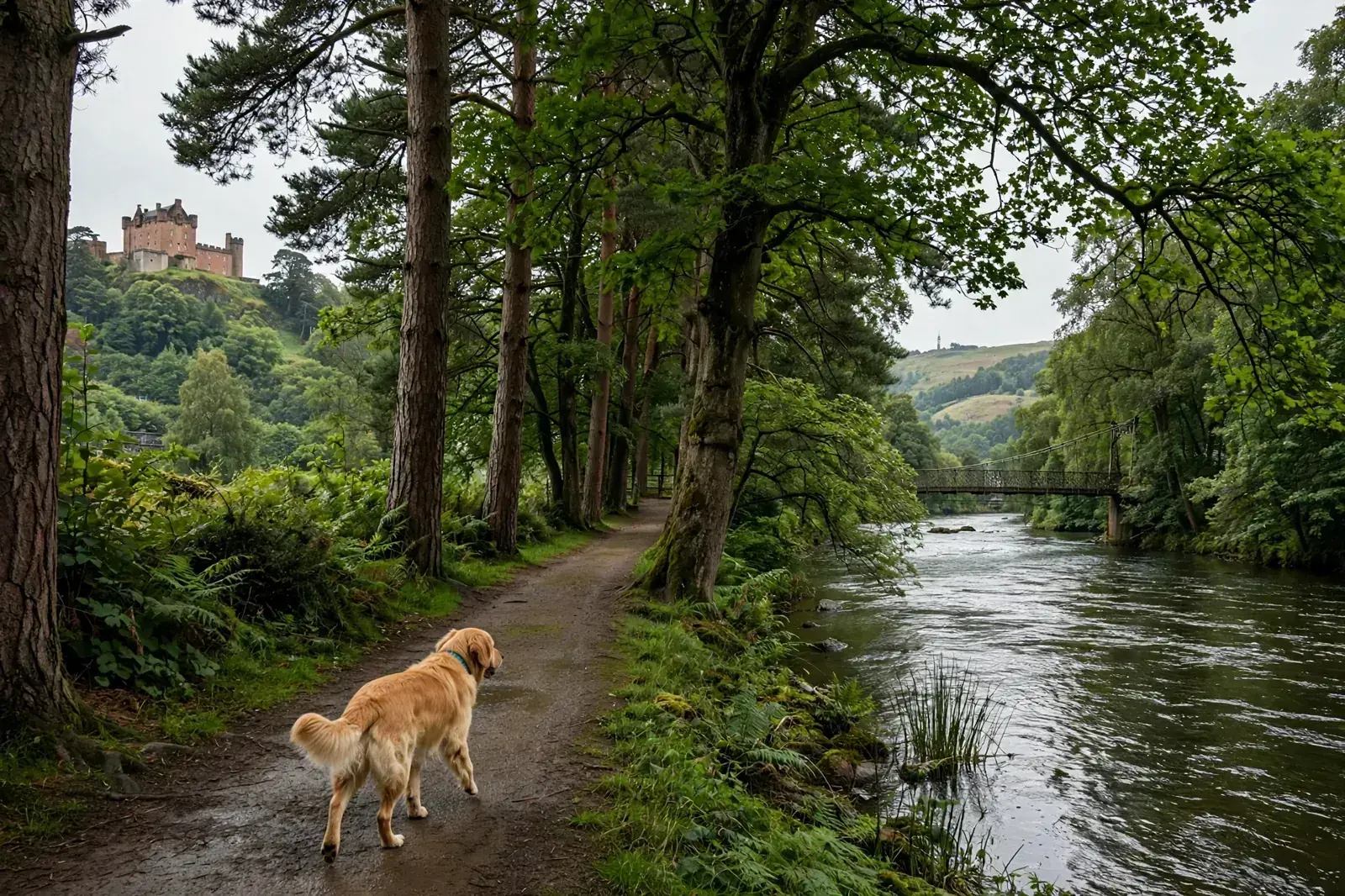
Extend the Don theme if you have the time. Riverside paths continue upstream towards the Brig o' Balgownie, the thirteenth-century bridge that Byron wrote about, and the surrounding woods give a sheltered option when the seafront wind is at its worst. These paths can be muddy after rain and narrow in places, so they suit a steady dog more than a lunging one, and passing places require the usual choreography of stepping in, shortening the lead and letting others by. It is a good reminder that Aberdeen's best dog walking is often its oldest: the routes people have walked along this river for centuries still work, because they were built at walking pace.
A Royal Deeside day trip: west along the A93
With a car, Aberdeen's finest dog day out runs west. The A93 follows the River Dee through Banchory, Aboyne and Ballater towards Braemar and the Cairngorms fringe — Royal Deeside, named for the royal family's long association with Balmoral, and one of the great drivable river valleys in Scotland. For a dog the formula is simple and repeatable: a riverside or woodland walk, a village stop with a cafe or bakery, a castle grounds or estate trail if the rules allow, and the river never far away. Break the drive into legs of thirty to forty-five minutes rather than doing the whole valley in one push, and the dog arrives at each stop fresh instead of frazzled.
Banchory, about forty minutes out, is the natural first stop: a handsome town with riverside paths along the Dee and woodland walking on Scolty Hill for those who want a viewpoint. Aboyne adds a village green, more riverbank and a good lunch stop. Ballater, the closest village to Balmoral, is the day-trip capital — allow real time here, for the old royal station, the riverside meadows and the easy woodland circuits in the hills immediately around the village. Castle stops along the valley, such as Crathes near Banchory with its famous gardens and estate trails, and Drum or Craigievar further into the valley, each set their own dog rules for grounds versus interiors, and these differ and change: check the latest official guidance before you travel, and plan on the grounds being the dog's share while interiors are taken in turns.
The valley's working landscape sets the lead rules. Deeside is sheep country, deer country and, in spring and summer, ground-nesting bird country, so a dog off the lead belongs only where you can see the whole picture and recall is absolute; everywhere else, use a lead or a long line and treat livestock encounters as a cue to clip on early, not late. Red deer come down to lower ground in winter, red squirrels are a genuine possibility in the pinewoods — a chase risk for high-drive dogs even on a path — and adders bask on warm paths in summer, so keep dogs to the track and know where the nearest vet is before you need one. If Deeside persuades you to stay longer and head for the hills proper, our seasonal guide to the Cairngorms with a dog covers the higher, wilder end of this same landscape, and the comparison with Inverness as a dog base helps if you are choosing between Scotland's two northern cities for a longer tour.
Logistics decide whether the day feels easy. Fuel and dog supplies thin out as you go west, so start with a full tank and a full water container. Mobile signal is patchy in the upper valley; download maps and your accommodation address before leaving Ballater. In winter the A93 is a serious road in serious weather — daylight is short, ice is common, and a Deeside day trip should shrink to Banchory or Aboyne rather than pressing on to Braemar. In summer the opposite applies: the long northern evening makes Ballater and back a relaxed full day, with the last beach walk of the trip waiting for you back in Aberdeen at ten at night.
Where to stay and eat with a dog
Aberdeen's dog-friendly accommodation clusters in the same three areas this guide has used throughout, and choosing between them is choosing your mornings. Seafront and city-centre hotels and apartments put the beach outside the door — unbeatable for the first and last walks of the day, and the easiest option without a car — but they ask a dog to settle amid city noise, lifts and corridors. West-end and Duthie-side guesthouses and self-catering options trade the sea view for gardens, quieter streets and a shorter drive to Hazlehead and the A93. Old Aberdeen and Bridge of Don options suit walkers who want Seaton Park and the quieter northern beach, and who are happy to bus or drive into the centre.
Whatever the area, run the same checks before booking, because "dogs welcome" in Aberdeen can mean anything from a dog treated as a guest to a dog tolerated in one ground-floor room. Confirm which rooms or units actually accept dogs, the per-dog charge, the maximum size or number, and whether the dog may be left alone — then ask the two questions that matter in a granite city: is there a practical toilet patch within two minutes of the door for the late-night walk, and is the flooring in the room forgiving of a dog coming in wet off the beach? A drying area, an outside tap or even a utility sink changes a wet-week stay from a battle over towels into a routine. Get the answers in writing, and treat a vague reply as a no.
Eating with a dog follows the usual Scottish pattern of steady improvement and total inconsistency between neighbouring businesses. Harbour-side and seafront cafes tend to be practised with sandy dogs; pubs in Torry, Footdee and the west end often welcome dogs in the bar even when the restaurant is human-only; and the Deeside villages are generally strong, with walkers and dogs forming a core part of trade. None of this should be assumed for a specific meal. Name the dog when you book, ask where exactly you will be seated, and favour places with a terrace or bar area so a restless dog has a dignified exit. After a beach morning, a dog that is rinsed, dried and settled on its own mat will be welcome in far more places than its muddier self, which is the simplest argument for keeping the drying kit in the car all trip.
Wind, tides and practical planning
Aberdeen's weather deserves its own section because it, more than any rule, shapes a dog trip here. The city sits at roughly the latitude of southern Alaska's panhandle, and the North Sea moderates the cold but delivers the wind. Summer days are long and can be genuinely warm on a sheltered beach; summer evenings still call for a layer. Winter brings short days, regular gales and a wind chill on the seafront that shortens walks for small, old or thin-coated dogs in a way the thermometer alone does not predict. Pack a dog coat for those dogs in any month from October to April, plan two shorter walks instead of one heroic one in a gale, and remember that a dog that refuses at the door on a storm day is giving you information, not attitude.
Build the trip around three checks. First, tides: the beach, the harbour mouth and any rockpool or shoreline exploring all change with the tide table, so look it up the night before rather than at the water's edge. Second, wind direction: an easterly comes straight off the sea and makes the seafront the coldest place in the city, while the same day can be perfectly pleasant in Hazlehead's woods or the Don valley — swapping the day's plan to match the wind is the mark of a well-run Aberdeen trip. Third, daylight: the difference between June and December at this latitude is roughly ten hours of it, which changes everything from Deeside driving to how many outings fit between breakfast and dark. A torch and a light-up collar are winter essentials for the last walk, not novelties.
For arrivals and departures, Aberdeen is well connected by the standards of the north: trains run south to Dundee, Edinburgh and Glasgow and north-west towards Inverness, the airport sits north-west of the city near Dyce, and the harbour serves ferry routes north. Dogs arriving by train get an immediate dividend — the station is central, and the beach or the Dee-side paths are a short lead walk away for a decompression stroll. Check your operator's current dog rules before travelling, carry water for the journey, and plan the first hour in the city exactly as you would at home: toilet, water, a short familiar-style walk, then rest. Vets are well provided for across the city, but save the number and location of your nearest practice — and its out-of-hours arrangement — before the trip rather than during an emergency, and note that a Deeside day puts you up to an hour from the city practices, which argues for the valley's own vets' numbers in the phone as well. Aberdeen is also the ferry port for the Northern Isles: see our guide to Shetland with a dog for pet cabins and kennels on the overnight crossing. The same port serves Orkney: see our guide to Orkney with a dog for the ferry options and island rules.
Finally, the small courtesies that keep Aberdeen as dog-friendly as it currently is. This is a city where dogs are broadly welcomed because most owners behave well in visible places: leads on the boulevard, waste picked up on a two-mile beach where everyone can see, quiet dogs at the dolphin viewpoint, respectful dogs in a medieval cathedral quarter. Every visitor with a dog is either adding to that reputation or spending it. Travel so that the next dog is still welcome — and check the latest official guidance before you travel for anything in this guide that a council order, a property or a season could have changed.
Practical questions
Before you go
Are dogs allowed on Aberdeen beach all year?
Aberdeen's main city beach is generally open to dogs throughout the year, which makes it unusual among British resort beaches, but local orders and seasonal arrangements can change and individual stretches near facilities may carry their own signs. Keep dogs under close control around other beach users, clean up immediately, and check the latest official guidance before you travel, including any signage at the access point you use on the day.
Can I watch dolphins at Torry Battery with my dog?
Yes, provided your dog stays on a short lead and settles quietly. Torry Battery overlooks the harbour mouth where bottlenose dolphins are regularly seen, and the site is exposed, uneven in places and popular with other watchers. Keep your dog close, away from the edges and from other people's telescopes and tripods, bring water and shelter from the wind, and step away if your dog becomes restless or vocal so other watchers and the wildlife are not disturbed.
Which Aberdeen park is best for a longer off-lead run?
Hazlehead Park, west of the centre, is the better choice for a longer run because of its scale: broad playing fields, woodland edges and long internal paths give a dog room to move away from roads. Duthie Park, by the River Dee, suits shorter, calmer outings with more lead walking around its formal gardens and Winter Gardens. In both parks, use open grass away from sports pitches, play areas and other visitors, keep recall reliable, and follow any local signs on the day.
Where can I walk my dog in Old Aberdeen?
Old Aberdeen works well as a lead walk: follow the cobbled High Street past King's College Chapel, continue towards St Machar's Cathedral, and extend the outing along the River Don through Seaton Park for greener, softer ground. Keep dogs on a lead around the cathedral grounds, university buildings and other visitors, watch paws on wet cobbles, and treat Seaton Park's open grass as the place for a calmer sniff and stretch before heading back.
Can I take my dog on a day trip to Royal Deeside from Aberdeen?
Yes. The A93 corridor west through Banchory, Aboyne and Ballater gives a straightforward dog-friendly day out, with riverside paths, woodland walks and castle grounds to combine. Keep dogs on a lead around livestock, deer and ground-nesting birds, check each property's current dog rules before setting off because grounds and interiors differ, carry water for the whole day, and allow extra time for the return drive in fading light outside summer.