This guide is independent and contains no paid placement. Beach rules, parking charges and pub policies change, so check the signs and the official guidance before you travel.
Mortehoe suits a dog that is happy on a lead, steady on uneven ground and content with a quiet village after a big coastal walk. Start in the village, walk out to Morte Point on a lead, drop down to Woolacombe Beach only when the season, the signs and the tide allow it, and save the steep climb back for a slow, watered return.
First, understand the village
Mortehoe sits on the clifftop above Woolacombe Bay in North Devon, a small village of stone cottages, narrow lanes and a church tower that you can see for some distance along the coast. It is not a resort in the usual sense. There is no seafront parade here, no arcade and no long row of shops. That is exactly why many dog owners like it: the village stays calm even when Woolacombe, a mile down the hill, is busy with surf schools, beach cafes and families carrying windbreaks and bodyboards. Mortehoe works best as a base for walking, not as a place to rush through on the way to somewhere louder.
The shape of the village matters for planning a dog day. The centre gathers around the church of St Mary and a small cluster of cottages, a pub and a shop, and the lanes fan out from there towards the coast path, towards Woolacombe and towards the farmland inland. Pavements are narrow or absent in places, walls run close to the road, and cars, tractors and delivery vans all use the same tight lanes. A dog that walks neatly on a short lead will be comfortable here. A dog that lunges at passing vehicles, pulls hard towards every gate or tries to greet every walker will find the first ten minutes demanding, so build in a calm start rather than heading straight for the cliff edge.
Arrive with a plan for the first hour. Park, let the dog out for a short toilet walk on a lead, offer water, and walk the village lanes at a gentle pace before you commit to a longer route. That slow start does two useful things. It lets a nervous dog learn the sounds of the village — a tractor, a gull, a gate closing — without the added exposure of a cliff path. It also lets you check the practical details that shape the rest of the day: where the car park is, which lane leads to the coast path, whether the shop is open, and how busy the village feels. If the dog is still unsettled after that first loop, choose the shorter Morte Point circuit rather than a long linear walk with no easy way back.
The village is also a good place to think about timing. Early morning is the quietest time on the coast path, and the light over Woolacombe Bay before the beach crowds arrive is the best part of the day for many walkers. Midday in summer brings more people, more dogs and more traffic on the road down to Woolacombe, and the climb back up to Mortehoe in the heat is harder for dogs than the descent. Late afternoon, when the beach empties and the wind drops, is often the most comfortable time for a second, shorter walk. In winter the village is quieter still, the coast path is muddier and the wind is stronger, but the sense of space on the headland is at its best — provided you dress for it and keep the dog warm and dry afterwards.
One more thing to settle before you walk: what sort of dog day you actually want. Mortehoe can give you a short headland loop, a long coastal hike, a beach afternoon, or a slow village day with a pub lunch and a garden nap. It cannot easily give you all four at full length in one day, especially with an older dog, a puppy or a dog that tires quickly on hills. Pick one main walk, one beach window if the rules and tide allow, and one calm stop, and let the rest of the day flex around the dog. That is the difference between a day that feels spacious and a day that ends with a tired dog being carried up the hill from Woolacombe.
The Morte Point walk
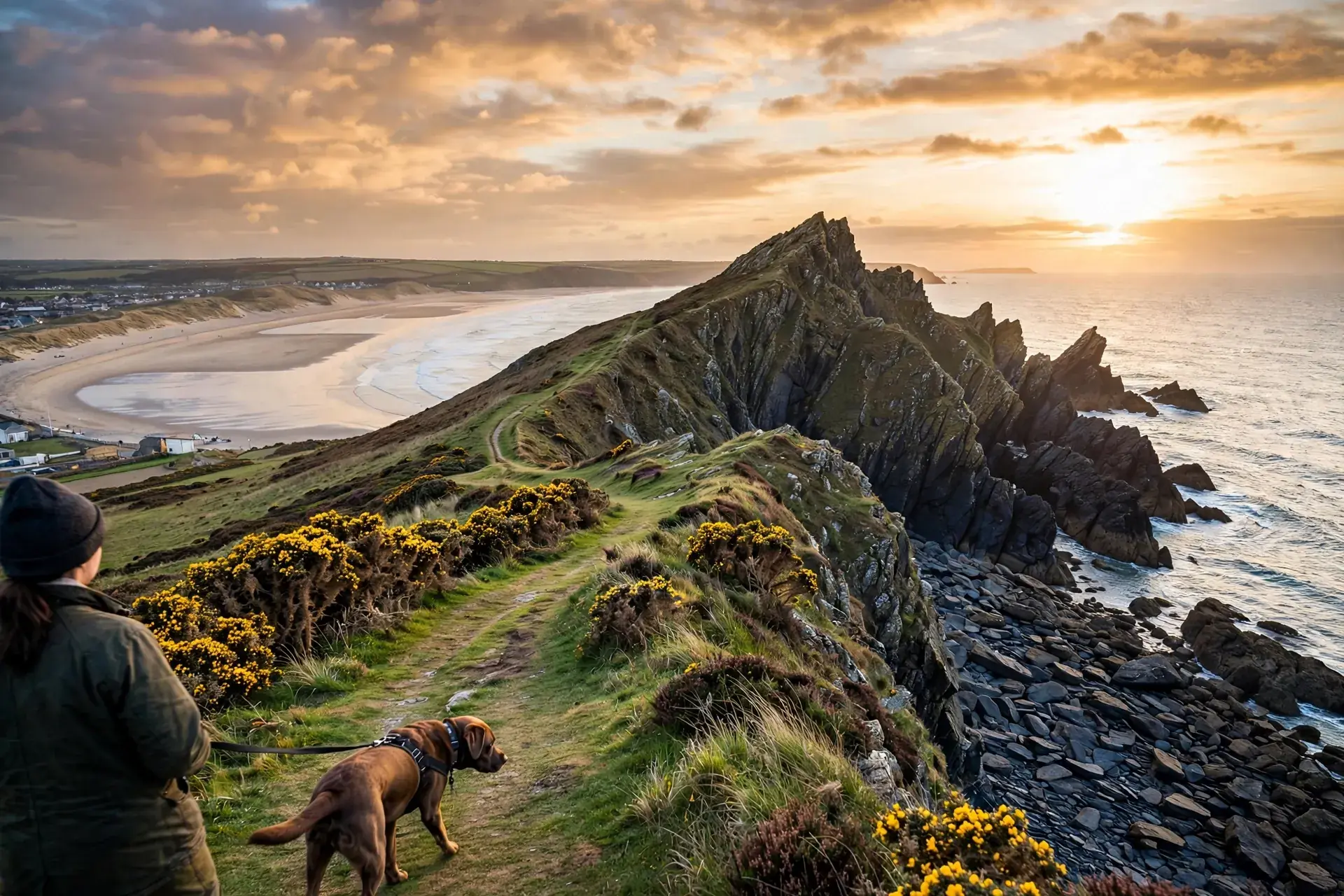
Morte Point is the rocky headland that gives this corner of North Devon its drama. From Mortehoe village the path runs west across open grassland and rocky ground towards the point itself, with Woolacombe Bay opening out behind you and the sea on three sides as you reach the far end. On a clear day the view runs a long way along the coast, and the sound changes as you walk: the village fades, the wind takes over, and the sea becomes the loudest thing around. It is a walk that rewards slow looking, and it is also a walk where a lead, good footwear and a sensible distance from the edge are not optional extras.
The ground underfoot is the first thing to plan for. The path is a mix of grass, bare rock, loose stone and, after rain, muddy patches where the track dips. It is not a surfaced promenade, and there are uneven steps and rocky sections where a dog needs to pick its way rather than trot. Small dogs may need a lift over the roughest stretches, and older dogs with stiff joints will feel the ups and downs more than the distance suggests. A harness with a handle gives you a way to steady a dog over a rock step without pulling on its neck, and a lead of two metres or less keeps the dog close enough to guide. A long line is a poor choice here: it tangles on gorse and rock, and it gives a chasing dog too much room near a drop.
Keep the dog on a lead for the whole headland walk. The reasons stack up quickly. The cliff edge is unfenced for long stretches, and the grass at the edge can hide a sudden drop. Sheep graze the coastal grassland, and a dog that runs at them can cause real harm and put itself at risk. Ground-nesting birds use the headland in spring and summer, and a dog running through the grass can disturb nests that are invisible from the path. Add in other walkers, other dogs on leads and the occasional gust that can unbalance a small dog, and the case for a short lead is straightforward. If your dog needs off-lead running, save it for a beach or enclosed field where the rules allow it, not for a headland with cliffs on both sides.
Allow time for the walk rather than rushing it. The circuit from the village to Morte Point and back is a comfortable half-day outing for most fit dogs, but the time depends on how often you stop, how much sniffing the dog wants to do and how windy it is. Take water for the dog and for yourself, because there is no tap or shop on the headland, and the wind can dry a dog out faster than you expect. In summer, carry enough water for the return as well as the outward leg, and offer it in the shelter of a dip in the ground rather than on the most exposed part of the point. In winter, the same walk can feel twice as long in a headwind, and a dog that is wet and cold on the way back will need a coat and a warm car or cottage at the end of it.
Know when to turn back. If the wind is strong enough to push you sideways, if the rain is driving horizontally across the point, or if visibility drops so you cannot see the path ahead, the sensible choice is to retrace your steps to the village. There is no shelter on the headland and no shortcut back. The same applies if the dog starts to lag, limp, shiver or refuse to walk: those are signs to stop, check paws for cuts or thorns, offer water, and head back by the shortest safe route. A shorter walk that ends with a comfortable dog is a better day than a longer walk that ends with an injury, and Morte Point will still be there on a calmer day.
Woolacombe Bay and the beach
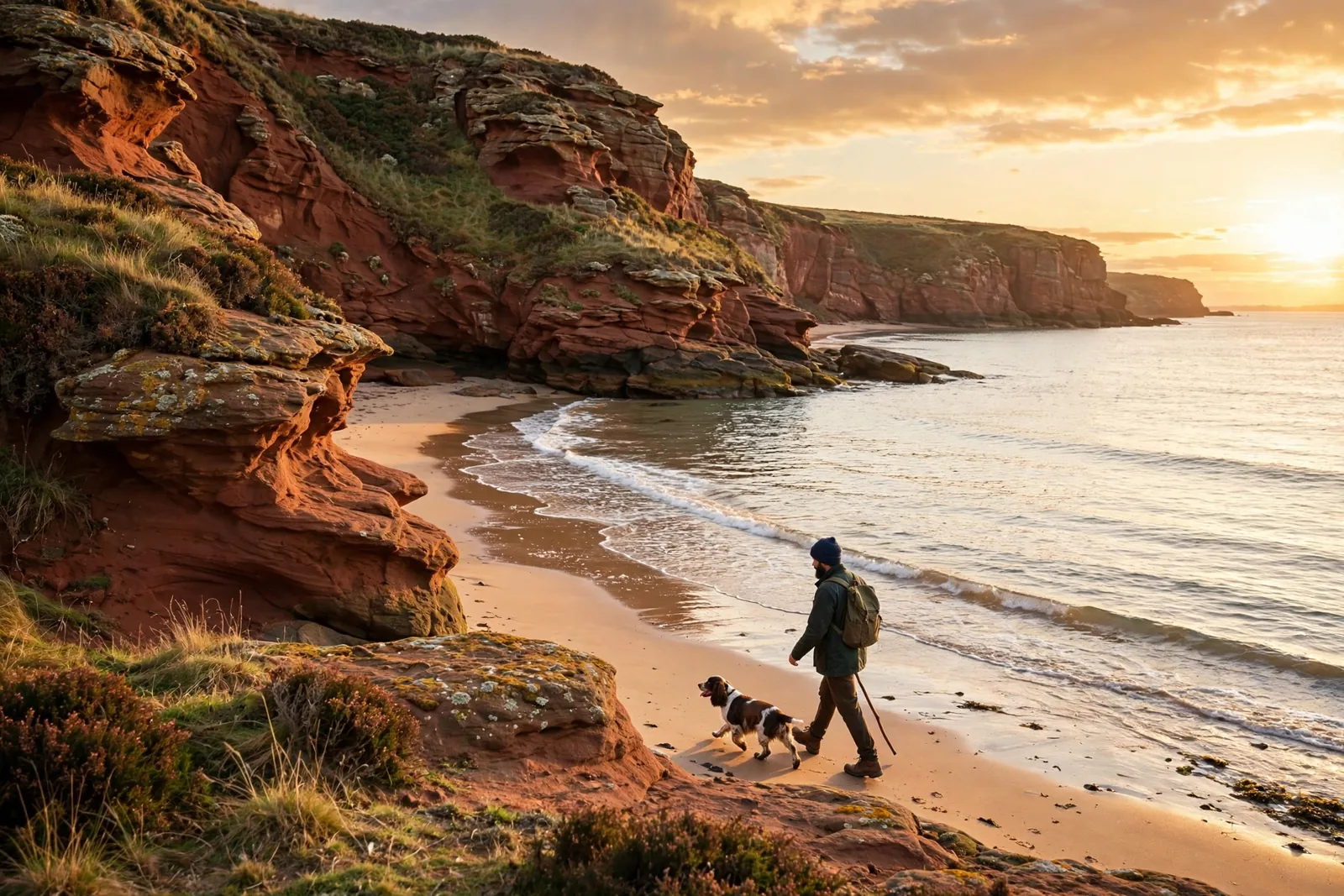
Woolacombe Beach is the long, wide sweep of sand below Mortehoe, and it is the reason many people come to this part of Devon at all. From the clifftop the bay looks inviting: pale sand, a gentle curve, and surf rolling in from the Atlantic. From the sand itself the scale is different. The beach is about three miles long, the tide covers a great deal of sand, and the walk from one end to the other is a proper outing rather than a stroll. Dogs love the space, the smell of the sea and the chance to run, but the beach needs the same careful reading as the headland — season, zone, tide and weather all matter.
Dog access on Woolacombe Beach is seasonal and zoned, and the detail changes, so read the signs at the access point you actually use rather than relying on memory or a single online summary. In the quieter months dogs generally have much wider access, while in the summer season a restriction applies to the central part of the beach near Woolacombe village. The northern end, towards Mortehoe, and the southern end, towards Putsborough, are the usual places to look for dog-friendly sand, but the boundary lines move with the signs, not with habit. If you are unsure whether you are in a restricted zone, ask a beach warden, a lifeguard or a local shop, and check the official guidance before you travel.
The tide is the practical fact that catches most visitors. Woolacombe is a wide, flat beach at low tide, which makes it tempting to walk a long way out towards the water, and the incoming tide can cut off the route back along the sand faster than people expect. Check the tide times before you set off from Mortehoe, plan to be off the lowest part of the beach well before the tide turns, and keep an eye on the water while the dog is playing. A dog that chases the waves will not notice the tide, and a dog that runs after a ball thrown too far out can quickly be out of its depth. Keep throws short and parallel to the shore, not straight out to sea, and keep the dog on a lead near the water if it is a strong chaser or a poor swimmer.
Surf and currents deserve respect even on a calm-looking day. Woolacombe is a popular surfing beach, and the same waves that attract surfers create rip currents and strong undertows that are dangerous for dogs as well as people. Never let a dog swim in surf it cannot stand in, and never go in after a dog that is in difficulty — call for help from a lifeguard instead. After a swim, rinse the dog with fresh water if you can, check ears and paws for sand and salt, and dry the dog before the walk or drive back up to Mortehoe. Salt water, swallowed in quantity, can make a dog ill, so carry fresh water and offer it regularly rather than letting the dog drink from the sea.
On the sand itself, a few small habits make the day easier. Bring a long line rather than letting the dog off the lead entirely if recall is unreliable, because the beach is wide and distractions — other dogs, children, gulls, surfers, kites — are constant. Pick up after the dog and carry the bags with you, because bins at the beach access points fill quickly on busy days. Watch for hot sand on a sunny day, for sharp shells and for litter, and check paws after a long run. In summer, the sand can be hot enough to be uncomfortable, and a dog that is panting hard, seeking shade or lifting its paws needs water, shade and a rest, not another game of fetch.
The South West Coast Path from Mortehoe
Mortehoe sits directly on the South West Coast Path, the long-distance trail that follows the coast of South West England, and that changes what a dog walk from the village can be. You are not limited to a single loop. You can walk west towards Morte Point and beyond, or east and south along the cliffs towards Woolacombe, Putsborough and, for the very fit, much further along the North Devon coast. The path is well waymarked with the familiar acorn symbol, and the sections around Mortehoe are among the most scenic on this stretch — but they are also steep, exposed and physically demanding, so choose the distance with the dog, not with the map.
Heading east from Mortehoe towards Woolacombe is the shorter, more popular option, and it is the one most dogs will enjoy. The path drops down towards the bay, with views back to Morte Point and forward to the long beach, and the walking is a mix of grassy track, steps and stony ground. The descent is steady rather than sheer, but the return climb is a proper hill, and a dog that runs down happily may need frequent stops on the way back up. Keep the dog on a lead on the narrow sections, especially where the path runs close to the road or close to the cliff edge, and step aside for faster walkers rather than trying to hold a line on a narrow stretch.
Heading west past Morte Point takes you into wilder, quieter country. The path continues along the cliffs towards Bull Point and the lighthouse, with fewer people, more wind and longer gaps between places to stop. This is a walk for a fit dog, a fit walker and a day with good weather and plenty of daylight. There is no cafe or shop to aim for, and the ground stays rough and uneven, so carry water, a lead, a phone with charge and a plan for turning back. If the dog is already tired after Morte Point, do not push on simply because the path continues. The coast path rewards the walker who knows their limit and turns back with a dog still in good spirits.
For a longer day, some walkers use the coast path as one leg of a loop and a quiet inland lane as the other, but that needs careful route-finding and a realistic sense of distance. The lanes inland from Mortehoe are narrow, with blind bends and no pavement, and a dog on a lead beside a lane with fast traffic is not a relaxing end to a coastal walk. A better long option for many visitors is to walk the coast path in one direction and arrange a lift or a taxi back, or to walk out and back on the same coastal stretch so the dog knows the ground on the return. Whatever you choose, tell someone your route and your expected return time if you are walking alone, and check the official guidance before you travel for any path closures or diversions.
Waymarking, weather and daylight are the three things to check before a coast path day. The acorn signs are regular, but in fog or heavy rain they are easy to miss, and the path can split around a field or a rocky outcrop in a way that is not obvious at first glance. A downloaded offline map helps, but do not rely on a phone signal on the headland — coverage is patchy, and a phone that is also your camera and your map will run down faster in the cold and wind. Start early enough that you finish in daylight, and build in a margin for a slower return, a lame paw or a detour. A coast path walk that ends in the dark, with a tired dog and a steep lane still to climb, is a walk that should have been shorter.
Parking, lanes and the church
Parking in Mortehoe is straightforward if you arrive with the right expectation: use the village car park, arrive early on a good day, and do not try to squeeze a car into a lane that was built for a cart. The village car park is the practical starting point for the coast path, for Morte Point and for the walk down to Woolacombe, and it saves the village lanes for residents, deliveries and farm vehicles. Charges and opening arrangements can change, so check the signs in the car park itself and check the official guidance before you travel.
On sunny weekends and in school holidays the car park fills early, and the overflow is not a second car park a short walk away — it is the narrow lanes themselves, where a badly parked car can block a tractor, a delivery van or an emergency vehicle. If the car park is full, the better choice is to come back later, to park in Woolacombe and walk up to Mortehoe, or to choose a different day for the headland walk. Parking considerately is not just politeness here; it is part of keeping a small village working for the people who live in it, and a dog owner who parks well is a dog owner who is welcome back.
The lanes themselves need a little care with a dog. They are narrow, walled and winding, with limited visibility around bends and very few pavements. Walk on the side that gives you the best view of oncoming traffic, keep the dog on a short lead on your inside, away from the road, and be ready to step into a gateway or passing place when a vehicle approaches. At night the lanes are dark, so a reflective lead, a collar light and a torch are worth carrying even for a short evening toilet walk. A dog that is used to pavements and street lighting may find the lanes unsettling at first, so keep the first evening walk short and familiar.
The church of St Mary, at the heart of the village, is a useful landmark and a calm place to pause. The churchyard is an old, quiet space with stone walls and grass, and it is a place to be respectful rather than a place to let a dog run. Keep the dog on a lead in the churchyard, keep it off graves and planted areas, and pick up after it. The tower is a good point to orient yourself: from the church you can find the lane to the coast path, the lane down to Woolacombe and the lane back to the car park, and on a first visit it is worth standing there for a minute and fixing the layout in your mind before you set off.
Finally, think about the car as part of the dog's day. On a warm day a car parked in the sun heats up quickly, even with the windows open, and a dog should never be left in a car in warm weather. On a cold or wet day the car is a useful warm, dry base between walks, but a wet dog in a cold car will chill quickly, so dry the dog, offer water and use a coat or blanket. Keep a towel, a spare lead, a water bowl and a bag for muddy gear in the car so the return to Mortehoe village is not a scramble, and check the dog's paws before the drive home — a cut picked up on the rocks at Morte Point is easier to deal with in the car park than on the motorway.
Pubs, cafes and a place to sit
After a coastal walk, a pub or cafe in Mortehoe is the natural place to stop, and the village has a small number of places where a dog can settle while you eat or drink. The pattern in North Devon is familiar: dogs are usually welcome in the bar area or on an outdoor terrace, less often in the main dining room, and the rule can depend on the time of day, how busy the place is and whether the dog can settle quietly. Do not assume a place that welcomed dogs last year still does, and do not assume a place that welcomes dogs on a quiet Tuesday will do the same on a packed Saturday lunchtime. Ask at the door, and check the official guidance before you travel.
The Ship Aground, the village pub in Mortehoe, is the best-known stopping point, with a bar and a garden where dogs are commonly welcomed, and a menu that suits a hungry walker. Sit in the area the staff suggest rather than choosing a table in the dining room and hoping for the best, and settle the dog on a mat under the table with a water bowl before you order. A dog that has just walked Morte Point will often sleep through lunch if it has water, a comfortable spot and no reason to watch every person who passes. A dog that is still wired from the walk, panting hard or scanning the room, needs a few minutes outside first, a drink and a chance to cool down before it is asked to lie still.
Cafes in Mortehoe and down in Woolacombe follow a similar pattern, with outdoor seating often the easiest option for a dog. A terrace table on a sunny day can be a good compromise, but it brings its own checks: is the terrace shaded, is the dog on a lead where it cannot wander into the road or into another table's food, and is there water available? Bring your own water and a collapsible bowl rather than relying on a cafe to provide one, and bring a mat so the dog is not lying on cold stone or wet wood. If the weather turns, a takeaway coffee and a sandwich eaten on a bench above the bay can be a better dog day than a crowded indoor cafe where the dog cannot settle.
Good pub and cafe manners make the next dog owner's visit easier. Keep the dog on a lead at all times indoors, keep it off chairs and tables, and do not let it beg from other tables or approach other dogs without the owner's agreement. If the dog barks, whines or paces, take it outside for a short break rather than waiting for it to settle on its own. Clean up any mess immediately and tell the staff, and leave a table that is as tidy as you found it. Pubs and cafes that welcome dogs do so because most dog owners behave well; one noisy, uncontrolled visit can change a policy for everyone.
If you are staying overnight, ask your accommodation about the nearest dog-friendly place for an evening meal, and book ahead in the summer. The village is small, tables are limited, and a walk-in on a Friday evening in August may find the pub full and the dog with nowhere to sit. A booked table, a dog that has already had a good walk and a mat under the table is a combination that works, and it leaves you free to enjoy the evening rather than managing a restless dog in a busy room. And if the pub is full, a takeaway eaten in the garden of a dog-friendly cottage, with the dog asleep at your feet, is not a poor second choice.
Staying overnight with a dog
Mortehoe and the Woolacombe area have a range of places to stay with a dog, from cottages and bed and breakfasts in the village itself to larger holiday parks and hotels down in Woolacombe and along the coast. The right choice depends on the dog more than on the view. A cottage with an enclosed garden suits a dog that needs a safe toilet area at night. A bed and breakfast with a ground-floor room suits an older dog that struggles with stairs. A larger park with a dog exercise area suits a young dog that needs space, but it may also mean more dogs, more noise and more stimulation than a nervous dog can handle. Start with the dog's needs, then look at the location.
Ask the specific questions before you book, and get the answers in writing. How many dogs are allowed, and is there a charge per dog per night or per stay? Is the garden genuinely enclosed, and how high is the fence or wall? Are dogs allowed in the living room, on the furniture, or only in a specific room? Is there a place to dry a wet dog, a tap outside, or a hard floor by the door for muddy paws? Where is the nearest practical toilet walk after dark, and is it lit? A property that answers these questions clearly has usually thought about dogs properly. A property that answers with a vague reassurance has not, and the gap will show on the first wet evening.
The location of the accommodation matters as much as the property itself. A cottage in Mortehoe village puts you on the coast path in minutes and gives you a quiet evening after the day visitors have gone. A place down in Woolacombe puts you on the beach in minutes, but it also puts you in the busiest part of the bay, with more traffic, more people and more noise. A place inland, on a farm or in a nearby village, may be quieter and cheaper, but it adds a drive to every walk. Think about the last walk of the day and the first walk of the morning: both should be easy, short and safe, not a drive along a dark lane.
Settle the dog into the accommodation as you would at home. Walk the boundary of the garden before you let the dog off the lead in it, check gates, gaps and low walls, and keep the dog on a lead in the garden until you are sure it is secure. Set up the dog's bed in the same place each night, keep feeding times the same, and bring the dog's own bedding, bowl and a familiar toy. A dog that knows where its bed is and where the door is will settle faster than a dog that is expected to work it out in a strange cottage after a long walk. And if you plan to leave the dog alone in the accommodation while you eat out, check the rule first — many places do not allow it, and a dog left alone in a strange place is a dog that may bark, chew or try to escape.
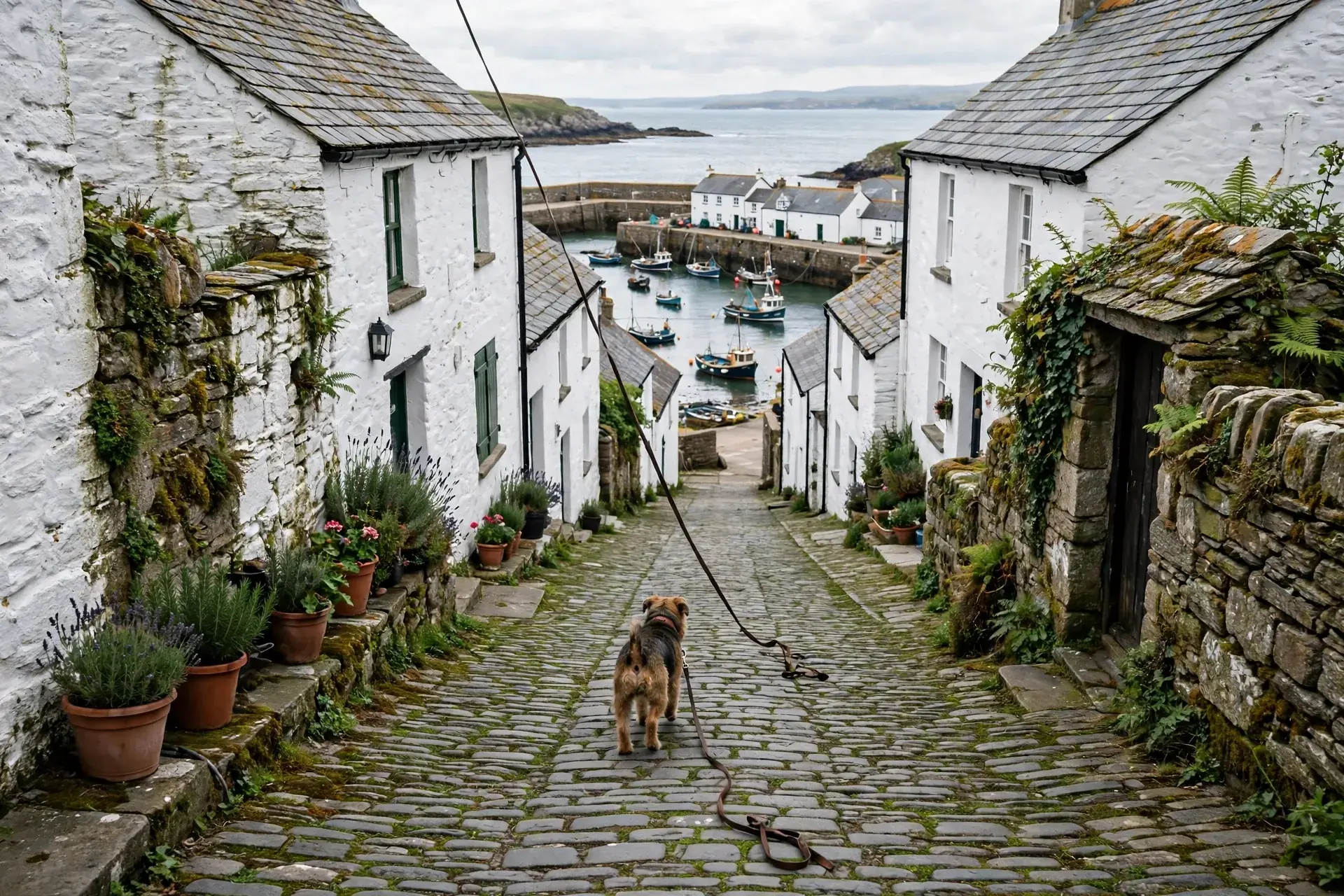
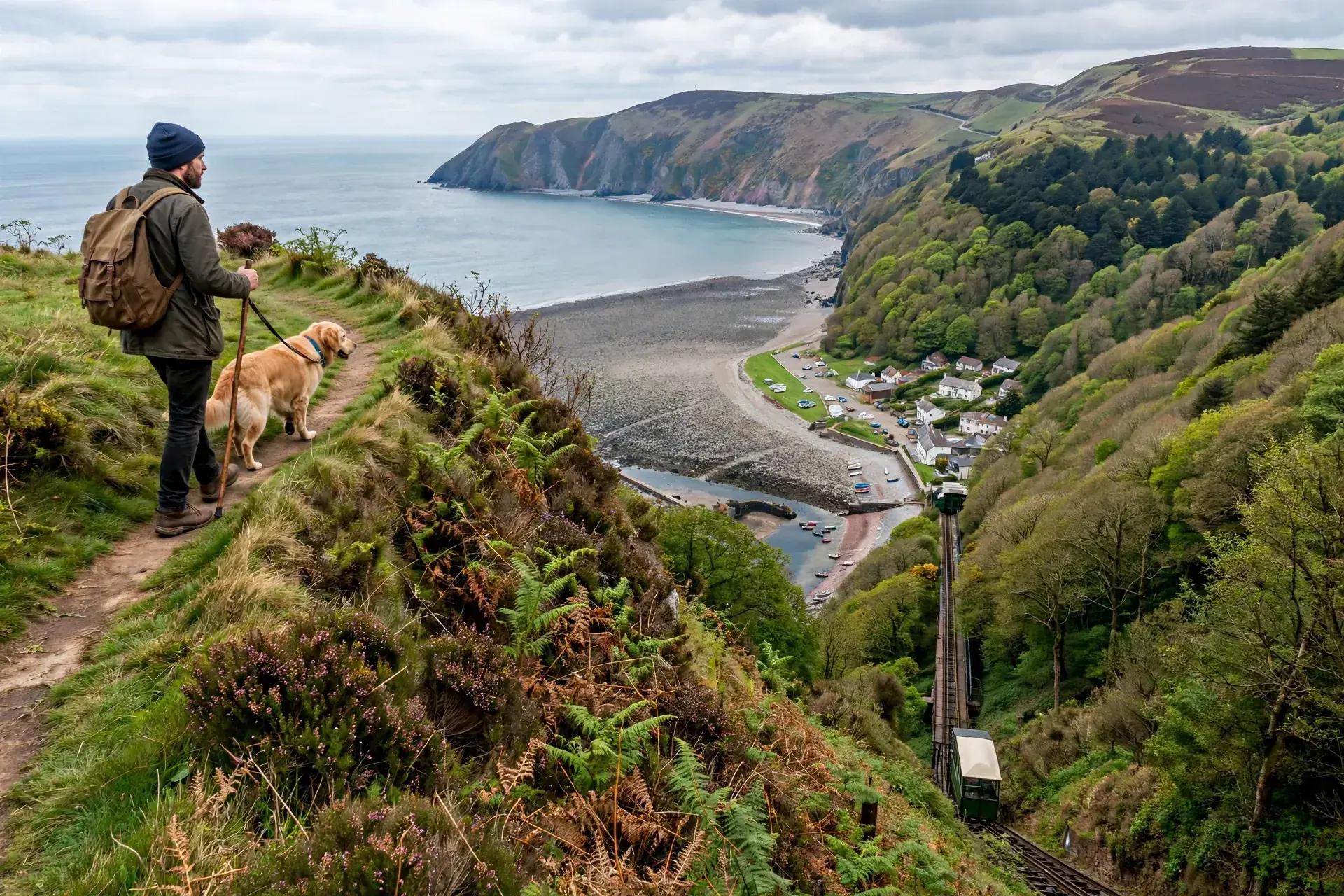
For a longer stay, Mortehoe makes a good base for exploring the wider North Devon coast with a dog, provided you plan the driving. The coast road is scenic but slow, with narrow stretches and holiday traffic, and a dog that is sick in the car will not enjoy a day of short hops between villages. Plan one main outing a day, with a long walk at the destination and a calm drive back, rather than three short stops that leave the dog in and out of the car all day. Our guide to Clovelly with a dog covers a car-free village further west along the coast, where the walk down to the harbour is steep and the planning is different again, and our guide to Lynton with a dog covers the cliff railway and the valley walks to the east, where steep paths and wooded valleys bring their own checks for dogs.
Cliffs, tides, livestock and paws
The safety checks for Mortehoe are not complicated, but they are worth doing in order, because the coast here is genuinely exposed. The first check is the cliff edge. Keep the dog on a lead, keep well back from the edge, and do not let the dog lean over to look at the sea below. Grass at the edge can be undercut, rock can be loose, and a dog that chases a gull or a rabbit towards the edge has no sense of the drop. Children, other dogs and walkers with cameras can all be a distraction near the edge, so keep your attention on the dog and the path, not on the view, when you are close to the cliff.
The second check is the tide, and it applies to the beach as much as to the rocks. Check the tide times before you leave Mortehoe, and do not walk on the rocks below the cliffs at low tide unless you are sure of the route back and the time you have. Rocks are slippery with seaweed, pools hide sharp edges, and a rising tide can cut off a rocky bay in minutes. The same applies to the beach at Woolacombe: a wide, flat beach at low tide can look safe for a long walk, but the tide comes in over a large area, and a dog that is playing at the water's edge will not notice the change. Plan to be off the lowest sand well before the tide turns.
The third check is livestock. Sheep graze the coastal grassland around Morte Point and on the fields inland, and cattle are common on the farms around Mortehoe. A dog that chases sheep can cause serious harm, and a farmer is entitled to protect livestock. Keep the dog on a short lead well before you reach grazing animals, move steadily past them, and do not let the dog stare at them or pull towards them. With cattle, give extra space, especially to cows with calves, and do not walk between a cow and its calf. If cattle approach you, stay calm, move away steadily, and let the dog off the lead only if you are in danger and can do so safely, so the dog can run clear while you move away.
The fourth check is the dog's paws and body after a coastal walk. Rocky ground, gorse, brambles and sharp shells can cut pads, and salt water and sand can irritate skin and ears. Check paws after the walk, look between the toes for thorns and grit, and rinse the dog with fresh water after a beach day. In spring and summer, check for ticks after walking through long grass and bracken, and remove any you find promptly. Adders are present in parts of Devon, including coastal grassland and heath, and a dog that sniffs in long grass or under rocks is at risk. Keep the dog on the path, do not let it push into dense undergrowth, and if a dog is bitten, keep it calm, carry it if you can, and seek veterinary help immediately.
Finally, know where the nearest vet is before you need one. Save the number of a veterinary practice in Woolacombe, Ilfracombe or Barnstaple before you set off, and keep it in your phone. Rural practices can be some distance away and may have limited opening hours, especially at weekends, so a small first-aid kit in the car — a bandage, saline, tweezers, a towel and the vet's number — is worth carrying. A dog that is injured on the headland cannot walk itself to help, and a plan made in advance is faster than a search made in a panic. Check the official guidance before you travel for any local safety notices, path closures or livestock warnings.
Wet weather and quieter days
North Devon weather changes quickly, and Mortehoe in the rain is a different place from Mortehoe in the sun. The coast path becomes muddy and slippery, the rocks at Morte Point become treacherous, and the wind on the headland can be strong enough to make a walk unpleasant for a dog that is already wet and cold. That does not mean a wet day is a wasted day, but it does mean choosing the right walk for the weather rather than forcing the planned walk through. A short, sheltered lane walk in the village, a drive to a wooded valley, or a slow morning in a dog-friendly cafe can be a better dog day than a long, exposed headland walk in a storm.
On a wet day, the practical checks change. The coast path holds water in the dips, the grass becomes slick, and the steps down towards Woolacombe can be slippery. A dog with a drying coat, a towel in the car and a warm place to dry off afterwards will cope well. A dog that is already cold, old or arthritic will struggle, and a puppy that is still learning to walk on a lead will find a wet, windy headland overwhelming. Shorten the walk, stay on the higher, firmer ground near the village, and avoid the cliff edge entirely in high wind. If the weather is bad enough that you would not want to be out in it yourself, the dog probably does not want to be out in it either.
Quieter days have their own rewards. Out of season, the beach at Woolacombe is emptier, the car park in Mortehoe is easier, and the coast path belongs to walkers rather than crowds. The dog can sniff for longer, stop more often and walk at its own pace without being passed by groups of people. The trade-off is that cafes and shops may have shorter hours, the weather is less predictable, and the light fades earlier. Plan for a shorter day, carry a torch, and check opening times before you rely on a particular place for lunch or a warm drink. A quiet-season walk, done well, is often the best walk of the year.
On a busy day, the same planning works in reverse. Arrive early, walk the headland before the crowds, and save the beach for the late afternoon when the day visitors are leaving. Avoid the middle of the day in high summer, when the sun is strongest, the sand is hottest and the car park is fullest. A dog that is hot, tired and thirsty at midday will not enjoy a beach walk, and a dog that is forced to walk on hot sand will remember it. Shade, water and rest are not luxuries on a hot day; they are the difference between a good walk and a dog in distress.
Whatever the weather, have a backup plan that does not depend on the coast path. A wooded walk inland, a drive to a nearby town with dog-friendly shops, or a simple morning in the cottage garden with a long chew can all be a good use of a day when the headland is closed by weather. The dog does not measure a holiday by miles walked. It measures it by how comfortable, safe and settled it feels, and a day that respects the weather is a day the dog will enjoy more than a day that fights it.
What to pack for Mortehoe
Packing for Mortehoe is packing for a cliff, a beach and a village lane in the same day, and the list is shorter if you think in those three parts. For the cliff, you need a short lead, a harness with a handle, good footwear for yourself, water for the dog and a phone with charge. For the beach, you need a long line if recall is unreliable, a collapsible water bowl, fresh water, a towel and a bag for wet gear. For the village, you need a mat for the pub, a spare lead, poo bags and a torch for a dark lane. Put the cliff and beach gear in the car the night before, so a morning start is not a search through bags.
Water is the item most people underestimate. There is no tap on Morte Point, and the walk from Mortehoe to Woolacombe and back is long enough, especially in the sun, for a dog to need more than a single drink. Carry a bottle for the dog as well as for yourself, offer water at regular stops, and do not let the dog drink from the sea or from rock pools. A collapsible bowl is light, cheap and easy to carry, and a dog that has its own bowl will drink more readily than a dog offered water from a cupped hand. In winter, the same rule applies: cold wind and a long walk dry a dog out, and a dog that is offered water in the shelter of a dip will drink more than a dog offered water on the exposed point.
For the dog's comfort, bring a drying coat or a large towel, a spare lead, and a first-aid kit with a bandage, saline, tweezers and the number of a local vet. A dog that is wet after a beach swim or a rain shower will chill quickly on the walk back up to Mortehoe, and a drying coat makes the difference between a comfortable return and a shivering one. A spare lead matters because leads break, get tangled in gorse and get dropped on a rocky path, and a walk back to the village without a lead is not a safe option. Poo bags are essential: carry more than you think you need, and carry them with you until you find a bin.
For the car, keep a towel, a blanket, a water bowl and a bag for muddy gear, and a change of shoes for yourself. The car is the warm, dry base between walks, and a dog that returns to a clean, dry car will settle faster than a dog that returns to a car full of wet sand. If you are staying overnight, bring the dog's own bed, bowl and a familiar toy, and set them up in the same place each night. Familiar smells and a familiar bed help a dog settle in a strange cottage, and a dog that sleeps well will walk better the next day.
Finally, pack for the dog you actually have, not the dog you wish you had. A puppy needs short walks, frequent toilet stops and a carrier or a lift over the roughest ground. An older dog needs a ramp or a lift into the car, a shorter walk, a warm coat and a bed that is easy to get into. A reactive dog needs a lead it cannot slip, a muzzle if that is its normal routine, and a plan for passing other dogs on a narrow path. A dog that is nervous of traffic needs a short lead on the lanes and a calm start in the village. The packing list is the same for everyone, but the way you use it changes with the dog, and the best-packed bag is the one that was packed with that dog in mind.
Practical questions
Before you go
Can dogs go on Woolacombe Beach from Mortehoe?
Yes, but the rules change with the season and the part of the beach, so check the signs at the access point you use. In the quieter months dogs generally have much wider access to Woolacombe Beach, while in the summer season a zoned restriction applies to the central beach near the village. The northern end towards Mortehoe and the southern end towards Putsborough are the usual places to look for dog-friendly sand, and the tide timetable matters because the beach is wide and the sea comes in fast. Check the official guidance before you travel.
Is Morte Point a safe walk for dogs?
Morte Point is a dramatic headland walk, not a fenced park, so it suits dogs that stay close and can be kept on a lead near the cliff edge. The paths are uneven, rocky in places and exposed to wind, and there are steep drops without barriers. Keep your dog on a lead, keep well back from the edge, and avoid the walk in high wind, heavy rain or poor visibility. Check the official guidance before you travel.
Where can I park in Mortehoe with a dog?
Use the village car park in Mortehoe rather than parking on the narrow lanes, and expect it to fill early on sunny days and in school holidays. The lanes around the church and the cottages are tight, with limited passing places, so parking considerately matters for residents and for farm and delivery vehicles. Arrive early, leave space for access, and walk from the car park to the coast path. Check the official guidance before you travel.
Are dogs welcome in Mortehoe pubs and cafes?
Several places in and around Mortehoe welcome dogs, usually in the bar area or on an outdoor terrace rather than in the main dining room, but policies change and can depend on the time of day. Ask before you sit down, keep your dog on a lead under the table, and bring a mat and water bowl so the dog can settle. If the indoor space is full or dogs are not admitted, a takeaway or a terrace seat is often the easier option. Check the official guidance before you travel.
How long is the walk from Mortehoe to Woolacombe?
The walk from Mortehoe village down to Woolacombe is short in distance, roughly a mile, but it is a steep descent on a road and footpath, and the return climb is the part that catches people out. Allow about 20 to 30 minutes down and longer back up, more with an older dog, a puppy or a dog that needs frequent stops. Take water, keep your dog on a lead beside the road, and do not rely on a bus back unless you have checked the timetable. Check the official guidance before you travel.
What should I do if my dog meets sheep or cattle near Mortehoe?
Put your dog on a short lead well before you reach grazing animals, move steadily past them without letting the dog run at them, and give cattle with calves extra space. If cattle approach, let the dog off the lead only if you are in danger and can do so safely, and move away calmly. Sheep are common on the coastal grassland around Morte Point, so keep your dog under close control even where you cannot see animals at first. Check the official guidance before you travel.