This guide is independent and contains no paid placement. Railway arrangements, opening patterns and local rules can change, so check the official guidance before you travel.
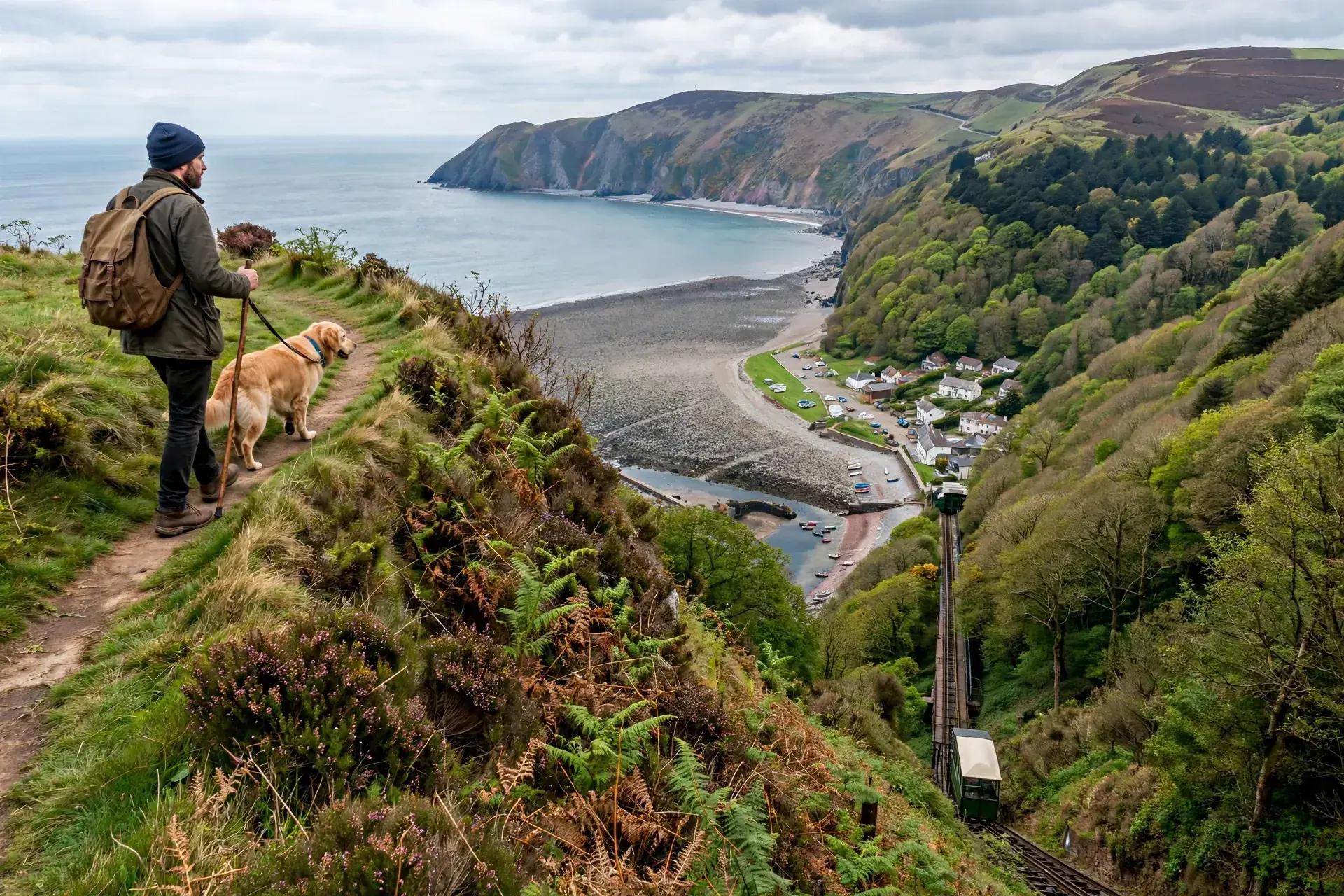
Lynton sits high above Lynmouth, and the cliff railway is the kindest way to connect the two with a dog. Ride one way, walk the other only if the slope, surface and your dog's joints allow it, keep dogs on a lead on exposed and narrow ground, and build the day around water, shade and an early turn-back point.
Start with the vertical journey
Most dog trips are planned sideways: a distance on a map, a loop back to the car, a cafe at the end. Lynton asks you to plan up and down instead. The town stands on the clifftop, Lynmouth sits at the harbour below, and the slope between them shapes every decision that follows. A dog that would happily walk for an hour on flat ground can find the same hour on a steep, sustained descent surprisingly tiring, and the walk back up is a different effort again. The sensible way to enjoy both towns is to treat height as the main feature of the day, not as an obstacle to rush through.
The Lynton and Lynmouth Cliff Railway links the two settlements directly. It is a funicular railway, with cars travelling up and down the cliff face, and it changes the logic of the visit completely. Instead of committing a dog to a steep walk in both directions, you can ride in one direction and walk in the other, ride both ways and spend your walking energy on the valley paths, or ride down, enjoy the harbour, and ride back up before tired legs and warm paws become a problem. That flexibility is especially valuable with an older dog, a puppy, a dog recovering from an injury, or a dog that is simply not used to hills. The railway also gives you a dignified exit plan: if the wind picks up, the rain arrives, or the dog's enthusiasm fades faster than expected, the vertical journey can be shortened without abandoning the day.
Before you board, think about how your dog handles enclosed, moving spaces. A cliff railway car is not a train carriage with room to wander; it is a compact space shared with other passengers, with a distinct movement, changes in light, and the sounds of machinery and water. Some dogs settle immediately, especially if they are used to lifts, buses or busy pavements. Others need a little preparation: a calm wait before boarding, a short lead, a familiar mat or jacket if the dog normally uses one, and a position away from the doors where people stream past. If your dog is highly anxious in confined spaces, barks at strangers in close quarters, or panics when a vehicle starts moving, it may be kinder to skip the railway altogether and choose a level walk in one town rather than forcing a short ride that colours the rest of the day. Check the official guidance before you travel for current boarding arrangements and any conditions that apply to dogs, because details can change between seasons.
Practical boarding habits make a real difference. Keep the lead short but not tight, so the dog cannot wander into another passenger's legs or block an exit. Ask the dog to sit or lie down before the car starts, and reward calm behaviour rather than talking excitedly through the whole ride. Keep bags, bowls and long lines stowed, because a loose strap is an easy trip hazard on a crowded car. If the car is full, waiting for the next one is usually better than squeezing a nervous dog into a packed space; Lynton rewards patience, and a calm dog at the harbour is worth a few minutes of waiting on the clifftop. On arrival, pause before stepping out, let other passengers clear the platform, and give the dog a moment to adjust to the new level, the new smells and the change in wind before setting off.
Use the railway as a planning tool, not just a novelty. A common pattern that works well is to start in Lynton, walk the Valley of Rocks while legs are fresh, return to Lynton, and then ride down to Lynmouth for a harbour stroll and a rest before riding back up. Another pattern suits dogs that tire quickly: ride down first, enjoy the harbour at a slow pace, and ride back up without attempting the slope at all. A third pattern suits fit, confident dogs on a cool day: walk down to Lynmouth, rest properly, and ride back up, so the descent is enjoyed once and the hardest climb is avoided. Each pattern answers a different question about the dog in front of you, and none of them requires walking the slope twice. Write the pattern down before you leave the car, and agree the turn-back point in advance, because decisions made on a steep path, with a tired dog pulling toward home, are rarely the clearest ones.
The vertical theme also explains why Lynton feels different from a flat seaside town. Views open suddenly, wind strengthens as you gain height, shade disappears on exposed rock, and a path that looked gentle from above can steepen without warning. Dogs experience all of this through their paws, their breathing and their confidence on uneven ground, not through the view. A dog that stops, pants heavily, seeks shade or starts to lag is not being stubborn; it is reporting on the slope. Build pauses into the plan, carry water from the start, and treat a short, happy walk at the right height as a better day than a long, strained walk that covers both towns on foot.
Valley of Rocks: strange stone and open edges
West of Lynton, the Valley of Rocks is the walk most visitors picture when they think of this coastline: a dry, open valley scattered with large, weathered rock formations, rising ground on both sides, and the sea beyond. For a dog, it is a walk of contrasts. There is space to move and plenty to sniff, but the ground is uneven, the surface changes from firm path to loose stone, and the edges are open in a way that a woodland path is not. The right approach is to enjoy the strangeness of the place while keeping the dog close enough that a sudden interest in another dog, a bird or a distant walker cannot turn into a dash across rough ground.
Keep the dog on a lead here as a default, even if your dog normally walks well off lead elsewhere. The reasons are practical rather than moral. Narrow sections bring walkers, children and other dogs close together; loose rock can shift underfoot; and a dog that chases across an exposed slope is harder to recall and harder to reach than a dog that chases across a flat field. A lead also helps on the steeper approaches, where a dog pulling downhill can unbalance its handler, and where a dog pulling uphill can overheat faster than expected. A harness with a secure clip, a lead long enough for sniffing but short enough for control, and a habit of shortening the lead before every narrow or busy section will serve you better than any debate about whether the valley is technically suitable for off-lead walking on a particular day.
Plan the Valley of Rocks as a there-and-back or short-loop walk rather than a forced circuit. Start from Lynton while the dog is fresh, walk out to a chosen turning point, rest, and return by the same route if the return looks safer or easier. This is not a failure of ambition; it is how exposed coastal walking works best with dogs. A return route is familiar, the dog already knows the surface, and you can judge the remaining energy honestly instead of discovering halfway around a loop that the second half is steeper than the first. If you do choose a loop, check the route on a map before you start, note where the path climbs, where it narrows and where it meets a road, and pick a bail-out point where you can cut back toward Lynton without adding distance.
Watch the ground as carefully as the view. Rock formations invite climbing and scrambling, but dogs do not always judge a descent as well as an ascent, and a dog that scrambles up a boulder with enthusiasm may hesitate, slip or jump awkwardly on the way down. Keep dogs off high rocks and unstable edges, and be especially careful after rain, when surfaces that look dry can still be slick. Paws need attention here too: rough stone, grit and repeated up-and-down movement wear pads faster than grass or woodland soil. Check paws at the turning point and again at the end of the walk, carry a spare towel to clean grit from between toes, and shorten the walk if the dog starts to favour a foot or lick its paws repeatedly. A dog boot or paw balm may help some dogs, but neither replaces a sensible route choice.
Weather changes the valley quickly. On a calm, cool day it is an open, airy walk with long views and plenty of shade-free space, which means sun and wind both matter: dogs overheat in direct sun even when the air feels pleasant, and wind on an exposed ridge can chill a wet or tired dog. On a windy day, gusts can startle a nervous dog and make a lead essential rather than optional. In fog or low cloud, the formations lose their landmarks, paths become harder to follow, and a dog that wanders is harder to spot; in those conditions, a shorter, lower walk is the wiser choice. The valley is at its best when you have time to stop, let the dog sniff, and enjoy the rocks without hurrying to a distant viewpoint that adds steep ground for little benefit.
For walkers who want to extend the day, the Valley of Rocks sits naturally within a wider Exmoor coastline. The moorland, cliffs and river valleys around Lynmouth reward a slower pace, and the guidance in our Exmoor with a dog guide covers ponies, deer, livestock, ticks and coast-path etiquette in more detail. Use that wider context to plan the next day, not to stretch today's valley walk beyond what the dog can enjoy. A short, confident walk in the Valley of Rocks, followed by a calm return to Lynton, leaves a dog in better shape for tomorrow than a long, exposed walk that ends with sore paws and a reluctant walker.
Watersmeet: river, woodland and shade
Watersmeet, east of Lynmouth where two rivers meet in a wooded valley, offers the opposite walking experience from the Valley of Rocks. Here the path runs through trees, beside water, with shade, softer ground and the sound of the river replacing the open wind of the clifftop. For many dogs this is the most enjoyable walk of a Lynton visit, and it is also the walk that best suits a hot day, a nervous dog that prefers enclosed paths, or a dog that needs a gentler gradient after the exposed valley. The trade-off is water itself: rivers are attractive, distracting and, after rain, powerful. A dog that loves to swim needs the same careful management here as a dog that fears water needs reassurance.
Start Watersmeet from Lynmouth if you want the riverside approach, or plan it as a separate, shorter outing rather than bolting it onto a long clifftop walk. The valley path can climb and descend, with steps, roots and uneven sections, so it is not automatically an easy walk just because it is wooded. Choose the section that matches the dog: a short, riverside stretch with frequent stopping points suits most dogs better than a long, continuous climb to a distant viewpoint. Let the dog set the pace on the way out, rest by the water, and remember that the return journey still counts. Dogs often seem freshest at the farthest point of a walk, when the river, the smells and the other dogs are most exciting, and tire on the way back when the novelty fades.
Water safety deserves a deliberate plan. Keep the dog on a lead near fast or deep water, near weirs or drops, and wherever the bank is steep or slippery. Even a strong swimmer can struggle in a fast current, cold water or a river swollen after rain, and a dog that enters the water happily may find the exit point harder than the entry point. Watch for slippery rocks at the water's edge, for dogs drinking large amounts of river water, and for the moment when play turns into fatigue. A dog that is shivering, swimming in circles, or struggling to climb out needs help immediately, and a long line is no substitute for close supervision. If you are unsure about the water level or the current on the day, enjoy the river from the bank and save swimming for a safer, calmer location.
Woodland brings its own checklist. Shade helps dogs stay cool, but damp woodland also means mud, leaf litter, ticks in season, and the occasional fallen branch or hidden hole. Check the dog after a woodland walk, especially around ears, armpits, belly and between toes, and carry a tick remover if you know how to use one. Keep an eye out for livestock or horses on approach paths, and for other dogs on narrow woodland sections where passing space is limited. A dog that is reactive on narrow paths needs a clear plan: shorten the lead, step to one side, create distance, and let the other walker pass before continuing. Watersmeet is a shared, popular place, and the kindest way to enjoy it is to assume you will meet people, children and dogs around every bend.
For puppies and older dogs, Watersmeet works best as a training walk rather than a distance challenge. A puppy can practise walking on a lead past water, bridges, steps and other walkers, with frequent rests and a calm finish, while an older dog can enjoy the shade and the softer ground without the exposed climbs of the valley. In both cases, the measure of success is not how far you went, but how the dog behaved at the end: settled, hydrated, clean enough to travel home comfortably, and still keen for a short evening stroll. If the dog finishes a Watersmeet walk exhausted, reluctant or sore, the next visit should be shorter, flatter and slower, even if the route itself felt easy to the human walker.
Pack for woodland as well as for the coast. A towel is essential after a riverside walk, even if the dog never enters the water, because mud, wet grass and dripping branches soak a low dog quickly. A drying coat helps on the journey home, and a spare lead is useful if one becomes muddy or tangled. Bring water even beside a river, because river water is not a reliable drinking supply, and bring a small first-aid kit that includes something to clean a minor paw cut. Watersmeet rewards preparation: the dogs that enjoy it most are the ones whose handlers planned for mud, water and narrow paths before they arrived.
The downhill road to Lynmouth harbour
The road and path down from Lynton to Lynmouth deserve their own plan, because a descent is not simply a walk in reverse. Going downhill, a dog's weight shifts forward, the front legs and shoulders take more load, and paws brake against the surface with every step. A surface that feels comfortable on the way up can feel harsh on the way down, especially if it is hard, cambered or covered in loose grit. Dogs with arthritis, hip or elbow problems, long backs, or simply a lot of birthdays behind them often find a long descent more painful than a climb of the same height, even though the descent looks easier to a human observer.
If you walk down, do it slowly and deliberately. Shorten the lead so the dog cannot surge ahead and then brake suddenly, keep to the side of the path away from traffic where possible, and stop often enough for the dog to reset its footing. Avoid letting the dog pull you downhill, because a pulling dog on a steep slope is a fall risk for both of you, and avoid carrying a dog that is too heavy to carry safely down a steep path. Watch for the early signs that the descent is becoming too much: a dog that starts to sit down, refuses to continue, pants with its tongue fully out, or begins to stumble or slip needs a rest, not encouragement to push on. In that situation, the railway or a pause in Lynmouth is not a backup plan; it is the plan.
Traffic and pedestrians add another layer to the downhill route. The road between the towns carries vehicles, and walkers, cyclists and dogs may share narrow sections. Keep the dog on the traffic side under control, on a short lead, and never allow a long line to trail across a road or path where it could tangle a cyclist or another walker. Teach the dog, before the trip if possible, to walk calmly beside you rather than ranging ahead on a steep slope; a dog that walks beside you downhill is easier to steer, easier to stop, and much less likely to step into the path of a vehicle at a bend. If your dog is reactive to traffic, bicycles or other dogs, consider riding the railway instead of walking down, because a steep, narrow descent is a poor place to practise a behaviour that is still unreliable.
Lynmouth harbour itself is a different world from the clifftop: lower, more sheltered, with water, boats, stone walls and the bustle of a small harbour town. Dogs often enjoy the change of pace, but harbour edges, wet stone, ropes, fishing gear and open water all need management. Keep the dog on a lead around the harbour, away from the water's edge and away from any working equipment, and do not assume that a harbour wall is a safe place for a dog to sit or pose. A calm harbour stroll, with time to sniff, watch the water from a safe distance and rest, is a good reward after a descent or a railway ride. A hurried harbour dash, with a tired dog pulling toward every new smell, is a recipe for a slip or a fright.
Think about the return before you arrive at the harbour. If you walked down, will the dog walk back up, ride back up, or rest in Lynmouth while you decide? If you rode down, the return is already solved, and the harbour visit can be as long or as short as the dog enjoys. If you walked down and the dog is already tired, do not assume that a rest and a drink will restore enough energy for a steep climb; a tired dog that starts a climb often tires faster on the second half, when the slope is steepest and the shade is thinnest. The railway exists precisely for this moment. Using it is not a shortcut or a compromise; it is the sensible way to enjoy two towns separated by a cliff without asking a dog to do the hardest part twice.
Finally, remember that the downhill route is also a route for other people with dogs, pushchairs, mobility aids and luggage. Courtesy matters on a slope: step aside where it is safe to do so, keep the dog close when passing, and avoid blocking a narrow section while you take photographs. A dog that is well managed on a steep path makes the route safer for everyone, and a handler who plans the descent, the harbour stop and the return as one journey, rather than three separate ideas, will enjoy Lynmouth far more than a handler who discovers the slope halfway down.
Town supplies, parking and toilets
Lynton and Lynmouth are small towns, and that is part of their charm, but it also means that supplies, parking and facilities need a little forethought. Do not arrive assuming that everything a dog needs will be available at the exact moment you need it. Pack the essentials in the car or in a day bag before you start: water, a portable bowl, poo bags, a towel, a lead and a spare lead, a drying coat in wet or cold weather, and any medication the dog needs. A small town may have shops and cafes, but opening patterns vary by season, and a shop that stocks dog treats on a summer Saturday may not be the reliable source you need on a wet weekday in November. Check the official guidance before you travel if a particular facility matters to your plan.
Parking is a practical decision, not an afterthought. Lynton's clifftop parking and Lynmouth's harbour-side parking serve different walking plans, and choosing the wrong one can add an unwanted steep walk at the start or the end of the day. If your main walk is the Valley of Rocks, parking in Lynton keeps the start close and avoids a climb before the walk begins. If your main walk is Watersmeet or the harbour, parking in Lynmouth keeps the riverside and harbour sections accessible without a descent first. If you plan to use the railway, park at the end where you want to finish, and use the railway to return to the car. Whichever you choose, leave the car with shade, ventilation and water in mind if the dog will wait in it at any point, and never leave a dog in a parked car in warm weather, even for a short stop.
Toilets, for humans and for dogs, should be planned before the walk, not during it. Use town facilities in Lynton or Lynmouth before heading onto a valley or coastal path, because exposed paths offer no dignified or practical alternative, and a dog that needs a toilet stop on a steep or narrow path creates a problem for everyone behind you. Carry enough poo bags for the whole walk, plus spares, and carry them out to a bin rather than leaving a bag beside a path. In a small, popular landscape, one abandoned bag is noticed, and a pattern of abandoned bags damages access for every dog walker who follows. A tidy dog walk is part of keeping these paths welcoming to dogs.
Food and drink stops need the same realistic planning as walks. Some cafes and pubs welcome dogs, others welcome dogs only in certain areas, and policies can differ between indoors, terrace and garden. Check the official guidance before you travel if eating together matters to the day, and have a backup plan that does not depend on a single venue: a packed snack, a sheltered bench, or a return to the car for a calm break. Dogs that are tired, wet or overstimulated do not always settle well in a busy cafe, so a quiet outdoor stop after a walk is often kinder than a long indoor meal. If you do stop indoors, keep the dog on a lead, settle them on a mat if they use one, and avoid feeding them rich cafe food that may upset their stomach on the journey home.
Supplies also include information. Save the location of the nearest veterinary practice before you need it, and keep the number accessible on your phone rather than relying on a signal on a cliff path. Rural practices may be a drive away, may have limited hours, and may direct you to an emergency service outside normal hours, so a few minutes of preparation before the walk is worth far more than a frantic search during one. The same applies to the railway timetable, parking information and local walking guidance: check them while you have a signal and a calm moment, not when you are already on a steep path with a tired dog.
Finally, plan the end of the day as carefully as the start. A dog that has walked a valley, ridden a railway and explored a harbour will need water, a towel, a check for ticks, grit and minor cuts, and a calm period before a car journey. Keep a clean towel and a spare bowl in the car, allow time for the dog to settle before driving, and avoid adding a second long walk on the way home just because the day went well. A Lynton visit that ends with a settled dog, a clean car and energy left for tomorrow is a successful visit, even if the distance covered was shorter than planned.
Older dogs, puppies and fitness levels
Not every dog should attempt the same Lynton day, and the differences matter more here than on a flat coastal walk. A fit adult dog in regular hill-walking condition can enjoy a valley walk, a railway ride and a harbour stroll in one day, with rests and water. An older dog, a puppy, a dog with joint problems, a brachycephalic breed that struggles in heat, or a dog that is simply unfit after a quiet winter needs a shorter, flatter and more flexible version of the same day. The goal is not to keep up with other walkers; it is to match the route to the dog that is actually with you.
For older dogs, the key issues are joints, stamina and recovery. A long descent loads the front legs, a long climb loads the hind legs and the heart, and uneven ground challenges balance and confidence. Choose one main activity rather than three: either a short valley walk or a harbour visit, not both at full length. Use the railway to remove the hardest climb or descent, build in frequent rests on level ground, and watch for stiffness after a rest, which often appears when a dog stands up after sitting for a few minutes. A dog that is stiff after a rest, reluctant to start again, or lagging behind on a gentle section is telling you the day is long enough. A portable ramp can help with steps and car access, a supportive harness can help on uneven ground, and a warm, dry coat after a wet walk helps an older dog recover faster than a cold, damp journey home.
For puppies, the key issues are different: short attention, rapid fatigue, toilet needs, socialisation and the need to learn calm behaviour in busy places. A puppy's first Lynton visit should be a training visit, not a distance visit. Choose a short, gentle section of a valley or riverside path, practise walking on a lead past people, dogs, water and steps, reward calm behaviour, and finish before the puppy becomes overtired or overstimulated. Puppies need frequent toilet breaks, frequent water, and a safe place to rest, and they should not be asked to complete a long, steep walk simply because the route exists. If the puppy is still learning recall, keep them on a lead throughout, because a valley with open edges and a river nearby is not the place to discover that recall fails when a distraction appears.
For fit adult dogs, the challenge is usually enthusiasm rather than fitness. A fit collie, spaniel or labrador may pull toward the next viewpoint, the next dog and the next stretch of water, and may seem tireless until the return journey reveals the cost. Manage enthusiasm with structure: a lead on narrow and exposed sections, a pause at every junction, water before the dog asks for it, and a turning point chosen in advance. A fit dog can also be the dog most at risk from heat, because a dog that keeps running in warm weather may not stop on its own. On a warm day, walk early or late, choose shaded woodland over exposed rock, carry extra water, and watch for heavy panting, drooling, wobbliness or a reluctance to continue, which are signs to stop, cool and rest immediately.
Breed and body shape matter too, and not only for the obvious reasons. Long-backed dogs need care on steep descents and steps. Short-legged dogs need more steps to cover the same ground and tire faster on rough terrain. Large, heavy dogs place more load on joints on a descent and may be harder to help if they slip. Brachycephalic dogs, with flat faces and narrower airways, struggle in heat, humidity and sustained exertion, and need shorter walks, more shade and more water. None of this means those dogs cannot enjoy Lynton; it means their Lynton day should be designed around their shape, with the railway doing the vertical work and the walking kept to level, shaded and manageable sections.
A simple fitness test helps before you commit to a route. Ask whether the dog has walked hills regularly in the past month, whether it recovers quickly after a walk at home, and whether it has any known joint, heart or breathing condition. If the answer to any of those questions is uncertain, choose the shorter route, ride the railway both ways, and treat the day as a trial. You can always return for a longer walk when you know how the dog responds. A dog that finishes a short Lynton visit keen, settled and sound is a dog that will enjoy the next visit; a dog that finishes a long visit sore or exhausted may associate the place with discomfort, which is a harder problem to undo than a missed viewpoint.
Rain, wind and a wet-weather backup
North Devon weather changes quickly, and a Lynton plan that only works in sunshine is a fragile plan. Rain makes rock slippery, mud makes paths treacherous, wind makes exposed ridges uncomfortable, and low cloud removes the landmarks that make a valley walk easy to follow. A good wet-weather backup is not a disappointment; it is part of visiting a cliff landscape responsibly with a dog. The backup should be decided before you leave the car, so that a change in weather leads to a calm switch of plan rather than a debate on a wet, exposed path.
On a wet day, shorten and lower the walk. Choose a sheltered, wooded or town-based route over an exposed valley or clifftop path, keep the dog on a lead throughout, and accept that the walk will be muddier, slower and shorter than the dry-weather version. A riverside walk in light rain can still be enjoyable if the water level is safe and the path is not flooded, but a valley walk in heavy rain, with wet rock and strong wind, is a different proposition. If the rain is heavy, the wind is strong, or visibility is poor, the kindest choice is often a short town walk, a railway ride if conditions allow and the official guidance supports it, and a longer, calmer stop in a dog-welcoming venue, rather than a forced march to a viewpoint that cannot be seen.
Wet-weather kit matters more than dry-weather kit. A waterproof coat for the handler, a drying coat or towel for the dog, a spare lead, and a waterproof bag for poo bags and valuables all make a wet walk manageable. A dog that is soaked to the skin, muddy to the belly and cold after a walk needs drying before a car journey, not after it, because a wet dog in a cold car loses heat and arrives home stiff and miserable. Keep a large towel and a dry blanket in the car, dry the dog thoroughly, check paws for grit and minor cuts, and allow time for the dog to settle before driving. If the dog is shivering, lethargic or reluctant to move after a wet walk, warm them gradually, offer water, and seek veterinary advice if they do not recover promptly.
Wind deserves separate attention, because it affects dogs differently from rain. A strong wind on an exposed path can startle a nervous dog, blow debris into eyes, and make a lead harder to control. Gusts at a cliff edge are a safety issue, not just a comfort issue, and a dog that is already anxious may become more so as the wind rises. If the forecast warns of strong winds, choose a sheltered valley or town walk, keep the dog close, and avoid exposed ridges and cliff edges altogether. The same caution applies to a dog that is reactive to noise: wind, waves and rattling gates can all raise arousal, and a walk that is calm in still air can become difficult in a gale.
A rainy-day backup can also be a different kind of day, not just a shorter walk. Use a wet morning to explore Lynton and Lynmouth at a slow pace, ride the railway if conditions allow, visit dog-welcoming venues, and let the dog rest properly between short outings. Use a wet afternoon to plan the next day's walk, check the forecast and the official guidance, and prepare kit for a drier window. Dogs do not measure a holiday by distance covered; they measure it by calm, interesting outings, regular food and water, and time with their people. A wet day spent well, with short, dry, interesting stops, is a better dog day than a wet day spent pushing through an exposed walk that leaves everyone soaked and tired.
Finally, remember that weather affects the ground after the rain stops. Paths stay muddy, rock stays slick, and rivers stay high for hours after a downpour. Do not assume that a walk is safe simply because the rain has eased; check the path, the river level and the wind before setting out, and be ready to turn back if the ground is worse than expected. The best wet-weather habit is humility: assume the landscape is more difficult than it looks, plan a shorter route than you think you need, and let the dog's comfort, not the original plan, decide when the walk ends.
Seasons, surfaces and staying safe
Lynton changes with the seasons, and a dog walk that is straightforward in May can be a different walk in August, October or January. Summer brings heat, crowds and busy paths, with dogs overheating on exposed rock and struggling to find shade. Autumn brings wet leaves, mud and shorter days, with paths becoming slippery and light fading earlier than expected. Winter brings cold, wind and the possibility of ice on shaded steps and rock, with dogs losing heat faster and handlers needing to plan for darkness. Spring brings new growth, nesting birds, livestock with young, and the return of ticks, with dogs needing closer control and more careful checking after a walk. Each season rewards a different route choice, and the same valley can be a summer, autumn and winter walk only if the plan changes with it.
Surfaces are the thread that runs through every season. Lynton's paths mix tarmac, stone, gravel, woodland soil, grass and bare rock, and each surface affects a dog differently. Tarmac is predictable but hard on joints and hot in summer sun. Stone and gravel can be rough on paws and slippery when wet. Woodland soil is softer but can hide roots, holes and mud. Grass is gentle but can conceal ticks, livestock droppings and uneven ground. Bare rock is the most demanding surface of all, especially on a slope, where a dog's claws may not grip as well as a human's boots. Check the surface before you commit to a long section, and choose the surface that suits the dog's paws, joints and confidence, not just the surface that leads to the prettiest view.
Seasonal hazards need a checklist, not a guess. In summer, carry extra water, walk early or late, seek shade, and watch for heat exhaustion, especially in brachycephalic, older or overweight dogs. In autumn, watch for slippery leaves, mud and the early dark, and carry a light if you may finish a walk at dusk. In winter, watch for ice, cold wind and short daylight, and keep walks shorter and closer to town. In spring and summer, check for ticks after every moorland, woodland or grassland walk, and keep dogs on a lead near livestock, especially where young animals are present. Throughout the year, keep dogs away from cliff edges, harbour walls and fast water, and remember that a dog's enthusiasm is not a reliable guide to safety: a dog will often run toward a hazard that a human would avoid.
For walkers who want to build a longer North Devon and moorland trip around Lynton, the contrast with inland granite moorland is instructive. Our Dartmoor dog walks guide covers a different landscape, with open moor, tors, boggy ground and its own livestock and weather challenges, and it helps explain why a dog that copes well on a Lynton valley path may still need a different plan on Dartmoor. Use Lynton as the coastal, vertical part of a wider trip, and Dartmoor or Exmoor as the inland, open part, rather than treating every moorland or coastal walk as interchangeable. The dog's paws, joints and confidence will notice the difference even if the map does not.
Safety also means knowing when to stop. A walk should end while the dog is still keen, not when the dog is exhausted, and a day should end while the dog is still settled, not when the dog is overstimulated. Signs that it is time to stop include heavy panting that does not ease with a rest, a dog that repeatedly sits or lies down, a dog that starts to lag, limp or favour a leg, a dog that becomes unusually quiet or unusually frantic, and any sign of pain, injury or distress. In each case, stop, rest, offer water, check paws and body, and head for the nearest safe exit, whether that is the railway, a town street or a return path. Do not push on to a viewpoint, a cafe or a car park that is farther away when a nearer, safer stopping point exists.
Finally, leave Lynton as you found it, and leave the dog in a state that makes the next visit easy. Clean up after the dog, keep the dog on a lead where other walkers, livestock or hazards require it, and respect any local signs or seasonal restrictions, checking the official guidance before you travel if you are unsure. A dog walk that is well planned, well paced and well finished does more than fill a day; it builds a dog's confidence on hills, water, woodland and busy paths, and it builds a handler's confidence too. Lynton, with its railway, its valley, its river and its harbour, is an ideal place to practise that kind of walking, provided the vertical journey is respected and the dog, not the itinerary, sets the pace.
Practical questions
Before you go
Can dogs ride the Lynton and Lynmouth Cliff Railway?
Dogs are generally welcomed on the railway, but boarding rules, carriage space and any seasonal conditions can change, so check the official guidance before you travel. Keep the dog on a short lead, settle them before the car moves, and avoid a busy departure if your dog is nervous in enclosed spaces.
Is the walk from Lynton down to Lynmouth suitable for an older dog?
The downhill direction is easier on stamina but harder on joints, because a long, steep descent loads the front legs, shoulders and paws for a sustained period. Many older dogs do better riding the railway one way and taking a short, level harbour stroll instead of walking the full slope in either direction.
Do dogs need to stay on a lead in the Valley of Rocks?
Plan to keep your dog on a lead through the Valley of Rocks. The ground is uneven, the edges are exposed, other walkers and dogs pass on narrow sections, and livestock may be nearby. A lead also stops a sudden chase or a slip on loose rock turning a scenic walk into an emergency.
What should I do if the weather turns wet halfway through a walk?
Turn back early rather than pushing on to a planned viewpoint. Wet rock, mud and wind make steep ground much less forgiving, and a wet dog loses heat faster than a dry one. Carry a towel and a drying coat, shorten the route, and finish with a calm, dry stop in Lynton or Lynmouth rather than adding another exposed section.
Is Watersmeet a good choice for a puppy's first longer walk?
Watersmeet can work as a gentle introduction if you choose the shortest, least steep option and keep the outing short, with frequent rests, water and shade. Puppies tire quickly, need toilet breaks and are still learning to walk calmly past people, dogs and water, so treat it as a training walk first and a distance walk second.
Where can I find water and a toilet stop in Lynton and Lynmouth?
Carry your own water and a portable bowl even when you expect to find a supply in town, because opening patterns and outdoor taps cannot be relied on. Use the town facilities before you start a cliff or valley walk, plan a toilet stop in Lynton or Lynmouth rather than on an exposed path, and check the official guidance before you travel for current locations and any charges.