This guide is independent and contains no paid placement. If affiliate links are added later, they will be clearly marked and will not change our editorial checks.
Narberth is one of the easiest small towns in Wales to visit with a dog: a compact, walkable High Street packed with independent food shops and cafes, a ruined Norman castle in a public garden above the town, and Canaston Woods a few minutes away for a proper riverside walk. Arrive hungry, park once, and do the whole town on foot.
A food town first, a dog town second
Most visitors come to Narberth because of its food. The town has built a reputation over decades as the place in Pembrokeshire where small producers, bakers, butchers, delis and cafes cluster together on a single walkable High Street, and that reputation is the best possible news for a dog owner. A food town is, almost by definition, a walking town: the pleasure is in drifting from shop to shop, stopping for coffee, carrying a paper bag of something warm, and pausing on a pavement while the dog sniffs a doorway. Nothing about Narberth requires a car once you arrive, and nothing about it asks the dog to wait in a car park while you go inside somewhere grand.
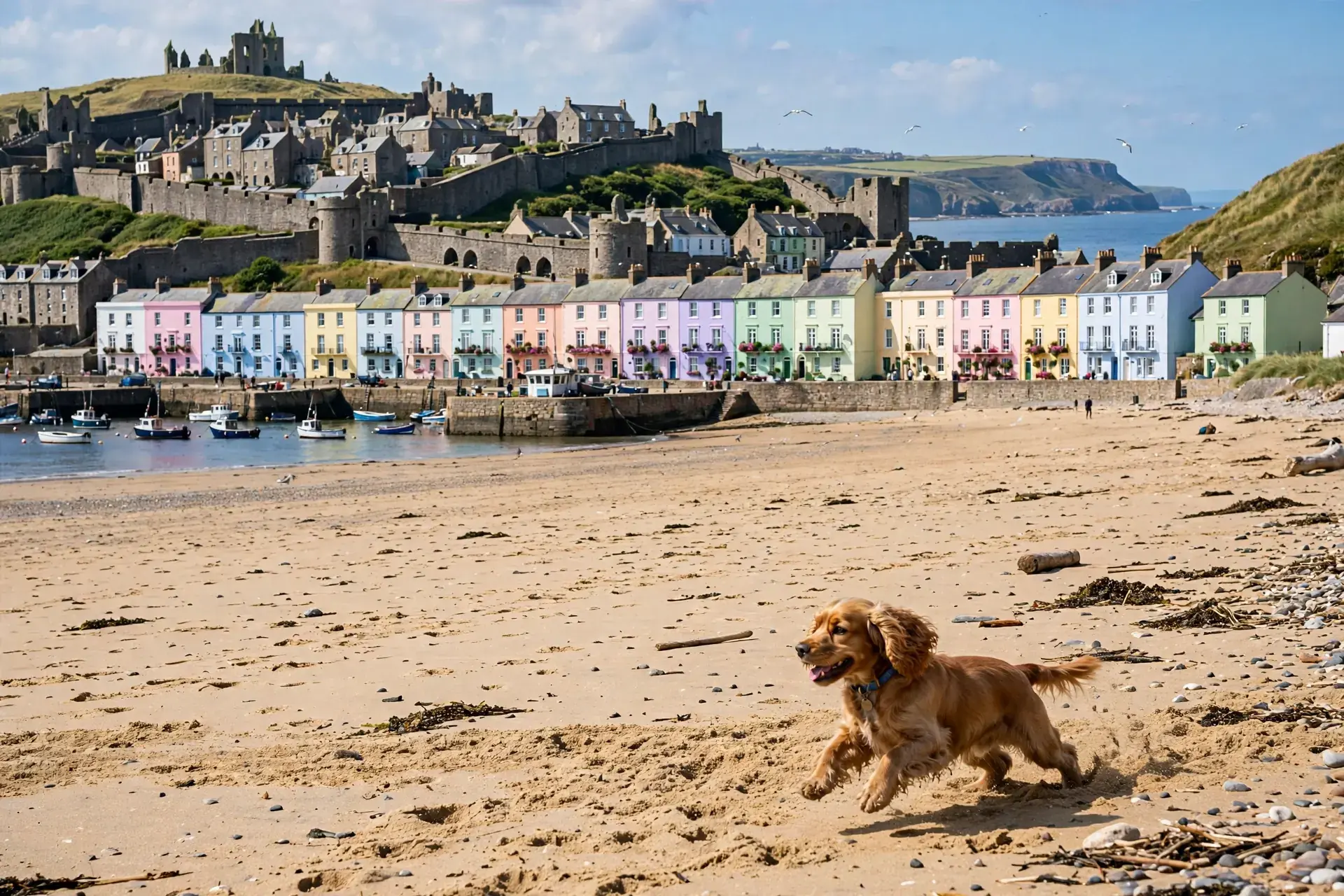
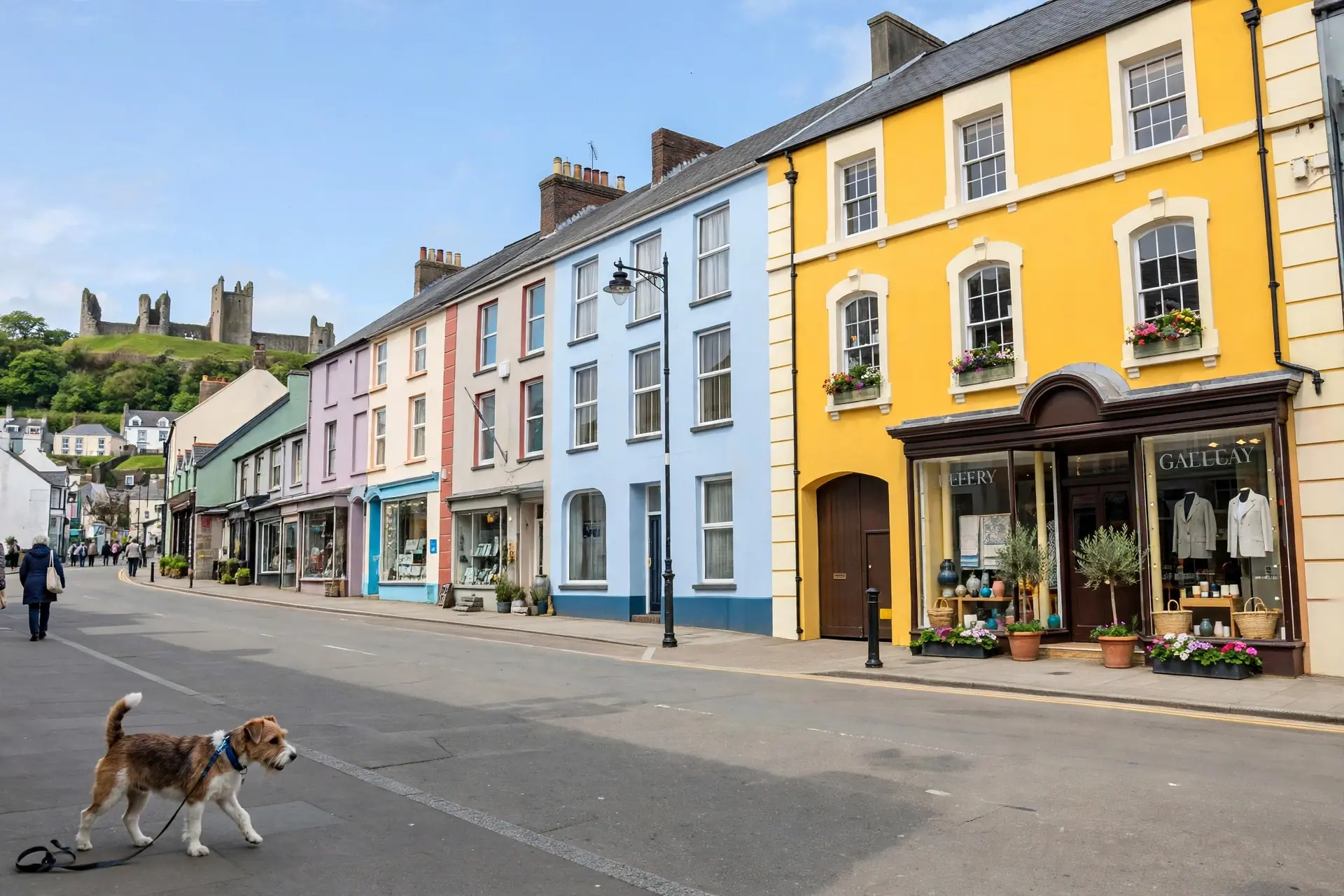
The shape of the town helps. Narberth sits on a hill above the Eastern Cleddau valley in south Pembrokeshire, roughly midway between Haverfordwest and Carmarthen on the A40, and about nine miles inland from Tenby. It is small enough that the centre can be crossed on foot in ten minutes, yet large enough to support a genuinely independent High Street rather than a row of chain stores. The buildings are a mix of Georgian and Victorian shopfronts, many of them painted in the soft colours that photograph so well, with the castle ruins standing on the rise at the western edge of town as a constant landmark. When you lose your bearings, look uphill: the castle tells you where you are.
That independence is the point. Narberth's shops are mostly owned by the people behind the counter, which means two things that matter to dog owners. First, the welcome is personal rather than corporate: a shopkeeper who decides their own policy is far more likely to wave a well-behaved dog inside, or to hold the door while you browse from the pavement, than a branch manager following head-office rules. Second, the range of what you can buy is genuinely local. Welsh cakes still warm from the griddle, Pembrokeshire lamb and pork from a traditional butcher, cheeses from small Welsh dairies, preserves, bread and cakes from independent bakeries, and bottles and boxes from delis that stock producers you will not find in a supermarket. Shopping here is not a chore to be got through before the walk; it is the walk.
The town's food calendar reinforces the habit. Narberth hosts an annual food festival, usually in September, when the High Street fills with producer stalls, tastings and cooking demonstrations, and a regular farmers' market brings local growers and makers into town through the year. Festival days are wonderful and busy, which is a trade-off worth thinking about with a dog: a reactive or nervous dog will find a quiet weekday far easier than a festival Saturday, while a bombproof, sociable dog will enjoy the extra smells and the extra fuss. If you are planning around a specific market date, check the official guidance before you travel, because market days and festival dates change from year to year and a wasted journey with a disappointed dog is an avoidable one.
There is also a practical rhythm to a Narberth visit that suits dogs. Arrive mid-morning, when the shops are open and the cafes are serving, and the town is at its liveliest. The dog gets a pavement stroll, a stop at every interesting smell, and probably a biscuit or two from shopkeepers who keep a jar by the till. By early afternoon the light softens over the coloured shopfronts, the castle garden is at its best, and the cafes fill with people taking a late lunch. The whole day runs at walking pace, which is exactly the pace a dog prefers. You do not need a timetable, a ticket or a booking to enjoy Narberth; you need comfortable shoes, a lead, a water bottle and an appetite.
One honest caveat: Narberth is a food town, not a beach town, and it does not pretend otherwise. If your dog's idea of heaven is an hour of off-lead running on sand, you will want to pair the town with a coastal day. Tenby, about twenty minutes away by car, supplies exactly that, and the combination of a Narberth morning and a Tenby afternoon is one of the best two-part days in Pembrokeshire. Treat Narberth as the slow, sensory half of the trip: the sniffing, the browsing, the eating, the sitting outside a cafe watching the town go by. The dog will not mind that there is no beach in the High Street. There is, after all, a butcher.
Narberth Castle and the town-centre stroll
Narberth Castle is the town's anchor and the natural starting point for any visit. The castle was built by the Normans, rebuilt in stone in the thirteenth century, and later slighted during the Civil War period, so what stands today is a ruin: substantial wall fragments, a gatehouse outline and the earthworks of a motte, set in a public garden on the hill at the western end of the High Street. It is not a staffed attraction with a ticket desk and a gift shop. It is something better for a dog owner: an open, free, grassy space with old stonework, views across the town and the valley, and room for a dog to potter on a lead while you look at the same view the castle's builders chose eight centuries ago.
Approach the castle on foot from the High Street and the walk itself becomes the point. The climb is short but noticeable, and the street narrows as it rises, with cottages and small gardens on either side. Dogs that pull will feel the gradient; older dogs and short-legged breeds will want to take it slowly, and there is no shame in that. At the top, the garden opens out around the ruins, with benches, mown grass and paths that loop between the walls. On a clear day the view runs across the rooftops of the town and out towards the rolling farmland of south Pembrokeshire, and on a windy day the same spot reminds you exactly why a castle was built here. Keep the dog on a lead throughout: the ruins include uneven stonework, low walls and drops that are easy to misjudge, and the garden is a shared public space used by families, so a loose dog bounding over a wall is nobody's idea of a good morning.
The castle garden is also the town's best picnic spot, and it rewards a little planning. Bring a blanket, buy lunch from one of the High Street delis or bakeries, and eat it on the grass with the dog settled beside you. There is shade under the trees on warm days and shelter behind the walls when the wind picks up, and the walk back down into town is downhill, which the dog will appreciate after a morning of uphill sniffing. If you are visiting with children, the ruins are exactly the right scale for a short explore: big enough to feel like a castle, small enough that nobody gets lost, and with enough grass for a ball game once the history lesson is over.
From the castle, the town-centre stroll writes itself. Head back down to the High Street and walk its length slowly, from the castle end to the far end and back again on the opposite pavement. This is a street that rewards the second pass: shopfronts you missed on the way up reveal themselves on the way down, a cafe you walked past turns out to have a sunny table outside, and a doorway you thought was a house turns out to be a gallery. The pavements are narrow in places, so keep the dog on a short lead and on your inside, away from the road, particularly where delivery vans are manoeuvring. Rush hour is a relative term in Narberth, but the A40 brings through-traffic, and a dog that lunges at lorries will be happier on the quieter side streets.
Those side streets deserve their own wander. The lanes running off the High Street hold cottages, small workshops and the town's museum, and they are noticeably quieter than the main street, which makes them a good decompression route for a dog that has had enough of people and pavement. A loop that takes in the castle, the High Street and two or three side streets covers perhaps a mile and a half, and it is the right distance for most dogs: enough to tire them out, short enough to leave energy for the woods later. If your dog is the sort that needs more, extend the loop towards the edge of town, where the houses thin out and the lanes turn into country roads with hedgerows and field gates. If your dog is the sort that needs less, cut the loop short and sit outside a cafe instead; Narberth forgives a short walk far more readily than a long one.
A few practical notes for the stroll. There are public toilets in the town centre, but check the official guidance before you travel for current opening hours, because small-town facilities change with the seasons. Water for the dog is your responsibility: carry a bottle and a collapsible bowl, and ask in a cafe if you need a refill, since most will happily oblige. Waste bins are placed along the High Street and in the castle garden, so there is no excuse for leaving anything behind, and the town's reputation for being tidy is something every visiting dog owner helps to protect. Finally, remember that the castle is a scheduled ancient monument as well as a garden: do not let the dog dig, climb on the walls or disturb the stonework, and keep to the paths where they are marked.
Markets, cafes and restaurants that welcome dogs
Food is the reason Narberth exists as a destination, so it deserves a proper section of its own, and it is also the part of the visit where a dog owner's planning matters most. The good news is that the town's food culture is built around small, owner-run businesses, and owner-run businesses are the ones most likely to welcome a dog. The less good news is that policies are individual, seasonal and sometimes decided on the day, so the only reliable rule is to ask, to accept a no gracefully, and to have a back-up plan that still involves eating well.
Start with the markets. Narberth's farmers' market brings local growers, bakers, cheesemakers and craftspeople into town on a regular basis, and a market is one of the best dog-friendly food experiences there is: everything happens outdoors, the dog can move at your pace, and the producers are usually delighted to talk about what they sell. Market stalls are also where you will find the things that make a Narberth visit memorable: seasonal vegetables, free-range eggs, honey, preserves, bread baked that morning, and cakes that rarely survive the journey home. Go early for the best choice, bring cash as well as a card in case a small stall prefers it, and keep the dog close in the crowds. A long lead in a busy market is a trip hazard for everyone, and a dog that weaves between legs will not be popular with a stallholder holding a tray of hot sausage rolls.
The cafes are the heart of the town's dog welcome. Several cafes on and around the High Street welcome dogs, and the pattern will be familiar to anyone who has travelled with a dog in Britain: outdoor seating is almost always fine, ground-floor indoor seating is often fine, and the most dog-friendly spots are the ones that put a water bowl by the door without being asked. The town's cafes range from traditional tea rooms to modern coffee shops, and the best approach is to choose by atmosphere rather than by a list. Look for a cafe with pavement tables and a relaxed feel, check whether there is space to tuck the dog under a table out of the walkway, and settle the dog with something to chew before you order. A dog that lies down quietly under a table is welcome almost everywhere; a dog that barks at every passing spaniel is welcome almost nowhere, and Narberth is no exception.
For restaurants, the picture is similar but slightly more formal. Narberth has a small number of well-regarded restaurants, including places that have built national reputations on local produce, and these are worth booking ahead whether or not you bring a dog. Some welcome dogs in certain areas, particularly at lunchtime or on a terrace, while others are people-only in the dining room. The honest advice is to decide what matters more on a given evening: the restaurant or the dog. If the restaurant is the point, book it and leave the dog settled at your accommodation. If the dog is the point, choose a cafe or a pub-style restaurant where the dog can sit with you, and save the fine dining for another night. Trying to force both into one evening is how dogs end up stressed and meals end up rushed.
There are also the food shops, which deserve more attention than they usually get. A deli, a bakery and a butcher are not just places to buy things: they are places where a dog owner can eat well without ever sitting down. Buy Welsh cakes, a pork pie, a loaf of bread and some cheese, and you have a lunch that can be eaten on a bench in the castle garden, on a log in Canaston Woods, or on the tailgate of the car with the dog sitting hopefully beside you. This is the lowest-stress way to eat in Narberth with a dog, and it is often the tastiest. The town's food shops are used to customers buying for a picnic, so ask what travels well and what should be eaten within the hour; a good deli will tell you honestly, and a good bakery will probably offer you a taste.
A few etiquette points will keep the welcome warm. Bring a blanket or mat for the dog to lie on in a cafe, so the dog is not sprawled across a walkway or on someone else's chair. Feed the dog before you sit down to eat, so it is settled rather than begging. Order the dog a bowl of water when you order your own drink, and tip generously in the places that treat your dog well: dog-friendly businesses remember the customers who remember them. And if a cafe or restaurant says no to dogs on a particular day, take it in good spirit. A small business that has had a bad experience with one dog will be cautious about the next, and the only way the welcome stays open is if every dog owner who uses it behaves as though they want to be invited back. For the wider picture on cafe etiquette, our guide to dog friendly cafes in the UK covers indoor manners, what to ask before you sit down, and the rights of assistance dog owners in more detail.
Canaston Woods and the countryside around town
If the town is the morning, Canaston Woods is the afternoon. The woods lie just south of Narberth, a short drive or a longer walk from the town centre, and they are the single best dog walk in the immediate area. Canaston is ancient woodland, a mix of oak, ash and other broadleaved trees growing along the valley of the Eastern Cleddau, and the paths follow the river through a landscape that feels a long way from the High Street even though it is only minutes away. The river is the centrepiece: shallow and clear in places, deeper and faster in others, with the sound of water following you along much of the walk, and with kingfishers, dippers and herons among the birds that reward a quiet approach.
The main paths through the woods are well used and easy to follow, but they are woodland paths, not pavements. Expect mud after rain, exposed roots, fallen branches and stretches where the ground is uneven, and choose footwear accordingly. For the dog, this is the best kind of terrain: soft ground, endless smells, and a river to paddle in. For the owner, it is worth carrying a towel in the car for the return journey, because a dog that has been in the Cleddau will not be dry by the time you reach the High Street. A drying coat is even better in winter, when a wet dog cools quickly in the shade of the trees. The woods are at their best in late spring, when the bluebells and wild garlic fill the valley floor, and in autumn, when the canopy turns and the leaves make a carpet underfoot. Summer brings deep shade and cool air beside the river, which makes Canaston a sensible choice on a hot day when the town pavements are baking.
Keep the dog on a lead for at least part of the walk. The woods are home to wildlife, the river has deep pools and fast water in places, and the paths are shared with walkers, runners and occasionally horse riders, so a dog that chases or bowls into other users will not be welcome. There are also livestock in the fields around the woods, and the fields are not always fenced from the paths, so a dog with a strong chase instinct needs to stay on a lead where sheep or cattle are visible. The general rule is simple: off lead only where you can see clearly, where the dog recalls reliably, and where nobody else is about. The woods are generous enough that you will find those stretches if you walk a little further in.
Beyond the woods, the countryside around Narberth offers a network of quiet lanes and public footpaths through farmland and small valleys. These are classic Pembrokeshire walking country: hedgerows, field gates, small streams, and views that open suddenly over a valley. The footpaths are marked on Ordnance Survey maps, and the best approach is to plan a loop before you set out, because the lanes are narrow, the verges are thin, and walking a dog along a country road with no pavement requires attention. A circular walk of three to five miles from the town, taking in a stretch of woodland, a stretch of farmland and a stretch of lane, is a satisfying half day, and it leaves the dog properly tired in a way that a town stroll never quite manages.
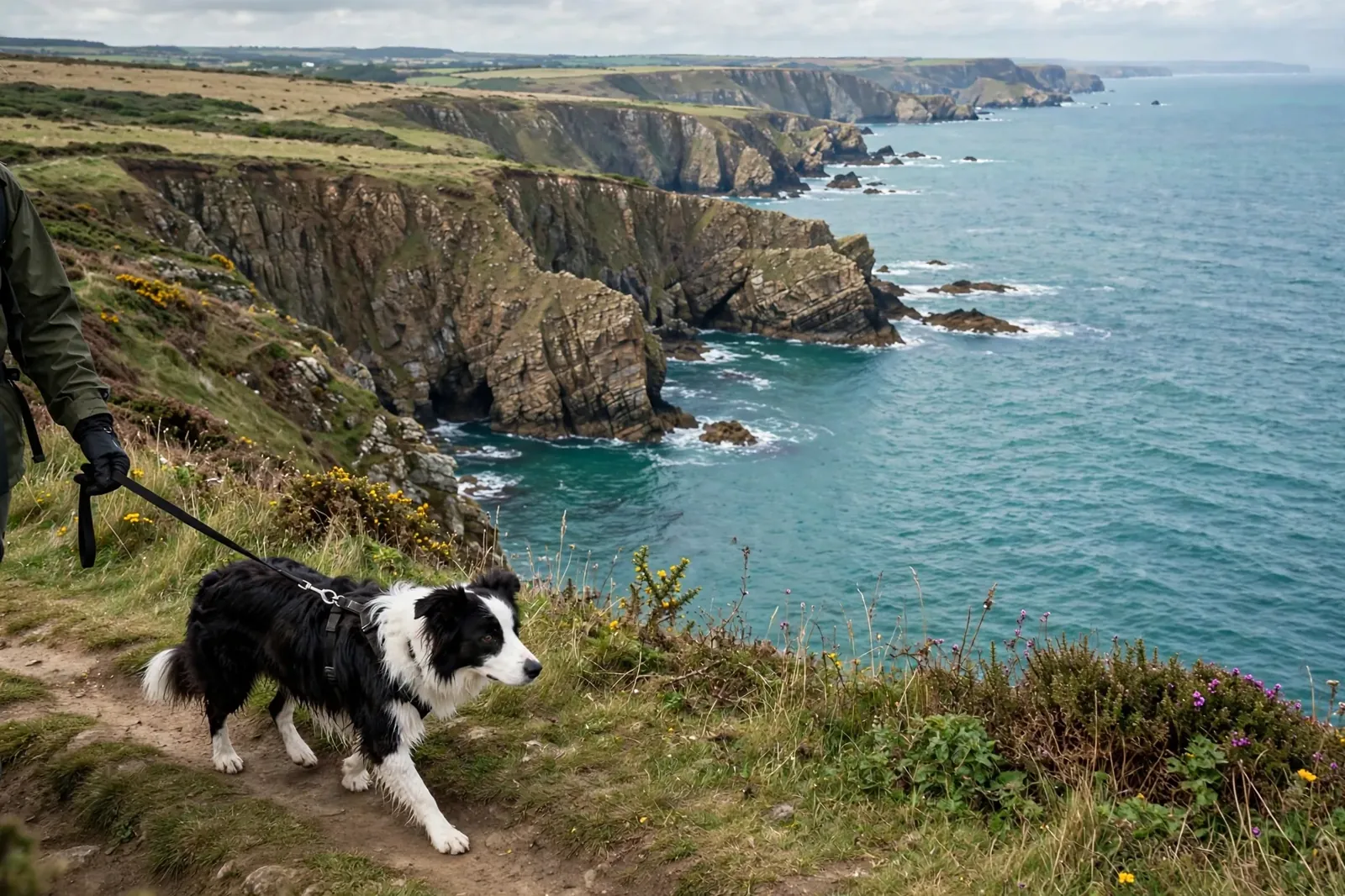
For longer days, Narberth is an excellent base for the coast. The Pembrokeshire Coast Path runs along the county's shoreline, and its southern sections around Tenby, Saundersfoot and Amroth are within easy reach by car. A morning in Narberth followed by an afternoon on the coast path is the classic Pembrokeshire day, and it works particularly well because the two halves of the day ask different things of the dog: town manners in the morning, open-air stamina in the afternoon. Check the official guidance before you travel for coast path conditions, seasonal dog restrictions on beaches, and livestock on cliff-top sections, because the coast path is a wilder environment than the woods and the rules change with the season.
One warning that applies to every countryside walk around Narberth: the weather. Pembrokeshire sits on the western edge of Britain, and the rain that waters its green fields can arrive quickly. A walk that starts in sunshine can be wet within half an hour, and a woodland path that was firm in the morning can be slippery by the afternoon. Carry a waterproof layer for yourself and a drying coat for the dog, check the forecast before you set out, and be willing to shorten a walk rather than push on through a downpour with a cold, wet dog. The woods and the lanes will still be there tomorrow, and a dog that is dried off and warm by the fire will forgive a shortened walk far more readily than a long, miserable one.
Independent shops and galleries
Shopping is not an afterthought in Narberth; it is the reason many people come, and it is where the town's character is most visible. The High Street and its side streets hold a concentration of independent shops that is increasingly rare in British towns: a bookshop, a gallery or two, craft shops, antique and vintage dealers, a hardware store that still sells things by the piece, clothing shops that stock labels you will not find on the high street, and food shops of every kind. The pleasure is in the browsing, and browsing with a dog is a skill worth developing.
The galleries deserve a special mention, because Narberth has quietly become a centre for art and craft in south-west Wales. Small galleries show work by local painters, printmakers, ceramicists and textile artists, and the standard is high: this is not souvenir art, but work made by people who live and work in Pembrokeshire and paint what they see. Most galleries are small, single-room spaces, which means a dog is a genuine consideration rather than an afterthought. Some welcome dogs inside, some prefer the dog to wait outside with a companion, and some are happy for a calm dog to come in if it stays on a short lead and does not brush against the ceramics. Ask at the door, accept the answer, and remember that a gallery's stock is fragile in a way that a bookshop's is not. A wagging tail at hip height is a real risk around a display of pottery, and the gallery owner knows it.
The bookshop is the easiest shop in town to visit with a dog. Bookshops are, by tradition, among the most dog-friendly shops in Britain, and a dog that lies quietly by the shelves while its owner browses is a familiar sight. Narberth's bookshop is the kind of place where an hour disappears: local history, Welsh writing, walking guides, children's books, and a second-hand section that rewards a patient rummage. Buy a walking guide for the area while you are there; it will pay for itself on the next walk, and the shopkeeper will usually know which routes are currently passable and which are waterlogged.
Antique and vintage shops are the opposite end of the spectrum: fascinating, but full of breakable things at tail height, and often crowded with stock. The best approach is to leave the dog with a companion outside, or to pop in alone for a quick look and return with the dog later if the shop is dog-friendly. If you do bring the dog in, keep it on the shortest possible lead and between you and the wall, away from the displays. The same advice applies to the craft shops, where baskets of wool, shelves of glass and displays of jewellery are all within reach of a curious nose. A dog that can be trusted to walk in a straight line is welcome in more shops than a dog that cannot, and Narberth's shopkeepers are quick judges of which kind yours is.
There is also a practical side to the shopping. Narberth is a good place to stock up for a self-catering stay or a longer road trip: the butcher, the baker, the deli and the greengrocer between them can fill a cool bag for a week, and the prices are fair for the quality. If you are staying in a cottage or a caravan nearby, do your main shop here rather than in a supermarket on the way in; the food will be better, the money stays in the town, and the dog will have had a proper walk while you shopped. Bring your own bags, bring a cool bag for the car on warm days, and remember that a car full of shopping and a wet dog is a combination that requires a blanket on the back seat.
Finally, take the time to talk to the shopkeepers. Independent shops run on conversation, and the people behind the counters in Narberth are a mine of local information: which cafe is best for lunch today, whether the woods are muddy, where the nearest vet is, and which beach is best at low tide. A dog is a natural conversation starter in a small town, and a shopkeeper who has just given your dog a biscuit is more likely to tell you about the walk that is not in any guidebook. That is the real souvenir of a Narberth visit: not the thing you bought, but the tip that made the afternoon better.
Staying over and parking
Narberth works as a day trip, but it works better as a base, and the town and its surroundings offer a good range of dog-friendly places to stay. The town itself has small hotels, bed and breakfasts and guest houses, several of which welcome dogs, and the surrounding countryside adds holiday cottages, farm stays and caravan sites within a short drive. The right choice depends on the dog: a town-centre bed and breakfast suits a settled dog that is happy in a new bedroom and can cope with stairs and a shared breakfast room, while a cottage with a garden suits a dog that needs its own space, a secure place to run, and a door that opens straight onto grass for the last outing of the night.
When you book, ask the questions that the listing does not answer. Is the garden genuinely enclosed, and how high is the fence? Is there a surcharge per dog, and is it per night or per stay? Are dogs allowed in the bedroom only, or in the living areas as well? Is there a limit on the number of dogs, and does the property have a policy on dogs left alone in the room? Can you park beside the door, so you are not carrying a dog's bed and bowls across a car park in the rain? The answers matter more than the photographs, and a property that answers them clearly is usually a property that has thought about dogs properly. Get the dog policy in writing with the booking confirmation, so there is no argument on arrival.
For a first visit, consider staying in or near the town rather than on the coast. The coast is busier, dearer and harder to park in during the summer, while Narberth is quieter, cheaper and central: Tenby, Saundersfoot and the beaches of the south coast are all within twenty minutes by car, Haverfordwest is fifteen minutes in the other direction, and the Preseli Hills are a straightforward drive north. A central base also means that a rainy day is not a wasted day: the town's shops, cafes and galleries are all indoors, the castle garden can be enjoyed between showers, and a wet afternoon is a good excuse for a long lunch. Dogs that stay in town also get a better routine, with the same morning walk and the same evening stroll each day, which is worth more to a dog than a change of scenery.
Parking in Narberth is straightforward, but it rewards a little thought. The town has public car parks within a short walk of the High Street, and these are the right choice for a dog owner: they are flat, they are close to the centre, and they leave the narrow High Street free for deliveries and residents. Do not try to park on the High Street itself unless you have a specific reason; the street is narrow, the spaces are few, and a dog unloading onto a pavement beside moving traffic is a poor start to the day. Park once, in a car park, and walk everywhere from there. Check the official guidance before you travel for current charges, time limits and payment methods, because small-town car parks change their arrangements from time to time, and a parking ticket is an expensive souvenir.
A few final practical points. The town's train station, on the West Wales line, is a short walk from the centre, and dogs are welcome on trains in Britain, so a car-free visit is possible if you plan it: arrive by train, walk to your accommodation, and use local buses or taxis for the coast. If you are driving, fill up before you arrive if you can, because the town's petrol options are limited and the nearest large supermarket is a drive away. Keep the vet's number saved in your phone before you need it, and know where the nearest out-of-hours vet is; the town is rural, and a vet visit that is a ten-minute drive in the daytime can feel a long way at midnight. And on a warm day, never leave a dog in a parked car, even for a few minutes, even with the windows open. Narberth's car parks are sunny, the cars heat up fast, and the town's cafes are happy to have the dog with you instead.
Put it all together and Narberth is a town that asks very little of a dog owner and gives a great deal back. A morning on the High Street, a picnic in the castle garden, an afternoon in the woods, and an evening in a cafe with a dog asleep under the table: that is the shape of a good Narberth day, and it is a shape that can be repeated, with small variations, for a whole week. The town will not shout about itself, and that is part of its charm. It is a place that rewards the visitor who slows down, looks in the shop windows, talks to the people behind the counters, and lets the dog set the pace. Do that, and Narberth will do the rest.
Practical questions
Before you go
Is Narberth a good town to visit with a dog?
Yes. Narberth is compact, walkable and full of independent shops, cafes and outdoor seating, with a castle garden to wander and Canaston Woods a short drive away. Most of the pleasure of the town happens outdoors, on foot, which suits a dog perfectly. Check the official guidance before you travel for current opening times and any seasonal changes to cafe and shop dog policies.
Can dogs go into Narberth Castle?
The castle ruins stand in a public garden area on the edge of the town centre, and dogs on leads are generally welcome in the grounds around the ruins. The site is an open ruin rather than a staffed attraction, so there is no ticket barrier, but keep your dog on a lead near the walls and the drops, and check the official guidance before you travel for any temporary closures.
Where can I walk my dog near Narberth?
Canaston Woods, just south of the town, is the best nearby walk: riverside paths through ancient woodland along the Eastern Cleddau. For longer days, Tenby's beaches and the Pembrokeshire Coast Path are about a 20-minute drive away. Keep dogs on leads where livestock graze and near the river, and check the official guidance before you travel for path conditions after wet weather.
Are there dog-friendly cafes and restaurants in Narberth?
Yes, several cafes and restaurants in the town centre welcome dogs, particularly on outdoor seating and in ground-floor areas, and the town's food shops and delis are easy to browse with a dog waiting outside or at a pavement table. Policies change by season and by owner, so always check the official guidance before you travel and ask before bringing a dog indoors.
Where should I park in Narberth with a dog?
Use the town centre car parks rather than trying to park on the narrow High Street, then walk in. The main car parks put you within a few minutes of the castle, the shops and the cafes, which makes it easy to leave the car and explore on foot. Check the official guidance before you travel for current charges and time limits, and never leave a dog in a parked car on a warm day.