This guide is independent and contains no paid placement. If affiliate links are added later, they will be clearly marked and will not change our editorial checks.
Tenby gives a dog four very different beaches, but the two big ones — North Beach and South Beach — normally exclude dogs from 1 May to 30 September. In summer, use Castle Beach and Harbour Beach with care, or drive a few minutes to the open sands beyond the town. Check the official guidance before you travel, because the council can change the dates and the marked zones.
First sight: painted houses under the walls
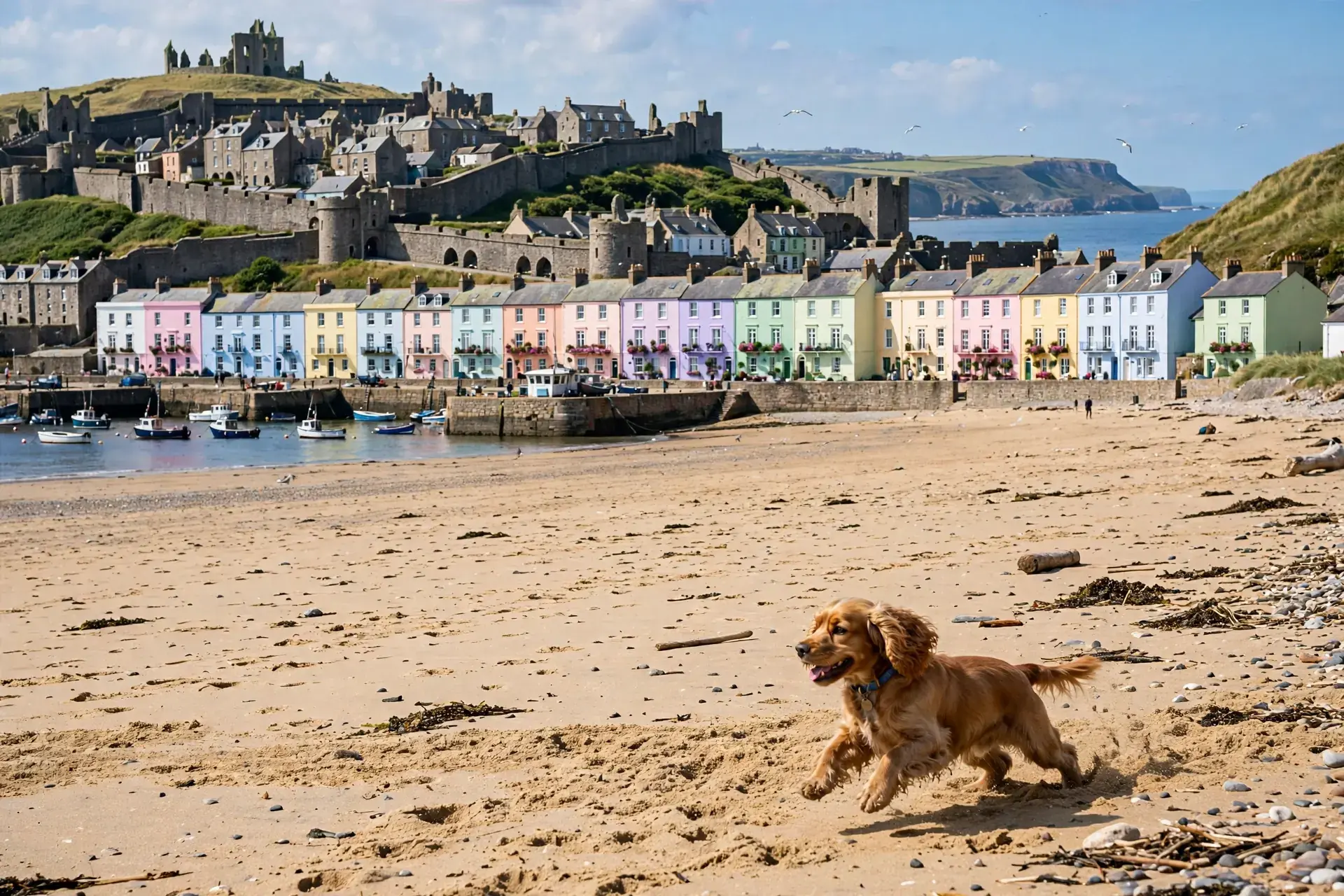
Tenby arrives all at once. The road drops towards the sea, the medieval walls come into view, and then the harbour opens out below a row of houses painted in ice-cream colours — pink, yellow, blue and mint — that look as though they were chosen to be photographed. Castle Hill rises at one end of the harbour, St Catherine's Island sits offshore at the other, and the whole town feels small enough to walk across in ten minutes, which is exactly what makes it work with a dog. Nothing here needs a car once you have arrived, and the best of the town is found on foot, at a dog's pace, with time to stop and look back at the view.
The town walls are the first thing to understand, because they shape every walk that follows. Tenby was a walled port in the Middle Ages, and long stretches of the thirteenth-century wall still stand, with the Five Arches gateway as the main opening on the landward side. Inside the walls the streets are narrow and bend without warning; outside them the town spreads up the hill towards the railway station and the modern estates. A dog on a lead belongs in the old town in a way that a dog off the lead never will: the pavements are thin, the corners are blind, and a spaniel that darts after a gull can be in the road before its owner has finished turning around. That is not a complaint about Tenby. It is the reason the town has kept its character, and it is also the reason a short lead and a calm heel are worth practising before the trip.
Start by walking the outside of the walls rather than through them. From the harbour, follow the road around Castle Hill and look up at the wall as it runs along the top of the slope, then come back through the Five Arches and into the High Street. The change in scale is immediate: the open sea air gives way to sheltered lanes, shop fronts, cafe tables and the smell of fish and chips. Dogs notice the change too. The harbour smells of salt, diesel and bait; the old town smells of food, other dogs and the warm stone of buildings that have stood for centuries. Give the dog ten minutes to take it in, standing still somewhere quiet, rather than marching straight to the first beach. A dog that has had a chance to sniff and settle will walk better for the rest of the day.
The other thing to grasp on arrival is that Tenby is a town of tides as much as of streets. At high water the harbour is full of boats and the beaches shrink to ribbons; at low water the sand stretches out for hundreds of metres, rock pools appear, and St Catherine's Island can be reached on foot across the causeway. The same beach can be a generous open space at nine in the morning and a narrow strip at noon, and the dog rules change with the season on top of that. Planning a Tenby day means checking two things before leaving the accommodation: the tide times and the date. Get those two right and the town is easy; get them wrong and the dog spends the morning watching other dogs play on a beach it cannot use.
This guide is organised the way a dog owner actually uses Tenby: beach by beach, because each of the four beaches has different rules, different sand and a different character, and the wrong choice wastes a morning. After the beaches come the harbour and the boats to Caldey Island, then the walled old town itself, and finally the coast path that leads out of town in both directions. The order matters. If the dog has already had a proper run on the right beach, the old town and the coast path are both easier, because a tired dog is a polite dog in a crowded street and a steady dog on a cliff path.
North Beach and the summer ban
North Beach is the long, open sweep of sand on the northern side of Castle Hill, reached from the town by steps down from the headland or by the road past the harbour. It is the beach most visitors picture when they think of Tenby: pale sand, clear water, rock pools at the edges, and the town rising behind it in a curve of coloured houses. On a quiet October morning it is one of the best dog beaches in Wales — wide, firm underfoot, with room for a long throw of the ball and space to keep clear of other groups. In high summer, though, it is the beach a dog cannot use at all, and that contrast is the single most important fact in this guide.
The summer exclusion on North Beach normally runs from 1 May to 30 September. During those months dogs are not allowed on the beach, and the restriction is enforced by Pembrokeshire County Council, with signs at the access points and patrols in the busy weeks. The dates and the exact boundary of the restricted area can change, so check the official guidance before you travel rather than relying on a date remembered from a previous visit. Outside the restricted season — roughly October through April — dogs are welcome on North Beach, and it becomes the natural first choice for a morning walk, especially at low tide when the sand is at its widest and firmest.
What makes North Beach work so well for dogs in the open season is its scale. The beach is long enough that a dog can run without crowding the families near the access steps, and the sand stays firm enough for a ball game even after rain. The edges are worth exploring: rock pools at the northern end hold crabs and small fish that fascinate a curious dog, and the base of the cliffs gives shade on a bright day. Keep the dog away from the cliff base after heavy rain, when loose material can fall, and watch for the weever fish that bury themselves in shallow sand on warm days — a sting is painful for a dog's paw, and a dog that suddenly yelps and holds a paw up on a summer beach should be carried off the sand and checked.
The approach to North Beach deserves a note of its own. The steps down from Castle Hill are steep and can be slippery when wet, and a dog that pulls on the lead can unbalance its owner on the way down. Take the steps slowly, keep the lead short, and let the dog go ahead only when you can see the sand. An older dog or a small breed may find the steps hard work, and the road route past the harbour, though longer, is gentler. There is a car park near the northern end of the beach for anyone arriving by car, but on busy days it fills early, and the walk from the town centre is short enough that most visitors are better off leaving the car where it is.
If the calendar says summer and North Beach is closed to dogs, do not try to bend the rule by arriving at dawn or using a quiet corner. The ban covers the whole beach, the restriction is well known locally, and a dog on a banned beach in July is the fastest way to spoil a holiday with a fine and a confrontation. The right response is to walk on to one of the alternatives in this guide — Castle Beach, Harbour Beach, or the sands beyond the town — and to save North Beach for the shoulder seasons, when the town is quieter, the sand is empty, and the dog has the whole sweep to itself.
South Beach and the long walk south
South Beach is the longest beach in Tenby, a straight run of sand that stretches for well over a mile from the harbour towards Penally, backed by dunes and the golf course. It is a different experience from North Beach: wilder, windier, with bigger skies and a feeling of open space that suits a dog that likes to run in straight lines. The sand is fine and soft, the water shelves gently, and on a low tide the beach is wide enough for several games of fetch to happen at once without anyone getting in anyone else's way. It is also, like North Beach, subject to a summer dog exclusion, and the same dates normally apply — 1 May to 30 September — so check the official guidance before you travel.
The ban on South Beach has a geography worth understanding, because the beach is so long that visitors sometimes assume the far end must be exempt. It is not, in the way people hope: the restricted area covers the main stretch of beach used by swimmers and families, and the signs at the access points mark where the exclusion begins and ends. The dunes behind the beach and the paths along the golf course are a different matter, and a dog can often be walked there on a lead while the beach itself is closed, but that is a walk, not a swim, and it should not be treated as a loophole. Read the signs at the point where you join the beach, and if the sign says no dogs, turn back rather than arguing with the wording.
Outside the restricted season, South Beach is the best place in Tenby for a long, tiring walk with a dog. Start at the harbour end and walk south with the sea on the left, and the beach simply keeps going until the legs give out. The sand near the waterline is firm enough for a comfortable pace, while the dry sand higher up the beach is softer and better for a dog that likes to dig. The dunes at the back of the beach are a separate pleasure: winding paths through marram grass, shelter from the wind, and the smell of gorse in spring. Keep the dog on a lead in the dunes during the bird nesting season and whenever livestock is grazing nearby, and keep it out of the fenced dune restoration areas, which are there to hold the sand in place.
South Beach is also the beach where the weather makes the biggest difference. A south-westerly wind funnels straight down the beach, and on a blustery day the sand blows at ankle height and stings the legs. A dog that dislikes wind will be happier on North Beach, which is more sheltered, or in the dunes behind South Beach. On a calm, warm day, though, there is nowhere better: the shallow water warms quickly, the sand is clean, and a dog that likes to swim can paddle for an hour without getting cold. Bring fresh water for the dog either way, because there is no drinking water on the beach itself and a dog that has been running in salt water will be thirsty long before the walk back.
The walk from South Beach to Penally makes a natural extension for a fit dog. At low tide the sand continues past the end of the formal beach, and the village of Penally has a pub and a quiet station on the line back to Tenby for anyone whose dog has run out of energy. The return along the coast path, above the beach rather than on it, gives a different view of the same coast and keeps the dog off the sand if the tide is coming in. Either way, plan the timing around the tide: South Beach narrows quickly as the water rises, and a dog that is tired and wet is much harder to carry up the steps at the harbour end than a fresh one.
Castle Beach, the small cove below the ruins
Castle Beach is the smallest of Tenby's four beaches, a sheltered cove tucked between the harbour and South Beach, below the remains of Tenby Castle on Castle Hill. At low tide it is a handsome little bay of sand and rock pools; at high tide it almost disappears, which is the first thing to know about it. The second thing is that it is the beach most dog owners in Tenby talk about first, because it is the one that stays usable when the two big beaches are closed in summer — though that depends on the current rules, so check the official guidance before you travel and read the notice at the top of the steps.
The cove owes its character to its position. The castle ruins above it, the harbour wall to one side and the cliffs to the other cut the wind and hold the warmth, so Castle Beach feels sheltered even on a day when South Beach is blowing hard. The sand is coarser than on the big beaches, mixed with pebbles and shells near the rock pools, and the water is shallow and clear. A dog that likes to paddle rather than swim will be happy here, nosing around the pools while its owner sits on the rocks. A dog that needs a long sprint will not: the beach is simply too small, and a ball thrown with any enthusiasm will end up in the water or against the cliff.
Access is by a flight of steps down from Castle Hill, and those steps are the reason Castle Beach never feels crowded. Families with pushchairs and cool boxes tend to choose the bigger beaches, which leaves the cove to walkers, swimmers and dog owners who do not mind the climb. The steps are steep and uneven in places, and they are slippery with seaweed after a high tide, so hold the handrail, keep the dog on a short lead, and carry a small dog down if it hesitates. There is no lifeguard here and no cafe on the sand, so bring water for the dog and a towel for the climb back up.
Castle Beach is also the best place in Tenby to teach a young dog about the sea. The water is calm, the slope is gentle, and the rock pools give a nervous dog something to investigate without committing to a swim. Let the dog choose its own depth, and never throw a ball into deep water for a dog that has not yet learned to swim confidently. The tide fills the cove from both ends, so keep an eye on the water while the dog is absorbed in the pools: the way back to the steps can be cut off faster than expected, and a dog that has to be carried through knee-deep water is not a happy dog.
One more detail matters for dog owners. Because Castle Beach is small and sheltered, it is popular with other dog owners, and that is both its charm and its complication. A reactive dog will meet other dogs at close quarters here, on the steps and in the cove, with no room to give a wide berth. If your dog needs space, arrive early, keep it on a lead until you can see who else is on the beach, and be ready to walk on to Harbour Beach or the coast path instead. A short, calm visit to Castle Beach beats a tense hour in a crowded cove.
Harbour Beach and the slipway
Harbour Beach is the patch of sand beside the harbour itself, at the foot of the town walls and a few steps from the slipway where the boats come and go. It is not a beach in the way North and South are beaches: it is smaller, busier, and shaped by the working harbour around it. Boats are launched and recovered here, fishing gear is stacked on the quay, and the lifeboat station stands close by. For a dog, that makes it the most interesting beach in Tenby and also the one that needs the closest supervision.
The appeal of Harbour Beach is its position. It is the nearest sand to the old town, it is sheltered by the harbour wall, and at low tide it joins the sand that stretches around the base of Castle Hill, giving a dog a surprising amount of room to explore. Children build sandcastles here, crab lines dangle from the harbour wall, and the water is shallow enough for a dog to paddle while its owner watches the boats. In summer, when the big beaches are closed to dogs, Harbour Beach is the fallback that many owners check first — again, subject to the current rules, so check the official guidance before you travel and look at the signs on the slipway before letting the dog off the lead.
The working harbour brings hazards that a dog owner should take seriously. There are ropes, chains, fish boxes, bait and discarded hooks on and around the quay, and a dog that scavenges will find all of them before its owner does. Fishing line is the worst of it: a length of monofilament tangled around a paw or swallowed with a piece of bait can turn a pleasant morning into an emergency vet visit. Keep the dog on a lead on the quay itself, check the sand for hooks and line before letting it run, and never let it eat anything it finds on a working harbour. The slipway is also slippery with algae, and a dog that runs down it at speed can slide straight into the water — amusing to watch, less amusing when the dog panics against a wet concrete slope.
Harbour Beach is at its best early in the morning, before the boats start moving and the day-trippers arrive. At dawn the harbour is quiet, the sand is clean from the overnight tide, and a dog can have a proper run in the space below the walls while the town is still waking up. By midday in August the same beach is a different place: crowded, noisy, and full of the things a dog should not eat. The lesson is a general one for Tenby, but it is sharpest here — the early dog gets the beach.
From Harbour Beach it is a short step to St Catherine's Island, the tidal island with its Victorian fort, which can be reached on foot across the sand at low tide. Dogs on a lead are welcome on the walk across, and the island gives a fine view back over the town and the harbour. Go only when the tide is falling or at low water, and leave in good time: the causeway covers quickly on a rising tide, and the island has no shelter and no fresh water. A dog that is tired after a beach run should not be taken across at all — the walk out is easy, but the walk back against a rising tide, carrying a wet dog, is not.
The harbour, the boats and Caldey Island
Tenby harbour is a working place, not a museum, and that is part of its appeal. Fishing boats land their catch here, the lifeboat is housed on the quay, and in the summer months a small fleet of passenger boats runs trips around the bay and across to Caldey Island. For a dog owner, the harbour is both a destination in its own right and a decision point: the boats are tempting, but the dog's place in the plan needs thinking through before buying a ticket.
Caldey Island sits about a mile offshore, a quiet island of fields, woods and a Cistercian monastery, with a village, a lighthouse and a long sandy beach of its own. The boats from Tenby take about twenty minutes to cross, and the trip itself is lovely — seals are often seen around the island, and the view back to Tenby from the water is the best in the town. Dogs can usually travel on the boat, but they are not permitted to land on Caldey Island, because it is a working monastery island with wildlife, livestock and a community that keeps the island deliberately quiet. Check with the boat operator before you travel, as arrangements can change with the season, and do not assume that a dog that rode the boat last year will be welcome on the island this year.
That rule shapes the practical question: what happens to the dog while the humans visit the island? There are only a few honest answers. One person stays in Tenby with the dog, and the party takes it in turns to visit the island on different days. Or the dog stays on the boat for the return crossing, which some operators allow and some do not, and which suits a calm dog on a cool day but not a nervous dog or a hot one. Or the island trip is skipped altogether, which is a perfectly good choice — Caldey is beautiful, but Tenby has four beaches and a coast path, and a dog that has a miserable day on a boat it did not want to be on is not a fair price for a monastery visit. Decide before reaching the ticket office, not at it.
The shorter boat trips around the bay are a different proposition. These run for half an hour or so, stay in sight of the town, and are usually happy to take a dog on board, provided the dog is on a lead and settled. A dog that likes boats will enjoy the wind and the spray; a dog that does not will tell its owner within the first minute, and the trip is short enough that the discomfort is brief. Ask the crew before boarding, keep the dog low in the boat and away from the edge, and bring a towel — a dog that shakes seawater over a boat full of strangers makes a memorable impression for the wrong reasons.
Back on the quay, the harbour is worth an unhurried hour with a dog on a lead. Watch the boats come in, look at the catch being unloaded, and walk the length of the harbour wall to the end, where the view opens out across the bay to Giltar Point and the coast towards Penally. The harbour wall is the best place in Tenby to watch the light change in the evening, and it is also a place to keep a firm grip on the lead: there are gaps in the wall, drops to the water, and gulls that will tempt a chasing dog to the very edge. The lifeboat station is open to visitors at times, and the crew are usually happy to talk about their work — a dog that sits quietly beside its owner while the crew talk is a welcome visitor; a dog that barks at the lifeboat is not.
Inside the walls: streets, pubs and cafes
Inside the town walls, Tenby becomes a different kind of walk. The High Street runs up from the harbour through the Five Arches, lined with independent shops, galleries, bakeries and ice-cream parlours, and the lanes that branch off it — narrow, crooked, and paved in stone — hold the town's oldest houses, including the Tudor Merchant's House. It is the prettiest part of Tenby, and also the most demanding for a dog: narrow pavements, blind corners, delivery vans squeezing through gaps that look too small for them, and a constant flow of people, pushchairs and other dogs. Keep the dog on a short lead here, always, and walk on the building side of the pavement rather than the road side.
The Five Arches deserves a pause. It is the main gateway through the medieval walls, a stone archway that every visitor passes through, and it is also a bottleneck: everyone entering or leaving the old town funnels through the same opening, and a dog that stops to sniff in the middle of it will block the way. Walk through briskly, keep the dog close, and stop on the far side, where there is room to look back at the walls without getting in anyone's way. The walls themselves can be followed for much of their length from the streets inside and the paths outside, and the stretch along the top of the town, with its view over the rooftops to the sea, is the best short walk in Tenby that does not involve a beach at all.
Tenby's pubs and cafes are, on the whole, generous to dogs. Many of the pubs welcome dogs in the bar area, and several have water bowls by the door and a jar of treats on the counter; the cafes with outdoor seating usually welcome dogs at the outside tables, and a few will bring a bowl of water without being asked. Policies vary from place to place and can change with the season, so look for the sign at the entrance or ask a member of staff before bringing the dog inside, and do not assume that a pub that welcomed dogs in October will do the same on a crowded August evening. The house rule everywhere is the same: the dog stays on the floor, on a lead, and settled under the table, and a dog that barks at every passing customer will be asked to leave.
Choose where to eat with the dog's temperament in mind. A calm older dog will be happy in a quiet bar with a fire and a corner to lie in; a young, excitable dog will be happier at an outside table, where the distractions are further away and the dog can watch the street. Lunchtime is easier than the evening, when pubs fill up and the noise rises. Bring the dog's mat, so it has a defined place to lie, and a chew to keep it occupied while the food arrives — a dog that has something to do is a dog that is not stealing chips from the next table. And remember that the dog has probably already had its exercise: a pub visit after a beach walk is a reward for a tired dog, while a pub visit before the walk is a test of patience for everyone in the room.
Shopping with a dog in Tenby is a mixed picture. The food shops, delis and bakeries generally ask dogs to wait outside, while many of the gift shops, galleries and outdoor shops are happy for a well-behaved dog to come in. Take it in turns if there are two of you — one shops, one holds the dog outside — rather than tying the dog to a post in a busy street, which is stressful for the dog and an invitation to trouble. The ice-cream parlours are the hardest test of all: a dog that has smelled a waffle cone will not forget it, so buy the ice cream, walk to a quiet corner, and let the dog have its own treat from the pocket, not from the cone.
The old town is also where the practical things are: the pharmacy, the post office, the small supermarket for dog food and supplies, and the vet practices on the edge of town. Note where the nearest vet is on arrival, and save the number in the phone before it is needed — a dog that has eaten something on the harbour or cut a paw on a shell will need a vet faster than a search engine can provide one. The town's museum, on Castle Hill, covers Tenby's history as a port and a resort, and while dogs are not allowed inside, the walk up to it, past the castle ruins and along the top of the walls, is one of the best short loops in town, with views in every direction.
The coast path out of Tenby
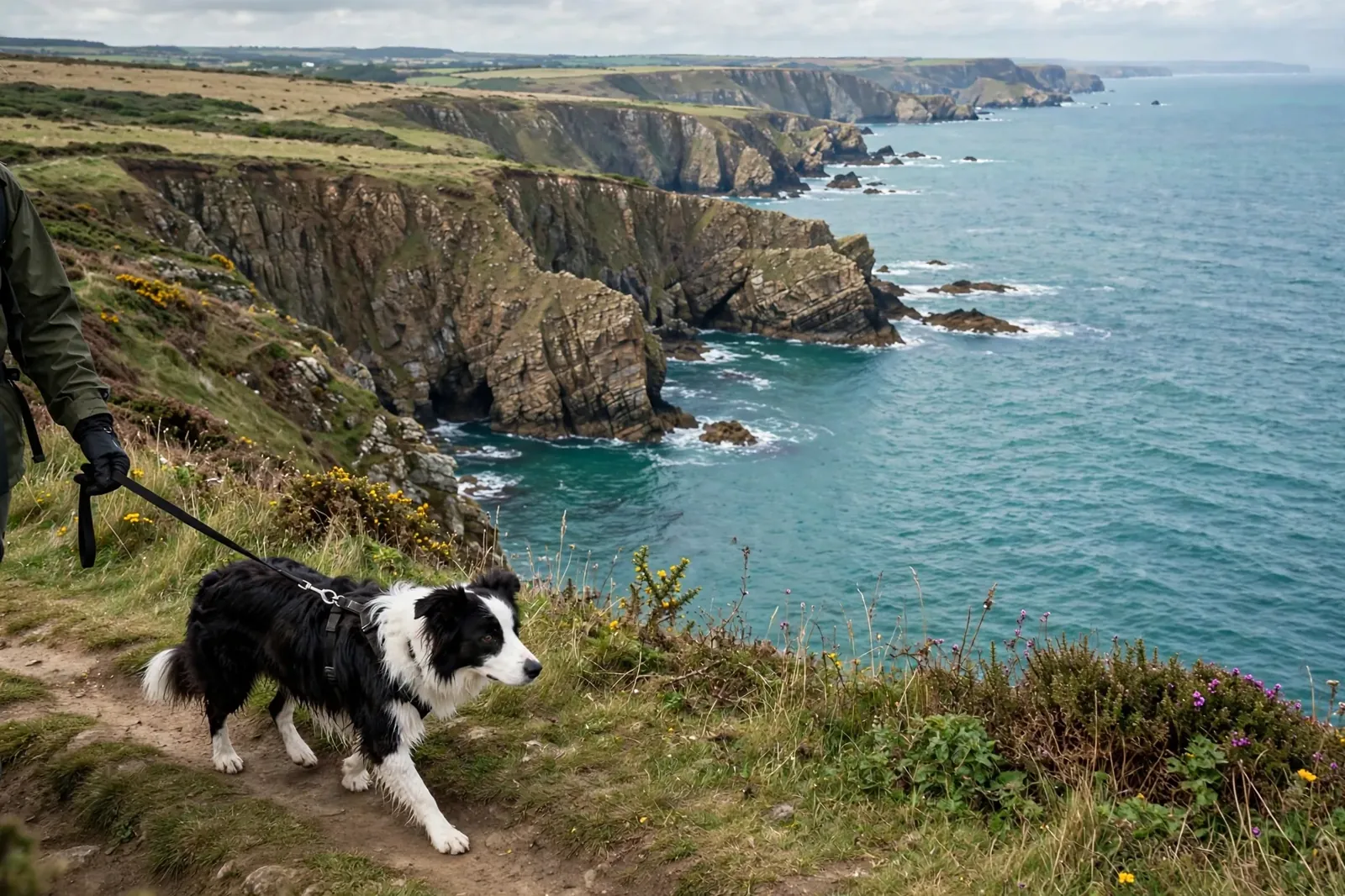
The Pembrokeshire Coast Path runs straight through Tenby, and the town is one of the best places to join it with a dog, because the path leaves in both directions and both directions are worth walking. To the north-west, the path climbs out of town towards Saundersfoot, through wooded valleys and along cliff tops, with views back over Tenby's beaches that get better with every step. To the south-east, it runs towards Penally, Manorbier and beyond, along open cliff tops with the sea on one side and farmland on the other. Both stretches are well waymarked, both have their own character, and both reward a dog that has already had a beach run and is ready to walk steadily rather than sprint.
The Saundersfoot direction is the gentler of the two to start with. The path leaves Tenby through the dunes and woodland behind South Beach, climbs through trees, and then follows the cliff top to Saundersfoot, a small harbour village about four miles away, with pubs and cafes that welcome dogs and a beach of its own. The walking is mostly on good paths with some steps and short climbs, and there are places to stop for water and a rest. A dog that is used to woodland will love this stretch: the shade, the smells, the leaf litter, and the sudden openings where the trees part and the sea appears below. Keep the dog on a lead through the wooded sections in the spring, when ground-nesting birds are about, and on the cliff-top stretches throughout the year, because the path runs close to the edge in places and the drop is real.
The Manorbier direction is wilder and more open. From Penally the path crosses fields and cliff tops, passing the Norman church at Penally and the old limekilns, and then drops to Manorbier, a village with a castle, a beach and a pub. The walking here is more exposed, with longer stretches without shelter and without water, so carry more than you think the dog will need — a litre of water for a half-day walk is not excessive on a warm day. The cliff edges on this stretch are unfenced in places, and the path can be narrow where it crosses farmland, so a dog that pulls on the lead is a liability here. Use a short lead, walk on the landward side of the dog, and stop well back from the edge to admire the view.
Livestock is a fact of life on the Pembrokeshire coast path, and Tenby's sections are no exception. Sheep graze the cliff-top fields, and cattle appear on some of the inland stretches. Keep the dog on a lead whenever livestock is in sight, and if the dog has a strong chase instinct, keep it on a lead for the whole walk rather than risking it. Farmers in Pembrokeshire have the right to protect their animals, and a dog that worries sheep can be shot — that is not a threat, it is the law, and it is the reason the lead stays on. Our full guide to the Pembrokeshire Coast Path with a dog covers the longer sections, the water gaps and the multi-day planning in detail, and it is worth reading before attempting anything beyond a day walk from Tenby.
For anyone planning a longer Welsh walking holiday, Tenby makes a good first base before heading north to the mountains. The contrast is the point: a few days of sand, harbour and gentle cliff walking, then the very different demands of high ground. Our Snowdonia guide covers the lead rules on Yr Wyddfa, the sheep country, and the easier valley walks for dogs that are not ready for a summit — useful reading before trading the Tenby beaches for a mountain path.
Reading the tide before the dog does
Tides govern Tenby more than any other single factor, and a dog owner who ignores them will have a worse day than one who checks them. The tidal range here is large: at low water the beaches are wide and the harbour is a muddy hollow full of boats sitting on the sand; at high water the sea comes right up to the harbour wall and the steps. The difference between the two states is a matter of hours, and the change is fastest in the middle of the tide. A dog that is playing happily on a wide beach at ten in the morning can be paddling at the foot of the steps by noon, with the way back cut off behind it.
Check the tide times the night before, and check them again in the morning. Tide tables for Tenby are published online and in the local shops, and the harbour office posts the times too. Note the time of low water and the time of high water, and plan the beach walk for the falling tide or the low-water window, not the rising one. The safest pattern is simple: arrive at the beach as the tide is going out, walk while it is out, and leave while there is still plenty of sand. A dog that is tired and wet is slow, and a slow dog on a rising tide is a problem that is easy to avoid and miserable to solve.
Rock pools deserve the same respect as the tide. They are the most interesting part of Tenby's beaches for a dog — crabs, small fish, seaweed to nose through — and they are also where a dog can cut a paw on a barnacle or a broken shell. Check the dog's paws after a rock-pool session, and rinse them with fresh water if the dog has been wading in the pools. The pools also hide weever fish in the summer, buried in the sand at the edge of the water, and a dog that steps on one will yelp and hold the paw up. The treatment is hot water — as hot as the hand can bear — applied to the sting for as long as the dog will tolerate it, and a vet visit if the dog is in obvious distress or the swelling spreads.
The causeway to St Catherine's Island is the place where tide care matters most. The island is reached on foot across the sand at low water, and the crossing is easy and delightful when the tide is right. But the causeway covers quickly, the water comes in from both sides, and there is no shelter on the island once the tide turns. Never start the crossing less than two hours before low water, never linger on the island as the tide turns, and never take a dog across if the dog is already tired from a beach run. The fort on the island is not open to dogs inside, so the visit is a walk around the outside and a view back to the town — which is reward enough, provided the return is timed with care.
Finally, watch the dog in the water. Tenby's beaches shelve gently and the water is usually calm, but currents run around Castle Hill and the harbour entrance, and a dog that swims out after a ball can be carried sideways faster than its owner can run along the beach. Throw the ball parallel to the shore rather than out to sea, keep the dog in the shallows, and call it back at the first sign that it is swimming harder than it is making progress. A dog that is a strong swimmer at home in a lake is still a dog in the sea, and the sea does not care how strong it is.
Tenby through the year
Tenby changes completely with the seasons, and the best time to visit with a dog depends on what the dog needs. October through April is the dog owner's season: the summer beach bans are lifted, the town is quiet, the beaches are empty, and a dog can run on North Beach and South Beach without sharing the sand with a hundred other visitors. The weather is cooler and wetter, the days are shorter, and some of the cafes and boat trips close for the winter, but the trade is worth it. A wet, windy February morning on an empty South Beach, with a dog running flat out along the waterline, is the Tenby that dog owners remember.
May and September are the shoulder months, and they are the trickiest to plan, because the summer bans start on 1 May and end on 30 September, and the weather in those months can be as good as high summer. A late-September visit, a day or two after the ban lifts, gives the best of both worlds: warm sand, a quiet town, and a dog that can use every beach. An early-May visit gives the worst of both: the ban has just started, but the town is already filling up. If the dates are flexible, choose the last week of September over the first week of May, and check the official guidance before you travel, because the exact dates are set by the council and can shift.
High summer — late June through August — is the hardest season for a dog in Tenby, and it is worth being honest about that. The two big beaches are closed to dogs, the town is crowded, the pavements are hot, the car parks fill by mid-morning, and the pubs and cafes are at their busiest. It is still possible to have a good holiday: Castle Beach and Harbour Beach, the early-morning walks, the coast path, the sands beyond the town, and a cool house or cottage with a garden all make it work. But it needs planning, and a dog that has never been in a crowd will find August Tenby overwhelming. If summer is the only option, book accommodation with a garden, plan the beach walks for first thing in the morning, and treat the middle of the day as rest time.
Winter in Tenby has its own pleasures and its own cautions. The town is quiet, the pubs are warm, the walks are empty, and the light on the harbour in a December afternoon is worth the trip on its own. But the wind off the sea is cold, the cliff paths are muddy, and the steps down to the beaches are slippery. A dog that is older or arthritic will feel the cold on a winter beach walk, so bring a drying coat and a warm place to dry off afterwards. Fireworks around early November unsettle many dogs, and Tenby's displays are visible from much of the town, so plan for a quiet evening indoors if the dog is noise-sensitive.
Whatever the season, pack for the beach and the town together: a lead and a long line, a towel and a drying coat, fresh water and a collapsible bowl, poo bags, a ball that floats, and a spare lead. The most useful item of all is a copy of the tide times and a note of the beach rules for the dates of the visit, kept in the pocket rather than in the phone — phones run out of battery, and a wet phone is no use at the top of the steps to Castle Beach.
Arrival, parking and the practical kit
Tenby is reached by road along the A477 and the A478, and by train on the line from Swansea to Pembroke Dock, with the station a short walk from the old town. The train is a good option with a dog: the walk from the station to the harbour takes a few minutes, the town is compact, and there is no need for a car at all once you have arrived. By car, the approach is through the narrow streets of the old town or around the outside to the car parks, and the first decision is where to leave it. The multi-storey car park near the town centre is the most reliable choice, with the North Beach and South Beach car parks as alternatives for anyone heading straight to the sand. All of them fill quickly on fine weekends and in school holidays, so arrive early, and never leave a dog in a parked car on a warm day, even in the shade and even with the windows open — a car heats up far faster than most people expect, and a dog cannot cool itself in one.
Accommodation in Tenby ranges from hotels and guest houses to self-catering cottages and caravan parks, and the dog-friendly options are plentiful, especially outside the high season. The questions to ask before booking are the same ones that matter everywhere: how many dogs are allowed, what the pet fee is, whether there is a garden or an enclosed area, and how far the nearest beach walk is. A cottage inside the walls is convenient for the pubs and the harbour, but a house outside the walls with a garden and parking is often better for a dog, because the dog can be let out last thing at night without a walk through the town. For anyone weighing a longer stay on the Welsh coast, our guide to dog-friendly holiday parks in Wales compares the coastal and countryside options, the boundary checks and the booking questions that matter.
The practical kit for a Tenby break is short but specific. Bring a short lead for the town and a long line for the beach, because the two jobs are different and one lead does both badly. Bring a towel and a drying coat: a dog that has been in the sea will be wet, sandy and cold, and a car or a cottage full of wet dog is nobody's idea of a holiday. Bring fresh water and a bowl, because there is no drinking water on the beaches and the cafes will not always have a bowl to spare. Bring poo bags, and use them — Tenby's beaches are cleaned and the town's reputation for clean sand depends on every owner picking up after their dog. And bring a basic first-aid kit for the dog: saline for rinsing paws, a bandage, tweezers for thorns and hooks, and the number of the nearest vet saved in the phone.
One last piece of practical advice: give the dog a job on arrival. Tenby is a town of small pleasures — a sniff along the harbour wall, a paddle on Harbour Beach, a sit outside a cafe with a treat — and a dog that is asked to do those things, one at a time, will enjoy the town far more than a dog that is dragged from sight to sight. The town has been welcoming visitors and their dogs for a very long time, and it rewards the unhurried. Walk the beaches in the morning, the walls in the afternoon, and the harbour at dusk, and Tenby will give the dog the holiday it deserves.
Practical questions
Before you go
When are dogs banned from Tenby's beaches in summer?
On Tenby's North Beach and South Beach, dogs are normally excluded during the summer season, which usually runs from 1 May to 30 September. The exact dates and the marked zones can change, so check the official guidance before you travel and read the signs at each beach entrance. Castle Beach and Harbour Beach follow different arrangements, and the rules are set by Pembrokeshire County Council.
Which Tenby beach is best for dogs in summer?
In summer, most visitors with dogs head for the beaches just outside the town, such as the sands at Saundersfoot and Amroth, or the dog-friendly stretches further along the Pembrokeshire coast. Within Tenby itself, Castle Beach and Harbour Beach are the smaller alternatives to check first, but their rules and space at high tide are limited, so always confirm the current signs before letting a dog off the lead.
Can dogs go on the boat to Caldey Island?
Dogs can usually travel on the boat from Tenby harbour, but they are not permitted to land on Caldey Island itself, because it is a working monastery island with wildlife and livestock. That means one person has to stay on the boat or in Tenby with the dog, or the dog stays on board for the return trip. Check with the boat operator before you travel, as arrangements can change with the season.
Do dogs have to stay on a lead inside Tenby's town walls?
Yes, keep your dog on a lead inside the walled old town. The streets are narrow, pavements are thin in places, and the town fills with families, pushchairs, delivery vans and other dogs, especially around the harbour and the Five Arches. A short lead keeps the dog out of shop doorways and traffic, and it is the courteous choice in a crowded medieval street pattern.
Can dogs walk the Pembrokeshire Coast Path from Tenby?
Yes. The Pembrokeshire Coast Path runs through Tenby, and the stretches towards Saundersfoot in one direction and Penally and Manorbier in the other are popular with dog walkers. Keep the dog on a lead near cliff edges and livestock, carry water because there are long stretches without a tap or stream, and check the tide times before any section that drops to a beach.
Where can dogs go in Tenby's pubs and cafes?
Many of Tenby's pubs and cafes welcome dogs in their bar areas or on outdoor terraces, and several have water bowls and dog treats at the door. Policies vary from place to place and can change with the season, so check the sign at the entrance or ask a member of staff before bringing a dog inside. Dogs are generally expected to stay on the floor, on a lead, and settled under the table.