This guide is independent and contains no paid placement. If affiliate links are added later, they will be clearly marked and will not change our editorial checks.
Base yourselves in Newcastle if you want a proper seaside town with a mountain backdrop and a forest park on each side. Walk the promenade early, use the beach according to the signs on the day, keep Slieve Donard ambitions modest for most dogs, and give Tollymore and Castlewellan a full day each rather than treating them as quick leg-stretchers.
Plan by tide, then by height
Most seaside guides start with a list of attractions. Newcastle works better the other way round: look at the tide times first, then look up at the hills. The beach changes character completely between low water, when broad sand opens out towards Dundrum Bay, and high water, when the usable shore narrows and the promenade becomes the main walking route. A dog who needs space, a ball-free sniffing session or a nervous first paddle will have a very different experience depending on which version of the beach you choose. Build the day around that, and everything else — forest shade at midday, a lower mountain path in the afternoon, fish and chips on the front in the evening — falls into place without rushing.
Height is the second decision. Slieve Donard, at around 850 metres the highest peak in Northern Ireland, dominates every view from the town, which makes it tempting to treat the summit as the point of the trip. For many visiting dogs it should not be. Puppies, older dogs, short-legged breeds, dogs recovering from injury and dogs who have never walked on rough, steep ground will usually enjoy Newcastle far more from its lower paths, riverside trails and forest tracks. Fitter hill dogs can go higher in the right conditions, but the honest question is not whether a dog can be got to the top; it is whether the dog will enjoy the whole day, including the descent on tired legs and sore paws. Our wider Mourne Mountains with a dog guide grades the main routes and the Mourne Wall cautions in detail, and it is worth reading alongside this town guide before you commit to any summit plan.
Finally, think in halves of a day rather than in a single heroic itinerary. Newcastle rewards a split pattern: sea in the morning while the beach is quiet, trees in the heat or wind of the middle of the day, and a gentle promenade walk in the evening when day-trippers have gone. Dogs cope better with that rhythm than with one very long expedition followed by collapse, and owners get to see the town properly instead of using it purely as a car park for the hills. If you only have a weekend, pick one forest park properly rather than skimming both, and leave the other as a reason to return.
Beach and promenade rules: read the sign at your access point
Newcastle beach runs south from the town towards the Murlough shore and Dundrum Bay, a long sweep of sand backed in places by dunes. Rules for dogs are set locally and can differ between the busier town section and quieter stretches, and between summer and the rest of the year. That is why this guide does not print a single blanket rule as if it applied everywhere: the sign at the steps or ramp you actually use is the rule that matters, backed by the current council information. If a section requires leads, use a lead there even if dogs are running free further along the sand. If a section is restricted at the time you visit, move on without argument — there is almost always a better dog option a short walk or drive away, and a fine or a confrontation spoils a holiday faster than a changed plan.
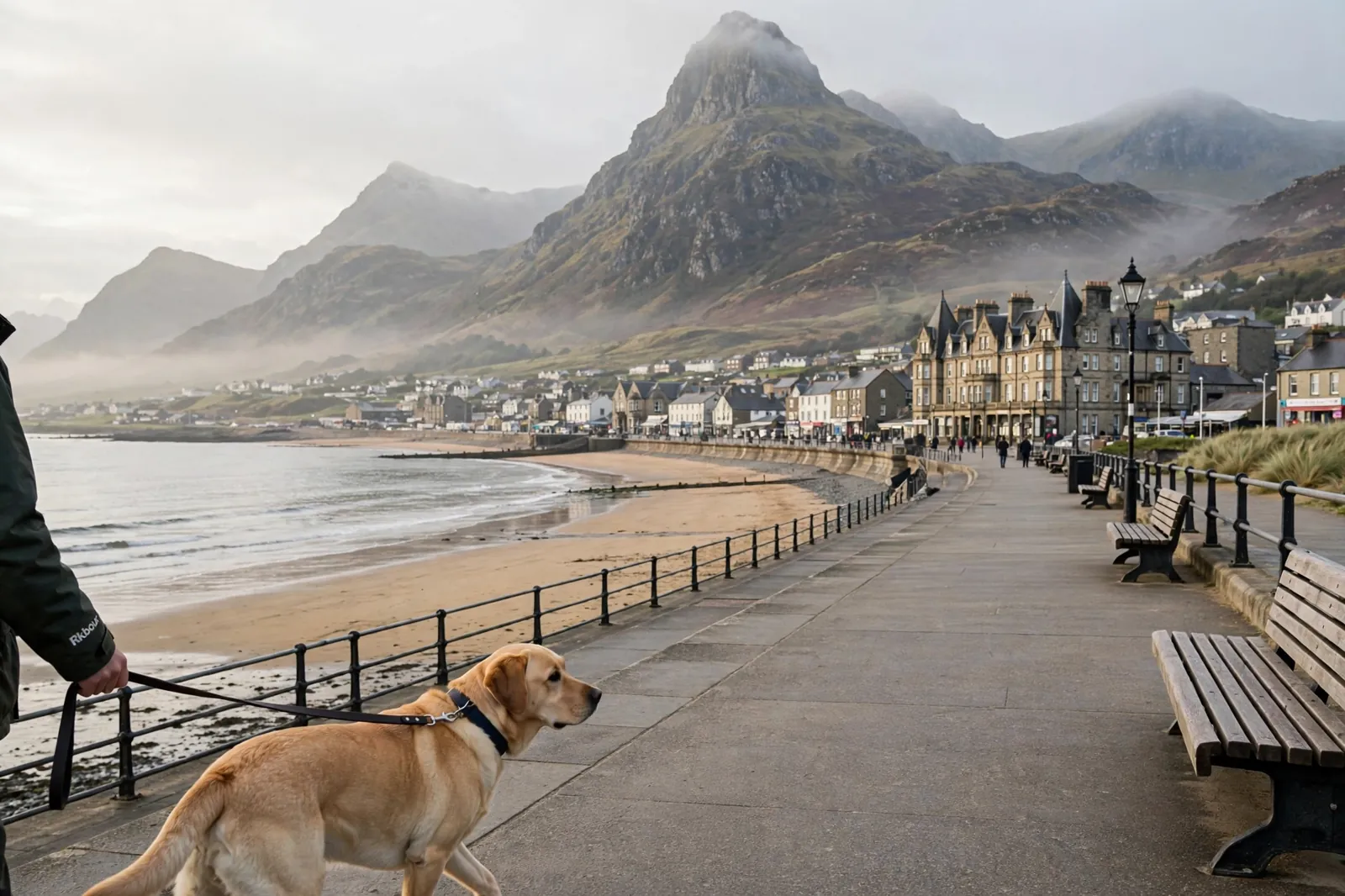
The promenade itself is the reliable, all-tide option. It is surfaced, step-free in its main sections and ideal for first and last outings, older dogs, and wet or windy spells when the sand is hard work. Treat it as shared space in the fullest sense: keep leads short near cafes, play areas, mobility scooters, runners and small children, and never let a long line stretch across the walking and cycling flow. Early morning and evening are noticeably calmer than the middle of a sunny day, when ice-cream queues, dropped food and excited children test even a steady dog. A dog who struggles with crowds will be happier on the front before breakfast and in the forest later, rather than being marched through the busiest hour to prove a point.
On the sand, the ordinary courtesies carry extra weight. Pick up everywhere, including below the high-tide line and in the dunes, and carry bags out to a bin rather than leaving them by a path for later. Keep dogs out of any roped or signed wildlife areas, give seals and resting birds a very wide berth, and recall your dog well before you reach other beach users rather than after. Murlough, at the southern end, is a sensitive dune and nature reserve environment: follow its specific signs closely, keep to paths where asked, and expect lead requirements to be stricter there for good reason. For the national picture behind local signs, see our explainer on dog-friendly beaches in the UK: rules, bans and fines, which sets out how seasonal restrictions and public spaces protection orders usually work.
Water safety deserves a plain word. The Irish Sea here is cold for most of the year, tides move, and channels and currents around river mouths and the harbour area are not places for a swimming dog to experiment. Let dogs paddle at the edge of a gently shelving section at low tide rather than throwing balls into deeper water, keep a lead or long line on near any current, and rinse salt and sand from coats and paws afterwards. On hot days — rarer here, but they happen — wet sand and shallow water are a kindness, hot promenade tarmac is not: test the surface with the back of your hand and shift the main walk to morning or evening.
Slieve Donard, lower down: the approaches most dogs actually enjoy
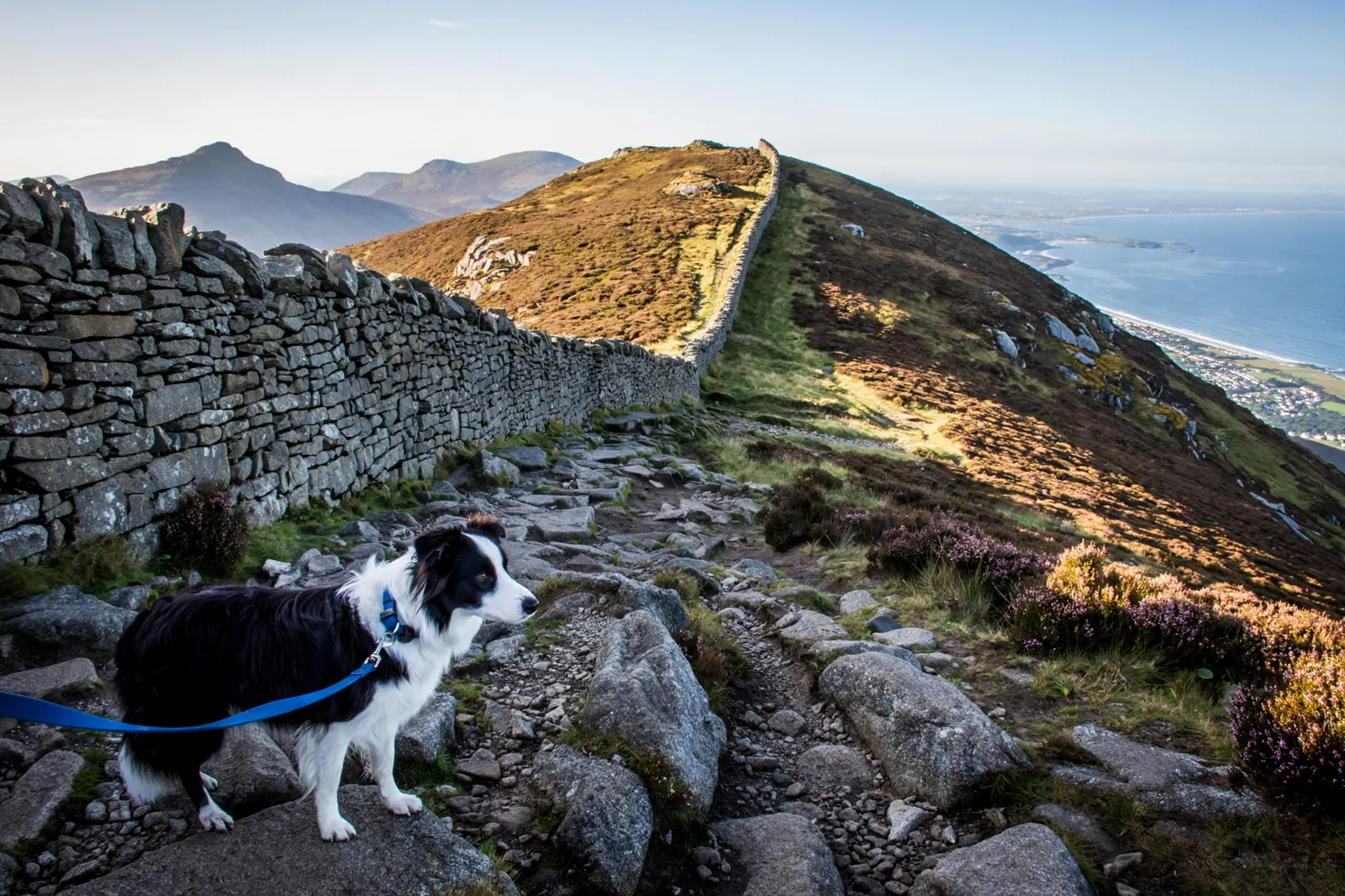
The classic way up Slieve Donard follows the Glen River from Donard Park at the edge of town, climbing through and then above the trees towards the col and the Mourne Wall. You do not need to follow it to the summit to get value from it. The lower, wooded part of the route, with the river beside the path, pools, bridges and shade, makes a satisfying walk in its own right and can be turned around at any point without any sense of failure. For a young dog building hill fitness, an older dog who still loves a proper outing, or any dog on a warm or windy day, an out-and-back on the lower Glen River path is often the best mountain decision of the whole trip.
Going higher changes the demands quickly. Above the treeline the path is rougher, steeper and fully exposed, with no water you should rely on for drinking, no shade and no easy bail-out except turning round and walking back down. Sheep and ground-nesting birds make close control essential, and a lead is the sensible default wherever livestock may appear without warning round a bend. Carry drinking water for the dog as well as yourself — dogs lose heat fast when they work hard uphill — plus a small first-aid kit that includes something to cover a cut pad. Stone and grit on mountain paths can slice soft town paws, so build up distance gradually during the trip rather than saving the biggest walk for the last day.
Weather judgement matters more than fitness. Cloud drops fast on Donard, wind at the col can be severe when the promenade below feels merely breezy, and a forecast that suits a beach morning does not guarantee a summit afternoon. Set a turn-around time before you start, tell someone your plan, and keep enough in reserve for the descent, when tired dogs misjudge steps and owners stop concentrating. If conditions close in, the forest and the shore will still be there tomorrow. Check the latest official guidance before you travel, including any path closures, forestry operations or warnings for the Mournes, and treat local mountain rescue advice as the authority over any blog itinerary, including this one.
Donard Park itself, at the foot of the route, is useful beyond the big walk: it is the natural place for a short morning leg-stretch, a picnic away from promenade crowds and a shaded option when the front is busy. Keep dogs under control around sports pitches, play areas and other park users, and clear up meticulously — town parks are where tolerance for visiting dogs is won or lost. Parking here and at other popular trailheads fills early on fine weekends, so arrive early, pay for enough time, and never leave a dog in a hot car while you extend a walk.
Tollymore Forest Park: rivers, bridges and proper shade
A few minutes inland from Newcastle, Tollymore Forest Park sits where the Shimna River comes down from the Mournes, and it is the single most useful bad-weather and hot-weather asset a dog owner in the town has. Waymarked trails of different lengths run through mature woodland, over distinctive stone bridges and along the river, so you can assemble anything from a gentle half-hour loop for an older dog to a longer half-day route for a dog who needs to move. The variety matters: a dog who has done the promenade twice already gets genuinely new smells, surfaces and sights here, rather than another lap of the same ground.
Manage the busy points with care. Car parks, the play area, picnic sites and any cafe or visitor facilities are lead-and-short-attention zones, and the park is also used by horses, cyclists and families with toddlers who did not come to meet your dog. Keep to close control on shared trails, step aside with your dog to let horses pass wide and quietly, and follow the marked routes where forestry work or river conditions have closed a section. After heavy rain the Shimna can run high and fast: admire it from the bridges and keep dogs out of spate water and away from slippery banks, however keen they look. In calmer conditions, shallow edges chosen carefully are fine for a paddle, but never let a dog plunge into deep pools or chase sticks into the current.
Practical planning makes Tollymore better. Expect an entrance or parking charge and check current opening arrangements before you set off, as times vary by season. Arrive earlier in the day in summer for a space and for quieter trails, carry water even though the river is beside you — dogs should drink what you bring, not whatever they find — and bring a towel and a drying coat for the car, because a Tollymore dog is usually a wet, leaf-scented dog. Ticks are a normal part of woodland walking in season: check coats, ears and armpits after every forest day and remove any ticks promptly with a proper tool. If you are staying several nights, Tollymore is the park to repeat at different times of day; the light through the trees early in the morning is a different experience from a late-afternoon family hour, and most dogs vote clearly for the early version.
Castlewellan Forest Park: a lake circuit and a slower afternoon
Castlewellan, a short drive north-west of Newcastle near the village of the same name, offers a contrasting forest day: a broad lake with a circuit path, formal gardens in the castle grounds, extensive woodland trails and well-known features such as the Peace Maze in the wider park. For dogs, the lake circuit is the headline — a mostly clear, followable route that suits a steady on-lead walk, a dog who pulls less when the path ahead is obvious, and owners who want distance without navigation. Allow more time than the distance suggests, because the circuit invites stops for water, photographs and watching other dogs from a sensible distance.
The same shared-space rules apply here as at Tollymore, with a few local emphases. Keep dogs on a lead around the castle, gardens, play and activity areas, and anywhere signed, and be especially careful near water sports, angling spots and any horses or bikes on shared trails. Not every part of a landscaped park is a dog area, and formal garden sections may have their own restrictions, so read signs at garden entrances rather than assuming access. Pick up everywhere, including on woodland spurs, and keep dogs out of the lake where signs or activities require it — both for water quality and for the safety of birds and other users.
Choosing between the two parks is simpler than it looks. Pick Tollymore for river atmosphere, shade and varied short loops close to Newcastle. Pick Castlewellan for a longer, flatter circuit, a change of scene mid-trip and a village stop on the way back. Dogs who are reactive or who need predictable space often cope better with an early lake circuit than with a busy town beach at midday, while sociable dogs who love watching the world may prefer Tollymore's variety. Either way, neither park is a place to let an unreliable dog run loose in the hope that space will solve recall: woodland hides deer, squirrels, other dogs and children round every bend, and a long line is the honest middle ground for a dog still in training.
As with Tollymore, charges, seasonal opening and occasional event closures change the plan, so check the latest official guidance before you travel. On event days and peak summer weekends, go early or choose the promenade at dawn and the forest the following morning instead. A Newcastle trip with three bases for walks — shore, Tollymore and Castlewellan — rarely runs out of options, which is exactly why the town suits a full week with an active dog better than many single-beach resorts.
Staying with a dog: houses first, hotels with questions
Newcastle has the range you would expect of a long-established resort: hotels and guesthouses in and near the town centre, self-catering houses and apartments, caravan and holiday parks in the surrounding area and smaller places in nearby villages such as Dundrum and Castlewellan. For most dogs, self-catering wins on practical grounds. A house or apartment gives you a door you control, space for a muddy dog to be dried without an audience, a fridge for dog food, and usually an easier first and last outing than a hotel corridor and lift. The feature that matters most is not a sea view; it is whether there is a genuinely enclosed outdoor space, what the floor surfaces are, and how far the late-night toilet walk actually is from your door.
Hotels and guesthouses can be excellent for a calm, sociable single dog and an owner who wants breakfast cooked, but the questions need to be exact. Which rooms accept dogs, and are they the rooms you are actually booking? What is the fee per dog per night, and is there a size or number limit? Where may the dog go inside the building — bar, lounge, terrace, or bedroom only — and can the dog be left alone in the room at all? Where is the nearest grass at 11pm, and is the route lit? A grand hotel at the foot of Donard may look like the classic choice, yet a simple house two streets back from the front may suit a nervous dog far better, because novelty and other guests are the real stressors, not thread count.
Wherever you book, run the arrival routine that protects deposits and first nights. Walk the boundary and check gates before the dog explores, photograph any existing marks or damage, move bins and cleaning products out of reach, lay a mat under bowls and set up the dog's own bed in a quiet corner away from the main doorway. Keep the first evening short and familiar: a promenade leg-stretch, normal food at the normal time, and no grand tour of the town's pubs. Tell the host promptly if anything goes wrong; owners who report a broken bowl or a muddy accident early almost always get a kinder response than those who let it be discovered at checkout. Finally, never assume that dog-friendly in a listing headline means dogs on sofas, dogs in beds or unlimited dogs — those are specific house rules, and asking costs nothing.
Eating and drinking: terraces, takeaways and honest expectations
Newcastle feeds dog owners best when expectations are set at terrace level. Cafes with outside tables, pubs with gardens or terraces, ice-cream and coffee stops on the front, and takeaway fish and chips eaten carefully on the promenade are the reliable pattern in most British and Irish seaside towns, and Newcastle is no exception. Some venues welcome dogs inside in part of the premises, and those are worth prizing, but policies change with ownership, season and even the member of staff on duty, so treat any list — including any names you find online — as a prompt to ask, not a guarantee. A quick, cheerful question at the door, with the dog held back from the entrance, gets a better answer than walking straight in and settling down.
Make your dog easy to say yes to. Arrive with a dog who has already had a walk and a toilet break, keep the lead short and the dog under the table or beside your chair rather than in the serving route, and bring a settle mat, water and a small bowl so staff do not have to improvise. Order something for the dog only from the venue itself if it offers dog treats or pup cups; do not feed chips and batter under the table, which teaches begging, upsets stomachs and leaves grease exactly where the next customer sits. If your dog barks at every passing spaniel, choose an end table outdoors, face the dog away from the traffic flow, and be ready to leave and finish as a takeaway rather than enduring an hour of noise for everyone.
Plan one proper food anchor per day and improvise the rest. A cafe breakfast after the early beach walk, a pub lunch after Tollymore, or fish and chips at the end of a Castlewellan day all work well; trying to fit three sit-down meals round a dog in a new town rarely does. Self-catering owners have the easiest fallback of all: cook on the evenings when the dog is tired, the weather closes in or nowhere suitable has space, and save eating out for the days when timing and temperament align. Keep dog food routines boring throughout — new treats, rich leftovers and scavenged beach finds are the classic recipe for a midnight stomach upset in a strange house, with no familiar vet round the corner.
Parking, vets and weather kit: the unglamorous half of the trip
Newcastle is straightforward to reach by road from Belfast and from the border, and many visitors also build it into a wider County Down touring route. That convenience has a price at peak times: seafront and trailhead parking fills, and a circling search with a hot, impatient dog in the car is a poor start to any walk. Decide your parking before you leave your accommodation, favour earlier starts, pay for more time than you think the walk will take, and keep coins or the relevant parking app ready, as payment methods vary between car parks. Never leave a dog unattended in a car in warm weather, even with windows cracked, and build toilet and water breaks into longer drives across the county rather than pressing on to the destination.
Identify a local vet before you need one. Save the number and address of a Newcastle-area practice in your phone on arrival day, note its out-of-hours arrangement, and carry your dog's vaccination and insurance details and any regular medication in quantities that cover extra days. The most common holiday problems are unglamorous: cut pads from stone and shingle, ear trouble after sea water, stomach upsets from scavenging, tick bites from forest walks and strains from doing a mountain day on town fitness. A small kit travels well — paw cover or boot, tick remover, saline, basic dressings, spare lead, and the drying layers that stop a wet dog chilling in a car — and most of it will be used at least once on a week's trip. If your dog takes ill or is injured, a local vet's advice always outranks anything in a guide.
Pack for four seasons in a single day, because the Mournes manufacture weather. A waterproof layer for the dog as well as for you, a drying coat, two towels that live in the car, a long line for open ground where leads are not mandatory but recall is not yet proofed, poo bags in every pocket and coat, and a charged phone torch for winter last outings will cover most Newcastle situations. In summer add water capacity and shade planning; in winter add reflective gear for promenade walks in the dark and a willingness to shorten hill plans in high winds. Above all, keep the plan reversible: the best Newcastle days are the ones where a closed trail, a restricted beach section or a sudden squall simply moves you to the next good option — shore, river woodland or lake — without anyone feeling the holiday has failed.
Practical questions
Before you go
Are dogs allowed on Newcastle beach in County Down all year?
Access and lead rules can vary by section of beach and by season, and restrictions are set locally. Parts of the shore near the town are busier and more tightly managed in summer, while quieter stretches towards Murlough are usually better for dog walking. Always read the signs at the access point you use and check the latest official guidance before you travel, rather than assuming a rule seen online still applies.
Can I walk my dog in Tollymore and Castlewellan forest parks?
Yes, both parks are popular with dog walkers, but dogs should be kept under close control and on a lead around car parks, play areas, livestock, horses and busy visitor facilities. Carry water, pick up after your dog everywhere including on forest trails, and follow any temporary signs about forestry work, nesting wildlife or events. Check the latest official guidance before you travel for opening times, charges and closures.
Should I take my dog up Slieve Donard?
Only if your dog is fit, experienced on rough mountain ground and comfortable around other walkers, and only in suitable weather with plenty of water. Many dogs are better served by the lower Glen River and forest approaches, which give mountain scenery without the exposed summit ridge. Never drag an older, young or unfit dog to the top to complete a tick list, and turn back early if paws, heat or wind become a problem.
Where can I eat in Newcastle with my dog?
Expect the most reliable options to be cafes with outdoor seating, pub terraces and takeaway food eaten on the promenade, rather than full indoor dining rooms. Policies change often, so ask at the door, keep your dog on a short lead under the table, and bring a settle mat and water. If eating together indoors matters, confirm the current policy directly with the venue before you book a table.
What is the best base in Newcastle for a dog holiday?
For most dogs, a self-catering house or apartment with an enclosed outdoor space, hard floors and parking close to the door works best, ideally within an easy walk of the promenade for first and last outings. Hotels and guesthouses can suit calm single dogs, but check the exact room, the pet fee, where the dog may go inside the building and where the nearest late-night toilet walk is before you pay.