This guide is independent and contains no paid placement. If affiliate links are added later, they will be clearly marked and will not change our editorial checks.
The Causeway Coast works brilliantly with a dog if you plan beyond the Giant's Causeway itself: use the signed seasonal dog zones on the Portrush and Portstewart strands, keep dogs on a short lead on cliff paths and near livestock, and accept that dogs cannot cross the Carrick-a-Rede rope bridge. Base yourself in Portrush, Portstewart, Bushmills or Ballycastle, walk the coast in sections, and check the official latest guidance before you travel for beach zones, closures and ferry rules.
Beyond the famous stones
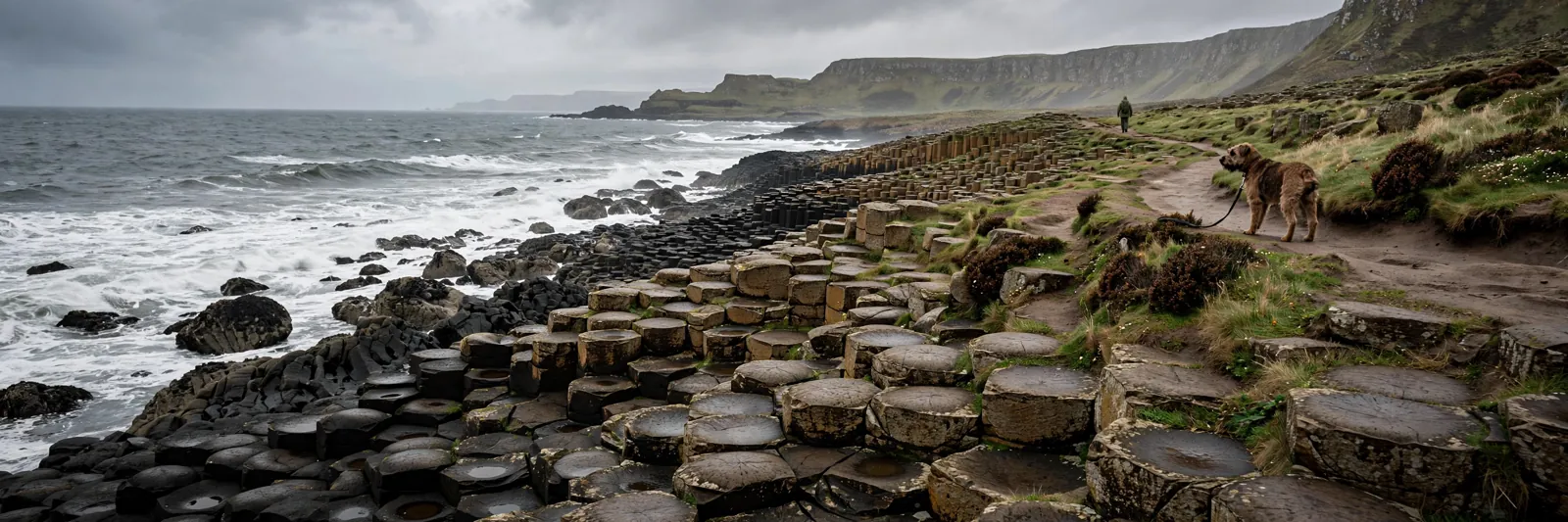
Most visitors drive to one car park, walk down to a cluster of basalt columns, take photographs and leave. With a dog, that approach misses almost everything that makes this coastline rewarding — and it also concentrates you in the busiest, most tightly managed part of the shore. The Causeway Coast stretches for roughly thirty miles between Portstewart and Ballycastle, taking in two resort towns, a working harbour village, a ruined clifftop castle, long strands, small coves and some of the most dramatic cliff walking in Ireland. A dog turns that string of places into a proper trip rather than a single stop, because dogs need walking anyway, and nearly every mile of this coast offers somewhere worth walking.
This guide deliberately covers the coast beyond the stones themselves. For the columns, the visitor centre arrangements and the specific rules at the Giant's Causeway site, read our dedicated guide to dogs at the Giant's Causeway and treat this page as its companion: the beaches, towns, paths and practicalities that fill the days around that visit. The two work best together. Use the Causeway guide for the headline attraction, and this one to decide where to stay, where the dog can actually run, and how to handle the places — above all Carrick-a-Rede — where the dog's role is spectator rather than participant.
One honest warning before the detail. Rules on this coast are layered: national park-style management at the Causeway, council-managed beaches with seasonal zones, National Trust sites with their own dog policies, and farmland paths where livestock have right of way in every sense. Nothing here is static. Seasonal dates shift, diversions appear after storms, and ferry and rail timetables change. Where this guide gives specifics, they are a planning starting point; where a fact could change your day, it says so plainly — check the official latest guidance before you travel, and always obey the signs you find on arrival. A sign at a beach entrance outranks any website, including this one.
Getting there from Belfast, by road, rail and ferry
Belfast is the natural gateway. By car, the Causeway Coast is an easy run of roughly an hour to an hour and a quarter to Portrush, heading north-west towards Ballymena and then Coleraine before picking up the coast road. Dogs travel in cars under the usual common-sense rules: secured, ventilated, and given a leg-stretch and water stop if the journey stretches. The final stretch along the coast road itself is part of the pleasure, but it is narrow and busy in summer, and lay-bys fill quickly. If your dog gets restless or car-sick, aim to arrive via the faster inland route and save the scenic road for shorter hops between towns during the stay.
By public transport, trains run from Belfast towards Coleraine, with connections and a branch serving Portrush, and local buses link the coastal towns and the main visitor sites along the A29 and coast road corridor. Travelling this way with a dog is entirely possible but requires a different rhythm: check the operator's current dog policy before you travel, keep the dog on a lead and off seats, travel outside the busiest services where you can, and build in toilet stops at stations rather than hoping for a convenient field. Timetables thin out considerably outside the summer season, so a plan that works in August may leave you stranded in February. Check the official latest guidance before you travel, for both the timetable and the pet policy.
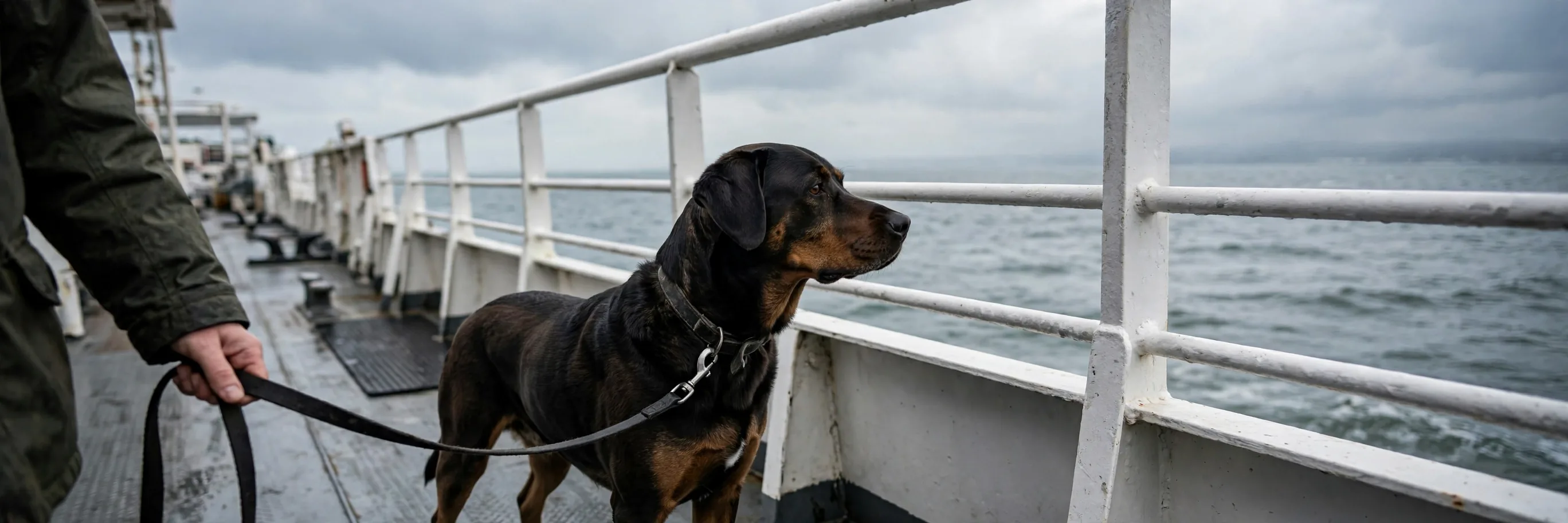
Many visitors arrive by sea from Great Britain, sailing into Belfast or Larne from Scotland or northern England. Ferry travel with a dog is well established on Irish Sea routes, but the arrangements differ sharply by operator and vessel: some require dogs to stay in vehicles or in onboard kennels, some offer pet-friendly cabins or designated exercise areas, and all require the dog to be booked in advance. Our guide to dogs on UK ferries works through operator rules, costs and how crossings work in detail — read it before booking, because the cheapest ticket is not always the kindest crossing for an anxious dog. Note also that Northern Ireland has its own rules on dog control and identification; carry your dog's microchip details and your vet's contact number, and check the official latest guidance before you travel if you are arriving from outside the UK, as pet travel documentation rules differ.
Portrush and Portstewart strands: seasonal dog zones explained
The two big resort strands are where most dogs get their best run of the trip — and where most owners get caught out. Portrush has two main beaches, the West Strand and the East Strand, either side of the town and its harbour headland, while Portstewart Strand, a long sweep of sand backed by dunes, lies a few miles west and is managed with conservation as well as recreation in mind. All of them operate seasonal dog restrictions of some form. The pattern to expect is tighter control in the main summer season — typically designated dog zones, lead requirements near the busiest sections, or exclusions from parts of the beach — and considerably more freedom in autumn, winter and spring. The exact zones, dates and boundaries are set locally and signed at the entrances.
The practical method is simple and worth stating bluntly. On your first visit to each beach, stop at the entrance sign before the dog touches the sand, read which zone you are in, and plan the walk around it. If the dog-friendly section is at the far end of the strand, walk there on the lead and exercise there, rather than assuming the whole beach is shared. Keep dogs out of any marked bathing or lifeguarded zones during the season, respect dune conservation fencing at Portstewart — the dunes are a protected habitat, not a playground — and remember that a beach described as dog friendly in January may be a very different proposition in July. Our general explainer on UK beach dog rules, bans and fines covers how seasonal restrictions and fixed-penalty enforcement work across the UK, and the same principles apply here: ignorance of a signed restriction is not a defence.
Used well, the strands are superb. Early mornings outside the peak weeks give you firm sand, low light and few people; the West Strand at Portrush allows a satisfying there-and-back without touching a road; and Portstewart's length means even a busy day has a quieter end if you are willing to walk for it. Carry fresh water even on cool days — dogs drink seawater when thirsty and regret it — and rinse sand and salt from paws after dune walks, checking between the toes for grass seeds in summer. Where this guide cannot help you is with this year's exact dates and zone maps, because they change: check the official latest guidance before you travel, from the council and site managers, and treat the entrance signs as final.
Carrick-a-Rede and Ballintoy: the rope-bridge reality
Carrick-a-Rede, near Ballintoy, is the coast's second headline attraction: a rope bridge strung high above the sea to a small fisherman's island. The dog practicalities need to be understood before you book tickets, not discovered at the barrier. Dogs cannot cross the rope bridge. The bridge is narrow, exposed and managed with timed, one-way crossings; it is not a place for animals, and dogs are not permitted onto the island. Phrase it to yourself exactly that way when planning, and do not build an itinerary that assumes an exception will be made on the day.
That does not make the site a write-off for dog owners. The coastal path from the car park area towards the bridge viewpoint is a fine walk in its own right, and dogs on leads are part of the scene along it. The workable pattern for a couple or group is to split roles: one person crosses with the tickets while the other walks the dog along the clifftop and enjoys the views of the island, the bridge and, on clear days, across to Scotland. Solo travellers with a dog should plan Carrick-a-Rede as a viewpoint walk rather than a crossing, or leave the bridge for a dog-free day in a longer stay. Timed ticketing operates in busy periods and slots sell out; book ahead through the official channels, and check the official latest guidance before you travel, because opening arrangements, wind closures and dog policy details can all change. High winds close the bridge at short notice, which is one more reason the dog's version of the outing — the clifftop walk — is the more reliable plan.
Ballintoy itself deserves the time the bridge queue might otherwise eat. The harbour, reached by a famously winding little road, is a compact, atmospheric place for a lead walk among boats and rock, and the village makes a natural pause between the Causeway and Ballycastle. Keep dogs close around the harbour: working quays have vehicles, ropes, stacked gear and sudden edges, and harbour water is not drinking water. As everywhere on this coast, clean up meticulously — small communities notice, and dog access everywhere depends on the behaviour of the last dog owner who visited.
Dunluce Castle and the cliff path
Dunluce Castle stands on cliffs between Portrush and the Causeway, a ruined medieval stronghold in one of the most photographed settings in Northern Ireland. For dog owners it divides neatly into two experiences. The grounds and interior of a historic monument are a managed heritage environment, and dog access inside ticketed historic sites is commonly restricted or limited to assistance dogs; treat entry with a pet dog as something to confirm, not assume, and check the official latest guidance before you travel. The second experience — the castle as the centrepiece of a coastal walk — is unrestricted in the ways that matter, and for many dog owners it is the better one anyway.
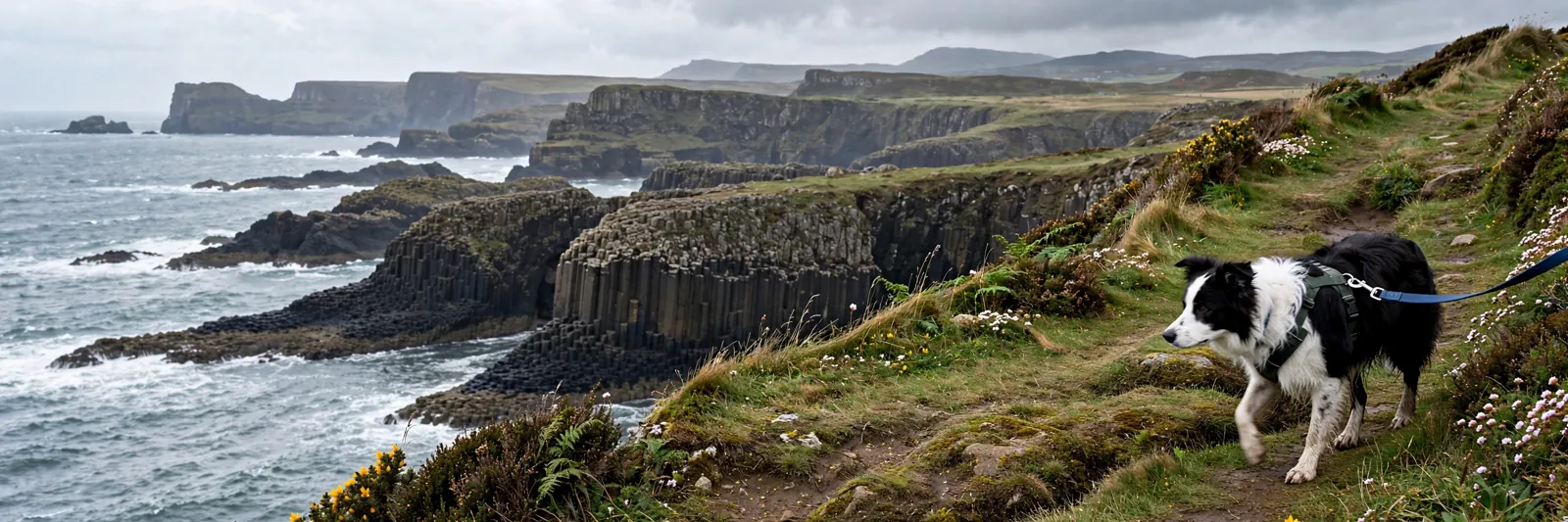
The cliff path in the Dunluce area gives you the classic views: the castle on its basalt outcrop, the sea below, and the coast running away towards the Causeway in one direction and Portrush in the other. Walk it with the dog on a short lead throughout. These are genuine cliff edges, in places unfenced, with Atlantic weather that can gust without warning; a dog that pulls towards seabirds needs a harness you trust and an owner who braces rather than admires the view at the wrong moment. Stay on the formed path, keep well back from any edge that looks undercut, and turn back in conditions that make you uneasy — the castle will still be there tomorrow, which is more than can be said for anyone who treats a wet cliff path casually.
Practically, Dunluce works best as part of a linked walk rather than a standalone dash from a car park. Combine it with a strand walk at Portrush to vary the exercise — open sand for energy, cliff path for interest — and time a visit for softer light if photography matters. Facilities cluster at the site and in nearby Bushmills, a village that also gives this stretch of coast its famous whiskey name and a useful base of cafés and services. As with Carrick-a-Rede, if part of your group wants the full interior tour, split roles and let the dog party take the longer cliff walk; nobody loses.
Walking the Causeway Coast Way in sections
The Causeway Coast Way is a waymarked long-distance route of roughly thirty-three miles between Portstewart and Ballycastle, passing Portrush, Dunluce, the Giant's Causeway, Dunseverick, Ballintoy and Carrick-a-Rede along the way. Walking all of it with a dog is possible, but the sensible approach for almost everyone is sections: pick the stretch that matches your dog's fitness, the day's weather and the bus or car logistics you can actually arrange, and enjoy it properly rather than enduring a forced march. Four natural sections suggest themselves — Portstewart to Portrush along the coast, Portrush past Dunluce towards the Causeway, the Causeway to Dunseverick and Whitepark Bay, and the eastern stretch towards Ballintoy, Carrick-a-Rede and Ballycastle — each a satisfying half-day or day in its own right.
Expect variety, including bits that are not postcard material. The route mixes cliff path, beach, field paths, steps and stiles, and some road walking where the coast offers no alternative. Stiles and narrow gates are a real consideration for large, elderly or nervous dogs: a dog that cannot be lifted briefly may need a detour, and it is better to discover that from a map at breakfast than from a stile at dusk. Surfaces near the cliffs can be slippery after rain, and sections are occasionally diverted for erosion, nesting birds or land management. Check the official latest guidance before you travel for the route's current state, and download or carry a map rather than relying on coastal signal, which is patchy exactly where you would most like it.
Logistics make or break a section walk. The coastal bus services that link the towns and main sites can turn a linear walk into an easy day — walk one way, ride back — but frequencies vary by season and day of the week, so confirm times before setting out and know the last bus as precisely as you know the distance. Carry more water than feels necessary for both of you, pack a small first-aid kit including a spare lead, and plan a bail-out point for each section: a village, a car park, a road crossing where a taxi could reach you. Dogs hide tiredness on exciting ground and then crash; build the day around the dog's honest range at home, not around an optimistic guess, and let a dog that has done enough stop at the next town while the humans rearrange the plan.
Towns, food and where to base yourselves
Where you sleep shapes the whole trip, because it decides which walks need no car. Portrush is the largest base: a traditional resort with the two strands, a harbour, amusements and the widest choice of places to stay and eat, which suits families and anyone who wants an evening stroll built into the day. Portstewart, a few miles west, is quieter and more genteel, with its long strand, a promenade and a harbour, and it makes an excellent base for dogs that find resort bustle stimulating in the wrong way. Bushmills sits inland of Dunluce and the Causeway and works well for walkers who want the central coast on foot. Ballycastle, at the eastern end, is a characterful small town and harbour with a good beach and a ferry connection to Rathlin Island — note that a Rathlin day trip is a separate planning exercise with its own dog rules, so check the official latest guidance before you travel if it tempts you.
Eating with a dog on this coast follows the pattern familiar across the UK: many pubs and cafés welcome dogs in bar areas, gardens or terraces, some provide water bowls and treats, and policies vary by venue and can change with season or management. The reliable habits are to ask at the door rather than assume, to settle the dog under the table on a mat if you carry one, and to keep leads out of walkways. Coastal towns get very busy at summer lunchtimes; an early or late meal is calmer for everyone, and a dog that has already had its main walk will settle while a dog bursting with unspent energy will not. Book dog-friendly accommodation by confirming the detail that matters — dogs in the room with you, any size or number limits, any charge, and whether the garden is genuinely enclosed — and get it in writing.
For supplies, the towns cover the essentials: pet shops and supermarkets for food, and veterinary practices in the larger towns for anything more serious. Save the number of a local vet and the out-of-hours arrangement in your phone on arrival day, before you need either. If your dog eats a specific food, bring enough for the trip plus a spare day; rural stockists may not carry it, and a sudden diet change on a walking holiday is a reliable way to manufacture a bad night. Finally, build one low-key day into any stay of four days or more: repeated cliff walks, sea air and new smells are genuinely tiring for dogs, and a strand potter plus a café afternoon keeps the whole party, human and canine, in good humour.
Livestock, cliffs and keeping a dog safe
The single most important safety subject on this coast is livestock. The cliff-top fields are working farmland, and sheep and cattle graze right up to the path in places. A dog does not need to touch an animal to cause harm: sheep can be injured or lose lambs through stress and scattering alone, cattle with calves can be genuinely dangerous to a person holding a dog, and farmers are entitled to protect their stock. The rules are therefore absolute. Keep the dog on a short lead wherever livestock are present or signs require it, never let a dog chase or worry animals, and give herds a wide berth by leaving the path on the seaward-safe side only where the ground allows. If cattle approach and you feel threatened, the standard advice is to let go of the lead — a dog can outrun cattle, and a person holding one often cannot — move calmly to a gate or fence, and recover the dog once things settle. Our guide to the law around livestock worrying is worth reading before any rural walking holiday, and the same discipline applies on every field path here.
Cliffs are the second subject. Keep dogs on a lead on all cliff sections without exception, however reliable their recall is at home: seabirds flush without warning, edges are softer than they look, and a dog that has never chased anything may chase a gull. Fit a harness for cliff days so a sudden lunge loads the body rather than the neck, keep the lead short near edges, and keep children and dogs from racing each other along the path. After storms, treat every path as suspect until you have seen it: undercut turf and fallen fencing are common, and turning back is a success, not a failure. Check the official latest guidance before you travel for reported closures, and respect any taped or signed closure on the day absolutely.
Round the safety list off with the unglamorous items that actually spoil holidays. Ticks live in the long grass of field and dune paths, so check the dog each evening and carry a tick remover. Adders are present in parts of the UK and Ireland's rough coastal ground — keep dogs out of dense scrub on warm days and know your nearest vet. Blue-green algae can appear in still water in summer; do not let dogs drink from or swim in discoloured ponds and slow rivers. Wash salt and sand off after beach days, watch for limping that suggests a cut pad or a grass seed, and carry poo bags in numbers that assume no bins — then use the bins in towns or take waste home, because a coast this loved is kept clean by its visitors or not at all. None of this is meant to dim the trip. The Causeway Coast with a dog, planned with open eyes, is one of the great British and Irish coastal holidays: big beaches, serious scenery, welcoming towns and walks you will talk about for years. Plan the zones, respect the bridge rule, keep the lead short on the cliffs, and check the official latest guidance before you travel — then go and enjoy it.
Practical questions
Before you go
Can dogs cross the rope bridge at Carrick-a-Rede?
No. Dogs cannot cross the rope bridge at Carrick-a-Rede, and they are generally not permitted beyond the ticketed bridge area. Dogs are welcome on a lead on the coastal path towards the viewpoint, so one person can wait with the dog while others cross. Check the official latest guidance before you travel, as access arrangements can change.
Are dogs allowed on Portrush and Portstewart beaches all year?
Not on every section all year. Portrush and Portstewart strands operate seasonal dog zones and restrictions, typically with tighter rules in the summer season and more freedom outside it. The exact zones, dates and lead requirements are signed at beach entrances. Check the official latest guidance before you travel and follow the signs on the day.
How do I get to the Causeway Coast with a dog from Belfast?
By car, the drive from Belfast to Portrush takes roughly an hour to an hour and a quarter via the main roads towards Ballymena and Coleraine. Trains run from Belfast towards Coleraine and Portrush, with onward buses along the coast. If you are arriving by sea from Great Britain, ferry operators carry dogs under their own pet rules, so book the dog in advance and check the official latest guidance before you travel.
Can I walk the whole Causeway Coast Way with my dog?
The Causeway Coast Way runs for roughly 33 miles between Portstewart and Ballycastle and most of it can be walked with a dog on a lead, but it is best tackled in sections. Some stretches involve cliff paths, stiles, road walking and fields with livestock, and a few diversions may apply. Plan shorter sections, carry water, and check the official latest guidance before you travel for closures or diversions.
Do I need to keep my dog on a lead on the cliff paths?
Yes, as a rule. Cliff edges, nesting seabirds and grazing livestock make the Causeway Coast cliff paths a lead-only environment for any sensible owner, and local signs may require it. Keep the lead short near edges and livestock, and never let a dog chase sheep or cattle. Check the official latest guidance before you travel for any additional local rules.