Nobody paid for a mention in this guide, and we wrote it independently. Should affiliate links be added in future, each one will be clearly labelled, and the checks behind what we say about the trail, the rules and the facilities will stay exactly as they are.
The Norfolk Coast Path is about 84 miles of mostly flat walking from Hunstanton to Hopton-on-Sea. Keep your dog on a lead through bird reserves and near seals, stay well away from seal colonies, check tide times before beach and marsh sections, and use the Coastliner bus for the return journey.
Dunes, salt marsh and why they matter
Norfolk's north coast is one of the most important wildlife landscapes in Britain, and the Norfolk Coast Path walks straight through it. The trail runs along sand dunes, salt marsh, reed beds, shingle ridges and tidal creeks, from the Wash in the west to the Broads in the east. This is not scenery that happens to have wildlife in it: the habitats are the point. The North Norfolk Coast is a Site of Special Scientific Interest, a Special Protection Area and a Ramsar wetland of international importance, and the birds that depend on it are the reason the path has rules that dog owners need to understand before they set out.
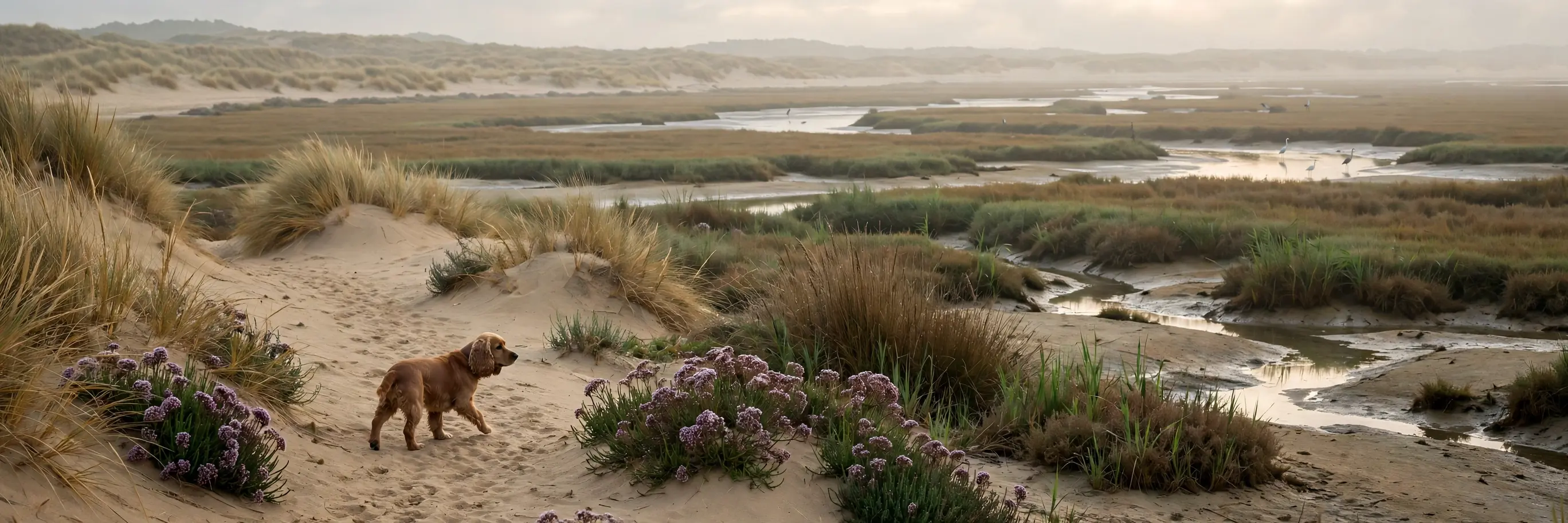
The dunes are the first habitat most walkers meet. They are built by marram grass trapping wind-blown sand, and they shelter rare plants, insects and ground-nesting birds such as little terns and ringed plovers. The dunes look tough, but they are fragile: a dog running through the marram can damage the plants that hold the dune together, and a dog that wanders off the path in spring can destroy a nest in a few seconds. The waymarked path crosses the dunes on boardwalks and fenced routes in the most sensitive places, and staying on those routes is not a suggestion but a condition of walking here. In summer the dunes are also one of the few places on the coast where a dog can find shade, although the sand itself can become hot underfoot.
Behind the dunes lies the salt marsh, a flat world of creeks, samphire and sea lavender that floods on the highest tides and drains as the tide falls. The marsh is a feeding ground for wading birds such as redshank, avocet and curlew, and in winter it holds huge flocks of geese and ducks. The path crosses the marsh on raised banks and boardwalks at places such as Cley and Salthouse, and the creeks that cut across it can be deep, muddy and fast-flowing. Dogs should not be allowed to run loose across the marsh: the mud is a genuine hazard, the creeks can trap a dog that cannot climb out, and the birds are easily disturbed. A lead on the marsh is a safety measure as much as a wildlife rule.
Understanding these habitats changes how you walk the trail. The Norfolk Coast Path is not a beach walk with birds in the background; it is a wildlife walk that happens to run beside the sea. The best days on it are the ones when you slow down, use binoculars, watch the marsh at high tide and give the birds and seals the space they need. A dog that walks calmly on a lead through a reserve and then gets a proper run on a wide, quiet beach is a dog that has had a good day, and it is also a dog that has not disturbed the wildlife that makes this coast special.
The 84-mile route in sections
The Norfolk Coast Path runs about 84 miles, or roughly 135 kilometres, from Hunstanton on the west coast to Hopton-on-Sea near Great Yarmouth in the east. It is a National Trail, waymarked with the acorn symbol, and it forms the eastern half of the Norfolk Coast Path National Trail together with the Peddars Way, which joins it at Holme-next-the-Sea. The whole trail is famously flat: there are almost no hills, and the few climbs are short rises over the dunes or up to a cliff top at Hunstanton and Cromer. That flatness is deceptive, because the surfaces are hard work. Deep sand, soft marsh paths, shingle and long stretches of exposed coast in wind all tire a dog faster than a flat pavement walk of the same distance.
The western section from Hunstanton to Wells-next-the-Sea is the wildest and the most remote. Hunstanton has striped red and white cliffs and a wide sandy beach at low tide, and the path east from there crosses the dunes and marshes of Holme, Thornham and Titchwell. Holme-next-the-Sea is where the Peddars Way ends and the coast path begins, and it is a good place to start or finish a walk. The villages here are small and spaced out, with few shops and cafes, so carry water and food, and check in advance which pubs and cafes are open outside the summer season.
The middle section from Wells-next-the-Sea to Cromer is the most popular and the best served. Wells is a working harbour town with a long sandy beach, a pine wood and a miniature railway, and it makes a good base. East from Wells the path passes Holkham, one of the finest beaches in England, a vast sweep of sand backed by pine woods and dunes, and then Blakeney, Cley and Salthouse, where the marshes are at their widest and the birdlife is at its richest. Sheringham is a seaside town with a steam railway, cafes and a good choice of dog-friendly accommodation, and Cromer has the famous pier, crab fishing and a cliff-top path that suits dogs that like a sea view.
The eastern section from Cromer to Hopton-on-Sea is quieter and more varied. The path leaves the open coast at Cromer and runs through the villages of the Norfolk Broads hinterland, past Happisburgh lighthouse and the wide sands of Winterton and Horsey, where grey seals haul out in large numbers. Great Yarmouth is a busy resort town that the path skirts rather than crosses, and the final stretch to Hopton-on-Sea is a gentle walk through dunes and holiday parks. If you only have a few days, the middle section from Wells to Cromer gives you the best of the coast in the shortest distance, while the western section gives you the wildest walking and the eastern section gives you the seals.
Bird reserves and seasonal lead rules
The bird reserves along the Norfolk coast are among the best in Europe, and they set the rules for dogs on this trail. RSPB Titchwell Marsh, near Brancaster, is one of the most visited reserves in the country, with freshwater lagoons, reed beds and a sandy beach. Dogs are welcome on the beach and on some paths, but they must be on a lead, and they are not allowed in the hides or on some of the reserve trails. The visitor centre has a cafe and a shop, and the beach at Titchwell is one of the best places on the coast for a dog to run, provided the seasonal restrictions are respected and the dog is kept away from the nesting areas in the dunes.
RSPB Snettisham, on the Wash, is famous for its spectacular wader roosts, when tens of thousands of knot and other wading birds are pushed off the mudflats by the rising tide and fly over the pits in huge flocks. The reserve is a sensitive place for birds, and dogs must be on a lead and kept to the paths. Cley Marshes, run by the Norfolk Wildlife Trust, is the oldest nature reserve in the country and one of the most important, with reed beds, pools and a visitor centre that looks out over the marsh. Dogs are welcome on the coast path that crosses the reserve, but they must be on a lead, and they are not allowed in the hides or on the reserve trails away from the path.
The seasonal rules matter most in spring and summer, when ground-nesting birds are breeding in the dunes and on the shingle. Little terns nest on the beaches at Holme, Blakeney Point and Winterton, and ringed plovers nest on the shingle at Cley and Salthouse. These birds nest on the ground, in shallow scrapes that are almost invisible, and a dog running loose can destroy a nest without its owner ever seeing it. The reserves and the wardens fence off the nesting areas and put up signs, and those signs should be treated as an instruction, not a suggestion. Keep your dog on a lead through all nesting areas from April to August, and keep to the waymarked path.
Outside the breeding season, the rules are simpler but still important. In autumn and winter the coast holds huge numbers of wildfowl and waders, including pink-footed geese, brent geese and wigeon, and the birds need to feed undisturbed to survive the winter. A dog that flushes a flock of feeding birds forces them to burn energy they cannot spare, and repeated disturbance can drive birds away from a feeding site altogether. The rule is the same all year: keep the dog on a lead in reserves and on the marsh, keep to the path, and save off-lead time for the wide beaches where dogs are allowed and the birds are not nesting. Look up the current position for each reserve before you go, because the rules can change with the seasons and with the breeding success of the birds.
Seals: distance, seasons and safety
Norfolk is one of the best places in Britain to see seals, and the Norfolk Coast Path passes two of the most important seal colonies in the country. Blakeney Point is home to England's largest colony of grey seals, with thousands of pups born there each autumn, and Horsey and Winterton, on the east coast, hold a large colony that is accessible on foot from the beach. Common seals also haul out on the sandbanks and mudflats of the Wash and at Blakeney Harbour. Seeing a seal colony is one of the great experiences of the Norfolk coast, but it is also one of the places where a dog can do the most harm if it is not kept under control.
The rules for seals are simple and strict. Keep your dog on a lead at all times near a seal colony, stay at least 100 metres away from hauled-out seals, and further still during the pupping season, which runs roughly from November to January. Do not let your dog approach, chase or corner a seal, and do not let it bark at seals from close range. A seal that feels threatened will bite, and a seal bite can seriously injure a dog and can also transmit infection. A pup that is separated from its mother by a dog may not be reunited, and a pup that is abandoned will usually die. The wardens at Blakeney Point and Horsey will advise you on the safe viewing distance on the day, and their advice should be followed without argument.
Blakeney Point is reached by boat from Morston Quay in summer and on foot along the shingle spit in winter, although the walk is long and exposed. Dogs are not allowed on the seal-watching boats, and the walk to the point is not suitable for every dog, because the shingle is hard going and there is no shade or water. Horsey is easier: the beach is reached from Horsey Gap car park, and the seals haul out on the beach itself, with wardens and fencing to keep visitors at a safe distance. Winterton is similar, with a car park and a short walk to the beach. Both are best visited in the winter pupping season, when the seals are at their most numerous, but that is also when the rules are at their strictest.
If you find a seal on a beach away from a colony, treat it with the same respect. A lone seal on a beach is often resting, moulting or unwell, and it needs space and quiet. Keep your dog on a lead, keep well away, and do not try to push the seal back into the sea. If a seal looks injured, entangled or in distress, contact the British Divers Marine Life Rescue or the RSPCA rather than approaching it yourself. A dead seal should be reported to the local council or to the UK Cetacean Strandings Investigation Programme. The seals are wild animals, not a photo opportunity, and the best photographs are taken from a distance with a long lens, not from a few metres away with a dog at your side.
Beaches, tides and salt marsh
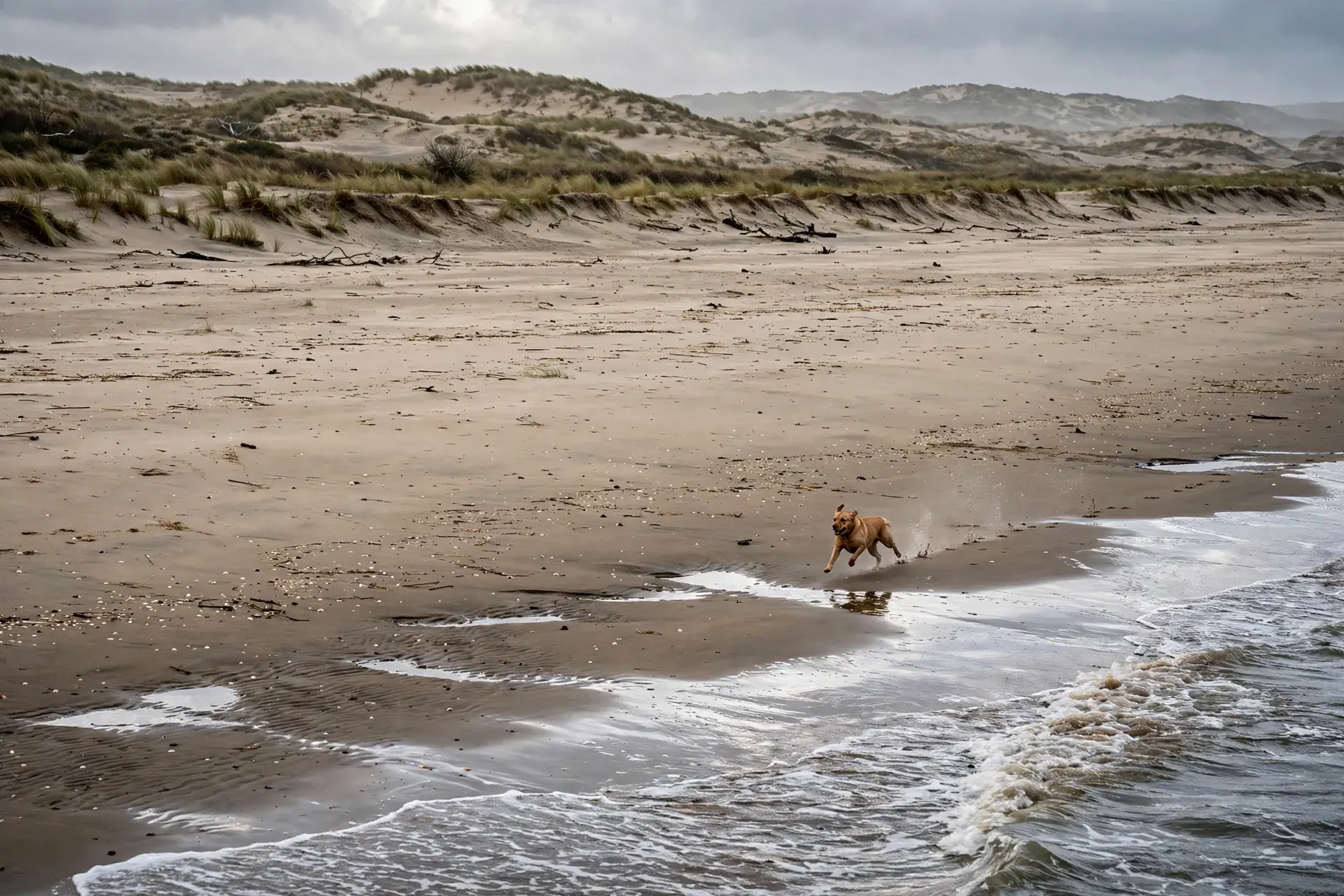
Norfolk's beaches are wide, sandy and often empty, and they are the reason many dog owners choose this trail. Holkham is the most famous, a vast beach backed by pine woods where the sand stretches for miles at low tide. Wells beach is similar, with a long walk from the car park to the sea and a pine wood that gives shade on a hot day. Brancaster beach is wide and sandy, with a shipwreck visible at low tide, and Hunstanton's beach is sandy at low tide and backed by cliffs and a promenade. Cromer beach is sandy and popular, with a pier and a town behind it, and the beaches at Winterton and Horsey are wide, quiet and backed by dunes.
At Holkham, Wells and Cromer the pattern is the same: the main bathing beach closes to dogs for the summer, and the rest of the sand stays open to them all year. The usual dates run from 1 May to 30 September, and the edge of the restricted area is normally marked by a sign at the beach entrance, so read it when you arrive rather than guessing from where other people are standing. Rules are set beach by beach by the local council and they can change, so look up the position at each beach you plan to visit before you travel. For a national overview of how beach bans work, the guide to dog-friendly beaches in the UK explains seasonal bans, public space protection orders and fines.
Tides matter on the Norfolk coast as much as anywhere in Britain. The Wash has one of the largest tidal ranges in the country, and the tide can come in fast across the flat sands at Hunstanton, Holme and Brancaster. The salt marsh creeks at Cley, Salthouse and Blakeney fill quickly on a rising tide, and a dog that is playing in a creek can be cut off or swept along. Always check tide times before a beach or marsh walk, walk on a falling tide where possible, and never let a dog swim in a tidal creek or near a harbour entrance. The tidal channels at Wells and Blakeney are deep and fast-flowing, and they are not safe for dogs even at low tide.
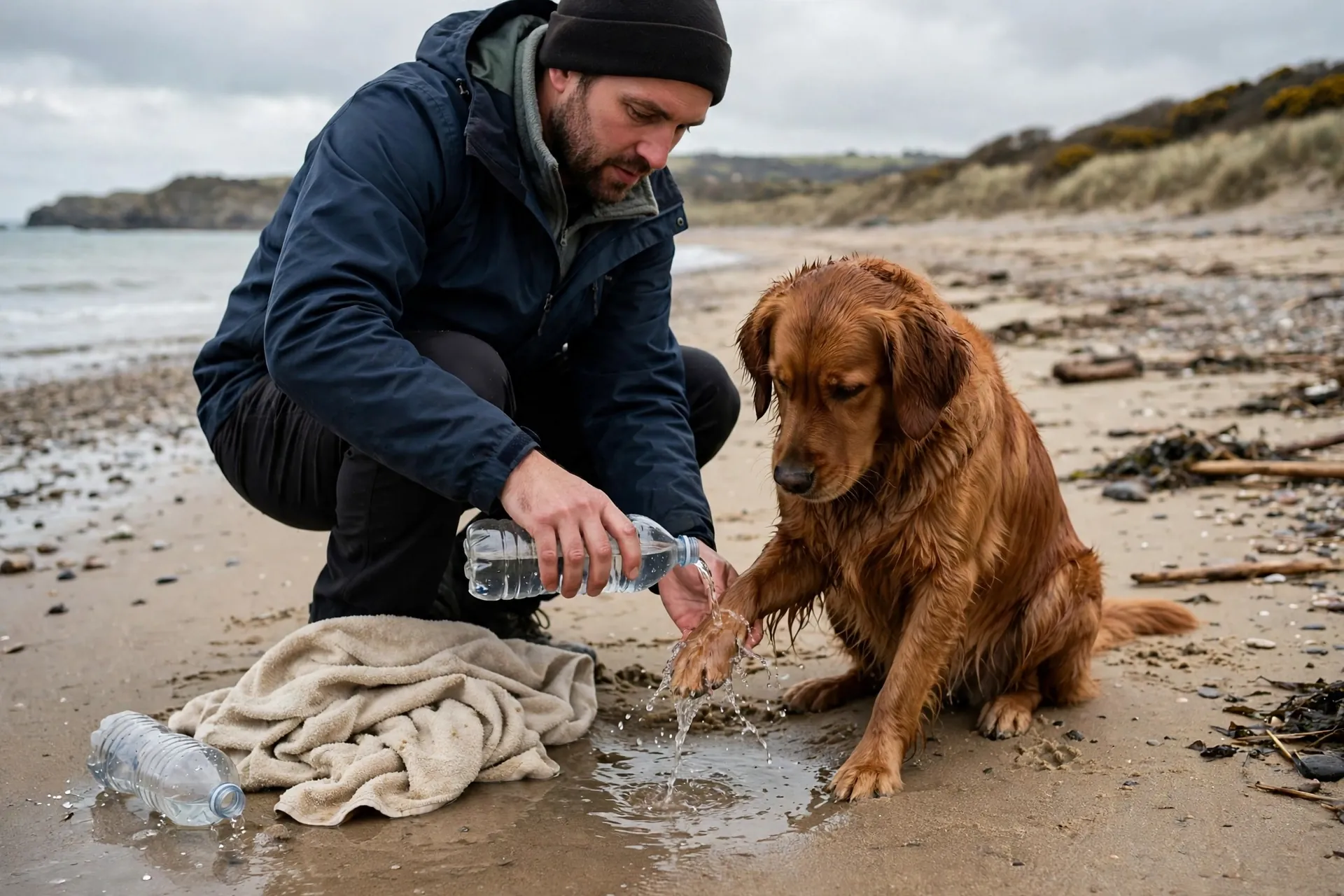
Salt marsh mud is another hazard that surprises visitors. The mud beside the creeks is deep, soft and sticky, and a dog that runs into it can become stuck. If your dog gets stuck in mud, do not follow it in: call the dog back calmly, and if the dog cannot get out, call for help rather than risking yourself. The coastguard can be reached on 999, and the local lifeboat stations at Wells, Cromer and Hunstanton cover the coast. After a beach walk, rinse your dog's paws with clean water, because salt and sand between the toes cause irritation, and check for cuts from shells and shingle. For rinsing, checking and treating paws after a day on the sand, see our guide to dog paw care after the beach.
Buses, trains and getting back
The Coastliner is what makes linear walks work on this coast. It follows the road from Hunstanton through Wells-next-the-Sea, Blakeney, Sheringham and Cromer, stopping close to the path in most villages, so you can walk one way and ride back. Dogs are generally allowed on board, on a lead and on the floor rather than a seat, at the driver's discretion. In summer the service runs often enough to plan a day around, but in winter it thins out and Sunday buses are limited, so keep the timetable saved offline on your phone: the signal drops out on the marshes just when you need to look a time up.
The Bittern Line railway runs from Norwich to Sheringham, with stops at Cromer, West Runton and other villages along the coast, and it connects with the North Norfolk Railway, a steam railway that runs from Sheringham to Holt. Dogs travel free on most UK trains if they are on a lead and do not occupy a seat, which makes the train a practical way to reach the coast and to return from a linear walk. The railway is also a useful backup if the bus is full or delayed, and the stations at Sheringham and Cromer are close to the coast path.
The Coastliner does the heavy lifting on this trail. Leave the car at one end, walk to the other, and ride the Coastliner back. The stops sit close to the coast path in most villages, and the drivers are used to walkers with dogs. A second car suits a group, and taxis run in the larger towns, though in the smaller villages they need booking ahead. Whatever you settle on, sort the return journey out before you start walking: a missed bus on a winter evening can leave you facing a long walk back in the dark with a tired dog.
If you are walking the whole trail over a week, consider staying in one or two bases and using the bus to reach each day's start. Wells-next-the-Sea and Sheringham both make good bases, with bus connections in both directions and a good choice of accommodation. The bus runs roughly east to west in the morning and west to east in the afternoon, so you can usually catch a bus out and walk back to your base, or walk out and catch a bus back. Plan the day around the bus timetable rather than around the walking distance, and build in a buffer so a late bus does not become a problem.
Where to base yourself
Norfolk's north coast has a good range of dog-friendly places to stay, from campsites and holiday cottages to hotels and bed and breakfasts. Wells-next-the-Sea is the best base for the middle of the trail, with a harbour, a beach, a pine wood and a good choice of pubs and cafes. Sheringham is the best base for the eastern half, with a railway station, a seaside town and a good choice of accommodation. Hunstanton suits the western end, with a promenade, a beach and a good choice of hotels, and Cromer suits the eastern end, with a pier, a town and a cliff-top path.
Before you book anywhere, ring the host and ask about the dog's day, not the bedroom. Where will the dog sleep, and is there a hose or an outside tap for sandy paws? Is the garden properly fenced, and is there somewhere under cover where wet coats and leads can drip dry? Is there a lit spot nearby for a last toilet trip after dark? A place with a tiled floor and an enclosed garden will suit a walking dog far better than a prettier property with pale carpets and no tap outside, and a host who genuinely welcomes dogs will answer these questions straight away. Our comparison of the two east coasts, Northumberland vs Norfolk coast, looks at beaches, drive times and space in more detail if you are still choosing between the two.
A tent is the cheapest bed on this coast. Campsites suit many walkers here: low cost, no fixed check-in, and the sea a short walk away. Several sites along the north Norfolk coast welcome dogs, although some only allow them on certain pitches or insist they stay on a lead at all times. Caravan parks and holiday parks are common too, especially around Hunstanton and Great Yarmouth, and many have direct access to the beach. Book ahead for school holidays and August, when dog-friendly places on this coast sell out early, and in winter, check before you go that the place you are staying, the pub and the cafe will actually be open, because some close or cut their hours.
Walking the whole trail is easier from two bases than from a new bed every night: one in the west around Wells, one in the east around Sheringham or Cromer. Moving every day costs you packing, driving and settling time that would be better spent walking or resting, and a dog that has to learn a new house each evening does not sleep as well. Two bases cover the full trail with manageable bus journeys to each day's start, and the dog gets a familiar bed to come back to. Luggage transfer services do exist for the Norfolk Coast Path, although they need booking well ahead; ask about them before you travel if you want your bags carried for you.
Kit, water and paws
Sand, marsh and wind: that is the kit list on this trail. A well-fitted harness, a short lead for the reserves and the villages, and a longer lead or a long line for the beaches will cover most of what the trail throws at you. Carry a collapsible bowl and a litre of water per dog for every half day: streams and taps are not guaranteed on the coast, and the water in the marsh creeks is salty and not safe for a dog to drink. Take more than you think you will need on the western section, where the villages are spaced out and you can walk a long way without a tap.
Sand and shingle are hungry work. A dog that walks twelve miles a day across them burns far more energy than it does at home, and a tired, under-fed dog flags earlier and takes longer to recover, so food deserves more thought on a multi-day walk than it does on a day trip. Put a little extra in the evening bowl rather than a heavy breakfast before a long day, and carry high-value treats for recall and for rewarding calm behaviour near birds, seals and livestock. If your dog eats a raw or special diet, sort out where to buy or store it before you go: the village shops may not carry it, and the big supermarkets are in Hunstanton, Fakenham, Cromer and Great Yarmouth.
Sand, salt, shingle and sharp shells: that is what the pads are up against on this trail. Give the paws a proper look every evening, and rinse them with clean water after each beach walk: look between the toes for cuts, and pick out any grit that has worked its way in. Rub in a paw balm when the pads look dry or cracked, and think about boots for a dog with tender feet on the shingle at Cley and Salthouse. Limping, licking one paw over and over, or a flat refusal to walk is the signal to stop for the day, not to push on.
The dog's weather kit is small but it earns its place. A light waterproof coat helps a short-coated or older dog in rain and wind, and a drying coat or a couple of old towels makes the end of a wet walk much easier. In summer, a cooling mat or a damp towel in the car helps after a hot walk, and a sunshade is essential if the dog waits in the car at all. On a warm day, a parked car is no place for a dog, even with a window open: the temperature inside climbs far faster than the air outside. On this coast, the shade is usually a pine wood or a pub garden.
Seasons and weather
The marshes fill with birds again in spring. The days get longer, the temperatures stay mild, the wading birds come back to the marshes, and the beaches are quiet before the summer season. April and May are especially good, with wildflowers on the dunes and the first little terns arriving at the nesting colonies. Nesting means the lead stays on near the colonies, without exception. The ground can still be wet after winter, so waterproof boots for you and a towel for the dog are worth packing, and the wind off the sea can feel cold even on a sunny day.
Summer is the season that tests the planning. The weather is at its warmest, the beaches fill up, and the ground-nesting birds are still raising their young, while some beaches close parts of the sand to dogs. Walk in July or August and you should be out early, carrying extra water, and planning the day around shade and a chance to swim. Heat is the real danger on this trail: the beaches and the dunes offer no shade, and the sun bounces off the sand and the sea. Watch for heavy panting, drooling, confusion or wobbling, and get the dog into the shade with water straight away if you see any of them. The long evenings make up for it, and a walk after the heat has eased is often the best of the day.
Autumn is when the coast belongs to the seals. Grey seal pups are born at Blakeney Point and Horsey from November to January, and from October onwards the marshes fill with pink-footed geese, brent geese and wigeon. September and October bring quieter paths and a warm sea, and the summer beach restrictions come to an end on many beaches, although the dates are worth checking beach by beach before you travel. The light softens, the blackberries come out along the hedgerows, and the seal colonies are at their most impressive. Winter empties the coast out: dramatic seas, empty paths and huge flocks of birds, but also short days, strong winds and a risk of flooding on the marsh paths after a storm.
The weather off the North Sea can change in an hour. A morning that looks fine can turn by lunchtime, especially out on the exposed dunes and marshes. Check the forecast the evening before you walk, and check it again in the morning, carry waterproofs even on a sunny day, and be ready to shorten a walk or swap a beach section for a woodland walk at Holkham or a village walk if the wind picks up. The Met Office forecast for the Norfolk coast is a good starting point, and a word with a cafe or campsite owner is often more accurate about the next few hours than a national forecast.
A realistic walking plan
A seven-day plan for the full trail might look like this: Hunstanton to Thornham on day one, Thornham to Burnham Overy Staithe on day two, Burnham Overy Staithe to Wells-next-the-Sea on day three, Wells to Cley on day four, Cley to Sheringham on day five, a rest day in Sheringham on day six, Sheringham to Happisburgh on day seven, and Happisburgh to Hopton-on-Sea on day eight. That is roughly twelve miles a day, with one rest day, and the dog gets a mix of beaches, marshes and villages. Shorten any day that includes a long stretch of deep sand, and add a second rest day after the middle section if your dog is older or less experienced.
A long weekend is the easy way in. Base yourself in Wells-next-the-Sea and walk to Holkham one day and to Blakeney the next, keeping the third day free for a beach afternoon. The Sheringham option is Cromer one day and Cley the next, with a steam railway trip on the third day. A week gives you the whole middle section from Hunstanton to Cromer, which is the most varied stretch of the trail, with beaches, marshes, pine woods and seaside towns in a single week. Whatever plan you choose, book accommodation first and build the walking around it, because the best dog-friendly places on the north Norfolk coast are booked early in summer.
The birds are the reason to be out early here. The reserves and the seal colonies are quietest first thing, and an early start brings cooler temperatures, quieter paths and better light for photographs, and the dog is still fresh rather than already tired by the heat. Try to be finished by mid-afternoon, leaving the evening free for the dog to rest, eat and sleep. End the day with a short stroll to a beach or a pub garden rather than a forced extra mile, and let the dog settle for the night. If the weather turns, cut the day short without feeling bad about it: the path will still be there tomorrow, and a dog that enjoyed the walk will want to come back.
The Norfolk Coast Path is a National Trail, and it is looked after for walkers, dogs included. If you find a damaged stile, a fallen waymark or a blocked path, let the trail authority know, and respect any temporary diversion, which is usually there because a path has become unsafe after a storm or a high tide. The trail is at its best walked slowly, with time to watch the marsh at high tide, the seals on the beach and the waders on the mudflats, and with a dog that is plainly enjoying itself. That is the real measure of a good walk on the Norfolk coast, not the number of miles on the map.
Practical questions
Before you go
How long is the Norfolk Coast Path and how many days does it take with a dog?
The Norfolk Coast Path runs about 84 miles from Hunstanton to Hopton-on-Sea, and most walkers take six to eight days at 11 to 14 miles a day. With a dog, plan for seven to nine days with at least one rest day, because sand, soft ground and wind make the miles harder than they look on a map. Many dog owners walk it in weekend sections instead, riding the Coastliner bus back to the start.
Can dogs walk on Norfolk beaches in summer?
Yes, on most of them. Some of the most popular beaches close part of the sand to dogs in summer, usually from 1 May to 30 September, but the restricted area is often only one stretch of the beach, and the rest stays open all year. The rules are made beach by beach through local orders and they can change, so look at the council's own pages before you set off, and read the notice at the entrance before you unclip the lead.
How close can my dog get to seals in Norfolk?
Keep your dog on a lead and stay well away from seals, ideally at least 100 metres, and further still during the pupping season from November to January. Seals haul out at Blakeney Point, Horsey and Winterton, and a dog that approaches them can injure a seal, separate a pup from its mother, or be bitten. Use binoculars, follow the signs and the wardens' advice, and never let a dog chase or corner a seal on the beach.
Do dogs have to be on a lead in Norfolk bird reserves?
Yes, in most cases. Nature reserves such as RSPB Titchwell Marsh, RSPB Snettisham and the Cley and Salthouse marshes ask visitors to keep dogs on a lead, and some reserve paths and hides do not allow dogs at all. Ground-nesting birds use the dunes and marshes in spring and summer, and a loose dog can destroy a nest in seconds. Check the official guidance before you travel for the rules at each reserve you plan to visit.
Is the Norfolk Coast Path flat enough for an older dog?
It is one of the flattest National Trails in England, with very few climbs, which suits older dogs and dogs that struggle with steps. The difficulty comes from the surfaces instead: deep sand on the beaches, soft ground on the marsh paths, shingle at Cley and Salthouse, and long stretches with little shade. Keep daily distances shorter, plan rest stops, and check paws for sand, salt and shingle cuts at the end of each day.
Can dogs use the Coastliner bus on the Norfolk coast?
Dogs are generally welcome on the Coastliner, the bus that runs along the north Norfolk coast between Hunstanton, Wells-next-the-Sea, Sheringham and Cromer. They usually travel on a lead and on the floor rather than on a seat, at the driver's discretion. For walkers it is the most useful transport on the coast, because it follows the shoreline and connects the main villages. Check the official guidance before you travel for the current timetable and for any change to the dog policy.