This guide is independent and contains no paid placement. Beach rules are set by local councils and can change, so treat the rules described here as a planning guide and check the official guidance before you travel for the exact beach and dates you have chosen.
If your trip is short and you live in the south or east, Norfolk usually wins on driving time and gentle walking — but you must plan around summer beach zones. If you can spare the extra driving, or you live in the north, Northumberland usually wins on space: long, quiet beaches where a dog can run without a crowd. In winter, both coasts open up, and the decision flips to weather, daylight and where you can stay warm.
The two coasts at a glance
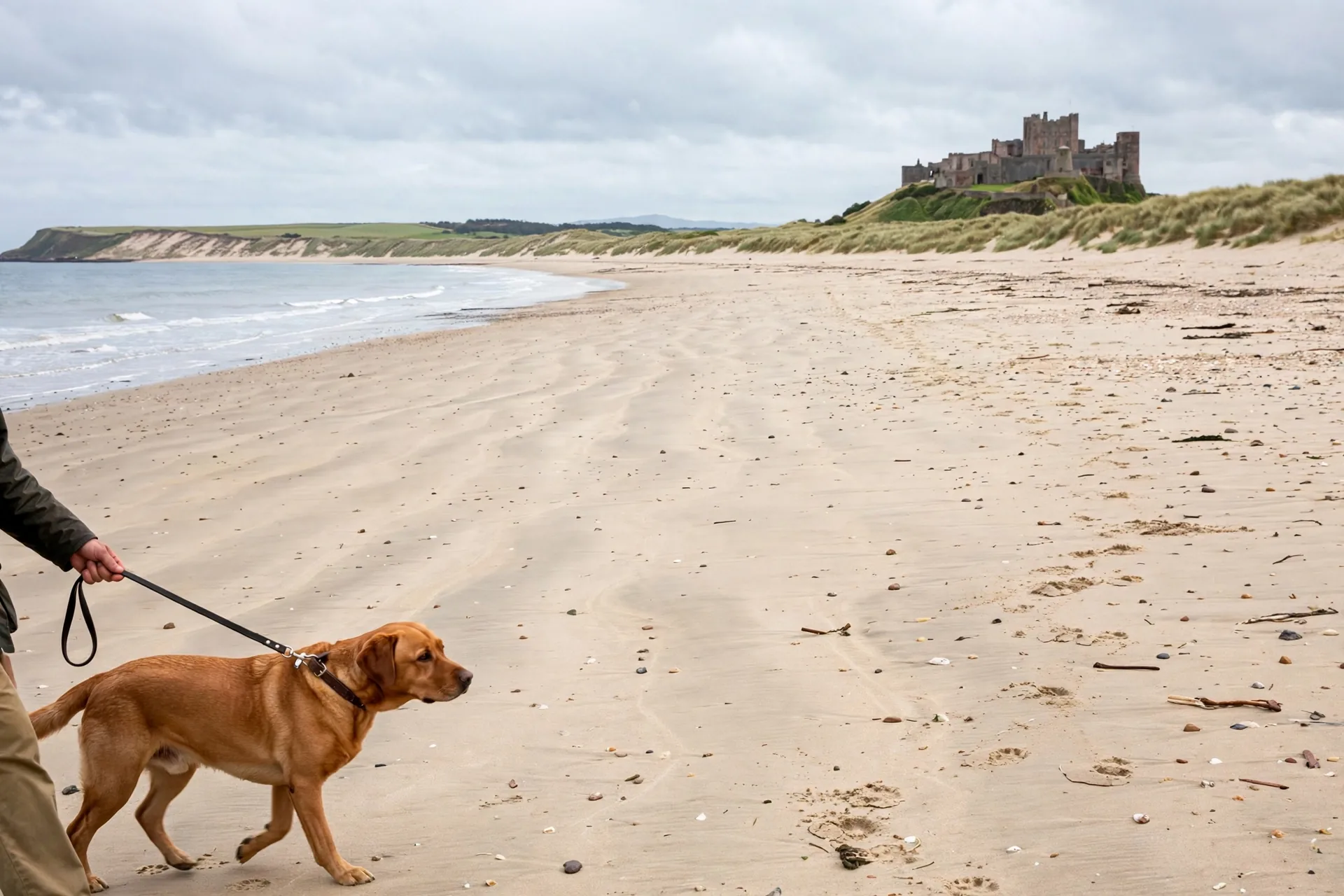
Northumberland and Norfolk share the same sea and very little else. Northumberland is England's most northerly county, a long, thin strip of coast running from Berwick-upon-Tweed in the north down past Bamburgh, Seahouses and Alnmouth to Druridge Bay and Newbiggin in the south. Its beaches are wide, sandy and often startlingly empty, backed by dunes, castles and low cliffs. The county is thinly populated, the light is famously clear, and a weekday walk can feel like a private beach. The price of that emptiness is distance: from London it is a five-to-six-hour drive, and even from Leeds or Manchester it is a serious journey rather than a spontaneous dash.
Norfolk is the opposite shape. Its coast curves from Hunstanton in the west, around Cromer and Sheringham in the north, down through Happisburgh and Winterton-on-Sea to Great Yarmouth in the south-east. The land is famously flat, the beaches range from wide golden sand at Holkham to shingle and sand at Cromer, and the county is threaded with market towns, nature reserves and the inland waterways of the Norfolk Broads. From London the north Norfolk coast is roughly a three-hour drive, and from Cambridge or the East Midlands it is shorter still. That accessibility is Norfolk's great strength — and, in school holidays, its great weakness, because the resort beaches fill up and the dog rules tighten exactly when everyone wants to be there.
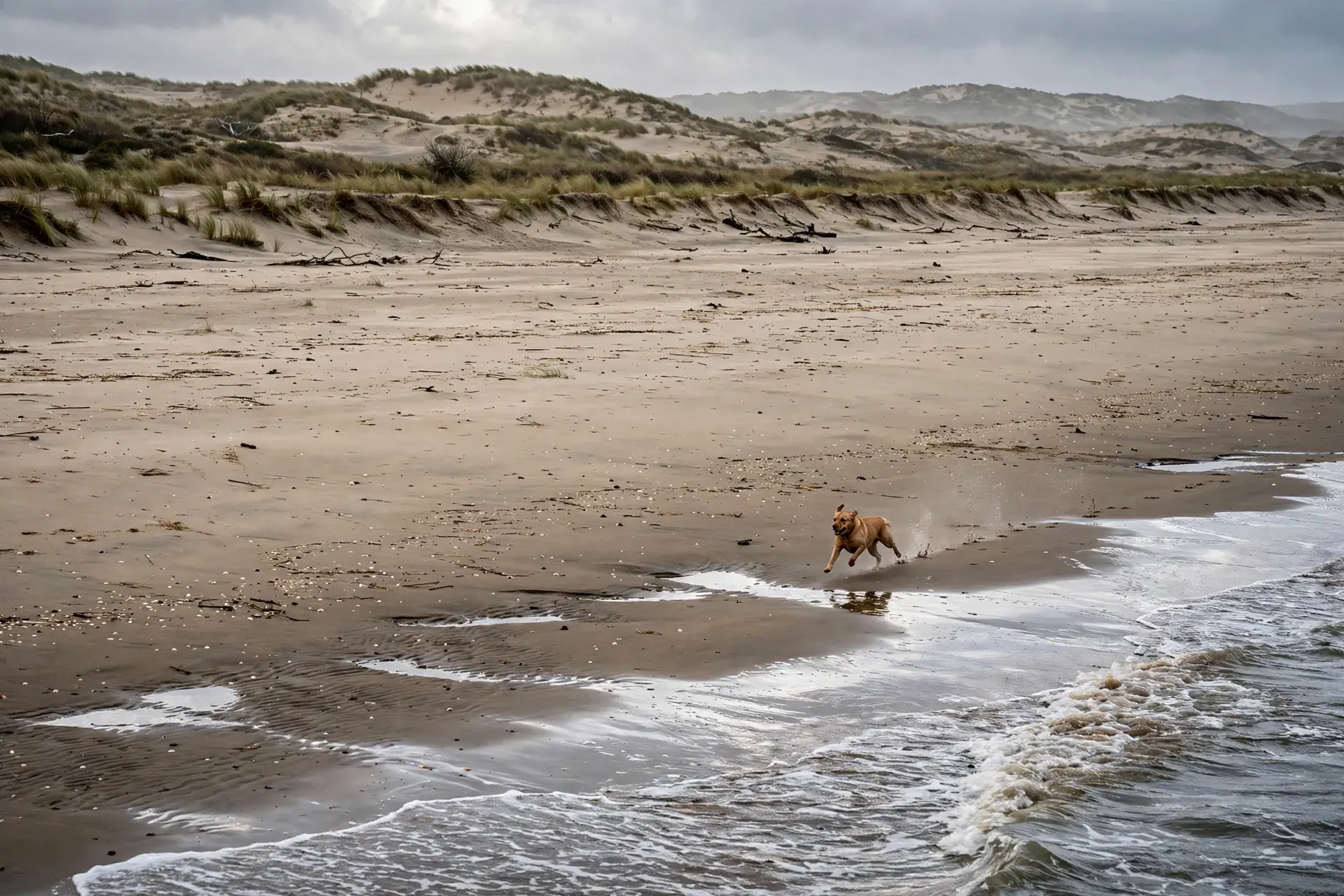
The single most useful difference between the two is not scenery but space per dog. On a Northumberland beach you can often walk for twenty minutes and meet nobody. On a Norfolk resort beach in August you may be sharing a zoned strip with dozens of other families and their dogs, which changes the whole character of the walk. A confident, sociable dog may love that. A nervous dog, a dog in training, or a household with three dogs and one pair of hands will not. Before you compare anything else, decide how much empty sand your dog actually needs, because that one answer pushes most trips towards one coast or the other.
The second difference is how the rules work. Northumberland's long beaches mostly stay open to dogs all year, with restrictions confined to short central sections at a few resort beaches in summer. Norfolk's resort beaches are more heavily zoned: central sections commonly restrict dogs during the summer months, while other stretches nearby stay open all year. That means a Norfolk trip needs more homework and more flexibility on the day — you need a plan B beach for the day the wind, the tide or the crowds make your first choice unworkable. A Northumberland trip needs less homework but more driving, more weather tolerance and a warmer coat. Neither coast is better in the abstract. The better coast is the one whose trade-offs match your dates, your starting point and your dog.
Scenario 1: the long-weekend drive
The long weekend is where the driving arithmetic does most of the deciding. Suppose you leave after work on Friday and must be home on Sunday evening or Monday morning. From London, the north Norfolk coast takes roughly three hours in clear traffic, which means a Friday-evening arrival in daylight for much of the year, a full Saturday, and a Sunday walk before the drive home. From the same starting point, Northumberland takes roughly twice as long, which turns Friday into a motorway evening, eats Saturday morning if you leave late, and makes Sunday feel like a packing day rather than a beach day. For a two-night break from the south, Norfolk is usually the rational choice, and no amount of empty sand compensates for spending half the break in the car.
The arithmetic reverses as soon as the starting point moves north. From Newcastle, the Northumberland coast is under an hour away, while Norfolk is a four-to-five-hour drive. From Edinburgh, Bamburgh and the northern Northumberland beaches are closer than most English resorts. From Leeds or York, Northumberland is roughly two to two-and-a-half hours, which is a perfectly workable Friday drive. The rule is simple: if the coast you want is more than about three hours from home, a two-night break is mostly travelling, and you should either extend to three or four nights or pick the nearer coast. For a four-night break, Northumberland's extra driving starts to pay for itself, because the remaining days are longer, quieter and less crowded than the equivalent Norfolk days.
There is a second long-weekend question: what happens when the weather turns. A Norfolk long weekend has a built-in wet-weather fallback in the Broads, the market towns and the nature reserves, and the flat ground means a rainy walk is still a walk. A Northumberland long weekend in driving rain is more exposed: the beaches are still walkable, but the wind off the North Sea is colder and stronger, and the distances between shelter, cafes and car parks are longer. If your long weekend falls in a settled forecast, Northumberland is superb. If the forecast is mixed and the break is short, Norfolk's gentler conditions and shorter drive make it the lower-risk booking. Check the forecast the week before, not the month before, and keep a cancellation or date-change option if the accommodation allows it.
Finally, think about the Friday-night arrival routine. A dog that has spent three or five hours in the car needs a short, calm toilet walk, water and a familiar bed — not a grand first beach. Pick accommodation within a short drive of a quiet evening walk, and arrive with the dog's routine already planned: where the last walk happens, where the dog sleeps, and where breakfast happens in the morning. The coast that lets you arrive calmly and start properly on Saturday morning is the coast that gives you the better weekend, whatever the brochures say.
Scenario 2: grandparents and children along
A multi-generational trip changes the beach completely. The ideal beach is no longer the wildest or the emptiest; it is the one where a grandparent with stiff knees, a child with a bucket, and a dog on a lead can all be comfortable at the same time. Norfolk wins this scenario more often than not. The ground is flat, the car parks are usually close to the sand, the walks from car to beach are short, and the resort towns have toilets, cafes and shelter within easy reach. Holkham's vast flat sand is easy walking once you cross the boardwalk from the car park, and Wells-next-the-Sea has the kind of compact town-and-beach pairing that suits a group with different paces. A grandparent can sit with a coffee while the children and the dog play within sight, and nobody has to climb a dune system to reach the sea.
Northumberland can work for a family group, but it needs more careful choosing. Bamburgh's beach is spectacular and the castle is a genuine attraction for children, yet the walk from the village to the best sand crosses dunes that are hard work for anyone with limited mobility. Seahouses has a harbour, boat trips and fish-and-chip shops that children love, but the beach access and the crowds on a summer day need planning. Alnmouth and Beadnell are gentler options, with village facilities close to the sand, and they suit a family group better than the wilder stretches. If the group includes someone who uses a wheelchair or a pushchair, ask the accommodation and the local council about step-free beach access before you book, because a beautiful beach with a steep dune path is not a family beach for that group.
Children and dogs together need one more consideration: control. A beach full of other children, picnics and dogs is a high-distraction environment, and a dog that is fine on an empty beach may struggle when a toddler runs past with an ice cream. Norfolk's resort beaches in summer are exactly that environment, so a family dog needs to be genuinely steady around children and food, or the group needs to pick a quieter Norfolk beach and visit the resort town separately. Northumberland's empty beaches remove much of that pressure, which is why families with a young or excitable dog sometimes prefer the longer drive: the beach itself does the training work that a crowded beach makes harder.
Facilities matter as much as sand. Check where the nearest toilets are, whether there is shade or shelter for a hot or wet day, and whether dogs are welcome in the cafes you will actually use. A beach with no shade in a heatwave is a welfare problem for a dog, and a beach with no shelter in a downpour is a miserable day for a grandparent. Pack a shade tent, water and a bowl for both coasts, and plan the day around the dog's needs: a morning beach session, a shaded lunch, and a shorter evening walk will suit a mixed-age group far better than a single long day on the sand.
Scenario 3: the multi-dog household
One dog is a companion. Two dogs are a team. Three or more dogs are a logistics operation, and the coast you choose has to work as a system: car space, lead handling, accommodation limits, exercise and toilet stops all multiply. Northumberland is usually the kinder coast for multi-dog households, for one blunt reason: space. On a long, empty beach you can walk two or three dogs without constantly negotiating other dogs, picnics and children, and you can let a reliable dog run while keeping a younger dog on a long line. The distances between car parks also mean you can pick a quiet access point and walk away from the crowd, rather than funnelling every dog through a single busy entrance.
Norfolk demands more management. The zoned resort beaches mean your legal walking area may be a defined strip, and three dogs in a defined strip next to other families is a very different exercise from three dogs on an open beach. The seal colonies add a hard rule: dogs must be kept on leads and well away from seals, and a multi-dog household that cannot guarantee that control should simply avoid Horsey and Blakeney Point during pupping season. That is not a criticism of Norfolk — the seals are one of Britain's great wildlife spectacles — but it is a constraint that a multi-dog household must plan around rather than discover on the day.
Accommodation is the other multi-dog bottleneck, and it applies to both coasts equally. Many cottages, hotels and campsites cap dogs at two per booking, and a third dog often needs explicit permission and an extra charge. Some accept three or four dogs only in specific units or outside peak season. Confirm the exact number, the total pet charge and the rules about leaving dogs unattended before you pay anything, because a booking that accepts "dogs" in general may still refuse your third dog in particular. Also check the garden or exercise area: a multi-dog household needs somewhere secure for the first and last toilet walk of the day, and a cottage with an open garden next to a road is a poor fit no matter how good the beach is.
On the road, plan the car as carefully as the beach. Three dogs need crates or guards, ventilation, water and a stop every couple of hours, and the longer drive to Northumberland means more stops and more planning. Pack a spare lead, a long line, towels, a first-aid kit and the vet's number for the area you are visiting. On the beach, walk the dogs you can genuinely control together; if one dog's recall is unreliable, use a long line rather than hoping the open space will fix it. The coast that gives a multi-dog household the best trip is the one where the dogs can be exercised without constant negotiation — and for most multi-dog households, that is the emptier coast, provided the drive and the accommodation work.
Month-by-month beach rules: the decision table
Beach rules are the hinge of this whole comparison, and they change through the year. The table below is a planning summary, not a legal statement: local councils set the rules, zones and dates can change, and you should check the official guidance before you travel for the exact beach you plan to use. Treat any beach where you cannot confirm the current rule as a beach you have not yet chosen.
- January to March: Both coasts are at their most open. Summer restrictions have lifted almost everywhere, the beaches are quiet, and the main constraints are weather, daylight and cold water. Norfolk's seal pupping season runs through this period at Horsey, so keep dogs on leads and well away from seals. Northumberland's beaches are wild and windy; a dog that loves running will love them, and a short-coated dog will need a coat and a shorter session.
- April: The shoulder season sweet spot. Days lengthen, the worst of winter lifts, and most beaches are still open to dogs before summer zoning begins. Easter can be busy at resort towns, so pick a weekday or a quieter beach if your dog struggles with crowds. This is one of the best months for either coast, and the choice comes down to driving time and weather rather than rules.
- May: The changeover month. Summer restrictions commonly begin on 1 May at many resort beaches, which is when the two coasts start to diverge. In Northumberland the effect is limited, because most of the long beaches stay open and only short central sections are restricted. In Norfolk the effect is larger: central resort sections at Cromer, Sheringham, Hunstanton and Great Yarmouth commonly restrict dogs for the summer, and you need to know which neighbouring stretch stays open. Check the official guidance before you travel, because the start date and the exact zones vary by council.
- June to August: The widest gap between the coasts. Northumberland still offers long, open beaches where dogs can run, and the main challenge is the weather and the midges on still evenings inland rather than the rules. Norfolk requires active planning: use the all-year beaches such as Holkham, Winterton-on-Sea, Happisburgh and Sea Palling, use the dog-friendly zones at resort beaches, and go early or late in the day to avoid the hottest and busiest hours. If your dates are fixed in high summer and your dog needs a long off-lead run, Northumberland is the easier choice.
- September: The second sweet spot. Summer restrictions commonly lift at the end of September, the crowds thin, the sea is at its warmest, and both coasts open up again. September is often the best month for a dog beach trip on either coast, and the choice again becomes driving time and weather. Book early for the best cottages, because September is popular with walkers and with dog owners who know the rules.
- October: Autumn proper. Both coasts are open, the light is beautiful, and the beaches are quiet on weekdays. The constraints are shorter days, stronger winds and the first storms, so plan shorter walks and a warm, dry place to return to. This is also a good month for combining a beach trip with an inland walk, a market town or a castle visit.
- November to December: Winter rules, winter rewards. Almost all beaches are open to dogs, but daylight is short, the wind is cold, and some facilities and cafes close for the season. Norfolk's seal pupping season begins, so the seal beaches need extra care and leads. Northumberland in winter is dramatic and empty, but it demands good clothing, a warm car and a realistic plan for a dog that will get cold and wet. Both coasts suit a hardy dog and an owner who enjoys a bracing walk; neither suits a dog that hates wind and rain.
The practical lesson of the calendar is that the months when the rules matter most — May to September — are also the months when Northumberland's advantage is largest. Outside those months, the rules barely separate the coasts, and you should choose on driving time, weather and what else you want from the trip. If you can only travel in high summer, weight the rules heavily. If you can travel in April, September or October, weight them lightly and enjoy either coast.
Northumberland beaches in detail
Bamburgh is the postcard beach: a vast sweep of sand with the castle rising behind it, and one of the most photographed coastlines in England. Dogs are welcome on much of the beach, and the sheer scale of the sand means you can walk away from the busiest section and find space even on a summer day. The walk from the village crosses dunes, so allow extra time and energy, and carry water: there is little shade on the sand itself. Bamburgh is the beach to choose if you want the classic Northumberland experience and your dog can manage the dune crossing. If mobility is a concern, check the access route in advance, because the easiest approach is not always the one signposted first.
Seahouses, a few miles south, pairs a working harbour with a long beach and the boat trips to the Farne Islands. The harbour is busy in summer and the boats are a genuine attraction, but dogs are not part of every boat trip, so check before you promise the children a seal-watching cruise. The beach itself is long and sandy, and walking south from the town quickly takes you away from the crowds. Beadnell Bay, just south of Seahouses, is quieter still: a wide bay with dunes, a small village and a car park that makes access straightforward. Beadnell is a good choice for a nervous dog or a first Northumberland visit, because it is beautiful without being overwhelming.
Further south, Embleton Bay and Alnmouth offer two more distinct characters. Embleton is a long, quiet beach backed by dunes, popular with walkers and much less busy than Bamburgh. Alnmouth is a village beach with an estuary, a golf course and a compact village of pubs and cafes, which makes it a good base for a group that wants beach and facilities together. Druridge Bay, further south again, is a seven-mile stretch of sand and dunes with a country park, a lake and a cafe, and it is one of the best places in the county for a long, uninterrupted dog walk. For the full county picture, including castle visiting rules, Holy Island tide times and Hadrian's Wall walking, our Northumberland dog guide covers the inland and coastal detail in one place.
Two warnings belong with any Northumberland beach plan. The first is Holy Island: the causeway to Lindisfarne is covered by the tide twice a day, and the crossing times change daily. Never attempt the causeway without checking the safe crossing times for that day, and never let a dog roam near the causeway road. The second is the tide itself: Northumberland's beaches are wide and flat, which means the tide goes out a long way and comes back quickly. Check tide times before a long walk, keep an eye on the water, and do not let a dog chase into a rising tide or a strong current. The North Sea is cold all year, so keep swimming sessions short and watch for a dog that is shivering or reluctant to come out.
Norfolk beaches in detail
Holkham is Norfolk's great beach: a vast, flat expanse of golden sand backed by pinewoods and a nature reserve, with a long boardwalk walk from the car park to the sea. Dogs are welcome all year, and the scale of the beach means you can walk a long way from the main access point and find quiet sand even in summer. The boardwalk crossing is the one awkward part for a dog that pulls or a group with a pushchair, so allow time and keep leads short on the boards. Holkham is the beach to choose if you want Norfolk's best dog beach without worrying about summer zones, and it is the closest Norfolk equivalent to Northumberland's empty sand.
Winterton-on-Sea and Happisburgh are the quieter year-round options on the east coast. Winterton has wide dunes, a long beach and a village with a cafe, and it is a favourite with local dog walkers precisely because it stays calm. Happisburgh has a lighthouse, a cliff-top village and a sand-and-shingle beach that suits a dog that likes to explore, though the cliffs need care and the beach access is steeper than at Holkham. Sea Palling, further south, is another all-year beach with a village behind it and a long stretch of sand. These three beaches are the backbone of a summer Norfolk trip: they are the places you go when the resort beaches are zoned and you still want a proper beach day.
The resort beaches need a different approach. Cromer has a pier, a town full of cafes and a beach that mixes sand and shingle, and it is a lovely town for a dog-friendly day out — but the central beach carries summer restrictions, so you need to know which section stays open to dogs and plan your walk accordingly. Sheringham is similar: a smaller, characterful resort with a steam railway, a promenade and a beach where the dog rules change with the season. Hunstanton, on the west-facing coast, is famous for its striped cliffs and its sunsets, and its beach rules are again zoned in summer. Great Yarmouth is the biggest resort of all, with a long promenade and a long beach, and it too zones its central sections. None of this makes these towns unusable with a dog — it makes them towns where you check the zone, walk to the right section, and enjoy the cafes and the promenade as part of the day rather than assuming the whole beach is open.
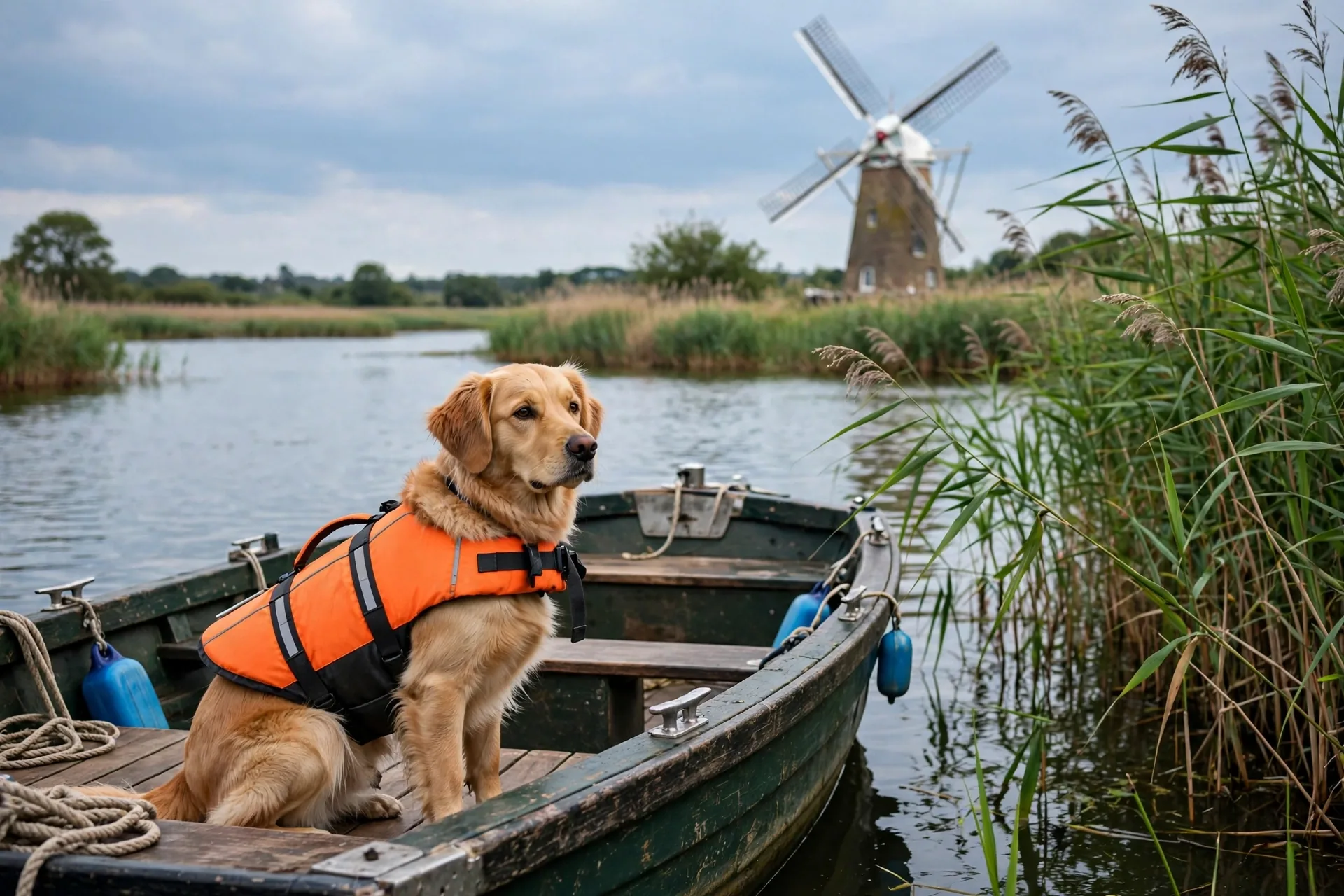
Two Norfolk special cases deserve their own warnings. The first is the grey seal colonies at Horsey and Blakeney Point. Seals haul out on the beaches, and during pupping season the pups are vulnerable and the mothers are protective. Keep dogs on leads, stay well back, never come between a pup and the sea, and do not let a dog approach a seal for a photograph. The second is the Broads: if the beach day is washed out or the dog needs a change of scene, the inland waterways offer towpath walks and boat trips, and our Norfolk Broads dog guide explains boat hire, life jackets and mooring rules. A Norfolk trip that pairs a beach day with a Broads day is often a better trip than two beach days in a row.
Getting there and getting around
The car is the practical choice for both coasts, because the best beaches are spread out and the bus services are thin outside the main towns. For Northumberland, the A1 runs the length of the county and gives access to Berwick, Bamburgh, Seahouses, Alnmouth and the southern beaches, while the coastal road between the villages is slower and narrower. For Norfolk, the A47, A11 and A140 feed into the coast, and the roads between the coastal villages are single-carriageway and busy in summer. Allow more time than the satnav suggests in school holidays, and plan a stop for the dog every two hours on a long drive.
Trains are possible but need planning. For Northumberland, the East Coast Main Line serves Berwick-upon-Tweed, Alnmouth and Morpeth, and local buses connect onwards to the coast, though the connections are infrequent and a car is still much easier for beach-hopping. For Norfolk, trains run from Norwich to Cromer and Sheringham on the Bittern Line, and to Great Yarmouth, while the rest of the coast needs buses or taxis. A car-free trip works best if you pick one base town and one or two nearby beaches, rather than trying to tour the whole coast. If you do travel by train, check the operator's dog policy: dogs usually travel free on most trains, but they must be on a lead and kept off seats, and a busy summer train is a poor place for a nervous dog.
Parking is a smaller but real part of the day. Northumberland's beach car parks are generally spacious and reasonably priced, though the popular ones at Bamburgh and Seahouses fill up on summer weekends. Norfolk's car parks at Holkham and the resort towns can be expensive in peak season and busy at midday, so arriving early or late in the day pays twice: easier parking and a quieter beach. Never leave a dog in a parked car on a warm day, even with a window open — a car heats up far faster than most people expect, and a shaded car park is not a safe kennel. Plan the day so the dog is with you, or the day is built around the dog, and the car is only for travelling.
Where to base yourselves
Base choice matters as much as beach choice, because it decides how far you drive each day and how the evenings work. In Northumberland, Seahouses and Bamburgh suit a beach-first trip, with harbour, castle and cafes close at hand, while Alnwick suits a trip that mixes coast and town, with a castle, gardens and a bookshop town inland. Berwick suits a northern trip that includes the border country and the Tweed. Whichever base you choose, check the dog rules of the accommodation itself: the number of dogs allowed, the pet charge, whether dogs can be left unattended, and whether there is a secure garden or a nearby toilet walk for the first and last outing of the day.
In Norfolk, the base towns each have a different character. Wells-next-the-Sea is compact, pretty and close to Holkham, with a harbour, cafes and a railway walk that suits a dog. Holt is a Georgian market town a few miles inland, good for a trip that mixes beach and shopping. Cromer and Sheringham suit a resort-based trip with a promenade, cafes and a railway, while the villages around Winterton-on-Sea suit a quiet, beach-first trip. For a longer stay, consider splitting the week: a few nights on the north coast and a few nights near the Broads, so the dog gets both beach and towpath without a long daily drive.
Cottages, hotels and campsites all have their place, and the right choice depends on the dog. A cottage with a secure garden suits a dog that needs a safe toilet area and an owner who wants to cook. A hotel suits a short break where the dog is welcome in the bar and the room is easy to clean. A campsite suits a hardy dog and an owner who enjoys being outside, but check the site's dog rules, the distance to the toilet block and the noise at night. Whatever you book, get the dog terms in writing: the number of dogs, the total charge, the cleaning rules and the policy on barking complaints. A booking that is clear about dogs before you pay is a booking that will not surprise you on arrival.
Weather, water and seasonal hazards
Both coasts face the North Sea, which means cold water, strong winds and changeable weather all year. The North Sea rarely gets warm enough for a long swim, even in August, and a dog that swims enthusiastically in a lake may tire quickly in cold, moving water. Keep swimming sessions short, watch for currents and undertows, and dry the dog thoroughly afterwards, especially a short-coated or older dog. On a hot day, the greater risk is heat: a dog on a wide, shadeless beach with no water can overheat quickly, so carry water, a bowl and a shade tent, and walk in the morning or evening rather than at midday.
Tides deserve respect on both coasts. Northumberland's wide, flat beaches mean the tide can cut off a headland or a causeway faster than it looks, and Norfolk's sandbanks and channels shift from year to year. Check tide times before a long walk, keep the dog in sight, and do not let a dog chase birds or seals into deep or fast-moving water. Cliffs need care too: Norfolk's soft cliffs at Happisburgh and elsewhere can crumble, and Northumberland's cliffs and castle headlands have unfenced drops. Keep dogs on leads near cliff edges, whatever the beach rules say about the sand below.
Seasonal hazards differ by coast. In Northumberland, the main summer nuisance is midges on still evenings inland, rather than on the breezy beaches themselves. In Norfolk, the main wildlife hazard is the seal colonies, and the main water hazard is blue-green algae in the Broads and some inland waters in warm weather, which can be dangerous to dogs that drink or swim in it. Check local warnings before letting a dog into any inland water, and keep the dog out of water that looks green, scummy or discoloured. For the full picture on beach law, fines and assistance-dog exceptions, our UK beach rules guide explains how seasonal bans and public space protection orders actually work.
The pre-booking checklist
Work through this list before you pay for anything, and the trip will largely take care of itself. First, fix the dates and the month, then check the beach rules for those dates on the exact beaches you plan to use — not for the county in general, but for the named beach and the named section. Second, match the coast to the trip type: a short break from the south points to Norfolk, a longer break or a northern start points to Northumberland, a family group points to Norfolk's facilities, and a multi-dog household points to Northumberland's space. Third, confirm the accommodation's dog terms in writing: number of dogs, total charge, garden security and the policy on leaving dogs unattended.
- Beach rules: Confirm the current rule for each beach you plan to use, including the summer zone boundaries and the lead requirements. Check the official guidance before you travel, and have a plan B beach for each day.
- Driving: Estimate the real driving time from home, including a stop for the dog every two hours, and decide whether the break is long enough to justify the journey.
- Accommodation: Confirm the dog count, the total pet charge, the garden or exercise area, and the nearest evening toilet walk.
- Tides and weather: Check tide times for the days you will walk, pack for wind and rain on either coast, and carry water, a bowl, a lead and a long line.
- Wildlife: If you plan to visit a seal colony, a nature reserve or a cliff-top walk, check the lead rules and the seasonal restrictions before you go.
- Vet cover: Note the nearest vet practice to your base and save an emergency vet number before you need it, especially for a rural Northumberland base.
- Daylight: In winter, plan the main walk for the middle of the day and the evening walk close to the accommodation, because darkness falls early on both coasts.
The final decision is simpler than the research suggests. If your dog needs space, if your dates fall in high summer, or if you live in the north, choose Northumberland and enjoy the emptiness. If your break is short, if you live in the south or east, if the group includes grandparents or small children, or if you want a gentle trip with a Broads day built in, choose Norfolk and plan around the zones. Either way, the best beach is the one you have checked, not the one you have assumed — and a dog that has a long, calm walk on an open beach will not care which county it was in.
Practical questions
Before you go
Which coast is better for dogs in summer: Northumberland or Norfolk?
Northumberland usually gives you more unrestricted summer beach, because its long beaches are quieter and fewer of them carry seasonal bans. Norfolk still works well in summer, but you need to plan around zoned resort beaches and pick the stretches that stay open to dogs all year. Check the official guidance before you travel, because the exact zones can change.
Are Northumberland beaches open to dogs all year?
Most of the county's long, open beaches are open to dogs all year, which is one of Northumberland's biggest advantages. A small number of central resort sections carry summer restrictions, so check the official guidance before you travel for the specific beach and the exact stretch you plan to use.
Which Norfolk beaches allow dogs all year round?
Holkham, Winterton-on-Sea, Happisburgh and Sea Palling are among the Norfolk beaches where dogs are welcome all year, and several resort beaches keep a dog-friendly zone even in summer. The resort centres of Cromer, Sheringham, Hunstanton and Great Yarmouth are the places where seasonal restrictions bite hardest, so check the official guidance before you travel.
Do I need to keep my dog on a lead on the beach?
It depends on the beach and the season. Some stretches require leads near wildlife, livestock, seal colonies and car parks, while wide open sand may allow off-lead exercise under close control. Keep a lead in your pocket on every beach, keep your dog under effective control at all times, and check the official guidance before you travel.
Can I take my dog to see the grey seals in Norfolk?
Yes, but with strict care. Grey seals haul out at Horsey and Blakeney Point, and the pupping season runs roughly from November to January. Keep your dog on a lead, stay well back, never come between a pup and the sea, and check the official guidance before you travel. If your dog cannot stay calm around wildlife, choose a different beach that day.
Which coast suits a first trip with a nervous dog?
Northumberland usually suits a nervous dog better, because you can walk for a long time without meeting many people or dogs, and you can retreat to an empty stretch if the first one feels busy. Norfolk can also work if you pick a quiet beach like Winterton-on-Sea on a weekday and avoid resort centres. Pick the quieter beach, not the more famous one.