This guide is independent and contains no paid placement. If affiliate links are added later, they will be clearly marked and will not change our editorial checks.
Farnham to Dover is 153 miles of chalk ridge, and most people with a dog allow 11 or 12 days for it. The walking stays close to villages and railway stations almost throughout, so a day can be cut short whenever the dog flags, and the Canterbury branch — longer, quieter, ending in a city with pubs and a station — suits most dogs better than the exposed cliff-top finish along the coast.
Five questions, answered first
Most people planning this walk ask the same five questions, so here are the short answers up front, with the detail later in the guide. First, yes, dogs can walk the full North Downs Way: the whole 153-mile National Trail is open to dogs on leads, and there is no section where dogs are banned. Second, allow 11 to 12 days with a dog, walking about 13 to 15 miles a day, with a rest day at Guildford or Canterbury. Third, the route is gentler than most long-distance trails: the climbs are short, the ridge is rarely high, and the hardest thing about it is the constant up and down rather than any single big hill.
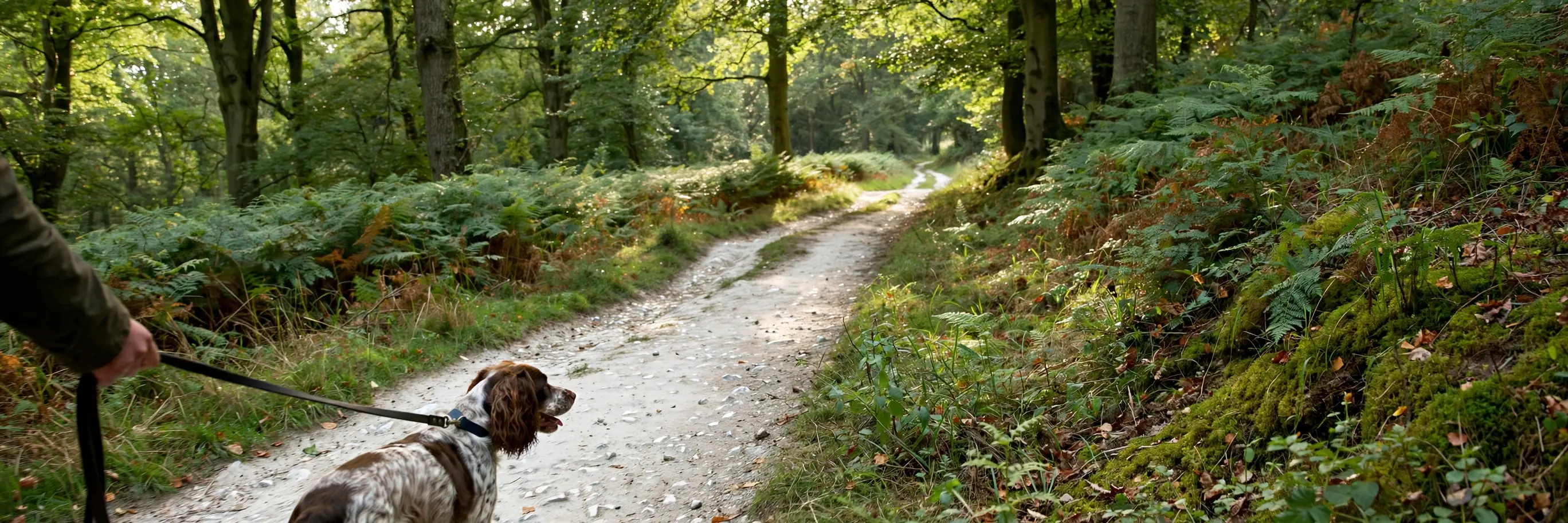
Fourth, the dog can be off lead on much of the woodland and downland, provided there is no livestock nearby and the dog is under close control — but the lead stays on through farmland, near sheep and cattle, near roads, and at the busy viewpoints. Fifth, and most usefully, this is the easiest long-distance trail in Britain to bail out of: Farnham, Guildford, Dorking, Reigate, Rochester, Canterbury and Dover all have railway stations close to the path, so a tired dog never has to walk a day it cannot manage. Those five answers are the whole plan in miniature; the rest of this guide is the detail that makes them work.
Walkers usually start at Farnham and finish at Dover, and there are two practical reasons to do it that way. Dover Priory station sits at the end of the walk, so the journey home is a single train, and the White Cliffs make a far better finish than a start. The wind helps too: the prevailing breeze comes from the south-west, so west-to-east walkers get it at their backs on the open Kent downland. Walking the other way has its own logic — the morning sun falls behind you rather than in your eyes on the Surrey ridges, and Farnham is an easy train ride from London Waterloo at the end — but for a dog there is no real difference, and the choice comes down to trains and timetables, not paws. Whichever end you start from, check the official guidance before you travel for the current route, the access rules and any diversions.
The route at a glance
The North Downs Way runs 153 miles (246 kilometres) from Farnham in Surrey to Dover in Kent, following the chalk ridge of the North Downs for most of its length. It is a National Trail, and it is one of the oldest walking routes in Britain in spirit, because much of it follows the Pilgrims' Way, the historic route taken by pilgrims travelling to the shrine of Thomas Becket at Canterbury Cathedral. The route splits near its eastern end: one branch goes through Canterbury itself, and the other follows the coast from Folkestone to Dover. The total of 153 miles counts the Canterbury route; the coastal alternative is shorter.
The stages in the table are the ones most walkers actually use, running from Farnham through Guildford, Dorking and Wrotham to Rochester, Canterbury and Dover, with the overnight stops falling where the pubs and stations are. The mileages are guidebook figures, so expect a mile or two of disagreement between books, and a bigger swing at the Dover end, where the route splits into the Canterbury branch and the shorter coastal branch via Folkestone. Use the table to shape the days, then check the official guidance before you travel for closures and diversions.
| Day | From – to | Miles | Character |
|---|---|---|---|
| 1 | Farnham – Guildford | 12 | Heathland and the Wey valley |
| 2 | Guildford – Dorking | 13 | Surrey Hills woods and views |
| 3 | Dorking – Reigate | 11 | Box Hill and open downland |
| 4 | Reigate – Oxted | 12 | Quiet woodland and farmland |
| 5 | Oxted – Wrotham | 14 | Into Kent, big skies |
| 6 | Wrotham – Rochester | 13 | Downland above the Medway |
| 7 | Rochester – Detling | 12 | Climbing back to the ridge |
| 8 | Detling – Lenham | 13 | Open Kent downland |
| 9 | Lenham – Wye | 13 | Villages, pubs and the Stour valley |
| 10 | Wye – Canterbury | 14 | Down to the cathedral city |
| 11 | Canterbury – Dover | 16 | Final ridge to the White Cliffs |
What recommends this trail to a dog owner is not any single day but the way the days stack up. No climb is long, no ridge is exposed, and no stretch runs far from a village, a pub or a station — yet eleven days of chalk and flint, of beech shade one hour and bare downland the next, add up to a serious undertaking. The climbs are short and sharp rather than sustained, the descents on chalk can be slick after rain, and the second week tests a dog that has never walked long days back to back. A fit dog that trains for it will finish at Dover still keen; one that only walks an hour a day at home will feel the second week in its legs, so build the miles up before you go.
The Pilgrims' Way: a thousand years of walking
The North Downs Way is not just a modern National Trail: much of it follows the Pilgrims' Way, the route taken by medieval pilgrims travelling to Canterbury to visit the shrine of Thomas Becket, the Archbishop of Canterbury who was murdered in his own cathedral in 1170. For four centuries, pilgrims walked this ridge from Winchester and London to Canterbury, and the path they wore into the chalk is still visible in places as a hollow way, a sunken track worn deep by centuries of feet. Walking it with a dog is a reminder that the best walking routes are rarely invented: they are inherited, and they survive because they follow the high, dry ground that stays walkable in all weathers.
The history is visible all along the route, and it gives the walking a texture that a purely scenic trail does not have. There are ancient churches in the villages, often open to walkers, and many of them welcome dogs inside or at least in the churchyard. There are hill forts, burial mounds and old drove roads, and there are pubs that have served walkers for centuries. Canterbury Cathedral itself is the natural end of the pilgrimage, and although dogs are not allowed inside the cathedral, the city is a fine place to finish a walk, with dog-friendly pubs, a riverside and a railway station.
For the dog, the history matters in a practical way too. The Pilgrims' Way follows the high ground because the high ground was dry, and the chalk ridge is still the driest walking in the south-east after rain. The route also passes through villages that grew up to serve travellers, which is why the pubs and the accommodation are as good as they are. The past, in other words, did the route planning for you: the ridge, the villages and the water sources are where they are because a thousand years of walkers found them to be the sensible places.
Woodland and open downland
The North Downs Way alternates between two kinds of walking, and the change between them is one of the pleasures of the route. The Surrey half is largely woodland: beech and yew woods, hazel coppice and pine plantations, with the path running through deep shade and over a soft carpet of leaves. The Kent half is more open: wide chalk downland, big skies, sheep-grazed turf and views that stretch for miles. The dog will enjoy both, but for different reasons: the woods are cool in summer and full of smells, while the open downland is where a dog can run freely and see for miles.
The woodland sections are kind to dogs in hot weather, because the shade keeps the ground cool and the air moist, and a dog that would overheat on an open ridge can walk comfortably through the woods. The woods are also where the ticks live, so check the dog every evening, and carry tick tweezers in the first-aid kit. After rain, the woodland paths hold mud and the tree roots are slippery, so keep the dog on a lead on the steep wooded descents and watch your own footing. In autumn the woods are at their best, with beech mast underfoot and fungi in the leaf litter, but beech mast and some fungi are not good for dogs to eat, so keep an eye on a dog that scavenges.
The open downland is the opposite: no shade, no shelter, big skies and a wind that comes straight across the ridge. On a clear day the views are superb, and a dog can run on the short turf where the path allows it. On a hot day, the downland is hard work, and the dog needs water, rest and shade wherever it can be found. On a windy day, a small or short-coated dog will feel the chill quickly. The two kinds of walking balance each other: a wooded morning and an open afternoon, or an open morning and a wooded afternoon, and the variety is what keeps a dog interested over eleven days.
Kent and Surrey: how the two halves differ
The Surrey half of the route, from Farnham to the Kent border, is the more wooded and the more suburban of the two. The path runs through the Surrey Hills, an Area of Outstanding Natural Beauty, past Guildford, Dorking and Reigate, and it is never far from a town, a station or a road. The villages are larger, the pubs are more numerous, and the walking is on a mix of woodland paths, heathland and open downland. Dogs that are nervous around traffic or crowds will find the Surrey half busier, especially at weekends, when Box Hill and the viewpoints attract large numbers of walkers, cyclists and other dogs.
The Kent half, from the border to Dover, is more open and more rural. The path runs along the Kent Downs, another Area of Outstanding Natural Beauty, through villages that are smaller and quieter, with fewer facilities but more space. The downland is wider, the skies are bigger, and the walking feels more remote, even though a station is never far away. Sheep graze the Kent downland extensively, so the lead rules matter more here, and the ground-nesting birds of the open turf need the dog on the path and on a lead in the breeding season from March to July.
For the dog, the practical difference is about water and shade. Surrey has more woods and more streams, so water and shade are easier to find; Kent has more open downland, so the dog needs water carried and shade sought out. Both halves have good pubs and good accommodation, but the Kent villages have fewer shops, so carry the dog's food for the stretch between towns. Our Dartmoor dog walks guide covers the same balance of open moorland and sheltered valleys, and the water and shade planning it describes applies here too.
Section by section: what each stretch is really like
The walk begins in Farnham, a handsome market town in Surrey with a railway station and dog-friendly pubs, and follows the River Wey out of the town before climbing onto the ridge. The first day to Guildford is a gentle introduction, with heathland, woodland and riverside paths, and Guildford itself is a good first overnight stop, with a wide choice of dog-friendly accommodation and a station for anyone who needs to leave early. The second day, from Guildford to Dorking, is one of the finest on the whole route: the path runs through the Surrey Hills with views across the Weald, and the woods are full of bluebells in spring.
The middle days, from Dorking through Reigate and Oxted to Wrotham, are the quietest part of the walk. The villages are small, the path is often empty, and the walking is on a mix of woodland, farmland and open downland. This is the stretch where the dog can relax into the routine of walking, and where the lead discipline matters most, because the farmland is working land and the sheep are everywhere. Rochester, at the end of the sixth day, is a fine place for a rest: a historic town on the Medway with a castle, a cathedral and dog-friendly pubs, and a station for anyone who wants a day off.
Rochester to Dover is where the walk earns its ending. The Medway crossing behind you, the path climbs back onto the Kent downland at Detling and rolls through Lenham towards Canterbury, wide turf, big skies, and villages that feel a long way from London. Canterbury itself is the natural rest day: a city with a station, dog-friendly pubs and a cathedral green to doze on. After that comes the hardest single day, Canterbury to Dover, long and exposed, dropping at last to the White Cliffs above the Channel. On the cliff tops the lead is non-negotiable and the dog stays well back from the edge, whatever the view. Dover waits below with a station, pubs that take dogs, and a castle on the hill above the town.
Stations: the dog's escape hatch
The railway is the North Downs Way's greatest gift to the dog walker. Farnham, Guildford, Dorking, Reigate, Oxted, Wrotham, Rochester, Canterbury and Dover all have stations within a short walk or bus ride of the path, and several smaller stations — Gomshall, Chilworth, Box Hill and Westhumble, Betchworth, Kemsing, Halling, Cuxton, Bearsted, Harrietsham, Charing and Wye — sit close to the route as well. That density of stations means that no day is a prison: if the dog is tired, lame or overheated, you can shorten the day, skip to the next town or leave the walk altogether, and be on a train within the hour.
Treat the stations as part of the plan rather than a rescue plan. A day that looks too long on paper can be cut at Gomshall or Chilworth, at Box Hill and Westhumble, or at Wrotham, and the walk can be spread across weekends without ever losing your place — leave the car at Guildford, ride out to the start, walk back to it. Dogs ride free on most British trains when they stay on a lead and off the seats, though the current rules for the services you intend to use are worth checking before you travel. A quiet rural service and a packed commuter train are very different places for a tired dog, so travel outside the peaks where you can, and let the dog drink and rest for ten minutes on the platform before you board.
The stations also solve the getting-there problem that bedevils most linear walks. You can park at one station, take the train to the start, walk back to the car, and never need a taxi or a lift. Or you can leave the car at home entirely and use the train at both ends, which is the simplest option of all on this route. Either way, the railway is what makes the North Downs Way the most accessible long-distance trail in the south of England, and the reason it is the best first long-distance walk for a dog that has never done one before.
Livestock, birds and leads
The flocks are the first thing to plan around. Sheep graze the chalk grassland from the Surrey Hills to the Kent Downs, thickest around Detling and Lenham, and cattle stand in the valley pastures along the Wey, the Medway and the Stour. Lambing runs through spring, when ewes with young are at their most protective and a loose dog is at its most dangerous. The rule that keeps everyone safe is simple and absolute: lead on whenever there are animals in the field, and lead on again whenever the ground folds away and you cannot see what is over the next brow — on this ridge, the sheep are very often just out of sight. A dog that runs at sheep can injure them, and the law gives a farmer strong powers where a dog worries livestock, so this is not a rule to bend because the field looks empty.
The skylarks are the other reason for the lead. They nest in the short turf of the open downland, from March into July, and a dog quartering the grass off the path can wreck a nest before its owner has time to call it back. Stay on the marked path through the breeding season, lead on, and accept that the harm is invisible — a nest deserted after a dog passed too close looks no different from a patch of grass that never held one. The same care applies at the Dover end, where seabirds nest on the cliff ledges: keep the dog on a lead, keep it well back from the edge, and do not let it peer over.
Cyclists are the likeliest meeting on the shared paths, especially around Box Hill on a fine weekend, where riders come down fast. Reel the lead in before they reach you, step to the side with the dog on your side of the path, and wait until they have passed — a long lead stretched across the trail is a tripwire. Horses use the same bridleways, and the drill is the same, with one addition: speak to the rider, let the horse see and hear you, and stand still while it passes rather than stepping out suddenly. The viewpoints draw crowds of their own: Box Hill, the Devil's Kneading Trough above Wye, the cliffs at Dover. On a sunny Saturday they are full of other dogs, children and cyclists in close quarters, so the lead stays on there too.
Water and food on the trail
The chalk is thirsty ground. Rain sinks straight through it, so the ridge itself carries almost no running water, and the villages, pubs and taps sit down in the valleys — the Wey at Farnham and Guildford, the Darent at Otford, the Medway at Rochester, the Stour near Canterbury. Carry a litre for the dog on top of your own, more on a warm day, and fill up at every sure source you pass: the overnight stop, a pub, a village tap, a cafe. The towns will always have a shop or a tap; the smaller villages may have neither, so a certain source is never worth walking past.
Valley water is there if you drop down for it, but dropping down costs the climb back. The Wey at Guildford, the Tillingbourne at Gomshall and Chilworth, the Stour below Canterbury — all of them run clear and fast, and a dog may drink from them gladly, but none of them sits on the ridge path, and a detour down and back up can eat an hour. Do not plan a day around a stream you have not seen on the map. Water that is green, still, or running below a farmyard is not drinking water for a dog. On a hot day, offer small drinks often and wet the belly and paws at any water you find. If the gums feel tacky instead of slick, the saliva turns thick, or the dog goes flat and will not keep walking, the day is over — stop, rest, and get the dog to shade and water.
A walking dog burns far more than a dog at home, so feed for the work. Keep the routine the dog knows — a proper meal morning and evening, nothing heavy in the middle of the day — and carry a pocket of its usual kibble or treats for small top-ups on the move. Do not change the food for the trip: a new diet on a walking holiday is the quickest way to an upset stomach, and a dog with a sore gut will not walk. If the bags are being transferred, pack each day's food in a sealed, labelled portion and keep one day's worth in your own pack, so a missing bag never means a hungry dog. A slightly bigger evening meal is fair after a long day, and fresh water should be waiting at every overnight stop.
Where to stay with a dog
The beds go first. From May to September the dog-friendly rooms along the route are scarce, so book as soon as the dates are fixed, starting with the towns — Farnham and Guildford at the western end, Rochester and Canterbury in Kent, Dover at the finish — where hotels and guesthouses give the most choice. Between them the pattern is pubs with rooms, small bed and breakfasts and farm stays. Most take dogs, but usually in only some of the rooms, and many add a small charge per dog per night. Get the arrangement in writing when you book: which room, what fee, whether the dog may be left alone briefly, and where the dog sleeps. A cheerful 'dogs welcome' on the phone can mean something narrower on arrival.
A tent changes the arithmetic. Campsites within a short walk of the path in the Surrey Hills and the Kent Downs give the dog its own space, no strange room, no other guests to disturb. The price is weight, and a dog that must be happy sleeping under canvas — quiet when footsteps pass in the dark, settled on its own bed. If the dog barks at every sound, the campsite will be a long night for everyone. Hostels are patchy: a few have private rooms that take dogs, many take none at all, so ask rather than assume. Whatever the roof, keep the evening the same as at home — feed at the usual hour, the dog's own bed, a last toilet walk before dark, then time to wind down.
Let someone else carry the weight. Local companies move bags from stop to stop along the whole route for a daily charge per bag, and with a dog it is money well spent: the day pack then holds only the day's water, the dog's food and bowl, waterproofs and a first-aid kit. The dog's essentials travel with you, never in the transferred bag — that day's food, medication, a spare lead, poo bags, a towel. Our guide to the Coast to Coast walk with a dog describes the same split between day pack and transferred bag, and it suits the chalk just as well.
Paws, weather and fitness
Paws decide whether the walk finishes. In dry weather the chalk paths are firm and forgiving, but flint sits in the chalk like broken glass, and a pad can be cut before the dog shows it. After rain the same chalk turns to a paste that packs between the toes and makes every descent a slide, while the woodland paths hold mud and the tree roots are slick. Make the evening check a ritual: rinse the feet with clean water, dry them properly, check for nicks and cuts, for soreness between the toes, and for pads gone red or swollen, and rub in paw balm when the pads look dry. A dog that starts to limp should rest rather than push on — a day off in Guildford or Canterbury costs one day, while a limp walked on for three days can cost the trip.
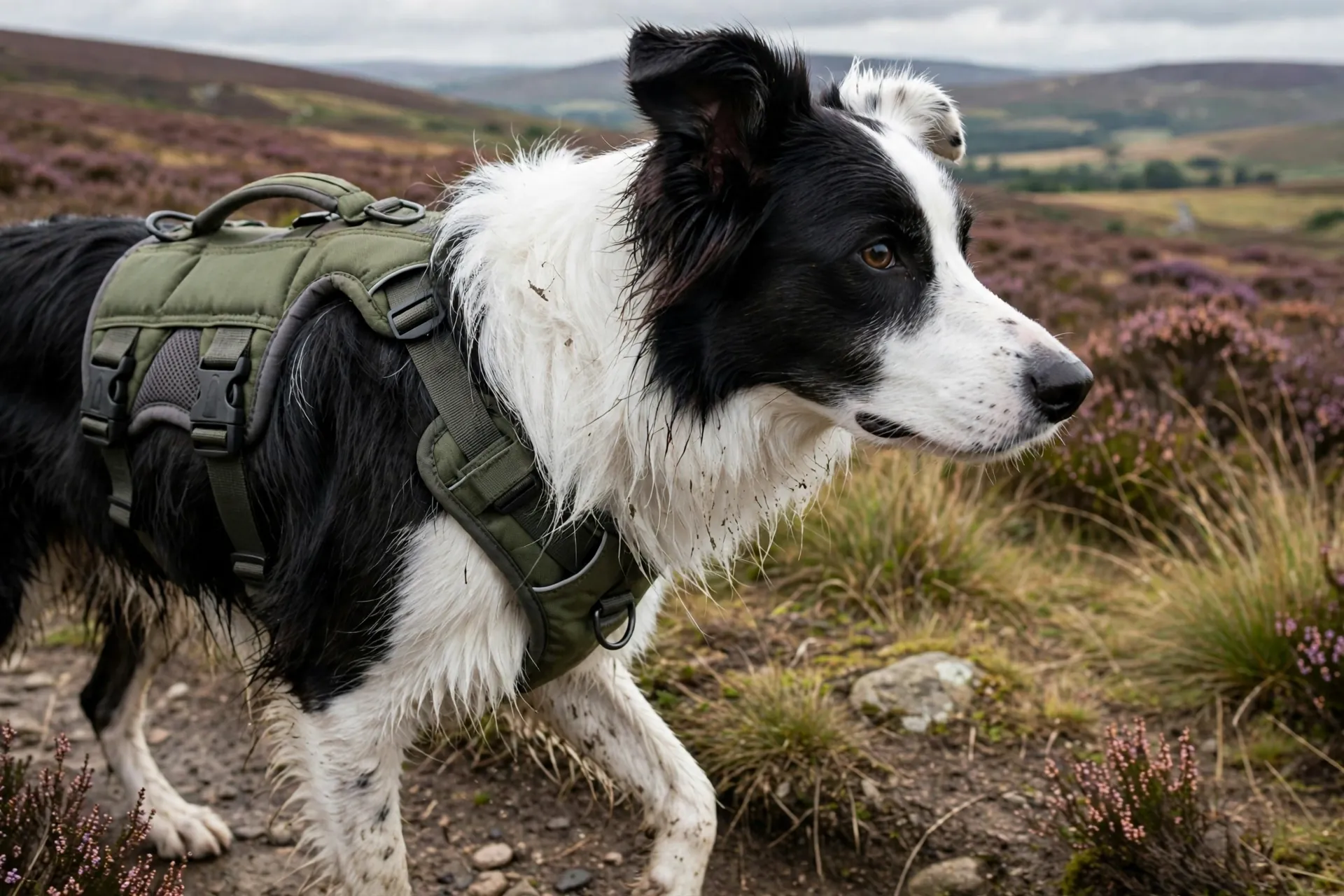
The ridge makes its own weather. Wind off the Channel and the Weald can arrive with the rain behind it and very little warning, so waterproofs for both of you are a given, and a dog coat earns its place on a wet week — short-coated, older and small dogs chill fastest. Summer turns the problem round: the open downland has almost no shade, so heat, not rain, is the day's risk. Set off early, sit out the middle of the day in whatever shade you can find, and watch for heavy panting and a dog that will not keep moving. A harness with a handle earns its keep for steadying the dog on the steep wooded descents and the chalk slopes; our dog hiking harness guide is worth a read before you go.
Start with the vet, then the training. Any dog with arthritis, a heart condition or an old injury should be checked before the trip is booked, and the vet's word should settle whether eleven days is sensible at all. For a healthy dog, six weeks is the build-up: work up to two long days back to back, on mixed ground, on a lead for long stretches, with hills in the mix wherever you can find them. Rehearse the day itself, not just the miles — feed in the morning, a long walk with water stops, feed again in the evening, and a quiet night. And if the build-up shows the dog struggling, walk the route in sections across several weekends instead: the stations make that easy, and it is a kinder choice than a dog that fades on day eight.
What to pack for the dog
Keep the kit to what the dog actually uses. On the dog: a harness that fits, with a handle, and two leads — one in use, one spare. In the pack: a collapsible bowl, water capacity of at least a litre for the dog, poo bags, and the dog's usual food in sealed portions. Then the small things that save a day: a towel, a rain coat for the dog, paw balm, a basic first-aid kit with tick tweezers, any regular medication, and the dog's own bed or blanket so it can settle at each stop. Before you leave, put the vet numbers for the route and a copy of the vaccination record in your phone.
Work the food out day by day before you leave. A labelled portion per day, one day's worth in the day pack and the rest in the transferred bag, so you always know how much is left without opening everything. Take more poo bags than the trip should need and carry every one of them out — this is protected landscape and working farmland, and a bagged pile left beside the path is litter, however neatly tied. A small dry bag keeps the dog's food and medication dry when rain comes in sideways, and a dry towel waiting in the transferred bag is worth its weight after a wet day.
And leave room for the dog's own pace. It will want to stop at every gatepost, every sheep-scented patch of grass, every beck it crosses, and those pauses are the walk, not an interruption of it. Build them into the day and eleven days will feel generous rather than rushed. A pilgrims' road is best walked slowly, with a dog at your side.
Practical questions
Before you go
Can dogs walk the full North Downs Way?
Yes — dogs can walk all 153 miles of the National Trail from Farnham to Dover, on public rights of way across the Surrey Hills and the Kent Downs. The lead goes on through farmland, near livestock, and at the busy viewpoints. Check the official guidance before you travel for current access rules.
How long does the North Downs Way take with a dog?
Most walkers take 10 to 12 days, walking about 13 to 15 miles a day. With a dog, 11 or 12 days is a comfortable plan, with a rest day at Guildford or Canterbury. The route splits near Dover, so the total depends on whether you take the Canterbury route or the coastal route.
Is the North Downs Way very hilly for a dog?
It is gentler than most long-distance trails. The climbs are short and the ridge is rarely high, but the path goes up and down constantly, and the descents on chalk and flint can be hard on paws. Fit dogs cope well, and older dogs will appreciate the many stations that allow a shorter day.
Are dogs allowed off lead on the North Downs Way?
On quiet woodland and open downland with no livestock in sight, yes, as long as the dog stays under close control and comes back when called. The lead goes back on in farmland, around sheep and cattle, near roads, at viewpoints, and in every village and town on the way.
Which is better for dogs, the Canterbury route or the coastal route to Dover?
The Canterbury route is longer, quieter and better supplied, with villages, pubs and a city at the end of it, which suits most dogs. The coastal route from Folkestone to Dover is shorter but more exposed, with cliff tops where the dog must stay on a lead. Walkers with a nervous or reactive dog usually prefer the Canterbury route.
Can I reach the North Downs Way by train?
Yes — that is one of the route's best features. Working back from Dover, stations at Canterbury, Rochester, Wrotham, Oxted, Reigate, Dorking, Guildford and Farnham all sit close to the path, so you can step on or off the walk at many points. Dogs ride the trains on a lead, but check the official guidance before you travel for current rules.