This guide is independent and contains no paid placement. Venue and event rules change, so where this guide flags a check, please confirm the latest official information before you travel.
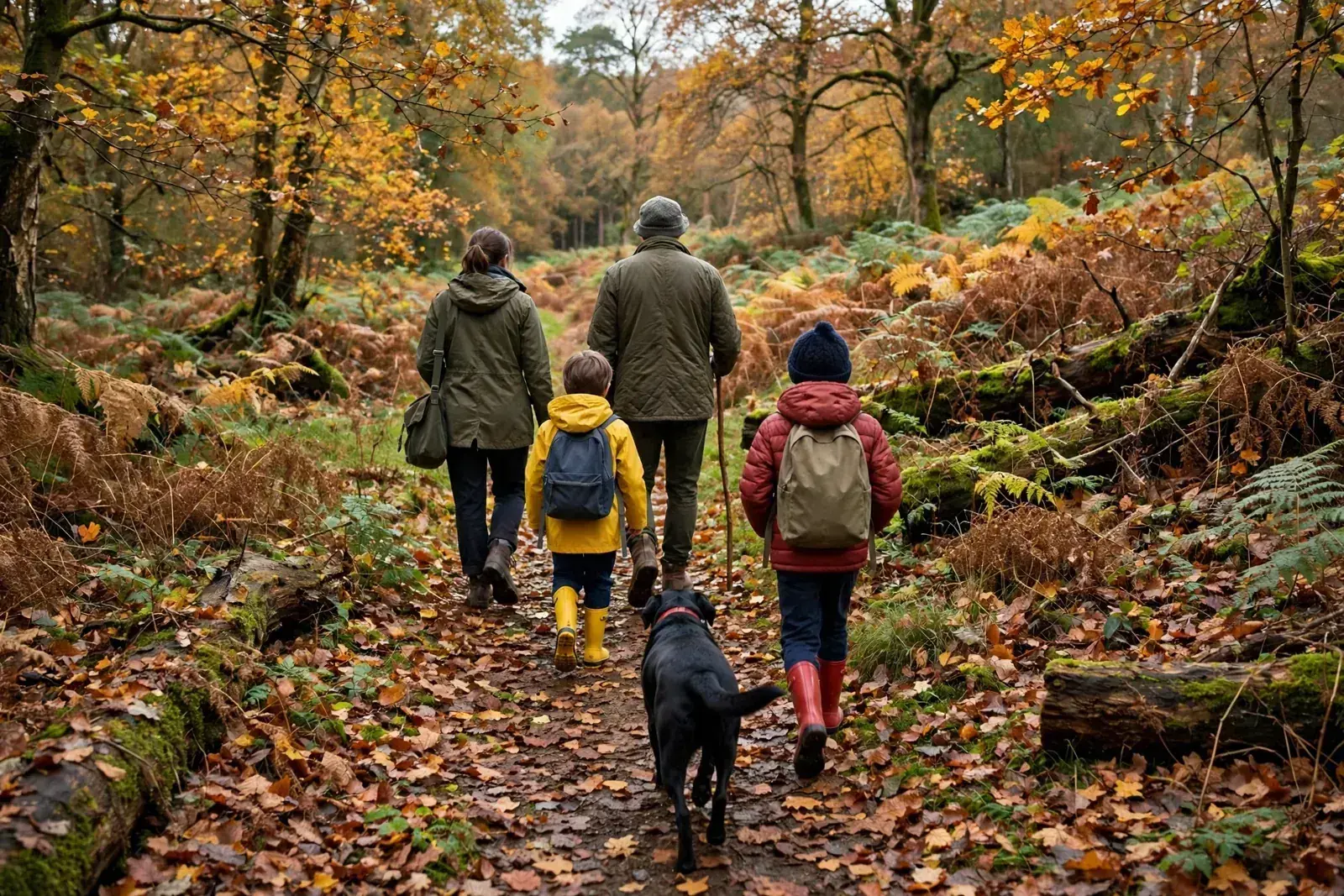
October half term with a dog in the UK rewards families who plan for autumn rather than against it: book accommodation with drying space, hard floors and a secure garden, build the big walk into the short daylight window, carry towels, spare leads and a drying coat as standard kit, and choose indoor attractions honestly — most are people-only, so pairs should split visits while one adult walks the dog. Pack for mud, check tide, daylight and livestock rules before each outing, and keep evenings short, warm and unhurried.
A different season, not a smaller summer
Begin by retiring the summer template. The family break that worked in August — long evenings, light at nine, a dog who could be exercised after supper — simply does not exist in late October. The clocks usually change during or just before half term week in England and Wales, sunset arrives before the evening meal, and many attractions move to shorter autumn hours or close for the season entirely. Families who arrive expecting summer with jumpers spend the week surprised. Families who plan for autumn have a better holiday than the summer one in some respects.
Autumn's compensations are real. Woodland colour peaks in many parts of Britain around half term, beaches that were restricted or crowded in August are quieter and often fully open to dogs again once seasonal rules lift — though dates vary by beach, so check the official latest guidance before you go. Prices for many stays dip below summer peaks, popular towns breathe again, and dogs cope far better with cool walking weather than with summer heat.
The planning posture that works is daylight-first. Put the main walk and any dog-inclusive outing in the middle of the day, treat mornings as slow starts with a proper local leg-stretch, and design evenings around food, games and a short leaded toilet walk rather than expeditions. That single reordering — big things at midday, small things after dark — solves most October half term friction before it happens.
Booking checks that matter more in October
Autumn exposes weaknesses in accommodation that summer hides. A cottage with no drying space is a nuisance in June; in a wet October week with a large muddy dog it becomes the defining feature of the holiday. Prioritise hard floors in living areas, a porch, utility or boot room, an outside tap or at least a hose, and somewhere a wet dog can be contained while it dries that is not the sofa. Ask where, exactly, the after-dark toilet walk happens, and whether it is lit, because you will be doing it in the dark every single night.
Check the heating as seriously as the view. Old stone cottages and converted barns can be charming and cold in equal measure, and a dog who sleeps on the floor feels draughts the family on sofas never notice. Confirm the property's dog rules in writing as usual: number and size of dogs, any charge, whether dogs may be left alone and for how long, and whether the garden is genuinely enclosed — a low stone wall that contains a child will not necessarily contain a dog who has seen a rabbit on the far side.
Our wider guide to half term dog holidays covers term-date variation across the UK's nations and regions, which matters because half term is not a single national week. Scottish schools, in particular, often break earlier in October. If your plans involve visiting family or meeting friends from another region, confirm whose half term you are actually booking before assuming shared dates.
Mud is a system, not an accident
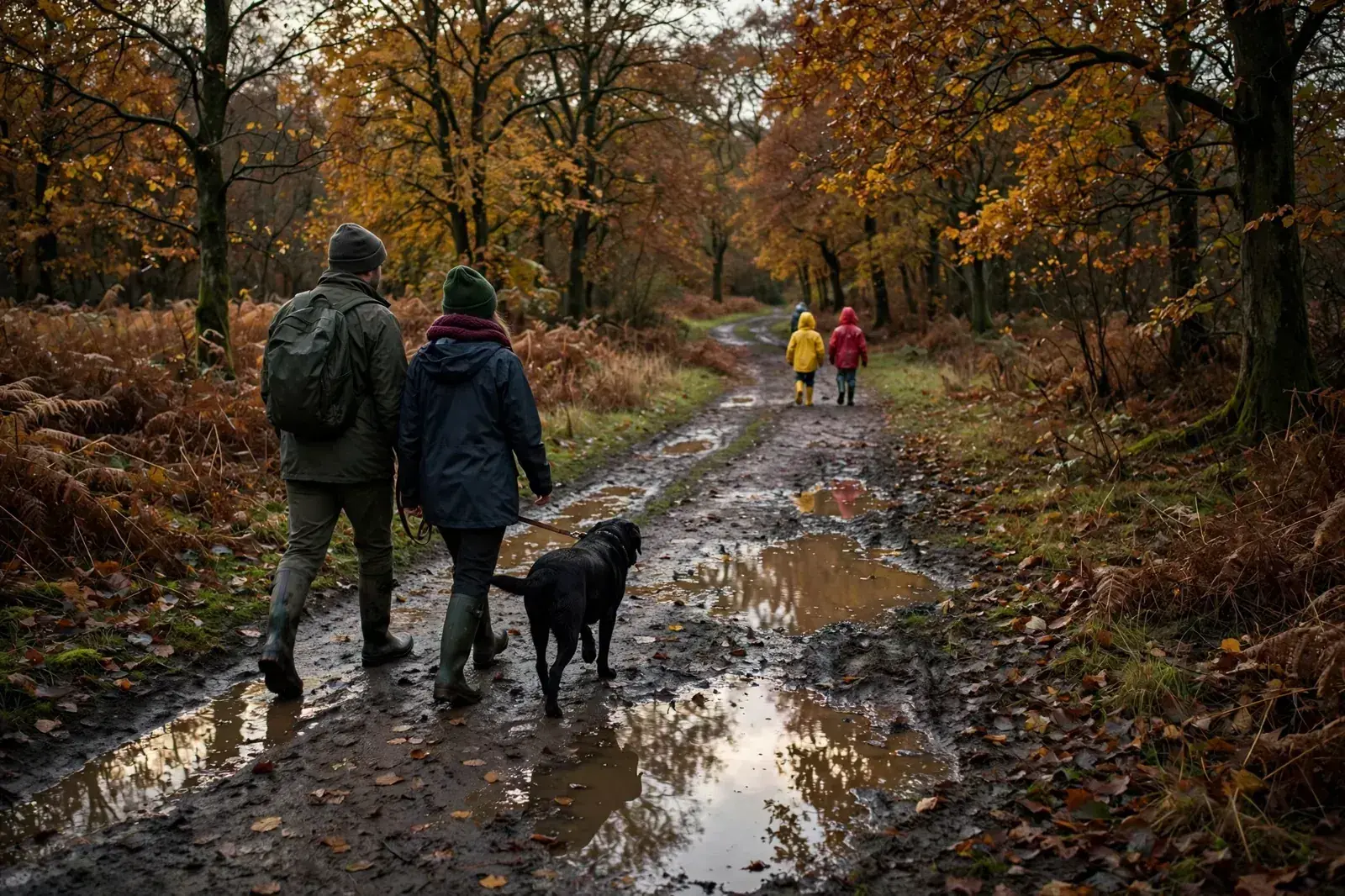
Accept in advance that mud is the week's main material, and organise for it rather than fighting it dog by dog and day by day. In the car, a boot liner or old blankets, a stack of towels that live permanently by the tailgate, and a large bottle of water with a bowl for paw rinsing will handle most returns. A dog drying coat, put on after a rough towel-down, contains an astonishing amount of remaining damp on the drive back and in the first hour indoors.
At the accommodation, set up the mud station on arrival, before the first walk: towels by the door the dog will actually use, a mat or old rug inside it, bags and the spare lead there too, and a house rule that dogs pause in that zone until paws have been checked. Children can be given the towel job as an official role; dogs learn the pause routine within a day if everyone applies it the same way, and carpets survive the week.
Choose walks with mud in mind rather than discovering it. Forestry tracks, former railway paths, surfaced trails around reservoirs and well-drained coastal paths stay usable after rain in a way that cross-field footpaths in clay country do not. Save low-lying riverside fields for dry spells, treat any path description written in summer with suspicion, and remember that a shorter surfaced walk with a dry dog often beats a heroic cross-country route that produces a dog who needs hosing and a family that needs new boots.
Shorter days: torches, visibility and the evening walk
Darkness changes dog management in ways families underestimate. A recall that is flawless at noon in a familiar field is a different proposition at dusk among deer scents and other walkers with torches. Keep evening walks on the lead or a long line in a familiar, enclosed or low-risk place, and save exploratory walking for daylight. Reflective or light-up collars and leads make your dog visible to drivers, cyclists and other walkers, and a head torch keeps your hands free for gates, bags and leads.
Roads deserve fresh respect in half term week. Rural lanes around holiday accommodation are often unlit, without pavements, and used by drivers who are also on unfamiliar ground. Walk facing traffic where there is no pavement, keep the dog on the traffic-far side, wear something reflective yourself, and consider whether the garden or a nearby field gate loop can replace a lane walk entirely after dark. Urban breaks invert the problem: pavements are lit but busier, with restaurant spill-out, dropped food and other dogs in close quarters.
Plan the day's timings backwards from sunset where you are staying, not from habit at home. Latitude matters: an October evening in Cornwall and an October evening in the Highlands are different propositions by more than an hour of usable light. Check the sunset time for your destination at the start of the week, put the big walk comfortably inside it, and treat any route that only just fits as a route that does not fit at all once a child, a dog and a wrong turning add their delays.
Family planning: splitting days without splitting up
The honest centre of an October half term with a dog is that some attractions are people-only. Castles with interiors, museums, swimming pools, cinemas and many paid attractions do not admit dogs beyond assistance dogs, and a week designed as if they did collapses by Tuesday. Design instead around a split-visit rhythm: one adult takes children inside while the other does a genuinely good dog walk nearby, then swap or regroup for the shared parts of the day — the café, the town, the beach, the walk everyone does together.
That rhythm works best when the dog half is treated as a real activity rather than a waiting room. Research the walk near each attraction with the same care as the attraction itself; many heritage towns and visitor sites sit beside rivers, parkland or trails that make the dog shift the better half of the bargain. Our guide to dog-friendly holiday parks in the UK is useful if your base is a park, because on-site dog walks, drying facilities and rule differences between parks matter more in October than in August.
Give children a voice in the split. Older children may choose the dog walk over the museum some days, and a child who has a job — map holder, torch keeper, towel officer — experiences the dog-shaped parts of the holiday as participation rather than restriction. Build in at least one day with no fixed booking at all. Half term weeks that are programmed to the hour leave no slack for the wet day, the tired dog or the place you discover and want to revisit, and slack is what families remember fondly.
Weather windows, wind and honest cancellations
October weather in Britain is not bad weather; it is changeable weather, often within a single walk. Plan in windows rather than days: a route for the dry morning, a town-and-café fallback for the wet afternoon, and the flexibility to swap them at breakfast without disappointment. Layered clothing, waterproofs for every human and a spare set of dry clothes in the car turn a shower from a day-ender into an anecdote. For dogs, the main weather risks are cold wind after a soaking, and overheating almost never — October is the kindest walking month of the year for most breeds.
Wind deserves as much attention as rain on coasts and hills. Gusts on exposed headlands can unbalance small children and small dogs, blow dogs towards cliff edges they would normally respect, and make gates and car doors genuinely hazardous. Check a proper forecast for your exact location on the morning of any exposed walk, observe conditions when you arrive, and treat turning back as a normal decision you model calmly for your children rather than a failure to be argued with.
Some days should simply be cancelled into a better shape. If a storm day lands mid-week, declare it: a short local walk in the best available window, a dog-friendly café or pub lunch where you have confirmed dogs are welcome inside, films and games at base, and an early night. Dogs are entirely content with that day. It is adults, carrying a mental itinerary, who need persuading that a cancelled expedition plus a rested family beats a miserable forced march in horizontal rain.
Eating out and evenings with a dog in autumn
Summer's pub gardens thin out in October, and the question changes from where dogs can sit outside to which places genuinely welcome them indoors. Many pubs do, especially in walking country, but cafés and restaurants vary widely and seasonal hours shorten. Phone or check the venue's own information before setting out with a hungry family and a wet dog, arrive with the dog towelled and as dry as circumstances allow, and apply the standard courtesies: dog on the floor, out of walkways, settled on a mat if you have brought one.
Book evening meals earlier than you would in summer, for two reasons. Kitchens in smaller places often close earlier out of season, and a family that eats at six can be back for the dog's last walk before the deepest dark and cold. Self-catering families should plan the week's food with the same realism: arrive with the first evening and breakfast covered, because rural shops keep shorter hours and nobody's first holiday memory should be a torchlit search for milk.
Evenings are also when Halloween may intrude on a half term break, since 31 October frequently falls inside the holiday week. If you are staying away that night, your dog is in an unfamiliar property on the noisiest door-knocking evening of the autumn. Keep the dog away from the accommodation's front door, expect callers even in holiday areas, and read the Halloween guide alongside this one if your dates overlap — the hazards travel with you.
The October packing list that earns its space
Pack for the dog as a separate list, not as an afterthought added to the family's. Food for the week plus a spare day, because rural substitution of a sensitive dog's diet is a false economy; any medication with margin to spare; bedding that smells of home; the drying coat, towels and a spare lead and collar, because the first set will be wet when you need them; bags in every coat pocket and car door; and a torch and reflective gear treated as essentials rather than accessories.
Add a basic dog first aid kit and the details of a vet near your accommodation saved in your phone before you travel, including the out-of-hours arrangement. Mud season is also stick-injury, cut-pad and thorn season, and a minor problem handled promptly in the cottage stays minor. Check paws each evening by torchlight: October fields carry harvest debris, and a small cut found at six o'clock is a different matter from the same cut found, infected, after you get home.
Finally, pack for the humans' tolerance as much as the dog's comfort. Enough changes of socks, a second pair of footwear per person if space allows, and a car that is organised rather than merely full will decide whether the fourth muddy walk is funny or fractious. October half term with a dog is one of the best family breaks in the British calendar when it is planned as itself. Planned as a summer holiday in disguise, it is a week of small avoidable frictions. The dog, muddy and content, will vote for the first version every time.
Practical questions
Before you go
When is October half term in the UK?
Dates vary by nation, region and school, and Scotland's October break often falls earlier than in England and Wales. Many English schools break for one week in late October, around the weekend the clocks go back, but there is no single national date. Check your own school's published term dates and, if meeting family from another area, confirm theirs before booking anything.
Are beaches open to dogs in October half term?
Many beaches that restrict dogs in summer lift those restrictions in autumn, and October half term often falls just after seasonal rules end — but dates and zones vary by beach and some restrictions run longer. Always check the signs on arrival and the council or beach owner's latest information before relying on a beach day, and keep dogs away from seals resting on autumn shores.
What should I pack for a dog in October?
Bring food plus a spare day, medication with margin, home-smelling bedding, towels, a drying coat, a spare lead and collar, poo bags in every pocket, a torch and reflective or light-up gear for dark walks, and a basic first aid kit. Save the number and out-of-hours details of a vet near your accommodation in your phone before you travel.
How do I handle muddy dogs at holiday accommodation?
Set up a mud station at the door you will use: towels, a mat, bags and a spare lead, and pause the dog there after every walk for a towel-down and paw check. Ask before booking about hard floors, drying space and an outside tap, and check what the after-dark toilet walk is like. A drying coat in the car contains most of the damp on the way back.
Can dogs go into indoor attractions at half term?
Usually not, beyond assistance dogs. Museums, castles' interiors, pools and cinemas are generally people-only, so plan a split-visit rhythm: one adult walks the dog somewhere genuinely good nearby while the other takes children inside, then regroup for shared parts of the day. Check each attraction's official dog policy before building a day around it.