This guide is independent and contains no paid placement. Venue and event rules change, so where this guide flags a check, please confirm the latest official information before you travel.
Halloween with a dog in the UK works best as an early-exercise, early-evening, doors-managed plan: walk and feed before trick-or-treat callers start, move all chocolate, sweets and decorations out of reach, create a quiet room away from the front door, skip costumes that restrict or stress your dog, and treat any bangs as the start of fireworks season. If your dog is door-reactive or noise-sensitive, the kindest option is a calm night in with the doorbell expectation removed — a note and a bowl of sweets by the gate, or lights off and curtains drawn.
Start with the doorbell, not the decorations
Most Halloween advice for dogs starts with pumpkins. Experienced owners start somewhere else entirely: the front door. Between roughly teatime and eight in the evening on 31 October, that door may knock or ring a dozen times, each arrival announced by excited voices, rustling costumes and a sudden cluster of strangers on the step. For a dog, that is not a festival. It is a repeated home-invasion drill, with each round arriving just as the last surge of adrenaline begins to fade.
Work through your dog's likely response honestly before the day. A sociable, steady dog may simply be curious, and for that dog the task is manners: no lunging to greet, no slipping through the open door, no investigating bags of sweets at child height. A territorial or anxious dog will experience the evening very differently, and rehearsing calm behaviour in a single afternoon will not rewrite that response. Management, not training miracles, is the realistic goal for this year's Halloween.
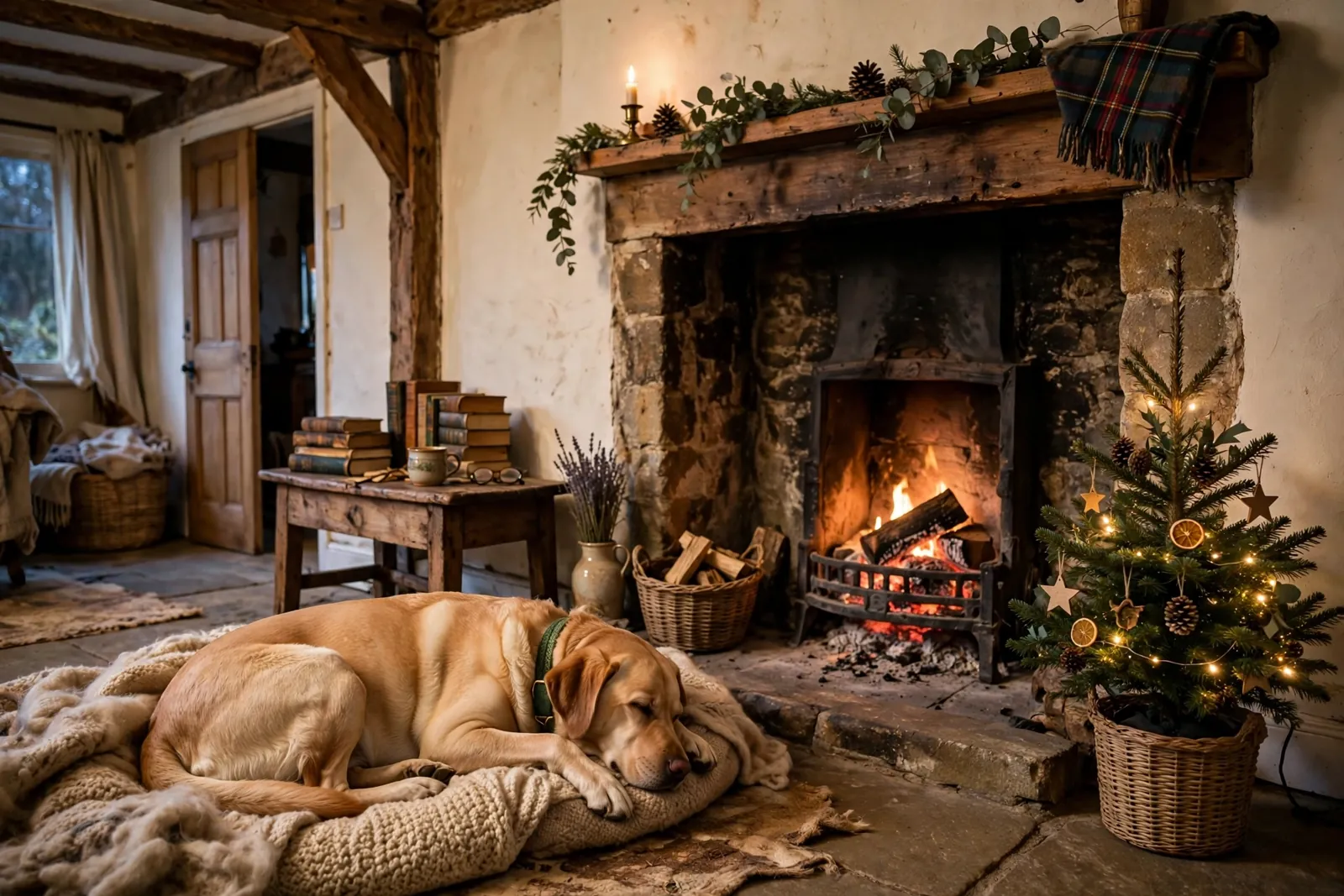
The simplest management tool is distance. Settle the dog in a room away from the front door well before callers begin, with water, bedding, a familiar-smelling blanket and something absorbing to chew. A baby gate or closed door between dog and hallway protects everyone: the dog cannot rehearse barking at visitors, callers are not faced with an aroused animal at knee height, and nobody has to hold a collar with one hand and a sweet bowl with the other.
Walk early, feed early, finish early
Shift the whole day forward. The main walk belongs in daylight, ideally finishing before schools empty and the first costumed groups appear, because a dog walked at dusk on Halloween meets every trigger at once: children in strange silhouettes, dropped sweets on dark pavements, rustling capes and the occasional early firework. A good daylight walk on familiar ground, with time to sniff and decompress, buys you a dog who can sleep through the busy hours rather than patrol them.
Feed earlier than usual as well. A dog who has eaten, toileted and settled by late afternoon is a dog whose basic needs will not collide with peak caller time. Add a final short garden break just before the knocking typically starts in your street, on a lead if your garden is not fully secure, because an unexpected bang at exactly the wrong moment is how dogs end up over fences they have never challenged before.
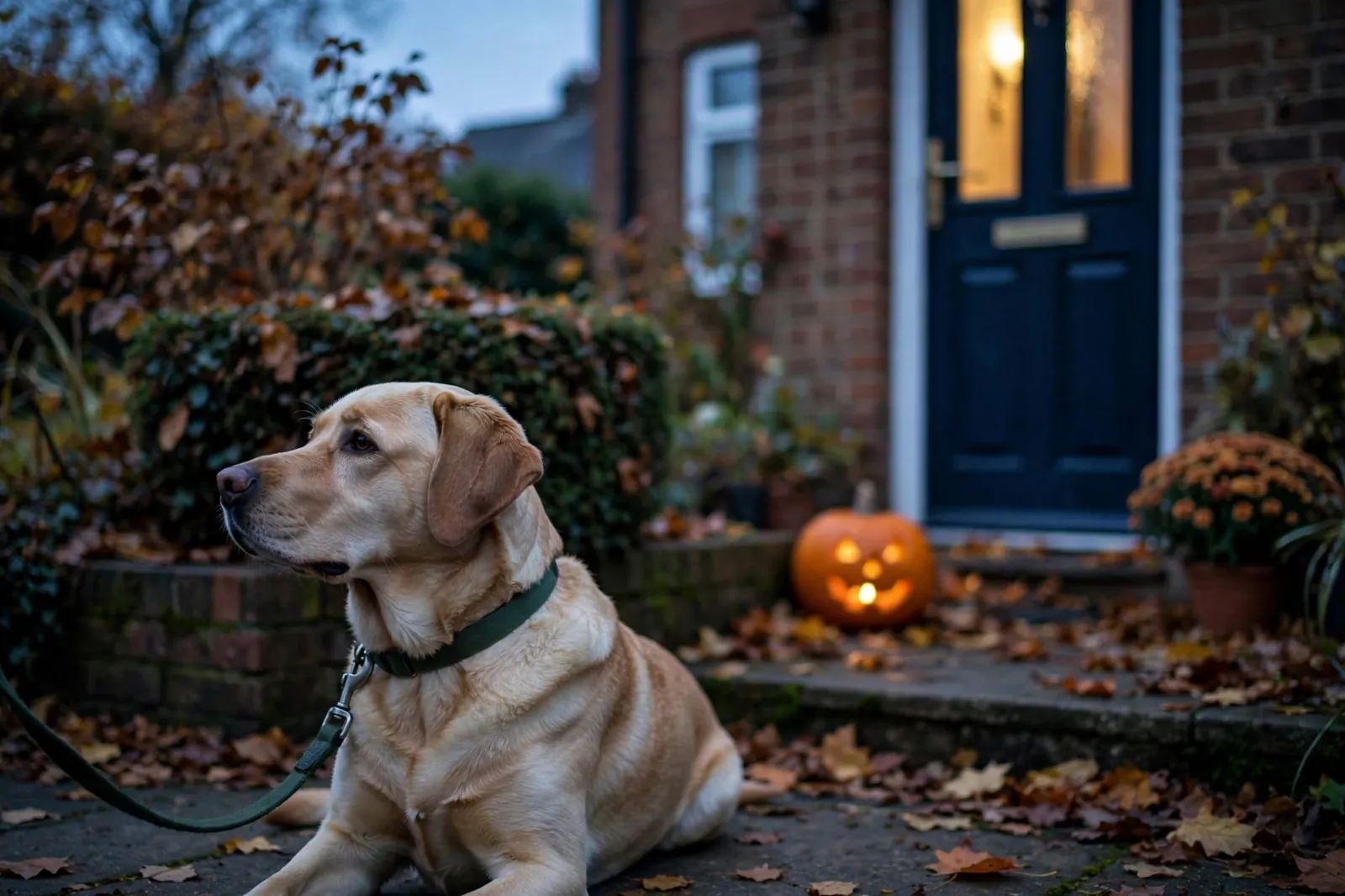
After dark, keep outings to the minimum and keep them boring: lead on before the door opens, a torch for dropped-sweet scanning, the shortest useful route, and no assumption that a normally reliable recall will survive a firework or a fleeing cat in fancy-dress chaos. Our guide to fireworks and dogs in the UK covers the noise side of this season in depth, and Halloween is best treated as its opening night rather than a separate event.
Chocolate, sweets and the floor-level buffet
Halloween concentrates more dog hazards into one evening than almost any other date outside Christmas. Chocolate is the headline risk: theobromine is toxic to dogs, darker chocolate is more dangerous, and even small quantities warrant a call to your vet rather than a wait-and-see approach. Sweets add a second layer. Sugar-free products may contain xylitol, also listed as birch sugar or E967, which is extremely dangerous to dogs even in tiny amounts, and foil wrappers, lolly sticks and hard boiled sweets bring obstruction and choking risks of their own.
Treat every bag in the house as a dog-height problem waiting for a moment of inattention. The callers' bowl by the door, your own children's haul spread out for sorting, the handbag with emergency chocolate in it: all of these live, at some point in the evening, exactly where a dog's nose works best. Store sweets in a closed container on a high surface or in a shut cupboard, sort hauls at a table rather than on the floor, and sweep the doorstep and front path afterwards for dropped items.
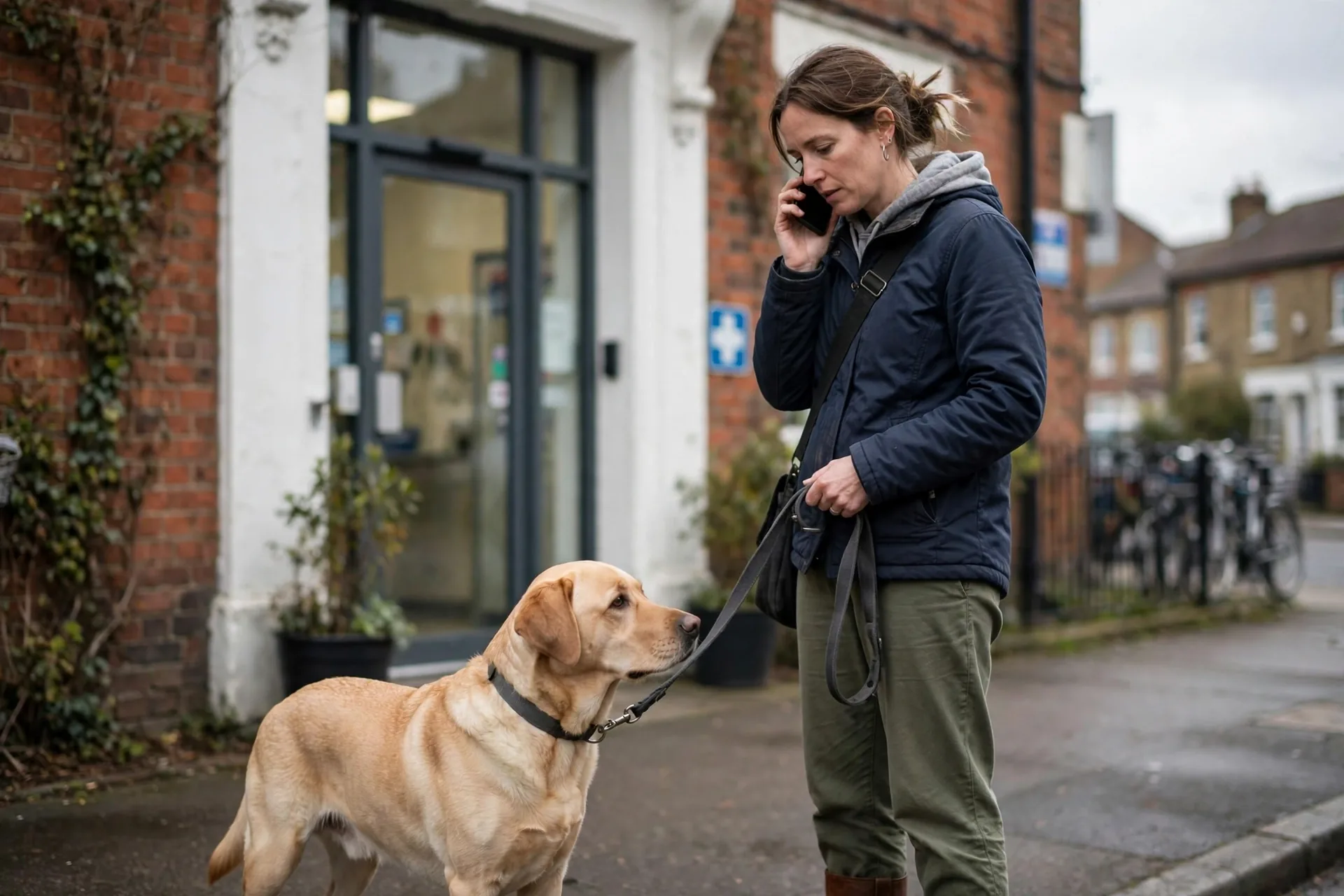
If you suspect your dog has eaten chocolate, sweets or wrappers, act immediately rather than waiting for symptoms. Note what was eaten, roughly how much, the dog's weight and the time, and phone your vet or the out-of-hours service straight away — our emergency vet on holiday guide explains how to find urgent help away from home, and the same calm sequence applies at home. Do not induce vomiting unless a vet instructs you to. Speed and information are what help; internet reassurance is not a treatment.
Costumes: for dogs, and the ones dogs meet
A dog costume photograph is charming. A dog costume itself deserves scrutiny. Anything that restricts movement, covers the ears or eyes, traps heat, dangles chewable parts or changes how the dog moves is a welfare problem dressed as a joke. If you dress your dog at all, choose a light, well-fitting item the dog has worn happily in short practice sessions beforehand, supervise constantly, and remove it at the first sign of freezing, pawing, panting or attempts to chew it off. A themed bandana or collar achieves the photograph with almost none of the risk.
Other people's costumes are the bigger variable. To a dog, a toddler in a dinosaur suit, a teenager with a mask and a tall hat, or a neighbour whose face has vanished behind a sheet does not read as familiar people playing. It reads as strangers with altered shapes, altered gaits and altered voices approaching the house. That is why greetings at the door should be human-only for most dogs this evening, and why pavement encounters after dark should be given wide, cheerful distance rather than introduced as socialisation.
Children, for their part, should be gently steered by the adults present: no rushing at dogs, no offering sweets to dogs however politely the dog appears to ask, and no knocking at houses where a dog is visibly distressed behind glass. If you are taking children out and leaving the dog at home, that separation is not a compromise. For most households it is the design that lets everyone enjoy the evening in the role that suits them.
Decorations, candles and the edible pumpkin question
Decorations change a familiar home into an obstacle course of novel objects, and novelty is what dogs investigate with their mouths. Real candles inside pumpkins are a burn and fire risk around wagging tails and curious noses; battery candles give the same window effect without the hazard. Fake cobwebs, hanging decorations and small plastic items should hang genuinely out of reach, not at the height a determined dog can reach on hind legs, and trailing electrical cables for lights and sound effects need the same protection you would give them around a toddler.
Pumpkin itself is a nuanced case. Plain pumpkin flesh is not the toxic threat that chocolate is, and small amounts of cooked plain pumpkin are fed to dogs deliberately by many owners. But a carved pumpkin that has sat on a doorstep for days, growing mould, collecting candle wax and being sampled by wildlife, is not food. Neither is the stringy, glittered, painted or preserved version used in displays. Keep doorstep pumpkins as decoration only, and clear them away promptly after the event rather than leaving them to rot at dog height.
Glow sticks and glow jewellery deserve a specific mention because they appear every Halloween and dogs puncture them. The liquid inside tastes foul and commonly causes drooling, pawing at the mouth and distress, and while it is usually a case for rinsing the mouth and calling your vet or a poison advice service for guidance, prevention is far simpler: glow items stay on children, not on collars, and spent ones go straight into a closed bin.
Local events: pumpkin trails, parties and honest suitability
Halloween events now fill the last week of October: pumpkin patches, illuminated trails, farm attractions, pub parties and organised dog fancy-dress walks. Some are genuinely enjoyable with a dog in daylight. Many evening events are not, whatever their marketing says, because they combine crowds, darkness, amplified sound effects, sudden scares designed to make people scream, and costumed actors whose job is to startle. A dog has not consented to any of that, and an event that delights your children may be endured, at best, by your dog.
Judge events by their mechanics rather than their theme. A daytime pumpkin patch with outdoor space, normal voices and room to step away suits many dogs well, provided ground rules on leads and livestock are followed and the dog is not allowed to scavenge windfall fruit or decorations. An after-dark scare trail does not, full stop. For anything in between, check the official latest guidance before you go: the organiser's own page should say whether dogs are admitted, whether the route is on leads, and whether fireworks or pyrotechnics close the evening.
If you are travelling for Halloween rather than spending it at home, apply the same event test to your accommodation's location. A cottage on a village's main trick-or-treat street, or beside a venue hosting a fireworks party, is a poor base for a nervous dog however lovely it looks in daylight photographs. Ask hosts direct questions about noise and door traffic before booking, and check our seasonal stays guidance for the booking questions that transfer well to any high-noise date in the calendar.
The fireworks overlap: Halloween is only the overture
In much of the UK the bangs do not wait for 5 November. Fireworks commonly begin in the run-up to Halloween, continue through Bonfire Night and, in some neighbourhoods, appear sporadically for weeks. Planning only for a single evening therefore under-protects most noise-sensitive dogs. Use late October as the point to put the full routine in place: curtains closed before dusk, television or radio on at a normal volume, a den or covered crate available without the dog being shut inside it, and toilet breaks moved earlier in the evening.
Talk to your vet before the season peaks if your dog has a history of serious noise fear. There are evidence-based options, from behaviour support to prescribed medication for the worst nights, but they need lead time and a conversation about your individual dog. Products bought in panic on the day itself rarely match that standard. Never punish fear responses, never drag a frightened dog outside to get used to fireworks, and never leave a known noise-phobic dog home alone on a night when displays are expected locally.
Identification deserves a seasonal check too. More dogs go missing around fireworks season than at almost any other time, often bolting from gardens or slipping leads after a sudden bang. Confirm your dog's microchip details are current, that the dog wears an ID tag with a number you will actually answer, and that fences and gates have been checked before the season rather than after the first escape attempt. It takes ten minutes in daylight and it is the cheapest insurance in this entire guide.
Designing the calm evening itself
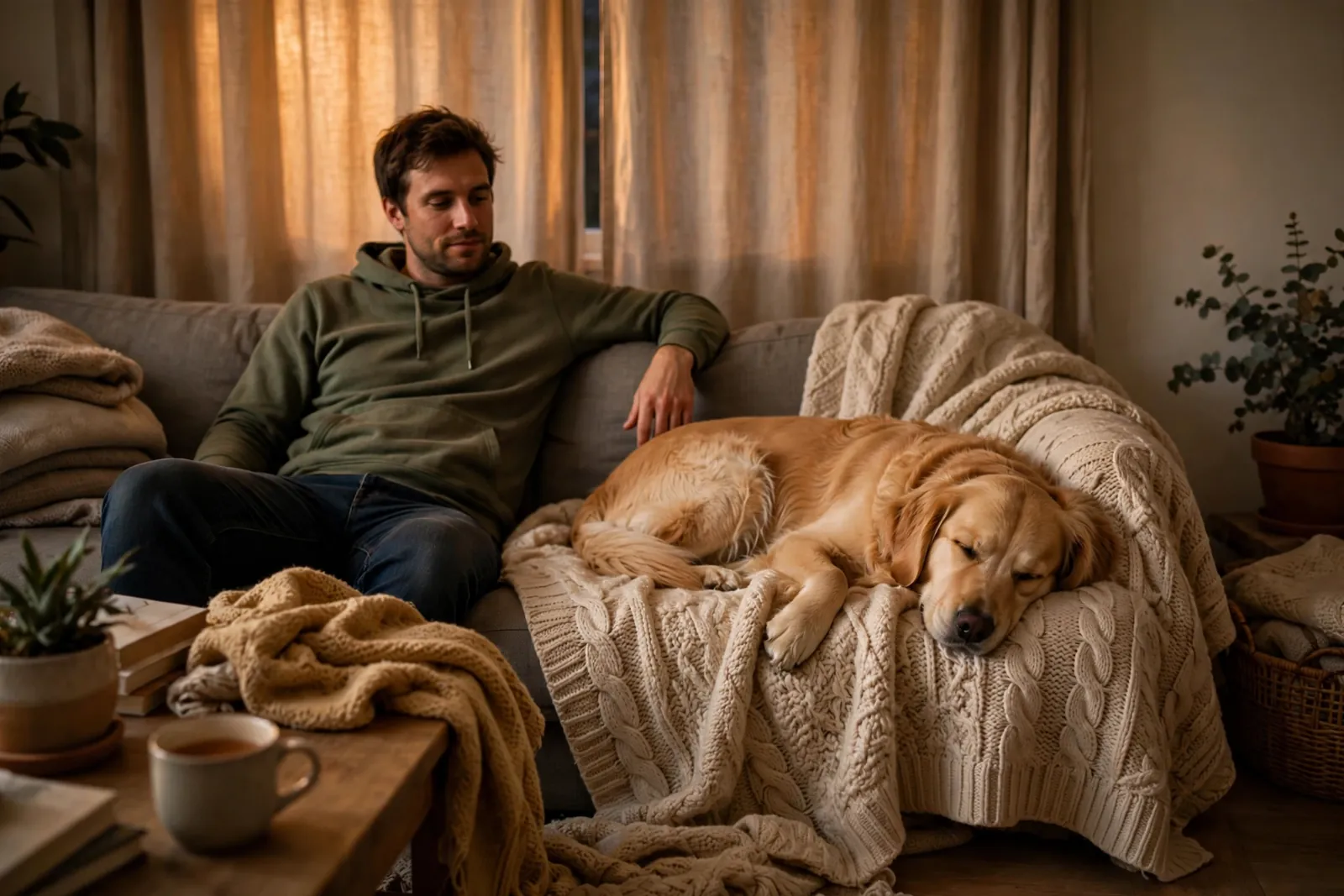
Put the pieces together and a good Halloween evening is deliberately uneventful. By late afternoon the dog has been walked, fed and toileted. The quiet room is set up with bedding, water, chew and familiar sounds. Sweets live in one closed container, handled by one person, and the dog has no hallway access when the door is opening. A polite note about a nervous dog, with sweets left at the gate, is a completely respectable choice and many callers' parents will quietly thank you for making the rule clear.
During the evening, check on the dog at natural intervals without turning each check into a reunion. Scatter a few treats in the bedding, refresh water, offer a garden break on the lead if needed, and keep your own energy unremarkable. Dogs read households accurately: a family that jumps at every knock and shouts towards the door is telling the dog that callers are alarming, whatever soothing words accompany it.
After the last callers, resist the urge to declare victory and open every door at once. Do a doorstep and path sweep for dropped sweets by torchlight, let the dog out for a final leaded garden break once the street has quietened, and keep the ordinary bedtime routine ordinary. Then make a note of what worked and what did not while you still remember it. Bonfire Night is days away, Diwali celebrations may add further fireworks depending on where you live, and New Year follows within two months. Halloween done well is a rehearsal that teaches you exactly what your dog needs for the rest of the noisy season.
Practical questions
Before you go
Can dogs eat Halloween sweets or chocolate?
No. Chocolate is toxic to dogs, and many sugar-free sweets contain xylitol, which is extremely dangerous even in small amounts. Wrappers, lolly sticks and hard sweets add choking and blockage risks. Keep all Halloween sweets in a closed container out of reach, and if you think your dog has eaten any, phone your vet immediately with the type, amount, time and your dog's weight.
Should I take my dog trick or treating?
For most dogs, no. Dark streets, costumed strangers, excited children, dropped sweets and sudden fireworks make trick-or-treating one of the most stressful walks of the year. A calm evening at home with the dog settled away from the front door is kinder. Confident, adult dogs in quiet areas may cope with a short outing, but a lead, distance from costumed groups and an early return are essential.
Are dog Halloween costumes safe?
Some light, well-fitting costumes are tolerated by dogs who have practised wearing them, but anything restrictive, hot, dangling or covering the ears or eyes should be avoided. Watch for freezing, pawing, panting or chewing at the costume and remove it at once if you see them. A themed bandana or collar is a safer way to join in, and no photograph is worth a stressed dog.
How do I stop my dog barking at trick-or-treat callers?
Management works better than last-minute training. Settle your dog in a room away from the front door before callers start, with bedding, water, a chew and background sound, and use a gate or closed door so the dog cannot rehearse door behaviour. A note asking callers not to knock, with sweets left at the gate, is a fair and effective option for very reactive dogs.
Do fireworks displays happen around Halloween in the UK?
Yes. Fireworks commonly start before Halloween and continue beyond Bonfire Night, so treat late October as the start of fireworks season. Walk and toilet your dog before dusk, close curtains, provide a den, check ID and microchip details are current, and speak to your vet in advance if your dog has serious noise fear — check the official latest guidance before you go to any organised display.