This guide is independent and contains no paid placement. If affiliate links are added later, they will be clearly marked and will not change our editorial checks.
Okehampton works as a dog trip because everything is close together: the castle ruins welcome dogs on leads and sit a short walk from the town centre, the Granite Way leaves from the station on a flat, traffic-free old railway line, and the serious Dartmoor walking around Meldon Reservoir and Yes Tor starts just a few miles away. Base yourself in town, do the castle first, then choose between an easy trail day and a proper moor day.
Start at the castle, then earn the moor
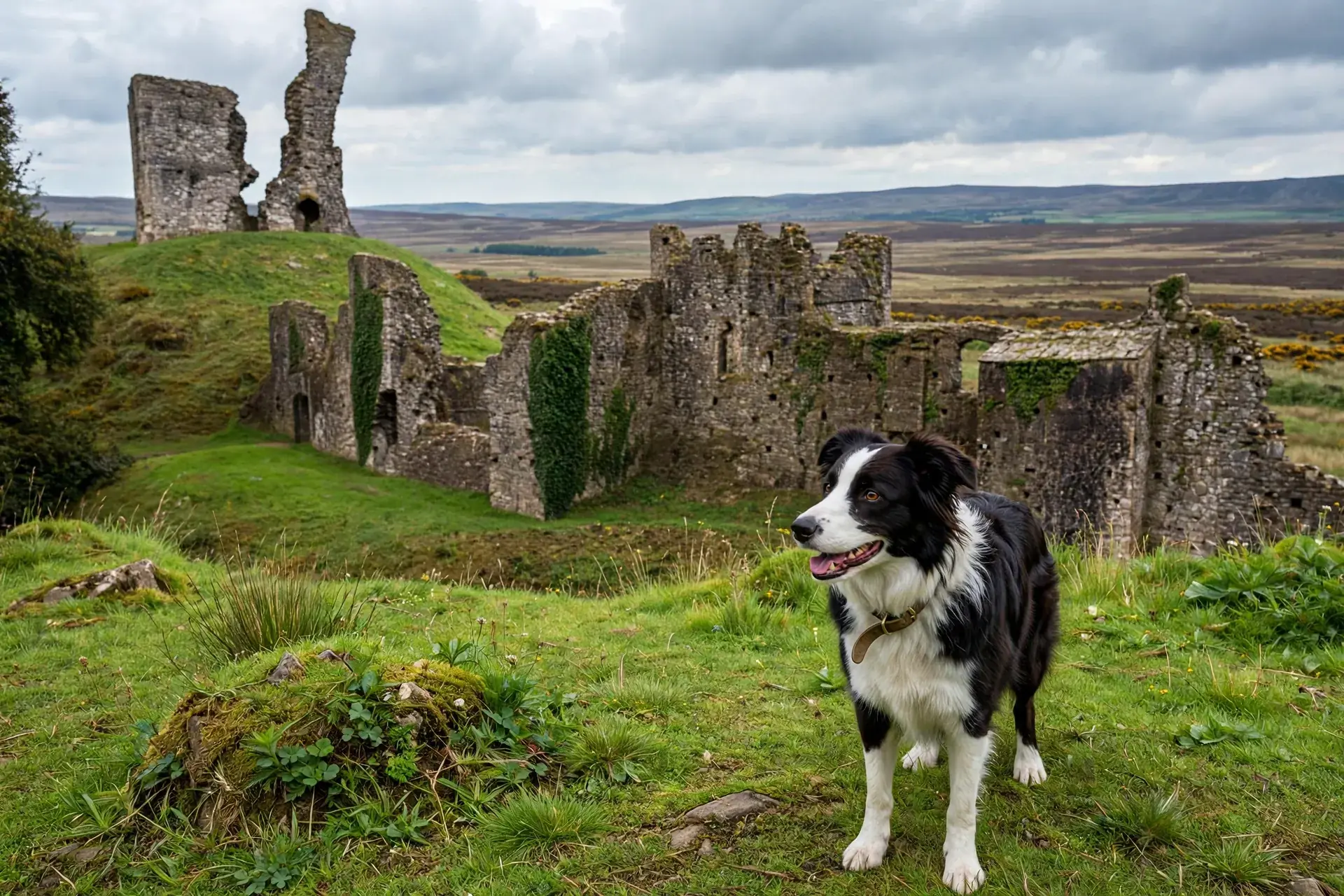
Begin at Okehampton Castle, because it explains the town in a single view. The ruins stand on a wooded spur above the West Okement river, just south-west of the town centre, and English Heritage describes them as the remains of the largest castle in Devon. What survives is a Norman motte-and-bailey castle that was later rebuilt in stone, most visibly in the fourteenth century under the Courtenay family, who turned it into a grand residence with a great hall, lodgings and a chapel before it fell into ruin after the family lost favour in the sixteenth century. The grassy motte rises steeply above the river, the broken walls of the keep and hall stand open to the sky, and the whole site feels more like a wooded hilltop than a formal attraction, which is exactly why dogs suit it so well.
Dogs on leads are welcome at the castle, according to English Heritage, and the visit works best as a slow wander rather than a tick-box stop. Allow an hour or two: climb the motte for the view back over the town and out towards the moor, pick your way through the low walls of the hall and lodgings, and then take the woodland walk that loops around the site through the trees below the castle. The paths are uneven, the motte is steep and slippery after rain, and there are unfenced drops in places, so keep your dog on a lead throughout, wear shoes with grip, and keep children and excitable dogs well back from the edges. A picnic on the grass in the grounds is a good use of the site on a dry day, and the shade under the trees makes it one of the more comfortable places in Okehampton on a hot afternoon.
Plan the visit around the castle's seasonal opening, because this is a volunteer-run site and its arrangements change. English Heritage lists free entry during the open season, roughly April to October, with shorter hours than a staffed attraction, and the site is closed in winter; some visitors have also reported pre-booked entry in recent years. Check the official guidance before you travel for the current opening days, hours and any booking requirement, and do not build a whole day around the castle in January. Even when the castle itself is closed, the lanes and riverside paths around it still make a pleasant walk, and the ruins can be seen from the valley below, so the area is worth a look in any season. If the gates are shut, treat it as a sign to head for the Granite Way instead and come back to the castle on a better day.
Starting here also sets the geography of the trip in your head, which matters more in Okehampton than in most Devon towns. From the motte you can see the town spread out below you, the river running through the valley, and the dark edge of the moor rising to the south. That is the whole trip in miniature: town, river and moor, each within reach of the others. A dog that has had a good sniff around the castle grounds and a run of woodland path is settled and ready for a longer walk, and you will have earned the moor properly, rather than driving straight past the town to a car park on the high ground. The castle is the gateway in the literal sense too: the old roads out of Okehampton towards the moor, the station and the Granite Way all radiate from this end of town, so a morning here makes the rest of the day fall into place.
The Granite Way: cycling and walking the old railway
The Granite Way is the single best reason to bring a dog to Okehampton, and it starts in the most convenient place imaginable: the station. This is an 11-mile traffic-free rail trail that runs from Okehampton station to Lydford, following the bed of the former Devon and Cornwall Railway along the north-western edge of Dartmoor, and it forms part of National Cycle Network Route 27, the Devon Coast to Coast route between Ilfracombe and Plymouth. The railway gradient is gentle, the surface is mostly tarmac with a short unsurfaced stretch, and the route is wide, level and free of cars, which makes it one of the most forgiving long walks in the national park. It is also a trail with a proper sense of occasion: the line crosses two great viaducts, Meldon Viaduct and Lake Viaduct, with wide views across the valley to the high moor.
For most dog owners, the out-and-back walk to Meldon Viaduct is the right first taste. From the station the trail runs south-west past the old military sidings and out onto the viaduct, a wrought-iron truss girder bridge high above the valley, with views down to Meldon Quarry, the reservoir and the dam, and up towards the tors. The round trip to the viaduct is about five and a half miles and takes most walkers around an hour each way at a comfortable pace with sniffing stops, which makes it a satisfying half-day outing without committing to the full eleven miles to Lydford. The full route is twenty-two miles there and back, which is a long day on foot for most dogs, so walkers usually choose a shorter section and turn back, while cyclists can comfortably ride the whole way to Lydford and return in a day. Either way, the viaduct is the natural turning point for a first visit, and it is worth pausing there: the wind comes straight off the moor, the view opens in every direction, and the dog will feel the change in the air.
Riding the Granite Way turns an eleven-mile walk into a morning's outing, and it opens up the far end of the trail — Lydford, its gorge and its castle mound — to dogs that could never walk there and back. The deal is simple: the dog either runs beside the bike or rides in a trailer, and only the first of those needs a fit, steady dog that has built up to it over weeks of short rides on quiet lanes. A trailer suits almost every other dog — small ones, old ones, puppies, and any dog that tires halfway — and it keeps the dog out of the wind on the viaducts, where a running dog has nowhere to shelter. Hire bikes and trailers at Okehampton station, right where the trail begins, with another hire point further along the line; trailers go first in school holidays and on fine summer weekends, so reserve one rather than hoping. Before you set off, check the brakes, the bell and the trailer hitch yourself, and agree a pace: the trail is flat, but eleven miles each way at cycling speed is a long effort for a dog on foot, so stop often, offer water at every stop, and turn back at Meldon Viaduct if the dog is flagging rather than pushing on to Lydford.
Horses come first on this trail, then bikes, then walkers — or at least that is the order that keeps everyone safe. Riders come down from the Meldon end and from the lanes above the line, and a horse meets a loose dog badly, so call the dog in and hold it close to the fence side whenever hooves are coming. Cyclists are the opposite problem: they arrive fast and almost silently from behind, often in groups, and a dog wandering across the tarmac is in real danger. Keep to the left-hand side, keep the lead short enough that the dog cannot cross the middle of the path, and step right off the surface when you hear a bell or a voice. A long lead has no place here — it turns the whole width of the trail into a tripwire — and a bright collar or lead helps a rider spot the dog a long way off. There are bins at the station and at the main access points, but nothing in between, so carry used bags until you reach one. Water is the other thing the trail does not provide: the open stretches between the woods and the viaducts have no streams a dog can reach and no shade in summer, so carry a bottle and a bowl and offer drinks before the dog starts panting hard.
Rain changes the Granite Way less than it changes almost any other Dartmoor walk, which is why locals use it as their bad-weather route. The tarmac holds up when the open moor turns to bog, and the wooded cuttings near the station end give real shelter while the rain is at its worst — though once you are out on Meldon Viaduct there is nothing overhead at all, and the wind straight off the moor will find every gap in a coat. In winter the trail goes quiet, the low light runs the length of the valley, and you can walk for a mile without meeting anyone; the trade-off is a slick surface underfoot and a wind that bites a short-coated dog, so bring a coat for the dog and be ready to turn at the viaduct. Spring brings bluebells in the woods below the line, autumn thins the crowds to almost nothing, and summer is the only season when you need to think about heat rather than rain. Do check for closures before you set out: a short stretch of maintenance can shut a section of a rail trail completely, and the diversion, if there is one, is usually a lane with traffic rather than a pleasant alternative.
Dartmoor walks from the town: Yes Tor, Meldon and the West Okement
The serious walking starts a few miles south of town, around Meldon Reservoir, and it is a different world from the Granite Way. Here the surfaced trail gives way to open moor, and the ground rises steadily towards the two highest points in southern England: High Willhays at 621 metres and Yes Tor at 619 metres, close together on a high plateau above Okehampton. The reservoir itself was built in the 1970s, a concrete dam holding back the West Okement river in a steep-sided valley, and it makes a useful landmark and a starting point: the car park by the dam has toilets, the walk across the dam wall is level and easy, and from there the paths fan out along the reservoir, up into the woods, and onto the open common. A dog that has walked the Granite Way will find this country bigger, rougher and more exciting, and it needs a different kind of preparation.
Choose your route by the dog in front of you, because the options around Meldon cover the whole range from gentle to genuinely demanding. The easiest is the loop along the West Okement from the reservoir, about five kilometres out and back, taking around an hour to an hour and a half, with only a little height gain and a riverside path that suits older dogs and puppies. A step up is the Meldon Reservoir and Black Tor circular, about four and a half miles and two to two and a half hours, crossing the dam, following the reservoir shore to the river, then climbing onto the moor to Sharp Tor and back along Longstone Hill. The classic summit walk is the climb from the reservoir to Yes Tor and High Willhays, roughly five miles as a circular route or about eight and a half miles out and back, taking three and a half to four and a half hours, with more than four hundred metres of ascent over rough, pathless ground in places. The full circular from Okehampton station, taking in the Granite Way, the reservoir, the West Okement valley and both summits, is about nineteen kilometres and a genuinely challenging day. Do not attempt the summit routes in mist, high wind or heavy rain unless you are confident with a map and compass, because the paths fade on the open moor and the weather on the plateau can be far worse than in town.
The West Okement valley deserves a slower look, because it holds one of the most unusual places on Dartmoor. Black-a-Tor Copse, the oak woodland in the upper valley, is a national nature reserve, a fragment of the high-altitude oak wood that once covered much of the moor, with moss-covered boulders, twisted trees and a damp, green stillness that feels completely different from the open common above it. The path through the valley follows the river past Shelstone Tor, and in summer the woodland gives shade and shelter that the open moor never offers. Keep your dog on a lead or under very close control through the copse and anywhere near the river, because the ground is fragile, the boulders are slippery, and the reserve is protected. The river itself is shallow and rocky in the upper valley, and many dogs love a paddle in it, but the water is cold, the current can be strong after rain, and the stepping stones and weirs are not places to let a dog charge ahead.
Two warnings shape every walk on this side of Okehampton, and both are easy to get wrong. The first is the military training area: much of the high moor around Yes Tor and the West Okement lies inside the Okehampton firing range, and access is restricted during live firing. Check the Dartmoor firing programme before you travel, and never ignore a red flag or a warning sign on the moor. The second is livestock. Dartmoor ponies, sheep and cattle graze freely across the common, and dogs must be kept under close control around them at all times; during lambing and around cattle with calves, keep your dog on a lead. Worrying livestock is a serious matter, and a dog that chases sheep on the open moor can be in real danger as well as causing real harm. Adders are present on Dartmoor in the warmer months, so keep dogs out of dense bracken and long grass in summer, and know the signs of a bite and the route to a vet. Ticks are common too, so check your dog thoroughly after every moor walk and carry a tick remover.
Packing for a moor day from Okehampton is a matter of carrying what the town cannot give you once you leave it. Bring an Ordnance Survey map of the area, Explorer OL28, or a downloaded offline map, because mobile signal is patchy on the high moor and a phone alone is not a navigation plan. Bring water for the dog and a bowl, because the river water is not always safe to drink and there is nothing to drink on the plateau. Bring food, a spare lead, a whistle, a first-aid kit, a drying coat and a towel for the car, and layers for yourself, because the temperature on Yes Tor can be several degrees lower than in Okehampton and the wind is rarely calm. Tell someone your route and expected return time, especially for the longer circuits, and start early: a summit walk that starts at ten in the morning in November will be finishing in the dark. If all of that sounds like a lot of caution for a dog walk, it is, and it is also what makes the day work: the dogs that enjoy Dartmoor most are the ones whose owners planned for the moor as it is, not as it looks from the town. For a gentler taste of the same landscape from a different moorland gateway, our guide to Bodmin with a dog covers the walks out of Bodmin onto the Cornish moor, where the ground is lower and the navigation is easier.
The town itself: market, museum and a proper high street
Okehampton is a working market town first and a tourist town second, and that is good news for dog owners, because it means the town is built for everyday life rather than for show. Fore Street runs through the centre with a mix of independent shops, cafes, bakeries and pubs, and the pavements are wide enough for a dog and a pushchair to pass without anyone having to step into the road, though the street carries real traffic and dogs should stay on a lead and on the pavement side. Behind the main street are quieter lanes, small squares and the riverside paths along the East and West Okement, which meet in the town to form the River Okement proper. The town sits on the northern edge of Dartmoor at the junction of the A30 and the road south into the national park, which is why it has always been a gateway: travellers, traders and soldiers have passed through here for centuries, and the town still feels like a place people pass through on their way to somewhere wilder.
On market day Fore Street feels like a different street: stalls spread out along the pavements, the smell of hot pasties drifts across the road, and half the town seems to be out doing the week's shopping at once. Dogs on leads are part of that crowd rather than an intrusion — this is a working market, not a tourist display — but it is still a crowd, so come early if your dog is uneasy shoulder-to-shoulder with strangers, and keep it on the pavement side of the stalls, away from the food. The stalls are genuinely useful for a dog trip: bread, cheese, fruit and pasties bought here make a far better trail lunch than anything grabbed from a service station, and they pack neatly into a rucksack for the castle grounds or the reservoir shore. Market days shift with the season and with local events, so confirm which day you are aiming for before you build a whole morning around it; turning up on the wrong day means a quiet Fore Street and a dog wondering where everyone went.
The Museum of Dartmoor Life, in the town centre, is the best wet-weather stop in Okehampton and the best introduction to the landscape you will be walking in. It is housed in an old mill building and tells the story of Dartmoor through farming, mining, quarrying, the railway and everyday life on the moor, with objects, photographs and displays that give the empty-looking moorland a human history. Dogs are not generally admitted to small museums, so plan for one person to visit while the other walks the dog along the river, or save the museum for a day when the dog is resting after a long walk. Either way, it is worth an hour, because it changes how you see the moor: the ruined mine buildings, the field walls, the old railway embankments and the granite quarries all start to make sense once you know what people were doing out there. The museum shop is a good place for a proper walking map of the area, which is worth buying before a summit walk.
Simmons Park, the town's riverside park, is the easy dog walk that every stay in Okehampton needs. It runs along the river with lawns, trees, a play area and paths that are level and well surfaced, and it is the place for a first-thing-in-the-morning stretch and a last-thing-at-night toilet walk without getting in the car. It is also a good place for older dogs and puppies that cannot manage the moor: flat, short, interesting enough with ducks and squirrels to hold a dog's attention, and close to the town centre if the weather turns. The park connects to the wider network of riverside paths, so a short loop through the park and along the river can be stretched into an hour's walk without leaving town. Keep dogs on a lead in the park, pick up after them, and remember that the river here is fast-flowing after rain and unfenced in places.
Getting to Okehampton without a car is easier than it is for most Dartmoor towns, thanks to the Dartmoor Line. Regular trains run between Exeter St Davids and Okehampton, a journey of around forty minutes, after the line reopened to passenger services in 2021, and the station is also the start of the Granite Way, so a car-free visitor can step off the train and straight onto the trail. Dogs travel on trains in the UK under the usual conditions: on a lead, under control, and not on the seats, and a well-behaved dog is welcome on the Dartmoor Line as on other services. If you are driving, the A30 runs right past the town, which makes Okehampton an easy stop on a longer journey through Devon, and a good base for exploring both Dartmoor and the north Devon coast. Bus services connect the town to Exeter, Tavistock and the surrounding villages, though they are less frequent than the train, so check times before relying on them with a dog.
Eating and drinking with a dog in Okehampton
The food in Okehampton is plain, generous and unshowy, and the welcome for dogs follows the same pattern. Pubs around Fore Street and the lanes down towards the castle take dogs in the bar as a matter of course, and several have gardens or a patch of outdoor seating where a muddy dog after the Granite Way is no problem at all. A water bowl by the door is usually a fair signal, but the dining room is a separate question from the bar, and evening is a separate question from lunch, so ask before you settle in with a dog that needs to lie under a table for an hour. Bring the mat from the car, keep the lead looped under your chair, and order something that does not need you to leave the table every five minutes. A dog that has already walked and eaten its own meal will usually curl up and sleep through yours; a dog that is still full of the moor and hungry will not, and no pub lunch is worth a dog that spends it whining at the smell of other people's food.
Morning is when the cafes earn their keep. After a first walk — Simmons Park for a short leg-stretch, or the first mile of the Granite Way for something longer — a cafe stop works because the dog is already tired and ready to sleep, and a cafe is a much easier room for a dog to settle in than a pub dining room. Most of the cafes along Fore Street put tables outside when the weather allows, and several let dogs inside too, though which ones and on what terms shifts from season to season, so treat any list you read online as a starting point rather than a promise. Settle the dog on its own mat in a corner or by the door, keep the lead short and tucked under your chair instead of trailing across the floor, and carry your own water and a folding bowl — on a busy market-day morning a cafe may have no spare bowl to lend. A chew or a stuffed toy buys you twenty quiet minutes with a puppy; a dog that is barking at every person through the door is telling you it has had enough, and the kindest move is a takeaway eaten on a bench by the Okement rather than a standoff in a crowded room.
Staying a few days means shopping, and Okehampton makes that easy in a way a moorland village never could. The town has a supermarket for the weekly shop — including dog food, so running out mid-stay is a problem you can fix in ten minutes — and a scatter of bakers, delis and farm shops along Fore Street for the good stuff: bread still warm, local cheese, and pasties for the rucksack. Dogs are welcome in some of these shops and expected to wait outside others, which is why a second person helps: one to hold the lead, one to browse properly. On your own, keep it quick, keep the dog in sight, and never tie it up outside a shop and walk away — a market town is a busy place and a tied-up dog is a stressed one. The market stalls cover the same ground on market day, and a pasty eaten on a bench after a walk up to Yes Tor tastes better than most restaurant meals after the same walk, which is worth remembering when you are planning the day.
Four things are worth knowing before you plan an evening around eating out. Weekend nights in summer are the pinch point: book a table for Friday or Saturday, and say when you book that a dog is coming, how big it is and how it behaves in a room full of strangers — a calm spaniel under a table and a boisterous young Labrador are two different bookings, and a pub that welcomes one may turn the other away. Dog rules also move: a place that took dogs inside last spring may have changed its mind, or changed its dining room, or simply be full, so check with the place itself rather than trusting a review written two years ago. Feed the dog its own meal before you sit down, or bring a small portion to give under the table; a hungry dog surrounded by food smells will spend the whole meal asking. And the days here work best when you keep meals simple — a pub lunch, a cafe breakfast, a market picnic, a takeaway by the river — because none of those needs a reservation made weeks ahead, and all of them leave the dog fed, walked and settled.
Staying over, parking and the practical details
What makes Okehampton work as a base for a week is not scenery but errands. Within a few minutes' walk of the centre there is a supermarket, a pharmacy, a vet, and enough places to eat that you never need the car for the ordinary business of a stay. Arrive, park, walk to the shops, cook dinner, take the dog along the river in the evening — and do the same again tomorrow, with the Granite Way or the reservoir as the day's walk instead of a drive. That matters more with a dog than a view does: a cottage ten miles up a moorland lane is prettier on the first evening and a nuisance by the third morning, when the dog needs a walk and the milk has run out. Here the dog gets its morning walk in Simmons Park or along the Okement before breakfast, the car stays parked, and the week runs on foot.
Places to stay around Okehampton split into the obvious groups: hotels and bed and breakfasts in the town itself, self-catering cottages in the town and the lanes around it, farm stays a short drive out, and holiday parks and campsites on the edge of Dartmoor. Every group has dog-friendly options, and in every group the question is never just ‘do you take dogs?’ but ‘do you take my dog, in this room, on these dates?’ Ask about the exact room or cottage, how many dogs it takes, what the charge is and whether it is per dog or per stay, and whether size or breed changes the answer. Ask about the garden — is it fenced all round, how high, does the gate latch properly — because a garden a dog can escape from is worse than no garden at all. Ask whether the dog can be left alone while you eat out, and for how long, since that decides whether dinner is a pub meal or a takeaway. And look at the floor and the stairs: hard floors forgive muddy paws, pale carpet does not, and a ground-floor room saves an old dog a climb at the end of a long day on the moor.
A cottage of your own usually suits a dog stay here better than a hotel room, and the reason is routine: your own kitchen for the dog's meals, your own door to the garden for last thing at night, and nobody else's timetable to fit around. The cottages worth paying more for are the ones with a fenced garden, a washing machine for muddy towels and dog bedding, and a location you can walk from — a cottage on the town's southern edge, with a path to the Granite Way or down to the river, beats a prettier one that needs the car for every walk. Holiday parks and campsites around Okehampton work well too, particularly for families, but the same checks apply: dog limits, charges, fencing, and the rules on leaving a dog alone in the unit. If you are weighing a park stay against a cottage, our guide to dog-friendly holiday parks in Devon explains how to compare pet fees, boundaries and nearby walks before you book. Caravans and lodges need one extra check: the steps and the decking, because a dog that cannot manage steps will need carrying every time it goes out.
Where you park should follow what you are doing that day, and Okehampton's car parks line up neatly with the walks. The station car park is the one for the Granite Way — the trail starts at the platform end — and for the Meldon walks too, since the viaduct and the reservoir are the same direction. The castle has its own small car park a short walk from the ruins, handy for a castle morning combined with the woodland loop. The town car parks sit a few minutes from Fore Street, the museum and the riverside paths, and there is on-street parking in places as well. The reservoir has its own car park, signposted off the A30, which is the right start for Yes Tor and High Willhays — and the one that fills first on a fine weekend, so get there early. Charges and time limits change, so check what is posted on the day rather than relying on last year's prices. And the rule that never changes: a parked car is never a place to leave a dog in warm weather, not even for a quick shop — leave the dog at your stay instead.
Think of the kit in three piles: trail, moor and car. For the trail, a short lead for the busy stretches and a long lead for the open ones, a harness that fits properly, and a spare lead in the bag in case one comes back caked in mud. For the moor, water and a folding bowl — there are long miles on the Granite Way and the high ground around Yes Tor with nothing a dog can drink — plus a tick remover, because Dartmoor ticks are a fact of life, and a coat for a short-coated dog when the wind comes off the plateau. For the car, a towel, a drying coat and a blanket, plenty of poo bags, the dog's normal food and any medication, and an Ordnance Survey map or an offline map on your phone, since signal fades on the high moor. Save the vet's number and the insurance details in your phone before you leave home, and then leave room for the one thing no list covers: patience, because the trail is shared, the moor weather turns, and the best days here are the unhurried ones.
Vets, emergencies and wet-weather plans
Sort this out on arrival, not when you need it. Okehampton has veterinary practices in the town, and the numbers worth saving in your phone are the nearest practice and the out-of-hours emergency line — which may be answered from Exeter, a drive rather than a walk, and further still on a Sunday evening. Rural practices close earlier than city ones and can be twenty minutes away even on a good day, so do not assume you can sort an emergency in five minutes. If the dog takes regular medication, bring more than the trip needs, in its original packaging with the prescription details, and keep photographs of the vaccination record and the insurance documents on your phone. Third-party liability cover is worth having anyway on a trip where the dog will meet strangers, livestock and other dogs every day.
The problems that actually happen on a Dartmoor trip are ordinary ones, and all of them are easier if you have thought them through. Sheep come first: a dog that chases sheep on the open common is in serious trouble, so keep the dog under control around livestock and on a lead at lambing time. River water is the next one — a dog that has swallowed too much of the West Okement or eaten something on the moor may vomit or develop diarrhoea; give it a few hours without food, small amounts of water, and a call to the vet if it does not settle or goes lethargic. Adder bites are uncommon but urgent: keep the dog calm and still, carry it if you can, and do not cut or suck the bite. Heat is the summer risk on the Granite Way: shade, cool water on the belly and paws, and a vet if the dog does not recover quickly. And the most common injury of all is a cut paw from granite or broken glass, so carry a small first-aid kit with a bandage and a clean cloth, and check paws after every walk.
Okehampton sits on the edge of the high moor, and the weather here behaves like it: rain can arrive in minutes, mist can drop onto the plateau while the town is still sunny, and the wind on Yes Tor can be strong enough to push a small dog sideways. Check the forecast the night before and again over breakfast, and always have a shorter version of the day's walk in mind — the Granite Way is flat and the town is never far, so cutting a walk short is easy and costs nothing. If the whole day looks bad, do not force a summit: the surfaced trail stays walkable in rain, the castle woods and the Meldon woods give shelter, and the town's cafes, pubs and museum give you somewhere dry to wait out the worst. Two towels and a drying coat turn a wet dog from a miserable one into a manageable one, and a dog that has had a dry evening and a good sleep is a better walking companion tomorrow than a dog dragged through a storm for the sake of a ticked box.
A wet day here can still be a good dog day if you treat it as a different kind of day rather than a ruined sunny one. Start with a short, sharp walk — the castle woods or the first stretch of the Granite Way — then dry the dog properly and settle it with a chew while you have a long cafe lunch. One person can visit the Museum of Dartmoor Life while the other walks the dog along the river, or you can drive to a covered attraction nearby and take the dog for the outdoor parts only. Take a shorter walk in the afternoon when the rain eases, and finish with a pub evening instead of a long drive home in the dark. In winter, when the castle is shut and the light goes early, this pattern matters even more: plan one good walk in the middle of the day and do not try to fit a summit and a trail ride into the same short day. The moor will still be there tomorrow.
Practical questions
Before you go
Can dogs go into Okehampton Castle?
Yes. English Heritage welcomes dogs on leads at Okehampton Castle, and the grassy grounds and the woodland walk around the ruins suit a dog on a lead well. The castle opens seasonally and is run by volunteers, with free entry in its open season, so confirm the current opening days, hours and any booking arrangements before you travel. The motte is steep and the ground is uneven, so keep your dog on a lead and wear shoes with grip.
Is the Granite Way suitable for dogs?
For most dogs, yes. It is an 11-mile former railway line from Okehampton station to Lydford, surfaced for most of its length, gently graded and with no traffic, which makes it one of the gentlest long walks anywhere on Dartmoor. Dogs are welcome, but the trail is shared: keep yours on a short lead when cyclists or horse riders are about, carry water because the open stretches offer little shade, and expect wind on the viaducts. There is no need to do all eleven miles — walking out to Meldon Viaduct and back is a satisfying half-day on its own.
Where can dogs walk on Dartmoor near Okehampton?
Start at Meldon Reservoir or on the Granite Way. The reservoir car park gives you three options: an easy 5-kilometre loop along the West Okement, a 4.5-mile circular taking in Black Tor, or the longer climb to Yes Tor (619 metres) and High Willhays (621 metres). Much of the high moor is open access land, but it doubles as a military training area — look up the Dartmoor firing programme before you go, keep the dog under close control around sheep, ponies and cattle, and carry a map and compass, because paths fade once you leave the reservoir behind.
Are dogs welcome in pubs and cafes in Okehampton?
Many do, but the answer changes from place to place. Pubs around Fore Street and the lanes towards the castle generally take dogs in the bar, and several have gardens or outdoor seating where a dog is welcome; cafes are similar, with outdoor tables in good weather and some that allow dogs inside. Rules shift with the season and between the bar and the dining room, so ask the venue itself before you plan an evening meal around it. Walk the dog first, bring a mat for it to settle on, and keep it on a lead even in a relaxed room.
Where is the best place to park in Okehampton with a dog?
Pick the car park that matches the walk. For the Granite Way and the Meldon walks, use the car park at Okehampton station, where the trail begins. For the castle, use its own small car park a short walk from the ruins. For Fore Street, the museum and the riverside paths, use the town car parks. For Yes Tor and High Willhays, use the Meldon Reservoir car park — and get there early on fine weekends, because it fills up. Charges and time limits change, so check what is posted on the day, and never leave a dog in a parked car in warm weather.