This guide is independent and contains no paid placement. If affiliate links are added later, they will be clearly marked and will not change our editorial checks.
Bodmin rewards dogs that like space: the moor starts at the edge of town, the steam railway welcomes dogs, and the town centre is compact enough to explore on foot. Keep the dog on a lead near livestock and on boggy ground, take turns at Bodmin Jail because dogs do not go inside the museum, and use the town as a quiet central base for the rest of Cornwall.
Bodmin, the moor gateway
Most visitors meet Cornwall at the coast, through a beach car park, a harbour wall and a queue for ice cream. Bodmin offers the opposite introduction. This is an old market town sitting on the southern edge of Bodmin Moor, roughly in the middle of the county, where the A30 runs past on its way between the two coasts and the land rises from farmland into granite tors, rough grass and open sky. For a dog, that geography is the whole point: the town is a working place with pavements, shops and pubs, and within a ten-minute drive the dog is on one of the largest areas of open access land in the south-west of England.
Bodmin was once the county town of Cornwall, and the town centre still shows it. There is a handsome parish church, St Petroc's, a Victorian-era jail that now draws visitors from across the country, a railway heritage that survives as a working steam line, and streets of granite and slate buildings that were built for trade rather than for tourists. None of that makes Bodmin a theme park. It makes it a useful, honest base: supermarkets and vets are here, the traffic is lighter than in the coastal resorts, and a dog can be part of the day rather than a problem to be solved around it. If the plan is to walk hard in the morning, eat properly at lunchtime and be back at a cottage or pub by evening, Bodmin fits the shape of the trip better than almost anywhere else in Cornwall.
The town's position matters more than its size. From Bodmin, the north coast at Wadebridge and Padstow is a short drive one way, the south coast around Fowey and the Fowey estuary is a short drive the other, and the moor itself is on the doorstep. That centrality changes how a dog holiday works. Instead of choosing one coast and driving back and forth along the same road every day, a Bodmin base lets the day be decided by the weather: moor in the morning when the sky is clear, coast when the wind drops, town and railway when the rain arrives. Dogs that travel badly benefit too, because most days involve one short drive rather than a long haul, and the dog can be walked properly before the car moves at all.
It is worth arriving with the right expectations. Bodmin is not a pretty harbour village, and it does not pretend to be one. Some streets are plain, some shopfronts are tired, and the town's best qualities — the moor, the railway, the market, the quiet lanes — take a little finding. The reward for looking is a Cornwall that feels lived-in rather than staged, and a dog that gets long, open walks without the summer crowds that fill the coastal car parks. This guide works through the town in the order a dog owner actually uses it: the moor first, then the jail and the historic centre, then the railway, then food, drink, sleep and parking.
Before any of that, a word about rules and change. Opening hours, dog policies, parking charges and railway timetables all move with the season, and a single policy can change between one visit and the next. Where this guide is unsure about a current rule, it says so plainly and asks the reader to check the official guidance before you travel. That is not a dodge; it is the only honest way to write about a town whose best attractions are run by different organisations with different rules. The walking advice, the safety notes and the shape of the town do not change quickly. The prices and the fine print do.
Walking the moor edge
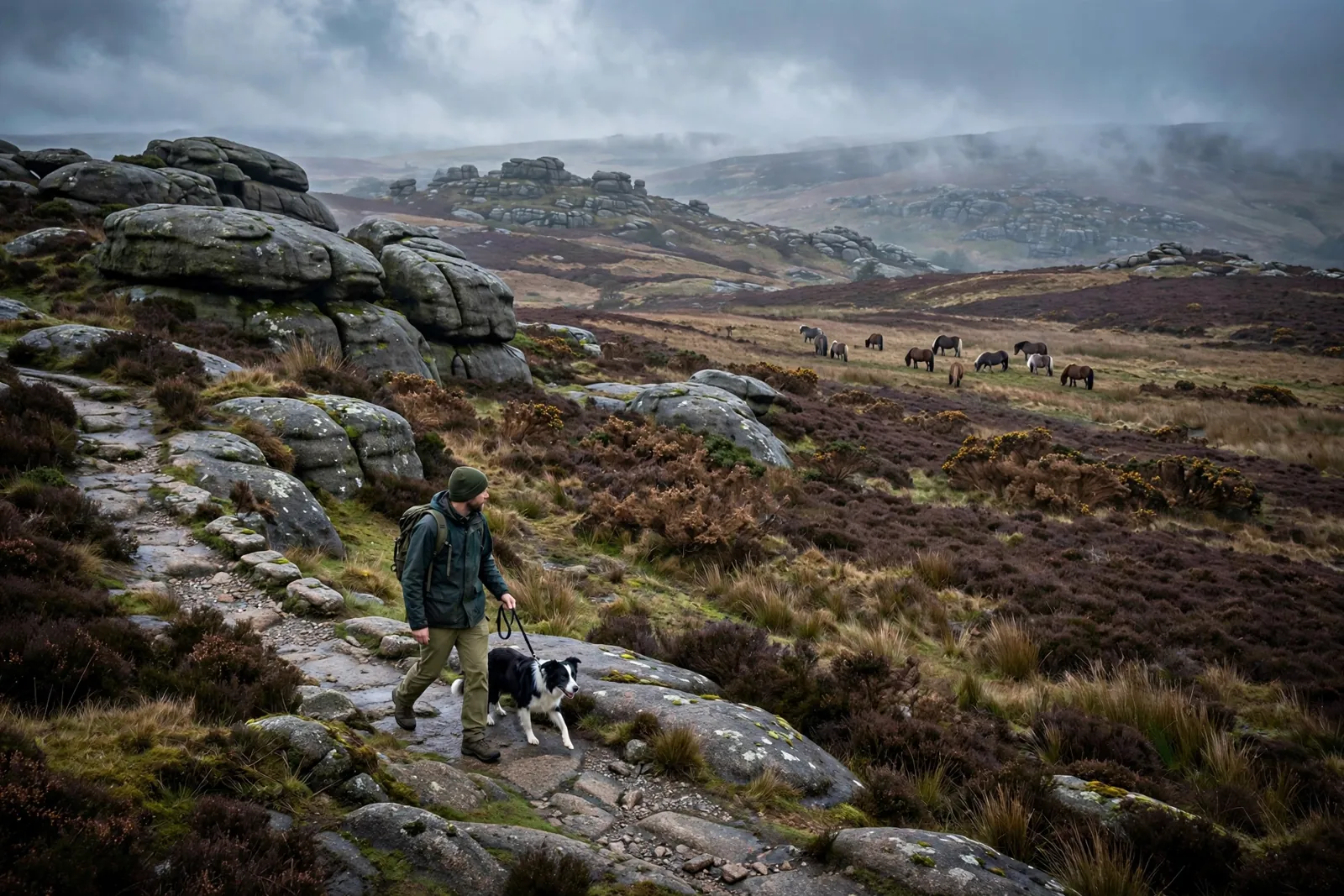
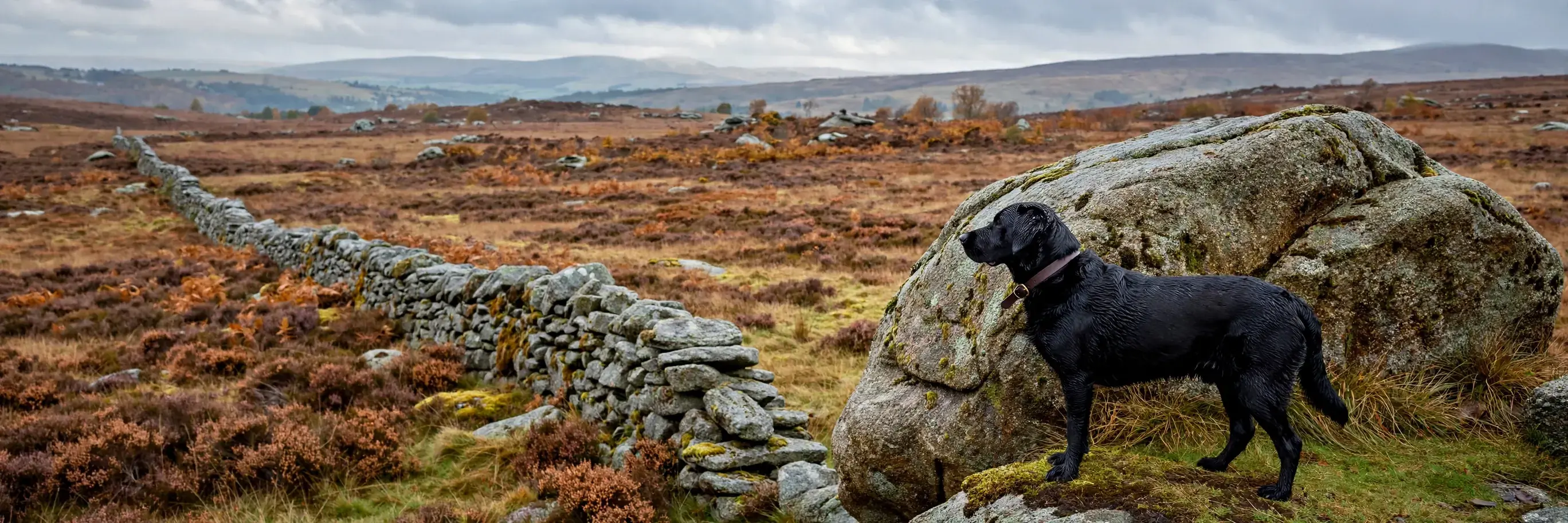
The first walk most dog owners take from Bodmin is not in the town at all. It is up onto the edge of Bodmin Moor, where the lanes narrow, the stone walls take over from hedges, and the ground opens into rough grass, gorse and granite. The moor is a National Landscape, a designation that replaced the old Area of Outstanding Natural Beauty title, and it covers roughly 200 square kilometres of high ground in the middle of Cornwall. Brown Willy, at 420 metres, is the highest point in the county, and Rough Tor, its near neighbour, is the more popular climb. For a dog, the appeal is obvious: long sightlines, room to run on a long line, and a landscape that smells of heather, sheep and rain.
The edge of the moor is the right place to start, rather than the deep middle. Edge walks give the dog the moor experience — open ground, tors, stone walls, grazing animals — with a road, a car park or a village never far away if the weather turns or the dog tires. The lanes around the southern and eastern edges, towards Cardinham and the Camel Trail, offer shorter loops on firmer ground. The northern edge, towards Rough Tor and Brown Willy, is wilder and needs more planning. A good first day in Bodmin is an edge walk in the morning, when the dog is fresh and the light is best, followed by the town in the afternoon when the dog is ready to sleep under a pub table.
Access is generous but not unlimited. Much of Bodmin Moor is open access land under the Countryside and Rights of Way Act, which means walkers can roam away from paths in many areas, but that freedom comes with responsibilities that matter more with a dog than without one. Livestock graze freely, ground-nesting birds breed in spring and early summer, and the ground itself can be treacherous after rain. The practical rule is simple: treat open access as permission to explore carefully, not as permission to let the dog range out of sight. A long line gives the dog freedom to sniff and quarter the ground while keeping the owner in control, and it is the single most useful piece of kit for a moor walk.
Navigation deserves respect even on a short walk. The moor looks open and easy to read, and in clear weather it is, but mist can arrive fast, and the tors that look close can be a long, boggy walk apart. A phone map helps, but signal is patchy in places and a battery dies faster in the cold, so a paper map or a downloaded offline map is worth carrying on any walk longer than an hour. The habit to build is to note the direction of the car park and the nearest road before setting off, to check the time at the halfway point, and to turn back while the dog still has energy in reserve. Dogs rarely complain until they are already tired, and a tired dog on boggy ground is a slow dog.
Water is another edge-of-moor problem that surprises first-time visitors. The moor has streams and pools, but they are not all safe to drink from, and in dry spells some of them shrink to mud. Carry water for the dog and a collapsible bowl, and do not rely on finding a clean stream at the right moment. The same goes for shade: there is almost none on the open moor, so on a warm day the dog needs water, rest stops and a plan to be off the high ground before the heat of the afternoon. In winter the problem reverses, and wind chill on an exposed tor can be far colder than the temperature in Bodmin town suggests.
Rough Tor and the open moor
Rough Tor is the walk most people mean when they say they are going up onto Bodmin Moor with a dog, and it earns the attention. The tor itself is a dramatic pile of granite boulders with wide views across the moor, and the approach from the car park at the end of the lane is short enough for a reasonably fit dog while still feeling like a proper hill walk. The path climbs steadily rather than steeply, crosses open grass and passes the remains of a medieval settlement and a stone circle, so the walk has history underfoot as well as views at the top. On a clear day the panorama takes in much of north Cornwall, and on a cloudy day the tor still has a brooding, granite character that suits the place.
The practical details matter. The car park for Rough Tor is small and fills quickly on fine weekends and school holidays, so an early start is the difference between a calm arrival and a long wait for a space. From the car park, the path to the tor is straightforward, but the ground around it is uneven, with loose stones, hidden holes and patches of bog after rain. Dogs should be on a lead for the approach through grazing land, and many owners keep the lead on all the way to the top, using a long line on the open ground beyond the tor where the dog can range more freely. The summit itself is a scramble over boulders, and not every dog will want to climb it; there is no shame in letting the dog wait on the grass below while the humans take turns on the rocks.
Beyond Rough Tor, the moor opens towards Brown Willy and the long ridge that runs across the high ground. That is a bigger walk, best saved for a second visit or a day when the weather is settled and the dog is proven on rough ground. The route between the two tors crosses open moor with few landmarks, and the ground between them can be wet even in summer. A fit, experienced dog and owner can do it comfortably in a few hours, but it is not a walk to improvise: check the forecast, carry food and water, and agree a turn-back time before leaving the car park. The reward is a sense of space that is rare in southern England, and a dog that sleeps soundly for the rest of the day.
Other moor walks suit different dogs. The area around the Cheesewring and the Hurlers stone circles, on the eastern edge of the moor near Minions, offers a shorter, gentler introduction with a village, a pub and a car park close by, and the stones themselves give the walk a clear destination. The Camel Trail, which runs from Bodmin and Wadebridge along a former railway line to Padstow, is almost the opposite of a moor walk: flat, surfaced and easy, and ideal for older dogs, puppies building up distance, or a recovery day after a hard moor climb. Our guide to Dartmoor dog walks covers similar tor, pony and livestock questions for the larger moor across the border in Devon, and the safety habits transfer directly to Bodmin Moor.
Whatever route is chosen, the moor walk should end the way it began: with the dog checked over. Granite is hard on paws, gorse is sharp, and ticks are a real risk in rough grass and bracken from spring through autumn. A quick check of paws, ears and belly at the car park takes two minutes and catches most problems before they become vet visits. Carry a tick remover, check the dog again at the accommodation that evening, and watch for limping the next morning, which is often the first sign of a sore pad after a long day on stone.
Livestock, bogs and moor safety
Bodmin Moor is a working landscape, not a dog park, and the animals on it are the first thing a dog owner needs to understand. Ponies, cattle and sheep graze freely across the moor, often in places where the path runs straight through the herd. Most of the time the animals are calm and used to walkers, but they are not pets, and a dog that chases, barks at or crowds them can cause real harm — to the livestock, to the dog, and to the farmer's livelihood. The law is clear on this point: dogs must be under close control around livestock, and on a lead when livestock are nearby, and a farmer may act against a dog that is worrying livestock. The practical rule is stricter than the legal minimum: if livestock are visible, the lead goes on, the dog is kept on the far side of the path, and the group walks past calmly without stopping to let the dog stare.
Ponies deserve particular care. Bodmin Moor ponies are hardy, semi-feral animals that are used to people but not to being approached, and mares with foals in spring and early summer are protective. Keep the dog well away, never let the dog run up to a pony, and do not feed ponies from the hand, however tempting it looks. Cattle can be more intimidating than they first appear, especially when they have calves or when a dog is running loose among them. If cattle block the path, do not try to push through with the dog; walk around them at a distance, or turn back and take another route. Sheep are the most vulnerable of all, and a dog that chases sheep can cause ewes to miscarry or to run into fences and walls. Even a dog that has never chased sheep before can be triggered by a flock breaking and running, which is why a lead near sheep is non-negotiable.
Bogs are the second hazard, and they are harder to see than livestock. Bodmin Moor is a granite plateau with thin soil and poor drainage, and after rain the ground holds water in places that look solid from a distance. A patch of bright green grass, a dark hollow between tussocks, or a line of rushes often marks ground that will not hold a dog's weight. The danger to a dog is not usually drowning in the dramatic sense, but exhaustion, cold and panic when the animal sinks to its belly in cold mud and cannot climb out. Keep the dog on paths and firm ground in wet conditions, watch for the colour and texture of the grass ahead, and if the dog does go in, stay calm, call it back along the route it entered by, and be ready to help from firm ground rather than wading in after it. Wet, muddy dogs also need a plan for the car: towels, a waterproof seat cover and a change of clothes for the humans are not luxuries on a moor day.
Adders are a seasonal risk that many visitors overlook. Adders are Britain's only venomous snake, and they bask on warm, south-facing banks and stone walls on the moor from spring through early autumn. They are shy and will move away if they can, but a curious dog nosing into a sunny bank can be bitten on the face or paw. The signs of a bite — swelling, pain, lethargy, vomiting — need a vet quickly, so know where the nearest vet is before the walk, keep the dog calm and carry it if possible, and do not wait to see if the swelling goes down on its own. Keeping the dog on paths and out of long bracken and sunny banks in warm weather reduces the risk considerably, and it is one more reason a long line beats a free run on the moor.
Ground-nesting birds add a seasonal restriction that responsible owners should respect. From roughly March to July, birds such as skylarks and curlews nest on the ground on the moor, and a dog running free can destroy a nest in seconds without the owner ever seeing it. Keeping the dog on a lead or a short line during the breeding season, and sticking to paths through the most sensitive areas, is a small price for a walk that will still be there next year. The same habit protects the moor's archaeology: the stone circles, hut circles and field systems on Bodmin Moor are scheduled monuments, and dogs scrambling over them cause damage that cannot be repaired.
Finally, the weather on the moor changes faster than in the town below. A clear morning can turn to driving rain and low cloud by lunchtime, and the wind on an exposed tor is stronger and colder than the forecast for Bodmin suggests. Check the forecast for the moor itself, not just for the town, carry a waterproof layer for the humans and a drying coat for the dog, and be willing to cut a walk short. There is no prize for finishing a route in a storm, and a wet, cold dog that has to walk another hour back to the car is a dog that will be miserable for the rest of the day. The moor will still be there tomorrow, and so will the pub.
Bodmin Jail and the old town
Bodmin Jail is the town's best-known attraction, and it is also the one that needs the most planning for a dog owner. The jail is a large, imposing Victorian prison building on the edge of the town centre, now run as a museum and visitor attraction with exhibitions about crime, punishment and the lives of the prisoners who were held there. It is a genuinely interesting place, with cells, stories and artefacts that give a vivid sense of nineteenth-century Cornwall, and it is worth half a day even for visitors who are not normally drawn to museums. The catch is simple: dogs are generally not allowed inside the museum building itself. That is the rule for most indoor attractions of this kind, and it means the group needs a plan before arriving at the gate.
The practical answer is to take turns. One person visits the museum while the other walks the dog around the town, then they swap. The jail is close enough to the town centre for this to work well: the dog walker can explore the streets, the churchyard and the lanes around the jail, and the visitor inside is rarely more than an hour or two from the door. Alternatively, visit the jail on a day when the dog can stay comfortably at the accommodation, or split the day so that the moor walk comes first, the dog rests in the car in shade with ventilation on a cool day — never in heat — or at the cottage, and the jail visit follows when the dog is settled. What does not work is arriving at the jail with a dog and no plan, and hoping the rules have changed. Check the official guidance before you travel for the current dog policy, because special events and the jail's own hotel and restaurant areas may have different rules from the museum itself.
Outside the building, the jail is still worth seeing with a dog. The exterior is dramatic, with high granite walls and a tower that dominates the skyline from several streets, and the area around it is good for a short walk and photographs. The town centre itself rewards a slow wander on a lead. St Petroc's Church, one of the largest parish churches in Cornwall, sits in a churchyard that is pleasant for a quiet walk, and the streets around Fore Street and the market area hold a mix of independent shops, cafes and historic buildings. Bodmin's history as a county town shows in the scale of its civic buildings: the old assize courts, the former barracks and the market hall all speak to a town that once administered the county, and a dog on a lead is welcome to walk past all of them.
The town's darker history is part of the appeal for many visitors, and the jail is only the most famous example. Bodmin has stories of smugglers, highwaymen, executions and the famous Beast of Bodmin Moor, the big-cat legend that has been reported in the area for decades. None of these stories needs to be believed literally to be enjoyed, and the dog will not care about any of them, but they give the town a character that is different from the fishing villages and surfing beaches elsewhere in Cornwall. A walk around Bodmin with a dog is a walk through a working Cornish town with a past, not a walk through a resort, and that difference is worth slowing down for.
For the dog, the old town is best taken in short stretches. Pavements are generally wide enough for a dog on a lead, but some of the older streets are narrow and busy with traffic, so a short lead and good heelwork matter more here than on the moor. The market area and the streets around the church are the calmest parts of the centre, while the main road through the town is best crossed quickly at a proper crossing. Shade is available in the churchyard and in the smaller lanes, and water for the dog should be carried in summer, because the town centre has few obvious places to fill a bowl. A morning in the town, with the dog walking between the jail, the church and the market, followed by lunch in a dog-friendly pub, is a complete and satisfying half-day.
The steam railway with a dog
The Bodmin and Wenford Railway is one of the town's great pleasures with a dog, and it is also one of the easiest. This is a heritage steam railway that runs from Bodmin General station, on the edge of the town, down to Bodmin Parkway on the main line, with a branch to Boscarne Junction near the Camel Trail. The journey is short — roughly half an hour each way — but it is a proper steam experience, with a locomotive, heritage carriages, a guard, and the sound and smell of a working railway. For a dog, the appeal is that the railway is an event in itself: a new place to sit, new smells, and a ride that ends at a station with walks nearby.
Dogs are welcome on the Bodmin and Wenford Railway, and that welcome is the reason the railway belongs in any Bodmin guide. The usual arrangement is that dogs travel on a lead, at their owner's feet, and a small fare may apply — check the official guidance before you travel for the current dog fare and for any restrictions on special event trains, such as dining trains or Santa specials, where different rules may apply. The practical advice is to arrive early, let the dog have a toilet walk and a sniff around the station before boarding, and choose a carriage that is not crowded if there is a choice. A dog that is settled before the train moves will usually stay settled; a dog that is rushed onto a busy train at the last minute may not.
The stations themselves are part of the day. Bodmin General is a restored Great Western Railway station with a small museum feel, a shop and a cafe, and the platform is a good place for a dog to watch the locomotive being prepared. Bodmin Parkway, at the other end of the line, is a main-line station with a car park and access to the Camel Trail, so the railway can be combined with a flat walk or a cycle ride. Boscarne Junction, on the branch line, is close to the Camel Trail and to the vineyards and walks around the Camel Valley. The combination of a steam ride one way and a walk back along the trail is one of the best dog days in Cornwall, and it works because the railway and the trail were built for each other.
A few practical notes make the railway day smoother. Steam trains are noisy, and the whistle and the hiss of steam can startle a nervous dog, so a first visit should be short, with the dog given time to hear the locomotive from a distance before boarding. Bring a blanket or a mat for the dog to lie on in the carriage, because the floor can be draughty and the dog will settle better on something familiar. Keep the lead short and the dog away from the doors and the aisle, and be ready to move if another dog boards that does not get on with yours. Most heritage railways ask that dogs do not sit on the seats, and that rule is worth respecting even when the carriage is empty. Finally, check the timetable before leaving the accommodation: the railway runs on selected days, more often in summer and at weekends, and a wasted journey to a closed station is the kind of mistake that is easy to avoid.
The railway also connects Bodmin to the wider world in a way that matters for car-free travellers. Bodmin Parkway is on the main line between Plymouth and Penzance, with trains to London and to the rest of Cornwall, and the heritage line links it to the town. A visitor arriving by train can therefore reach Bodmin, ride the steam railway, walk the Camel Trail and explore the town without a car at all, which is a rare thing in rural Cornwall. For a dog owner travelling by train, the combination of a main-line station, a heritage railway and a flat trail is a strong reason to choose Bodmin over a coastal town that can only be reached by car. Check the official guidance before you travel for the current timetable and for the rules on dogs on main-line trains, which are separate from the heritage railway's own policy.
Market, cafes and pubs
Bodmin's market is the town at its most useful, and it is a good place to start a dog day in town. The town holds markets on the main market days, with stalls selling local produce, plants, crafts and food, and the market area is an outdoor, dog-friendly space where a dog on a lead is part of the scene rather than an exception. The best approach is to go early, when the stalls are being set up and the dog can walk the rows without crowds, and to bring a shopping bag and a plan: local meat, vegetables, bread and cheese for a picnic or a self-catering evening are all available, and the quality is usually better than the supermarket equivalent. Dogs should be kept on a short lead in the market, because the aisles are narrow and the stalls are at nose height for a curious dog.
Cafes in Bodmin are generally dog-friendly, especially those with outdoor seating, and the town has a good range for a place of its size. The pattern is familiar to anyone who travels with a dog in Britain: cafes with a terrace or a pavement area welcome dogs readily, cafes with an indoor seating area vary, and the best way to know is to ask at the door or check the official guidance before you travel. A dog that settles under a table will be welcome almost anywhere; a dog that barks, paces or begs will not be, however friendly the policy. Bring a mat for the dog, order at the counter if that is easier, and keep the first cafe visit short so the dog learns that cafes are boring, comfortable places.
Pubs are where Bodmin is at its best with a dog. Cornwall has a strong tradition of dog-friendly pubs, and Bodmin's pubs — in the town centre and in the villages around the moor — are no exception. The usual arrangement is dogs welcome in the bar area and on a lead, often with a water bowl and sometimes with treats behind the bar. The dog-friendly pub is also the social heart of a Bodmin stay: it is where walkers compare routes, where the weather forecast is debated, and where a wet dog is dried by the fire without anyone minding. The etiquette is the same as in any pub: keep the dog on a lead, keep it out of the way of staff carrying food, and take it outside if it becomes restless. A dog that can settle for an hour in a pub is a dog that can enjoy the whole of Cornwall.
Food in Bodmin is practical rather than fashionable. There are cafes and pubs serving breakfast, lunch and dinner, takeaways for a night in, and supermarkets for self-catering. The town is not a food destination in the way Padstow or St Ives are, and that is part of its charm: prices are lower, portions are generous, and a dog is rarely a problem. For a special meal, the villages around the moor and the coastal towns within a short drive offer more choice, but for a working dog holiday, Bodmin's food is exactly what is needed — filling, affordable and close to where the dog is sleeping.
The villages around Bodmin are worth exploring for food and drink too. Cardinham, to the south-east, has a pub and woodland walks that suit a shorter day. Minions, on the eastern edge of the moor, has a pub near the Hurlers stone circles and is a good lunch stop after a moor walk. Blisland, to the north, is a pretty village with a pub and a green that is ideal for a quiet afternoon. Each of these is a short drive from Bodmin, and each offers a different version of the same thing: a dog-friendly pub, a village walk and a sense that Cornwall is still a place where people live and work, not just a place to visit.
Staying over and parking
Bodmin works as a base because the accommodation is practical and the parking is straightforward. The town and the villages around it offer cottages, bed and breakfasts, pubs with rooms, campsites and caravan sites, and many of them welcome dogs. The key question is not whether dogs are accepted, but how many, at what charge, and with what rules. Some places accept two dogs free, others charge per dog per night, and a few accept dogs only in selected rooms or units. Always confirm the dog policy in writing before paying a deposit, and check the details that matter for the particular dog: is there an enclosed garden, how far is the nearest toilet walk, is the dog allowed to be left alone in the room, and what happens if the dog barks. A cottage on the edge of the moor with a secure garden is worth more than a smarter place in the town centre with no outside space.
Self-catering cottages suit most dog owners best in Bodmin, because they give the dog a routine: the same door, the same garden, the same feeding place. Look for cottages with a secure garden or yard, a hard floor that can be cleaned after a muddy walk, and a drying area by the door. Check the distance to the first walk that needs no car, because a cottage that requires a drive for every toilet trip becomes tiring by the third day. Pubs with rooms are a good alternative for a short stay, especially for a single night on the way to somewhere else, but check whether the dog can be left in the room while the owners eat, and whether there is a secure place for the dog during breakfast. Bed and breakfasts vary widely in their dog rules, and some accept dogs only in certain rooms, so the same written confirmation matters.
Campsites and caravan sites around Bodmin and the moor offer another option, and they suit dogs that are used to outdoor living. The best sites have a dog walk on site, a dog wash area, and pitches that are not too close to the road or to the play area. Check the site's rules on leads, on dogs being left in caravans, and on the number of dogs per pitch before booking. In summer, book early: the sites closest to the moor and the coast fill quickly, and the dog-friendly pitches are often the first to go. In winter, some sites close or run with reduced facilities, so check the official guidance before you travel for the current season dates.
Parking in Bodmin is easier than in most Cornish towns. The town has several car parks in and around the centre, including Priory car park and Dennison Road, both within a short walk of the market, the jail and the shops. Charges and time limits change, so check the official guidance before you travel for the current rates and for any changes to the car parks themselves. The car parks are generally flat and well-lit, and they are a practical base for a town day: park once, walk the town, and return to the car for the moor or the coast. Bodmin Parkway station, a few miles south of the town, has its own car park for rail travellers, and the moor car parks near Rough Tor, Minions and the Camel Trail are the starting points for walks rather than town visits.
A practical parking habit makes the whole stay smoother. For a moor walk, arrive early, park in the designated car park rather than on a verge or in a passing place, and leave the car tidy and locked with nothing valuable visible. For a town day, use the town-centre car parks and walk, rather than driving between the market, the jail and the pubs. For a coast day, remember that coastal car parks fill much earlier than Bodmin's, so leave Bodmin early and plan to be at the beach before the middle of the morning. And for any day, keep a towel and a water bowl in the car: a dog that has been on the moor will need both before the drive home. Our guide to dog-friendly beaches in the UK explains the seasonal bans and fines that apply on the coast, which is worth reading before a beach day from a Bodmin base.
Vets and practical services are part of the staying-over plan too. Bodmin has veterinary practices in the town, and the nearest out-of-hours vet should be noted before the trip, not searched for in an emergency. The town also has supermarkets, a pharmacy, pet shops and a launderette, which are the unglamorous services that make a dog holiday work. A dog that eats a special diet, takes medication, or needs a particular food should have supplies brought from home, because the local shops may not stock the exact brand. A spare lead, a spare collar tag with the accommodation's address, and a copy of the dog's vaccination record are worth packing, even for a short stay.
A two-day rhythm that works
The best way to use Bodmin is to let the moor set the rhythm of the day and the town fill the gaps. A two-day plan shows how that works in practice, and it can be repeated, shortened or stretched to fit a longer stay. Day one starts early, with a moor walk while the dog is fresh and the light is good. From Bodmin, drive to the Rough Tor car park, walk to the tor and back, and be off the high ground by late morning. The dog will have had its big walk, and the rest of the day can be slower: lunch in a dog-friendly pub, an afternoon wandering the town centre and the churchyard, and an evening at the accommodation with the dog asleep by the fire. Day one is about the moor, and everything else is a bonus.
Day two starts with the railway. Arrive at Bodmin General in good time, let the dog settle on the platform, and ride the steam train to Bodmin Parkway. From there, walk part of the Camel Trail, which is flat, surfaced and easy for a dog that worked hard the day before, and return by train or by a short drive. The afternoon can be the jail, taken in turns, or a visit to a village pub near the moor, or a drive to the coast for a beach walk if the weather is kind. The point of day two is contrast: the moor is wild and open, the railway is gentle and nostalgic, and the trail is easy and social. A dog that has had both will be tired in the best way.
A longer stay can build on the same pattern without repeating it. A third day could be a coast day, with a beach walk in the morning and a harbour town in the afternoon. A fourth day could be a quiet day, with a short walk from the accommodation, a market morning and a long pub lunch. A fifth day could be a bigger moor walk, towards Brown Willy or the Cheesewring, for a dog that has proven itself on Rough Tor. The mistake to avoid is trying to do everything every day: the moor, the coast, the jail, the railway and the market cannot all be fitted into a single day without the dog spending most of it in the car. Bodmin rewards a slower pace, and the dog will enjoy the trip more if the days have space in them.
Wet weather needs a plan too, and Bodmin has one. On a rainy day, the moor walk becomes a short, local loop rather than a long climb, the railway becomes the main event, the town's cafes and pubs become the afternoon, and the jail becomes the indoor attraction that the coast cannot offer. A wet day in Bodmin is still a good day, because the town was built for people who live with rain, not for people who only visit in sunshine. The dog will need drying, the humans will need a change of clothes, and the evening will be spent indoors — which is, after all, what a holiday cottage is for.
Finally, the rhythm of the trip should include the dog's own needs, not just the humans' itinerary. A dog that is walked hard in the morning needs a rest in the afternoon, not another long walk. A dog that is nervous in crowds needs a quiet pub, not a busy market. A dog that is old or arthritic needs a flat trail, not a tor climb. The best Bodmin trips are the ones where the humans notice the dog getting tired and stop, rather than the ones where the humans push on to the next attraction. The moor, the jail and the railway will all still be there tomorrow, and a dog that is rested and happy will enjoy them more than a dog that is exhausted.
Seasons, weather and what to pack
Bodmin changes with the seasons more than the coastal resorts do, because the moor amplifies the weather. Spring, from March to May, is a good time for a Bodmin trip: the moor is greening, the lambs are in the fields, and the crowds have not yet arrived. It is also the season when ground-nesting birds need protection, when adders begin to appear, and when the weather can change in an hour. A spring walk needs layers, a waterproof, and a lead for the dog, and it rewards the visitor with a moor that feels alive after winter.
Summer, from June to August, is the busiest season, and Bodmin is quieter than the coast even then. The moor is at its best in early summer, with heather beginning to colour the ground and long evenings for walks, but the heat is a real risk for dogs on open ground with no shade. Walk early in the morning or late in the evening, carry water, and watch for signs of overheating: heavy panting, drooling, lethargy and a reluctance to walk are all reasons to stop, find shade and cool the dog down. Summer is also the season when the moor car parks fill earliest, when the railway runs most often, and when the town's pubs and cafes are at their busiest. An early start is the simplest way to enjoy summer in Bodmin.
Autumn, from September to November, is many regular visitors' favourite season in Bodmin. The crowds have gone, the heather is in full colour, the air is clear, and the moor walks are at their most atmospheric. The light is lower and softer, the pubs have fires lit, and the dog can walk for hours without overheating. Autumn is also the season when the ground gets wet again, when the bogs fill up, and when the days shorten quickly, so a torch, a waterproof and a plan to be back at the car before dark all matter. A Bodmin trip in October, with the moor in autumn colour and the town quiet, is a different and better trip than the same trip in August.
Winter, from December to February, is the quietest season and the most demanding. The moor in winter is beautiful and harsh: frost on the granite, low sun, and wind that cuts through layers. Walks need to be shorter, the dog needs a coat if it is short-haired or old, and the humans need to be prepared for mud, ice and early darkness. Some attractions run reduced hours in winter, and some accommodation closes, so check the official guidance before you travel for the current season dates. A winter trip to Bodmin suits a dog and owner who enjoy wild weather and empty paths, and who are happy to spend the evenings indoors.
Packing for Bodmin is packing for the moor, and the list is short but important. A long line and a short lead, a harness that fits well, a collapsible water bowl and water, a towel and a drying coat, a tick remover, poo bags, a torch, a paper map or offline map, and a first-aid kit for the dog are the essentials. For the humans, a waterproof, layers, sturdy boots with ankle support, and a change of clothes in the car cover most situations. A dog coat is worth packing for short-haired, old or small dogs, and a blanket for the car and for pub floors helps the dog settle. The packing list for a Bodmin trip is not long, but every item on it earns its place on the moor.
Practical questions
Before you go
Can dogs go on Bodmin Moor?
Yes, in most places, but dogs must be kept under close control and on a lead near livestock, and extra care is needed around boggy ground, adders in warm weather and grazing ponies, cattle and sheep. Check the official guidance before you travel, stick to clear paths on your first visit, and carry water, because there is little shade or reliable drinking water on the open moor.
Are dogs allowed at Bodmin Jail?
Dogs are generally not allowed inside the Bodmin Jail museum building itself, so plan for one person to stay outside with the dog or visit in turns. Dogs on a lead are welcome in the town centre around the jail, and the outside of the building, the town's historic streets and the nearby walks give a dog plenty to do while the group takes turns inside.
Can dogs travel on the Bodmin and Wenford Railway?
Yes, dogs are welcome on the Bodmin and Wenford Railway, usually travelling on a lead at their owner's feet, and a small fare may apply. Check the official guidance before you travel for the current dog fare and any restrictions on special event trains, arrive early so your dog can settle before boarding, and choose a quieter carriage when the train is busy.
Where can I park in Bodmin with a dog?
Bodmin has several town-centre car parks, including Priory and Dennison Road, plus the Bodmin Parkway station car park a few miles south. Town-centre parks are the most convenient for the market, pubs and the jail, while the moor car parks near Rough Tor and the Camel Trail are better for walks. Check the official guidance before you travel for current charges and time limits.
Is Bodmin a good base for a dog-friendly holiday in Cornwall?
Yes, Bodmin works well as a central base: the moor is minutes away, the north and south coasts are both within an easy drive, and the town has supermarkets, vets, pubs and a railway station. It suits travellers who want walking and history first and the beach second, and it is quieter and cheaper than the busiest coastal resorts.