This guide is independent and contains no paid placement. If affiliate links are added later, they will be clearly marked and will not change our editorial checks.
Pitlochry is one of the easiest Highland bases for a dog trip: the dam and salmon ladder, the Loch Faskally paths and the main street are all within walking distance of each other, and the town has plenty of dog-friendly places to eat, drink and stay. Keep your dog on a lead near the river and livestock, plan one big walk a day rather than three, and check the official guidance before you travel for current opening times and access rules.
Why Pitlochry suits a dog break
Pitlochry sits in Highland Perthshire, on the River Tummel, roughly halfway between Perth and the Cairngorms on the road north to Inverness. It is small enough to cross on foot in twenty minutes, yet it has the things a dog trip actually needs: a railway station, a choice of places to stay, a proper high street with cafes and outdoor shops, and walks that start at the edge of town rather than at the end of a long drive. That combination is rarer than it sounds in the Highlands, where many beautiful villages have one shop, one pub and no pavement.
The town works as a base because the walking is layered. There is a gentle, almost flat circuit around the dam and the loch for older dogs and for the first morning after a long drive. There are woodland paths through Faskally Wood and up Dunfallandy Hill for a middle-distance walk with shade and squirrels. And there is Ben Vrackie, a proper hill, for the days when your dog still has energy after breakfast. You can choose the effort to match the dog in front of you, day by day, without moving accommodation.
Pitlochry is also a town that expects visitors with dogs. The area has been a tourist centre since Victorian times, when the railway brought holidaymakers north, and the habit has never really left. Walkers, anglers, theatre-goers and families with dogs all use the same streets, so a wet spaniel in a cafe is an ordinary sight rather than a novelty. That does not mean every doorway is open to dogs — it means the question is normal, the answers are usually practical, and a polite ask at the door almost always gets a straight answer.
Think of the trip in three parts: the town itself, the dam and loch, and the hills and glens around it. The first two need no car at all. The third needs a short drive, and the drives are short ones — Blair Atholl is about seven miles north, Dunkeld about fifteen miles south, and the Queen's View over Loch Tummel is roughly six miles west. If you only have a weekend, you can fill it without ever driving more than half an hour. If you have a week, Pitlochry is a sensible first base before heading further north, because it lets you settle the dog into a routine before the longer journeys begin.
One honest warning: Pitlochry is popular, and the main street and the dam paths can be busy in summer, at weekends and during school holidays. A dog that is nervous in crowds will do better early in the morning, when the riverside paths are quiet, and in the shoulder seasons of May, September and October. The town is at its best, for dogs at least, when the day-trippers have gone home and the loch is left to the ducks and the evening walkers.
Pitlochry Dam and the salmon ladder
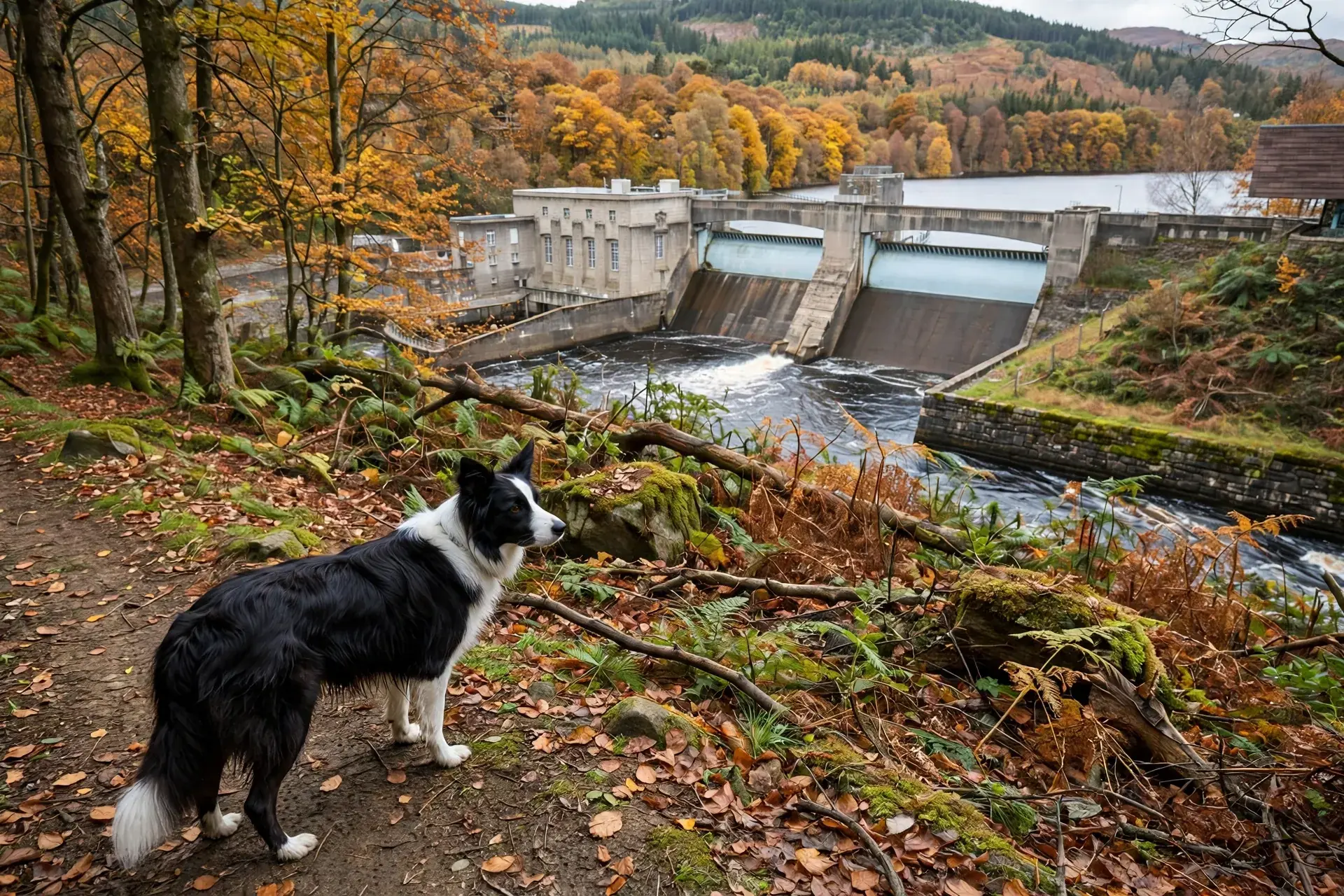
The dam is the landmark most visitors come for, and it is the natural centre of a dog walk in Pitlochry. Pitlochry Dam was built in the early 1950s as part of the Tummel hydro-electric scheme, and it holds back the River Tummel to form Loch Faskally. A pedestrian walkway crosses the top of the dam, and there are paths on both banks, so you can build a short loop that takes in the dam, the river below it and the wooded shore of the loch without retracing your steps.
The feature that makes the dam famous is the fish ladder. Salmon migrating upstream to spawn cannot jump a dam wall, so a ladder of thirty-four stepped pools, about 310 metres long, lets them climb past it in stages. There is an underwater viewing chamber where, in season, you can watch the fish pass through the ladder, and a visitor centre nearby explains how the dam and the ladder work. Opening times for the viewing chamber and the visitor centre change with the season, so check the official guidance before you travel rather than assuming they will be open on the day you visit.
Salmon usually run from late spring into autumn, with the busiest period often falling between June and September, but the numbers vary every year with river levels, rainfall and water temperature. A dry summer can delay the run; a wet autumn can bring fish through in a rush. Treat a sighting as a bonus. The walk is worth doing whether or not a salmon appears, because the river below the dam, the wooded banks and the views across Loch Faskally are good in their own right, and dogs are far more interested in the smells on the path than in the fish-count board.
Keep your dog on a lead around the dam. The paths are shared with families, cyclists and other dog walkers, the ground near the water can be slippery, and the river below a hydro-electric dam is not a paddling spot: water levels and currents can change quickly when the turbines run. Stay behind railings and barriers, do not let your dog scramble down the banks near the outflows, and carry your own water rather than letting your dog drink from the river at the dam. Our guide to dogs at waterfalls in the UK covers the same fast-water rules — slippery rocks, rising water and safe viewing distances — and most of it applies here too.
The dam is also the starting point for the loch circuit. From the dam you can follow the shore path along Loch Faskally, through the trees, with views back towards the town and the hills beyond. The path is mostly level and well surfaced in places, though it can be muddy after rain, and it suits a steady on-lead walk of an hour or so. In autumn the beech and birch woods along the loch turn gold and copper, which is the prettiest time to walk it; in summer the tree cover gives shade on hot days, which matters more for a thick-coated dog than for its owner.
Woodland and riverside walks
Faskally Wood, on the north side of the loch, is the walk most dog owners come back to. The wood is managed forest with waymarked trails, tall trees, open glades and a network of paths that link the loch shore to the higher ground above it. Red squirrels live here, which is a delight and a discipline problem in equal measure: keep a squirrel-chasing dog on a lead or a long line, because a dog that bolts into the trees can be out of sight in seconds and the paths are shared with other walkers. The wood is also popular with mountain bikers, so teach your dog to move to the side of the path when a bike bell rings, and keep the lead short on blind corners.
For a shorter, gentler walk, the riverside paths along the Tummel below the dam and around the town are the easiest option. They are mostly flat, they pass benches and open grass where a dog can have a sniff and a rest, and they connect with the town so you can finish at a cafe. The ground can be soft after rain and the riverbank is not fenced everywhere, so a dog that likes water needs a lead near the bank, especially after heavy rain when the river runs high and fast. The same caution applies on every riverside walk in this guide: the Tummel is a working hydro river, not a village stream, and its level can rise without much warning.
Dunfallandy Hill, just south of the town, is a good middle-distance option. The climb is steady rather than steep, the top gives views over the town, the river valley and the hills beyond, and the way down can be looped back through the woods. It is a walk of an hour or two rather than a day, and it suits a dog that wants a proper hill without a mountain. The paths are waymarked in places and rough in others, so wear boots with grip and carry water for the dog, because there is no reliable drinking water on the hill itself.
Ben Vrackie is the big walk, and it should be treated as one. The hill rises to 841 metres above the village of Moulin, just north of Pitlochry, and the return walk takes most fit walkers four to five hours. The path is clear and well used, but it is steep in places, exposed near the top, and the weather can change fast — sunshine in the town can be wind and rain on the summit. Only take a fit, experienced dog, carry water and a lead, keep the dog close near livestock and steep ground, and be ready to turn back. The reward is a wide view across the Highlands, and the satisfaction of a dog that has genuinely earned its dinner.
Killiecrankie, about three miles north of Pitlochry, is worth a half-day on its own. The Pass of Killiecrankie is a wooded gorge where the River Garry runs fast between steep banks, and the riverside paths there are among the most atmospheric in the area. The Soldier's Leap, where a Jacobite soldier is said to have leapt across the river in 1689, is a famous viewpoint. Keep your dog on a lead here: the paths run close to the river, the drops are real, and the gorge is busy with walkers in summer. The visitor centre at Killiecrankie has information about the battle of 1689 and the wildlife of the gorge, and the paths connect with longer routes for walkers who want to keep going.
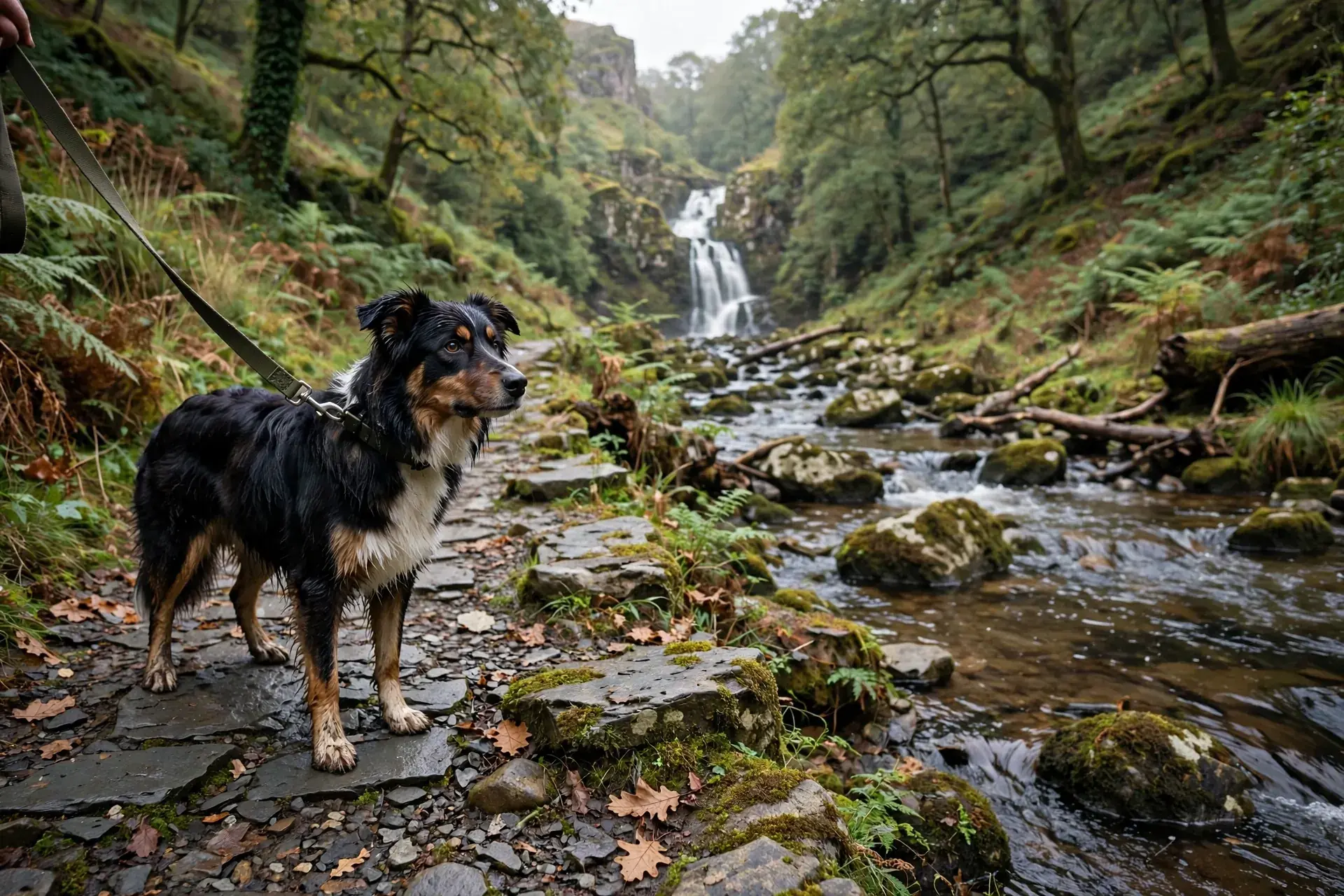
The Linn of Tummel, where the Tummel meets the Garry, is another riverside walk a short drive from town, with wooded paths, waterfalls and a quieter feel than the dam. It is a good choice for a dog that finds the dam paths too busy, and for a walk in autumn when the trees are at their best. Wherever you walk in this area, check for livestock before letting a dog off the lead, and remember that sheep and deer are common on the open ground above the town. Scottish access rights come with responsibilities: keep dogs under control near livestock, and use a lead during lambing and around ground-nesting birds in spring and early summer.
Cafes, pubs and shops in town
Pitlochry's main street, Atholl Road, runs through the centre of town, and most of what you need is on it or just off it. Cafes, pubs, hotels, outdoor shops, a supermarket and a handful of gift shops sit within a few minutes' walk of each other, which means you can plan a town morning around the dog rather than around the car: walk the dam first, then come back into town for coffee, then browse the shops while the dog rests.
Dogs are welcome in many of the town's cafes and pubs, but the rule is almost always "ask first". Some places welcome dogs throughout, some only in the bar or on the terrace, and some only outside. The pattern is familiar to anyone who travels with a dog in Britain: a water bowl by the door and a dog biscuit on the counter usually mean you are welcome, while a "no dogs" sign means what it says. Policies can change with the season and with staffing, so a place that welcomed dogs last year may have changed its mind, and the reliable check is the sign at the door, the venue's website or a quick phone call.
Pubs are often the easiest option, especially the older ones with a bar area separate from the dining room. The Moulin Inn, in the village of Moulin just north of the town centre, is a well-known dog-friendly pub with its own small brewery, and it is a natural finish to the Ben Vrackie walk or a starting point for a shorter stroll. In town, several hotels and pubs have beer gardens and terraces where dogs are welcome in good weather. If you want to eat a full meal with the dog beside you, a pub bar or a cafe terrace is usually a better bet than a formal restaurant dining room, and booking ahead and mentioning the dog avoids an awkward turn at the door.
For coffee and cake, the town has a good choice of cafes, and many of them put a water bowl outside in summer. Takeaway is always a fallback: buy a coffee and a sandwich, find a bench by the river or in a garden, and let the dog settle beside you. On wet days, that is sometimes the happiest option of all, because a dog that has just walked through Faskally Wood is not always the cleanest dining companion.
The shops are worth a look for practical reasons as well as browsing. Outdoor shops on the main street sell the things dog walkers run out of on holiday: waterproofs, walking boots, water bottles, towels, tick removers and dog treats. A supermarket in town covers food, dog food and the forgotten lead. If you are staying in self-catering accommodation, do the shopping on arrival day rather than on the first walking day, so the dog is not left waiting in a warm car while you queue. And if you are buying a souvenir, the local shops sell the usual Highland mix — whisky, wool, shortbread and walking maps — which is a reminder that Pitlochry is a town built on visitors, and that it expects you to browse.
Where to stay with a dog
Pitlochry has a wide range of places to stay, from large hotels on the main street to small bed and breakfasts, guest houses, self-catering cottages and holiday parks on the edge of town. That range is useful, because different dogs need different stays. A calm older dog may be perfectly happy in a hotel room with a bed by the radiator. A young, muddy spaniel is usually better in a cottage with a hard floor, a garden and a boot room where the towels live.
Hotels in the town centre vary in their dog rules. Some accept dogs in all rooms, some only in selected ground-floor rooms, and some charge a nightly or per-stay pet fee. Ask three questions before you book: which rooms take dogs, whether there is a charge and how much it is, and whether the dog can be left alone in the room while you eat. Many hotels will not allow a dog to be left unattended, which means planning your evenings around the dog — a pub that welcomes dogs is suddenly more valuable than a restaurant that does not. The town has several hotels with gardens and terraces, and a ground-floor room with a door to the garden is worth paying extra for if your dog needs a late-night toilet trip.
Self-catering cottages and lodges suit most dog owners best, because they come with a kitchen, a washing machine, a garden or terrace, and no one to apologise to when the dog shakes mud across the floor. Look for an enclosed garden if your dog cannot be trusted off the lead, a hard floor rather than pale carpet, and a location with a walk from the door rather than a drive to the first path. Cottages on the edge of town, towards Moulin or towards Faskally, often have a path to the woods within minutes, which changes the whole rhythm of the stay: the first and last walks of the day become a pleasure rather than a chore.
Holiday parks and campsites around Pitlochry are another option, especially for families with more than one dog. Our guide to dog-friendly holiday parks in the UK explains the questions that matter most — pet fees, which units actually take dogs, boundary heights, and where the after-dark toilet walk is — and all of them apply here. Book early for school holidays and for the autumn colours, because the dog-friendly units in the best locations are the first to go, and ask for the pet fee in writing so there are no surprises at check-in.
Whatever you book, tell the host about the dog before you arrive, and be honest about size, number and behaviour. A host who knows a large dog is coming can put you in the right room; a host who finds out at the door may not be able to. Bring the dog's own bed and a familiar blanket, because a dog that sleeps in its own bed settles faster in a strange room. Pack a towel for the door, a drying coat for wet days, and a spare lead. And if you are staying somewhere with a garden, check the boundaries on arrival before you let the dog off the lead — a gap in a fence that a terrier can fit through is the sort of thing you want to find in daylight, not at midnight.
Getting there and parking
Pitlochry is about twenty-five miles north of Perth on the A9, the main road north through the Highlands. From Edinburgh or Glasgow the drive is roughly two hours in good traffic; from Inverness it is about an hour and three quarters south. The A9 is a fast road with long stretches of dual carriageway, and it is the main route for lorries and coaches as well as cars, so allow extra time in summer and at weekends, and plan a stop for the dog. There are service areas and lay-bys along the route, but the best stops are the towns themselves — Dunkeld, just south of Pitlochry, is a good place to break the journey and give the dog a short walk by the river.
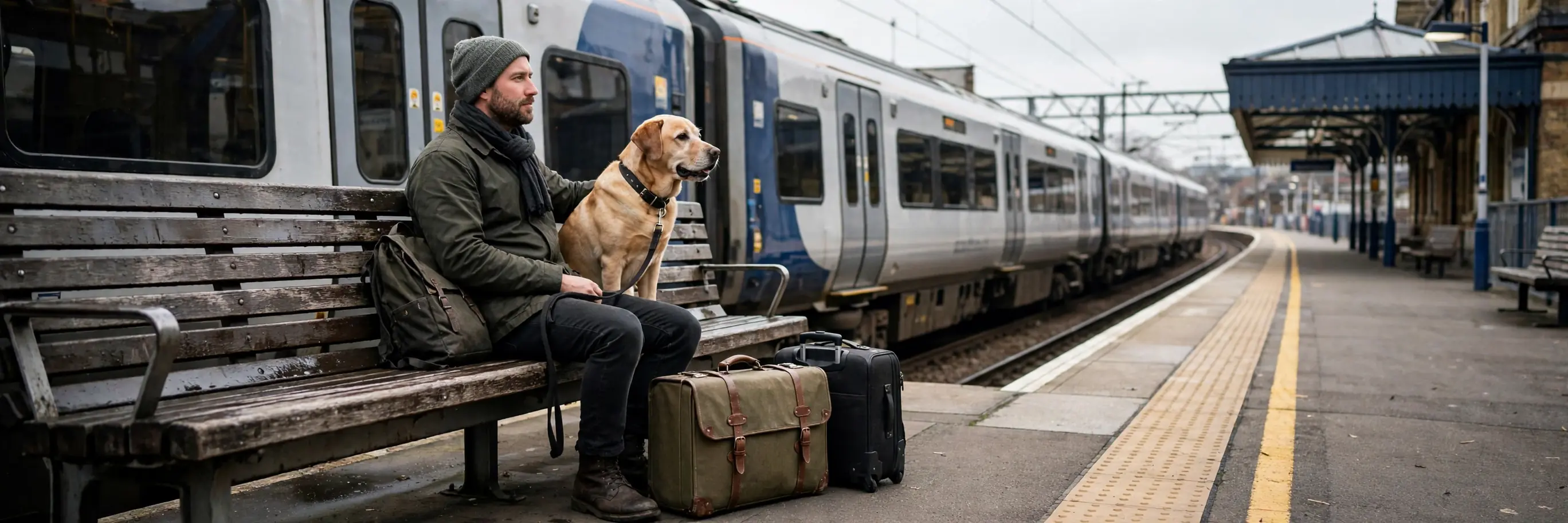
The train is a genuinely good option for Pitlochry. The town has its own station on the Highland Main Line, with direct trains from Edinburgh, Glasgow and Inverness, and the station is a short walk from the main street and the dam paths. Dogs travel free on most UK trains and do not need a ticket, though they should be kept on a lead and off the seats, and a busy train at peak times is not the place for a nervous dog. Our guide to dog-friendly train stations in the UK covers waiting rooms, platforms and changing trains, and it is worth a read if you are arriving by rail for the first time. If you arrive by train, remember that you will be walking everywhere, so pack light and choose accommodation near the station or the main street.
Parking in Pitlochry is straightforward but not unlimited. The town has several public car parks within a short walk of the main street, the dam and the riverside paths, including car parks near Atholl Road and by the station. Charges and time limits vary between car parks and can change, so read the signs at the machine and keep the ticket visible. On busy summer weekends the central car parks fill up by late morning, and the practical answer is to arrive early, park once, and walk everywhere for the rest of the day. There is also parking at the dam and at some of the walk starting points outside town, including Killiecrankie, but those fill up too, and the same rule applies: early is easy, late is a queue.
On warm days, never leave a dog in a parked car, even with a window open — a car in sunshine heats up fast, and the Highlands are no exception. Park in shade where you can, leave water in the car, and take the dog with you. If you need to shop, take turns, or use a cafe where the dog is welcome while the other person goes to the shops. Buses run through Pitlochry and connect with Blair Atholl, Dunkeld and Perth, but services are less frequent than in a city, so check the timetable before you rely on a bus, and confirm that dogs are allowed — most local buses accept dogs at the driver's discretion.
Highland day trips from Pitlochry
Blair Atholl, about seven miles north of Pitlochry, is the easiest day trip and the one most dog owners do first. Blair Castle, the historic home of the Duke of Atholl, stands in extensive grounds with gardens, woodland walks and a ruined kirk, and dogs on leads are welcome in the grounds and gardens. The castle itself does not admit dogs, so plan the visit as an outdoor one: walk the grounds, visit the gardens, and take turns if someone in the party wants to go inside. The village has a station, a couple of places to eat, and a good base for walks into Glen Tilt, one of the classic Highland glens, where the path follows the river between steep hills and the walking is gentle for the first few miles.
Dunkeld, about fifteen miles south, is a smaller, quieter town with a cathedral, a riverside walk and a good choice of cafes. The town sits on the River Tay, and the paths along the river and through the woods at the Hermitage, just west of Dunkeld, are among the best short walks in Perthshire. The Hermitage has tall Douglas firs, a riverside path and a folly overlooking a waterfall, and dogs on leads are welcome on the paths. It can be busy at weekends, so go early or late in the day, and keep your dog on a lead near the river, where the banks are steep in places.
The Queen's View, about six miles west of Pitlochry on the road to Tummel Bridge, is a viewpoint over Loch Tummel that has been famous since Queen Victoria visited in 1866. There is a car park, a visitor centre and a short walk to the viewpoint, and the view across the loch to Schiehallion is one of the classic Highland scenes. It is a good stop on a driving day rather than a walk in itself, and it pairs well with a longer drive west towards Loch Rannoch or north towards the Cairngorms. Dogs on leads are welcome at the viewpoint, but the car park is busy in summer, so go early or out of season if your dog dislikes crowds.
Further afield, Aviemore and the Cairngorms are about an hour's drive north, and Loch Tay is about half an hour west. Both are worth a day if you have a week, but they are long days, and a dog that has already walked in Pitlochry may be happier with a shorter outing. The better rule for a week in Pitlochry is to alternate: one big day out, one quiet day on the loch paths, and let the dog set the pace. A tired dog that has had a good walk is a happy dog; a dog that has been driven from viewpoint to viewpoint all day is a bored one, and the difference shows in the evening.
For a different kind of day, the Edradour Distillery, just outside Pitlochry, is one of the smallest traditional distilleries in Scotland, and the area around it has pleasant walks. Distillery tours do not generally admit dogs, so treat it as a stop for the humans while the dog waits outside with someone, or as a place to visit on a day when the dog is resting. The same applies to the Pitlochry Festival Theatre, which has a theatre building, gardens and a riverside setting — the gardens and the area around the theatre are good for a walk, but the auditorium is not a place for a dog.
Seasons, weather and packing
Spring in Pitlochry, from March to May, is a good time for a dog trip. The days get longer, the woods come into leaf, the salmon start to run, and the summer crowds have not yet arrived. The weather is changeable — sunshine, rain and a cold wind can all appear in one afternoon — so pack layers and a waterproof for both of you. Lambing season runs through spring, which means dogs must be on a lead near sheep, and ground-nesting birds are at their most sensitive, so keep to the paths and keep the dog close in open country.
Summer, from June to August, is the busiest and the warmest season. The days are long, the dam paths are at their best, and the town is full, but midges can be a serious problem in the Highlands in summer, especially in the evening near water and woodland. Midges bite humans more than dogs, but they still annoy dogs, and a dog that is being bitten will not settle. A midge repellent that is safe for dogs, a walk in the middle of the day rather than at dusk, and a breeze on the hill are the practical answers. Heat is the other summer risk: carry water on every walk, avoid the hottest part of the day for a thick-coated dog, and never leave a dog in a car. The river is tempting on a hot day, but the Tummel is cold and fast, so let a dog paddle only in slow, shallow water well away from the dam.
Autumn, from September to November, is many people's favourite season in Pitlochry. The trees along Loch Faskally and in Faskally Wood turn gold, copper and red, the light is low and warm, the midges are gone, and the town is quieter after the summer. The salmon run continues into the autumn, and the hill walks are at their clearest. The trade-off is weather: rain is more likely, the paths are muddier, and the days shorten quickly after October, so start walks earlier and carry a torch for the walk back in the dark. Pack a drying coat and extra towels, because a wet dog in autumn is a daily event rather than an exception.
Winter, from December to February, is quiet and short-dayed. Pitlochry in winter is a town of wood smoke, early dark and frost on the loch, and the walks are beautiful in a different way — bare trees, clear air, and the hills white with snow. But the days are short, the paths can be icy, and some attractions and visitor centres reduce their hours or close. Check the official guidance before you travel for winter opening times, carry a torch and a charged phone, and keep walks shorter and closer to town. A dog that is used to winter walking will love it; a dog that is not should be built up gradually, with a coat for a short-haired breed and a check of paws for ice and salt after every walk.
The packing list for Pitlochry is the same as for any Highland trip, with a few local additions. Bring a lead and a long line, a harness, a collapsible water bowl and a bottle, poo bags, a towel and a drying coat, a tick remover, and a torch. Add a dog coat for a short-haired or older dog in winter, and a spare lead in case one breaks on a hill. For the humans, walking boots with grip are essential — the paths around the dam and the loch are muddy after rain, and the Ben Vrackie path is steep and rocky — and a waterproof jacket is worth carrying even on a sunny morning, because Highland weather changes fast.
Practical tips: vets, water and leads
Before you travel, save the number of the nearest vet. There are veterinary practices in Pitlochry and in the surrounding towns, but opening hours are shorter than in a city, and an out-of-hours emergency service may be based in Perth or further away. Check the official guidance before you travel for the nearest practice and its hours, and save the number in your phone before you need it. If your dog takes regular medication, bring more than you need, and carry the prescription details with you, because a rural pharmacy may not stock an unusual drug at short notice.
Water is the practical detail most people get wrong. Dogs need water on walks, and the river is not a reliable substitute, especially near the dam and after rain, when the water can be silty or fast. Carry a bottle and a bowl on every walk, including the short ones, and offer water regularly rather than waiting for the dog to ask. In summer, carry extra; on Ben Vrackie, carry more than you think you need, because there is no safe drinking water on the hill. If your dog does drink from a stream, choose slow, clear water away from farmland and roads, and watch for signs of stomach upset afterwards.
Lead rules in and around Pitlochry are a matter of judgement as much as law. On the dam paths, the main street and the loch shore, a lead is the right choice, because the paths are shared and the river is close. In the woods, a long line gives a dog freedom without the risk of a bolt after a squirrel or a deer. On open hill ground, a dog with reliable recall can be off the lead, but only when there is no livestock in sight, no ground-nesting birds in season, and no steep ground ahead. Scottish access law gives you the right to walk on most land, but it also requires you to keep your dog under proper control, and a dog that chases sheep is a serious problem for a farmer, so err on the side of the lead whenever you are unsure.
Ticks are present in the woods and grassland around Pitlochry from spring to autumn, and the risk is highest in bracken and long grass. Check your dog after every walk, especially around the ears, the belly and between the toes, and remove any tick promptly with a tick remover, twisting gently rather than pulling. Midges, as noted above, are a summer evening problem near water. Neither should stop you walking, but both should be part of the routine: check, remove, and carry the right tool.
Finally, plan the day around the dog, not the other way round. A good Pitlochry day for most dogs is a morning walk, a rest while the humans have lunch, a shorter afternoon walk, and an evening stroll by the loch. A dog that has had two good walks and a proper rest is a contented companion in a pub or a cafe; a dog that has been dragged around all day is a tired, sore and grumpy one. Build rest into the plan, and remember that the point of the trip is the dog's enjoyment as much as yours — the dam, the woods and the river will still be there tomorrow.
Practical questions
Before you go
Can dogs walk across Pitlochry Dam?
Yes, there is a pedestrian walkway across the dam, and dogs on a lead are generally welcome on the paths around it. Keep your dog close near the water, stay behind barriers and railings, and do not let your dog swim near the dam outflows, where currents are strong and unpredictable.
When is the best time to see salmon at the Pitlochry fish ladder?
Salmon usually run from late spring into autumn, with the busiest period often from June to September. Numbers vary every year with river levels and weather, so treat a sighting as a bonus rather than a guarantee, and check the official guidance before you travel for current viewing times.
Are dogs allowed in cafes and pubs in Pitlochry?
Many cafes and pubs in Pitlochry welcome dogs, especially in bar areas, on terraces and in beer gardens, but policies vary from place to place and can change with the season. Look for a sign at the door, check the venue's website or social media, or phone ahead before you go.
Where can I park in Pitlochry with a dog?
Pitlochry has several public car parks within a short walk of the main street, the dam and the riverside paths, including car parks near Atholl Road and by the station. Charges and time limits vary, so read the signs at the machine, and choose a shaded spot and leave water in the car on warm days.
Is Ben Vrackie suitable for dogs?
Fit, experienced dogs can enjoy Ben Vrackie, a steep hill walk of around four to five hours return from Moulin, but it is a serious climb with exposed sections and changeable weather. Carry water, keep your dog on a lead near livestock and steep ground, and turn back early if conditions worsen.