This guide is independent and contains no paid placement. If affiliate links are added later, they will be clearly marked and will not change our editorial checks.
Plockton is a small Highland village on Loch Carron where palm trees grow in front gardens, seal boats leave from the harbour, and the shore road is made for slow walking with a dog. Come for a seal trip and a bay-side wander, stay for the quiet evenings, and treat tide times and boat timetables as the two things worth checking before you travel.
The palm-tree surprise: why Plockton looks the way it does
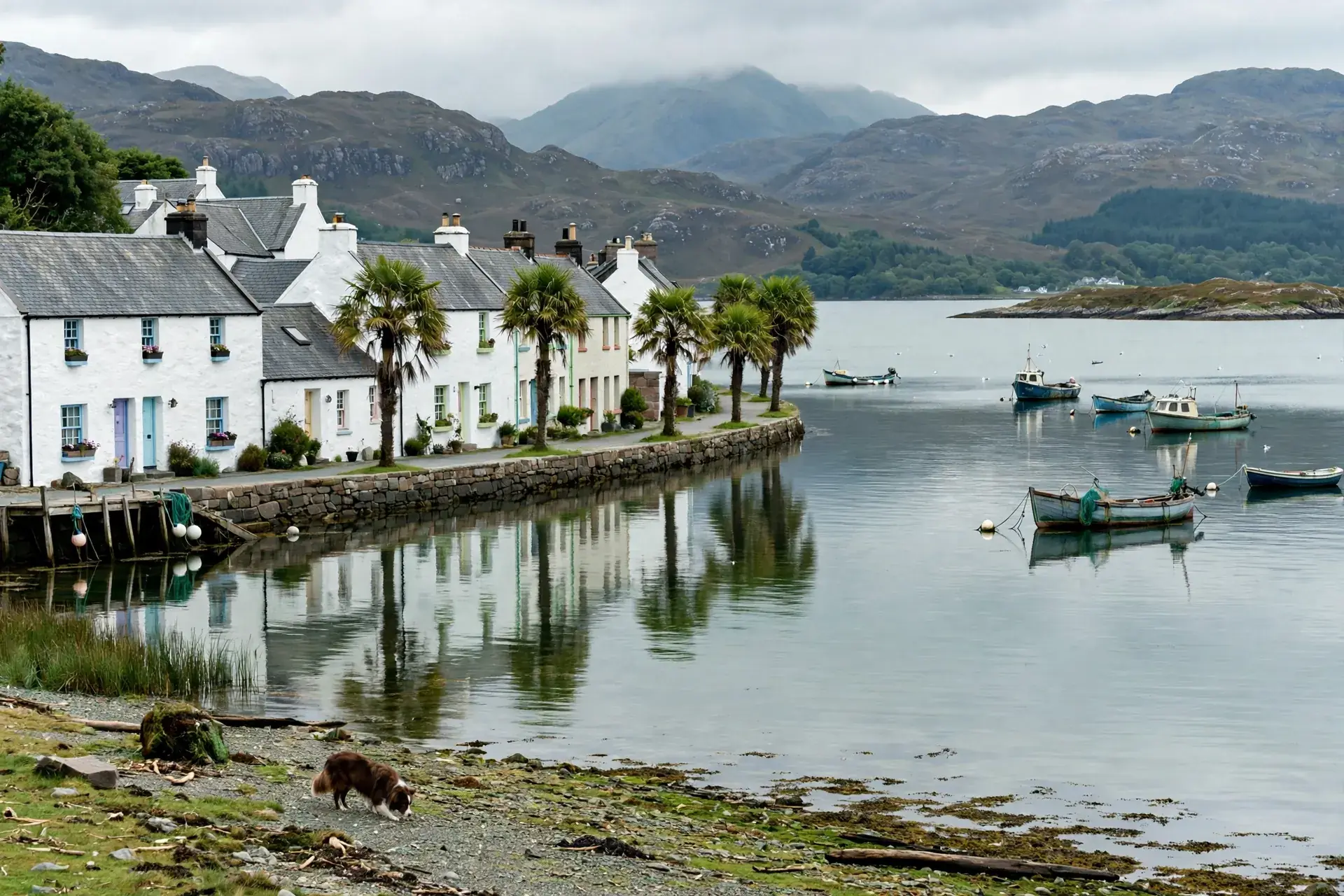
The first thing that stops most visitors in Plockton is not a view or a building. It is a palm tree. Or several of them, rising above whitewashed cottages on a Scottish west-coast shore, with dark Highland hills behind them and a grey-blue sea loch in front. The contrast is so sharp that first-time visitors often assume the trees are a trick of some sort, or that they have misjudged where they are. They have not. Plockton sits in one of the mildest pockets of the Highlands, sheltered by the surrounding hills and warmed by the North Atlantic Drift, the ocean current that carries warm water up the west coast of Britain. Frosts are rarer here than in inland glens a few miles away, and plants that would struggle elsewhere in Scotland survive in cottage gardens along the shore. The result is a village that looks faintly Mediterranean from a distance and unmistakably Highland close up, and that tension is the whole charm of the place.
Understanding that mild climate helps you plan a dog trip here, because it shapes almost everything about the village. The sheltered bay of Loch Carron stays calm on days when the open coast is rough, which is why small boats can work from the harbour for much of the year and why the shoreline walk is pleasant even when the weather is unsettled. The same shelter means the village feels warm on a sunny afternoon in a way that surprises people who have just driven over a windswept moor. For a dog, it means a shore walk that is gentle rather than exposed, with plenty of places to pause in the lee of a wall or a cottage. It also means midges in summer, which the later section on seasons covers in detail, because the calm, damp air that suits palm trees suits midges too.
Plockton's shape is part of the story. The village curves around the bay in a loose crescent of whitewashed houses, many of them built in the late eighteenth and nineteenth centuries when the settlement grew as a planned fishing village. The houses face the water, their backs to the hill, and the road that links them is narrow and slow. There is no high street in the usual sense, no parade of shops competing for attention, and no large car park dominating the centre. Instead there is a harbour, a small green, a church, an inn, and a handful of places to eat and stay, all within a short walk of one another. Television viewers may recognise the setting: the village was used as a filming location for the BBC series Hamish Macbeth in the 1990s, and the show's gentle, slightly eccentric version of Highland life still matches the feeling of the place on a quiet morning, when the only movement is a fishing boat and a dog trotting along the shore road.
For a dog owner, the practical consequence of all this is simple. Plockton is a village to explore on foot, at a dog's pace, with frequent stops. The distances are short, the gradients are gentle along the shore, and the rewards are visual rather than strenuous: the changing light on the loch, the boats swinging on their moorings, the gardens full of plants that have no business growing this far north. Dogs that are overwhelmed by busy towns often do well here, because the village is quiet, the traffic is light, and the open water gives them something to watch without the pressure of crowds. Dogs that need constant stimulation may find it too calm, which is why the walking and boat sections below matter: the village is the base, and the loch, the bays and the hills around it supply the activity.
One more thing worth knowing before you arrive is that Plockton is a working village, not a theme park. People live in the cottages, boats are worked from the harbour, and the palm trees belong to private gardens. That matters for dog etiquette: gardens are not for sniffing through, the harbour is a working place with ropes, crates and moving vehicles, and the quiet that visitors love is the same quiet that residents live in. Keep your dog close, keep the noise down, and the village will feel welcoming. Treat it as a backdrop and it will feel closed. The rest of this guide is built around that idea: enjoy the village slowly, use the water and the walks, and leave the place as calm as you found it.
A first slow loop of the village
The best way to meet Plockton is to park once, put the car keys away, and walk. Start at the harbour, where the seal-trip boats tie up and where the village's working life is most visible. Let your dog take in the smells — fish boxes, rope, seaweed, diesel — and give them a few minutes to settle before you move on. From the harbour, the shore road curves around the bay past the cottages, and this is the walk that defines the village. It is short, flat and endlessly watchable: boats at anchor, gardens behind low walls, the hills across the loch changing colour with the cloud. Walk it slowly. Stop where your dog stops. There is no need to cover ground, because the ground here is the point.
As you follow the curve of the bay, notice how the village changes character. Near the harbour the houses are close together and the road feels like a village street; further around the bay the cottages spread out, gardens get larger, and the shore opens into small rocky coves and patches of sand and shingle. This is where dogs get their best sniffing done, among the seaweed at the tide line and the rock pools left behind by the ebb. Keep your dog on a lead along the road itself, but the open shore at low tide gives room for a longer line and a proper explore, provided you watch for boats, mooring chains and the occasional sharp shell. The tide matters more than the clock in Plockton: at high tide the water comes right up to the road in places, and at low tide the bay opens into wide flats that smell of salt and mud and are irresistible to most dogs.
Allow at least an hour for this first loop even though the distance is modest, and allow two if you are the sort of person who stops to look at boats. The loop works well as a settling-in walk on arrival, because it shows your dog the whole village in one gentle pass: the harbour, the houses, the shore, the places where other dogs have been. Nervous dogs benefit from that single slow circuit, which maps the village as safe territory before you ask them to cope with a boat or a busier lunchtime. Confident dogs benefit too, because the shore gives them a proper sniffing workout without the need for a long hike. If your dog is still buzzing after the loop, repeat it in the other direction; the light will have changed, the tide will have moved, and it will feel like a different walk.
The village's small scale is also what makes it feel car-free, even though it is not literally so. Cars do use the shore road, and residents need access to their homes, but through-traffic is minimal and the narrow road forces everyone to drive slowly. Most visitors park on arrival and then forget the car exists, which is the right approach. The practical rule is to keep your dog on a short lead whenever you are on the road, use the wider shore sections for sniffing stops, and never assume a driver can see a small dog around a bend between two cottages. At night the village is very dark by town standards, so bring a torch and a light for your dog's collar if you plan an evening wander; the stars are excellent, but the road edges are not lit.
One detail that catches people out is how little there is to buy in the village. There is no supermarket, and the small shops that exist are seasonal or limited in range. That is part of the charm, but it means you should arrive with dog food, treats and any medication your dog needs, rather than expecting to stock up locally. The nearest larger shops are a drive away in Kyle of Lochalsh or further afield, so a quick supplies check before you leave home saves a detour. Water is not a problem: carry a bottle and a collapsible bowl on every walk, because the village has few obvious places to fill up once you are out on the shore, and dogs drink more than you expect after a salty paddle.
Seal-watching boat trips with a dog
The seal trip is Plockton's signature experience, and it is the one activity worth planning your day around. Small boats leave from the harbour and run out into Loch Carron to where grey seals and common seals haul out on rocks and skerries, and the trip usually combines seal watching with a slow tour of the bay, the fish farms and the shoreline. The boats are small enough that the experience feels personal rather than industrial, and the guides know the loch well enough to find seals on most days. The whole trip typically lasts around an hour, which is short enough for most dogs, and the sheltered water keeps the motion gentle compared with open-sea trips further out. That combination — short, sheltered, and focused on animals that dogs find fascinating — makes it one of the more dog-compatible boat trips on the Scottish west coast.
Whether your dog can come aboard depends on the operator and the sailing, so ask when you book rather than turning up and hoping. The long-running seal trips from Plockton harbour have traditionally welcomed well-behaved dogs, particularly outside the busiest sailings, but policies can change with the season, the boat in use and the number of passengers already booked. When you enquire, say how big your dog is, whether they are comfortable on boats, and whether they are likely to bark at seals or at other passengers. A calm dog that will lie on a blanket is an easy yes; a large, restless dog on a crowded boat is a harder sell, and an honest answer from the operator is worth more than a reluctant permission. If the answer is no for your preferred sailing, ask about a quieter one — early morning and late afternoon trips are often calmer, and operators are more flexible when the boat is half empty.
Preparing a dog for the trip is straightforward but worth doing properly. Bring a non-slip mat or blanket for your dog to lie on, because boat decks are hard, wet and slippery, and a dog that cannot settle will spend the trip sliding around. Keep the lead short and attached, even if your dog is normally reliable off lead, because a boat is the worst place for a dog to decide to investigate something. Feed a smaller meal than usual a couple of hours beforehand if your dog is prone to travel sickness, and bring water and a small treat for the return. If your dog has never been on a boat, introduce them to the idea gently: let them sniff the boat at the harbour, watch other passengers board, and settle on their mat before the engine starts. A dog that boards calmly is a dog that will enjoy the seals; a dog that is already stressed at the pontoon will not.
On the water, the rules are simple. Keep your dog low and still, keep them away from the edge, and do not let them bark at the seals. Seals are easily disturbed, and a barking dog can ruin the sighting for everyone on board as well as stressing the animals. The best moments come when the boat cuts its engine and drifts quietly near a haul-out rock: the seals watch the boat, the passengers watch the seals, and a settled dog will watch everything with them. Bring a camera, but do not spend the whole trip behind it; the light on Loch Carron changes by the minute, and the view back towards the village, with its palm trees and whitewashed cottages, is as memorable as the seals themselves. If the weather turns or the sea gets up, the operator may shorten or cancel the trip, so check the official guidance before you travel and keep your plans flexible.
Booking ahead is sensible in summer and during school holidays, when the popular sailings can fill up. Outside the peak season, you may be able to book on the day at the harbour, but it is still worth checking the timetable the evening before, because sailings depend on tides, weather and demand. Prices are modest for a wildlife trip of this kind, and the value is high: an hour on the loch gives you a completely different view of the village and its surroundings, and it gives your dog a story that no ordinary walk can match. If your dog cannot go on the boat, the harbour is still worth a visit at sailing times, because the seals sometimes come close enough to the shore to be seen from land, and the sight of the boats returning with happy passengers is a good consolation. For a longer Scottish island adventure after Plockton, our Isle of Skye guide covers the roads, walks and ferry practicalities of the island just across the water.
Bays, beaches and paddling spots
Plockton does not have a single grand beach. What it has is better for most dogs: a series of small bays, rocky coves and patches of sand and shingle that appear and disappear with the tide, each with its own character. The main bay in front of the village is the obvious starting point. At low tide the water pulls back to reveal a broad expanse of sand and mud, scattered with rock pools, seaweed and the mooring chains of the anchored boats. Dogs love this terrain, and a low-tide wander here can keep a curious dog happily occupied for an hour without ever leaving the village. The surface is mostly soft underfoot, though there are rocky patches and the odd sharp shell, so watch where a small or older dog is stepping, and check paws afterwards.
Tide times are the single most useful piece of information for a dog owner in Plockton, and they are worth checking every morning. A falling tide opens up the shore and the rock pools; a rising tide can cut off a tempting stretch of sand faster than you expect, especially where the shore curves around a headland. The general rule is to start your shore walk on a falling tide, keep an eye on the water behind you, and never let your dog chase a ball or a scent around a rocky point when the tide is coming in. Local tide tables are available online and in the village, and the harbour notice boards often carry the day's times. If you are unsure, ask a local or check the official guidance before you travel, because a tide that looks harmless from the road can move surprisingly fast across flat sand.
The rock pools deserve a section of their own, because they are where dogs and children alike spend the most time. At low tide the pools hold crabs, small fish, anemones and seaweed, and the smell alone is enough to keep a dog investigating for ages. Let your dog sniff and paddle, but stop them from drinking the pool water, which can be salty and stale, and from eating dead crabs or fish on the shore, which can cause stomach upsets. Rinse your dog's paws and belly after a rock-pool session, because the combination of salt, sand and seaweed dries into a gritty coat that irritates skin, and check between the toes for small stones or shell fragments. A short lead works well here: it gives your dog enough freedom to explore the pools while keeping them out of the deeper water and away from the boat moorings.
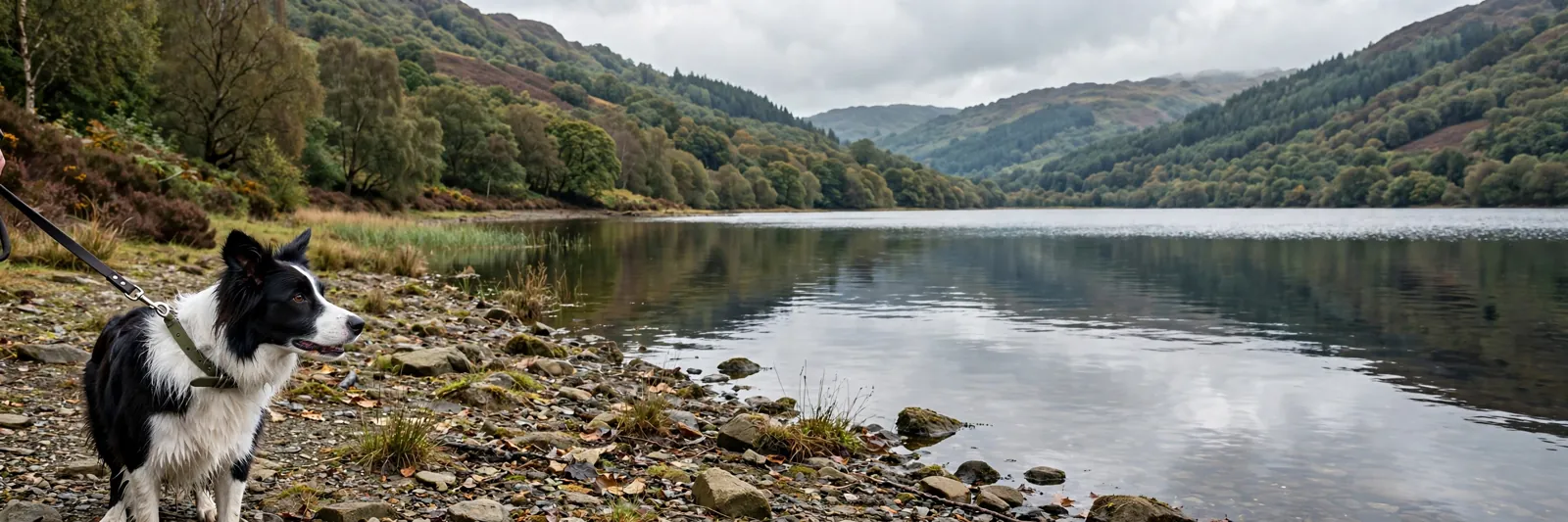
Beyond the main bay, the shoreline around Plockton offers quieter spots for dogs that prefer space. The coast towards the north of the village and the small coves along the loch shore are less visited, and a short walk from the centre will usually find you a stretch of shore to yourselves, particularly outside the middle of the day. These places are best explored on foot from the village rather than by car, because parking is limited and the walking is easy. Carry water, because the shore has no fresh water source, and remember that the loch water is cold even in summer — most dogs will paddle happily, but few should be encouraged to swim for long, and older or small dogs should be kept to the shallows. If your dog does swim, dry them thoroughly afterwards and watch for shivering, which is a sign to head back to warm, dry ground.
Swimming safety matters here because the loch looks calmer than it is. The bay is sheltered, but there are currents around the harbour entrance and near the channels used by boats, and the water deepens quickly in places. Keep your dog out of the harbour channel and away from the slipway when boats are launching or landing, and never throw a ball into deep water where your dog has to swim out of their depth to retrieve it. A long line is a good compromise: it lets a confident swimmer enjoy the water while keeping them within reach. After any swim, rinse with fresh water if you can, towel dry, and check ears, because loch water in the ears is a common cause of irritation in dogs that swim often. The reward for all this care is a dog that can paddle and swim safely in one of the prettiest bays in the Highlands, and that is a fair trade.
Longer walks from the village
Once you have walked the village and paddled the bay, the hills and headlands around Plockton offer longer outings that suit dogs with energy to burn. The countryside here is a mix of woodland, moorland and loch shore, and the walking is gentler than the big Highland mountains further inland, which makes it a good choice for dogs that are fit but not mountain-hardened. The classic longer walk from the village climbs gently behind the houses and then follows tracks and paths with views back over Loch Carron and out towards the hills of Skye. The going underfoot is mixed — grass, heather, forestry track and the occasional boggy patch — so waterproof footwear and a towel for the dog are sensible, and a lead is needed where the path crosses grazing land or runs near sheep.
Sheep are the main thing to plan around on the longer walks. The hills around Plockton are working farmland, and sheep graze the open ground for much of the year. The law in Scotland gives walkers a right of responsible access, but that right comes with a clear responsibility: keep your dog under close control around livestock, and on a short lead wherever sheep are visible. Even a friendly dog that only wants to say hello can panic a flock, and a chasing dog can cause serious harm and land its owner in legal trouble. If your dog has a strong chase instinct, choose the shore and woodland paths over the open hill, and keep the lead on for the whole walk. The same rule applies to ground-nesting birds in spring and early summer, when dogs should be kept on paths and under control on the moor.
Woodland walks near the village are a good middle option: sheltered from the wind, rich in smells, and easier on older dogs than a hill climb. The mixed woodland around the loch holds the usual Highland wildlife — roe deer, red squirrels, woodpeckers and a chorus of smaller birds — and dogs will want to investigate every rustle. Keep them on a lead or a long line in the woods if their recall is unreliable, because deer are present and a chasing dog can disappear quickly among the trees. The forest floor is soft and kind to paws, but after rain the paths can be muddy and the puddles deep, so a drying coat and a boot full of towels are part of the kit. In autumn the woods are especially good, with fungi, fallen leaves and a smell that keeps dogs busy for hours.
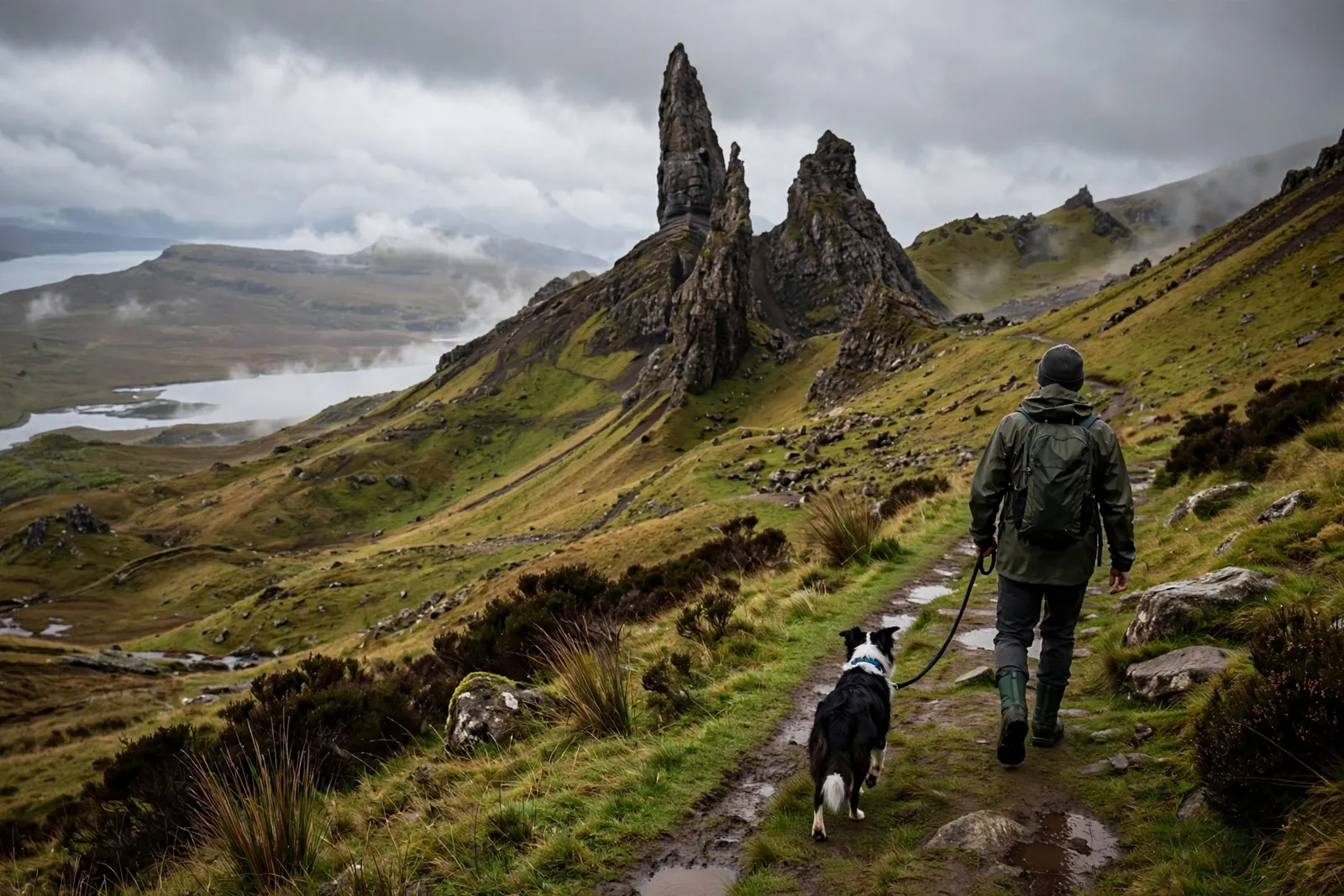
For a bigger day out, Plockton is well placed as a base. The road to Applecross over the Bealach na Bà, one of Britain's most dramatic mountain passes, is a short drive away, and the Applecross peninsula offers wild coastal walks that feel a world away from the village — though the pass itself is not a drive to take lightly, and the road is single-track with passing places in many stretches, so check the official guidance before you travel and drive it in good weather. Closer to home, the Kyle of Lochalsh and the Skye Bridge are about half an hour's drive, opening up the whole of Skye for a day trip, and Eilean Donan Castle sits on the road towards Kyle, its loch-side setting one of the most photographed in Scotland. Dogs are welcome on the castle grounds in many cases but not inside the castle itself, so plan for one person to stay outside with the dog if you want to go in. Our Loch Lomond guide covers another great Scottish water-and-walk destination if you are building a longer tour, and the same principles — tide times, livestock, lead control — apply there too.
Whatever distance you choose, the walking rhythm in Plockton should stay slow. This is not a place for ticking off miles, and the best walks are the ones with time built in for sniffing, paddling and sitting on a rock watching the loch. Plan a route, but be ready to shorten it if your dog is tired, the weather turns, or a bay at low tide proves too tempting to leave. Carry more water than you think you need, a few treats, a spare lead, and a basic first-aid kit with a tick remover, because ticks are present in the Highland countryside from spring to autumn. Check your dog for ticks after every walk through long grass or bracken, and remove any you find promptly with a tick hook. The walks around Plockton are not difficult, but they reward the same care as any Highland walk: good footwear, a charged phone, and respect for the weather, which can change in the time it takes to walk around a bay.
Eating and drinking with your dog
Plockton's food scene is small, seasonal and personal, which is both its charm and its challenge for dog owners. The village has an inn, a small hotel with a restaurant, and a handful of cafes and takeaway spots that open and close with the season, and the number of tables is limited. That means planning matters more here than in a town with dozens of options. If you want a proper sit-down meal with your dog, check in advance which places welcome dogs and where: many will welcome a dog in the bar, the garden or an outdoor seating area, while the main restaurant may be dogs-out. Rules change with the management and the season, so a place that welcomed dogs last summer may have a different policy this year, and the only reliable check is to ask on the day. Our guide to dog-friendly cafes across the UK explains the etiquette that helps everywhere, from settling your dog under the table to choosing a quiet corner.
The village inn is the natural first stop. Inns in Highland villages are usually the social heart of the place, and Plockton's is no exception: a bar with a fire, a garden or terrace in summer, and a menu built around local seafood and simple, filling food. Dogs are often welcome in the bar area and outside, and a well-behaved dog that settles under the table is usually made welcome. Bring a mat or blanket for your dog to lie on, because stone and wooden floors are cold and hard, and order a bowl of water when you order your own drinks. Lunchtime is easier than dinner for dogs, because the bar is quieter and the staff have more time, and a late lunch after a morning seal trip is one of the best rhythms of a Plockton day. If the inn is busy, ask about takeaway options or eat outside; the bay is a fine dining room on a calm evening.
Fish and chips eaten on a bench by the water is the other essential Plockton meal, and it may be the one your dog remembers best. Takeaway food suits dogs perfectly: no rules about indoor space, no need to settle under a table, and a bench with a view of the boats. Buy the food, find a bench or a flat rock, and share the moment rather than the chips — fried food is not good for dogs, but a small piece of plain white fish, with no batter and no salt, is a reasonable treat for most dogs, and a few chips are harmless in small numbers. Keep the packaging away from a curious nose, and take all litter with you, because gulls will scatter anything left behind and the village is proud of its clean shore. If your dog is a food thief, keep the bag on your far side and your hand on the lead; a gull stealing a chip is funny, a dog stealing a whole supper is not.
Cafes in the village tend to be small and seasonal, and their dog policies vary the most. Some welcome dogs inside, some offer outdoor tables only, and some close in winter altogether. The practical approach is to treat cafes as a bonus rather than a plan: if a cafe welcomes your dog, enjoy it; if not, buy a coffee to take away and drink it on the shore. That attitude works well in Plockton because the village itself is the cafe — the benches, the harbour wall and the grassy patches by the bay are all pleasant places to sit with a takeaway coffee while your dog watches the boats. For self-catering visitors, the local shops stock the basics, but the range is limited, so bring specialty dog food, treats and any dietary extras from home rather than relying on the village shop.
A few etiquette points make eating out with a dog in a small village much smoother. Settle your dog before you order, using the mat and a chew or a stuffed toy to give them something to do while you eat. Keep the lead short and tucked under your chair leg, not stretched across a walkway where staff and other customers will trip over it. If your dog barks at other dogs or at people passing the table, move to a quieter spot or take the food outside rather than hoping the dog will settle. Clean up any spilled water or dropped food promptly, and tip generously when a place has gone out of its way to welcome your dog. Small villages remember good dog owners, and they remember bad ones too; the welcome your dog gets next year depends partly on the behaviour of dogs this year.
Getting there and getting around
Plockton is remote enough to feel like a discovery and accessible enough to reach without a major expedition, and the journey is part of the experience. By car, the village is reached from the A87 through Kyle of Lochalsh or from the A890, and the final approach runs along the loch shore with views that make the drive feel like the start of the holiday. The roads are good by Highland standards, but they narrow as you near the village, and the last stretch is the sort of road where you drive slowly, pull into passing places, and wave at oncoming drivers. Allow more time than the satnav suggests, because you will want to stop for photographs, and because Highland roads reward patience. Fuel up before you leave the main road, because there is no petrol station in the village, and check the official guidance before you travel if you are driving in winter, when ice and high winds can affect the exposed stretches.
The train is the more romantic option, and it suits dogs well. Plockton has its own station on the Kyle of Lochalsh line, one of Scotland's most scenic railways, which runs from Inverness through the Highlands to the coast. Dogs are welcome on the train, usually free of charge, and the journey itself is a highlight: lochs, glens, viaducts and, on a clear day, views that make the hours pass quickly. The station is a short walk from the village centre, which means a rail-based trip to Plockton can genuinely be car-free once you arrive — the one case where the phrase really applies. Book tickets in advance where possible, bring water and a blanket for your dog on the train, and choose a quiet carriage if you can, because a long journey is easier on a dog that can settle undisturbed.
Parking in the village is limited, which is worth knowing before you arrive with a car full of dog gear. There is parking near the harbour and in a small car park, but spaces fill up on summer weekends and during the middle of the day, and the narrow streets leave little room for creative parking. Arrive early or late in the day if you can, park considerately without blocking driveways, gates or the harbour working area, and then walk everywhere. Do not leave your dog in a parked car, even on a mild day: cars heat up quickly in sun, even in the Highlands, and a dog in a car on a warm afternoon is at real risk. If you need to leave the car while you walk the village, take the dog with you — that is the point of coming to Plockton, after all.
Getting around without a car is easy once you are in the village, because everything is within walking distance. For longer trips, local buses connect Plockton with Kyle of Lochalsh and the surrounding area, but services are infrequent, especially on Sundays and in winter, so check timetables in advance and do not assume a bus will be there when you want it. Dogs are usually welcome on local buses, but the driver has the final say, and a large dog on a busy bus may be refused, so have a backup plan. Taxis are available from Kyle of Lochalsh, and some local operators will take dogs if you ask when you book. For most visitors, the practical solution is simple: use the car or train to get to Plockton, then walk everywhere in the village, and drive or take the train for day trips.
Where to stay with a dog
Staying overnight in Plockton changes the trip completely, because the village belongs to its residents and overnight guests in the early morning and the evening, when the day visitors have gone. The choice of accommodation is small but well suited to dogs: a village inn with rooms, a small hotel, bed and breakfasts, and self-catering cottages, some of which welcome dogs. Book early, because the number of dog-friendly beds is limited and the best places fill up months ahead for summer weekends. When you enquire, say how many dogs you have, their size and breed, and whether they are used to staying in unfamiliar places. A small cottage with a garden is ideal for many dogs, while a hotel room suits a calm dog that settles quickly; a nervous dog may do better in self-catering, where there are fewer strangers in corridors and no breakfast room to negotiate.
The questions worth asking before you book are the same ones that matter anywhere in the Highlands, but they matter more in a small village where alternatives are few. Ask whether dogs are allowed in the bedroom or only in certain rooms, whether there is a charge and how much it is, and whether dogs can be left alone in the room — many places prohibit this, so plan your days around taking the dog with you. Ask about the garden or outdoor space: is it enclosed, how high is the fence, and is there a gate your dog could slip through? Ask where the nearest late-night toilet walk is, because a dark, unfamiliar lane at midnight is no fun for anyone. And ask about drying space, because a wet dog in a small cottage needs a proper place to dry, not a corner of the bedroom.
Self-catering cottages are the most flexible option for dog owners, and Plockton has a good number of them, many in the whitewashed cottages that give the village its look. A cottage gives you a kitchen, a living room and, usually, a garden, which means you can feed your dog at the usual time, dry them properly after a shore walk, and settle them in a familiar routine. When you book, check the cottage's rules on dogs on furniture and beds, bring your dog's own bed and blankets to protect the soft furnishings, and clean up thoroughly before you leave, because the cottage's next dog-owning guests depend on your good behaviour. A cottage also solves the eating problem: if the restaurants are full or your dog is tired, you can cook in and eat with the dog beside you.
If Plockton itself is full, the surrounding area offers good alternatives. Kyle of Lochalsh, a short drive away, has more hotels, guest houses and self-catering options, and it works well as a base with a day trip to Plockton, though you lose the early mornings and late evenings that make the village special. The Applecross peninsula and the villages along Loch Carron also have dog-friendly stays, and they suit visitors who want wilder walking as well as village life. Wherever you stay, confirm the dog policy in writing before you pay, including the charge, the number of dogs allowed and any restrictions on leaving the dog alone. A written confirmation protects you if the policy changes between booking and arrival, and it is worth having in a village where the alternative accommodation may be a long drive away.
One last point about staying: Plockton is quiet at night, and that quiet is part of the stay. Dogs that bark at unfamiliar sounds may struggle on their first night in a cottage where the noises are different — boats creaking, gulls calling, the wind in the trees — so bring something familiar from home, keep the first evening calm, and give your dog a long, tiring walk before bed. A tired dog sleeps well anywhere. If your dog does bark in the night, settle them quickly and quietly rather than letting the barking continue; the neighbours are close in a village of terraced cottages, and a good night's sleep for everyone is worth a few minutes of your attention.
Seasons, weather and midges
Plockton is a year-round village, but it changes character with the seasons, and the best time to visit with a dog depends on what you want from the trip. Late spring, from May into June, is many people's favourite: the days are long, the gardens are at their best, the seal trips are running regularly, and the midges are not yet at their worst. Early autumn, in September and early October, is nearly as good, with warm days, quieter roads, and the added colour of the hills turning. Both shoulder seasons offer the best balance of weather, wildlife and space, and both suit dogs well, because the temperatures are mild and the village is busy enough to feel alive without being crowded.
Summer is the warmest and busiest season, and it brings the fullest timetable of boat trips, the longest days and the most open cafes. It also brings the most visitors and the most midges. Midges are the small biting flies that are a fact of life on the west coast of Scotland from roughly June to September, and they are worst on calm, damp evenings near water and woodland — exactly the conditions that make Plockton's evenings so pleasant. Dogs are less bothered by midges than people, but they can still be irritated around the ears and belly, and a dog that is scratching at its ears is not enjoying the evening. Bring insect repellent for yourself, consider a dog-safe repellent if your vet recommends one, and plan your evening walk for a breezier stretch of shore or a time when the wind has picked up. A light breeze is the best midge repellent there is, and the bay often has one when the gardens do not.
Winter in Plockton is quiet, atmospheric and not for everyone. The village empties, the light becomes low and golden, and the bay can be spectacular in a storm, with waves breaking over the harbour wall and the hills dusted with snow. Dogs that enjoy cold weather will love a winter visit, and the lack of crowds means the shore is yours alone. But the practicalities are harder: boat trips and cafes may run reduced hours or close altogether, the days are short, and the weather can be genuinely wild, with high winds and heavy rain. If you visit in winter, check what is open before you travel, pack for the worst weather you can imagine, and plan shorter walks with warm, dry shelter to return to. The reward is a Plockton that few visitors see, and a dog that has the whole bay to itself.
Weather in the Highlands is changeable in every season, and Plockton is no exception. A morning of sunshine can turn into an afternoon of rain, and a calm bay can become choppy within an hour if the wind shifts. The practical approach is to dress for rain even on a sunny morning, carry a waterproof for yourself and a drying coat for your dog, and keep your plans flexible. Check the forecast the evening before and again in the morning, and be ready to swap a boat trip for a woodland walk or a long lunch if the weather turns. The village is well placed for bad-weather days, because the shore walk is short and sheltered, the inn is warm, and a cottage with a fire is a good place to wait out a shower. The worst weather mistake in Plockton is not the rain itself but the assumption that a fine morning guarantees a fine afternoon.
Practical kit and village etiquette
Packing for Plockton is mostly common sense, but a few items make the trip noticeably easier. Start with the shore kit: a long line for the beach, a short lead for the road, a collapsible water bowl and a bottle of fresh water, towels for drying, and a tick hook. Add a non-slip mat for boats and cafes, a drying coat for wet days, and a blanket for the car or the cottage. Bring your dog's usual food and treats, because the village shop's range is limited, and any medication your dog needs, with the prescription details in case you need a vet. Save the number of the nearest vet before you travel — the closest practices are a drive away, so knowing where to go in advance saves precious time in an emergency.
On the shore, the etiquette is simple: leave no trace, keep your dog under control, and respect the working harbour. Pick up after your dog everywhere, including on the beach and the rock pools, and carry bags with you on every walk, because there are few bins once you leave the village centre. Keep your dog off other people's gardens and away from moored boats and fishing gear, and do not let them chase the ducks, gulls or wading birds that feed on the shore. If your dog meets another dog on the narrow shore road, give way politely and keep both dogs on short leads until you know they are friendly; the road is too narrow for an uncontrolled greeting. And if your dog barks at the seals from the shore, move them away: the seals are wild animals, and the village takes their welfare seriously.
Finally, a note on photographs, because Plockton is one of the most photographed villages in the Highlands. The palm trees, the cottages and the boats make a beautiful picture, and dogs in the foreground make it better. Take your photographs, but be considerate: do not stand in someone's garden to get the shot, do not block the narrow road while you frame it, and do not let your dog wander into a stranger's doorway while you are looking through the viewfinder. The best photographs in Plockton are taken slowly, at the edges of the day, when the light is low and the village is quiet. Early morning, with the mist on the loch and the boats still at anchor, is the finest time of all, and a dog trotting along the empty shore road in that light is a photograph worth getting up for.
Practical questions
Before you go
Can dogs go on the seal-watching boat trips in Plockton?
Often yes, but it depends on the operator and the day. The small seal-watching boats that run from Plockton harbour have traditionally welcomed well-behaved dogs, especially outside the busiest sailings. Always ask when you book, tell the operator your dog's size and temperament, and bring a lead and something for your dog to lie on. If the boat is full or the sea is rough, be ready to wait for a later sailing or skip the trip.
Is Plockton really car-free?
Not strictly. Cars do use the village roads, and residents need access to their homes. What feels car-free is the pace: traffic is light, the shore road is narrow, and most visitors end up walking everywhere once they have parked. Keep your dog on a lead near the road anyway, because the same narrow lanes that slow cars also leave little room to step aside.
Where can my dog swim or paddle around Plockton?
The sheltered bay in front of the village is the obvious spot, and dogs paddle there at low tide when the water pulls back over sand and shingle. Check the tide times before you go, watch for boats and mooring lines, and rinse your dog afterwards because sea water and sand dry into a gritty coat. Avoid letting your dog swim near the harbour steps or where boats are manoeuvring.
Are there dog-friendly places to eat in Plockton?
Plockton has a small number of places to eat and drink, including a village inn and seasonal cafes, and dogs are often welcome in outdoor seating areas and sometimes inside. Rules change with the season and the management, so ask before you sit down rather than assuming. Bring a mat for your dog to settle on, and order takeaway fish and chips to eat on a bench by the bay if indoor space is tight.
How long should I allow for a visit to Plockton with a dog?
Half a day is enough to walk the shore, watch the boats and eat lunch, but a full day or an overnight stay is far better. The village rewards slow time: an evening walk when the day visitors have left, a morning seal trip before the wind picks up, and a second wander at low tide. If you are passing through on the way to Skye, allow at least three unhurried hours.
What is the best time of year to visit Plockton with a dog?
Late spring and early autumn are the sweet spots. The days are long, the seal trips run regularly, the midges are usually calmer than in high summer, and the village is busy enough to feel alive without being crowded. Summer brings the warmest weather and the fullest boat timetable, but also more visitors and midges. Winter is quiet and atmospheric, though boat trips and cafes may run reduced hours, so check the official guidance before you travel.