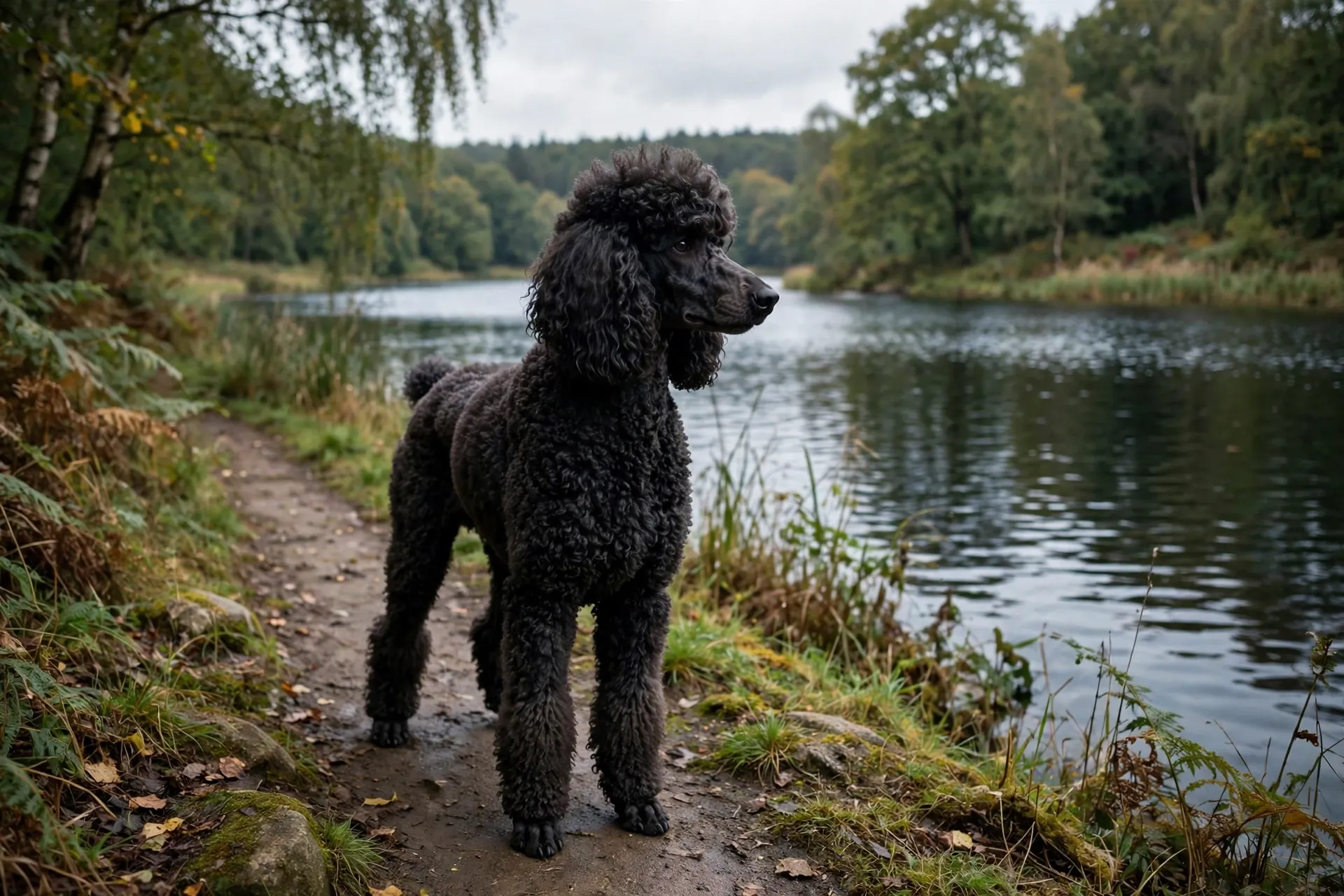
This guide is independent and contains no paid placement. If affiliate links are added later, they will be clearly marked and will not change our editorial checks.
Do not plan a Poodle trip by breed name alone. Plan it by size: a Toy Poodle fits in a carrier and cools quickly, a Miniature Poodle is the most portable all-rounder, and a Standard Poodle needs large-dog space, a serious drying routine and a hotel room that genuinely fits a big, active dog. The coat is the other constant: it sheds less visibly than many coats, but it mats, holds mud and takes time to dry.
Three sizes, three packing lists
Pack for a Toy Poodle and the bag looks almost like hand luggage. A soft carrier that fits under a seat or on a lap, a small fleece, a lightweight raincoat, a slicker brush, a small comb, a collapsible bowl, a short lead and a familiar blanket cover most days. The weight is low, the footprint is small, and the main risks are chilling, being stepped on in a crowd, and a coat that tangles behind tiny ears. The dog can be carried through a busy station, lifted over a stile, and settled on a hotel bed without rearranging the room. That portability is real, and it is also the reason Toy Poodle trips can go wrong in a quieter way: because everything is small, it is easy to underestimate cold, wet ground, long gaps between toilet stops, and the effect of a long day with no rest.
Pack for a Miniature Poodle and the bag grows, but the trip stays flexible. The carrier becomes a medium crate or a proper car restraint, the raincoat is longer, the drying towel is bigger, and the food bag lasts longer. A Miniature Poodle can usually walk the same routes as a larger dog, swim in the same shallow water, and sleep in a standard hotel room without special furniture. This is the size that most closely matches the popular image of a Poodle holiday: a dog that walks all day, dries reasonably fast, fits in most dog-friendly spaces, and still travels well by train and car. The trade-off is that a Miniature Poodle is not a small Standard Poodle in every respect. Leg length, stride, stamina and cold tolerance still differ, and a Miniature that is pushed to match a Standard's walking distance day after day will show it in tiredness, sore paws or reluctance at the door.
Pack for a Standard Poodle and the list changes character. The carrier is replaced by a large crate, a crash-tested harness, or a guarded boot space with a ramp for older dogs. The towel becomes two large towels plus a drying coat. The grooming kit needs a sturdier brush and a comb that can work through a dense, wet coat without pulling. The food bag is heavier, the water bottle is larger, and the hotel question is no longer whether dogs are allowed, but whether the room, the lift, the stairs and the nearest grass area work for a tall, athletic dog that may weigh twenty kilograms or more. A Standard Poodle can cover long, hilly walks, swim strongly and learn quickly, but the dog also needs more floor space, more drying time, more food, and more planning around cars, trains and stairs. Three dogs, one breed name, three completely different trips.
The point of starting with luggage is that it forces the right questions early. How big is the dog, really, not on a breed chart but on a scale and a tape measure? How long is the coat today, and how long will it be on the last day of the trip? How far will the dog walk, and how much of that route is mud, water, steep ground or busy pavement? A Toy Poodle in a long continental clip is a different grooming commitment from a Toy Poodle in a short utility clip, just as a Standard Poodle with a short summer clip is a different drying commitment from a Standard in full show coat. Size sets the container, coat sets the daily workload, and temperament sets the schedule. Get those three right and most of the rest of the trip falls into place.
Size also changes who else the trip affects. A Toy Poodle on a train is easy to keep out of the aisle. A Standard Poodle on a crowded train needs a seat plan, a mat, and a settle that holds through stops, announcements and other dogs. A Toy Poodle in a small hotel room is comfortable. A Standard Poodle in the same room may block the door, crowd the bed, and leave little space for a drying routine. None of this makes one size better than another. It makes size the first filter for every later choice, from the car to the beach to the restaurant table. The rest of this guide works through that filter, size by size, so that the advice fits the dog actually travelling.
The size comparison: what actually changes
Official size bands vary slightly between kennel clubs and show systems, so treat published heights as a guide and measure the individual dog. In broad terms, a Toy Poodle stands under about 28 centimetres at the shoulder, a Miniature Poodle stands roughly between 28 and 38 centimetres, and a Standard Poodle stands over about 38 centimetres, often reaching 45 to 60 centimetres or more. Weight follows the same spread, from a few kilograms for a small Toy to twenty kilograms and above for a large Standard. Those numbers matter because hotels, carriers, crates, harnesses, life jackets, coats and ramps are all sold by measurement, not by breed label. A hotel that allows small dogs may still set a weight limit that excludes a Standard Poodle, and a carrier labelled for Poodles may fit a Toy and be useless for a Miniature.
Walking ability follows size, but not in a simple straight line. Toy Poodles are active, alert dogs, yet their short legs, small paws and faster heat loss mean that long, wet, hilly days cost them more than the distance suggests. A three-mile flat walk with breaks is very different from a three-mile moorland walk with stiles, boggy ground and a cold wind. Miniature Poodles often have the best balance of stamina and portability for a British walking holiday, covering moderate distances comfortably while still being easy to lift, carry and settle. Standard Poodles usually have the greatest stamina and stride length, and they are often the happiest on long, varied routes, provided they are fit, their paws are conditioned, and the day includes water, rest and sniffing time rather than a forced march.
Temperature and weather sensitivity also shift with size. Small dogs lose heat faster relative to body size, so a Toy Poodle in a cold wind or after a swim needs drying and warming sooner than a Standard Poodle in the same conditions. Large dogs, by contrast, can overheat faster on a warm, humid day if they are exercised hard in a thick coat, and they still need shade, water and rest. The practical rule is to dress and schedule for the dog in front of you: a fleece or raincoat for a small, wet or clipped dog; shade and water breaks for a large, active dog; and a drying routine for every size after water or rain. Never assume that a thick-looking curly coat equals warmth when wet, because a soaked coat loses insulation and adds weight.
Social space changes too. A Toy Poodle at ankle height is easy to miss in a busy pub garden, and well-meaning strangers may try to pick the dog up. A Standard Poodle at knee height is harder to miss, but can block a narrow path, lean on strangers, or intimidate a nervous dog simply by size and enthusiasm. Training therefore has a different emphasis by size: for a Toy, the priority is often confidence, safe handling and not being overwhelmed; for a Miniature, it is reliable recall and polite greeting; for a Standard, it is loose-lead walking, calm settling in tight spaces, and a recall that holds when the dog is excited. All three need the same basics, but the failure mode that ruins a trip is different for each.
Finally, size changes cost. A Toy Poodle eats less, needs smaller doses of some treatments, and may travel free or cheaply on some transport, but still needs grooming, insurance and veterinary care. A Standard Poodle eats more, needs larger equipment, may attract a higher pet fee, and can cost more to groom. Budget by the individual dog, not by the breed name, and ask hotels and transport providers for the exact rule that applies to that dog's weight and height. When in doubt, declare the variety, height and weight in writing at booking, and keep the reply with the confirmation. That single habit prevents most size-related surprises on arrival.
The curly coat: low shedding, high maintenance
The most repeated claim about Poodles is that they do not shed, and the most useful correction is that they shed differently. Poodle hair grows continuously, like human hair, and loose hair is often trapped in the surrounding curls instead of falling onto furniture and clothing. The result is less visible shedding around the house and on a car seat, which many allergy-sensitive households value. It is not the same as no shedding, and it is certainly not the same as hypoallergenic in any absolute sense. Allergens are carried in dander, saliva and urine as well as in hair, so a person who reacts to dogs may still react to a Poodle. The honest wording is low shedding, not non-shedding, and anyone travelling with an allergy-sensitive companion should spend time with the breed before booking a shared holiday cottage.
The trade-off for less visible shedding is maintenance. A curly coat mats. It mats behind the ears, under the collar, in the armpits, between the toes, and anywhere a harness rubs. It mats faster when wet, when dirty, and when a dog is left unbrushed for a few days on a busy trip. Mats are not merely cosmetic: tight mats pull on the skin, trap moisture, hide sores and ticks, and can become painful enough to change a dog's behaviour. On a holiday, the risk rises because the dog swims, walks in mud, wears a raincoat or harness for hours, and sleeps in unfamiliar bedding. A coat that was fine at home can become a problem by day three of a wet Lake District week if nobody brushes it properly.
Brushing a Poodle correctly takes longer than brushing a short-coated breed, and the technique matters more than the tool. Work in small sections, lift the coat, and brush or comb down to the skin, not just over the surface. A slicker brush can remove surface tangles, but a metal comb is the honest test: if the comb glides through a section without catching, that section is clear; if it snags, there is still a tangle underneath. Pay special attention to the friction points: behind the ears, under the jaw, the armpits, the groin, the tail base, and the feet. Those are the places where a quick brush-over looks finished and a comb reveals the truth. On a trip, brush in a calm moment, after the dog has toileted and settled, not immediately after an exciting walk when the dog is still buzzing.
Clip length is a travel decision, not just a style decision. A short utility clip, often called a kennel or sporting clip, dries faster, shows mud less, mats less, and makes daily checks easier. A longer clip looks fuller and more traditional, but it holds more water, takes longer to dry, needs more brushing, and can hide grass seeds, ticks and skin problems. For a wet, active holiday, most travelling Poodles are easier in a shorter clip, with the face, feet and tail tidied by a groomer before departure if the owner does not do it at home. If a longer clip is kept for the trip, the daily brushing time must be protected in the schedule, not squeezed into the last five minutes before dinner. Tell the groomer the trip dates, the activities planned, and the coat length that can realistically be maintained away from home.
Ears, eyes and feet deserve their own travel checks. Poodle ears are covered in hair that can trap moisture, and ear canals should be checked regularly for smell, redness, discharge or head shaking, especially after swimming. Do not pluck ear hair aggressively on holiday unless a vet has advised it, because irritation can make a problem worse. Eyes can water in wind and on long walks, and hair around the eyes should be kept clear so it does not rub the cornea. Feet need checking after every muddy or coastal walk: mud balls between the toes, grass seeds, cracked pads, and sand or salt residue all cause limping if missed. A short, calm foot check after each walk, with a rinse in clean water when needed, prevents most of these problems from becoming a vet visit.
Skin is the final part of the coat story. Poodles can be prone to skin sensitivity, and a holiday introduces new shampoo, new bedding, new laundry detergent, pollen, seawater and lake water all at once. Keep the dog's usual shampoo if possible, rinse thoroughly after swimming, and dry the coat rather than leaving it damp under a coat or blanket. If a rash, hot spot or persistent itch appears, do not try a new medicated wash without veterinary advice, and note what changed: a new beach, a new food, a new bed, or a long wet day. That note helps a vet enormously, and it helps the owner avoid repeating the trigger on the next trip. The coat is not a barrier to travel; it is a daily system, and on a Poodle holiday that system is part of the itinerary.
Grooming rhythm on the road: a realistic daily routine
A workable travel grooming routine has four moments: before the walk, after the walk, after water, and before bed. Before the walk, check the coat for existing tangles, fit the harness or coat without trapping hair, and make sure the lead, collar and any buoyancy aid sit comfortably. After the walk, remove mud from feet and legs, check for grass seeds and ticks, and brush any section that has become tangled by a harness or raincoat. After water, rinse with clean water where possible, towel dry, and brush again once the coat is mostly dry, because brushing a soaking coat can break hair and brushing a matted coat dry can hurt. Before bed, do the comb test on the friction points, check ears and feet once more, and settle the dog on clean bedding. The whole routine may take ten minutes for a short-clipped Miniature and thirty minutes or more for a long-coated Standard, and that time should be in the plan.
Pack a grooming kit that fits the coat, not the suitcase. A slicker brush, a metal comb, a small pair of blunt-tipped scissors for cutting out a tight mat safely, a detangling spray, the dog's usual shampoo, a microfibre towel, a drying coat or large towel, and ear-cleaning solution only if the vet has recommended it, cover most trips. Add a tick remover, a small torch for checking dark coats, and a spare lead and collar in case the main set gets soaked. For a Toy Poodle, choose smaller tools and a lighter towel; for a Standard Poodle, choose a sturdier brush and at least two large towels, because one towel will be soaked before the dog is dry. Keep the kit in one bag, accessible without unpacking the whole car, so that a muddy return to a hotel does not become a search through luggage in the rain.
Grooming appointments need forward planning. Most Poodles need professional grooming every four to eight weeks, depending on clip length and coat growth, and a long trip that crosses a grooming date should be planned around it. Book a groom before departure if the trip is long, or find a groomer near the destination for a tidy-up if the stay is extended. Do not book a full clip on the first day of a holiday unless the dog is used to that groomer, because a stressed dog with a new groomer, a new place and a new routine is a recipe for a difficult session. A bath and tidy, with face, feet and sanitary trim, is usually enough mid-trip, and a full restyle can wait until home. If the dog is nervous about grooming, keep the pre-trip groom familiar and unhurried.
Children, other dogs and strangers can undo grooming work in minutes, so set simple rules. Ask children not to hug or lift a small Poodle without permission, and ask other dog owners to keep greetings brief if the coat is freshly brushed and the dog is tired. A harness that fits well, without rubbing behind the front legs, reduces matting and chafing, and a raincoat that fits the body length without bunching under the belly reduces tangles. After a long day, resist the temptation to put a wet dog straight into a crate or car boot and drive home: a wet, matted coat in a warm car becomes a skin problem, and a dog that is dried and brushed travels more calmly. Grooming on a Poodle trip is not vanity; it is comfort, health and the difference between a dog that settles and a dog that scratches all night.
Water lovers, with limits: lakes, rivers and the sea
Poodles were bred as water retrievers, and many of them still love water with an enthusiasm that surprises first-time owners. The breed name itself reflects a history of splashing, retrieving and working in water, and a Poodle that has been introduced to water gradually often paddles, swims and retrieves with confidence. That history is a useful starting point, not a guarantee. Individual dogs vary enormously: some charge into every lake, some paddle only to belly depth, and some dislike getting their feet wet at all. Size affects water too. A Standard Poodle can swim strongly and cover distance, a Miniature Poodle can swim well in calm, shallow water, and a Toy Poodle can be chilled quickly by cold water and can tire sooner than the owner expects. Never assume that a Poodle will swim, and never throw a reluctant dog into water to test the theory.
Choosing water safely starts before the dog gets wet. Check local rules first, because some beaches restrict dogs seasonally, some lakes ban dogs from swimming areas, and some rivers have livestock, fishing or boating rules that affect access; check the official guidance before you travel for the specific beach, lake or river planned. Look for a gentle, non-slip entry, a shallow slope, and an exit the dog can use without scrambling up a steep bank. Avoid fast-flowing water, weirs, strong currents, and water with visible algal blooms, warning signs or heavy boat traffic. Blue-green algae can be dangerous to dogs, and a dog that drinks from a bloom-covered lake can become seriously ill, so if the water looks suspicious, keep the dog out and choose another spot. After heavy rain, rivers can rise quickly and carry debris, and a calm-looking stretch can hide a strong undercurrent.
Buoyancy aids are worth considering for many Poodle trips, especially for Toy and Miniature dogs, older dogs, dogs recovering from injury, and any dog swimming in open or moving water. A well-fitted aid should support the dog without restricting the legs, have a handle for lifting the dog out, and be bright enough to see in the water. Fit it at home first, let the dog wear it on land, and check that it does not rub under the front legs or ride up over the head in the water. Even with an aid, stay close, keep swims short at first, and watch for tiredness: a dog that starts swimming with its head low, that stops wagging, or that struggles to climb out is a dog that needs to come out now, not after one more throw. For more on seasonal beach rules, see our guide to dog-friendly beaches in the UK before choosing a coastal day.
After water, the Poodle routine matters as much as the swim. Rinse the coat with clean water to remove salt, sand, lake residue and mud, towel dry thoroughly, and check ears, feet and skin once the dog is dry. Salt water can dry the coat and irritate skin if left in, and sand trapped between toes causes limping and chewing. Dry the dog before a car journey where possible, and use a waterproof car cover or crate liner so that a wet dog does not soak the car and chill on the drive home. Watch for drinking too much water during retrieval games, because excessive water intake can cause vomiting and, in rare cases, water intoxication, so offer fresh drinking water, take breaks, and keep retrieval sessions short. A tired, cold or over-excited dog should be warmed, dried and rested, not taken straight to another activity.
Lakeside and riverside walks also need land-based planning. Muddy banks, slippery wooden jetties, and steep towpath edges are hazards for all sizes, but a Toy Poodle can be swept off its feet by a current that a Standard Poodle barely notices, while a Standard Poodle can pull hard on a lead near a busy towpath with cyclists. Keep dogs on a lead near roads, locks, weirs and busy cycle paths, use a long line on open lakeside grass where it is allowed, and carry a towel and a spare lead for the return journey. If a dog is allowed off lead, recall must work near water, ducks, swans and other dogs, because a Poodle that chases waterfowl into a lake is a rescue problem, not a photo opportunity. The best water days are planned as water days: a morning swim, a drying and resting break, and a gentle afternoon walk, rather than a swim squeezed between two long hikes.
A clever dog needs a job: enrichment, training and boredom
Poodles are famously intelligent, and intelligence on holiday is a double-edged gift. A clever dog learns a hotel routine quickly, picks up new cues fast, and can be a joy to train on a walk. The same dog, left without a job, will invent one, and the invented job is often barking at corridor noises, chewing a hotel cushion, unzipping a bag, opening a door, or reorganising the contents of a suitcase. Boredom in a Poodle rarely looks like sleepiness; it looks like activity, noise and mischief, often timed for the moment the owner leaves the room. The solution is not more walking alone, but a mix of physical exercise, mental work, sniffing, training and rest, spread through the day so that the dog is tired in the right way.
Build brain work into the daily plan in small, repeatable doses. Scatter feeding, where kibble is scattered on grass or on a snuffle mat, turns breakfast into ten minutes of searching. A short training session, five to ten minutes, on a new cue or a familiar cue in a new place, is more tiring than another mile of walking. A sniffy walk, where the dog is allowed to stop, investigate and choose the route on a long lead, satisfies the need to explore without covering distance. A safe chew, a stuffed food toy, or a puzzle feeder gives the dog a legitimate project in a hotel room. Rotate these through the day rather than saving them all for the evening, because a dog that has had no mental work all day will be at its most inventive when the owner is tired and trying to eat dinner.
Training priorities for a travelling Poodle are practical, not showy. A reliable recall, a settle on a mat, a wait at doors and gates, a loose lead, and a polite greeting cover almost every holiday situation. Practice the settle in different places: a cafe terrace, a hotel lobby, a picnic blanket, a train seat area. The mat becomes a portable safe place, a signal that this is a resting spot, not a play area. Practice recall away from distractions first, then add distance, then add other dogs and water, because a recall that works in a garden may fail at a lake with ducks. For a Toy Poodle, practice being handled calmly, being picked up safely, and settling in a carrier, so that busy places do not become overwhelming. For a Standard Poodle, practice walking past other dogs without pulling, waiting at narrow gates, and settling in a small space without pacing.
Alone time in accommodation needs honesty and preparation. Many hotels and cottages have a rule about leaving dogs alone, and some forbid it outright, so check the rule before booking, not after arrival. A dog that is happy alone at home for two hours may still bark in a new place, because the sounds, smells and routine are different. Build up alone time gradually on the trip: leave for five minutes, return calmly, then ten minutes, then longer, always after exercise, brain work and a toilet break. Leave a safe chew, a familiar blanket, and a radio or television on low if that helps the individual dog, but do not rely on background noise to mask distress. If the dog barks, paces, pants or damages things when left, do not repeat the experiment and hope it improves; change the plan, take the dog along, use a local dog-sitting service if available, or split the group so the dog is not left alone.
Separation distress is different from boredom, and it needs a different response. A bored dog chews when it has energy and opportunity; a distressed dog may howl, drool, pant, try to escape, or refuse food, even when tired. If these signs appear on a trip, reduce alone time, increase settling practice, and seek veterinary or behaviourist advice rather than punishing the behaviour. Punishment after the event does not teach a dog to feel safe alone, and it can make the problem worse. On a short holiday, the kindest plan is often the simplest: keep the dog with the group, choose dog-friendly restaurants and attractions, and save the dog-free activities for another trip. A Poodle that is included in the day, with brain work and rest built in, is usually a calm, funny and remarkably adaptable travel companion.
Transport and rooms by size: cars, trains and hotels
Car travel is where size first becomes a safety question. In the UK, drivers must ensure that a dog is suitably restrained so that it cannot distract the driver or cause injury in a sudden stop, as set out in the Highway Code, and the practical choice is a crash-tested harness, a secured crate, or a boot guard with a dog guard and a non-slip mat. A Toy Poodle may travel in a small carrier secured on the back seat, provided the carrier cannot slide and the dog can lie comfortably. A Miniature Poodle usually needs a medium crate or a well-fitted harness, with a seat cover and a mat to prevent slipping. A Standard Poodle needs a large crate that actually fits the boot, a crash-tested harness on the back seat, or a guarded boot space with a ramp for older or arthritic dogs. Measure the car, the crate and the dog before buying, and test the set-up on a short journey before a long holiday drive.
Journey planning matters as much as restraint. Break long drives every two hours for a toilet stop, water and a short walk, and never leave a dog in a parked car in warm weather, even with a window open. Keep the car cool, ventilated and shaded, and avoid feeding a large meal immediately before a long drive if the dog is prone to travel sickness. For more detail on restraint choices, see our guide to dog car safety, which compares harnesses and crates by dog, car and journey. Pack a travel kit for the car itself: water, a bowl, a lead, a towel, a spare blanket, poo bags, a first-aid kit, and the dog's usual food in a sealed container. A wet, muddy dog in a car without a towel and a cover is a guaranteed mess, and a dog that is uncomfortable in the car will be reluctant to get in again the next day.
Trains, buses and ferries add a second set of size rules. Many UK train operators allow dogs free of charge, but the dog must be kept under control, must not occupy a seat, and may need to travel in a carrier or on a lead at the owner's feet, depending on the operator; check the official guidance before you travel for the specific operator and route. A Toy Poodle in a carrier is usually the easiest train passenger. A Miniature Poodle on a mat at the owner's feet can travel well on a quiet service, but needs a settle that holds through crowded stops. A Standard Poodle on a busy train needs a window seat area, a mat, and a plan for other dogs passing in the aisle, and the owner should avoid peak-time services where possible. For buses, rules vary by operator and local authority, and some services require a carrier or restrict dogs to certain times, so check before relying on a bus for a lakeside return journey.
Hotels, cottages and lodges need the same size-first approach. A hotel that welcomes dogs may still limit the number of dogs per room, charge a per-dog fee, restrict dogs to certain room types or floors, or set a weight limit. A Toy or Miniature Poodle will fit most dog-friendly rooms, but a Standard Poodle may need a larger room, a ground-floor room near an exit, or a room with a tiled floor that is easy to clean after a wet walk. Ask for the exact room type, the pet fee, the alone-time rule, the nearest toilet area, and whether dogs are allowed in the restaurant, bar or breakfast room. For a fuller booking checklist, see our guide to dog-friendly hotels in the UK. In a cottage, check the garden boundary, the gate height, the flooring, and the distance to a safe toilet walk after dark, because a beautiful garden with a low fence is not a secure garden for a determined Poodle.
Stairs, lifts and access complete the picture. A Toy Poodle can be carried up stairs and lifted into a bath, but should not be expected to climb steep, open-tread stairs repeatedly. A Miniature Poodle can usually manage stairs well, but older or arthritic dogs of any size benefit from a ramp or a lift. A Standard Poodle in a hotel without a lift may need a ground-floor room, especially if the dog is older, recovering from surgery, or simply tired after a long walk. Ask about lift size as well as availability, because a large crate or a large dog plus luggage may not fit a small lift. The best room for a Poodle trip is rarely the prettiest room; it is the room closest to the exit, with space for a bed, a mat and a drying routine, and with a toilet walk that does not require a long corridor, a lift and a car park at midnight.
Rain, mud and British weather: the Poodle advantage and the catch
British weather is the Poodle trip in miniature: the coat that looks smart in sunshine becomes a sponge in rain, and the dog that loves water becomes a mud magnet on a wet footpath. The advantage is that Poodles are generally hardy, active dogs that do not mind rain as much as some breeds, and a curly coat does provide some insulation when dry. The catch is that a wet curly coat is heavy, slow to dry, and prone to matting, and a wet dog in a warm hotel room can quickly become a damp, smelly, scratching dog. The solution is a system, not a single product: a raincoat that fits, a drying coat or large towels, a door routine for muddy feet, and a drying space that is ventilated rather than sealed.
Choose rain gear by body length and leg movement, not by breed label. A coat that is too short leaves the belly and legs exposed; a coat that is too long bunches under the belly and rubs. For a Toy Poodle, a lightweight coat that does not overwhelm the dog is best, with a fleece underneath in cold weather. For a Miniature Poodle, a mid-length coat with leg coverage for muddy paths works well. For a Standard Poodle, a longer coat with a belly panel and a drying layer underneath saves the most time, because a large dog can collect an astonishing amount of mud on a single walk. Test the coat on a walk at home, with a harness underneath if that is how it will be worn, and check for rubbing behind the front legs and under the collar. A coat that chafes on day one will be hated by day three.
The door routine is the most valuable habit on a wet trip. Keep a towel, a foot washer or a shallow bowl of clean water, a brush, and a lidded box for muddy leads by the door, whether that door is a hotel room, a cottage or a car boot. On return, wipe feet and legs, check for mud balls between toes, remove any grass seeds, and brush the legs and belly before the mud dries into the curls. Dried mud is harder to remove, pulls more hair, and hides skin problems. If the dog is soaked, towel dry first, then use a drying coat, and ventilate the room: open a window slightly, use an extractor fan, or hang towels where air circulates. A wet dog dried in a sealed, heated room will steam the room and stay damp longer, while a dog dried with ventilation dries faster and settles sooner.
Route choice in wet weather should favour surfaces that stay usable. Surfaced paths, forestry tracks, coastal promenades and park trails hold up better than clay woodland paths, riverside meadows and unpaved farm tracks after days of rain. Ask at a hotel, visitor centre or local shop which walks hold up best in wet weeks, because local knowledge is rarely written down and is often more useful than a map. Carry a spare towel in the car for the return journey, a waterproof bag for wet coats and leads, and a change of socks and shoes for the owner, because a wet owner is less patient with a wet dog. Plan a shorter, drier walk on the wettest day, with a longer walk saved for a better forecast, rather than forcing a long, muddy route that leaves everyone tired and the dog matted.
Seasonal hazards complete the weather picture. Summer heat needs shade, water and rest, especially for a thick-coated or large dog exercised hard. Autumn brings mud, fallen leaves that hide holes and drains, and fireworks that unsettle noise-sensitive dogs. Winter brings cold, ice, road salt that irritates paws, and short daylight that makes evening walks darker. Spring brings pollen, grass seeds and nesting birds that tempt a chase. In every season, check paws after walks, rinse off salt and mud, and watch for limping, chewing at feet, or reluctance to walk. A Poodle that is dried, brushed and checked after every wet walk is a dog that can enjoy British weather rather than endure it, and the owner who builds that routine into the day will spend less time grooming and more time walking.
Packing by size: three checklists that actually fit
For a Toy Poodle, pack light but do not pack thin. A soft carrier, a harness and lead, a small fleece and a raincoat, a slicker brush and comb, a small towel and a drying coat, a collapsible bowl and water bottle, the usual food and treats, a familiar blanket, poo bags, a tick remover, and any medication in its original packaging cover most trips. Add a second blanket for cold nights, a spare lead, and a small first-aid kit. The carrier should be the dog's safe place, not a punishment, so introduce it at home with treats and short journeys before the holiday. In a hotel, the carrier, blanket and bed together create a familiar corner that helps a small dog settle in a new room.
For a Miniature Poodle, add capacity without adding bulk. A medium crate or harness, a longer raincoat, two towels, a drying coat, a larger water bottle, a longer lead and a long line for open grass, a snuffle mat or puzzle feeder, a training pouch, and a grooming kit with a sturdier brush cover a walking holiday well. Add a boot cover or seat cover for the car, a spare towel for the return journey, and a torch for evening toilet walks. A Miniature Poodle can carry a small backpack on a walk in some cases, but weight must be minimal and the dog must be conditioned gradually; never load a small dog with a heavy pack on the first day of a holiday. The goal is a kit that fits in one bag and one car boot space, so that the dog, not the luggage, sets the pace.
For a Standard Poodle, pack for size and drying time. A large crate or crash-tested harness, a ramp if the dog is older, a long raincoat, at least two large towels and a drying coat, a large water bottle and bowl, a longer lead and a long line, a sturdy brush and comb, a tick remover, a first-aid kit, and a waterproof car cover are essentials. Add a spare set of bedding, because a large wet dog can soak a bed in one night, and a lidded box for muddy leads and towels. In a hotel, ask for extra towels on arrival, not after the dog is already wet, and plan where the dog will dry: a bathroom with a tiled floor and ventilation is far easier than a carpeted bedroom. A Standard Poodle trip is not harder than a Toy trip, but it is bigger in every practical dimension, and packing for that scale prevents the small frustrations that accumulate into a difficult week.
Across all sizes, keep three items non-negotiable: identification, health records and a vet contact. A microchip, an ID tag with a mobile number, and a recent photo help if the dog is lost. Vaccination records, insurance details and any medication list help a local vet help the dog quickly. Save the nearest vet and an emergency vet number for the destination before departure, and note any known allergies, conditions or triggers in the phone. These items weigh nothing, cost nothing, and matter enormously on the one day they are needed. A well-packed Poodle trip is not about owning every product; it is about having the right size, the right coat routine, and the right plan for water, weather and brain work, so that the dog can enjoy the trip as much as the owner.
Practical questions
Before you go
Are Poodles really hypoallergenic and low shedding?
Poodles shed less visibly than many breeds because loose hair is often caught in the curly coat, but no dog is truly hypoallergenic. Allergy risk depends on the person, the coat condition and the home, so sensitive travellers should test time with the breed and keep bedding washed.
How often should a travelling Poodle be brushed?
Brush a longer coat daily on a trip and a shorter clip every two to three days, working in sections down to the skin. After swimming, mud or rain, brush again once the coat is dry, because damp curls mat fastest behind the ears, under the collar and in the armpits.
Can a Poodle swim on a UK holiday?
Many Poodles enjoy paddling and swimming, but water confidence varies by dog and size. Choose a gentle entry, check local rules and water safety notices before entry, use a well-fitted buoyancy aid for weak or small swimmers, and rinse and dry the coat afterwards.
What size carrier or crate does a Poodle need for travel?
The dog must be able to stand, turn and lie down comfortably, with room for a mat but not so much space that the dog slides around. A Toy Poodle may travel in a small carrier, a Miniature in a medium crate, and a Standard usually needs a large crate or a crash-tested harness on the back seat.
How do I stop a bored Poodle being destructive in a hotel?
Plan brain work into the day: scatter feeding, a training session, a sniffy walk and a safe chew, then a calm settle before leaving the room. Never leave a distressed dog alone to practise barking, and ask the hotel in advance about its alone-time rule and any dog-sitting option.
Do Standard Poodles count as large dogs in hotels?
Many hotels treat a Standard Poodle as a large dog for room size, pet fees and dog-number limits, while Toy and Miniature Poodles usually fall in the small-dog category. Always declare the exact variety and weight at booking, because policies are set by the property, not by breed name alone.


