This guide is independent and contains no paid placement. Local rules, parking arrangements and access can change, so check the official guidance before you travel.
Plan Porlock around the hill, not around the postcard. Use the gentler approach if the steep road worries you, keep the dog on a lead near roads, boats and livestock, save the return climb for when the dog still has energy, and treat Porlock Weir as a tidal harbour to visit slowly rather than a beach to run on.
The hill that shapes the trip
Most visitors meet Porlock twice: once as a name on a map of Exmoor, and once as a sudden change in the road under their wheels. Porlock Hill, on the A39 between Minehead and Porlock village, is one of the most talked-about descents in England, not because it is long, but because it is steep, twisting and impossible to ignore. The gradient reaches about one in four at its steepest, which means that for every four metres travelled forward, the road drops roughly one metre. That is a serious slope for any vehicle, and it is a serious piece of planning for anyone travelling with a dog.
For the driver, the challenge is control. A steep descent punishes speed, heats brakes and rewards a low gear chosen before the slope begins rather than halfway down it. Heavy vehicles, vehicles towing trailers, and vehicles carrying a full holiday load all feel the gradient more, and the road gives little room for hesitation: bends arrive quickly, the verge is not a refuge, and traffic coming the other way has its own climb to manage. For the walker, the challenge is different but just as real. Porlock village sits in a hollow below wooded hills, so a walk that starts with a cheerful downhill stretch almost always ends with a climb back to the car, the cottage or the start of the route. Dogs do not complain about gradients in words, but they show it in slowing steps, in more frequent pauses, and in a reluctance that is easy to misread as stubbornness when it is really tired legs.
The sensible response is to treat the hill as the first walk-planning decision, not as an afterthought. Decide how you will arrive before you decide where you will walk. Decide how the dog will travel: secured, settled, with water available at the stop before the descent and a toilet break taken in good time, not rushed on a narrow verge. Decide, too, how the day will end. A dog that has spent an hour sniffing along the harbour, wading through shingle and climbing back toward the village will be a different dog from the one that set out in the morning. If the return climb is the hardest part of the day, it should happen while the dog still has energy and while daylight, weather and patience are all still on your side.
None of this makes Porlock difficult in the sense of being unwelcoming. On the contrary, the hill is part of why the village feels so sheltered and so separate from the faster roads to the east. The wooded slopes that make the descent dramatic also shelter the village from wind, hold the lanes in shade on a hot day, and give the whole place a sense of arrival that a flat approach could never provide. The trick is simply to respect the slope in both directions: drive it, or avoid it, with a plan, and walk it with the return leg in mind from the first step.
Getting in without the steepest road
There is no need to prove anything on Porlock Hill. The well-known alternative is the toll road, a narrower, gentler route that climbs and descends more gradually through woodland to the west of the main hill. It is a private road, so a toll is charged, and its character is quite different from the A39: quieter, greener, with fewer large vehicles and a pace that suits a cautious driver and a nervous passenger, canine or otherwise. The trade-off is width. Passing places matter, and a driver who is uncomfortable reversing into a passing place on a wooded lane may prefer the wider main road after all. Check the official guidance before you travel for current toll arrangements, seasonal availability and any vehicle restrictions, because a private road can change its terms without the fanfare of a main-road closure.
The other straightforward alternative is to approach from the east, from Minehead, which is roughly six miles away along the coast road. That route still involves hills, as any Exmoor coast road does, but it avoids the single famous descent into Porlock from the south. It also puts useful facilities within easy reach: fuel, shops and veterinary practices are concentrated in Minehead, and for a visitor staying in Porlock, knowing that a larger town is a short drive away is reassuring in a way that no amount of village charm can replace. If the dog is unwell, if a lead breaks, if the weather turns, the eastward road is the practical escape route, and it is worth driving it once in daylight so that it feels familiar if it is ever needed in a hurry.
Whichever approach is chosen, a few driving habits make the journey kinder for a dog. Secure the dog properly, keep the car cool and ventilated, and avoid feeding a large meal immediately before a steep, winding descent, which is a common trigger for travel sickness. Stop before the hill, not on it, for water and a toilet break, and let the dog settle again before moving off. A dog that arrives calm is far more likely to enjoy the village lanes than a dog that arrives stressed, panting and desperate for a break. The hill, in other words, is not just a road problem; it sets the mood for the whole visit, and a calm arrival is worth ten minutes of extra driving.
Walkers without a car face a different version of the same question. Bus services in this part of Exmoor are limited and seasonal, so check the official guidance before you travel rather than assuming a frequent service. If public transport is part of the plan, build slack into the day: a missed connection with a tired dog on a hillside is a much bigger problem than a missed connection in a town. Porlock rewards slow travel, but slow travel still needs a timetable.
The village at walking pace
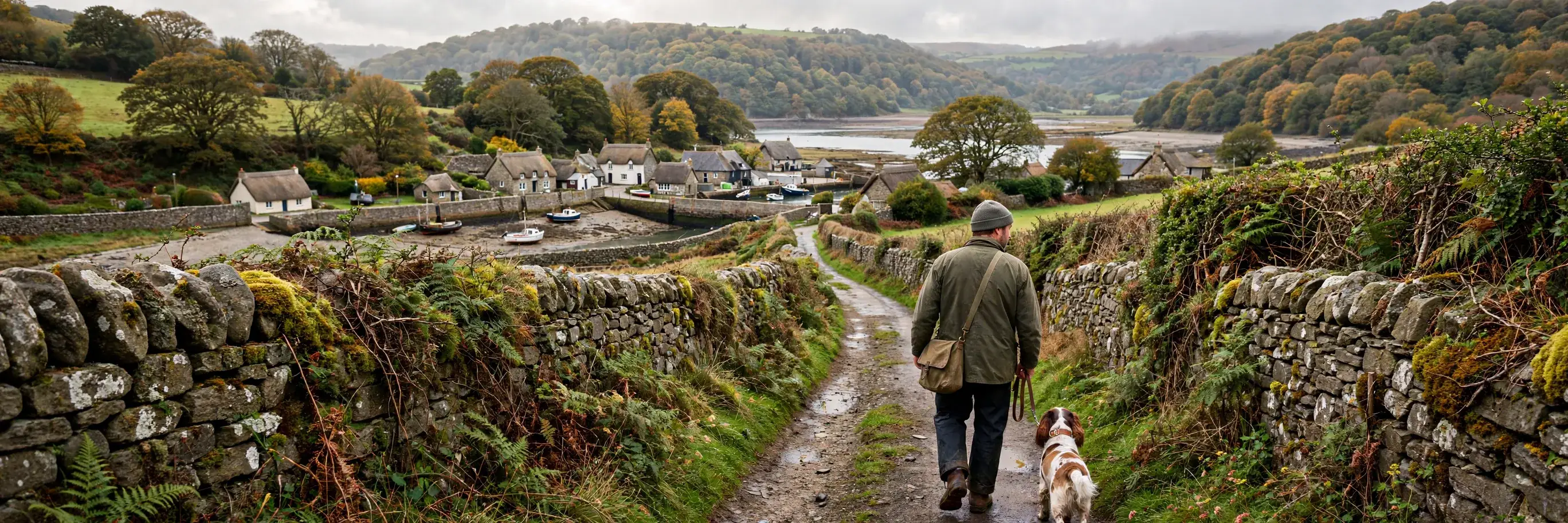
Once the hill is behind you, Porlock changes tempo completely. The village is small, walkable and best understood on foot with a dog on a short lead. Thatched cottages, stone walls and narrow lanes give it a compact, enclosed feel, and the main street carries enough through-traffic to make pavement manners matter: keep the dog close, keep to the pavement where one exists, and be ready for cars, delivery vans and other dogs appearing around corners. This is not a village green with acres of open grass in the centre; it is a working village whose charm comes from its buildings, its gardens and the wooded hills rising directly behind it.
A slow village loop is the right first walk for most dogs, and it is the right test for any longer walk planned later in the day. Start gently, let the dog sniff the walls and gateways, and watch how it handles the surfaces. Stone lanes can be uneven, and after rain they can be slippery; a dog that is unsteady on wet stone will also struggle on wet shingle at the harbour and on muddy moorland tracks. The village loop also reveals the dog's real energy level, which is often different from its excitement level at the car. A dog that pulls hard for the first five minutes and then settles into a steady sniffing pace is ready for a longer outing; a dog that is still frantic after twenty minutes may be overstimulated rather than under-exercised, and a longer walk will not fix that.
For older dogs, small dogs and dogs recovering from injury, the village itself is a complete outing. A loop of the lanes, a pause on a bench, a drink, and a slow return is a genuinely satisfying walk, and there is no rule that says a good dog day must involve a summit. Porlock's lanes offer shade in summer, shelter in wind, and plenty of smells without the exposure of the open moor. For puppies, the same loop is valuable socialisation in miniature: people, traffic noise, other dogs at a distance, and the general business of a village, all at a pace the owner can control. Keep encounters short, keep the lead short near junctions, and reward calm behaviour rather than dragging a reluctant puppy past every new sight.
Eating and drinking with a dog in Porlock follows the usual pattern for a small Exmoor village: some places welcome dogs in particular areas, others do not, and policies can change with the season or the management. Do not assume that a place which welcomed dogs last year still does, and do not assume that a water bowl outside means dogs are welcome inside. Ask before entering, keep the dog under the table or on a mat rather than in a walkway, and have a backup plan for a takeaway or a picnic if the dog is tired, wet or muddy. A calm dog that has already had its walk is a much easier cafe companion than a dog that has been waiting in the car while its owners eat.
Porlock Weir: tide and shingle
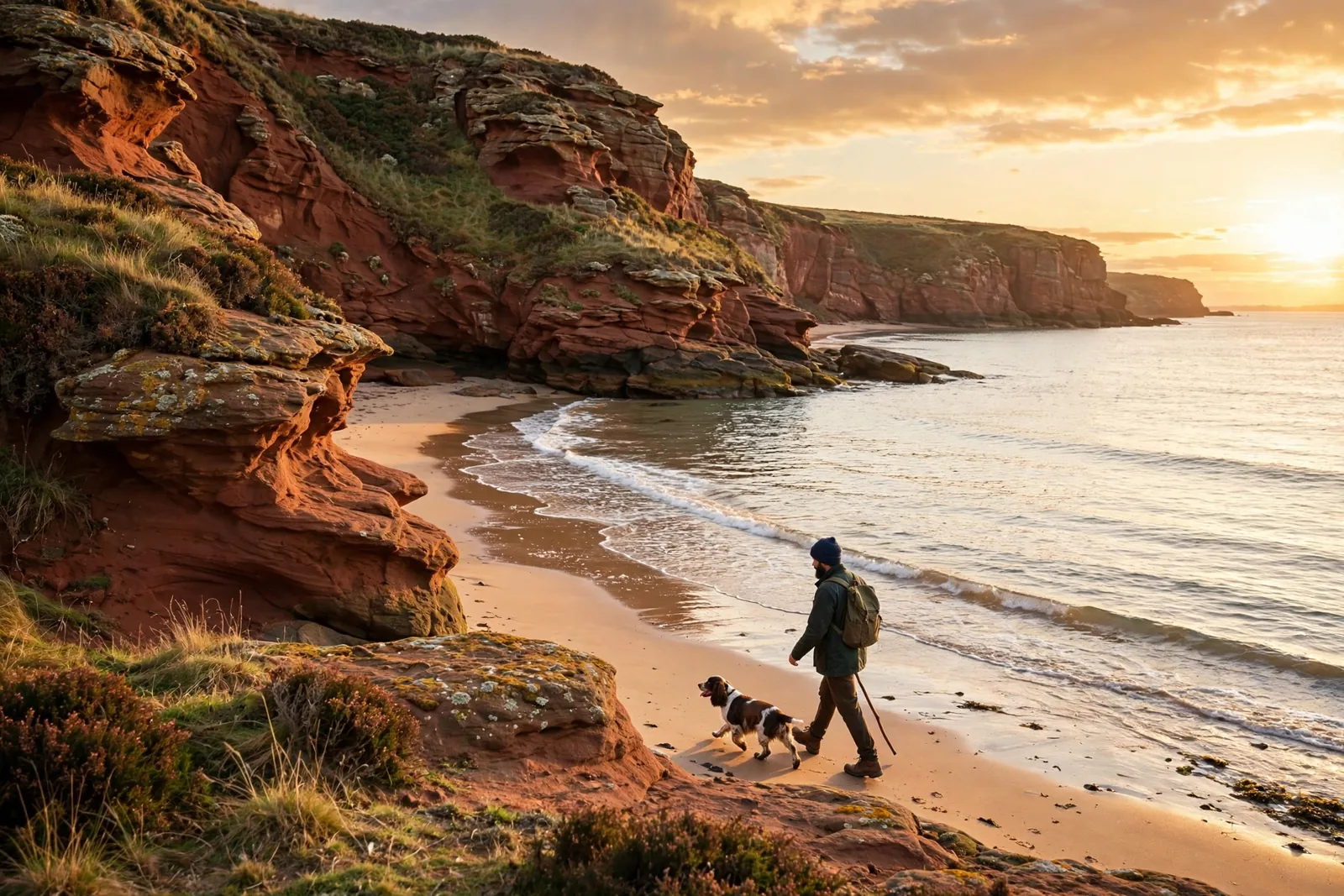
Porlock Weir, roughly a mile and a half west of the village, is where Porlock stops being inland and becomes coastal. The walk between the two is one of the great short dog walks in Somerset, but it should be understood for what it is: a lane and path walk with a downhill outward leg and an uphill return, carrying traffic in places, and ending at a small working harbour rather than a sandy beach. The harbour itself is tidal, which changes its character completely through the day. At high tide, boats float, water laps against the quay and the scene looks like a postcard; at low tide, boats sit on the shingle, the harbour dries out, and the shore becomes a wide expanse of pebbles, rock pools and muddy patches that dogs find endlessly interesting and owners find endlessly muddy.
That tidal rhythm should shape the visit. Arriving at high tide gives a prettier harbour and a shorter, cleaner walk along the quay, but less shore to explore. Arriving as the tide falls gives the dog more ground to sniff, but also more hazards: slippery weed-covered rock, sharp shells, fishing lines, discarded hooks and the general debris that a working harbour accumulates. Keep the dog on a lead around boats, slipways, mooring lines and parked vehicles, and keep a close eye on what it picks up from the shingle. A dog that scavenges on a beach can swallow fish remains, bait or broken shell in seconds, and the nearest vet is not next door. Check the official guidance before you travel for tide times on the day of the visit, because a harbour that is full at lunchtime may be empty by mid-afternoon, and the walk back should not be started at the moment the dog is wettest and tiredest.
The shore at Porlock Weir is shingle, not sand, and that matters for paws, joints and stamina. Shingle shifts underfoot, so a dog works harder for every step than it does on a firm path, and a long shingle walk can tire a small or older dog surprisingly quickly. It also throws up stones when a dog runs, and a dog that charges across loose pebbles risks a twisted leg or a cut pad. A slow, sniffing pace on a long line, where it is safe and permitted, suits the shore far better than a sprint. Bring a towel for the return journey, because a dog that has paddled at the water's edge will bring a mixture of salt water, mud and small stones back into the car or cottage, and salt left on a coat can irritate skin if it is not rinsed off later.
The harbour is also a place for manners. Porlock Weir is small, and people live and work there. Boats are not playground equipment, mooring lines are not toys, and a dog that runs onto a slipway or barks at a boat owner from a quay is not being friendly, it is being a nuisance in a confined space. Keep the dog close, clean up promptly, and remember that the harbour's appeal is its working character. Visitors who treat it like a quiet beach, with the dog under control and the noise down, are the ones who keep it welcoming. For a broader sense of which shores allow dogs and when, the rules change by season and by local order, so it is worth reading our guide to dog-friendly beaches in the UK and their 2026 rules before assuming that a coastal walk has the same rules all year round.
Finally, think about the walk back before the walk out. The return from Porlock Weir to the village climbs, and it climbs after the dog has already spent its energy on the shore. Build in a rest at the harbour, offer water, and start back while the dog is still willing rather than waiting until it is exhausted. If the dog is small, carry it for a short stretch if needed; if the dog is large and stiff, allow extra time and frequent pauses. The best Porlock Weir visit is not the longest one, it is the one where the dog walks home as happily as it walked out.
Toward Dunkery Beacon
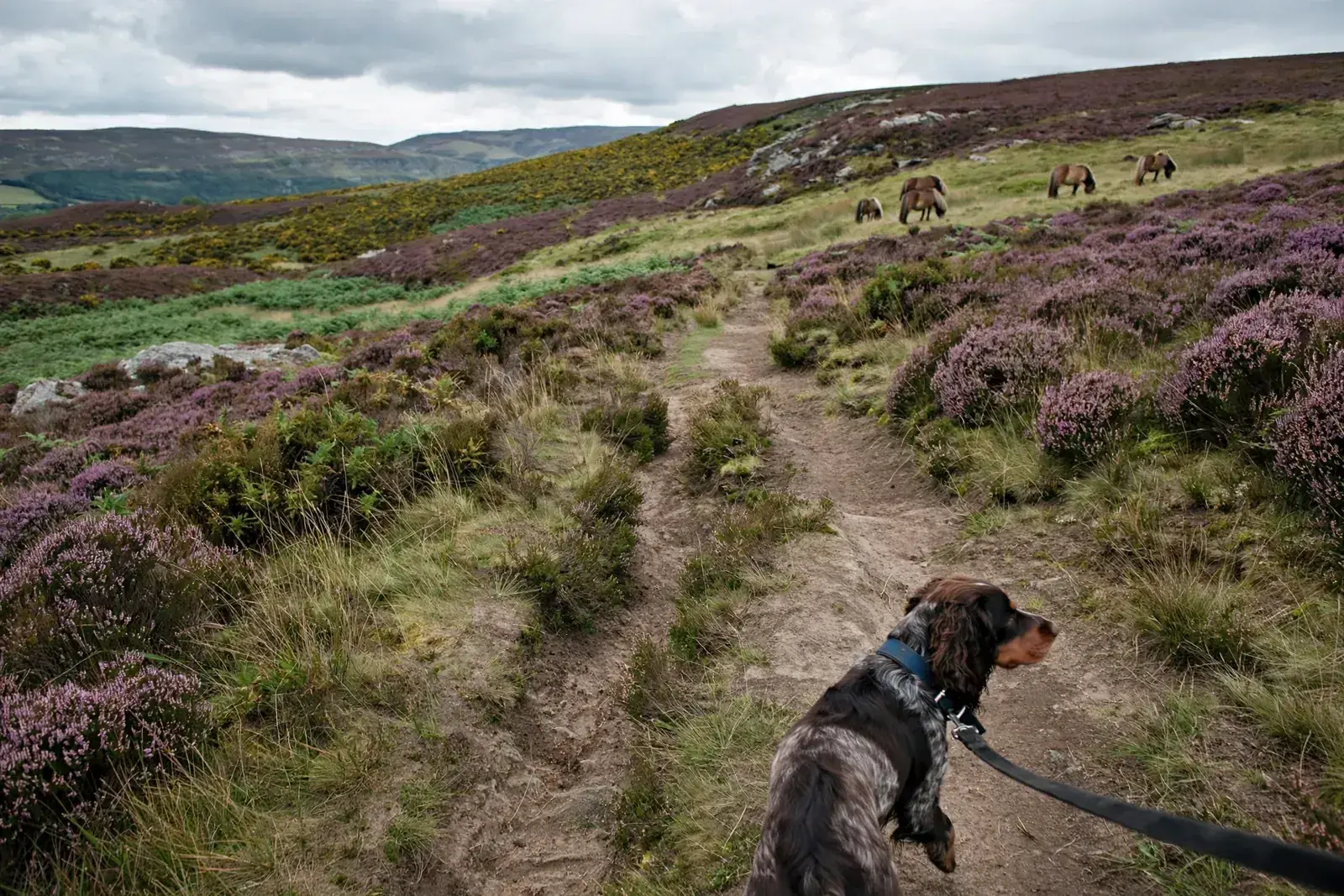
From Porlock, the moor rises to the south and east toward Dunkery Beacon, the highest point on Exmoor at 519 metres, and the direction of that walk tells you most of what you need to know about its difficulty. This is not a gentle hill walk with a cafe at the top; it is an open moorland outing with exposed ground, changeable weather, livestock and long stretches where the only landmarks are tracks, heather and sky. That openness is exactly its appeal. On a clear day, the views from the Dunkery ridge reach across the Bristol Channel, over the Somerset coast and deep into Exmoor, and a dog that loves open running will find the moor intoxicating. On a misty day, the same ground can feel featureless and disorienting, and a dog off the lead in fog is a dog that can vanish into bracken in seconds.
Choosing the approach is the key decision. A full walk from Porlock village to the beacon and back is a long outing, several miles each way with a substantial climb, and it should be attempted only by fit dogs on cool days with plenty of water and a realistic turnaround time. A far more forgiving option is to drive to a higher starting point on the moor road, which shortens the climb and leaves the walk itself as a ridge and summit outing rather than a valley-to-summit expedition. That higher start does not make the walk easy: the ground is still open, still exposed to wind, and still crossed by livestock, but it removes the steepest and longest part of the ascent, which is often the part that defeats an older dog or a dog that is fit for an hour but not for a morning.
Whichever approach is chosen, the moorland rules are non-negotiable. Keep the dog on a lead near livestock, and that means sheep, cattle and the free-roaming Exmoor ponies, not just the animals that look nervous. Ponies may look gentle, but they can kick, and a dog that chases a pony or a deer can cause panic, injury and, in the case of livestock worrying, serious legal consequences for the owner. Keep a wide distance from ponies and red deer, especially in spring when foals and calves are present and in autumn during the deer rut, when stags are unpredictable. Use a long line on open ground only where there is no livestock nearby and where the dog's recall is genuinely reliable, not merely hopeful. Our wider Exmoor guide for dogs covers ponies, red deer, ticks and livestock rules in more detail, and it is worth reading before any moorland walk in this area.
Navigation and weather deserve the same respect as livestock. Carry a map, not just a phone, because signal on the moor is unreliable and a phone battery dies faster in cold wind. Tell someone the route and the expected return time. Dress for wind and rain even if the village is sunny, because the beacon can be ten degrees colder and much windier than Porlock below, and a short-coated dog that is comfortable in the village may need a coat on the ridge. Carry more water than seems necessary: moorland streams may be dry in summer, may be muddy after rain, and should not be relied on as the dog's only drink. Check the dog for ticks after any walk through bracken or long grass, especially from spring to autumn, and remove any tick promptly with a proper tick remover.
The summit itself is a cairn on open ground, not a viewpoint with fences and facilities, so plan the top as a pause rather than a destination with services. Offer water, let the dog rest on a lead, take the photograph, and start back before the dog cools down too much in wind. Many moorland problems happen on the descent, when tired legs meet uneven ground, so keep the pace steady and the lead ready. A Dunkery walk done well ends with a dog that is tired, clean enough to travel home, and still keen for a short evening stroll in the village. A Dunkery walk done badly ends with a dog carried, limping or lost in fog, and the difference is almost always the planning done before the car door opened.
Porlock Marsh and its birds
Between Porlock Weir and the open sea lies Porlock Marsh, a flat, wet, reed-fringed landscape that looks nothing like the village lanes or the high moor, and that is precisely why it deserves its own section. The marsh formed where a shingle ridge was breached, allowing the sea to flood low-lying ground behind it, and the result is a mosaic of saltmarsh, freshwater pools, ditches and grazing land that changes with the tide, the season and the rainfall. For a dog, it is a paradise of smells: waders, ducks, geese, herons and egrets in season, plus the everyday scent of cattle and sheep grazing the marsh grass. For the birds, a loose dog is a predator, and the difference between a good marsh walk and a damaging one is almost entirely about lead control.
The rule for the marsh is simple: keep the dog on a lead, stay on marked paths, and keep well away from flocks, roosting birds and any area where birds are clearly agitated. Ground-nesting birds are at their most vulnerable in spring and early summer, when a single disturbance can cause a nest to be abandoned, but winter is sensitive too, because waders and wildfowl that have flown long distances need to feed and rest without being flushed repeatedly. A dog that runs through a flock, even playfully, burns the birds' energy reserves and can separate young birds from their parents. This is not a case where a well-behaved dog is an exception; even a calm dog looks like a threat to a bird, and the marsh is one of the few places where the owner's judgement matters more than the dog's temperament.
The ground itself also demands care. Porlock Marsh is wet, and wet in the way that soaks boots, fills ditches and turns paths to mud after rain. Some paths are firm and surfaced, others are grassy tracks that become slippery and waterlogged, and the ditches that drain the marsh are deeper than they look. Keep the dog out of deep ditches, both for safety and because ditch water can carry agricultural runoff and, in warm weather, the risk of blue-green algae in standing water cannot be ruled out. If the dog does get into standing water, rinse it off afterwards and watch for stomach upset. In summer, add biting insects to the list: marsh midges and flies are a genuine nuisance for dogs with thin coats or sensitive ears, and a dog that is constantly shaking its head is not enjoying the walk, however beautiful the light over the reeds may be.
For birdwatchers with dogs, the marsh offers a compromise that works well: walk the dog first, on a lead, along a firm path, and then pause at a viewpoint where the dog can lie down and settle while the owner watches. A settled dog, lying quietly on a mat with a chew or a long-lasting treat, is far less disruptive than a dog pacing at the end of a lead. Bring binoculars, not just a phone camera, because the best marsh birds are often distant, and a dog owner who is scanning the horizon is less likely to let the lead drift toward a flock. Early morning and late afternoon are often the best times for birds and the quietest times for people, but they are also the times when light fails fastest, so carry a torch and a reflective lead or coat for the dog if the walk might run into dusk.
Finally, treat the marsh as a seasonal place rather than a year-round constant. In winter, after storms, paths may be closed or flooded; in spring, access may be restricted to protect nesting birds; in summer, the marsh can be dry in places and lush in others. Check the official guidance before you travel for any current restrictions, closures or grazing arrangements, and be prepared to change the plan. A marsh walk that is skipped because the birds need peace is not a wasted day; the village lanes, the harbour at a different tide, or a woodland walk inland will still be there, and the birds will be, too, if visitors give them room.
Three walks for different dogs
The best way to use Porlock is to match the walk to the dog, not the dog to the walk. Three outlines below cover most visitors, and each can be shortened, lengthened or swapped for a rest day without any sense of failure. All three assume a lead near roads, livestock and the harbour, water carried from the start, and a return leg planned before setting out.
The first walk is the village and harbour outing, roughly three miles there and back, and it suits most dogs, including older dogs that are still mobile, puppies that are learning the world, and dogs that are new to Exmoor. Walk from the village to Porlock Weir, pause at the harbour, and return the same way, with rests built in. The outward leg is mostly downhill, the return is uphill, so start back while the dog is still fresh. Allow at least two hours including stops, more if the dog is a slow sniffer, and treat the harbour as a destination to sit and watch rather than a beach to charge across. This walk is also the best test walk: if the dog handles the shingle, the lane traffic and the return climb well, a longer moorland walk the next day is realistic; if it struggles, the village lanes alone are a perfectly good holiday.
The second walk is the woodland and valley option, heading inland and uphill into the wooded combes behind Porlock rather than out to the coast. These valley walks offer shade, shelter from coastal wind, softer ground under trees, and fewer open encounters with livestock, although sheep and ponies can still appear on valley tracks. Distances here are flexible: a short valley loop of two to three miles suits a medium-energy dog, while a longer valley walk that climbs toward the moor edge can stretch to five or six miles for a fit dog. The key feature is gradient: valley walks climb steadily rather than steeply, which suits dogs that tire on sharp slopes but can manage a long, gentle ascent. After rain, valley paths can be muddy and tree roots can be slippery, so choose footwear and a lead length that allow the owner to stay upright while the dog investigates.
The third walk is the moorland walk toward Dunkery Beacon, and it should be reserved for fit, experienced dogs on a cool, clear day. From the village, this is a long outing; from a higher starting point on the moor road, it becomes a ridge walk of a few miles with a summit pause. Either way, the dog should be comfortable with open ground, wind, livestock at a distance, and a long period without shade or water sources. This is not a walk for a brachycephalic dog in warm weather, a puppy still building stamina, or a dog whose recall fails around ponies. Turn back at a fixed time rather than at a fixed distance: if the dog has not reached the summit by the planned turnaround time, the summit will still be there another day, and the dog will be safer for the decision. A moorland walk that ends early with a happy dog is a success; a moorland walk that pushes on to the cairn with an exhausted dog is not.
Across all three walks, the same practical details apply. Poo bags should be carried out, not left by a path or hung on a branch, and a spare bag is worth its negligible weight. A long line is useful on open ground where it is safe, but it should be shortened near roads, gates, livestock and other walkers, and never used as a substitute for recall training. A harness that fits well beats a collar for a strong puller on a downhill lane, and a harness with a handle helps an older dog over stiles and shingle. Finally, keep a note of where the car is parked and how to get back to it without retracing a steep descent in the dark; Exmoor lanes look very different at dusk, and a tired dog and a tired owner are a poor combination for navigation.
Seasons, water and paws
Porlock in spring is a village waking up: lambs in the fields, birdsong in the valley woods, and moorland tracks that are still soft from winter rain. For dogs, spring is also the season of greatest sensitivity around livestock and ground-nesting birds, so leads matter more, not less, just because the weather is kinder. Spring mud is deceptive, too: a path that looks firm can hide a boggy patch, and a dog that runs through a muddy gateway can strain a leg on hidden ruts. Carry a towel, expect to wash paws, and check for ticks as the bracken grows, because tick season on Exmoor runs from spring into autumn and a tick found early is a tick dealt with easily.
Summer brings the opposite problem: heat, and the need to plan around it. Porlock's wooded lanes offer shade that the open moor does not, so a summer walk should start early, use valley shade, and avoid the exposed Dunkery ridge in the middle of the day. Dogs cool themselves by panting, and a dog that is panting hard, drooling excessively or seeking shade constantly is telling its owner to stop, not to push on to the next viewpoint. Never leave a dog in a parked car on a warm day, even with a window open, and never assume that a stream will be flowing in a dry summer: carry water for the dog and for the owner, and offer it little and often rather than waiting for a single long drink at the end. Shingle at Porlock Weir can also be hot underfoot in strong sun, although the sea breeze usually keeps it cooler than an inland beach, and a dog that is hopping between pebbles is not being fussy, it is in discomfort.
Autumn is, for many dog owners, Porlock's best season. The crowds thin, the light softens, the moor turns russet with heather and bracken, and the air is cool enough for a fit dog to enjoy a long walk without overheating. Autumn also brings its own hazards: fallen leaves hide mud, roots and rabbit holes; fungi appear in woodland and some species are toxic if eaten, so a dog that scavenges should be watched closely on valley paths; and the deer rut in autumn makes stags unpredictable, which is another reason to keep a wide distance and a short lead on the moor. Fireworks around early November can unsettle noise-sensitive dogs, so a cottage stay that includes a fireworks weekend should include a safe indoor retreat, familiar bedding and a plan to keep the dog inside during displays.
Winter in Porlock is quiet, wet and beautiful in a stark way, but it is not a season to underestimate. Short days mean that a walk planned for the afternoon can easily run into dusk, and dusk on a moorland track or a shingle shore is no place to be without a torch and a reflective coat. Rain swells streams, floods valley paths and makes Porlock Hill itself more demanding to drive, with wet leaves and standing water adding to the gradient's challenge. A dog that gets wet on a winter walk needs to be dried and warmed promptly; a wet coat left to dry in a cold cottage can chill a small or older dog quickly. On the other hand, winter has real advantages: empty lanes, empty harbour quays, and a village that feels entirely local, and a dog that loves cold air and mud will enjoy winter Porlock more than any summer visitor could guess.
Practical checks before you go
A Porlock trip goes smoothly when a handful of practical checks are done before departure, not discovered on arrival. First, confirm the accommodation's dog rules in writing: how many dogs are accepted, whether there is a size or breed condition, whether the dog can be left alone and for how long, and where the dog is allowed to toilet after dark. Do not rely on a listing headline that says dog-friendly, because that phrase covers everything from a cottage with an enclosed garden to a room where the dog must stay in a crate. Check the official guidance before you travel for any local access changes, path closures or seasonal restrictions that affect the walks planned.
Second, plan for the nearest vet. The nearest town with veterinary practices is Minehead, roughly six miles east of Porlock, and practices there keep their own opening hours, which vary by day and season. Save the practice details and an emergency number before the trip, and note the driving time in both directions, because a dog that needs attention after a harbour incident or a moorland injury should not be waiting while its owner searches for a phone number. If the dog takes regular medication, pack more than the trip requires, keep it in its original packaging, and carry a note of the dosage and the prescribing practice, in case a local vet needs to help.
Third, think about the car as part of the dog's day. Porlock's lanes and harbour area have limited parking, and a car parked far from the walk start means a longer walk before the walk begins, which matters for an older dog. Arrive early in peak season, be prepared to walk a short distance from the car, and never leave a dog unattended in a car in warm weather. Keep a towel, a spare lead, a bowl and a bottle of water in the car at all times, because a Porlock day that starts in the village can easily end at the harbour, on the moor or in a muddy valley, and the car is the base that has to serve all three.
Finally, pack for the dog, not just for the photographs. A well-fitting harness, a short lead and, where appropriate, a long line; a coat for a short-coated or older dog in wind and rain; a tick remover and a basic first-aid kit including a bandage and saline for cleaning a cut pad; poo bags and a spare roll; a familiar bed or blanket for the cottage; and food measured for the trip plus a little extra. None of this is glamorous, but it is the difference between a trip that adapts to Porlock's hills, tides and weather and a trip that is derailed by the first muddy paw or the first unexpected climb. Porlock does not demand specialist equipment, it demands a little foresight, and a dog whose owner has thought about the hill, the harbour and the return leg will enjoy all three far more.
Practical questions
Before you go
Is Porlock Hill safe to drive with a dog in the car?
It depends on the vehicle, the load and the driver. Porlock Hill is famously steep, so many drivers prefer the gentler toll-road alternative or approach from Minehead, and dogs should be secured and settled before any steep descent. Check the official guidance before you travel and do not attempt the hill in a heavily laden vehicle if you are unsure.
Can dogs walk from Porlock village to Porlock Weir?
Yes, the walk is roughly a mile and a half each way and suits many dogs, but it is not flat: there is a climb on the return leg, the lane carries traffic in places, and the harbour shore is shingle. Keep the dog on a lead near the road and around boats, carry water, and allow extra time for the walk back uphill.
Should dogs be on a lead at Porlock Weir and Porlock Marsh?
Use a lead at the harbour, around boats and slipways, and on the marsh. The marsh is sensitive ground for birds, the harbour has moving vehicles and mooring lines, and the shingle shore can hide fishing gear. A short lead gives control without stopping the dog from sniffing and watching the water.
Is Dunkery Beacon a realistic walk with a dog?
For a fit dog on a cool day, yes, but choose the approach honestly. A full walk from Porlock village is a long moorland outing with exposed ground and livestock, while a higher starting point shortens the climb considerably. Check the official guidance before you travel, carry water, and turn back early if the dog is tiring or the weather closes in.
What is the hardest part of a Porlock walk for older dogs?
Usually the return climb rather than the distance itself. Porlock sits in a hollow, so many pleasant outward walks are downhill and the way home is uphill. Older or stiff dogs do better on a short, level village loop, a slow harbour visit with rests, or a drive to a higher starting point so the walk itself stays gentle.
What should I pack for a Porlock day out with a dog?
Water and a bowl, a lead and a long line for open ground where it is safe, a towel for shingle and mud, poo bags, a tick remover, and a warm layer for the dog in cold wind. Add a charged phone, a map, and the details of the nearest vet in Minehead, and check the official guidance before you travel for any local restrictions.