This guide is independent and contains no paid placement. If affiliate links are added later, they will be clearly marked and will not change our editorial checks.
Portree is the best base on Skye for a dog trip: it has the island's largest choice of stays, shops and places to eat, and sits in the middle of the island, so the Trotternish cliffs and the Cuillin are both day trips. Plan one big walk a day, keep the dog on a lead around the harbour and on cliff paths, and save the evening for a slow circuit of the painted waterfront.
The harbour sets the plan
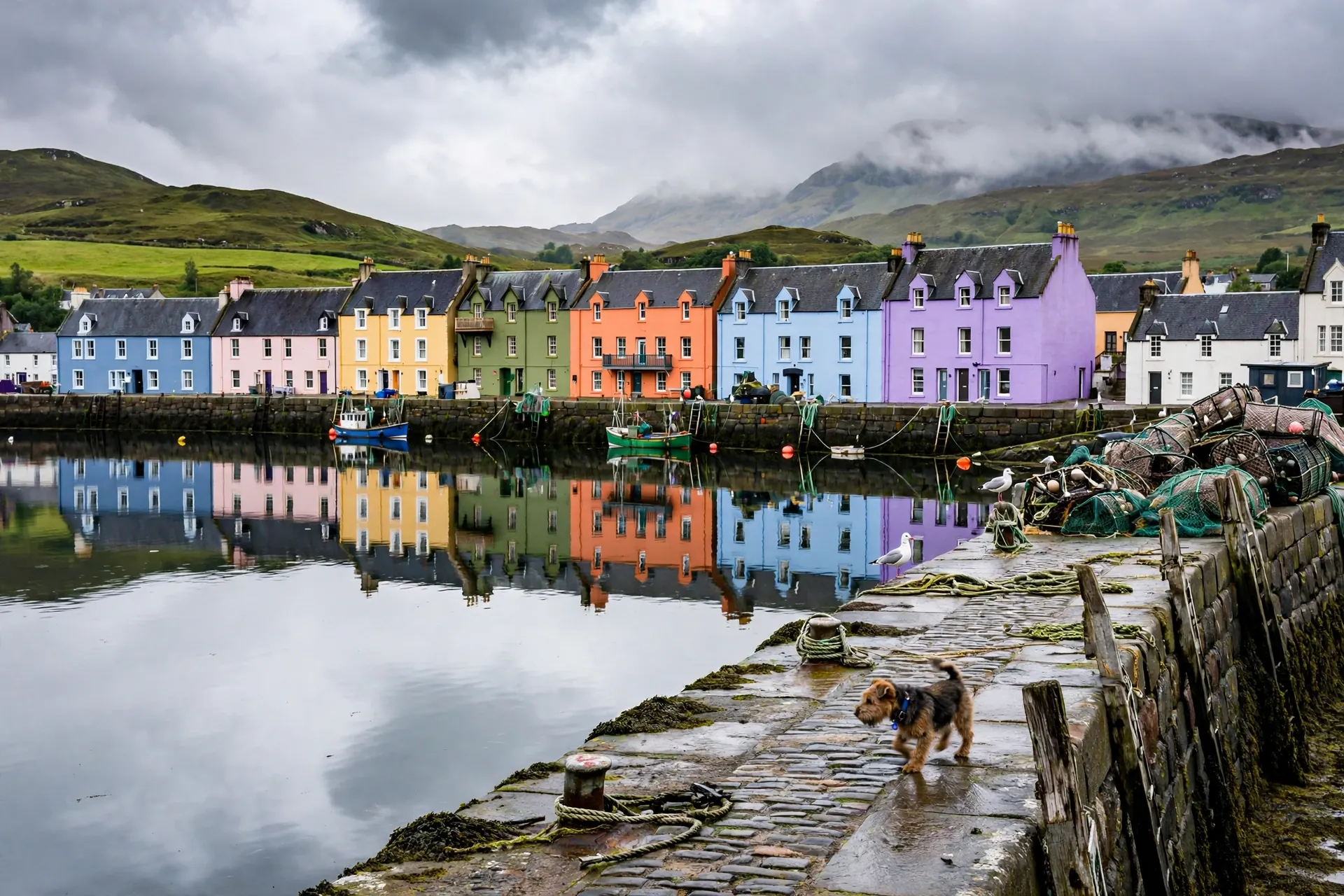
Stand on Portree pier at eight in the morning and the whole trip makes sense. The painted houses — mustard, sky blue, coral pink, white — face the water in a neat row, fishing boats nudge against the pontoons, and the hills of the Trotternish ridge sit behind the town like a backdrop that has been left out overnight. This is the view that fills the postcards, and it is also the most practical starting point for planning a week with a dog. Portree is Skye's largest town and its only real hub: the place with the supermarket, the vet, the fuel, the cash machine, the outdoor shop and the largest number of dog-friendly beds on the island. Everything else on Skye is a drive away, and Portree is the point from which those drives are shortest.
That matters because Skye is bigger than it looks on a map. The island stretches roughly fifty miles from the Skye Bridge in the south to the lighthouse at Rubha Hunish in the north, and its roads are mostly single carriageway, with single-track stretches that slow every journey. A base at the island's southern end turns every Trotternish outing into a two-hour round trip before you have walked a step; a base at the northern tip does the same to the Cuillin. Portree sits almost exactly in the middle, on the east coast where the A87 from the bridge meets the A855 that loops around Trotternish. From here, the Old Man of Storr is a fifteen-minute drive, the Quiraing is under an hour, the Fairy Pools are about forty-five minutes, and Talisker Bay is around an hour. No other town on Skye gives you that reach in every direction.
The harbour itself is worth planning around rather than rushing past. It is a working harbour, not a museum: creel boats land shellfish, the ferry to Raasay leaves from the pier, and delivery vans thread between walkers on the quayside. That working character is exactly why it suits dogs. The flat, paved circuit around the waterfront is one of the easiest walks on the island for older dogs, puppies and dogs that are still learning to settle in new places. A slow loop past the boats, down to the pontoons and back up through Somerled Square takes twenty to thirty minutes, gives a dog a full afternoon of smells, and costs nothing. Do it at the end of every day trip, when the dog is tired and the light is dropping across the water, and it becomes the ritual that frames the holiday.
Use the harbour as your planning board. Mornings are for the big walk, because Skye's weather is usually at its most settled before midday and the popular car parks fill by ten. Afternoons are for the town: the shops, a late lunch, a second shorter walk. Evenings are for the waterfront, when the day-trippers have gone and the painted houses catch the last light. If the forecast turns, flip the pattern — town in the rain, hills in the clear spell — because the whole point of basing yourself in Portree is that you can change your mind without moving house.
Choosing your base in Portree
Portree's accommodation ranges from harbour-front hotels and guesthouses to self-catering cottages, holiday flats and campsites on the edge of town. For a dog trip, self-catering usually wins. A cottage or flat with its own door gives you a private garden or yard for the last outing at night, a kitchen for early breakfasts before the day's walk, and somewhere to dry a wet dog without negotiating a hotel corridor. Look for a ground-floor entrance, an enclosed or fenced outdoor space, and hard floors rather than pale carpet. Ask directly whether the garden fence is genuinely dog-proof: a low dry-stone wall or a hedge with gaps is not the same as a fence, and a determined terrier will test the difference on the first evening.
Hotels and guesthouses in Portree are a good fallback, especially for short stays, but read the dog policy properly before booking. Some welcome dogs only in selected rooms, some charge a per-night pet fee, and some restrict dogs to the bar or lounge rather than the dining room. The questions worth asking are the same ones that matter anywhere: which rooms accept dogs, is there a charge and how much, where does the dog sleep, where is the nearest toilet spot after dark, and can the dog be left alone in the room while you eat. Our guide to dog-friendly hotels in the UK sets out the full list of questions to ask before you pay, and it is worth reading before you book a Portree hotel, because the answers vary widely even within one town.
Location inside Portree matters more than it does in most towns. A stay on the harbour front puts you on the waterfront circuit the moment you step outside, but it can be noisy on summer evenings when the pubs are busy, and parking can be tight. A stay up the hill towards the Aros Centre or on the road out towards Staffin is quieter and often has better parking, but it adds a ten-minute walk — uphill on the way home — to every outing, which is a real consideration for an older dog or for the last walk of the day. A stay near Somerled Square puts you closest to the shops and the supermarket, which is the most practical choice if you are self-catering and will be carrying shopping every day. There is no wrong answer, but there is a wrong assumption: that everywhere in a small town is equally close to everything. Check the walk on a map before you book, not after you arrive.
Book early. Portree is the bottleneck of Skye tourism: every visitor who wants a bed, a meal and a shop passes through it, and the number of genuinely dog-friendly rooms and cottages is far smaller than the number of visitors. For May to September, book dog-friendly accommodation three to six months ahead if you can; for Easter and the October half term, two to three months is realistic. If you are travelling outside the main season, you will have more choice and lower prices, but check what is actually open: some smaller guesthouses and cafes close from November to March, and the range of places to eat with a dog shrinks with them. Check the official guidance before you travel if a particular venue matters to your plans, because opening hours on Skye change with the season and are not always updated online promptly.
Trotternish day trip: Storr and Quiraing
The Trotternish peninsula is the reason most people come to Skye, and it is the day trip that Portree is built for. The A855 leaves town to the north and follows the coast past the Old Man of Storr, the Quiraing, Kilt Rock and Staffin, in a loop that returns to Portree from the west through Uig. The full loop is about fifty miles of driving, but the walking is what you are here for, and the honest plan is one major walk in the morning and one viewpoint stop in the afternoon, not a frantic circuit of everything.
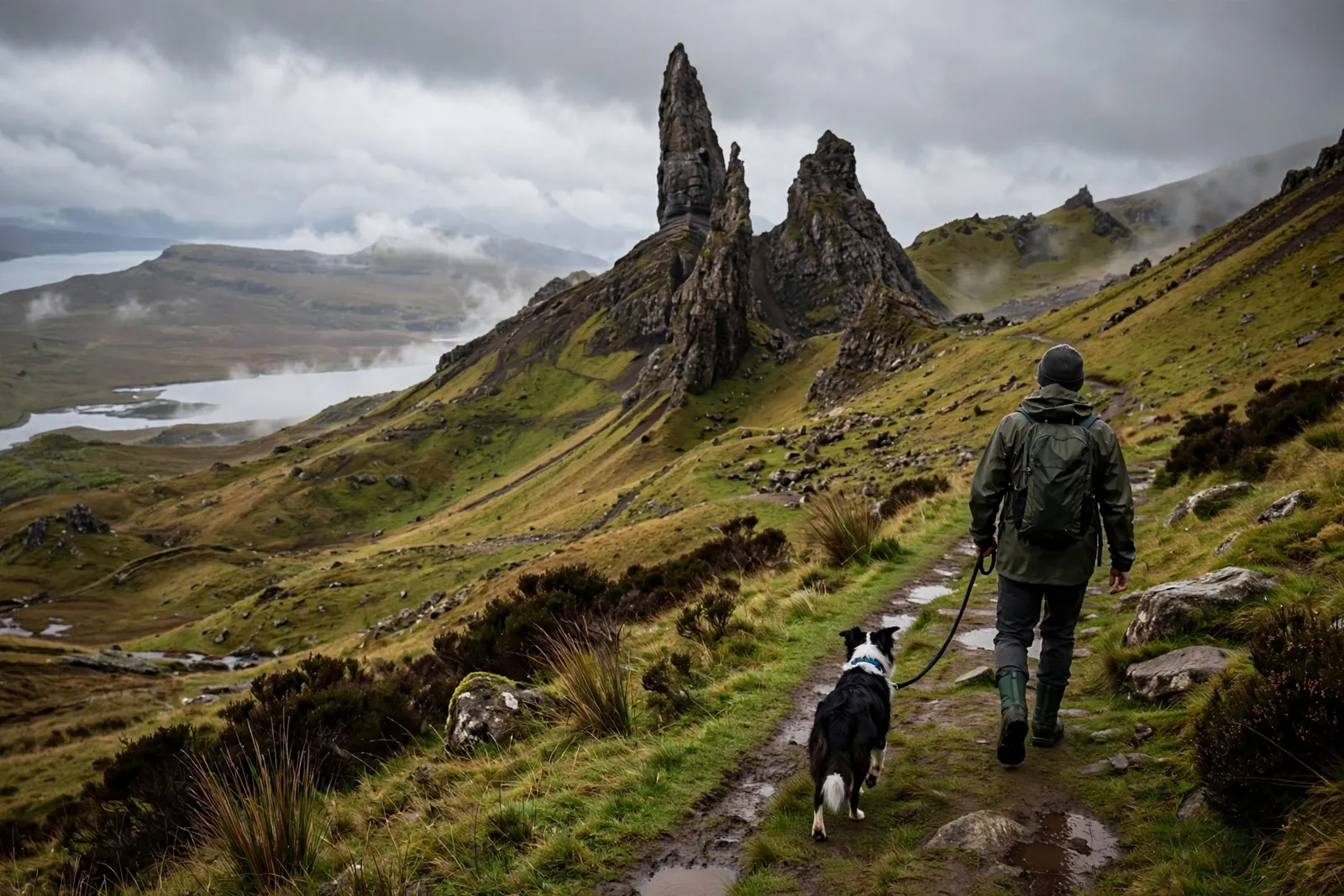
Start with the Old Man of Storr. The car park sits on the A855 about six miles north of Portree, and the path climbs roughly three and a half kilometres to the pinnacles, gaining about 300 metres. The lower half is a wide, well-built path that most dogs manage easily; the upper half is steeper, rockier and looser underfoot, with sheer drops near the pinnacles themselves. Keep your dog on a lead for the whole walk. Sheep graze the hillside, the path is busy, and the drops are real. Carry water — there is none on the hill — and a spare lead, because a wet or muddy lead that slips from your hand on a slope is a problem you do not want. In summer, start before nine to beat both the crowds and the heat on the exposed climb; in winter, start after the frost has lifted and be ready to turn back if the upper path is icy. The view from the pinnacles, across the Sound of Raasay to the mainland mountains, is the single best reward on Skye for the effort, and dogs that have earned it tend to sleep all the way back to Portree.
After the Storr, drive on to the Quiraing, the landslip landscape of pinnacles, hidden valleys and the rock formation known as the Prison. The Quiraing car park is small and fills early, so aim to arrive either before ten or after three. The full Quiraing circuit is about four miles and takes three to four hours, crossing steep, uneven ground with drops that demand a lead and a sensible dog. A shorter option is the walk out to the Prison and back, which gives you the drama without the full circuit and suits dogs that are not up to a long, rough traverse. Whichever you choose, keep the dog close: the path edges are unfenced, the ground is uneven, and the weather on the Quiraing can change in minutes, with fog rolling in off the sea and turning a clear path into a guessing game. If visibility drops, turn back. The Quiraing will still be there tomorrow.
On the way back towards Portree, stop at Kilt Rock and Mealt Falls, where a waterfall drops off the cliff into the sea. The viewpoint is a short, flat walk from the car park and is a good leg-stretch for a dog that has already done the Storr. The viewing platform is fenced, but the cliff edge beyond it is not, so keep the lead on. Staffin, a little further north, has a beach that is good for a paddle at low tide, though the sand is mixed with rock and the beach is exposed to the wind. The Dinosaur Museum at Staffin is a small, friendly stop if the weather turns, but check the official guidance before you travel, because opening hours are seasonal. End the day by driving back to Portree through Uig, where the ferry to the Outer Hebrides leaves, and finish with the harbour circuit. It is a long day — six to eight hours including driving — so do not plan a second big walk for the same day.
Cuillin day trip: Fairy Pools and Talisker
South of Portree, the island changes character. The soft green hills of Trotternish give way to the black, jagged Cuillin ridge, and the walking becomes wilder and more remote. The drive south on the A87 to Sligachan takes about twenty minutes, and from there the road to Glenbrittle and the Fairy Pools winds through the foothills of the mountains. This is the day for water, not height: the Fairy Pools are a series of clear blue-green pools and waterfalls on the Allt Coire a' Mhadaidh, and they are the most dog-friendly of Skye's famous sights.
The Fairy Pools walk is about two and a half kilometres each way from the car park, over a gravel path with a river crossing on stepping stones. Dogs love it, and with good reason: the pools are made for paddling, the river is shallow in most places, and the scenery is extraordinary. Keep your dog on a lead near the water and other walkers, and do not let them drink from the pools — the water is clean to look at but it is still a mountain stream shared with sheep and other animals. Watch for slippery rock around the pool edges, and keep the dog out of the deepest pools, where the current is stronger than it looks. The car park is the practical problem: it fills by mid-morning in summer, and the overflow parking adds a long walk along the road. Arrive before nine or after four, and you will have the pools almost to yourself. In winter the path can be boggy and the stepping stones slippery, so wear proper boots and keep the dog on a short lead for the crossing.
From the Fairy Pools, Talisker Bay is the natural second stop. The drive to Talisker takes you past Loch Harport and through Carbost, home of the Talisker distillery, and the bay itself is a broad sweep of dark sand backed by cliffs and a waterfall. The walk from the car park to the beach is about a mile across farmland, and the path can be muddy after rain. Dogs can run on the beach, but check the tide times first: at high tide the beach narrows sharply, and the return path can be cut off if you are not paying attention. The bay is exposed to the Atlantic wind, so bring a windproof layer even on a sunny day, and keep the dog in sight — the cliffs at either end of the beach are unfenced. Talisker Bay is also a good place to see seals, so keep the dog on a lead if seals are hauled out on the rocks.
Sligachan itself is worth a stop on the way back to Portree. The old bridge over the River Sligachan is one of the most photographed spots on the island, and the hotel there has a large garden where dogs are welcome. It is a good place for a late lunch or a drink, and the river is a favourite paddling spot for dogs — though the water is cold even in summer. If your dog is still full of energy, the path from Sligachan towards the Cuillin foothills offers a short, flat out-and-back walk with mountain views, but do not be tempted to follow the serious climbers' routes: the Cuillin proper is a mountaineer's range, with scrambling and exposure that is not suitable for dogs, and the ridge should be admired from below. Our wider guide to the Isle of Skye with a dog covers the island's other walks and the practical rules for single-track roads and ferries in more detail, and it is worth reading alongside this Portree plan if you are staying for a week.
Harbour walks and short loops
Not every day needs a mountain. Portree has enough short walks to fill a rest day, and they matter because dogs — like people — need days when the plan is gentle. The harbour circuit is the obvious one: from Somerled Square down to the pier, along the waterfront past the painted houses, around the pontoons and back up through the town. It is flat, paved and about a mile, and it works in any weather. Go early, when the fishing boats are unloading and the gulls are arguing over the catch, or late, when the water is still and the houses are reflected in it. Keep the dog on a lead: the quayside is a working area with vehicles, ropes, creels and deep water beside the pier, and a dog that chases a gull can be in the harbour before you have time to react.
For a longer loop, follow the path from the harbour up towards the Aros Centre and the woodland behind the town. The Aros Centre, on the southern edge of Portree, has a woodland walk that climbs gently through trees to a viewpoint over the town and the bay. It is about two miles there and back, sheltered from the wind, and a good choice on a wet or blustery day when the cliff paths are unpleasant. The centre has a cafe and a shop, and dogs are welcome in parts of the building — check the official guidance before you travel, because the policy can change with the season. The woodland paths can be muddy after rain, so wear boots and bring a towel for the car.
A third option is the coastal path north from Portree towards the Storr, which follows the shore for a mile or two before the ground rises. It is rougher than the harbour circuit, with uneven ground and sheep in the fields beside the path, so keep the dog on a lead and wear proper walking shoes. The reward is a quieter stretch of coastline with views back towards the town and across to Raasay, and on a clear day you can see the mainland mountains beyond. Turn back when the path gets steep or indistinct rather than pushing on — this is a leg-stretch, not a mountain day.
Whatever short walk you choose, build in a rest stop. Dogs that have walked for an hour need water and a chance to lie down, and Portree's benches along the waterfront are made for exactly that. Sit for ten minutes, let the dog watch the boats, and you will get more out of the rest of the day than if you march on. The other rule for short walks is the same as for long ones: pick up after your dog. Portree is a small town and the harbour is its front room; there are bins along the waterfront, and leaving waste behind is the fastest way to make a town less welcoming to the next dog that visits.
Eating out with a dog in Portree
Portree has the best choice of places to eat on Skye, which is another reason to base yourself here. The harbour-front pubs and the restaurants around Somerled Square range from fish and chips eaten on a bench to proper sit-down dinners, and many welcome dogs in at least part of the premises. The usual pattern is that dogs are welcome in bar areas and on outdoor seating, but not in the main dining room, and that policies vary by venue and by season. Confirm at the door rather than assuming, and have a backup plan — a takeaway eaten on the harbour wall is a perfectly good dinner on Skye, and some of the best fish and chips on the island are eaten exactly that way.
A few practical rules make eating out with a dog work. Bring a mat or a blanket for your dog to lie on, because cold stone floors and wooden boards are not comfortable for a dog that has to settle for an hour. Feed the dog before you go, so you are not competing with a hungry animal for your own dinner. Choose a table at the edge of the room, away from the main thoroughfare, so the dog is not stepped on by every passing waiter. Avoid the busiest mealtimes if your dog finds crowded rooms stressful — an early lunch at noon or a late dinner after seven is calmer than the six o'clock rush. And keep the lead short: a long lead across a walkway is a trip hazard, and a dog that wanders to the next table to investigate someone else's dinner will not be popular.
Self-catering changes the equation. Portree has a supermarket and several smaller shops, so you can cook for yourself most nights and save eating out for the occasions that suit the dog. Buy breakfast supplies the evening before a big walk, because an early start means the shops may not be open when you want to leave. Stock up on dog food and treats in Portree before heading to the remoter parts of the island, where shops are few and far between. And remember that Skye's shops, like its restaurants, keep seasonal hours: in winter, some close early or shut for a few weeks, so check the official guidance before you travel if you are depending on a particular shop being open.
If you are staying for a week, the best rhythm is to eat out two or three times and cook the rest. The nights you eat out, pick the pub or cafe that suits the dog — a quiet bar with a fire and a corner table — rather than the fanciest restaurant in town. The nights you cook, eat early and get the dog settled, because the next morning's walk starts early. Either way, the dog eats first, settles second, and the humans eat third. That order has never failed.
Driving, parking and single-track roads
Driving on Skye is part of the holiday, and it is also the part that catches visitors out. The A87 from the Skye Bridge to Portree is a good two-lane road, but the A855 around Trotternish and many of the roads to beaches and viewpoints are single-track, with passing places. The rule is simple: use the passing places to let faster traffic through, pull in to let oncoming traffic pass, and never park in a passing place. If you meet a car coming the other way, reverse to the nearest passing place — the car that is closest to one reverses. Be patient: the driver behind you is not in a hurry, and the driver in front of you is probably looking at the same view you are.
For dogs, the driving matters as much as the walking. Skye's roads are winding, and a dog that is sick in the car will be sick on a Skye road. Feed the dog at least two hours before a long drive, keep the car cool, and stop every hour or so on a long journey. A car harness or a crate keeps the dog safe and stops it from distracting the driver on a single-track road where a moment's inattention matters. Never leave a dog in a parked car in warm weather, even for a few minutes: a car in Highland sunshine heats up fast, and there is no shade in a Portree car park at midday.
Parking in Portree is straightforward but competitive. The town has car parks around Somerled Square and the harbour, plus on-street parking on the approach roads, and they fill by late morning in summer. The practical answer is to park once and walk: leave the car at your accommodation if you can, or in the car park you find first, and explore the town on foot. For day trips, the car parks at the Storr, the Quiraing and the Fairy Pools are the pinch points. Arrive early, park properly within the marked bays, and never block a passing place or a farm gate. If a car park is full, do not invent a space on the verge: it blocks the road for everyone, including the emergency services, and it is the behaviour that turns local opinion against visitors. Drive on, come back later, or pick a different walk.
The ferry to Raasay leaves from Portree pier and is worth knowing about even if you do not take it. Raasay is a small, quiet island a twenty-minute crossing away, with walks that suit dogs and far fewer visitors than Skye. The ferry takes cars, and foot passengers with dogs are welcome. Check the official guidance before you travel, because the timetable is seasonal and the ferry can be cancelled in bad weather. If you do cross, Raasay's southern walks are gentle and the views back to Skye are worth the trip on their own. It is the best bad-weather backup on the island, because Raasay's walks are lower and more sheltered than Skye's mountain paths.
Weather, midges and seasons
Skye's weather is the single biggest variable in a dog trip, and the only reliable rule is that it will change. A clear morning can turn to rain by lunch, and a wet afternoon can clear to a golden evening. The practical response is layers, not optimism: waterproof jacket and trousers, a warm layer, a hat, and a dry bag for the dog's towel and treats. Check the forecast the night before and again in the morning, and be ready to swap the day's plan — hills in the clear spell, town and short walks in the rain. The Met Office forecast for Portree is the most useful single source, and the mountain forecast is worth checking separately if you are heading for the Storr or the Quiraing.
Midges are the other seasonal reality. From late May to September, and worst in July and August, midges swarm in still, damp conditions, especially at dawn and dusk and near water and woodland. They bite humans far more than dogs, but a dog with thin fur or a bare belly can be bothered, and a walk through a midge cloud is miserable for everyone. The defences are simple: walk in the middle of the day when the wind is up, choose exposed coastal paths over sheltered woodland, use repellent on yourself, and carry a midge net for your head. A light breeze is your friend: if the wind drops and the midges rise, cut the walk short and head for the coast or the car. May, June, September and October have far fewer midges than high summer, which is another reason they are the best months to visit with a dog.
Seasons change the island more than most visitors expect. May and June bring long daylight — eighteen hours or more — and the hills are green and the lambs are out. July and August bring the crowds, the midges and the highest prices, but also the warmest weather and the fullest range of open venues. September and October bring autumn colour, quieter roads and the first storms, and the light is at its best for photography. Winter, from November to March, is quiet and atmospheric: the town is half-empty, the prices are low, and the mountains wear snow, but daylight is short — seven or eight hours — and storms can close roads and cancel ferries. Whatever the season, the dog's needs do not change: water, shade, rest and a lead near cliffs and livestock. The season only changes how much of each you need.
Packing and practical kit
Pack for Skye as if you are going walking in the mountains, because you are, even on the days when you only mean to stroll around the harbour. The dog's kit list starts with the obvious — lead, harness, collar with an ID tag, food and water bowls, enough food for the whole trip plus a day's spare — and then adds the things that Skye specifically demands. A long line is useful for beaches and open ground, where a dog can run without being off the lead near sheep or cliffs. A drying coat or two towels is essential, because the dog will get wet, and a wet dog in a car or a cottage is a problem that compounds. A first-aid kit with tick removers, antiseptic and bandages is worth carrying on every walk: ticks are common on Skye from spring to autumn, especially in bracken and long grass, and a tick removed promptly is a tick that causes no trouble.
Water is the item most people forget. There is no reliable drinking water on the Storr, the Quiraing or the Fairy Pools path, and the streams, while clear, are shared with sheep. Carry at least a litre for the dog on a half-day walk, more in warm weather, and a collapsible bowl that weighs nothing. Treats are the other essential: a pocketful of high-value treats is what keeps a dog close to you on a busy path, brings it back from a sheep field, and rewards it for settling in a pub. Pack them where you can reach them without stopping.
For the humans, the list is boots, waterproofs and layers, as above, plus a paper map. Mobile signal on Skye is patchy — good in Portree, unreliable in Glenbrittle and non-existent in some glens — so do not rely on your phone for navigation on a walk. A paper map of Skye and a compass are cheap insurance, and the habit of checking the map before you leave the car is worth more than any app. Download offline maps before you travel, and save the numbers you might need: your accommodation, the nearest vet, and the breakdown service. Portree has a veterinary practice, but it is a small one, and out-of-hours cover may mean a drive to the mainland, so note the details before you need them and check the official guidance before you travel.
Finally, pack patience. Skye rewards the traveller who builds slack into the day: a walk that takes an hour longer than planned because the dog found a stream, a lunch that stretches because the rain came in, a viewpoint that empties because everyone else left at four. The dogs that enjoy Skye most are the ones whose owners do not rush them, and the owners who enjoy Skye most are the ones who let the dog set the pace. Portree, with its harbour, its shops and its central position, is the place that makes that unhurried rhythm possible. Use it.
Practical questions
Before you go
Can dogs walk around Portree harbour off the lead?
No, keep your dog on a lead around the harbour. The quayside is a working area with vehicles, boats, fishing gear and other visitors, and the water is deep beside the pier. A short lead gives your dog room to sniff the boats and the fish boxes without wandering into traffic or near the harbour edge.
Is the Old Man of Storr walk suitable for dogs?
Fit, sure-footed dogs manage the Storr path well, but keep them on a lead. The upper path is steep, rocky and busy, with sheer drops near the pinnacles and sheep grazing on the hillside. Avoid the middle of the day in summer, carry water, and be ready to turn back if your dog struggles on the loose stone.
Can dogs go to the Fairy Pools?
Yes, dogs are welcome on the Fairy Pools walk, and many enjoy paddling in the pools. Keep them on a lead near the water and other walkers, watch for slippery rock, and do not let them drink from the pools. The car park fills early in summer, so arrive before 9am or late in the afternoon.
Are dogs welcome in Portree pubs and cafes?
Many Portree pubs and cafes welcome dogs, especially in bar areas and on outdoor seating, but policies vary by venue and by season, so check the official guidance before you travel and confirm at the door. Bring a mat for your dog to settle on, and avoid busy mealtimes if your dog finds crowded rooms stressful.
Where can I park in Portree with a dog in the car?
Portree has car parks around Somerled Square and the harbour, plus on-street parking on the approach roads. Never leave a dog in a parked car in warm weather, even briefly, and in summer plan to park once and explore on foot. Arrive early in peak season, as the central car parks fill by late morning.
When is the best time of year to visit Portree with a dog?
Late spring and early autumn usually suit dogs best: long daylight, milder weather and fewer midges than high summer. May, June, September and October offer good walking conditions, while July and August bring the biggest crowds and the worst midges. Winter is quiet and atmospheric, but daylight is short and storms can close roads.