This guide is independent and contains no paid placement. Beach restrictions, castle rules and lift policies change, so where this guide flags a check, please confirm the latest official information before you travel.
Scarborough with a dog is a tale of two bays split by a castle headland. South Bay is the classic resort beach by the harbour and arcades; North Bay is quieter, rockier and better for longer walks. Seasonal dog bans normally cover the central bathing sections of both bays from May to September, while the promenades and Marine Drive stay walkable on a lead all year. Scarborough Castle grounds generally welcome dogs on leads, but the headland is steep and exposed, so go for the views and the open grounds, not for shelter or interiors.
Two bays, one headland: how Scarborough actually works
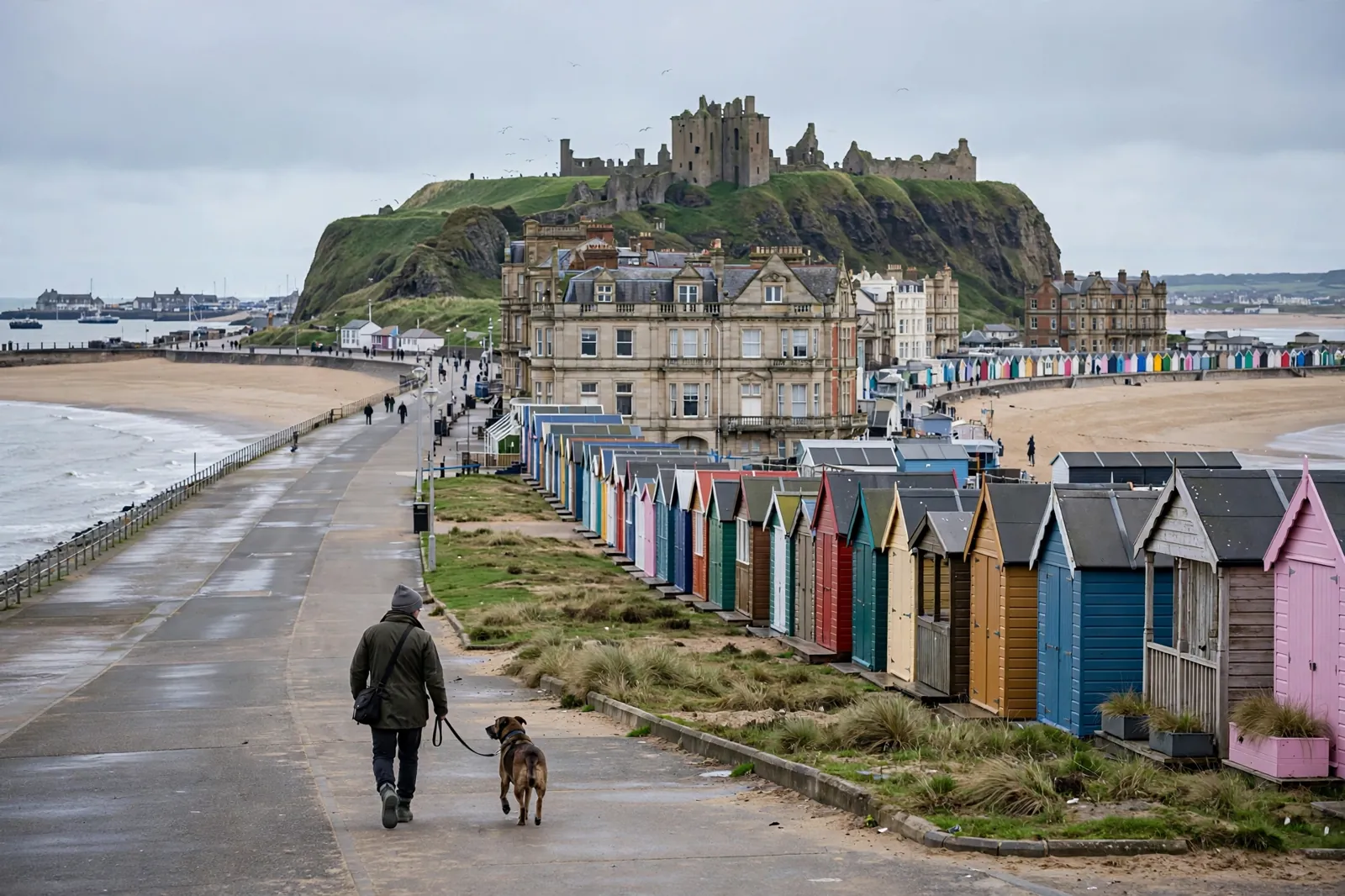
Most seaside towns ask you to learn one beach. Scarborough asks you to learn two, and then to learn the lump of rock that separates them, because almost every good decision on a Scarborough dog trip follows from that geography. The town curves around a high headland topped by the ruins of Scarborough Castle. South of the headland lies South Bay: the harbour, the lifeboat station, the arcades, the Spa and the wide, gently shelving sand that made Scarborough famous as a resort. North of the headland lies North Bay: a broader, quieter sweep towards Peasholm Park and Scalby, with rock pools, beach huts and a more spacious feel even on busy days.
That split matters more with a dog than without one. In summer, the busiest, most restricted sand is in the middle of each bay, close to the main entrances, while the promenades above the beaches remain your reliable, year-round walking surface. On a windy day the two bays can feel like different towns, one taking the weather full in the face while the other sits comparatively sheltered. On a hot day, the headland paths offer views and breeze but almost no shade. Understanding Scarborough as two bays plus a headland, rather than as a single beach with a castle attached, turns a confusing first morning into a simple set of choices: which bay for the morning walk, which side for lunch, and whether the castle climb fits the dog you actually have, rather than the dog in the brochure photograph.
Plan for hills as well as sand. Scarborough is not a flat resort with a beach bolted on. The town centre sits above South Bay, streets climb steeply from the harbour, and the castle headland rises sharply between the bays. Cliff lifts and funiculars exist precisely because those climbs are real, but as this guide explains below, you cannot assume a dog can ride them on any given day. A dog trip here rewards sensible footwear, honest distances and a willingness to use the flat promenade and Marine Drive as your main east-west route, saving your legs and your dog's joints for the one climb you choose deliberately, rather than three climbs you stumble into by accident.
North Bay or South Bay? Choosing your side
South Bay is Scarborough in its classic postcard form. The sand is wide at low tide, the harbour arm curves protectively around fishing boats and pleasure craft, and the seafront is lined with the full apparatus of a traditional resort: cafés, fish and chip shops, amusement arcades, donkey rides in season and the Spa buildings at the southern end. For a dog, South Bay offers excellent promenade walking, constant interest and easy access to food and shelter, balanced against crowds, noise, dropped food and the strictest attention to seasonal beach restrictions. A confident, sociable dog who settles well under a café table will often love a South Bay morning. A nervous dog, a scavenger or a dog who needs space from other dogs will usually be happier starting the day elsewhere.
North Bay feels different from the first few steps. The promenade is spacious, the beach huts add colour without adding crush, and the bay opens out towards open coast rather than closing around a harbour. At low tide there are rock pools and rougher ground towards the northern end, which suit careful exploring on a lead but demand attention to slippery rock, deep pools and incoming tides. Peasholm Park sits just behind the North Bay seafront, giving you a green, shaded alternative within minutes of the sand, and the North Bay side generally offers easier parking and calmer evening walks. If you are staying for more than a day, many dog owners find North Bay the better base and South Bay the better excursion, rather than the other way round.
Neither bay is simply better. They are tools for different jobs. Use South Bay early, before the arcades and cafés fill, for a lively harbour walk and breakfast with a view. Use North Bay for the long, settling walk that tires a dog properly, for low-tide exploring outside the restricted season or beyond the restricted zones, and for the last walk of the day when the light is good and the promenade is quiet. And use the headland between them consciously: crossing from one bay to the other via Marine Drive is a walk in its own right, not a shortcut, so count its distance and exposure in your dog's daily total rather than treating it as free mileage between two beaches.
Seasonal beach bans explained: read the signs, not the rumours
The single most important practical fact in this guide is that Scarborough's main beaches are not open to dogs all year, and pretending otherwise is how visitors end up in an awkward conversation with a warden on their first morning. Seasonal restrictions normally ban dogs from the central bathing sections of both North Bay and South Bay during the main season, usually running from the start of May to the end of September. Outside that season, dogs are generally allowed on those same beaches. Within the season, parts of each bay beyond the signed restricted zones may remain accessible, but the boundaries are specific, they are marked by signs and maps at beach entrances, and they are not visible from the promenade railings where most people make their decision.
That is why the working rule is simple and non-negotiable: read the sign at the exact entrance you are about to use, on the day you are about to use it. Do not copy what another dog owner is doing further down the beach, because they may be inside a permitted stretch, outside the restricted hours or dates if any apply that year, or simply wrong. Do not rely on a forum post, a leaflet from a previous summer or a line in any guide, including this one, over the sign in front of you. Our national guide to dog-friendly beaches and UK rules sets out how these local restrictions work across the country, and Scarborough is a textbook example of the pattern: a local order, seasonal dates, defined zones and on-the-spot enforcement. If the dates or zones matter to your trip, check the official latest guidance before you go, from the council or beach operator, and check again at the access point.
The promenades are the consolation that is not really a consolation. When the sand is restricted, dogs on leads can still walk the seafront promenades above both bays and the full Marine Drive route around the headland, which means a summer Scarborough dog day is still a proper walking day, just a paved one. Build summer days around that fact rather than fighting it: promenade and park walks in the morning, a café or harbour wander at midday, and, if you want sand under paws in high season, travel to a beach outside the town whose rules you have checked just as carefully, rather than gambling on an unsigned gap in Scarborough's defences. In autumn, winter and early spring, the calculation reverses and Scarborough becomes one of the easiest large resorts in Yorkshire for a beach dog, with both bays open, quieter promenades and the castle headland at its most dramatic. Many regulars with dogs deliberately choose Scarborough out of season for exactly that reason.
Tides deserve the same respect as bans. Both bays change character dramatically between high and low water. At high tide the usable sand shrinks, in places to very little, and dogs, families and walkers are compressed onto what remains. At low tide the bays open out, rock pools appear and the walkable area expands, but so does the distance to the sea and the risk of being cut off around rocky sections and the headland foot if you wander without watching the water. Check tide times before a beach walk, keep a clear line of retreat to a slipway or steps, and keep dogs out of rock-pool areas where a slip means a cut paw or a trapped leg. A torn pad on wet rock ends more seaside holidays than rain ever does, so carry a basic first-aid kit and know where the nearest vet is before you need one.
Marine Drive and the promenades: the year-round backbone
If the beaches are Scarborough's seasonal pleasure, Marine Drive is its permanent one. This is the road and promenade that sweeps around the foot of the castle headland, linking South Bay to North Bay in one long coastal curve, with the sea on one side and the steep, grassy headland slopes on the other. For a dog owner it is the most useful walk in town: level or gently graded for most of its length, walkable in every month of the year regardless of beach restrictions, and long enough to count as a real walk rather than a toilet stroll, especially if you continue along either bay's promenade at each end.
Walk it with your eyes open. Marine Drive is a working road as well as a promenade, so traffic passes close to the pavement in places and the sensible routine is a short lead, dog on the landward side, and extra care at junctions, car park entrances and the harbour end where vehicles, cyclists and pedestrians mix. It is also one of the most exposed walks in Scarborough. Wind funnels around the headland, sea spray crosses the promenade in rough weather, and there is very little shelter for long stretches. On a calm evening it is magnificent, with the castle above you and both bays opening in turn. In a winter gale it is a test of character for human and dog alike, and sections can close in severe weather or for maintenance and rock work, so check for closures before committing to it as your only route between the bays, and always have the longer town route in mind as a backup.
The promenades at each end extend the same idea. South Bay's seafront promenade gives you a flat, busy, café-rich walk past the harbour to the Spa. North Bay's promenade gives you a wider, calmer version of the same, with room for dogs who need space and benches placed for exactly the kind of pause a tired dog appreciates. Join them together and you have a full seafront traverse of Scarborough that never requires a paw to touch restricted sand, which is why this town remains viable with a dog even at the height of the summer season. Carry water on warm days despite the sea breeze, because promenade walking in sun is thirsty work, carry bags and use the bins provided, and keep dogs off seawalls and railings where a sudden lunge at a gull could end badly. Gulls, incidentally, are professional food thieves in Scarborough as in every resort: never feed them, guard chips and ice creams closely, and keep your dog from chasing them, both for the dog's safety near edges and drops and for everyone else's lunch.
The castle headland, honestly: views, wind and steep grass
Scarborough Castle occupies one of the great headland positions in England, a high, windswept plateau between the two bays that has been fortified in one form or another for centuries. As a dog day out it needs honest framing. The attraction is almost entirely outdoors: extensive grounds, substantial ruins including the great keep, and panoramic views over both bays, the harbour and the open sea. Dogs on leads are generally welcome in those grounds, while indoor spaces are not open to dogs other than assistance dogs. That makes the castle a genuine option with a dog, unlike many historic houses where the dog offer amounts to a car park and a promise. Our guide to dogs at English Heritage sites explains the general pattern across the estate, and Scarborough follows it: leads everywhere, respect for other visitors, and rules that can change, so check the official latest guidance before you go, including opening times, ticket arrangements and any temporary closures.
Now the honesty. The headland is steep to reach, high once you are there and exposed in almost all weathers. Paths and grass slopes that are pleasant on a dry, calm day become slippery and demanding after rain or in a strong wind, and there is little shade and limited shelter anywhere on the site. A fit dog who is comfortable on a lead around other visitors will usually enjoy the space, the smells and the strangeness of a ruined fortress. An elderly dog, a dog recovering from injury, a puppy who should not be doing steep climbs and repeated steps, or a dog who is frightened by wind, flapping flags and open drops may not enjoy it at all, and no view is worth a frightened dog. Judge the climb from the town as carefully as the site itself, because the approach routes are part of the effort, and remember that you still have to get down again, which for ageing knees, canine and human, is often the harder half.
Practical castle tactics are straightforward. Go early or later in the day in summer to avoid the busiest period and the strongest sun on an unshaded headland. Carry water for the dog as a matter of course, and a bowl, because the wind will take a surprising amount out of both of you. Keep the lead short near edges, walls and other visitors, and give the whole site a miss in genuinely severe weather rather than treating the ticket as a sunk cost that must be defended. If there are two of you and one wants a slower, more detailed look at any indoor interpretation, split your time rather than hurrying a dog through an experience it is not enjoying. And never use the castle car park, or any car park in Scarborough, as a place to leave a dog while you visit without them. That rule has no exceptions for sea breezes, shaded corners or short visits.
If the castle does not suit your dog, the headland still earns its place in your trip from below. The views of the castle silhouette from Marine Drive, from the harbour and from North Bay are free, require no climb and are, for many visitors, the photographs they actually keep. A dog who walks the full seafront traverse with the castle constantly above them has not missed the castle. They have experienced it in the way that suits a dog best, from the ground, at walking pace, with the sea alongside.
Harbour, Old Town and the Spa end of South Bay
South Bay rewards slow exploration away from the sand itself. The harbour area, with its working boats, lighthouse pier and seafood stalls, is a rich sensory walk for a dog on a short lead: fish smells, gulls, ropes, lobster pots and a constant flow of people to watch. It is also an area of trip hazards, wet surfaces, vehicle movements and dropped seafood, so the harbour is a place for close control rather than relaxed wandering. Keep dogs clear of working areas, mooring lines and boat operations, watch for hooks and discarded bait around fishing spots, and apply a strict leave-it to anything on the ground, because harbour floors contain things no dog should eat. A short harbour circuit in the morning, before it fills, is one of the pleasures of a Scarborough stay, and it pairs naturally with breakfast at a café where you have confirmed dogs are welcome.
Behind the seafront, the Old Town climbs in a tangle of steep streets and steps towards the castle and the parish church. It is characterful and photogenic, and its gradients are the point to plan around: what looks like a short hop on a map can be a serious climb on foot. With a fit dog it makes an interesting alternative route between the town and the headland. With an older dog, or in wet weather when cobbles and steps are slippery, choose the promenade and Marine Drive instead and enjoy the Old Town in smaller pieces. Anne Brontë is buried in the churchyard of St Mary's on the headland side of the Old Town, which draws literary visitors up the hill; whether or not that is part of your trip, the surrounding streets illustrate the same lesson, that Scarborough's charm and Scarborough's hills are the same thing viewed from different legs.
At the southern end of South Bay, the Spa buildings and the gardens and paths around them give the bay a calmer finish than the arcade-heavy centre. The seafront walk from the harbour to the Spa and beyond towards the cliff and gardens is a good target for a dog who finds the central seafront overstimulating, because the crowds thin as you go south while the views across the bay back towards the castle improve. Seating, shelters and green spaces along this stretch make it the natural place in South Bay for a pause with a dog who needs to settle and watch the world at a distance. As everywhere in Scarborough, individual venues along the route set their own dog policies for indoor and terrace space, so check doors and ask before assuming, and treat the outdoor walk itself as the guaranteed part of the plan.
Parks and walks beyond the sand
A Scarborough dog trip improves considerably once you add its parks, because parks solve the two recurring seafront problems: summer sand restrictions and hot, shadeless promenades. Peasholm Park, just inland from North Bay, is the best known, a landscaped park around a lake with paths, lawns, mature trees and a distinctly sheltered feel compared with the seafront a few minutes away. Dogs on leads can enjoy the paths and green space with you, while the lake itself, its boats and its wildlife are not a dog swimming invitation, so keep dogs out of the water and away from nesting and feeding birds. Peasholm works particularly well as a midday summer stop, when the beach is restricted and the promenade is at its hottest, and as a gentler walk for dogs who find the seafront's noise and movement tiring. Check any current park notices on arrival, because events and seasonal attractions change how busy and how accessible parts of the park feel.
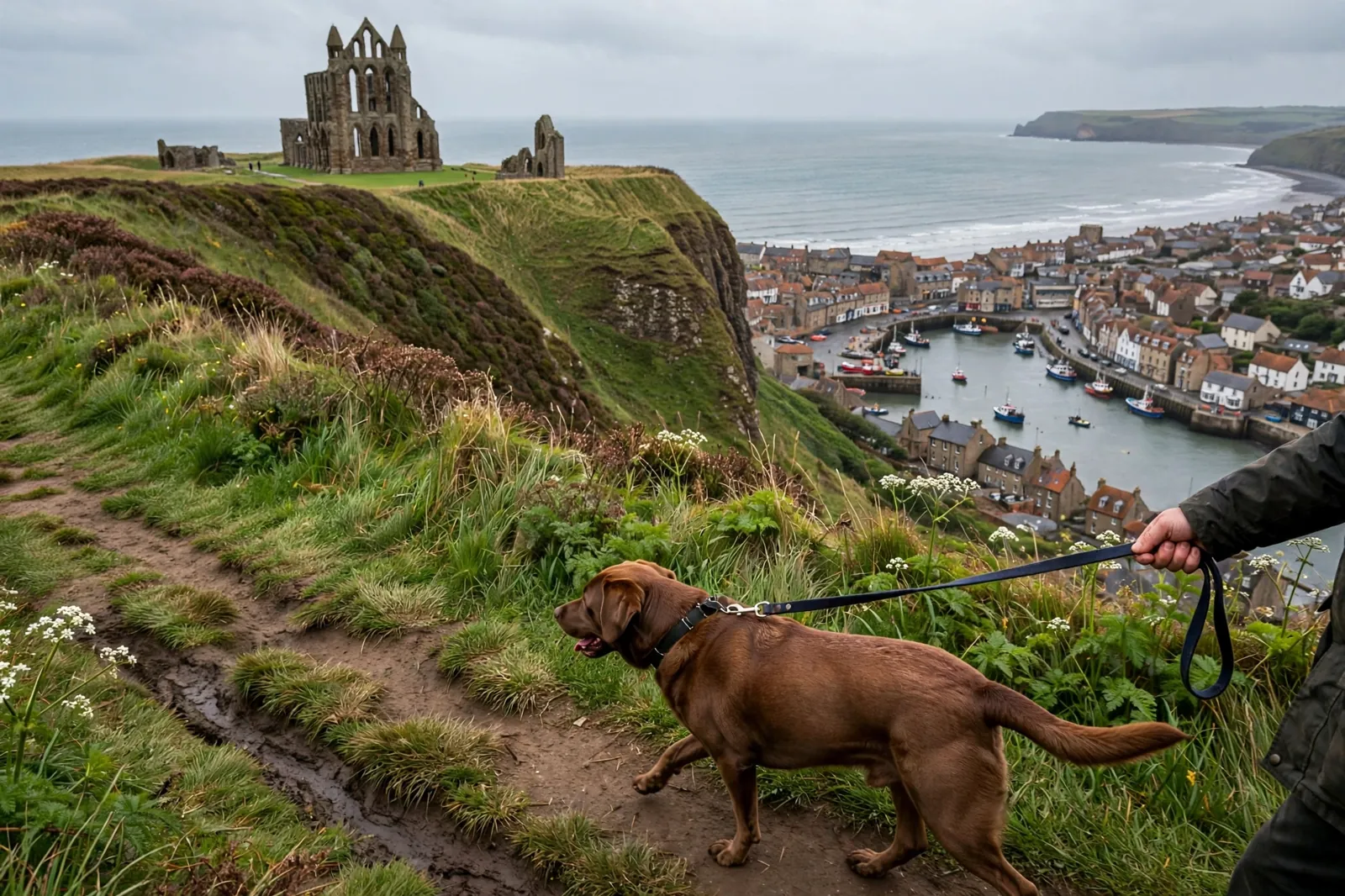
Other green space fills out the picture. The Italian Gardens and the broader South Cliff gardens at the southern end of the town offer terraced paths, planting and sea views in a quieter register than the central seafront, well suited to a lead walk combined with the Spa end of South Bay. Further afield, the Cinder Track, the former railway path running north from Scarborough towards Whitby, gives you the classic ex-railway proposition: a long, largely traffic-free route through coastal and rural scenery that you can join for a short out-and-back section rather than attempting any heroic through-route. As with any shared trail, expect cyclists and other walkers, keep your dog under close control, and plan your turning point honestly. For a coastal comparison further up this same shore, our guide to Whitby with a dog covers the other famous Yorkshire resort town, whose harbour, abbey headland and beach rules make an instructive contrast with Scarborough's two-bay layout.
Day trips beyond the town extend the options without requiring a change of base. The North York Moors and the villages of the coast north and south of Scarborough are all within driving distance, but they bring their own rules, particularly around livestock, ground-nesting birds and lead requirements on open access land in the breeding season. Treat any day trip as a fresh planning exercise rather than an extension of seafront habits: check parking, lead rules and dog access for the specific place, carry water and bags as if no facilities exist, and remember that a dog who has already walked Marine Drive in the morning does not also need a full moorland expedition in the afternoon. Scarborough's strength as a base is that the town itself can fill several varied days. Use that strength instead of spending the whole trip in the car.
Eating, cliff lifts and wet weather
Scarborough feeds dog owners well if you apply the usual discipline. The town has the full resort range, from fish and chip shops and seafront cafés to pubs, bakeries and restaurants in the centre and around both bays. In general terms, because individual policies change: many cafés and pubs welcome dogs in some or all areas, some offer only outdoor seating for dogs, takeaway fish and chips eaten carefully on the promenade is a long-established Scarborough ritual, and some food premises do not admit dogs beyond assistance dogs. The reliable method never changes. Check signage, ask before you settle, keep your dog on the floor and out of walkways, and have a takeaway backup plan that you would genuinely enjoy. On the seafront, guard food from gulls with a seriousness that will seem excessive for exactly one minute, until the first dive happens at the next table.
Two food hazards deserve specific mention in Scarborough. The first is dropped food along the South Bay seafront and around the harbour, where chips, batter, ice cream and seafood scraps accumulate at dog height on busy days, including cooked bones and other items that are genuine veterinary risks. A dog who scavenges needs a short lead, a trained leave-it and a handler watching the pavement rather than the view on those stretches. The second is the temptation to share your own food without thinking. Rich, salty, fatty seaside food upsets dogs reliably, and some common items are dangerous. Keep the dog's meals boring and regular, carry their normal food and treats with you, and let the humans do the culinary exploring alone.
The cliff lifts need a paragraph of their own because they shape so many Scarborough itineraries. Scarborough has a long history of cliff lifts and funiculars linking the town and cliff tops with the beaches and the Spa, and some still operate in some seasons. Do not build a dog itinerary that depends on one. Operators, opening patterns and dog policies vary and change, and a lift that carried a dog last summer may not do so, or may not be running, on your visit. Check the operator's current information before you rely on a lift, and always know your alternative: the road and path routes between the cliff top and the seafront, which are longer and steeper but always there. For dogs who dislike enclosed, moving, noisy spaces, the walk may be the better option in any case. Wet weather follows the same logic. Scarborough has indoor attractions, arcades and venues, but their dog policies are individual and often restrictive, so a wet day with a dog is usually best planned as a promenade walk in proper waterproofs, a park visit between showers, a café that has confirmed it welcomes you, and an early return to your accommodation, rather than as a hunt for indoor entertainment that may not admit the dog at all.
Stays, parking and practicalities
Scarborough offers one of the widest ranges of dog-welcoming places to stay on the Yorkshire coast, simply because it is a large resort. You will find hotels and guesthouses in the Victorian streets above both bays, self-catering flats and houses across the town, and holiday parks and campsites on the outskirts and along the coast. North Bay and the quieter streets above it tend to suit dogs who need calmer evenings and easy access to spacious walks. The South Bay and town-centre side suits owners who want cafés, the harbour and the station close at hand and are willing to trade a little bustle for that convenience. Whichever side you choose, check the specifics before booking rather than trusting a pet-friendly label: how many dogs, what size, what charge per dog per night, whether dogs are allowed on beds or sofas, whether a dog may be left alone in the room and on what terms, and crucially, what the nearest practical late-night and early-morning toilet walk actually looks like from the front door. In a town of cliffs and one-way streets, that last question matters more than the thread count.
Ask about access with the same care. Many Scarborough guesthouses occupy tall Victorian buildings with stairs and no lift, which is a material fact for an elderly dog, a large dog who cannot be carried, or an owner with limited mobility. Ground-floor rooms, cottages and modern hotels may suit you better, but only if you ask. Enclosed outdoor space is rarer in the town itself than marketing suggests, so if a secure garden is essential, look to self-catering properties and sites outside the centre and verify the fencing in words, not photographs. Bring your own bedding, towels and drying kit as a matter of course, because North Sea weather and wet sand will test any host's laundry arrangements, and a dog who arrives with its own bed settles faster in a strange room overlooking a strange bay.
Parking and arrival need a plan on busy days. Scarborough has seafront, cliff-top and town-centre car parks serving both bays, plus on-street parking in some areas, but the popular seafront and North Bay sites fill early on sunny weekends, bank holidays and event days, and charges, time limits and payment methods change. Read the signs and the operator's current information when you arrive rather than relying on any guide's figures. If you are arriving by train, Scarborough station sits on the town-centre, South Bay side of the town, which is convenient for South Bay stays and a proper walk or a bus or taxi ride from North Bay accommodation, so factor that transfer into your plans with luggage and a dog. For supplies and emergencies, Scarborough is well served for a resort town, with pet supplies and veterinary practices in the area, but save the exact details of the nearest practice and its out-of-hours arrangements in your phone before a long coastal walk, because signal on the headland and the Cinder Track is not guaranteed. And repeat the rule that outranks every convenience in this section: never leave a dog alone in a parked car in Scarborough, whatever the sea breeze appears to promise when you lock the door.
A weekend plan that actually works
A good Scarborough weekend with a dog is built around bays and timing rather than around a list of attractions. On your first evening, do very little on purpose. Walk the promenade on whichever side you are staying, let the dog learn the sounds and smells of the seafront at a quiet hour, find the nearest bins, benches and water points, and read the beach signs at your nearest entrance so that the morning holds no surprises. That unambitious first hour pays for itself for the rest of the trip.
Give one day to North Bay and the full seafront traverse. Start with a long North Bay promenade and, if the season and the signs allow, beach walk, continue around Marine Drive with the castle above you, and finish at the harbour for a late breakfast or an early lunch where dogs are confirmed welcome. In the afternoon, choose between Peasholm Park for shade and calm or the castle headland for views and effort, but do not attempt both at full length with a dog who has already walked the traverse. The traverse is the day. Everything else is an optional extra judged against the dog in front of you, not against an itinerary written at home.
Give the other day to South Bay and the town. Walk the harbour early, explore the Spa end of the bay as the crowds build in the centre, use the South Cliff gardens for a quieter lead walk, and spend the middle of the day on food, shops that welcome dogs and the ordinary pleasures of a resort town, with the dog settled and rested rather than trailed through every doorway. Out of season, add the beaches themselves to both days and Scarborough becomes a walking holiday first and a resort second. In season, accept the promenade version with good grace. Either way, the formula is the same one this guide began with: pick the right bay for the job, respect the signs on the sand, save your one big climb for when it will be enjoyed, and let the headland be the view that organises the whole trip. Do that, and Scarborough is not a compromise destination with a dog. It is one of the most complete seaside bases in Yorkshire.
Practical questions
Before you go
Are dogs allowed on Scarborough beaches all year?
No, not on the central sections. Seasonal restrictions normally ban dogs from the main bathing areas of both North Bay and South Bay during the summer season, usually from the start of May to the end of September, while access is generally allowed outside that season and on parts of the bays beyond the restricted zones. Boundaries and dates are set locally and can change, so read the signs at each beach entrance on the day and check the official latest guidance before you go.
Can dogs go into Scarborough Castle?
Dogs on leads are generally welcome in the castle grounds, which are mostly outdoors, but they are not allowed inside indoor spaces except for assistance dogs, and the headland is steep, exposed and short on shelter. Ticket, opening and dog arrangements change, so check the English Heritage official page for Scarborough Castle before you go, keep your dog on a lead throughout, and carry water because there is little shade on the headland.
Can dogs ride the Scarborough cliff lifts?
Policies differ between Scarborough's cliff lifts and funiculars and can change with operators and seasons, so do not assume a dog can ride. Check the operator's current information before you rely on a lift to get between the town, the South Bay beach and the Spa, keep your dog on a short lead and clear of doors and cables if dogs are allowed on your date, and have a step-free or road route planned as a backup.
Can dogs walk Marine Drive around the castle headland?
Yes. Marine Drive is a public seafront road and promenade route linking South Bay and North Bay around the foot of the castle headland, and dogs on leads can walk it with you. It is exposed to wind and sea spray, traffic passes alongside the pavement, and sections can close in severe weather or for works, so keep your dog on the landward side, use a short lead near the road, and check for closures before committing to the full loop.
Where can I stay in Scarborough with a dog?
Scarborough has hotels, guesthouses, self-catering flats, holiday parks and campsites that advertise dogs welcome, with the widest choice around North Bay and the quieter streets above South Bay. Always confirm the number and size of dogs allowed, any per-dog charge, whether a dog can be left alone, and what the nearest late-night toilet walk is before you book, and never rely on a generic pet-friendly label alone.