This guide is independent and contains no paid placement. If affiliate links are added later, they will be clearly marked and will not change our editorial checks.
Walk the headland and abbey grounds first, check the current dog rules for the abbey and the main beach before you go, use Sandsend and the Cleveland Way for big coastal walks, treat boat trips and heritage railway travel as check-first extras, and keep the harbour's busiest hours for short, purposeful visits on a short lead.
Start on the headland, above the rooftops
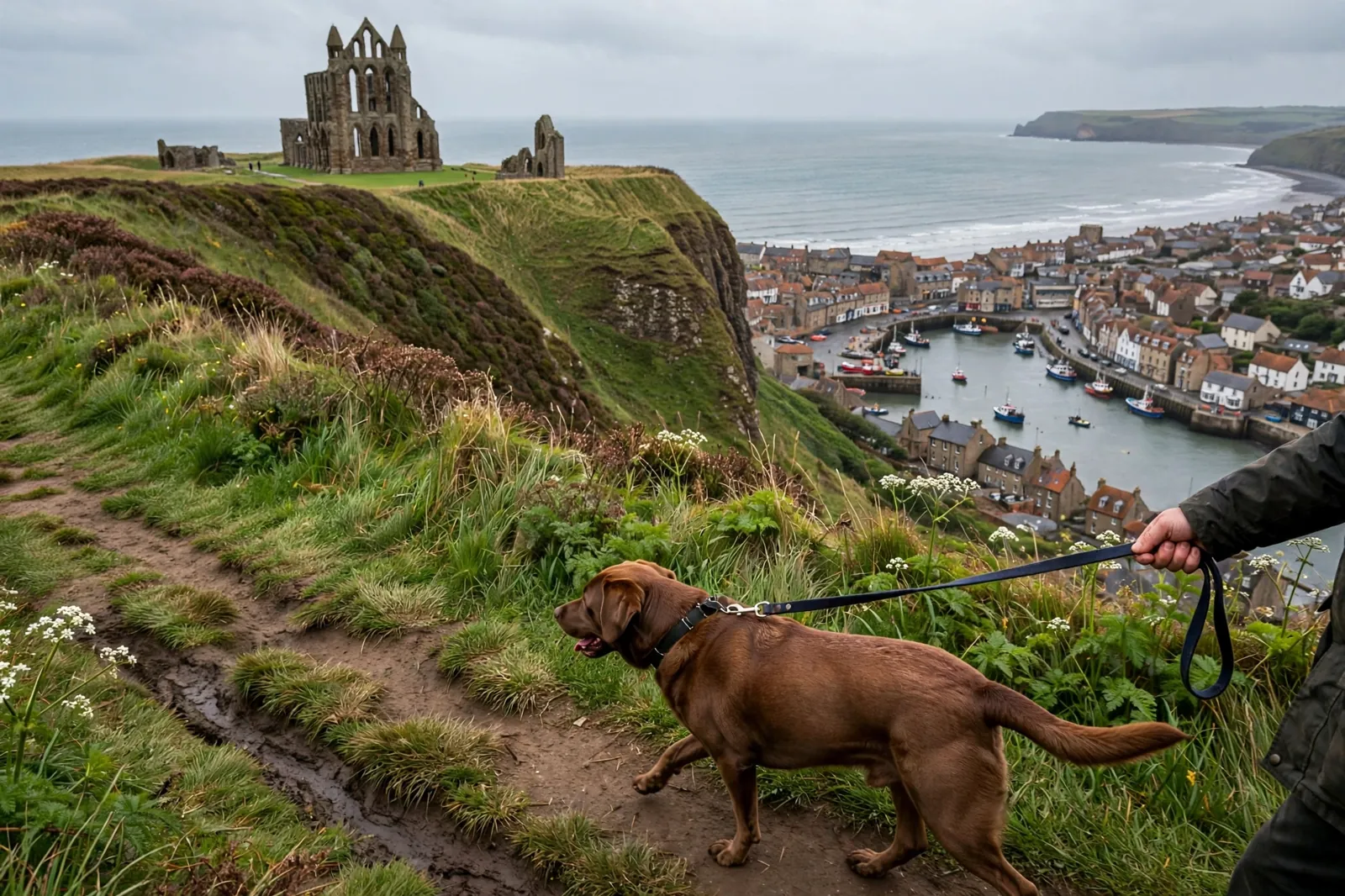
Whitby divides naturally into two levels, and dogs do better when you meet the upper one first. On the East Cliff, reached by the 199 steps from the old town or by the road and paths around the headland, stand the abbey ruins, St Mary's Church with its crowded churchyard, and a sweep of grass and cliff path that gives a dog space, wind and views before the town asks anything of it. A morning that begins up here — abbey exterior, churchyard paths on a lead, the first stretch of cliff path toward Saltwick — burns off the energy that makes harbour crowds stressful, and it shows you the whole geography of the place in one look.
Below, the harbour town packs a great deal into a small, steep bowl: a working fishing port split by the River Esk, a swing bridge joining east and west sides, piers reaching into the North Sea, and lanes of shops, cafes and amusements that fill completely on sunny weekends, regatta days and the town's famous event weekends. None of this is a reason to avoid the lower town with a dog; it is a reason to time it. Early mornings and evenings belong to the harbour. The middle of a busy day belongs to the headland, the beach at permitted times, or the coast path walking away from the crowds altogether.
Build each day in Whitby as one high walk and one low walk, and the town's steepness becomes a feature rather than a complaint. Fit dogs will happily do the steps several times a day. Older dogs, dogs with joint problems and anyone pushing through a town stay with a large dog should plan routes that use the road gradients or the harbour-level paths for some journeys, and treat the 199 steps as an outing in themselves rather than a shortcut. Whitby rewards that honesty: it is a small town, and no sight is lost by reaching it the gentler way.
Whitby Abbey and St Mary's: visiting with a dog
Whitby Abbey, the Gothic ruin on the East Cliff managed by English Heritage, is one of the more hopeful heritage visits for dog owners, because many English Heritage properties with substantial grounds welcome dogs on leads in their outdoor areas even where interiors are restricted. Whitby's abbey grounds are exactly that kind of site — but policies are property-specific and can change, so check the official site before you go for the current position on dogs, including any areas, such as the visitor centre and museum spaces, where dogs may not go. Our guide to dogs at English Heritage sites explains how to read these rules and what to expect at comparable properties.
If dogs are admitted to the grounds on your visit, plan it as the centrepiece it deserves to be: allow an hour or more for the ruins, the headland setting and the views, keep the lead short around other visitors and the pond and wildlife areas, and carry water, because the headland is exposed and unsheltered in every season. If the current rules make it assistance-only, the abbey still dominates a dog walk from outside — the perimeter, St Mary's churchyard paths and the cliff walks frame the ruins from every angle — and a travelling pair can split the visit while the dog enjoys the headland grass with the other owner.
St Mary's Church, beside the abbey, is a working church with its own arrangements; treat the interior as a check-first, likely human-only visit and the churchyard as lead-walking ground where respect for graves and other visitors is the whole etiquette. The Caedmon's Cross monument and the churchyard's sea-facing edge are among the great viewpoints of the Yorkshire coast. Around the headland, also allow time for the quieter pleasures: the coast path dipping toward Saltwick Bay, the whalebone arch and Captain Cook memorial area on the West Cliff, and the cliff-top gardens and paths that give Whitby a second, calmer promenade away from the harbour floor.
The working harbour, piers and boat trips
Whitby is a real fishing port, and its harbour is a workplace before it is a backdrop. That is what makes it interesting with a dog — crab pots, fish boxes, working boats, the fish market smells that will test any dog's lead manners — and it asks for working-harbour behaviour in return: short leads on the quays, no dogs among the gear and landings, care at the water's edge where ladders and drops replace railings in places, and a wide berth for vehicles moving catch and equipment. The swing bridge, which opens for boats and concentrates pedestrians when it closes again, is the harbour's pinch point; cross it at quiet moments if your dog dislikes dense, stationary crowds.
The two piers, east and west, give Whitby its classic harbour walks, reaching into the sea with the town and abbey behind you. In calm weather they make a fine lead walk and the best vantage for watching the port work. In rough weather they are no place for a dog at all: waves break over the pier ends in North Sea storms, surfaces are slick, and closures and local advice must be respected absolutely. Judge the piers by the sea state, not by whether other people are walking them, and keep dogs back from the edges in any swell.
Boat trips — harbour cruises, coastal trips and the occasional trip connected with the town's Dracula and heritage fame — vary by operator on dogs, with small open boats often unable to take them safely and larger vessels sometimes welcoming a lead dog on deck. Ask the specific operator before you queue, never assume, and consider your own dog honestly: a dog who cannot settle on a moving, noisy deck among strangers will not enjoy the trip, and neither will the boat. The same check-first approach covers the town's land trains and other seasonal attractions. Whitby's pleasures are mostly free and four-legged — headland, beach, piers and paths — so no dog trip depends on a boat saying yes.
Beaches: Whitby, Sandsend and Robin Hood's Bay
Whitby's main beach, the long sweep of sand below the West Cliff running toward Sandsend, operates seasonal dog restrictions during the main holiday period on its most popular section — typically the area nearest the town — while other stretches and times of year are more open. The exact boundaries, dates and hours are set locally and change, and our guide to UK dog-friendly beach rules explains how to read them; check the official site before you go and obey the signs at each beach access point, because the restricted length is only part of the beach and walking a little further often changes the answer. At low tide the sands are vast and glorious; at high tide the beach narrows dramatically against the cliff and promenade, so tide times shape beach days here as much as rules do.
Sandsend, the village at the northern end of the bay, a walk of about two miles along the beach at low tide or along the cliff and road paths, is many dog owners' favourite base for beach time: a quieter atmosphere, a stream crossing the sand that delights dogs, and its own local rules to check at the access points. The beach route between Whitby and Sandsend is a low-tide walk, full stop — the tide cuts off sections against the cliffs — so plan it with the tide table, walk it on a falling or low tide, and know your exit points. Dogs who love water need watching at the stream mouths and in the shore break, and the soft cliffs along this coast shed rockfalls: never sit or walk close under the cliff base, with or without a dog.
South of Whitby, Robin Hood's Bay, reached by the cliff path or a short drive, is the other classic excursion: a steep, picturesque fishing village dropping to a wide, rocky shore famous for fossil hunting. The shore rewards dogs and owners who like exploring rock pools and scaurs at low tide, with the same cautions — slippery rock, cut-off risk on a rising tide, and local dog rules to check for the beach area. Fossil hunting with a dog in tow is entirely possible if the dog is settled and the hammering stays gentle and away from the cliff base; loose fossils from the beach, never digging into the cliffs, is both the rule and the safe practice. Between Whitby beach, Sandsend and the Bay, a dog has a coastline to fill a week.
The Cleveland Way and the cliff paths
Whitby sits on the Cleveland Way National Trail, and the cliff walking in both directions is the town's serious dog exercise. North, the trail follows the cliff tops toward Sandsend and on to Runswick Bay and Staithes in a full day's staging, or in satisfying sections using the coastal villages as turning points. South, it climbs past the abbey headland and Saltwick Bay toward Robin Hood's Bay, about six miles of some of the finest cliff walking in England, and onward toward Scarborough for multi-day walkers. One-way walks with a bus or taxi return are the practical pattern for a holiday; check the official site before you go for current bus arrangements, and book dog-friendly taxis in advance rather than hoping at the kerb.
Cliff discipline is non-negotiable and simple. Dogs belong on a lead or a long line under genuinely close control near cliff edges, however reliable they are elsewhere: the edges are unfenced, the drops are fatal, rabbits and seabirds provoke sudden lunges, and coastal erosion means the ground itself near an edge cannot be trusted. Keep well back from edges in high wind or opt for inland routes entirely. Carry water — there is none on the cliff tops — and expect stiles, steps and muddy gateways on the field sections, which a dog with mobility problems may not manage; the promenade and beach at low tide are the kinder alternatives for those dogs.
Inland, the Esk valley offers the counterpoint: riverside and woodland walking around Sleights, Ruswarp — with its miniature railway and riverside park atmosphere — and the villages toward Danby and the North York Moors, where a bigger moorland day can be built for fit dogs, with leads around the sheep and ground-nesting birds that the moors demand in season. A Whitby week that mixes two cliff days, a moor or valley day and harbour-and-beach days at the tide's convenience is a week most dogs would vote for again.
Where to stay with a dog in Whitby
Whitby's neighbourhoods are levels as much as areas. The West Cliff, above the harbour on the town's west side, offers the grander hotels and guest houses, cliff-top gardens and the beach below — well placed for dogs, with the headland promenade as a built-in morning walk and gentler gradients than the old town. The old town streets on the east side, around Church Street and the market place, put you in historic Whitby's heart among the shops and pubs, with the abbey steps as your daily climb and very little in the way of gardens or parking. Sandsend, two miles north, is the quiet choice many dog owners end up preferring: beach at hand, a village pace, and Whitby as an easy walk or short drive for evenings and sights.
Ask the dog questions with Whitby's specifics in mind: which rooms accept dogs and on which floor, the fee and size or number limits, dining arrangements, and whether a dog may be left alone in the room — plus, here, where the nearest flat, lit walk is for late evenings, because a tired owner, a dark cliff path and a dog's last toilet walk are a poor combination. Converted fishermen's cottages can be charming and steep in equal measure, with stairs that challenge older dogs; ground-floor and garden access are worth more in Whitby than a sea glimpse from an attic window. Our national guide to dog-friendly hotels in the UK gives the full booking checklist to run through before you commit.
Event weekends transform availability and price. The town's celebrated Goth weekends, the regatta, folk and music events and peak summer fill dog-welcoming rooms early, and the atmosphere of the busiest weekends — costumed crowds filling every lane — is something to choose deliberately for a dog, not discover on arrival. If your dog is crowd-shy, pick an ordinary weekend and enjoy the same town with room to breathe. Arrive with familiar bedding, a chew for the first evening, towels for sand and harbour mud, and bags in every coat; Whitby's bins are plentiful but its lanes are narrow, and prompt clearing-up is part of the local social contract.
Fish and chips, pubs and eating together
Whitby makes a strong claim to Britain's most famous fish and chips, and the good news for dog owners is how much of the town's eating is pub, cafe and takeaway shaped. Traditional pubs on both sides of the harbour welcome dogs in bar areas at many addresses — confirm with each venue, as dining rooms vary — and independent cafes in the old town lanes and around the West Cliff often take a settled dog, especially outside peak hours. The famous fish restaurants themselves are busy, compact and mostly a human-only pleasure; the split-visit principle applies to dinner too, or the dog-inclusive answer is the takeaway eaten on the harbour wall or cliff top, which many locals would argue is the correct way to eat Whitby fish and chips anyway.
Eat with harbour awareness. Chips attract gulls as bold as any in Britain, dropped food litters the quays at busy times, and a scavenging dog needs a short lead and a watchful handler around the fish market and takeaway queues. Choose quieter moments for harbour-side eating, keep food high and covered, clear every scrap, and give your dog a walk and a toilet break before any sit-down meal so settling is realistic. The etiquette in our UK dog-friendly cafes guide — dog under the table, off the seats, lead out of walkways, mat down on hard floors — keeps Whitby's welcomes as warm as they currently are.
Build one food excursion into the week: the kipper tradition. Whitby's historic smokehouse heritage is part of the town's story, and kippers bought to cook at self-catering accommodation make a memorable breakfast — for the humans; rich smoked fish is a treat to keep away from dogs, whose stomachs rarely thank anyone for it. For the dog's own holiday indulgence, the town's pet shops and bakeries increasingly stock dog treats, and a new chew for the evening after a cliff walk is the safer celebration. As everywhere, re-check a venue's dog policy on its own site or by phone before an occasion depends on it.
Getting there, the steam railway and the seasons
Whitby is gloriously at the end of the line, and arriving takes a decision. By train, the Esk Valley line from Middlesbrough is one of England's scenic community railways, winding down the valley through the moors' edge to Whitby station by the harbour — a slow, beautiful arrival that dogs take in their stride under the usual national conditions described in our guide to taking a dog on UK trains. The North Yorkshire Moors Railway's steam services between Pickering and Whitby are a beloved trip in their own right; heritage railways set their own dog rules, often welcoming dogs on leads in standard carriages for a small fee, but check the official site before you go for the current position and any excluded special-event services. By car, the moor roads are scenic and the town's parking is limited and in demand — arrive, park once, and walk.
Season decides Whitby's mood. Spring brings cliff flowers, returning seabirds and beaches reopening as restrictions lift in stages — check the dates for your specific week. Summer is the full seaside programme: lifeguarded main beach areas, the regatta in its week, and the harbour at its busiest, all manageable with early walks and headland escapes. Autumn is arguably the dog owner's season — quieter lanes, big seas, the second Goth weekend to choose or avoid — and winter is dramatic, local and stormy, with short days, empty beaches and pubs with fires; the cliff paths in winter storms are for admiration from safe ground only.
Two last practicalities. Veterinary cover in a small coastal town means noting the local practice and its out-of-hours arrangement before you need it, and ticks are present in the moor and valley countryside in season, so check the dog after inland walks. And leave room in the plan for Whitby's unscripted pleasures: watching the bridge swing and the boats come in, an hour on the headland doing nothing, fish and chips above a grey sea. Dogs are exceptionally good at those parts of a holiday, and Whitby is exceptionally good at providing them.
Practical questions
Before you go
Are dogs allowed at Whitby Abbey?
Many English Heritage sites welcome dogs on leads in their grounds, and Whitby Abbey's outdoor ruins are that kind of visit, but policies are set per property and can change. Check the official site before you go for the current rules, including any indoor visitor centre areas where dogs may not be allowed. Keep dogs on a short lead in the grounds and carry water, as the headland is exposed.
When are dogs restricted on Whitby beach?
The main section of Whitby beach near the town operates seasonal dog restrictions during the main holiday period, while other stretches of the bay toward Sandsend have different arrangements. Exact dates, hours and boundaries are set locally and change, so check the official site before you go and follow the signs at each beach access point on the day.
Can dogs climb the 199 steps in Whitby?
The 199 steps are a public route between the old town and the abbey headland, and a fit dog on a lead can climb them. They are steep, busy at peak times and hard work for older dogs or dogs with joint problems, who will do better on the road and path routes to the headland. Take the steps slowly, keep to one side, and rest on the landings.
Are dogs allowed on the North Yorkshire Moors Railway?
Heritage railways set their own dog policies, and the North Yorkshire Moors Railway has traditionally welcomed dogs on leads in standard carriages, sometimes for a small fee, with special-event services sometimes excluded. Check the official site before you go for the current rules, fares and any services where dogs cannot travel, and keep dogs off the seats.
When is the best time to visit Whitby with a dog?
Late spring and autumn usually suit dogs best: beaches are more open, the cliff paths are in good condition and the town is lively without being overwhelmed. Summer is the full seaside season and needs early walks and crowd planning. Event weekends, including the famous Goth weekends, are spectacular but very busy, so choose them deliberately if your dog dislikes crowds.