This guide is independent and contains no paid placement. If affiliate links are added later, they will be clearly marked and will not change our editorial checks.
Secure means secure for your dog, not secure in general. Search for bookable fenced fields, ask for exact fence height, gate type and exclusive-use rules, walk the boundary on a lead first, and keep sessions short, structured and calm rather than a free-for-all.
What secure really means
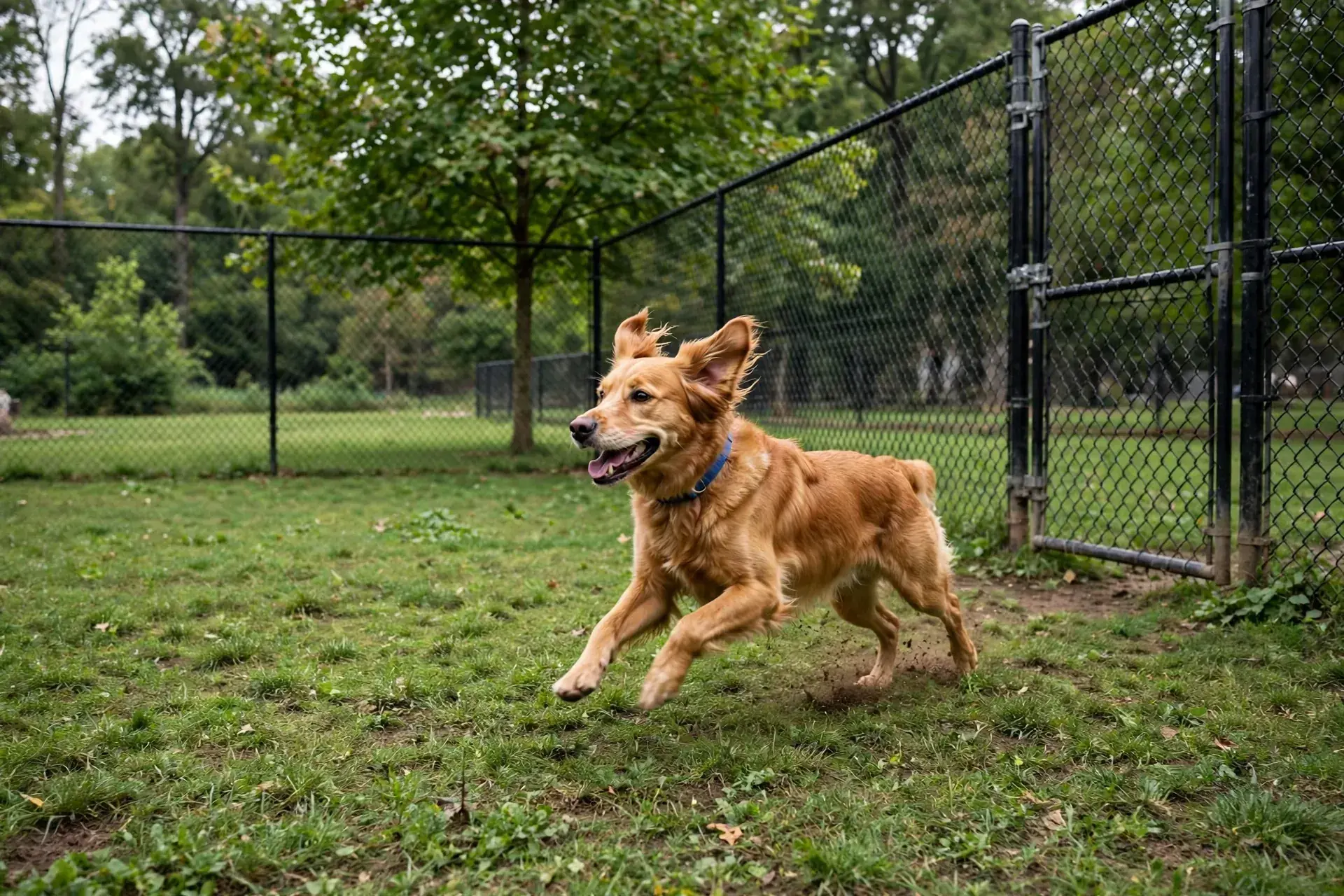
The word secure is used loosely in dog listings, and that looseness causes most disappointments. A council dog area with a low, broken fence, a gap under a gate and a public footpath through the middle is not secure in any useful sense, even if a website calls it enclosed. A private field with a 1.8-metre fence, a double-gate airlock, a buried base and a latch that a dog cannot nose open is secure for most dogs, but still not secure for a dog that can climb mesh, dig under a fence in minutes, or jump higher than the fence. Secure is always a relationship between a particular fence and a particular dog, and any guide that gives a single height or a single label without asking about the dog is oversimplifying.
Start by writing down your dog's escape profile honestly. Can it jump a 1.2-metre fence, or only a low garden gate? Does it dig, squeeze through gaps, climb mesh, or push through a weak latch? Does it bolt when startled, or does it stay close even off lead? Does it chase livestock, deer or other dogs through a fence line? A dog that digs needs a buried or concreted base; a dog that jumps needs height and a fence that cannot be climbed; a dog that bolts needs a double gate so that opening the car door or the field gate does not become an escape route. When you contact a field owner, send that profile in plain language and ask a direct question: has a dog like mine ever escaped from this field, and if so, how? An honest answer is worth more than a marketing claim.
Secure also means secure from the outside, not just from the inside. A field next to a busy road, a livestock field, a public footpath or a neighbouring dog area can be stressful or dangerous even if the fence holds. Dogs that fence-run, bark at passers-by, or become aroused by sheep on the other side of a fence may not escape, but they may still have a miserable session. Ask about what borders the field, whether other dogs are present at the same time, and whether the field is overlooked. A slightly smaller field with a quiet border is often better than a large field next to a road, a farm and a playground.
Finding fields near you
The fastest way to find secure fields is to search for bookable dog fields, secure dog exercise fields, and enclosed dog parks in your area, and to filter for exclusive use rather than public access. Private hire fields are usually listed on booking platforms, on the owner's own website, or through local dog-walking and training groups. Public parks with fenced dog areas are listed by councils, but their fences, gates and maintenance vary widely, so treat a council listing as a lead to investigate, not as a guarantee. Dog trainers, behaviourists and veterinary practices often know the best local fields, because they use them for recall training, reactivity work and puppy socialisation, and a recommendation from a professional who knows your dog is more valuable than a star rating.
Search in layers rather than in one pass. First, search within a comfortable driving distance, because a field that takes an hour to reach will not be used often enough to help a dog that needs regular off-lead time. Second, check the field's own photographs and description for fence height, gate type, size, surface and facilities, and be suspicious of listings that show only one angle of a fence or no gate photograph at all. Third, read recent reviews specifically for fence, gate, mud, size and exclusivity, and ignore reviews that only say a dog had fun. Fourth, contact the owner with your dog's profile and ask the direct questions in the next section. A field that answers clearly, quickly and specifically is usually a field that is managed well.
On holiday, the same method works with a local twist. Search for fields near your accommodation before you travel, book a session for the first full day, and use that session to settle a dog that has travelled. Holiday parks with enclosed gardens are a related option, and our holiday parks guide explains how to check whether a garden is genuinely enclosed rather than merely fenced on one side. A secure field near a holiday cottage can transform a trip for a dog that cannot safely be let off lead on a beach, a moor or a forest path, because it gives the dog a daily outlet without the risks of an open landscape.
The five-minute fence audit
Do this audit on every first visit, even if the listing looked perfect. Walk the entire fence line on a lead with your dog, slowly, and look for the five failure points: height, base, gates, corners and climbability. Height is the most obvious, but it is not the only one. A 1.8-metre fence with a 20-centimetre gap underneath is not secure for a small dog. A tall fence with a loose latch is not secure for a clever dog. A fence with a horizontal rail that a dog can climb like a ladder is not secure for an athletic dog. A corner where two fences meet at a weak post, or where a hedge grows through the fence, is a common escape point. Spend five minutes now and you save a lost-dog panic later.
Gates deserve a separate check, because most escapes happen at a gate, not through a fence. Test every gate yourself: does it self-close, does it latch reliably, can a dog nose it open, and is there a double-gate airlock so that you can enter without the dog bolting past you? Check the gap under the gate, the hinges, and whether the gate opens inwards or outwards. If you are entering with a car, ask whether you can drive into the field and close the gate before opening the car door, because that single detail makes a huge difference for a bolter. If a gate does not latch cleanly, tell the owner immediately, keep the dog on a lead, and do not use the field off lead until the gate is fixed.
Ground conditions are part of the audit too. Look for holes dug by previous dogs, rabbit holes, broken glass, litter, standing water, toxic plants and livestock on the other side of the fence. Check the surface: short grass suits most dogs, while long grass can hide holes and ticks, mud can cause slips and paw problems, and hard, rutted ground can strain joints. Note where the shade, water and shelter are, and where you will stand if it rains. A field that passes the fence audit but has no shade on a hot day, no water, and a muddy entrance is not a good field for a long session, even if it is technically secure.
Booking, prices and exclusive use
Most private secure fields are hired by the hour, with a typical session lasting 30 to 60 minutes and a price that varies by region, size, facilities and whether the booking is exclusive. Exclusive use means only your party and your dogs are in the field for the booked time, which is the only arrangement that works for reactive, nervous or recall-shy dogs. Shared use, where several owners book the same slot, is cheaper but is effectively a public dog park with a booking system, and it should not be sold as secure private exercise. Always confirm in writing whether your booking is exclusive, how many dogs are allowed, whether other dogs will be present, and what happens if a previous booking overruns.
Booking systems vary. Some fields use an online calendar with a gate code sent by text or email, some use a simple message booking, and some use a membership model with a monthly fee and a booking app. A gate code system is convenient, but check what happens if the code does not arrive, if you arrive late, or if the previous user has not left. Ask about cancellation terms, especially for weather, illness or a dog in season, and about whether you can extend a session if the field is free. Keep the booking confirmation, the gate code and the owner's phone number in your phone, and arrive with enough time to complete the fence audit before your session starts, rather than eating into your booked hour.
Price is not a reliable guide to security. An expensive field with a beautiful website can have a weak gate, while a modest farm field with a high fence and a double gate can be excellent. Compare fields on fence, gate, size, surface, exclusivity and border, not on price alone. If you plan to use a field regularly, ask about block bookings, off-peak rates and loyalty discounts, and consider whether a slightly further field with a better fence is better value than a nearer field that you do not trust. For a dog that needs regular off-lead time, a reliable field used weekly is better than a perfect field used once.
The first visit, step by step
Plan the first visit as a short, calm reconnaissance, not as a full exercise session. Arrive early, park safely, and keep the dog in the car while you walk the field alone if the owner allows it, or walk the fence line with the dog on a lead if that is the only option. Check the gates, the fence base, the corners, the ground and the borders, and note any concerns before you unclip. If anything worries you, keep the dog on a long line for the first session, or leave and tell the owner what you found. A first visit that ends early because you were careful is a success, not a waste.
When you do let the dog off, do it in stages. First, let it off in a small area near the gate, where you can recall it easily and where it cannot build up speed towards a fence. Practice a few recalls with high-value treats, watch how it responds to the boundary, and see whether it tests the fence, digs, or fixates on something beyond it. Then, gradually give it more of the field, while keeping recalls frequent and rewarding. End the session before the dog is over-tired or over-aroused, and finish with a calm lead walk back to the car. A dog that leaves a secure field calmly, on a lead, with a treat for recall, is a dog that will enjoy the next visit more.
Bring the right kit for a first visit: a lead, a long line, a harness, fresh water and a bowl, poo bags, treats, a towel, and a familiar blanket for the car. Do not bring a new toy that could cause guarding, a ball launcher that encourages frantic chasing, or a large group of unfamiliar dogs for a first visit. Keep the first session to 20 or 30 minutes, even if you booked an hour, and use the remaining time for a calm walk or a settle in the car. The goal of a first visit is not to tire the dog out; it is to teach the dog that this field is a safe, predictable place where recall works and good things happen.
Reactive, nervous and recall-shy dogs
Secure fields are most valuable for dogs that cannot safely be let off lead in public, and the way you use a field for those dogs matters more than the field itself. For a reactive dog, an exclusive field removes the surprise encounters that trigger barking, lunging and stress, and it gives the dog a chance to sniff, explore and decompress without needing to defend space. Our reactive dog holidays guide explains how quiet stays, off-peak walks and crowd-free routes help reactive dogs on holiday, and the same principles apply to a secure field: go at a quiet time, keep the session short, and do not add other dogs, people or novel stimuli until the dog is settled in the field alone.
For a nervous dog, a secure field can be a confidence builder, provided the field is not too large, too open or too novel at first. Start with a small, familiar field, visit at the same time of day, and let the dog explore at its own pace without forcing interaction or play. Use scent games, scatter feeding and a familiar blanket to make the field feel safe, and avoid training that pushes the dog beyond its comfort zone. A nervous dog that chooses to explore, sniff and return to its owner is learning confidence; a nervous dog that is chased, cornered or overwhelmed is learning fear. Watch body language closely: a loose body, a wagging tail held at a natural height, and voluntary exploration are good signs, while freezing, cowering, excessive panting or attempts to escape are signs to shorten the session.
For a recall-shy dog, a secure field is a training ground, not just an exercise area. Use the field to practice recall in stages, starting with short distances and high-value rewards, and gradually adding distance, distractions and duration. Do not use the field to practice recall by letting the dog run to the far end and then calling it once, which teaches the dog that recall only happens when it is already far away. Instead, practice many short recalls, reward generously, and always end a recall with something good, never with the lead going on and the fun ending. A dog that learns that recall is rewarding in a secure field is a dog that is more likely to recall in an open space later, although a secure field is not a substitute for recall training in real-world environments.
Puppies, older dogs and multi-dog groups
Puppies need secure fields used differently from adult dogs. A quiet, clean, exclusive field can be an excellent place for a puppy to explore, sniff and learn to recall, provided vaccinations are complete and the puppy is not overwhelmed by size, novelty or other dogs. Our puppy first holiday guide covers readiness, packing, car practice and settling in, and its advice on short sessions and familiar routines applies directly to a secure field. Keep puppy sessions short, often 10 to 20 minutes of free exploration plus a calm walk, avoid busy public parks until the puppy is confident, and choose a field with shade, water and a surface that suits small paws. Socialisation in a secure field should be gradual and positive, not a free-for-all with unknown dogs.
Older dogs benefit from secure fields in a different way. An older dog may not need a long run, but it may need a safe place to sniff, wander and move at its own pace without the pressure of other dogs, traffic or uneven open ground. Choose a field with a flat, even surface, shade, water and a short walk from the car, and keep sessions gentle. Avoid fields with steep slopes, deep mud, or long distances to the gate, and watch for stiffness, slowing or reluctance to move, which are signs to shorten the session. A secure field that allows an older dog to potter, sniff and lie in the sun is doing valuable work, even if the dog never runs.
Multi-dog groups need extra planning. Check the maximum number of dogs allowed, whether the field is large enough for the group, and whether the dogs are compatible off lead in an enclosed space. Introduce dogs gradually, watch for guarding of toys, water or people, and bring enough water, bowls and leads for each dog. If one dog is reactive, nervous or in season, consider booking a separate session rather than mixing the group, because a secure field does not fix incompatibility; it only contains it. A group session that ends calmly, with all dogs on leads and settled, is a success, even if the dogs spent most of the time sniffing rather than playing.
More than running: enrichment in a field
A secure field used only for running is a missed opportunity, and for many dogs it is also a recipe for over-arousal. Dogs need sniffing, exploring, problem-solving and resting as much as they need running, and a secure field is an ideal place to provide those things safely. Scatter feeding, where food is scattered in grass for a dog to find, uses nose, brain and body together, and it tires a dog more effectively than a frantic chase. Scent games, where a treat or a familiar scent is hidden in a container or under a cone, teach a dog to search calmly and to return to its owner for the next game. A simple obstacle, a tunnel, a low jump or a balance board can add variety, provided it is used at the dog's pace and not as a forced agility course.
Structure a session in blocks rather than as one long run. Start with a calm lead walk and a few recalls, move to a sniffing or scatter-feeding block, then a short play or run block, then a settle block where the dog lies on a blanket and watches the world. Repeat the blocks if the dog is still keen, and end with a calm lead walk. This structure prevents the common pattern in which a dog runs frantically for ten minutes, becomes over-aroused, and then cannot settle or recall. It also teaches the dog that a secure field is not a place where rules disappear, but a place where good behaviour is rewarded and fun is structured. Owners who structure sessions report calmer dogs, better recalls, and fewer conflicts, even in the same field.
Enrichment should match the dog. A scent hound may love a long scatter trail, a herding breed may love a controlled fetch or a flirt pole used carefully, a terrier may love digging in a designated sand pit, and a nervous dog may love simply exploring at its own pace. Avoid enrichment that encourages guarding, such as a single high-value toy in a group, or that encourages frantic chasing, such as a ball launcher used repeatedly without breaks. The best enrichment is the kind that leaves a dog tired, calm and keen to return, not the kind that leaves a dog panting, pacing and unable to settle in the car.
Safety, health and ground conditions
Ground conditions change with the seasons, and a field that is excellent in summer can be muddy, icy or waterlogged in winter. Check the surface before you book, ask about drainage, and avoid fields with standing water, deep mud or ice, which can cause slips, paw injuries and stomach upsets if a dog drinks from a puddle. In summer, check for shade, water and heat: a field with no shade, no water and a long walk from the car is not safe for a long session on a hot day, especially for brachycephalic, elderly or overweight dogs. In winter, check for ice on paths and gates, frozen water bowls, and a field that is usable in daylight, because a secure field in darkness is harder to audit and harder to enjoy.
Health risks in a secure field are usually low, but they are not zero. Dogs can pick up ticks in long grass, stomach upsets from drinking standing water or eating litter, and injuries from holes, glass or other dogs. Keep vaccinations, flea and tick treatments up to date, check the dog for ticks after a session, and clean any small cut promptly. Do not use a field if your dog is unwell, has diarrhoea, or is in season, unless the owner explicitly allows it and you have a plan to manage the situation. Clean up after your dog, bag waste and use the bin provided, and leave the field as you found it, because the next user deserves the same standard you expect.
First aid for a secure field visit is simple but worth packing: a lead, a phone, water, a towel, a tick remover, antiseptic wipes, a bandage and the number of the nearest vet. If a dog is injured, keep it calm, apply a bandage if needed, and seek veterinary advice rather than trying to treat a serious injury yourself. If a dog escapes, do not chase it, which usually makes it run further; instead, call it calmly, use a familiar treat or toy, and ask the field owner for help. Prevention, through the fence audit and a reliable recall, is always better than a search, and a dog that has a reliable recall in a secure field is a dog that is safer everywhere.
Etiquette when fields are shared
Not every secure area is privately booked. Council dog parks, community fields and some commercial fields operate on a shared basis, and etiquette matters more there than in an exclusive booking. Arrive on time, leave on time, and do not enter a field while another user is leaving, because the gate area is where most conflicts and escapes happen. Keep your dog on a lead until you are inside the field and the gate is closed, and do not let a dog rush up to another dog at the gate, which is a common trigger for a fight. If the field is busy, consider waiting for a quieter slot rather than adding your dog to a crowded, aroused group.
In a shared field, watch your dog continuously, not your phone. Intervene early if play becomes too rough, if one dog is being chased or cornered, or if a dog is guarding a toy, water or person. Recall your dog regularly, even if it is playing well, so that recall stays a habit rather than an interruption. Clean up immediately, bring your own bags, and do not leave toys, treats or litter behind. If another owner's dog is causing a problem, speak calmly to the owner, recall your dog, and leave if necessary, rather than escalating a confrontation in a field full of dogs. A shared field works when everyone follows the same simple rules: control your dog, clean up, respect the gate, and leave on time.
Finally, give feedback to field owners. If a fence is broken, a gate does not latch, a bin is overflowing, or a booking system fails, tell the owner promptly and specifically, with a photograph if possible. Good owners fix problems quickly, and your feedback helps the next user. If an owner does not fix a safety problem, do not use the field again, and consider leaving a factual review that helps other owners make an informed choice. Secure fields survive on trust, and trust is built by owners who maintain fences and by users who report problems, clean up, and respect the rules.
Practical questions
Before you go
What counts as a secure dog park?
A secure dog park is a fully enclosed area with a fence and a gate system that your specific dog cannot jump, climb, dig under or slip through. Secure is relative to the dog: a fence that holds a calm spaniel may not hold a determined terrier, a jumper or a dog that can open a latch.
How tall should a secure dog fence be?
A common standard is around 1.8 metres for a secure field, with many sites offering 1.5 to 2 metres. Height alone is not enough: check the base for gaps and digging, the gate latch, and whether the fence is climbable. Ask the site for its exact height and fence type before booking.
Are secure dog parks good for reactive dogs?
A privately booked secure field can be excellent for a reactive dog, because it removes surprise encounters and gives the dog space to decompress. A busy public dog park with many unknown dogs is a different experience and can make reactivity worse. Book exclusive use, visit at a quiet time, and keep the first session short.
Can I book a secure field just for my dog?
Yes, many secure fields are hired by the hour for exclusive use, often through an online booking system with a gate code. Check the maximum number of dogs, the rules on other users, the cancellation terms, and whether the field is genuinely exclusive or shared with other bookings at the same time.
What should I check before letting my dog off lead in a secure park?
Walk the fence line first, test both gates, check for gaps, holes, livestock on the other side, litter, and standing water. Keep your dog on a lead for that first walk, watch how it responds to the boundary, and only let it off when you are confident about the fence, the gate and the ground.
Are secure dog parks safe for puppies?
A quiet, clean, exclusive field can be a good place for a puppy to explore, provided vaccinations are complete and the puppy is not overwhelmed. Keep sessions short, avoid busy public parks until the puppy is confident, and choose a field with shade, water and a surface that suits small paws.