This guide is independent and contains no paid placement. If affiliate links are added later, they will be clearly marked and will not change our editorial checks.
Start in the Quarry, a 29-acre riverside park with open lawns, tree-lined avenues and the sunken Dingle garden. Walk part or all of the River Severn loop, keep your dog on a lead in the Dingle and near the river, visit dog-friendly Shrewsbury Abbey, and check flood warnings before you travel, because riverside paths and car parks close when the Severn is high.
Why Shrewsbury works with a dog
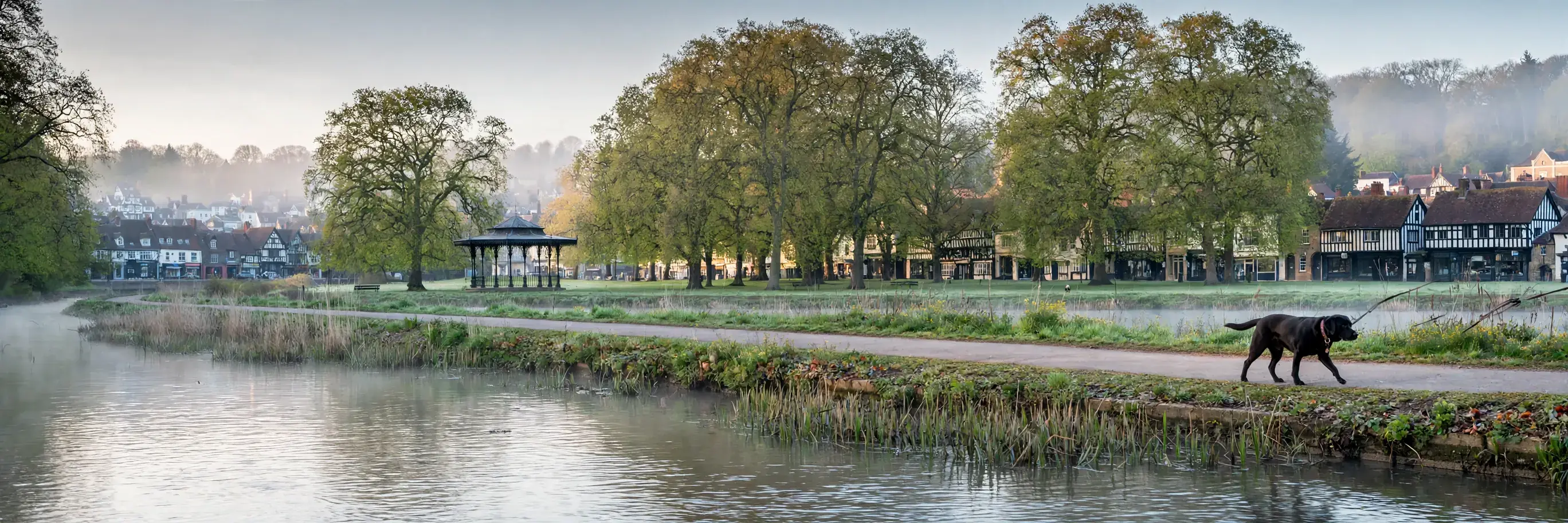
Shrewsbury is the county town of Shropshire, and its geography does most of the work for a dog owner. The River Severn, Britain's longest river, wraps around the old town in a wide loop, so the centre is almost an island of medieval streets held inside a bend of water. That shape means a walk that feels properly rural — riverside grass, meadows, kingfishers and swans — can start five minutes from a coffee shop, a bookshop and a train station. Few English market towns pack that much green space so close to their centre, and fewer still do it on ground that is mostly flat.
The town suits dogs that like to sniff rather than sprint. The main riverside paths are surfaced or well trodden, the gradients are gentle, and there are benches, bins and water points along the way. An older dog can manage a short Quarry circuit and a slow wander through the town, while a fitter dog can take on the full loop of about 12 kilometres (7.5 miles) and still have energy for a meadow detour. Because the loop is a loop, you can also cut it short at several bridges and lanes, which matters more than the headline distance: a dog that is tired at mile four should not have to finish mile seven to get back to the car.
There are limits to be honest about. Shrewsbury is not a beach town, and there is no vast off-lead common in the centre. The river is a real river, fast after rain and cold for much of the year, so swimming is a decision, not a default. Some of the best-known historic interiors do not admit pet dogs, and the town floods — sometimes badly — when the Severn rises. None of that should put you off. It simply means the trip works best when you plan around the river rather than against it, choose your walk by the water level, and treat the town streets and the park as two halves of the same day.
The River Severn loop, step by step
The classic Shrewsbury walk follows the Severn around the town. The full loop is about 12 kilometres (7.5 miles) and is generally rated easy to moderate, with very little climbing. Shorter published circular routes cover around 4.3 miles and take about an hour and a half, while a short Quarry circuit can be as little as a mile. The figures vary because different guides start in different places and cut different corners, so treat the distance as a range and choose your version on the day. A good rule is to decide your turn-back point before you set off, and to carry water even on a short walk, because there are stretches of open riverside with no shade and no tap.
A practical start is the Quarry, on the western side of the town, or the Frankwell area near the Welsh Bridge. From the Quarry, the riverside path runs beside the Severn with the park lawns on one side and the water on the other. Early in the walk you pass the bandstand, the war memorial and the tree-lined avenues that give the park its formal character, then the path opens out towards the meadows. Look for the weir, where the river drops and the sound changes, and for the footbridges that cross the Severn at intervals. Each bridge is a decision point: cross it and you can shorten the walk through the town, or stay on the river and keep going.
Heading downstream, the path passes the area once known as Gooseland, now the county cricket ground, and then Poplar Island, a countryside site where the path turns to grass and can get muddy in winter and after rain. Conservation grazing cattle are sometimes present here, so keep your dog on a lead and under close control, and give livestock a wide berth. The ground is worth watching too: after wet weather the riverside grass holds water, and a dog that loves a puddle will find plenty of them. A long line is useful on these open stretches, giving a dog room to sniff without letting it charge towards the water, other dogs or grazing animals.
The return leg brings you past Shrewsbury Abbey and the English Bridge, back towards the town centre. This is the most urban part of the loop, with pavements, road crossings and busier footpaths, so shorten the lead and keep your dog close. It is also the most convenient place to stop: cafes, toilets and shops are a short detour away, and the station is close by if you arrived by train. If you are walking the full loop, plan a proper rest here rather than pushing straight on. A dog that has walked seven miles needs water, a few minutes lying down in shade, and a chance to settle before the last stretch through the town.
The Quarry and the Dingle
The Quarry is Shrewsbury's main riverside park, a 29-acre Grade II listed green space on the loop of the Severn, close to the town centre. It has been the town's most important place for recreation since the 16th century, and it still does the job well: wide lawns for picnics and ball games, tree-lined avenues for a shaded stroll, a riverside path for watching the water, and a fenced play area and splash park for children in summer. For a dog owner, its greatest virtue is variety in a small area. You can give a dog a proper run, a quiet sniff around the gardens and a riverside walk without moving the car or crossing a busy road.
The park's layout rewards a slow circuit. Start on the riverside path and let your dog watch the river — swans, ducks and rowing boats are regulars — then cut across the lawns towards the centre of the park. The avenues are formal and shaded, good on a hot day, and the open grass is where most dogs do their best running. There is usually a coffee kiosk near the entrance and often an ice cream van in summer, which makes the Quarry a natural meeting point and a good place to pause. Toilets are available near the entrance, and the park is free to enter, although parking charges may apply depending on where you leave your car.
The Dingle is the park's quiet heart: a sunken, ornamental garden with ponds, ducks, flower beds and benches, built in the late Victorian period and centred on the Sabrina statue. It is beautiful, and it is also the part of the park where your dog needs to be on a lead and under close control. Dogs need to stay on a lead around the formal sunken garden, and the ponds and planting are not a place for a dog to splash or dig. Treat the Dingle as a short, calm detour rather than a play area: walk through slowly, let your dog sniff the edges, sit on a bench if the weather allows, and then return to the open lawns for the energetic part of the walk.
The old town: timber frames and quiet lanes
Shrewsbury's old town is a pleasure to walk with a dog because it was built for pedestrians, not cars. The streets inside the river loop are narrow, winding and full of timber-framed buildings, many of them black-and-white, leaning over the pavement in a way that makes every corner worth a look. The town has more than 600 listed buildings, and the centre still follows its medieval street plan, so a walk here is a sequence of small discoveries: a hidden courtyard, a passage between two shops, a pub sign, a church tower appearing over the rooftops. Keep your dog on a short lead in the centre, because pavements are narrow, shop doorways open straight onto the street, and delivery vans use lanes that look pedestrian-only.
The narrow passages, known locally as shuts, are one of Shrewsbury's charms and one of its practical challenges. They are short cuts between streets, often steep, cobbled or stepped, and they can be slippery when wet. Some are fine for a confident dog, but a dog that is nervous on steps or unsettled by echoing, enclosed spaces will prefer the main streets. Use the shuts sparingly, and check the surface before you commit a small or arthritic dog to a steep set of steps. The main shopping streets — Pride Hill, High Street and Wyle Cop — are wider and easier, with more room to step aside when a crowd passes.
Shrewsbury Market Hall, in the Square, is a covered market with food stalls, crafts and local produce, but dogs are not allowed inside except for guide dogs, so plan around it rather than through it. One person can browse while the other waits outside with the dog, or you can buy from the outdoor stalls and eat on a bench in the Square. The same split-the-party approach works for the town's museums and indoor attractions, most of which admit only assistance dogs. Treat the old town as an outdoor attraction in its own right: the buildings, the river views and the street life are the show, and your dog can enjoy all of them from the pavement.
Castle, Abbey and the town walls
Shrewsbury Castle stands on a red sandstone hill at the northern edge of the old town, on the site of a Norman castle built around 1070. Today it houses the Soldiers of Shropshire Museum, and the building and its grounds are a landmark rather than a dog walk. This is a point where the official rules matter more than the general reputation of the town: assistance dogs are welcome inside the castle and its grounds, but pet dogs are not otherwise allowed on site. That is the position given in the museum's own visitor information, and it is worth respecting even when the grounds look inviting. Do not plan to walk your dog around the castle, and do not leave a dog tied up outside while you go in — find a different viewpoint instead.
Shrewsbury Abbey is a different story, and a much better one for dog owners. The Abbey was founded as a Benedictine monastery by Roger de Montgomery in 1083, on the site of an earlier Saxon church, and it is now the parish church of Holy Cross, on Abbey Foregate on the eastern side of the town. Its own website says the Abbey is open to everyone, that dogs are most welcome if kept on a lead, and that it offers complimentary water and biscuits for canine visitors. There is no admission charge, although visitors are asked to leave a donation according to their means. That welcome is genuine, but remember that the Abbey is a working church: keep your dog calm and close, avoid service times if your dog is restless, and check the official guidance before you travel, because opening hours depend on volunteers and the Abbey may close between services on some Sundays.
The Abbey is also a useful anchor for the eastern end of the river loop. It sits near the English Bridge and the Abbey Foregate car park, which is a practical starting point for the downstream section of the walk. From the Abbey, you can follow the river back towards the town centre, or cross the bridge and walk the southern bank. The churchyard and the surrounding streets are quieter than the town centre, and they make a good place for a calm end to a long walk. If your dog has been on a lead all day, this is a good spot for a final sniff and a drink before the drive home.
River safety, flooding and wet weather
The River Severn is the reason Shrewsbury is beautiful, and the reason a dog owner needs to plan carefully. It is a powerful river, fast after rain, cold for much of the year, and prone to flooding that can close paths, car parks and roads with little warning. The town has lived with this for centuries: the Frankwell flood barriers are a familiar sight in winter, and the riverside car parks at Frankwell Main, Frankwell Riverside and St Julian's Friars have all been closed during recent floods, including in January 2024 and again in November 2025. When the Severn peaked at 4.69 metres at the Welsh Bridge gauge in January 2024, the bus station closed, towpaths were shut, and the town's flood defences stayed in place for days.
Before you travel, check the Environment Agency flood service for the Shrewsbury area and look for Shropshire Council updates on car park and road closures. Do this the morning you travel, not the night before, because river levels can change overnight. If a flood warning is in place for the River Severn at Shrewsbury, or for the Showground and the Quarry, do not walk the riverside paths, and do not drive into a riverside car park hoping it will stay open. Use a higher car park instead — Raven Meadows multi-storey is the usual alternative — and switch your walk to the town centre streets, the higher ground around the castle, or a hill walk outside the town. A flooded path is not a puddle: the water is cold, the current is strong, and the ground underneath is invisible.
Swimming needs the same caution. Some dogs love the Severn, and there are shallow spots along the river edge where a dog can paddle, but the river is not a lake. The current is strongest near the weir and after rain, the banks can be steep and slippery, and the water can be cold enough to cause problems for a small or older dog even in summer. Never let a dog swim near the weir, never throw a ball into fast water, and never let a dog swim in a flooded river. If your dog does go in, rinse it with clean water afterwards, check its paws and ears, and watch for signs of stomach upset in the following day or two. If you are unsure about the water, keep your dog on a lead and on the bank — a paddle in a shallow edge is enough.
Longer walks beyond the town
If you have a second day, or a dog that still has energy after the river loop, Shrewsbury is a good base for longer walks in the Shropshire countryside. The best-known is Attingham Park, a National Trust estate a few miles east of the town, with 200 acres of parkland, a Georgian mansion, a walled garden and a deer park. Dogs are welcome to explore the grounds, but they must be kept on a lead in all outdoor spaces except in the designated off-lead area, where a year-round woodland zone and a seasonal paddock offer a proper run. Only assistance dogs are allowed inside the mansion, shop and cafe, although there is dog-friendly seating outside and water bowls at the cafe. Check admission and opening times before you travel, because the estate can close for events and the paddock dates change with the farming calendar.
Attingham is worth the trip for the variety it offers: a mile walk through the parkland, woodland paths, riverside stretches along the Tern and the Severn, and the chance to see fallow deer in the deer park. Keep your dog on a short lead around the deer, and follow the signed short-lead areas where paths are busy. The estate is popular, so arrive early on weekends and be prepared for a car park that fills up. For a dog that has spent a day on town pavements, the open parkland is a welcome change, and the woodland off-lead area is one of the few places near Shrewsbury where a dog can run freely in a managed setting.
Other options within a short drive include the Rea Brook valley and the Shrewsbury to Condover circular, an 8.2-mile route that starts along the Rea Brook and heads out through fields and woods, passing Bomere Pool. That walk is longer and more rural than the river loop, and parts of it can get muddy after rain, so save it for a dry day and a fit dog. The same advice applies to the Severn Way, the long-distance path that follows the river through Shropshire: use it in sections, join it at a bridge or a car park, and walk the stretch that fits your dog rather than attempting a full day on an unfamiliar path.
Getting there: parking and trains
Shrewsbury is easy to reach by car and by train, and both options work well with a dog if you plan the last mile. By car, the town is served by the A5 and the A49, and the centre is compact enough that a single car park can serve a whole day. The most useful car parks for a dog walk are Frankwell Main and Frankwell Riverside, near the Welsh Bridge and the Quarry, Raven Meadows multi-storey in the town centre, and Abbey Foregate, near the Abbey and the eastern end of the river loop. Frankwell is the most convenient for the Quarry and the western riverside, but it is also the most exposed to flooding, so check the official guidance before you travel and have Raven Meadows as your backup. Abbey Foregate is a good choice for the downstream loop and the Abbey, and it is a short walk from the station.
By train, Shrewsbury station sits on Castle Foregate, at the northern edge of the town centre, a short walk from the castle, the Quarry and the river loop. The station is served by Transport for Wales, West Midlands Trains, Avanti West Coast and other operators, with direct services to Birmingham, Manchester, Crewe, Chester, Cardiff and the Welsh coast. Transport for Wales allows up to two dogs per passenger free of charge, provided they are well behaved, on a lead or in a carrier, and do not endanger or inconvenience other passengers or staff. Other operators have their own rules — some charge for dogs, some require a carrier for small pets — so check the official guidance before you travel, especially if you are changing trains or travelling with a large dog.
Arriving by train has a real advantage in Shrewsbury: you step out of the station and into the town, with no car park to find and no flood-prone riverside parking to worry about. The walk from the station to the Quarry takes about ten minutes through the town centre, and the river loop is accessible from there without any further transport. If your dog is nervous on trains, choose a quieter service, sit in a less crowded carriage, and bring a familiar blanket for the dog to lie on. A short practice journey before a long trip is worth the effort, and a tired dog travels better than a restless one, so give your dog a good walk before you set off.
Eating out and staying over with a dog
Shrewsbury is a good town for eating out with a dog, provided you choose the right kind of place. The town has a strong cafe and pub culture, and many of the independent cafes and pubs in the centre welcome dogs, usually in a specific area — a bar, a terrace, or a ground-floor room — rather than throughout the building. The pattern is familiar from other English market towns: look for a water bowl by the door, a dog biscuit on the counter, or a sign that says dogs are welcome, and always ask before you sit down. Policies change, and a place that welcomed dogs last year may have changed its rules, so check the official guidance before you travel and do not rely on a list that is months old.
For a longer stay, Shrewsbury has a range of dog-friendly accommodation, from town-centre hotels and bed and breakfasts to self-catering cottages and holiday parks in the surrounding countryside. The questions to ask are the same ones that matter anywhere: is there a pet fee, and how much is it per dog per night or per stay; is there a limit on the number or size of dogs; are dogs allowed in the bedroom, the dining room and the garden; and is there a secure area for a last walk at night? Get the answers in writing before you pay, and check whether the room is on the ground floor, whether there are steps, and whether the garden is enclosed. A town-centre hotel with a small, unenclosed courtyard is a poor fit for a dog that needs a secure run, while a cottage on the edge of town with a fenced garden and a riverside path from the gate is ideal.
If you are planning a longer break in Shropshire, compare the accommodation options properly rather than booking the first place that says dog-friendly. Our guide to dog-friendly holiday parks in the UK explains how to read pet fees, boundaries and site maps, and the same checks apply to a cottage or a hotel: the boundary, the toilet walk, the noise, and the distance to the first proper walk. For a town break, a central base that lets you walk to the Quarry and the river without driving is worth more than a larger room on the edge of town that needs a car for every outing.
A one-day plan and packing list
A good day in Shrewsbury with a dog starts early and stays flexible. Arrive before ten, park at Frankwell or Abbey Foregate, and walk straight to the Quarry for a first circuit while the park is quiet. Let your dog run on the lawns, walk through the Dingle on a lead, and follow the riverside path for a mile or two to stretch its legs. By late morning, the park will be busier, so move into the old town for a slow wander: Wyle Cop downhill towards the Abbey, the Square for a coffee, and the streets around the castle for a look at the timber-framed buildings. Stop for lunch at a dog-friendly pub or cafe, with your dog settled under the table on its blanket.
In the afternoon, choose the walk that fits the dog you have in front of you. A fit dog can continue around the river loop, crossing at a bridge to shorten it if needed, and finishing at the Abbey for a calm end to the day. A tired or older dog will be happier with a short riverside stroll and a longer rest in the Quarry, watching the river from a bench. Either way, build in a proper rest before the drive home: water, a few minutes lying down in shade, and a final toilet walk. A dog that is rushed from a long walk straight into a car is more likely to be sick or restless on the journey.
Packing for Shrewsbury is packing for a river town in England, which means packing for change. Bring a lead and a spare, a long line for the open meadows, poo bags, a water bottle and a collapsible bowl, a towel and a drying coat, a familiar blanket, and a torch if you are walking near dusk. In summer, add sun protection for a pale-nosed dog and extra water; in winter, add a coat for a short-haired or older dog and a pair of boots for yourself, because the riverside grass will be muddy. A first-aid kit with a tick remover, a bandage and your vet's number is worth carrying on any rural walk, and a charged phone is essential for checking flood updates and finding your way back to the car.
Finally, remember the comparison that helps on any coastal or riverside trip: the rules that apply on a beach are not the rules that apply on a river, and the rules that apply in a park are not the rules that apply in a church. Our guide to dog-friendly beaches in the UK explains how seasonal bans and fines work on the coast, while our Brighton with a dog guide shows how a busier seaside town handles dogs on the promenade and the pier. Shrewsbury is quieter than either, and that is its appeal: a river, a park, an old town and an Abbey that welcomes dogs, all within a single loop you can walk in a day.
Practical questions
Before you go
Can my dog go off lead in the Quarry Park?
Treat the open lawns as the place for a controlled off-lead run only when they are quiet and your dog has a reliable recall, and keep your dog on a lead in the Dingle, on the riverside paths, around the play area and whenever an event or crowd makes control harder. Follow the signs on the day, because local rules and event restrictions can change.
How long is the River Severn loop at Shrewsbury?
The full river loop is about 12 kilometres (7.5 miles), while shorter published circular routes are around 4.3 miles and the central Quarry section can be as short as about a mile. Pick the version that fits your dog, and use the bridges and town streets to shorten the walk rather than pushing a tired dog around the whole loop.
Can dogs go into Shrewsbury Castle?
No, pet dogs are not allowed inside Shrewsbury Castle or its grounds; only assistance dogs are welcome there, according to the museum's own visitor information. Enjoy the castle from the surrounding streets and the town walls walk instead, and plan a separate dog walk in the Quarry or along the river.
Is Shrewsbury Abbey dog friendly?
Yes. Shrewsbury Abbey says dogs are most welcome if kept on a lead, and it offers complimentary water and biscuits for canine visitors. Remember that it is a working church, so keep your dog calm and close, avoid service times if your dog is restless, and check the official guidance before you travel.
What should I do if the River Severn is flooding?
Do not walk riverside paths or drive into riverside car parks when flood warnings are in place. Check the Environment Agency flood service and Shropshire Council updates before you travel, use higher car parks such as Raven Meadows, and switch to town-centre streets or a hill walk instead. Never let a dog swim in a fast or flooded river.
Can I take my dog on the train to Shrewsbury?
Yes, in most cases. Transport for Wales allows up to two dogs per passenger free of charge, provided they are well behaved, on a lead or in a carrier, and do not endanger or inconvenience other passengers. Rules vary by operator, so check the official guidance before you travel, especially if you are changing trains.