This guide is independent and contains no paid placement. If affiliate links are added later, they will be clearly marked and will not change our editorial checks.
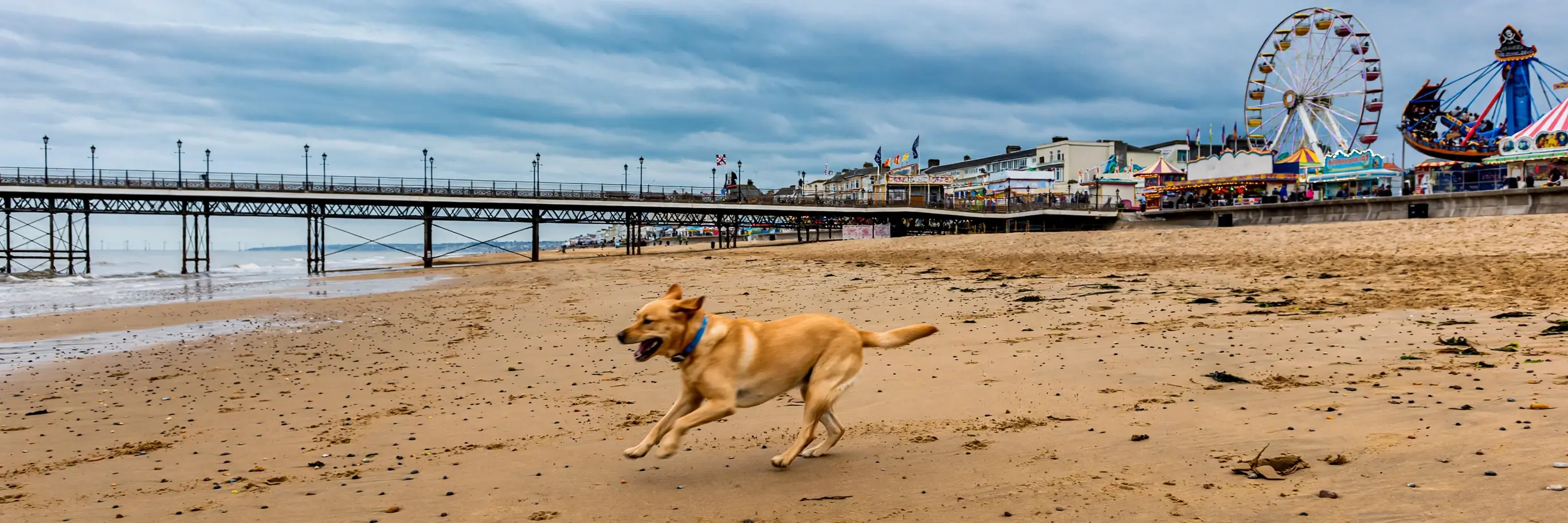
Skegness beach is dog-friendly all year on the stretches north and south of the central zone, but dogs are banned from the central Blue Flag beach from 1 May to 30 September under a council Public Space Protection Order, and must be on a lead on the promenade beside it. Check the tide times before every beach walk: the sand is very flat, so the sea comes in fast and a long way.
Start with the tide timetable
Most seaside guides start with the attractions. In Skegness, start with the tide timetable instead, because the tide decides what kind of beach you get and how much of it you can safely use. Skegness sits on the Lincolnshire coast at the northern edge of The Wash, and its beach is famously wide and flat. At low water the sand stretches a long way out towards the sea, and at high water the same sand disappears under the tide almost entirely. A walk that feels spacious at ten in the morning can be a narrow strip of wet sand by early afternoon, and a dog that was happily running in open space can suddenly be sharing a thin corridor with every other walker, paddler and dog on the beach.
The practical habit is simple: look up the tide times for Skegness the night before, and again on the morning of the walk. Note the time of high water and the time of low water, and plan the beach part of the day around them. A falling tide — the hours after high water, when the sea is moving away from the shore — is the safest window for a long beach walk, because the sand in front of you is getting wider rather than narrower. A rising tide is the one to treat with respect: walk with the sea on your left or right, keep an eye on the waterline, and turn back well before high water rather than trying to squeeze in one more throw of the ball.
The same timetable shapes the season as well as the day. In summer, the central beach is closed to dogs from 1 May to 30 September, so the tide timetable and the ban dates work together: a summer morning at low tide on the north or south beach gives a dog a huge expanse of sand, while a summer afternoon at high tide on the central beach gives a dog nothing at all, because the dog should not be there in the first place. In winter, when the whole beach is open to dogs from 1 October to 30 April, the tide matters even more, because the beach is at its emptiest and most tempting — and the weather is at its least forgiving if you misjudge the water.
Keep the tide check in the same place as the rest of the plan. Save the tide times on your phone, write the high-water time on a note by the door, and tell everyone in the group what time you need to be off the lower sand. Dogs do not read tide tables, and they do not understand why the route back has vanished, so the human in the group has to do that thinking in advance. If you are unsure about the tide on a particular day, check the official guidance before you travel, and ask at the lifeguard station or the visitor centre when you arrive.
Beach rules at a glance
Skegness beach is managed under a Public Space Protection Order (PSPO) made by East Lindsey District Council. A new order was granted in November 2024 and lasts for three years, with renewal due in November 2027. The order sets the seasonal dog ban on specified areas of the beaches at Skegness, Mablethorpe and Sutton on Sea, and it also requires dogs to be kept on a lead on the promenades in the ban areas during the same dates. The table below is a summary for planning; the signs on the beach and the council's own PSPO map are the final word on the day, so check the official guidance before you travel.
| Where | 1 May to 30 September | 1 October to 30 April |
|---|---|---|
| Central beach (Blue Flag area, roughly from the pier to the lifeboat station and North Parade) | Dogs banned from the sand | Dogs welcome on the whole beach |
| Promenade beside the central ban area | Dogs must be on a lead | Dogs can be walked normally; keep a lead handy in crowds |
| North Beach (towards Ingoldmells and Fantasy Island) | Dogs welcome all year | Dogs welcome all year |
| South Beach (past the boating lake towards Gibraltar Point) | Dogs welcome all year | Dogs welcome all year |
| Gibraltar Point beach and foreshore | No dogs on the beach or foreshore, 1 April to 1 September | Dogs on a short lead only; check reserve rules |
Breaching the PSPO can lead to a fixed penalty notice, commonly £100, and prosecution can carry a much larger fine, with figures of up to £1,000 quoted for beach-ban offences. Council wardens patrol the seafront, particularly on busy summer weekends, and the ban area is signposted on the beach itself. The sensible approach is to treat the signs as the boundary, not your memory of where the boundary was last year: the November 2024 order altered the size of the seasonal ban areas, so a stretch that was open in an earlier summer may not be open now.
Two other rules catch visitors out. First, barbecues are not permitted on any East Lindsey beach, so do not plan a beach barbecue with the dog in tow. Second, assistance dogs are treated differently from pet dogs under the usual exemptions — if you rely on an assistance dog, check the official guidance before you travel and carry whatever documentation the council or the venue asks for, rather than assuming every sign applies in the same way. For a fuller explanation of how seasonal bans and PSPOs work across the country, see our guide to UK beach dog rules, which explains the 2026 picture, fines and assistance-dog exceptions in detail.
Finally, remember that the rules describe the minimum, not the whole of good beach behaviour. Pick up after your dog everywhere, including on the open stretches where nobody is watching. Carry more bags than you think you need, and take them to a bin rather than leaving them on the sand or hanging them from a fence. Keep a dog on a lead around children, picnics, donkey rides and the lifeguard flags, even where off-lead walking is allowed. The central beach is lifeguarded in the summer season — in 2026 the RNLI lifeguards were on duty from 23 May to 6 September, from 10am to 6pm — and swimming should stay between the red and yellow flags. A dog that swims should stay close to its owner and well away from the flagged swimming area.
Central, North and South beaches
Skegness beach is one long stretch of sand, but for a dog owner it behaves like three different beaches, and the difference is everything. The central beach is the postcard: the Blue Flag sands in front of Grand Parade, the pier, the amusements and the donkey rides, with the lifeboat station at one end and the skate park at the end of North Parade marking the rough edge of the ban zone. In winter it is a superb dog beach — wide, firm, flat and open, with the whole town behind it. In summer it is a no-dog zone, and trying to use it with a dog between May and September is the single most common mistake visitors make.
North Beach runs from the central zone towards Ingoldmells and Fantasy Island. It is dog-friendly all year round, and it is the natural choice in summer: the further north you walk, the quieter the sand becomes, and a dog that needs space to run will find it here far more easily than on the crowded central sands. The walk north is flat and straightforward, but it is long, with fewer facilities the further you go, so carry water for the dog, and agree a turn-back point before you set off rather than discovering you are a mile from the car with a tired dog and a rising tide.
South Beach runs the other way, past the boating lake and the beach chalets towards Gibraltar Point. It is also dog-friendly all year round, and it has a different character: quieter, more open, and closer to the dunes and the nature reserve at the southern end. The southern stretch is where many regular dog walkers go, and it is the best option for a dog that finds the noise and crowds of the central seafront stressful. Note, though, that the far south of the beach meets the nature reserve, where the rules change again — dogs must be on a short lead, and the reserve beach and foreshore are closed to dogs from 1 April to 1 September — so the southern walk needs a turn-back point before the reserve boundary, not after it.
Choosing between north and south is mostly a question of what your dog needs on the day. North is the better bet for a long, straight run on firm sand and for a dog that wants to keep moving. South is the better bet for a calmer walk with a change of scenery, and for combining the beach with the reserve's paths on a lead. Either way, walk the dog on the beach that is open to dogs, not the beach that is nearest the car park. In summer that usually means a slightly longer walk to the sand, and it is worth it: a relaxed dog on an open beach is a better holiday than a stressed dog on the edge of a ban zone, watching the signs and the wardens.
One more practical point about the central beach in winter. When the ban lifts on 1 October, the whole beach opens to dogs, and the resort quiets down at the same time. This is the best season for many dog owners: the sand is empty, the air is cold and clear, and the dog can run the full length of the beach. It is also the season when the weather turns fastest, the light fades earliest, and the tide is least forgiving of a late start. Take a torch in the car from October onwards, check the sunset time as well as the tide time, and keep the dog in sight on the wide, flat sands, where a small dog can disappear into the distance surprisingly quickly.
The pier and the promenade
Skegness Pier is one of the town's defining sights: a long pier running out over the sand, lined with amusements, food stalls and places to sit and look at the sea. Dogs can go on the pier on a lead, which makes it a useful part of a seafront walk rather than a place to avoid. Treat it as a short, controlled walk, not a free run. The pier is narrow, busy and full of distractions — flashing machines, dropped food, other dogs, children running, and the sound of the sea underneath — so keep the lead short, walk at the dog's pace rather than dragging it through the crowd, and step aside to let others pass rather than squeezing through a gap.
Individual stalls and indoor areas on the pier may have their own rules, so check the signs at each entrance rather than assuming that access to the pier deck means access to everything on it. Some food outlets welcome dogs at outdoor seating and some do not, and the position can change between seasons, so ask before settling down with a dog under the table. If your dog is nervous in crowds, noisy places or on surfaces that move or rattle, walk the promenade beside the pier instead and look at the pier from the sand: the dog gets the same sea air without the stress, and you still get the view.
The promenade itself — Grand Parade, North Parade and South Parade running along the seafront — is the spine of any Skegness walk with a dog. It is flat, paved and easy for older dogs, dogs with sore joints and owners with pushchairs, and it links the pier, the beach access points, the gardens and the town centre in one level route. Between 1 May and 30 September, dogs must be on a lead on the promenade inside the beach ban area, and at any time of year a lead is the sensible choice on the busiest stretches, where the pavement is shared with cyclists, mobility scooters, families and fairground crowds.
Churchill Avenue, the wide shopping street running back from the seafront, is worth knowing about as a dog-walking route too. It is one of the main pedestrian routes in the resort, lined with shops, cafes and takeaways, and it gives a dog a change of surface and smell after the sand. Most shops will not admit dogs, and the street is at its busiest on summer Saturdays, so use it as a short link between the seafront and the quieter streets rather than as a long walk in itself. In winter, when the crowds thin out, the same street becomes a much calmer stroll, and the cafes with outdoor seating are easier to use with a dog lying quietly at your feet.
Seafront etiquette matters more in Skegness than in a quiet village, because the resort is built for crowds. Keep the dog on the seaward side of the pavement where possible, so it is not weaving through shop doorways. Do not let the lead trail across the pavement where it can trip a passer-by. If the dog needs a toilet break, use the grass or the sand, not the pavement outside a cafe, and clean up immediately. And if the dog barks at fairground rides, donkeys or the sea itself, move a little further away and let it watch from a distance rather than pushing it closer: a seafront that feels exciting to a person can feel overwhelming to a dog, and a short retreat usually solves the problem.
Gibraltar Point Nature Reserve
Gibraltar Point National Nature Reserve sits about three miles south of Skegness town centre, at the northern edge of The Wash, and it is the wild counterpoint to the resort: sand dunes, saltmarsh, freshwater lagoons, meadows and a wide, unspoilt shoreline, managed as a national nature reserve. It is a superb place to walk a dog, but it is a nature reserve first and a dog walk second, and the rules reflect that. Dogs must be kept on a short lead at all times in the reserve, and no dogs are permitted on the beach or foreshore between 1 April and 1 September. Only guide dogs are allowed inside the Visitor Centre, although dogs are welcome on the outside veranda.
The reserve's trails are well marked and mostly flat, with a loop of nearly four miles — about 6.3 kilometres — that takes most walkers around an hour and a quarter, plus shorter options for a dog that does not need the full circuit. The paths run through dunes and saltmarsh, past bird hides and freshwater pools, and out to views across The Wash. Grazing animals are kept on the reserve, which is one reason the short-lead rule is strict: a dog off the lead among grazing stock and ground-nesting birds is a genuine risk to wildlife, and to the dog. Keep the lead short even on the quiet paths, and keep the dog out of the lagoons and pools, where the water is part of the habitat, not a paddling pool.
Timing matters here more than in the town. Spring and summer bring breeding birds and the beach closure, so the reserve walk in those months is a paths-and-dunes walk, not a beach walk. Autumn and winter bring migrating birds, big skies and far fewer visitors, and the reserve beach opens to dogs on a lead from September onwards — but the weather is harsher, the wind comes straight off the North Sea, and the paths can be muddy after rain, so dress for the conditions and bring a drying coat for the dog. Bird hides are a good test of a dog's settle: if the dog cannot lie quietly for a few minutes while you look through the hide, watch from outside instead and keep moving.
Getting there is straightforward. There is a pay-and-display car park by the Visitor Centre on Gibraltar Road, with marked accessible bays, and the reserve is also reachable on foot along the coast from Skegness, which makes a long out-and-back walk for a fit dog — but check the tide and the reserve boundary before attempting the beach part of that route, and plan to walk back along the paths rather than the foreshore if the tide is rising. Entry to the reserve itself is free; the charge is for parking. Check the official guidance before you travel for current opening hours, car park arrangements and any seasonal notices, because the reserve is a working conservation site and conditions change with the seasons.
One last note on wildlife: seals are sometimes seen on this coast, and injured seal pups are washed up on the beaches around Skegness. If you see a seal on the beach, keep the dog well away and on a lead, do not approach the animal, and report it to the relevant rescue organisation rather than trying to help yourself. A curious dog and a stranded seal is a bad combination for both animals, and the right response is distance, a phone call and patience.
A seafront walk that works with a dog
Here is a practical route that fits the rules, the tide and a dog's energy, and that you can shorten or lengthen at several points. It assumes a summer day, when the central beach is closed to dogs, and it works just as well in winter, when the whole beach is open. Start at the railway station end of town and walk along Lumley Road towards the seafront, keeping the dog on a lead through the town streets. Turn onto Grand Parade and walk south along the promenade, with the sea on your left, past the pier and the amusements. This is the busy stretch, so keep the lead short, keep the dog on the seaward side, and do not stop in the middle of the pavement to look at the view.
Continue past the boating lake and the beach chalets towards the south beach, and once you are past the end of the central ban area — check the signs at the access point — take the dog down onto the sand. This is where the walk opens up: the beach widens, the crowds thin, and the dog can have a proper run if the tide is low and the sand is firm. Walk south for as far as suits the dog, then turn back along the same sand and come up onto the promenade again before the reserve boundary at Gibraltar Point, unless you are continuing to the reserve on a lead with the beach rules in mind.
For a longer day, drive or take the bus to Gibraltar Point and walk the reserve loop instead, or combine the two: a morning on the south beach, a quiet lunch, and an afternoon on the reserve paths. For a shorter day with an older dog or a puppy, skip the long beach stretch and do the promenade only: station to pier, pier to the gardens, and back along the front, with a sit-down on a bench and a drink at a dog-friendly terrace. The distance matters less than the shape of the walk — a flat, level route with water, shade and a place to rest will suit most dogs better than a long march with no break.
Build in the practical stops. Water is the first: carry a bottle and a bowl for the dog, because the seafront has plenty of places to buy a drink for yourself and far fewer places to fill a dog bowl, and salt water is not a substitute. Shade is the second: on a hot day the sand and the pavement both heat up, and a dog's paws can burn on hot surfaces, so walk early or late, test the pavement with the back of your hand, and rest in the shade of the gardens or the pier. The third stop is the toilet break: give the dog a chance to go on the grass or the sand before the busy stretch, and carry bags for the return journey as well as the outward one.
If the weather turns — and on this coast it can turn quickly — the promenade walk still works in light rain, but the beach walk does not. A wet dog on a windy beach loses heat fast, and a dog that is cold and wet is a dog that will not enjoy the next hour. In that case, cut the beach section short, walk the promenade, and save the long sand for a better day. Skegness is a resort that rewards a second visit, and there is no prize for finishing a walk in the rain.
Indoor and rainy-day options
Skegness in the rain is a different resort, and a dog owner needs a plan for it, because the town's main attractions are outdoors. The best rainy-day option with a dog is Natureland Seal Sanctuary on North Parade, at the northern end of the seafront. Dogs are welcome there on a lead in the outdoor areas, and can join their owners for most of the visit, including the penguins and the seal feeding times — adult and baby seals are fed at 11:30am and 2:00pm — but dogs are not allowed in the Gift Shop, the Blue Lagoon Restaurant or the Floral Palace, because of the free-flying birds and butterflies. Emergency poo bags are available at the entrance, and owners are responsible for cleaning up after their dogs. Natureland is open all year round except for Christmas Day, Boxing Day and New Year's Day, but check the official guidance before you travel for current opening times and prices.
Beyond Natureland, the rainy-day options narrow. Most indoor attractions, arcades and fairground buildings do not admit dogs, and the town's shopping centres and indoor markets are generally not dog-friendly either. That is not a reason to stay in the car: it is a reason to plan the day differently. Use the rain for a short promenade walk in waterproofs, then take the dog back to the accommodation to dry off and rest, and use the wettest hours for the human-only parts of the day — one person stays with the dog while the other visits an indoor attraction, or you visit together and leave the dog settled in the car only if it is safe, cool and legal to do so, which on a warm day it is not.
The car itself deserves a thought on a rainy day. A wet dog in a car will steam up the windows, soak the seats and smell for the rest of the trip, so pack a drying coat, two towels and a waterproof seat cover as standard, and keep a spare towel by the door of the accommodation for the return. If you are staying in a caravan or a holiday park, check where the dog can be dried: an outdoor tap, a covered porch or a utility area makes a rainy week manageable, while a small caravan with no drying space makes it miserable. Our guide to dog-friendly holiday parks covers drying facilities, outdoor taps and laundry in detail, and it is worth reading before you book a wet-week stay anywhere on this coast.
Food in the rain is the other practical question. Many Skegness cafes and pubs welcome dogs on their terraces and in outdoor seating areas, but far fewer admit dogs indoors, and a terrace in the rain is no use to anyone. Look for places with a covered outdoor area, or ask when you book whether the dog can come inside on a quiet weekday — some places will say yes when it is quiet and no when it is busy, and the only way to know is to ask. Fish and chips eaten on a bench in the rain is a Skegness tradition, but a dog that is cold, wet and hungry will not enjoy sharing it, so buy the food, take it back to the accommodation, and eat it warm with the dog dry beside you.
Where to stay and eat with a dog
Skegness is built for staying over: caravan parks, holiday parks, chalets, guest houses and hotels line the seafront and the roads behind it, and many of them accept dogs. The choice that matters is not whether dogs are accepted but how they are accepted. A caravan park with a dog exercise area, a fenced pitch and a short walk to the beach will suit a dog far better than a hotel that accepts dogs but has no outdoor space and a long walk to the nearest grass. Ask the same questions you would ask anywhere: how many dogs are allowed, what the pet fee is, whether the fee is per dog or per stay, whether dogs can be left alone in the unit, and where the nearest practical toilet walk is after dark.
Butlin's Skegness, the large resort on the edge of town, deserves a specific mention because it confuses many visitors. Dogs and cats are restricted to the Caravan Owners' section and are not allowed onto the main Butlin's resort, so a standard Butlin's break is not a dog break. If you are staying in the caravan owners' area, check the current rules with the resort before you book, and do not assume that a dog-friendly caravan means a dog-friendly resort. The same caution applies to holiday parks generally: the park may welcome dogs while the entertainment complex, the swimming pool and the restaurants do not, so check each part of the stay separately.
Self-catering accommodation — a chalet, a caravan or a cottage — usually works best for a dog in Skegness, because it gives the dog a door to its own patch of grass, a kitchen for its food, and a place to dry off without negotiating a hotel corridor. Look for a ground-floor unit with direct outdoor access, a fenced or enclosed garden if the dog needs one, and hard floors rather than pale carpets. Check the check-in time, typically in the afternoon, and plan the arrival so the dog gets a walk and a toilet break before you unload the car: a dog that has been in the car for two hours and then has to wait while you carry bags upstairs will not settle well.
Eating out with a dog in Skegness is mostly an outdoor affair. Terraces, beer gardens and pavement seating are where dogs are welcome, and the town has plenty of them in summer. Indoors, the position varies from place to place and from season to season, so check before you sit down, and have a backup plan — a takeaway eaten on a bench, or a meal back at the accommodation — rather than arguing with a member of staff about a rule you did not check. A dog that can lie quietly under a table is welcome in far more places than a dog that barks at every passing plate, so the training you do before the trip matters as much as the pub's policy: practise lying down in a busy place at home, and bring a mat for the dog to settle on.
One more point about staying over: Skegness is at its best out of season for dog owners, and the prices reflect it. School-holiday weeks in August are the most expensive and the most crowded, and the dog-friendly units sell out earliest. May, June, September and October usually offer a better balance — calmer beaches, open sands where the summer ban has lifted or not yet started, and prices that leave room for the pet fee. Winter breaks are the cheapest and the quietest, but check what is open: some attractions, cafes and parks close or reduce their hours from November to March, and a dog-friendly stay is only a good deal if there is somewhere to go when you get there. If you are combining Skegness with a city break, our guide to York with a dog covers a very different kind of trip — walls, riverside walks and a city of layers — and it pairs well with a Lincolnshire coast stay on the same holiday.
Getting there, trains and parking
Skegness railway station is the eastern terminus of the Poacher Line, managed by East Midlands Railway, with services to Nottingham via Grantham. The journey from Nottingham takes around two hours, and the station sits in the town centre on Lumley Square, about a fifteen-minute walk from the beach along Lumley Road and Grand Parade. The station has no car park of its own, but there are car parks nearby on Richmond Drive and along the seafront, and a taxi rank and the bus station are close by. Buses run up the coast towards Mablethorpe and inland towards Louth, Alford, Boston and Lincoln, mostly operated by Stagecoach East, so a car-free trip is workable if you plan the bus times in advance.
Travelling by train with a dog is straightforward on this line: dogs travel free on most UK trains when kept on a lead or in a carrier, and the Poacher Line is a rural branch line with plenty of space for a dog to lie at your feet. The practical issues are the same as anywhere: book a seat if you can, travel outside the busiest summer Saturday trains if the dog is nervous, bring water and a mat for the dog to lie on, and give the dog a toilet break before boarding and a walk as soon as you arrive. The walk from the station to the seafront is flat and easy, but it runs through the town centre, so keep the dog on a short lead and watch for traffic at the roundabout onto Grand Parade.
By car, Skegness is reached from the A52 and the A158, and the approach through the Lincolnshire Wolds is part of the trip — flat farmland, big skies and long straight roads. Parking is plentiful along the seafront and in the town centre, with large car parks on the promenade, at the Festival Car Park and on Richmond Drive, but the seafront car parks fill early on summer weekends and bank holidays, so arrive before mid-morning or park a little further back and walk in. Check the charges and the maximum stay at the machine or the sign before you leave the car: some car parks are pay-and-display with a time limit, and a dog walk that runs over the ticket is an avoidable fine.
For a dog, the car journey needs the same care as the walk. Never leave a dog in a parked car on a warm day, even with the windows open — the temperature inside a car rises far faster than most people expect, and a seafront car park in the sun is one of the worst places for it. Bring a sunshade for the car if you are parking in the open, and plan the first walk so the dog gets out of the car promptly on arrival. If you are staying for several days, ask your accommodation about parking: some caravan parks and hotels include a space beside the unit, while others use a communal car park a walk away, and unloading a nervous dog across a busy site at dusk is a poor start to the stay.
Finally, know where the vets are before you need one. Skegness has veterinary practices in the town, and there are further practices in Boston, Louth and the surrounding villages, but opening hours are shorter out of season and emergency cover may be based in a neighbouring town. Save the number of the nearest practice and the nearest out-of-hours service on your phone before you travel, and carry the dog's vaccination record and any medication in the car rather than buried in a suitcase. If the dog eats something on the beach — a fish hook, a piece of fishing line, a dead bird or a lump of palm oil washed ashore — a vet's number in your phone is worth more than a search engine when you are standing on the sand.
Tides, sand and safety checklist
Skegness beach is a safe place to walk a dog when the tide, the weather and the dog are all taken seriously. It is a dangerous place when any of them is ignored. The sand is very flat, which means the tide covers a long distance in a short time, and the sea can cut off a route back to the steps while you are still watching the dog run. Soft mud, channels and areas of sinking sand exist on the lower beach and on the Wash side of the coast, and they are not always obvious to the eye. The rule is to stay on firm sand, keep to the upper beach at high tide, and never walk out onto the lower sands or the mudflats to chase a dog that has run ahead.
Wind is the other hazard that catches people out. The Lincolnshire coast is exposed to the North Sea, and a wind that feels fresh on the promenade can be biting on the open beach, especially for a small, short-coated or older dog. In summer the same wind can hide the strength of the sun: a dog can overheat on a bright, breezy day, and a fair-skinned dog can burn on its nose and ears. Bring water, offer shade, and watch for the signs of heat — heavy panting, a dry mouth, a dog that slows down or lies down and will not get up — and get the dog into the shade and cool water immediately if you see them.
Use this checklist before every beach walk in Skegness, and run through it again on the day:
- Tide times: check the Skegness tide times for today, note high water, and start on a falling tide.
- Ban dates: confirm the central beach ban is not in force for your dates, or walk the north or south beach instead.
- Signs: read the signs at the access point you actually use, and follow the boundary on the ground.
- Lead: carry a lead even for an off-lead walk, and a short lead for the promenade, the pier and Gibraltar Point.
- Water and bowl: carry fresh water for the dog; do not let the dog drink seawater.
- Bags: carry more poo bags than you need, and take them to a bin.
- Paws and coat: check paws for cuts from shells and fishing debris after the walk, and rinse salt and sand off the coat.
- Weather: check the forecast and the wind, and turn back early if the weather changes.
- Vet number: save the nearest vet and out-of-hours number on your phone before you leave.
- Phone charged: keep the phone charged and in a waterproof pocket on a beach walk.
After the walk, the routine matters as much as the walk itself. Rinse the dog's coat and paws with fresh water to remove salt and sand, which can irritate the skin and the pads, and dry the ears of a dog that has been swimming. Check between the toes for sand and small stones, and check the coat for ticks after a walk through the dunes or the reserve, where ticks are a real possibility in the warmer months. Feed the dog after it has settled and cooled down, not immediately after a long run, and give it a quiet place to rest — a tired dog that has run on the sand for an hour needs sleep more than it needs another walk.
If something goes wrong — the dog cuts a paw, eats something it should not have, or gets into difficulty in the water — the priority is the dog, not the walk. Keep the dog calm, keep it warm, and get to a vet. The RNLI lifeguards on the central beach in summer can help with a person in difficulty in the water, but they are not a vet service for dogs, and a dog in the sea is a risk to the person who goes in after it. Never enter the water after a dog in a strong current: call for help, keep the dog in sight, and let trained rescuers take over.
Practical questions
Before you go
Can dogs go on Skegness beach in summer?
Not on the central Blue Flag beach between 1 May and 30 September, when East Lindsey District Council's Public Space Protection Order bans dogs from that stretch. The beaches to the north and south of the central zone stay open to dogs all year, and the whole beach opens to dogs from 1 October to 30 April. Always read the signs at the access point you use, because the exact boundary is marked on the ground.
Where can dogs go on the beach in Skegness between May and September?
Head north past the central zone towards Ingoldmells or south past the boating lake and beach chalets towards Gibraltar Point. Both stretches are dog-friendly all year round and give a dog far more space than the busy central sands. Keep the dog on a lead on the promenade beside the ban area, and check the signs before letting the dog off the lead.
Are dogs allowed on Skegness Pier?
Yes, dogs can go on Skegness Pier on a lead. The pier is a busy, narrow space with amusements, food stalls and other visitors, so a short lead, a calm pace and a plan for passing other dogs matter more than on the open beach. Some individual stalls and indoor areas on the pier may have their own rules, so check the signs at each entrance.
Can dogs go to Gibraltar Point Nature Reserve?
Yes, dogs are welcome at Gibraltar Point National Nature Reserve, but they must be kept on a short lead at all times, and no dogs are permitted on the beach or foreshore between 1 April and 1 September. Only guide dogs are allowed inside the Visitor Centre. The reserve is about three miles south of the town centre, with dunes, saltmarsh and bird hides, and grazing animals on site.
What should I check about the tide before a Skegness beach walk?
Check the tide times for Skegness on the day of your visit, note the time of high water, and start a beach walk on a falling tide so the sea is moving away from you. Skegness has a very flat, wide beach, so the tide can cover a long distance quickly and cut off a route back. Keep to firm sand near the top of the beach at high tide, watch for soft mud and channels, and turn back early rather than trying to outrun the water.