This guide is independent and contains no paid placement. If affiliate links are added later, they will be clearly marked and will not change our editorial checks.
Stamford is a small, walkable market town where a dog does best on a short lead in the centre and a long line by the river. Start with the Friday market, wander the stone streets in the quiet middle of the day, then let the dog stretch out on Stamford Meadows or the Burghley parkland paths.
A Friday market morning
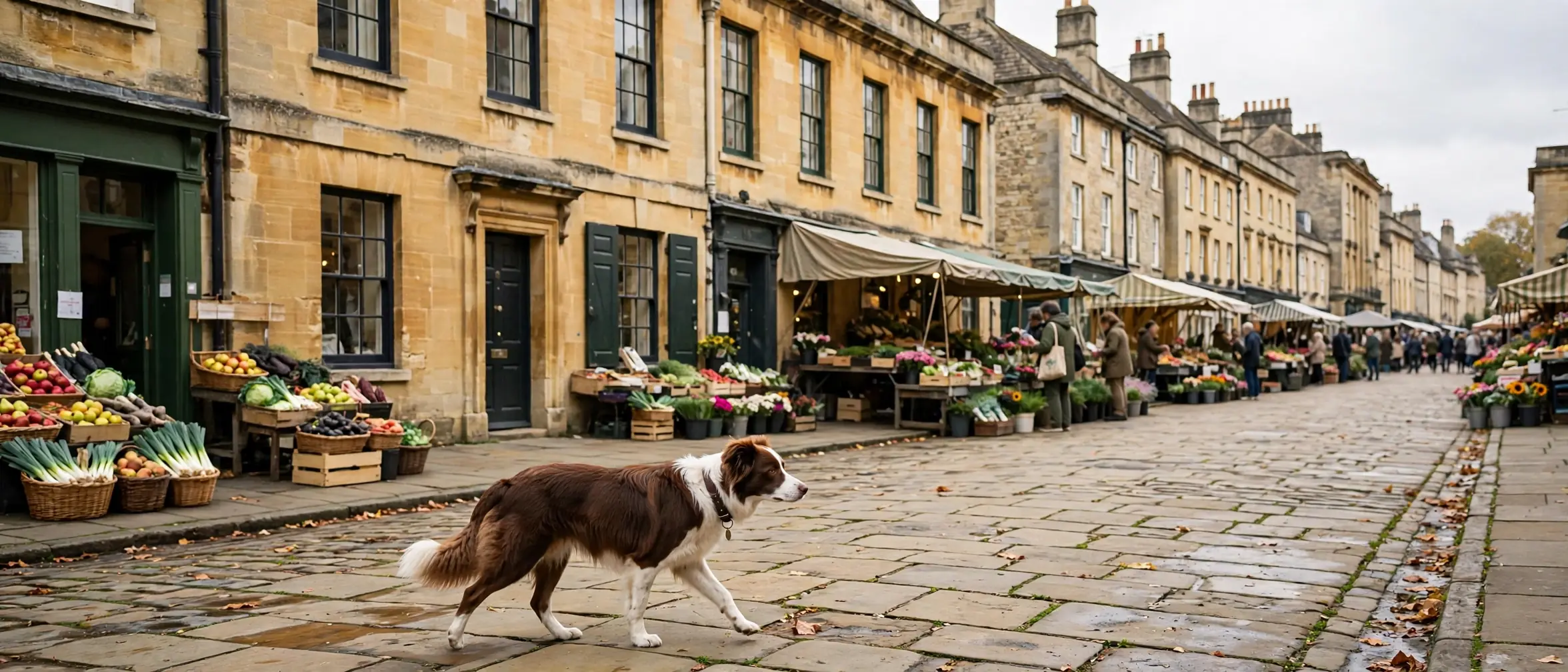
Friday is the day Stamford smells like itself. The market sets up in the Market Place and along Broad Street, and by mid-morning the air carries fresh bread, coffee, cut flowers, fruit and the faint, warm smell of hot food from the stalls. It is the best hour to arrive with a dog, because the town is awake but not yet crowded, the light is low on the stone, and the walking rhythm is unhurried: stall, pause, sniff, move on.
Start at the top of the Market Place and work your way down slowly rather than cutting through the middle. Dogs do better at the edges of a market, where there is room to step aside and where dropped food is easier to spot before a quick nose gets to it. Keep the lead short — a metre or so — and keep it on the side away from the stalls, so your dog is not weaving between legs and table corners. A harness with a handle helps in the tightest stretches, because you can lift the dog clear of a tangle without a scuffle.
The market is a working market, not a tourist display, and that is part of its charm for a dog walk. There are fruit and vegetable stalls, bread, cheese, flowers, plants and household goods, and the traders are used to dogs weaving past at ankle height. Many stallholders will offer a word and a pat, and a few keep a biscuit behind the counter, but do not assume it: ask before letting your dog take food from a stranger, and keep your dog from helping itself to anything at nose height. Grapes, onions, chocolate and cooked bones are all within reach at a market, and a dog that hoovers first and asks questions later needs a watchful owner.
Timing matters more than most people expect. Arrive between 8 and 9 in the morning and you will have the market largely to yourself, with stallholders still setting up and the streets quiet enough for a nervous dog to relax. Between 11 and 1, the Market Place is at its busiest, the pavements narrow, and a reactive dog will find the press of people, pushchairs and other dogs hard work. If your dog struggles with crowds, treat the busy hour as the time to slip away to the riverside instead, and come back for a coffee when the stalls begin to thin out in the afternoon.
After the market, give your dog a proper break before the next stretch. There are benches around the Market Place and on Broad Street, and a ten-minute sit with water and a chew lets a dog process a busy morning. Dogs that have been asked to walk politely through a crowd for an hour are tired in a way that looks like boredom: yawning, slowing down, sniffing the ground for longer. That is the moment to stop, not to push on to the next street. A market morning is a full morning for a dog, even if it feels like a gentle one to you.
If Friday does not suit your dates, the town still rewards a weekday visit. The streets are quieter, the cafes have more room for a dog under the table, and the stone looks its best in the low light of a winter morning or a long summer evening. The market is the loudest, most sociable version of Stamford; the other six days are the town at rest, and many dogs prefer it that way.
Stone streets and five churches
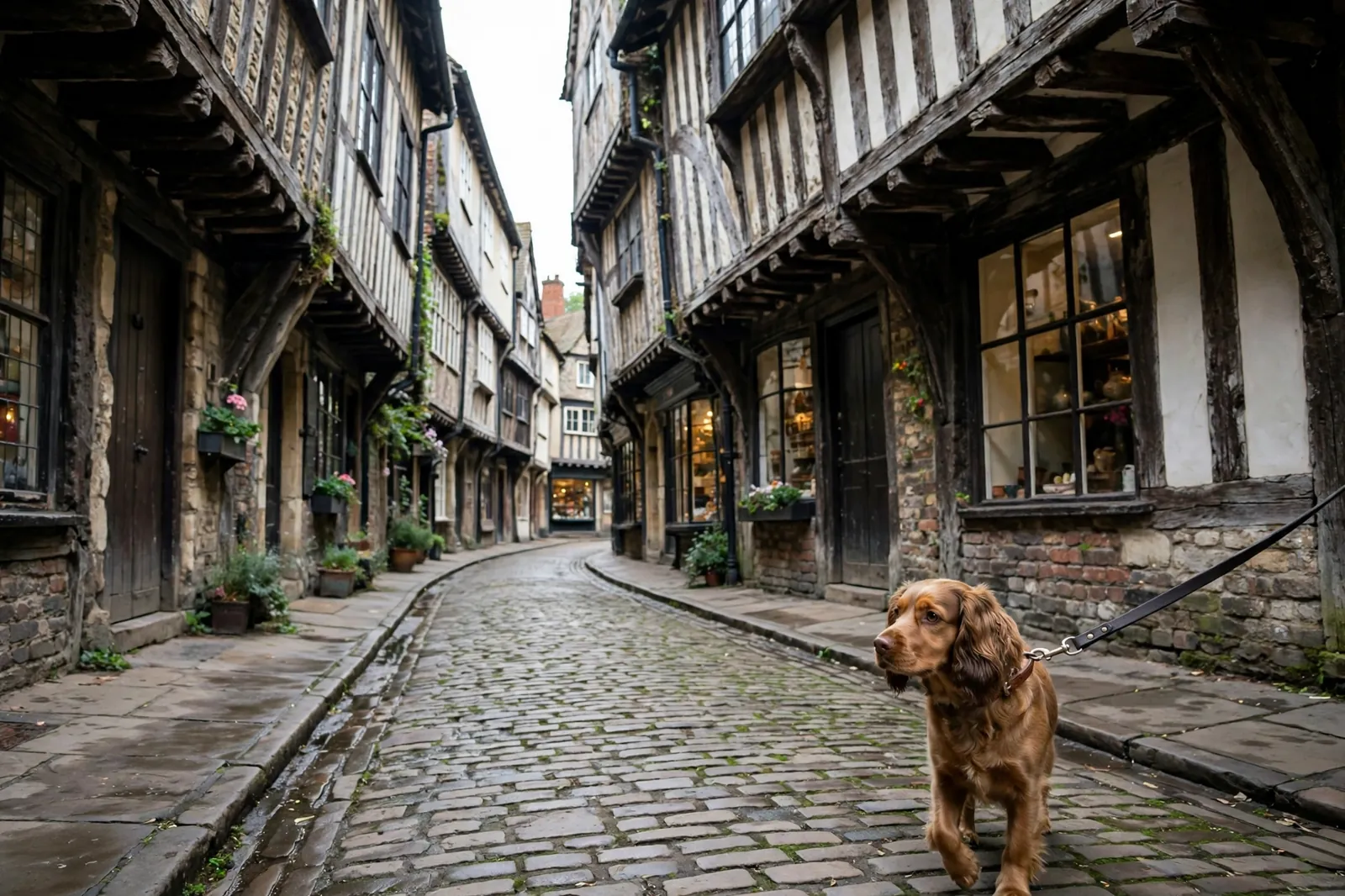
Stamford is often described as one of the finest stone towns in England, and the description is earned the moment you turn off the Market Place. The centre is built in warm, honey-coloured limestone, much of it from the 17th and 18th centuries, with Georgian fronts, stone-mullioned windows, iron railings and narrow passages that open without warning onto quiet courtyards. The effect is not a single grand view but a sequence of small ones: a stone arch, a church tower over the rooftops, a lane that bends and narrows until it feels private.
Walking these streets with a dog sets its own pace. The pavements are mostly good, but the town is old, and old towns have uneven flags, worn steps, kerbs of different heights and the occasional cobbled or setted stretch. Short-legged dogs and older dogs will feel the difference after an hour, so plan the walk in loops rather than one long march. Ironmonger Street, High Street and St Mary's Street make a natural circuit from the Market Place, with plenty of places to stop, and the climb back towards the town centre is gentle rather than steep.
One of Stamford's quiet boasts is that it has five medieval parish churches, all still standing in the town centre: St Mary's, St Martin's, All Saints', St George's and St John the Baptist's. You will not need to go looking for them — their towers and spires punctuate the skyline from almost every street, and each one anchors a different corner of the old town. St Mary's, with its tall 14th-century spire, stands at the top of St Mary's Hill and is the one most visitors photograph. All Saints' sits in the middle of the town, St George's stands on St George's Square, and St Martin's is across the river on the southern edge of the old town. Dogs are not generally taken inside churches, so treat the churches as outdoor landmarks: admire the stonework, read the noticeboards, and let the dog sniff the churchyard walls from the pavement.
Churchyards deserve a word of care. Some are open and grassy, and they look like inviting green spaces on a warm day, but they are burial grounds and quiet places, and dogs should be kept on a lead, kept off graves, and never allowed to treat a churchyard as a toilet area. The same applies to the small walled gardens and courtyards tucked behind the main streets: beautiful to look at, and best enjoyed from the lane with the dog beside you rather than inside.
The stone itself is worth a thought in hot and cold weather. Limestone pavements warm up in summer sun and can be uncomfortable for paws by mid-afternoon; in winter, the same stone can be slick with frost or wet leaves, and shaded lanes stay icy long after the main streets have thawed. In summer, walk the stone streets in the morning and save the river for the afternoon. In winter, stick to the gritted main pavements after a frost and avoid the steepest, shadiest alleys. Your dog's paws will tell you before you notice: a dog that keeps lifting a foot or pulling towards the grass is asking for a softer surface.
Stamford's other gift to a dog walker is that it is small. The whole historic centre can be crossed on foot in fifteen minutes, and there is no need to drive between sights. That matters for dogs that dislike car journeys or that settle better when the walk is continuous. Park once, walk everywhere, and let the town unfold at three miles an hour — which, for a dog, is exactly the right speed.
Stamford Meadows and the River Welland
The River Welland runs along the southern edge of Stamford, and the Meadows beside it are where the town exhales. This is open, flat grassland with the river on one side and the stone town rising on the other, and it is the natural place to take a dog after the close streets and market crowds. The walk from the town centre to the Meadows takes only a few minutes, which makes it easy to build into any visit: market in the morning, river in the afternoon, and a dog that has had both kinds of walking in one day.
The Meadows are at their best as a sniffing walk rather than a sprint. The grass is wide and open, the riverbank has its own smells — ducks, moorhens, damp earth, the slow green water — and the paths along the river give a dog a long, straight stretch to settle into a rhythm. The river itself is not deep or fast through the town, but it is still a river: keep dogs that are not strong swimmers on a lead near the bank, and be careful after rain, when the bank can be muddy and the water higher and faster than it looks. Blue-green algae can appear in slow rivers in warm weather, so if the water looks green and soupy, keep your dog out of it and check the official guidance before you travel.
Off-lead etiquette on the Meadows is a matter of judgement rather than a single rule. It is open ground where many owners let dogs run, but it is also shared with families, picnics, joggers, other dogs and the occasional grazing animal nearby, and there is no fence between the grass and the river or the road edges. A long line — ten metres of light line on a harness — gives a dog most of the freedom of off-lead running with a safety net you can step on in a second. It is the right tool here, especially for young dogs, recall that is still a work in progress, and dogs that fixate on ducks. If your dog's recall is reliable and the Meadows are quiet, off-lead time is reasonable; if the grass is busy with picnics and football, the line stays on.
Water safety deserves a little more attention than it usually gets. Dogs that love water will charge straight in, and the Welland's banks have spots where the edge drops away and the mud is deep enough to trap a small dog. Carry a towel even on a dry day, because a dog that has been in the river will want to roll in the grass immediately afterwards, and wet dogs and car seats are a familiar combination. In summer, check paws after a riverside walk: riverbank mud can hide sharp stones and broken glass, and grass seeds lodge between toes on the walk back through the long grass at the field edges.
The riverside paths also connect Stamford to its wider landscape. Walking east or west along the Welland takes you out of the town and into water meadows and farmland, with longer, quieter stretches for dogs that need more than a town walk. These are working landscapes with livestock, so a lead is essential where animals are grazing, and gates should be left as you find them. For a half-day walk, the river paths pair well with a return through the town centre; for a shorter visit, the Meadows alone, walked slowly with plenty of sniffing stops, is enough. Our guide to dog-friendly beaches in the UK covers the same kind of judgement — seasonal rules, shared spaces and checking before you go — in a coastal setting, and the habits transfer well to a river walk.
One practical note: the Meadows have little shade in the middle of the day. In summer, walk them early or late, carry water for the dog, and watch for the signs of overheating — heavy panting, drooling, a dog that slows and seeks shade. The town centre, with its stone shade and cafe awnings, is the better place for the midday hours, and the river is the better place for the first and last light of the day.
Around Burghley House
Just south of Stamford, across the river, stands Burghley House, one of the great Elizabethan houses of England, built for William Cecil, Lord Burghley, in the 16th century. You do not need to go inside to make it the centrepiece of a dog walk: the parkland around the house, laid out in part by Capability Brown, is a landscape of wide grass, a lake, mature trees and long views back to the house itself, and it is the kind of open ground that makes a dog's day.
Dogs are welcome in the parkland on a lead, but not inside the house or the formal gardens, so plan the visit as an outdoor walk with the house as the view rather than the destination. The parkland paths are surfaced in places and grassy in others, and the ground is gently rolling rather than flat, which suits dogs that like a bit of up and down without a serious climb. The lake is the main feature: it draws the eye, it draws the ducks, and it draws dogs that love water, so keep a lead on near the water unless you are sure of your dog's recall and swimming.
Livestock is the practical point to take seriously at Burghley. Sheep and cattle graze in the parkland at different times of the year, and a dog that chases livestock is a danger to the animals, to itself and to your visit. Keep the dog on a lead wherever livestock is visible, and keep it on a lead anywhere the grass is long enough to hide animals from view. The same rule applies on the paths that run from the parkland back towards Stamford: this is farmland, and the animals were there first.
The seasons change Burghley more than they change the town. In spring, the parkland is at its softest, with new grass and the first long evenings; in summer, the big trees give shade that the Meadows cannot, and the lake paths are cooler than the stone streets. Autumn is arguably the best season here, when the parkland trees turn and the paths are covered in leaves that dogs love to scuff through, but the leaves also hide mud and rabbit holes, so watch small dogs closely. In winter, the parkland can be bleak and windswept, and the paths get muddy quickly — good boots and a drying coat for the dog turn a bracing walk into a pleasant one.
Check the official guidance before you travel for opening times, admission and any seasonal access changes: the house, gardens and parkland run on a seasonal calendar, and special events — including the Burghley Horse Trials, held in late summer — change access and crowds dramatically. On event days, the parkland is busy and noisy, and a dog that is happy on a quiet Tuesday may not enjoy a festival atmosphere; those are days to choose the Meadows or a quieter village walk instead.
Getting to Burghley on foot from Stamford is part of the pleasure. The walk from the town centre takes you across the river and out along the parkland edge, and it is short enough to do as an extension of a town walk rather than a separate expedition. Allow a couple of hours for the round trip with stops, carry water, and remember that there is less shelter in the parkland than in the town — a waterproof for you and a drying coat for the dog are worth packing on any day that is not clearly settled.
Cafes and pubs that welcome dogs
Stamford is a sociable town, and its cafes and pubs are part of the walk rather than an interruption to it. The centre has a good spread of independent cafes, tea rooms and historic pubs, and many of them welcome dogs — usually in a specific area, on the terrace in summer, or in the bar rather than the restaurant. The rule is always the same: ask before you sit down, because the dog-friendly area and the dog-friendly hours can both change with the season.
The town's most famous pub is The George Hotel, a historic coaching inn on St Martin's, with stone courtyards and a long history of travellers passing through. It is the kind of place that sets the tone for Stamford: old stone, open fires in winter, and a terrace in summer. Whether dogs are welcome in a particular room or only in the courtyard changes with the management and the season, so check the official guidance before you travel and ask on arrival rather than assuming. The same applies to every pub in town: policies are set by the landlord, not by the town, and they can change.
The practical skill is choosing the right spot once you are inside. A corner table near the door is better than a table in the middle of the room, because your dog can settle against the wall and watch the room without being stepped on or stepped over. A blanket or mat from home gives the dog a defined place to lie, and it signals to staff and other customers that this dog is settled and supervised. Bring water — most places will offer a bowl, but not all have one to hand — and bring something for the dog to chew, because a dog that has nothing to do in a pub will find something to do, and it is rarely what you would choose.
Cafes are often easier than pubs for a first stop, because the visit is shorter and the dog's job is simpler: lie down for twenty minutes while you drink coffee. The cafes around the Market Place and Broad Street are used to dogs, and a dog that settles under a table is a familiar sight. Lunchtime is busier and noisier than mid-morning, and a dog that is fine at 10 in the morning may be overwhelmed at 1 in the afternoon, so plan the cafe stop for the quiet hour if your dog is new to eating out.
Terraces and outdoor seating are Stamford's best dog option in summer. The town's stone courtyards and pavement tables give a dog fresh air, space to stretch and a view of the passing world, which is usually more interesting to a dog than a dark interior. In winter, the same courtyards are cold, and an indoor bar with a fire is the better choice for an older dog or a short-coated breed — but keep the dog off the hearth and away from the fire, and watch that a long lead does not trail across a walkway where a waiter might trip.
A few manners make the difference between a welcome dog and a tolerated one. Keep the lead short and under the table, not stretched across the floor. Do not let your dog approach other tables, other dogs or other people's food. If your dog barks at strangers or at other dogs, a pub is not the place to practise; take the coffee outside or take it away. And if the dog will not settle after ten minutes, leave gracefully and walk instead — a pub that remembers your dog as the quiet one is a pub you will be welcome back in.
Where to stay with a dog
Stamford works as a day trip from much of the East Midlands, but staying overnight turns it into a proper break, and the town has a reasonable range of dog-friendly options. There are hotels and coaching inns in the centre, bed and breakfasts on the quieter streets, and self-catering cottages and holiday lets in the town and the villages around it. The right choice depends less on the star rating than on the dog's needs: a ground-floor room, a garden or courtyard, and a short walk to the Meadows matter more than a spa.
Ask the same questions you would ask anywhere, and ask them before you pay. Is there a charge per dog per night, and is there a maximum number of dogs? Are dogs allowed in all rooms, or only in specific ones — and are those rooms on the ground floor, with easy access to the outside for a late-night toilet trip? Can the dog be left alone in the room, and if so, for how long and under what conditions? Is there an enclosed garden, or will every toilet trip be on a lead on the pavement? Get the answers in writing, with the pet fee itemised, because "dog-friendly" on a booking site and dog-friendly at 11 at night are not always the same thing.
Self-catering is often the easiest option for a dog in Stamford. A cottage with a small enclosed garden gives the dog a safe place to stretch in the morning and a familiar base to return to, and it removes the worry of leaving a dog alone in a hotel room while you eat. The villages around Stamford — within a short drive of the town — have cottages that suit dogs well, and the surrounding countryside gives you a different walk each morning. If you are comparing several stays, our guide to dog-friendly holiday parks in the UK sets out the questions that apply just as well to a cottage or an inn: boundaries, fees, the after-dark toilet walk and what happens if the dog barks.
For a longer break, Stamford also works as a base for the wider area. Rutland Water, with its reservoir paths and birdlife, is a short drive away and offers a completely different landscape — big water, long flat paths and a proper day out for a fit dog. The villages of south Lincolnshire and the edge of the Cambridgeshire fens are within easy reach, and a week in Stamford can include a different walk every day without repeating a route. If you are planning a longer stay, check the rules for each place separately, because what applies in the town does not automatically apply on a reservoir path or in a country park.
One honest note: Stamford is popular, and the best dog-friendly rooms book up early for summer weekends and for the Burghley Horse Trials. If your dates are fixed, book early and confirm the dog arrangements in the same conversation as the room. If your dates are flexible, a midweek stay in spring or autumn is quieter, cheaper and easier on the dog — the town is at its best when you are not competing for a table or a parking space.
Getting there and parking
Stamford sits on the southern edge of Lincolnshire, close to the borders with Rutland and Cambridgeshire, and the A1 runs just west of the town. That makes it an easy drive from Peterborough, Leicester, Nottingham and Cambridge, and a straightforward day trip from London by train. The town's position on the main road is also its main drawback: the A1 is busy, and the approach roads carry fast traffic, so the last stretch of any journey needs care with a dog in the car.
By train, Stamford station is on the line between Birmingham and Peterborough, with regular services in both directions and connections at Peterborough for London, the north and the east coast. The station is a short walk from the town centre, and the walk from the platform to the Market Place takes you through quiet streets rather than along a main road, which makes it a good arrival for a dog that dislikes traffic. Dogs travel free on most trains in the UK when they are on a lead, but they should be kept off seats and out of the way in the aisle; a dog that is nervous on trains will do better on a quieter midday service than on a crowded commuter train. Check the official guidance before you travel for the latest rules on dogs on trains, and remember that a dog in a station needs a lead at all times.
By car, the Cattle Market car park, just off Scotgate, is the usual choice for dog owners. It is close to the town centre and a short walk from the riverside, which means you can park, walk the dog on the Meadows, and then come back into town without moving the car. There are other car parks around the town centre, and on-street bays on some of the quieter streets, but the central bays are better for a quick stop than for a long stay. Arrive early on Fridays, when the market fills the town, and early in summer, when visitors arrive in numbers; by late morning on a fine Saturday, the main car parks can be full. Check the official guidance before you travel for current charges, time limits and payment methods, because all three change.
Never leave a dog in a parked car, even for a short stop and even with a window open. A car in summer sun heats up to dangerous temperatures in minutes, and a car in winter is no place to leave a dog while you browse the market. If you need to pop into a shop that does not allow dogs, take it in turns, or leave the dog with a companion outside. The town is small enough that this is easy: one person shops, one person walks the dog, and you meet again at the Market Place.
Once you are parked, the town is best explored entirely on foot. The centre is compact, the pavements are generally good, and the main sights — the market, the churches, the stone streets and the river — are all within a fifteen-minute walk of each other. That is a genuine advantage for a dog that gets travel sick or that settles badly in a car: one journey, one arrival, and then the whole day on foot. For a longer stay, the same applies: pick accommodation with parking, and walk everywhere from there.
If your dog is not used to town traffic, Stamford is a gentle introduction. The centre is busy but slow-moving, with narrow streets that keep speeds down, and there are pedestrian areas and quiet side streets where a nervous dog can decompress. The busiest roads are on the edge of the centre, around the A1 junction and the ring of approach roads, and a dog that is kept on a short lead through those stretches will be fine. Avoid the temptation to cross busy roads on a long line; a short lead and a clear crossing point are the safer combination.
Seasons, weather and a practical checklist
Stamford changes with the seasons more than a first visit suggests, and a dog will notice the changes before you do. Spring is the gentlest season: the market is full of plants and flowers, the Meadows are soft underfoot, and the light on the stone in the early evening is at its best. The air is cool enough for a long walk, and the town is quieter than in summer. It is also the season when the river is highest after winter rain, so keep dogs out of fast water and off soft banks.
Summer brings the crowds and the heat. The Friday market is at its busiest, the pub terraces are full, and the stone streets can be hot underfoot by mid-afternoon. Walk early, before the heat builds, and use the shaded lanes and the tree-lined paths at Burghley for the middle of the day. Carry water for the dog — a collapsible bowl weighs nothing and is used constantly — and watch for hot pavements: if the stone is too hot for the back of your hand, it is too hot for paws. The Meadows have little shade, so save them for the morning or the evening, and never leave a dog in a car, even for five minutes.
Autumn is the season many regular visitors prefer. The crowds thin, the light turns golden, the trees in the Burghley parkland change colour, and the fallen leaves on the riverside paths are exactly the kind of thing dogs love. It is also the season when the ground gets wet and stays wet: riverside paths turn muddy, leaves hide holes and broken glass, and a dog that has been running through wet leaves will need a towel before it gets back in the car. Pack a drying coat and an old towel as a matter of routine from October onwards.
Winter in Stamford is quiet and beautiful, and it suits dogs that like cold weather and empty streets. The stone looks its best in frost, the pubs have fires, and the town is at its most peaceful. But winter also brings the hazards that catch people out: icy pavements, especially in the shaded lanes that never see the sun; salt and grit on the roads, which irritate paws and are harmful if licked off; and short days that mean a walk that started in daylight can end in the dark. Keep to gritted pavements after a frost, wipe paws after a walk on treated roads, and carry a light if you are out after 4 in the afternoon. Fireworks season, around early November, can unsettle noise-sensitive dogs, and the town's events can be loud — a dog that is frightened by bangs is better walked early in the day and settled at home in the evening.
Before you set off, a short checklist saves a surprising amount of trouble. Pack water and a bowl, a lead and a spare, a long line for the Meadows, poo bags, a towel and a drying coat, treats, and the number of the nearest vet saved in your phone. Check the weather, the market day, the Burghley opening times and the parking charges before you travel. And remember that the best plan for Stamford is a loose one: the town rewards the walk you take slowly, not the itinerary you rush through.
- Lead: short lead in the market and the stone streets, long line for the Meadows.
- Water: a bottle and a collapsible bowl, in every season.
- Feet: check paws after stone streets, riverbanks and gritted roads.
- Weather: a drying coat for the dog and a waterproof for you, from October to April.
- Vet: save the nearest practice number and opening hours before you walk.
- Parking: aim for the Cattle Market car park and arrive early on Fridays.
- Check first: market times, Burghley opening and any seasonal access rules can change — check the official guidance before you travel.
Stamford is not a town that needs to be conquered in a day. It is a town that rewards a slow walk, a long lunch and a second look at a street you thought you had already seen. For a dog, that is the best kind of place: new smells at every corner, soft grass at the end of every street, and a river waiting at the bottom of the hill. Come for the market, stay for the Meadows, and let the stone streets set the pace.
Practical questions
Before you go
Is Stamford a good town for a dog day trip?
Yes. Stamford is compact, mostly flat in the centre and rich in short, rewarding walks. The Friday market, the stone streets around the Market Place, the riverside meadows and the paths around Burghley House give a full day without a car, and most of the walking is on pavements and surfaced paths rather than busy roads.
Can dogs go into Burghley House and its parkland?
Dogs are welcome in the parkland around Burghley House, but they must be kept on a lead and are not allowed inside the house or the formal gardens. The parkland walks are the part to plan around: wide grass, lake views and long sightlines, with livestock sometimes grazing, so a lead and good recall control matter. Check the official guidance before you travel, as opening times and access rules change through the year.
Are dogs allowed off the lead in Stamford Meadows?
Stamford Meadows is open grassland beside the River Welland and is a popular spot for dogs, but there is no guarantee of a formal off-lead area, and the river, other dogs, picnics and grazing wildlife all call for judgement. Many owners use a long line there. Keep your dog under control near the water and near the road edges, and check the official guidance before you travel for any current restrictions.
Where is the best place to park in Stamford with a dog?
The Cattle Market car park, just off Scotgate, is the usual choice for dog owners: it is a short walk from the town centre and close to the riverside. Town-centre bays are better for a quick stop than for a long stay. Arrive early on Fridays and in summer, check the official guidance before you travel for current charges and time limits, and never leave a dog in a parked car.
Is there a vet in Stamford if my dog needs help?
Yes, there are veterinary practices in Stamford itself, and more in the surrounding towns. Save the number of the nearest practice and its opening hours before your walk, and know the out-of-hours route before you need it. For anything urgent, call the practice first so they can advise you or direct you to the nearest emergency service.