This guide is independent and contains no paid placement. If affiliate links are added later, they will be clearly marked and will not change our editorial checks.
Stonehaven suits dogs because everything is close together: a harbour to wander, a beach that allows dogs all year, a clifftop path to Dunnottar Castle about two miles south, and woodland walks for wet or windy days. Keep dogs on a lead near the cliffs and in the castle grounds, and check the official guidance before you travel, because access rules can change.
Why Stonehaven works with a dog
Stonehaven is a small harbour town on the Aberdeenshire coast, about fifteen miles south of Aberdeen on the A90 and on the railway line between Edinburgh and Aberdeen. It is the kind of place that rewards a slower pace: the town centre is compact enough to cross on foot, the harbour is a working one with boats, ropes and fish smells to investigate, and the beach is a short walk from the shops. For a dog, that compactness matters. You can build a whole day from short, varied outings rather than one long drive followed by one long walk, which suits older dogs, puppies and reactive dogs that tire of new places quickly.
The town's real advantage is variety within a small radius. In a single weekend you can walk a sandy beach, follow a clifftop path to a ruined castle on a sea stack, wander waymarked woodland, and potter around a harbour where the main entertainment is watching the boats and the gulls. Few Scottish towns of this size offer that range without a car, and Stonehaven does it while staying small enough that you are never far from a cafe, a tap or a place to sit down. That matters on a wet Aberdeenshire afternoon, when the difference between a good trip and a miserable one is often a warm room that welcomes dogs and a towel by the door.
Stonehaven is also a sensible base rather than just a stop. Aberdeen is close enough for a day trip, the Angus coast lies to the south, and Royal Deeside is inland to the west, so a week here can mix coastal days with completely different landscapes. The town itself has enough accommodation, pubs and takeaways that you do not need to drive every evening, and the railway station means a car-free break is genuinely possible if you plan around the local walks. If you are travelling without a car, check train times in advance, because services on this line are regular but not constant, and the walk from the station to the harbour is downhill on the way in and uphill on the way back.
One honest caveat belongs up front: this is the North Sea coast, and the weather sets the terms. Wind is a feature of almost every day, rain arrives quickly, and the temperature can feel several degrees colder than the forecast suggests once you are standing on the clifftop. That is not a reason to stay away; it is a reason to pack properly, to have a woodland or town-centre plan for the worst of it, and to treat the beach and the cliff path as fair-weather pleasures rather than certainties. Dogs rarely mind the wind, but a wet, cold dog that cannot dry off properly will not enjoy the next walk, so the practical sections of this guide spend as much time on drying and shelter as they do on scenery.
Start at the harbour
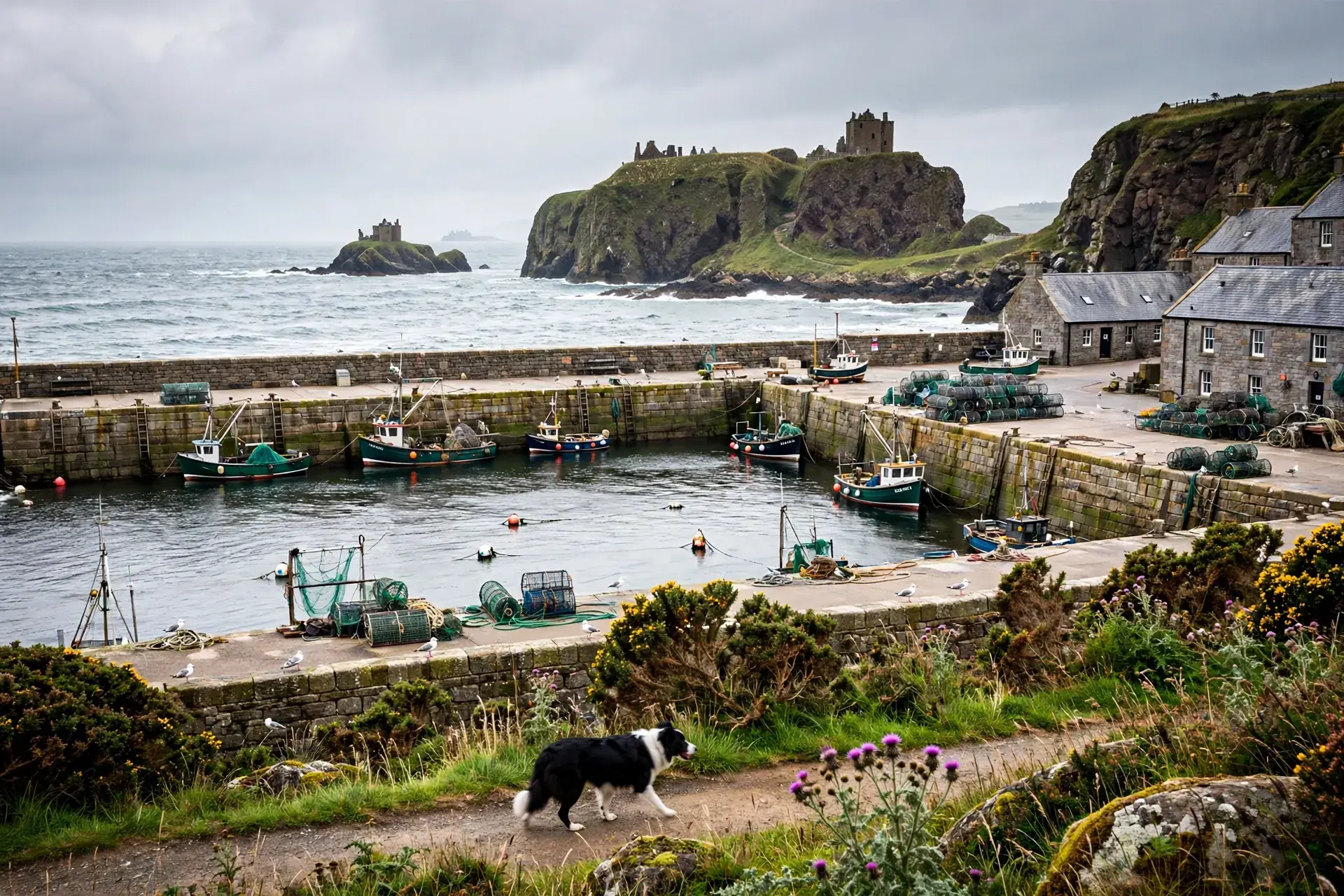
The harbour is the natural first stop, and it sets the tone for the whole visit. Stonehaven's old harbour is a curve of stone piers and working boats, with the Tolbooth Museum at its edge — the town's oldest surviving building, once a storehouse, courthouse and prison, now a small museum of local history. The harbour walls are low in places and the water is close, so keep your dog on a lead here: a dog that jumps or slips in would be in cold, deep water with steep stone sides, and the quayside is busy with ropes, creels and moving vehicles. A short lead and a calm pace are the right approach, and the harbour rewards them with more smells per square metre than almost anywhere else in town.
Walk the full curve of the harbour before deciding where to settle. The inner basins hold fishing boats and pleasure craft, the outer pier gives you the view back across the bay towards the beach, and the steps and slipways are worth noting for later — some are slippery with weed and best avoided with a dog. Early morning is the quietest time, when the boats are being readied and the gulls are doing most of the talking; midday brings visitors, ice-cream queues and the smell of fish and chips drifting across the water. If your dog is nervous around crowds or children, aim for the early or late slots and keep the middle of the day for the beach or the woods.
The harbour is also where the coastal path to Dunnottar Castle begins, so it doubles as a trailhead. The harbour car park is a practical meeting point if you are arriving by car, and the signed path heads south from here past Downie Point towards Strathlethan Bay. Before you set off, check the tide and the wind, fill the water bottle, and make sure everyone in the party — dog included — has had a toilet break, because there are no facilities on the clifftop. The Tolbooth Museum is worth a look while you are here, but check the official guidance before you travel for current opening times and whether dogs are allowed inside; small local museums often change their rules seasonally, and the harbour itself is the attraction that is always open.
One more harbour habit is worth building: check the fishing boats and the slipway for discarded hooks, line and bait before letting your dog sniff freely. Harbours are working places, and monofilament line and fish hooks are a genuine hazard for a dog that hoovers up anything interesting. A quick scan of the ground where you stop, and a habit of keeping your dog off the working areas of the quay, removes most of the risk. The same applies to the beach after a storm, when debris washes in and the strandline is full of things a dog will want to eat.
Stonehaven Beach: rules and routines
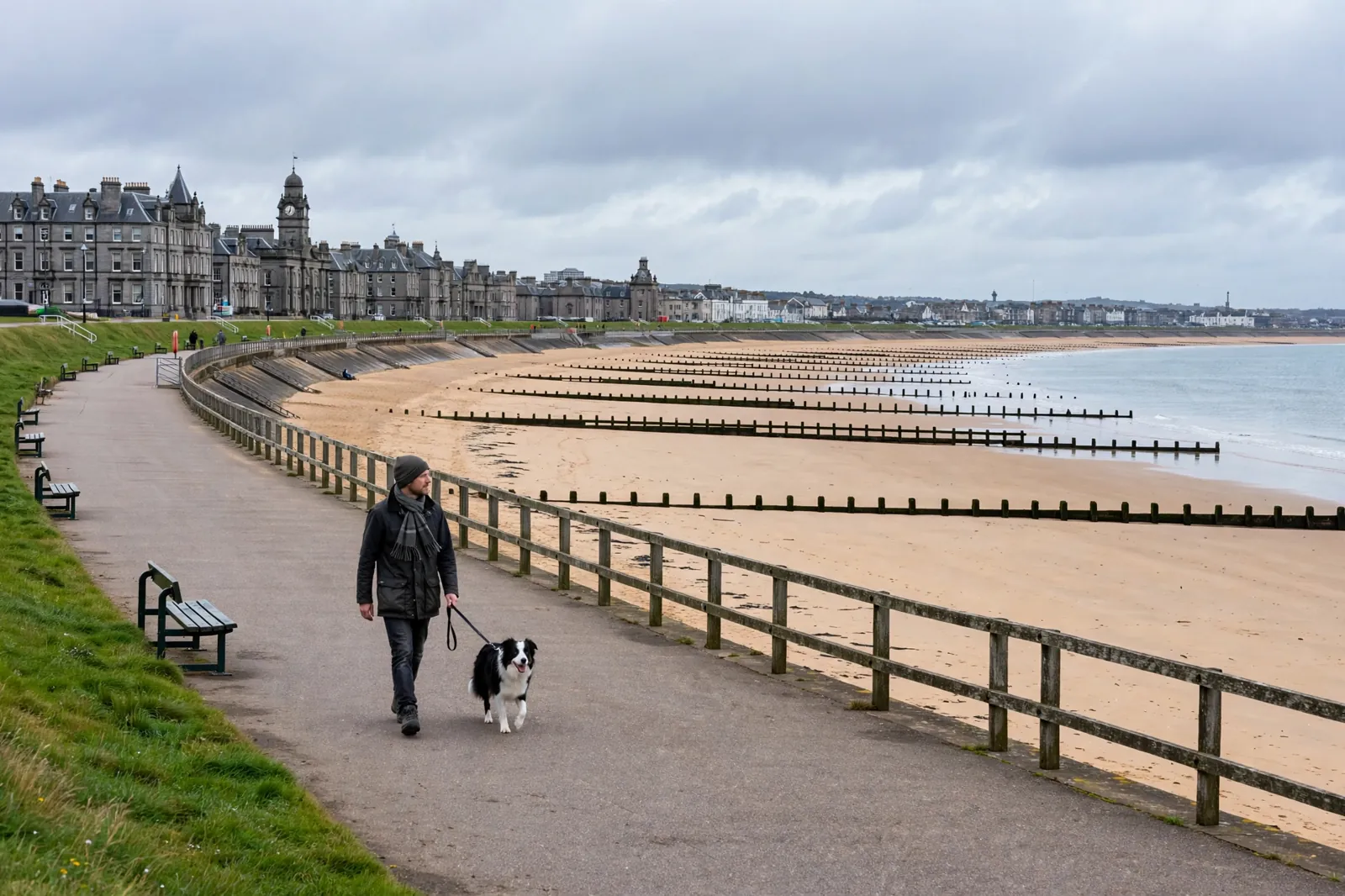
Stonehaven Beach is a broad sweep of sand at the north end of the bay, backed by the town and the open-air pool, and it is one of the more straightforward beaches in Scotland for dog owners: dogs are allowed all year. Scotland has no council dog bans of the kind that restrict English beaches in summer, so the Scottish Outdoor Access Code applies instead — keep your dog under control, use a short lead near other people, and always pick up after them. That freedom comes with responsibility: a beach where dogs are welcome all year is a beach where dog owners are expected to behave well all year, and the signs at the entrances are worth reading on the day, because local conditions and temporary restrictions can change.
The beach works best as a morning or late-afternoon walk. At low tide there is a wide expanse of firm sand for a good run, while at high tide the usable strip narrows and the walk becomes more of a promenade affair along the seafront. Check tide times before you go if your dog needs space to run, and remember that the North Sea is cold in every season — most dogs paddle rather than swim, and a dog that does swim should be rinsed off afterwards, because salt water and sand are a poor combination for skin and coats. The beach is also exposed, with little shelter from the wind, so a blustery day that looks fine from the car park can feel very different once you are out on the sand.
Lead decisions on the beach deserve a little thought. The beach is open enough for off-lead play when it is quiet, but it is a popular family beach, and the car park, the pool and the promenade all bring people, children and other dogs into the same space. The sensible pattern is a short lead on the approach and around the busiest stretch by the town, then a longer lead or off-lead time further along the sand when you can see clearly in every direction and recall is reliable. The Scottish Outdoor Access Code asks for dogs to be under close control near other people and during the bird nesting season, so keep that in mind in spring and early summer, when ground-nesting birds use the dunes and the quieter ends of the beach.
After the beach, the routine matters as much as the walk. Stonehaven's open-air pool sits at the edge of the beach — a heated seawater lido dating from the 1930s — and while dogs are not swimmers there, the area around it is a useful landmark for meeting up and for the walk back into town. Rinse sandy paws before getting into the car, towel the dog down properly, and if you are staying in rented accommodation, check where you are expected to dry a wet dog before you arrive with a soaking spaniel. A drying coat earns its keep on this coast: it keeps working while you have lunch, and it stops a wet dog from chilling on the walk back to the car.
North of the town, Cowie offers a quieter alternative when the main beach is busy. The small village at the northern edge of Stonehaven has its own stretch of shore and the ruined chapel of St Mary's, and the walk out there along the coast is a pleasant change from the town beach. It is less built up, with fewer facilities and fewer people, which suits dogs that prefer space to crowds — but that also means you should carry water and bags, and check the official guidance before you travel if you are unsure about access, because the paths and the shoreline here are less formal than the town beach.
The coastal walk to Dunnottar Castle
This is the walk most people come to Stonehaven for, and it deserves its reputation. From the harbour, the signed coastal path heads south past Downie Point to Strathlethan Bay, where small waterfalls run down the cliffs after rain, and on to the headland where Dunnottar Castle stands on its rocky stack. The direct path is about one and a half to two miles each way, and a circular route that returns inland through woodland and farmland is around 6.1 kilometres, taking most walkers about one and a half to two hours. Allow longer: the views slow everyone down, dogs want to stop and sniff, and the castle itself is worth unhurried time at the end.
The path is a clifftop path in the real sense, not a fenced promenade. In places it runs close to unfenced edges above a long drop to the sea, and the ground can be muddy and slippery after rain. Keep your dog on a lead for the whole coastal section, whatever their recall is like at home — a rabbit, a gull or a sudden gust is all it takes for a confident dog to be somewhere you cannot reach. Use a short lead rather than a long line near the edges, keep children close too, and step well back from the edge when you stop for photographs. If the wind is strong enough to make you lean into it, consider the woodland route instead; the castle will still be there on a calmer day, and the view from the clifftop is not worth a frightened dog or a near miss.
Dunnottar Castle itself is a ruined medieval fortress, famous for its position and its history: it was involved in the Wars of Independence, hosted Mary Queen of Scots, and famously sheltered the Honours of Scotland — the Scottish crown jewels — from Cromwell's army in the 1650s. Today it is a paid attraction, and the approach involves steep steps down to the entrance on the rock, which is worth knowing before you commit an older or less mobile dog to the descent. Dogs are allowed inside the castle on a short lead, according to the castle's dog policy last checked on 23 October 2026, and dogs are welcome on the clifftop path outside. That is a generous policy for a historic site, and it is worth respecting carefully: keep the lead short, keep your dog close on the steps and the narrow passages, and check the official guidance before you travel, as opening times, prices and rules can change.
If the steps or the crowds put you off taking your dog inside, the castle is still a superb destination without entering it. The classic view is from the clifftop path on the approach, where the whole stack and its ruined towers sit against the sea, and the grassy area at the entrance green is a good place for a rest and a drink before the walk back. Many visitors walk out, take their photographs, and return to Stonehaven without going inside — the walk itself is the experience, and the castle is the punctuation mark at the end of it. Whichever you choose, build in a buffer: the path is busier than you might expect on a fine day, and the return leg into a headwind always takes longer than the outward one.
A few practical details make the walk smoother. There are no toilets, shops or water points on the path, so carry water for the dog and a bowl, and use the facilities in town before you leave. The path is best in dry conditions and in the quieter hours — early morning gives you the light on the castle and the path mostly to yourself, while late afternoon gives you the sun behind you on the way back. In wet weather the cliff path becomes slippery and the waterfalls at Strathlethan Bay run hard; if the ground is sodden, the inland circular route through Dunnottar Woods is a better choice for the day.
Dunnottar Woods and inland loops
When the coast is too windy or too wet, Dunnottar Woods is the local fallback that still feels like a proper walk. The woods lie just inland from the town, with miles of waymarked footpaths through mature broadleaf trees, and a shorter waymarked loop of around 2.1 kilometres that works well as a morning stretch or a wet-day alternative. The paths are sheltered from the worst of the sea wind, the ground is softer underfoot than the clifftop, and the woodland gives a nervous dog fewer wide-open spaces to worry about. It is also the inland half of the Dunnottar circular route, so you can combine woods and coast in one walk when conditions allow.
Woodland walks need their own precautions. Keep your dog in sight and under control, because the woods are shared with other walkers, runners and cyclists, and the paths cross farmland where livestock may be present. The Scottish Outdoor Access Code asks for dogs to be on a short lead or under close control around livestock, and that is a rule to take seriously: sheep and cattle are common on the fields around Stonehaven, and a dog chasing stock can cause real harm and real legal trouble. Ticks are a consideration in woodland and long grass from spring to autumn, so check your dog after the walk and remove any ticks promptly, and ask your vet about tick prevention before a trip that includes a lot of woodland walking.
Beyond the woods, the inland lanes around Stonehaven offer quieter loops for dogs that prefer tarmac or firm tracks to muddy paths. The lanes south towards the castle and west towards the Deeside road are generally quiet, but they are working farm roads with tractors, blind corners and no pavements, so a lead and high-visibility gear are sensible, especially in the low light of a winter afternoon. If you are building a longer route, a paper map or a downloaded offline map is worth having: phone signal on the clifftop and in the woods can be patchy, and the path network is easier to follow when you can see the whole loop rather than a small phone screen.
For dogs that need a shorter, flatter outing, the town itself provides it. A loop from the harbour along the seafront to the beach and back through the town centre is level, surfaced and full of interest, and it works as a last walk of the day or a first walk before breakfast. Older dogs and puppies get the variety without the distance, and you can finish at a dog-friendly cafe for a warm-up. The point of a place like Stonehaven is that you do not need a heroic walk every day; the small loops are good enough, and a dog that has had three pleasant short walks is usually happier than one that has had a single exhausting one.
Eating and drinking with your dog
Stonehaven's food scene is small but well suited to a dog-owning visitor, because much of it is built around the harbour and the seafront, where outdoor seating is common in the warmer months. The town's fish and chip shops are famous — Stonehaven's chip shops have a national reputation, and the Bay fish and chip shop is widely regarded as one of the best in the country — and a takeaway eaten on a bench by the harbour is one of the simplest pleasures of the town. Takeaway food is also the easiest option with a dog: you order, you sit outside, and nobody has to negotiate a dining room. Bring a mat for your dog to lie on, a chew to keep them settled, and a bowl of water, and the harbour bench becomes a perfectly good restaurant.
For pubs and cafes, the pattern is familiar from other Scottish towns: many welcome dogs, often in the bar area or on the terrace rather than in the main dining room, and policies vary from place to place and season to season. The Marine Hotel on the seafront and the Ship Inn by the harbour are the two best-known options, and both are worth asking about directly rather than assuming — a phone call or a look at the door on the day settles it in seconds, and staff will usually tell you honestly whether the dog can come inside or is better off on the terrace. Smaller cafes around the town centre and the harbour are often dog-friendly too, but the honest position is that policies change, so check the official guidance before you travel or simply ask when you arrive.
A few habits make eating out with a dog easier anywhere, and Stonehaven is no exception. Feed the dog before you sit down so they are settled rather than hungry; choose a table at the edge of the room where the dog can lie out of the way of passing staff; keep the lead short and under your foot rather than trailing across a walkway; and bring something for the dog to do, whether that is a stuffed Kong, a chew or simply a familiar blanket. If your dog barks at other dogs or at people approaching the table, an outdoor table with space around it is a kinder choice than a crowded indoor room, and a takeaway is kinder still. The aim is a relaxed meal for everyone, and the town gives you enough options to choose the one that fits your dog rather than forcing the dog to fit the venue.
Self-catering visitors have it easier still. Stonehaven has supermarkets and local shops in the town centre, so you can stock up and cook in your accommodation, and a picnic on the beach or in the woods is often the best lunch of the trip anyway. If you are buying food for a picnic, remember the gulls: Stonehaven's gulls are bold and experienced, and an unwatched sandwich on a harbour bench has a short life expectancy. Keep food covered, keep the dog close while you eat, and clear up properly afterwards — a beach that welcomes dogs all year depends on visitors leaving it as clean as they found it.
Where to stay with a dog
Stonehaven has a reasonable spread of dog-friendly accommodation for a town of its size, from hotels and guest houses to self-catering cottages and flats, and the same principles apply here as anywhere else in Scotland. Book the dog in by name at the time of booking, not as an afterthought: confirm how many dogs are allowed, whether there is a charge per dog or per stay, which rooms or units accept dogs, and whether the dog can be left alone in the room. Get the answers in writing with the confirmation, because a verbal "that should be fine" is no help if the receptionist on duty has a different understanding of the policy.
Location within the town is worth thinking about before you book. A place near the harbour or the beach means the first and last walks of the day are short and easy, which matters for older dogs and for late-night toilet trips. A place on the edge of town near the woods may be quieter and closer to the coastal path, but it may also mean a walk along a road to reach the beach. Ask about the ground-floor position and the route to the nearest green space: a first-floor flat with a communal stairwell and no garden is a very different proposition from a ground-floor cottage with a door onto a lane, and the difference shows up at six in the morning in the rain.
Check the practical details that dog owners actually need. Is there somewhere to dry a wet dog — a porch, a utility room, an outdoor tap? Is there a secure garden or yard, and how high is the fence? Where does the dog sleep, and is there a hard floor that is easy to clean? Are there stairs the dog will have to manage, and is there parking beside the door or a walk across town with luggage and a lead? These questions sound fussy, but they are the difference between a stay that works and one where you spend the weekend improvising. A host who answers them precisely has almost certainly hosted dogs before, and that is a good sign in itself.
Finally, think about the rest of the trip when you choose a base. If you plan day trips to Aberdeen, a base near the station or the A90 makes the drive simple, while a base near the harbour suits a stay built around walking. Stonehaven works as a base for several days, but it is a small town, and in peak season the dog-friendly options book up early — particularly the ground-floor units and the cottages with enclosed gardens. Book ahead, confirm the dog details in writing, and have a backup in mind, because the worst time to discover that a property has changed its pet policy is on the doorstep with a tired dog.
Day trips from Stonehaven
Aberdeen is the obvious first day trip, about fifteen miles north on the A90 or a short train ride away. The Granite City has a long sandy beach with a boulevard, two large parks in Duthie and Hazlehead, the harbour at Torry Battery where dolphins are sometimes seen, and the quiet streets of Old Aberdeen — enough for a full day with a dog, and a very different feel from Stonehaven's small harbour. Our guide to Aberdeen with a dog covers the beach rules, the parks and the Deeside day trips in detail, and it is worth reading before you go, because the beach and park rules differ from Stonehaven's.
South along the coast, the Angus towns are an easy drive and offer a change of scene without a long journey. Montrose and Arbroath are both within an hour, with their own beaches and harbours, and the coastal villages between them reward a slow drive with stops. Further south, Dundee with a dog makes a good city day out, with its waterfront walks by the Tay, Broughty Ferry beach and the parks at Camperdown and Baxter. The point of these trips is not to tick off towns but to give the dog a different walk — a city waterfront one day, a quiet Angus beach the next — while Stonehaven stays the calm base you come back to.
Inland, Royal Deeside is the third direction, and it is the one that changes the landscape most completely. The road west from Stonehaven climbs towards Banchory and the Dee valley, where the riverside walks and the forests feel a world away from the coast. Perth with a dog is further — a longer drive, but a useful guide if your trip extends into a wider Scottish tour — and the Perthshire hills and the Tay are a natural next step for anyone heading home via central Scotland. For a single day from Stonehaven, though, Deeside is the more practical inland choice: closer, quieter, and full of the kind of riverside and woodland walking that suits dogs that have had enough of sea wind.
When you plan day trips, keep the dog's day in mind rather than the map. Two hours of driving for a one-hour walk is a poor trade for most dogs, and a dog that has spent the morning on the beach will often be happier with a short afternoon stroll than with another big expedition. Build the trip around one good walk and one pleasant stop, leave time to get back to Stonehaven for the evening walk, and remember that the dog's favourite part of the day is usually the familiar last walk near home base, not the new place you drove to see.
Practical planning: parking, vets and weather
Parking in Stonehaven is straightforward if you arrive with a plan. The harbour car park is the most convenient for the coastal path and the old town, the beach car park serves the seafront and the pool, and there is on-street parking around the town centre. All of them fill up on fine summer weekends, so arrive early or be prepared to park a little further out and walk in — which is no hardship with a dog, and often pleasanter than circling the harbour. Check the signs at each car park for charges, time limits and any seasonal changes, because the details vary and a ticket is an avoidable end to a good day.
Before you travel, save the details of the nearest vet and the nearest out-of-hours emergency vet, and keep the numbers in your phone rather than relying on a search when you are already worried. Stonehaven has veterinary practices in the town and the wider Aberdeenshire area, but opening hours vary, emergency cover may be based in Aberdeen, and a dog that has cut a paw on the rocks or eaten something on the beach needs a number you can call immediately. The same applies to your own travel insurance and your dog's insurance documents: keep a photo of the policy and the vet's number together, and know what your policy covers before you need it.
Weather is the practical issue that shapes everything else. The North Sea coast is windy in every season, and Stonehaven's exposed clifftop and beach can feel cold even on a sunny day. Pack a waterproof coat and a drying coat for the dog, a warm layer for yourself, and a windproof for the clifftop, whatever the forecast says. Check the forecast the evening before and again in the morning, and have a plan for each version of the day: beach and cliffs when it is dry and calm, woods and town when it is wet or wild. The Met Office forecast and the local tide times are the two things worth checking daily, and both are free.
Seasons change the town noticeably. Summer brings the crowds, the full opening hours and the best chance of a warm beach day, but also the busiest car parks and the most dogs on the beach. Spring and autumn are often the sweet spot for dog owners: quieter paths, cooler walking weather, and the beach largely to yourselves. Winter is dramatic and empty, with big seas and short days, and it suits hardy dogs and owners who enjoy the coast at its wildest — but the light goes early, the wind is stronger, and the cliff path can be treacherous when it is icy or waterlogged, so plan short walks and be back before dark.
One date deserves a specific warning. Stonehaven's Fireballs ceremony on Hogmanay, 31 December, is world famous: swingers carry flaming balls around the harbour at midnight, with crowds, drums and fireworks. It is a spectacular event for people and a miserable one for dogs. Do not take your dog to the harbour that night, and if you are staying in Stonehaven over New Year, make sure your dog is somewhere quiet, secure and well away from the noise, with the curtains drawn and something familiar to settle on. The same advice applies to any fireworks night: a dog that copes with a distant display may still panic at close-range noise, and the harbour at midnight on Hogmanay is about as close-range as it gets.
Finally, a word on the basics that make any trip smoother. Carry poo bags and use them — Stonehaven's welcome for dogs depends on owners cleaning up, and there are bins around the harbour, the beach and the town centre. Keep your dog's lead, water and bowl in the car or in a day pack so you are never caught short on the cliff path. Make sure your dog's ID tag is up to date and the microchip details are current before you travel, because a dog that slips a lead on an unfamiliar coast is a dog you want to be findable. These are small habits, but they are the ones that turn a good guide into a good trip.
Practical questions
Before you go
Can dogs go on Stonehaven Beach all year?
Yes, Stonehaven Beach is listed as allowing dogs all year. Scotland has no council dog bans of the kind found in England, so the Scottish Outdoor Access Code applies instead: keep your dog under control, use a short lead near other people, and pick up after them. Always check the signs at the beach entrance on the day, because local conditions and temporary restrictions can change.
Are dogs allowed inside Dunnottar Castle?
Dogs are allowed inside Dunnottar Castle on a short lead, according to the castle's dog policy last checked on 23 October 2026. The approach involves steep steps down to the castle entrance, and the site sits on a rocky headland with unfenced cliff edges, so keep your dog on a lead throughout and check the official guidance before you travel, as rules can change.
How long is the coastal walk from Stonehaven to Dunnottar Castle?
The clifftop path from Stonehaven harbour to Dunnottar Castle is about 1.5 to 2 miles each way, and a circular route via the woods and farmland inland is around 6.1 kilometres, taking most walkers about 1.5 to 2 hours. Allow extra time for stops, photographs and a dog that wants to sniff everything, and keep dogs on a lead near the cliff edges.
Is Stonehaven a good base for a longer dog-friendly break?
Yes. Stonehaven has a railway station on the Edinburgh to Aberdeen line, a compact town centre you can cross on foot, and a good spread of beaches, woodland and coastal paths within a short drive. Aberdeen is about 15 miles north and the Angus coast is an easy day trip south, so the town works well as a base for several days of different walks.
Can dogs go to the Stonehaven Fireballs ceremony?
No, not sensibly. The Fireballs ceremony on Hogmanay, 31 December, involves crowds, flaming balls swung overhead, drums and fireworks, which is a frightening combination for almost any dog. Leave your dog somewhere quiet and secure, well away from the harbour, and check the official guidance before you travel if you are visiting over New Year.
What should I pack for a dog trip to Stonehaven?
Pack for North Sea weather: a waterproof coat and a drying coat for the dog, towels, a long lead for the beach and a short lead for the clifftop path, poo bags, water and a bowl, and a warm layer for yourself even in summer. The wind off the sea is cold in any season, paths can be muddy after rain, and there is little shelter on the clifftop sections.