This guide is independent and contains no paid placement. If affiliate links are added later, they will be clearly marked and will not change our editorial checks.
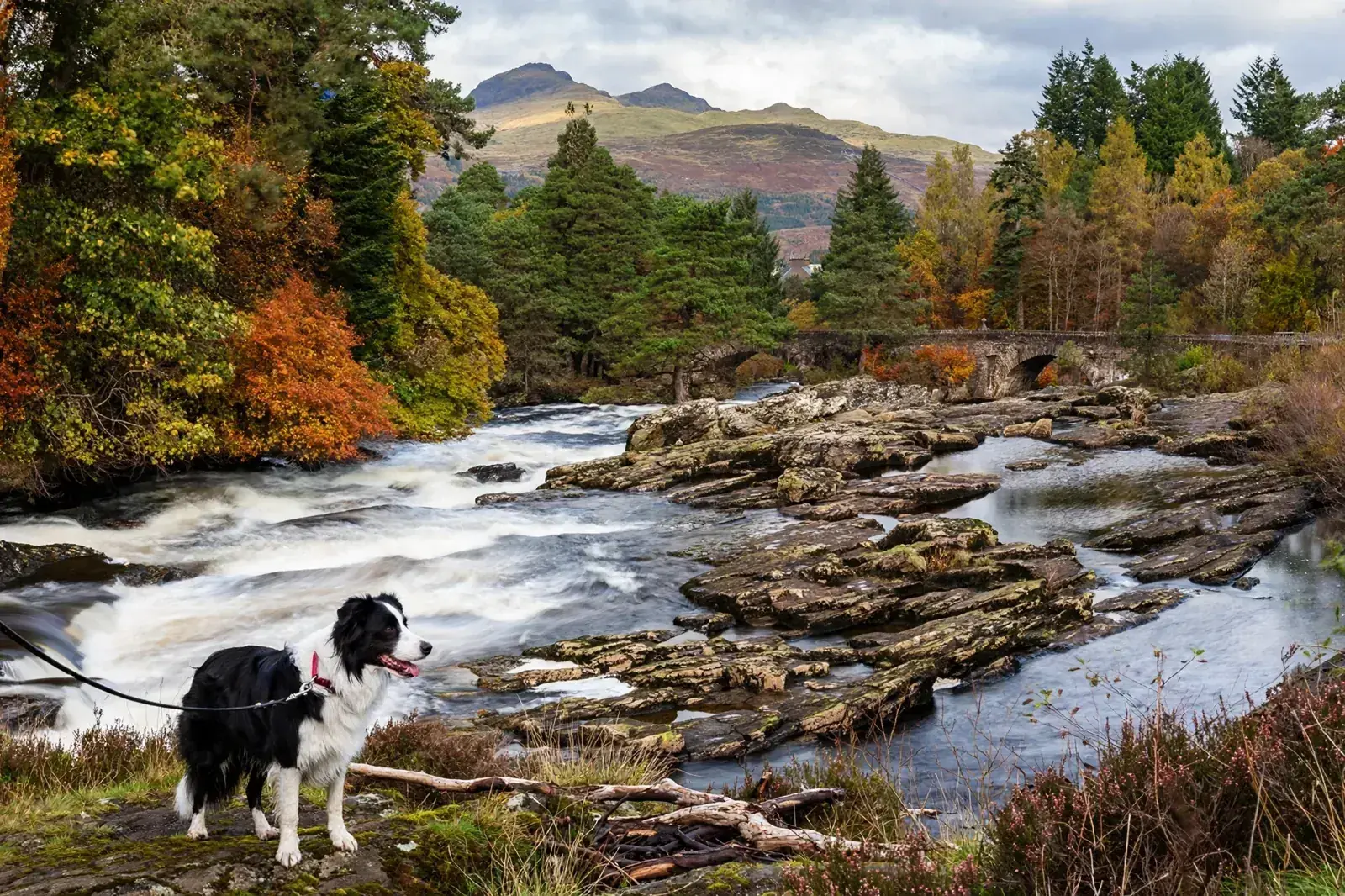
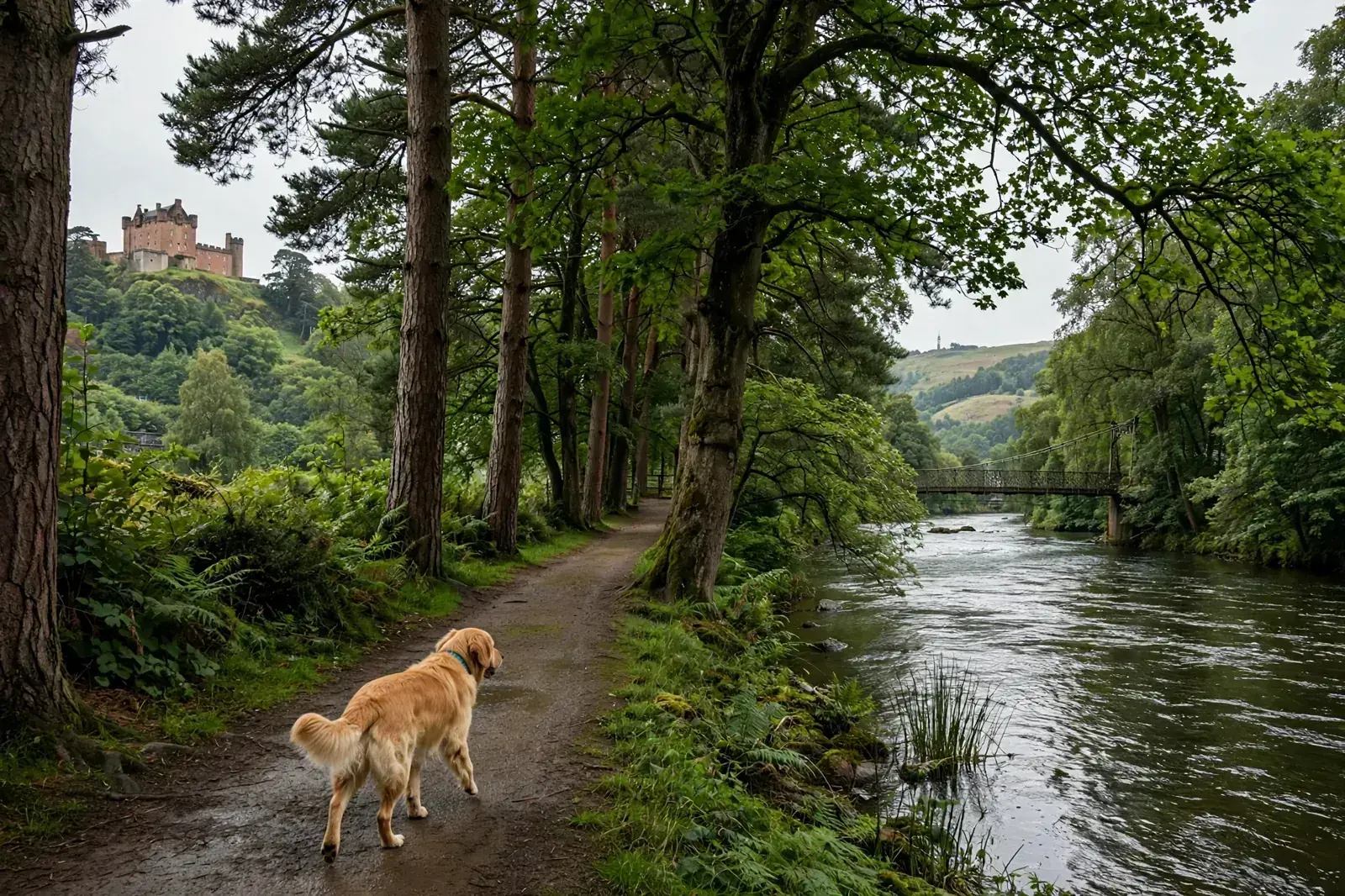
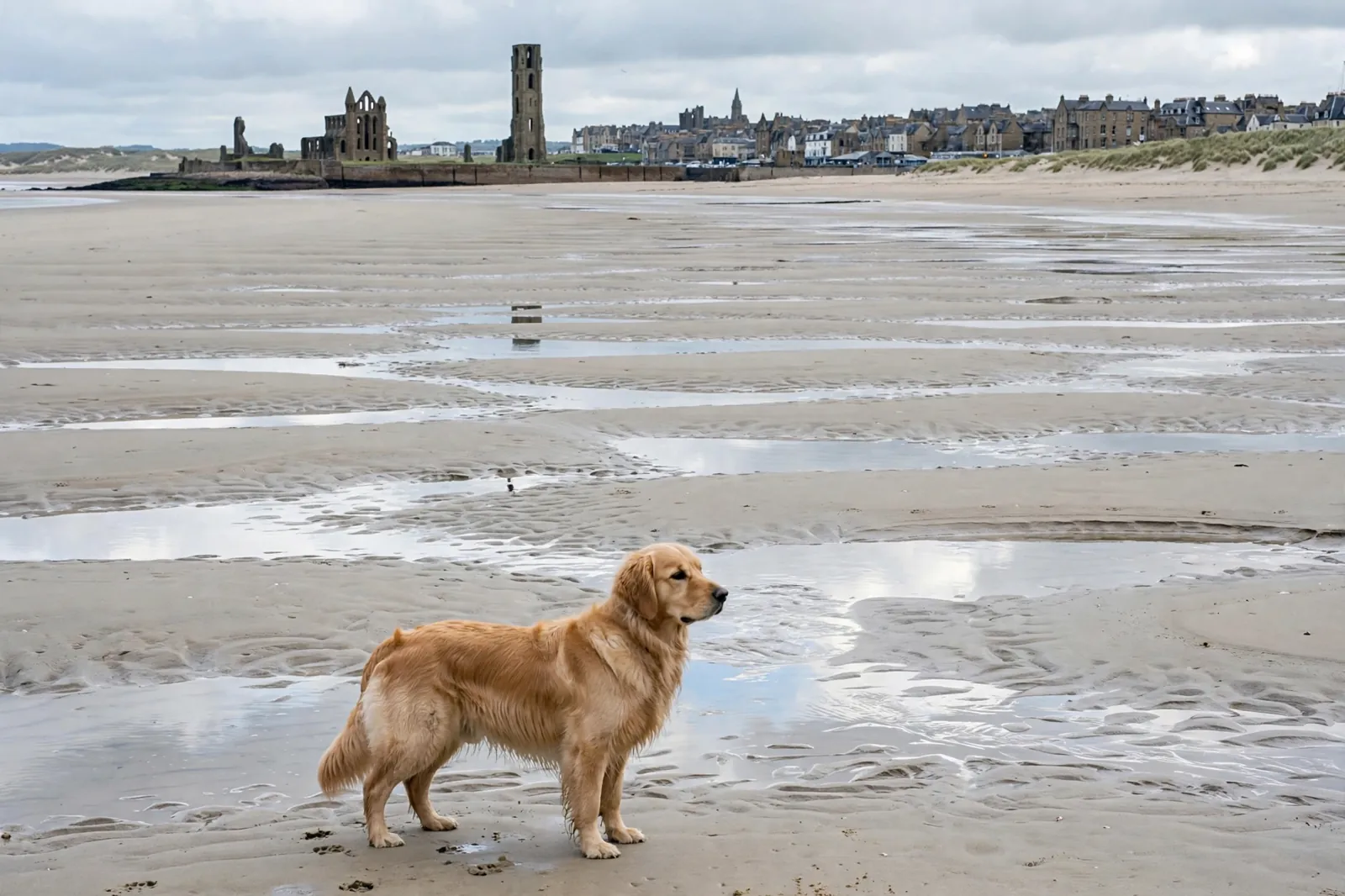
Base yourself near the River Tay and Perth almost plans itself for a dog: start on the North or South Inch for flat, open exercise, cross the bridges for a proper riverside loop, save Kinnoull Hill for a clear, calm day, and treat Scone Palace and Branklyn Garden as check-the-rules-first outings rather than assumptions. Then use the city as a practical springboard for Loch Tay, Dunkeld and the southern Highlands — with shops, vets and a warm bed waiting back at base.
Why Perth suits dogs: small city, big river, short distances
Most dog trips fail on logistics rather than scenery, and Perth is unusually kind on logistics. It is a compact city where the river is not an attraction on the edge of town but the organising feature in the middle of it. Two very large public parks — the North Inch and the South Inch — sit on opposite sides of the centre, the Tay runs between bridges that link them into natural loops, and a wooded hill rises close enough to feel rural without needing a mountain day to enjoy it. For a dog, that means a satisfying walk is rarely more than a few minutes from where you slept, ate or parked.
That closeness changes the shape of a stay. Instead of driving to one headline walk and then wondering what to do with a restless dog at nine in the evening, you can build the day in layers: a long morning circuit on an Inch and along the river, a slower lunchtime wander while the dog sleeps under a table or back at the accommodation, and a short, familiar last walk after dark on ground you already know. Dogs that are nervous in new places often settle better with that repetition, and owners get a holiday that does not depend on perfect weather or a single big expedition.
Perth also works because it is a real working city rather than a resort. There are supermarkets for forgotten food, pet shops for a replacement lead, groomers and veterinary practices within ordinary reach, and a station and road links that make arrival and day trips straightforward. None of that is glamorous, and all of it matters on day three, in rain, with a muddy dog and a torn harness. Plan Perth as a base that supports the adventures, not merely as a stop between them.
Set expectations correctly, though. This is not a beach town and not a remote Highland village. Some central streets stay busy, riverside paths are shared with runners and cyclists, and the most formal visitor attractions set limits on where pet dogs can go. The guide below separates the reliably dog-centred parts of Perth — the Inches, the river paths and the hill — from the places where a dog is a conditional guest, so you can give each outing the right amount of planning.
River Tay walks and bridge loops: let the river set the route
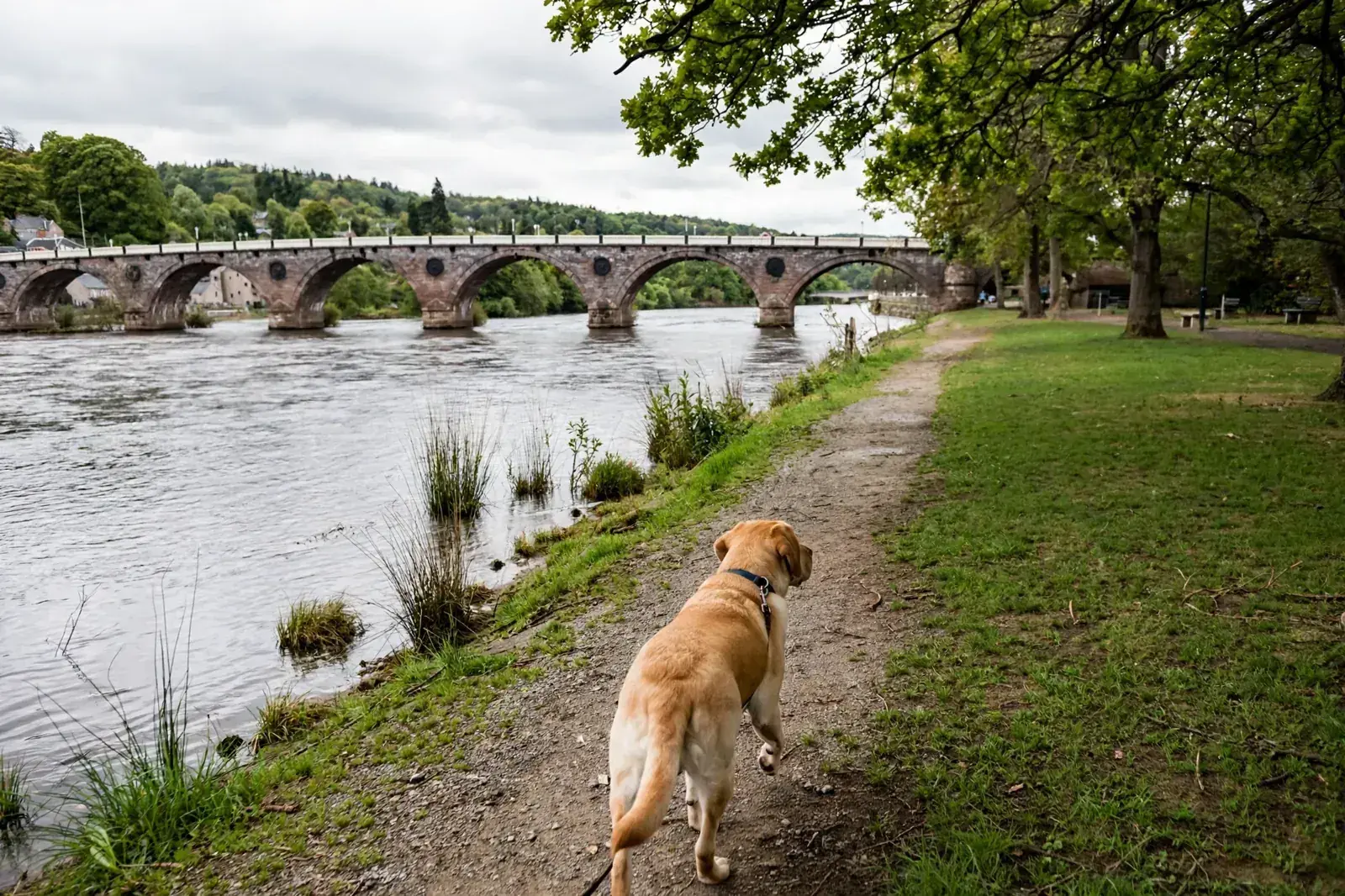
The simplest way to understand Perth on foot is to walk a bridge loop. Cross the Tay on one bridge, follow the riverside path on the far bank, and return over another bridge, adjusting the length by how far you walk between crossings. The exact bridges and path sections you use will depend on where you are staying and on any path works or flooding on the day, so treat the loop as a pattern rather than a fixed itinerary, and check the latest official guidance before you travel if a particular section matters to your plans.
For the dog, riverside walking has a particular rhythm. The paths are generally level and easy to follow, the interest comes from smells along the bank, birds, boats and other walkers, and there are natural pause points on bridges and at park entrances. That makes the Tay route a good choice for older dogs, for a first walk after a long drive, and for the last walk of the day when nobody wants navigation. Keep the lead on near roads, bridge approaches, anglers and any signed sections, and be disciplined about not letting a dog plunge down steep or slippery banks — the Tay is a large, powerful river, not a paddling stream.
River level deserves real respect here. After heavy rain the Tay can run high and fast, paths close to the water can flood or turn to deep mud, and a ball or stick thrown towards the current is a risk no dog should be asked to chase. Choose the higher, surfaced path options in wet spells, keep swimming dogs out of the main flow entirely, and be extra careful around swollen side channels and debris. If a section is closed or signed as unsafe, turn around and rebuild the loop on the other bank rather than treating the barrier as a suggestion.
Length is easy to scale. A short loop between the central bridges can fill forty relaxed minutes with plenty of sniffing; extending north towards the North Inch or south past the South Inch turns the same idea into a half-day walk with picnic stops. Carry water even on a river walk — dogs should not be expected to drink from the river — and carry waste bags all the way home, because bins cluster at park entrances and bridge ends rather than appearing exactly where you need one mid-path.
North Inch and South Inch compared: choose your park by the day you want
The two Inches are Perth's great dog asset, and they are not interchangeable. Think of them as two different answers to the question of what your dog needs today, and learn both early in the stay so you can pick without thinking for the rest of the trip.
The North Inch, on the northern side of the centre beside the Tay, is the expansive one: broad open grass, riverside edges and room for a proper run, a long-line session or a game well away from other people. It is the better choice for a young, energetic dog that needs space before it can be civilised in town, and for owners who want a long, flat circuit without leaving the city. Sports pitches, events and other users still shape how much of it is sensibly usable on a given day, so work around fixtures, keep clear of organised games, and recall a dog promptly when joggers, children or other dogs cross your space. Edges near roads and car parks are lead territory, however open the middle feels.
The South Inch, south of the centre and close to the station side of town, has a slightly more contained, everyday feel: open grass, paths, trees and a park atmosphere that suits a steadier outing. It is a practical choice for a shorter morning walk, for an older dog that wants interesting ground without a huge circuit, and for a wet day when you want to stay on or near paths and be back at a café or the car quickly. As on the North Inch, play areas, sports use and busy path junctions call for a lead and a bit of courtesy, and after-dark walks are best kept to the lit, familiar parts you have already walked in daylight.
A good Perth routine uses both. Burn energy on the North Inch on arrival day so the first evening is calm. Use the South Inch for the unhurried start on a day when the main outing is elsewhere — Scone, Kinnoull Hill or a drive north. Then return to whichever Inch your dog liked best for the final walk of the trip. Repetition is not a failure of imagination with dogs; familiar ground, read at sniffing pace, is often the walk they enjoy most.
Whichever park you choose, the basics hold: clear up every time, keep dogs out of play equipment and off pitches in use, give wildlife and nesting birds a wide berth in spring, and do not let a friendly dog charge up to a leaded dog on a path. Large parks only stay welcoming when the minority of careless owners does not spoil them for everyone else.
Kinnoull Hill viewpoint walks: Perth's wooded hill, taken steadily
Across the river from the centre, Kinnoull Hill gives Perth something many small cities lack: a genuinely wooded hill walk with far-reaching views over the Tay and the Carse of Gowrie, within easy reach of town. Woodland paths climb through trees to viewpoints and a summit area associated with a folly tower, and the contrast with the flat Inches is exactly why it is worth saving for the right day rather than spending it on arrival.
Choose that day with care. The hill rewards clear, calm weather, when the views justify the climb and paths are at their least slippery. After prolonged rain, expect mud, wet roots and greasy descents; in high wind, exposed viewpoint sections are no place for a dog that pulls; in ice, stay on the Inches instead. Footwear with grip matters more here than anywhere else in this guide, and a lead matters throughout: there are steep drops near viewpoint edges, other walkers on narrow paths, and wildlife in the woods. A harness gives better control than a collar on descents, and a long line is a poor idea near edges — keep the dog close where the ground falls away.
Pace the walk for the least fit member of the party, dog included. Build in stops on the way up rather than pushing for the top and facing a tired, footsore descent. Older dogs and dogs recovering from injury may do better on a shorter woodland circuit that skips the steepest summit push, and puppies should not be marched up and down repeated steep sections while their joints are still developing. Carry water for the hill in particular, because there is no reliable dog drinking point on the route, and check paws at the end for cuts, thorns and grit worked in on stony sections.
Kinnoull also makes a useful test before bigger Highland days. A dog that copes happily with an hour or two of wooded climbing, passing other walkers on narrow paths and settling afterwards is giving you honest information about what a day trip should look like. A dog that is exhausted or over-aroused by Kinnoull is telling you to scale the next day down to Dunkeld paths or another Inch-and-river circuit — listen to that information rather than to the itinerary you wrote at home. For bigger hill ambitions later in a Scotland trip, compare the approach with our guide to the Cairngorms with a dog, where altitude, weather and lead rules need even more care.
Scone Palace grounds with a dog: a lead-on outing, not a free run
A short drive north of the city, Scone Palace is one of Scotland's best-known historic houses, set in extensive grounds and gardens above the Tay, on a site bound up with the crowning of Scottish kings. It makes an appealing half-day from Perth — but only if you go in with the right picture of what a dog visit actually is.
The working rule is grounds yes, house no. Dogs on leads are generally welcome in the grounds and gardens, while the palace interior is for people only, apart from assistance dogs. That split has practical consequences. A couple can take turns inside while one person walks the dog through the grounds; a solo traveller should plan a grounds-only visit and enjoy it on those terms rather than arriving hoping for an exception. Grounds rules, opening dates, ticket arrangements and any areas closed for events, maintenance or livestock can change, so check the latest official guidance before you travel and again on arrival signage.
On the ground, keep the outing formal-garden polite. A short lead near planting, buildings, cafés, play areas and other visitors; no dogs in flower beds, however good the photograph would be; no extending leads across paths; and absolute distance from any livestock, estate animals or working areas. Clear up meticulously — historic grounds are exactly the setting where one careless owner hardens a policy for the next hundred dog visitors. If there is a dog-friendly café terrace or designated refreshment area on the day, use it, and otherwise plan food around the visit rather than assuming the dog can join you indoors.
Timing helps. The grounds are at their most enjoyable for a dog on a quieter weekday, outside the peak of an event day, and in the cooler parts of the day in summer because a lead walk around open grounds offers less shade than owners expect. Combine Scone with a proper free-running session on an Inch earlier or later in the day, so the dog's needs are already met and the palace visit can be the calm, leaded, looking-at-things part of the day that it is designed to be.
Branklyn Garden and quieter stops: the check-first part of the list
Branklyn Garden, on the Dundee Road side of the city and cared for by the National Trust for Scotland, is a small, highly regarded garden known for its plant collections. It is also the clearest example in Perth of a place to check before you promise yourself a dog outing. Garden policies at properties like this are often more restrictive than parkland policies and may limit pet dogs significantly, sometimes to assistance dogs only or to tightly defined conditions. Do not build a day around walking a pet dog through the planting until you have confirmed the current position, and check the latest official guidance before you travel.
That caution is not a reason to strike Branklyn from the trip. A party with two adults can split, as at Scone: one enjoys the garden properly while the other takes the dog on a riverside or Inch walk of similar length, then swap the dog duties at a café afterwards. Solo travellers can simply schedule Branklyn as a human hour inside a dog-centred day, with the dog settled safely at the accommodation only if the stay's rules genuinely allow the dog to be left, it is for a short period, and the dog is known to settle — otherwise, choose a different day structure rather than bending those conditions.
Build the rest of a quiet Perth day from similarly modest pieces. A slow circuit of the South Inch followed by coffee; a browse of independent shops that display a dogs-welcome sign, with the dog kept close in small interiors; a riverside bench while the dog watches the Tay; an early evening bridge loop as the light changes. Not every day of a dog holiday needs a named attraction, and Perth's strength is that its ordinary fabric — parks, river, cafés, short distances — fills a gentle day without strain. If you are continuing north-east afterwards, our St Andrews with a dog guide covers a very different kind of Scottish day, where beaches and golf-path etiquette replace river parks.
One more quiet-stop discipline applies everywhere in this section: small gardens, galleries, shops and cafés can withdraw dog access quickly if muddy paws, barking or leaded-dog stand-offs in doorways become the norm. Wipe paws before entering anywhere, keep visits short for a young or restless dog, and leave cheerfully the moment your dog has had enough. Being the party that exits early is how dog access survives for the next visitor.
Where to stay and eat: pick the walk, then pick the bed
Choose Perth accommodation backwards, starting from the first and last walks of the day. A stay within easy reach of an Inch or the riverside paths removes the small daily frictions that quietly ruin dog trips: no driving to a toilet walk in pyjamas, no crossing a busy road in the dark, no negotiating a car park with a desperate puppy. When you enquire, ask where the nearest sensible patch of grass actually is — “dog-friendly” answers about towels and bowls are welcome, but the walk question is the one you will live with twice a day.
Perth offers the usual Scottish city mix: chain and independent hotels in and near the centre, guest houses and bed and breakfasts in residential streets, self-catering flats and houses, and caravan, camping and lodge options in the surrounding countryside for those who prefer a rural edge. Verify the dog terms of the specific property every time, because policies sit with the individual business, not the city. The checks that matter are the number and size of dogs accepted, any per-dog or per-stay charge, whether dogs may be left alone in the room and under what conditions, whether they are allowed in breakfast rooms or only in a bar or terrace, and whether the garden — if there is one — is genuinely enclosed or merely prettily fenced in the photographs.
Self-catering suits many dog owners best here, for unglamorous reasons: a door you can open at 6am without crossing a lobby, a floor that tolerates a wet dog, space for a crate and drying coats, and a kitchen that makes feeding routines normal. Hotel stays suit shorter breaks and dogs that settle anywhere, provided the lift, stairs and corridor noise will not undo them. Rural stays on the edge of the city trade walk-from-the-door countryside for a drive into Perth — a fair trade for a reactive dog that would find central streets hard work all week.
Eating follows the same verify-as-you-go pattern. Perth has pubs, cafés and restaurants across the centre and riverside, and a good number welcome dogs in all or part of the premises, but the detail varies by room, by time of day and sometimes by how busy the venue is. Look for a venue where you can sit at the edge rather than in a thoroughfare, bring a settle mat so the dog has a defined place, arrive with a dog that has already been walked and toileted, and keep the first visit short and successful rather than marathoning a three-course test of everyone's patience. Water bowls are commonly offered; food for dogs, where it exists, is a bonus, never a plan.
Stock up early in the stay. Identify the nearest supermarket, pet shop and — importantly — the veterinary practice you would use in an emergency, and save the numbers before you need them. Perth's size works in your favour here: nothing essential is far away, which is precisely why it functions so well as a base when the more rural days go sideways.
Perth as a Highlands gateway: day trips that still work for the dog
Perth is often described as a gateway to the Highlands, and with a dog that phrase needs translating into honest driving and walking maths. The city's position on the main road and rail routes north means several worthwhile Highland-edge days are realistic without changing accommodation — and avoiding a change of base is itself a dog benefit, because the dog keeps one bed, one last-walk route and one routine while the scenery changes around them.
The closest Highland flavour is also the most dog-sensible. Dunkeld and the wooded Tay valley to the north make a gentle step up from Perth's own river walks: bigger trees, faster water and a village scale that suits a half or full day without heroic driving. Pitlochry, further up the A9 corridor, extends the same idea for a longer day. In both cases the discipline is identical — one proper walk as the centrepiece, food planned around the dog rather than discovered hopefully, and a return to Perth before everyone is overtired.
West and north-west, Loch Tay with a dog turns Perth into a base for a genuinely Highland loch day, with Kenmore and Killin at either end of the water and the Rob Roy Way country in between. That is a full-day commitment rather than an afternoon add-on: allow for slower rural roads, pick one end of the loch and do it properly instead of attempting both, and check lead rules around livestock and estate land carefully. Done at that pace, it is one of the strongest day trips in this guide.
The southern Cairngorms approaches and, for a longer expedition, the road towards Inverness with a dog show where Perth's gateway role reaches its limit. These are possible as long days for the right dog and driver, but they stop being kind when the dog spends six hours in a car for a forty-minute walk. If the northern Highlands are the real goal, stay up there for part of the trip and use Perth as the civilised first or last night instead — that is a gateway used properly, not a base stretched until it snaps.
Whatever the day trip, run the same pre-departure checks: road conditions and closures, mountain or rural weather if you are gaining height, livestock on open ground, lead rules at the destination, water and food for the dog in the car, and a plan B walk back near Perth if the day collapses. Gateway bases earn their keep on the plan B days as much as on the glorious ones.
Practicalities: river sense, Scottish weather and the boring essentials
River sense comes first in Perth, because the Tay is both the city's pleasure and its main hazard. Keep dogs out of fast or swollen water, off slippery banks and away from angling equipment and lines. In summer, be alert to the general risks that affect any large river system — debris after spates, cold shock in deep water even on warm days, and algae in still side pools during prolonged hot, dry spells; if water looks or smells wrong, keep the dog out and on a lead nearby. After any river-adjacent walk in wet weather, rinse and dry paws, and check for small cuts before they become sore.
Weather planning here is lowland Scottish rather than mountain Scottish, which tempts people to underprepare. Rain can sit over the Tay valley for a day without ever becoming dramatic, wind makes Kinnoull Hill and bridge crossings unpleasant out of proportion to the forecast, and winter daylight is short enough that a late start quietly deletes the long walk. Build each day around one weatherproof anchor — an Inch circuit works in almost anything — and treat hill views and garden visits as movable extras. Pack drying gear as seriously as you would for a coastal trip: two drying coats, spare bedding, old towels for the car and accommodation doorway, and a waterproof mat for wet dogs in cafés.
Seasonal notes are mostly about other land users. Spring brings lambing in the countryside around the city and nesting birds in the parks, so leads go on earlier and stay on longer near livestock and signed areas, in line with the Scottish Outdoor Access Code's expectations for responsible dog control. Summer brings sports fixtures and events onto the Inches, busier riverside paths and the need for shade and water on open grass. Autumn shortens the evenings quickly. Winter brings the risk of grit and de-icer on pavements — rinse paws after town walks — and occasional flooding that can close low riverside sections, so check the latest official guidance before you travel and follow local closure signs on the day.
Transport is straightforward but worth a thought. Perth station puts the city within reach of Edinburgh, Glasgow, Dundee, Aberdeen and Inverness routes, and dogs travel on UK trains under the usual operator conditions — check the latest official guidance before you travel, keep the dog off seats, and plan the walk at either end of the journey. By car, the main approaches are the A9 from north and south, the M90 from Edinburgh and the A90 from Dundee; city parking near the Inches and centre fills at predictable peaks, so arrive early for the morning walk on fine weekends. Finally, save the details that turn a mishap into a mere inconvenience: your accommodation address, the nearest vet and out-of-hours arrangement, your dog's microchip and insurance details, and a photograph of the dog on your phone in case you are ever separated.
Perth rewards the owner who plans it this way — river first, parks daily, hill on the good day, formal attractions checked rather than assumed, and the Highlands sampled at a pace the dog can enjoy. Do that, and the city stops being a dot on the way north and becomes one of the easiest, kindest bases in Scotland for a dog holiday.
Practical questions
Before you go
Are dogs allowed in the grounds of Scone Palace?
Dogs on leads are generally welcome in the grounds and gardens, but not inside the palace itself, apart from assistance dogs. Grounds rules, opening dates and any areas closed for events can change, so check the latest official guidance before you travel and keep your dog away from livestock, play areas and formal planting.
Can dogs go off lead on the North Inch and South Inch?
Both Inches are large open parks where many dogs exercise off lead away from paths, sports pitches and other users, but there is no blanket guarantee for every corner or every event day. Keep your dog under close control, use a lead near roads, car parks, play areas and organised sport, clear up after your dog, and follow any temporary signs on the day.
Is Kinnoull Hill suitable for an older dog?
It can be, if you choose the gentler woodland paths, allow plenty of stops and turn back before your dog tires. The summit routes include steeper, uneven and muddy sections and exposed cliff viewpoints, so keep dogs on a lead near edges, avoid the hill in high wind or ice, and pick a flat Inch or riverside walk instead on a low-energy day.
Are dogs allowed in Branklyn Garden?
National Trust for Scotland garden policies vary and can be more restrictive than parkland policies, often limiting dogs to assistance dogs or to specific areas and conditions. Do not assume a pet dog can tour the planting. Check the latest official guidance before you travel, and plan an Inch or riverside walk as the dog's outing that day either way.
Is Perth a good base for Highlands day trips with a dog?
Yes, for southern and central Highlands trips in particular. Loch Tay, Dunkeld, Pitlochry and the southern Cairngorms approaches are realistic day drives, and Perth gives you supermarkets, vets and wet-weather options back at base. Keep driving days honest, build in a proper walk rather than only photo stops, and check road and weather conditions before setting out.