This guide is independent and contains no paid placement. If affiliate links are added later, they will be clearly marked and will not change our editorial checks.
Dogs on leads are allowed around the outside of the visitor centre and across the National Trust open access fields, including the 1.2-mile walk towards the stones. Dogs are not permitted in the stone circle, the monument field, the exhibition, the cafe, the shop or on the visitor bus. Registered assistance dogs are allowed in all areas. Do not leave a dog in the car — the car park has no shade. Check the official guidance before you travel.
The answer in one minute
If you are driving to Stonehenge with a dog, here is the whole policy in one paragraph. Dogs on leads are allowed around the outside of the visitor centre and across the National Trust open access fields, including the walk from the visitor centre towards the stones. Dogs are not allowed in the stone circle itself, in the monument field around the stones, in the exhibition, in the cafe or shop, or on the visitor bus that runs between the visitor centre and the stones. Registered assistance dogs are allowed in all areas, including the stone circle. Dogs must not be tied up anywhere on the site, and they must not be left in a vehicle.
That split catches many visitors by surprise, because Stonehenge is an outdoor site and most outdoor places in Britain welcome dogs. The reason is legal as well as practical. Stonehenge is protected under the Ancient Monuments and Archaeological Areas Act 1979 and the Stonehenge Regulations 1997, which prohibit bringing an animal onto the site of the monument without the prior consent of English Heritage. The stones themselves are fragile, the ground around them is archaeologically sensitive, and the site is busy — a dog in the stone circle would be a risk to the monument and to other visitors. English Heritage applies the rule strictly, and it applies to members as well as to ticket holders.
None of that means a dog trip to Stonehenge is a waste of time. The landscape around the stones is one of the most interesting prehistoric landscapes in Britain, with barrows, earthworks and the Avenue running across open chalk downland, and the National Trust fields give a dog a proper walk with a view of the stones from a distance. Many dog owners find that the landscape walk, plus a visit to Avebury or a walk around Salisbury, makes a better day than a rushed visit to the stone circle alone. The rest of this guide explains how to plan that day, where the dog can and cannot go, and what to do if one of you wants to see the exhibition while the other stays with the dog.
One warning before you set off: do not plan to leave the dog in the car while you visit the stones. The car park at Stonehenge has no shade, and a car heats up quickly even on a mild, cloudy day. Dogs die in hot cars every summer in Britain, and a car park with no shade is one of the most dangerous places to leave one. If you are travelling alone with a dog and you want to see the stone circle, you will need to accept that you cannot do it on this visit — or arrange for someone else to stay with the dog. Check the official guidance before you travel, because the rules can change, and the signs at the site are the ones that apply on the day.
The stone circle and the monument field
The stone circle is the part of Stonehenge that most people picture: the ring of standing stones on Salisbury Plain, built in stages between about 3000 and 2000 BC. Visitors reach it from the visitor centre, either on the visitor bus or on foot across the fields, and they walk around the stones on a path that keeps them a short distance from the monument. Pet dogs are not allowed in the stone circle or in the monument field around it, and that includes the path around the stones. The rule is set out in English Heritage's dogs guidance and in the Stone Circle Access terms, which state that no dogs or other animals are allowed beyond the main entrance point, except registered assistance dogs.
The monument field is larger than most visitors expect. It is the open grassland immediately around the stones, enclosed by a fence, and it includes the area where visitors stand to look at the monument and take photographs. Dogs cannot enter it at all, even on a lead, and they cannot be carried in. That matters for owners of small dogs who might think of carrying a dog in a bag or a carrier — the rule is about animals on the site, not about leads, so a carried dog is still not allowed. The only exception is a registered assistance dog working with its handler, which is permitted in all areas, including the stone circle.
Special access visits, which allow a small number of people inside the stone circle before or after normal opening hours, have the same rule. These visits are popular because they let visitors walk among the stones, but they are not a way around the dog policy — pet dogs are not allowed on a special access visit either. If you have booked a special access visit and you are travelling with a dog, you will need to arrange for someone else to look after the dog, or to leave the dog at your accommodation. Do not book a special access visit and then hope the rule will be waived on the day, because it will not be.
The summer solstice is a special case. Stonehenge is open for the solstice, and large crowds gather to watch the sun rise over the stones. English Heritage asks visitors not to bring dogs, pets or other animals to the solstice, because the crowds, the noise and the long hours make it a poor environment for a dog, and dogs are not permitted in the monument field. If you are planning to attend the solstice with a dog, the sensible choice is to leave the dog at home or with a sitter, and to enjoy the event without worrying about the dog in a crowd.
The visitor centre: what dogs can and cannot do
The visitor centre is the modern building about a mile and a half from the stones, with the ticket office, the exhibition, the cafe, the shop and the car park. Dogs on leads are allowed around the outside of the visitor centre, which means the outdoor areas, the paths around the building and the picnic areas. They are not allowed inside the exhibition, the cafe or the shop. That is the practical split for most visitors: one person can go inside while the other stays outside with the dog, and then you swap.
The exhibition is worth seeing if you can arrange it. It tells the story of Stonehenge, with artefacts from the site, a reconstruction of a Neolithic house and a film about the building of the monument. It takes about 45 minutes to an hour to go through, and it is indoors, so it is a good option on a wet day. If you are travelling as a couple or a family, plan to take it in turns: one person visits the exhibition while the other walks the dog around the visitor centre and the landscape, and then you swap. If you are travelling alone with a dog, you will not be able to see the exhibition on this visit — accept that, and spend the time on the landscape walk instead, which is the better dog experience anyway.
The cafe and the shop have the same rule: dogs are not allowed inside. The cafe has outdoor seating, and dogs on leads are usually welcome in the outdoor area, but check the signs on the day, because the arrangement can change with the season. If you want a coffee or a meal, the outdoor seating is the place to sit with a dog, and the cafe staff can usually bring an order out to you. The shop sells books, gifts and souvenirs, and it is a quick visit — take it in turns if you want to go inside.
Dogs must not be tied up anywhere on the site, which includes the railings and fences around the visitor centre. That rule is there because a tied-up dog can become distressed, can trip other visitors, and can be a target for theft. If you need to go inside for a few minutes, take the dog with you to the outdoor area, or ask another member of your party to stay with the dog. Do not tie a dog to a fence and go inside, even for a short time, because staff may ask you to return to the dog, and it is not fair on the dog.
Assistance dogs: the exception
The exception reaches everywhere a visitor can go. A registered assistance dog may enter the stone circle, the monument field, the exhibition, the cafe, the shop and the visitor bus — the only dog allowed in any of those places. It exists for one reason: a disabled person who relies on an assistance dog should not be kept out of the site. It covers a dog doing its trained job beside its handler — guide dogs and hearing dogs, medical alert dogs and other trained assistance dogs — and it does not cover emotional support animals, therapy dogs, or pets described as assistance dogs without registration.
Have the paperwork ready before you reach the ticket office. English Heritage staff see assistance dogs regularly and will usually welcome the dog without fuss, but the identification is worth having to hand, above all at the ticket office and at the entrance to the stone circle. The dog should be on a lead or harness, under the handler's control, and wearing its working jacket if it has one. The site is busy and the stones are a distraction for any dog, so keep it close and give it time to settle.
Access at Stonehenge works well for assistance-dog handlers. The visitor bus takes assistance dogs, the visitor centre is step-free with accessible toilets and a hearing loop, and the surfaced path around the stones suits a wheelchair, although it can be uneven in places. The landscape walk across the fields is grass, and it can be muddy after rain. If access is a concern, ring English Heritage before the day: staff can talk through the route, the timing and what help is on site. Check the official guidance before you travel, because the arrangements can change with the season and with conservation work.
Buying a tabard on the internet does not make a pet a working dog, and nor does describing it as one. Do not claim a pet is an assistance dog, do not buy a jacket online and present the dog as trained, and do not argue with staff if they ask for identification. That behaviour makes life harder for genuine assistance-dog handlers, and it can end with a dog being refused entry. If you are travelling with a pet, plan the visit around the rules for pets instead, and use the landscape walk and the alternatives in this guide.
The landscape walk: 1.2 miles to the stones
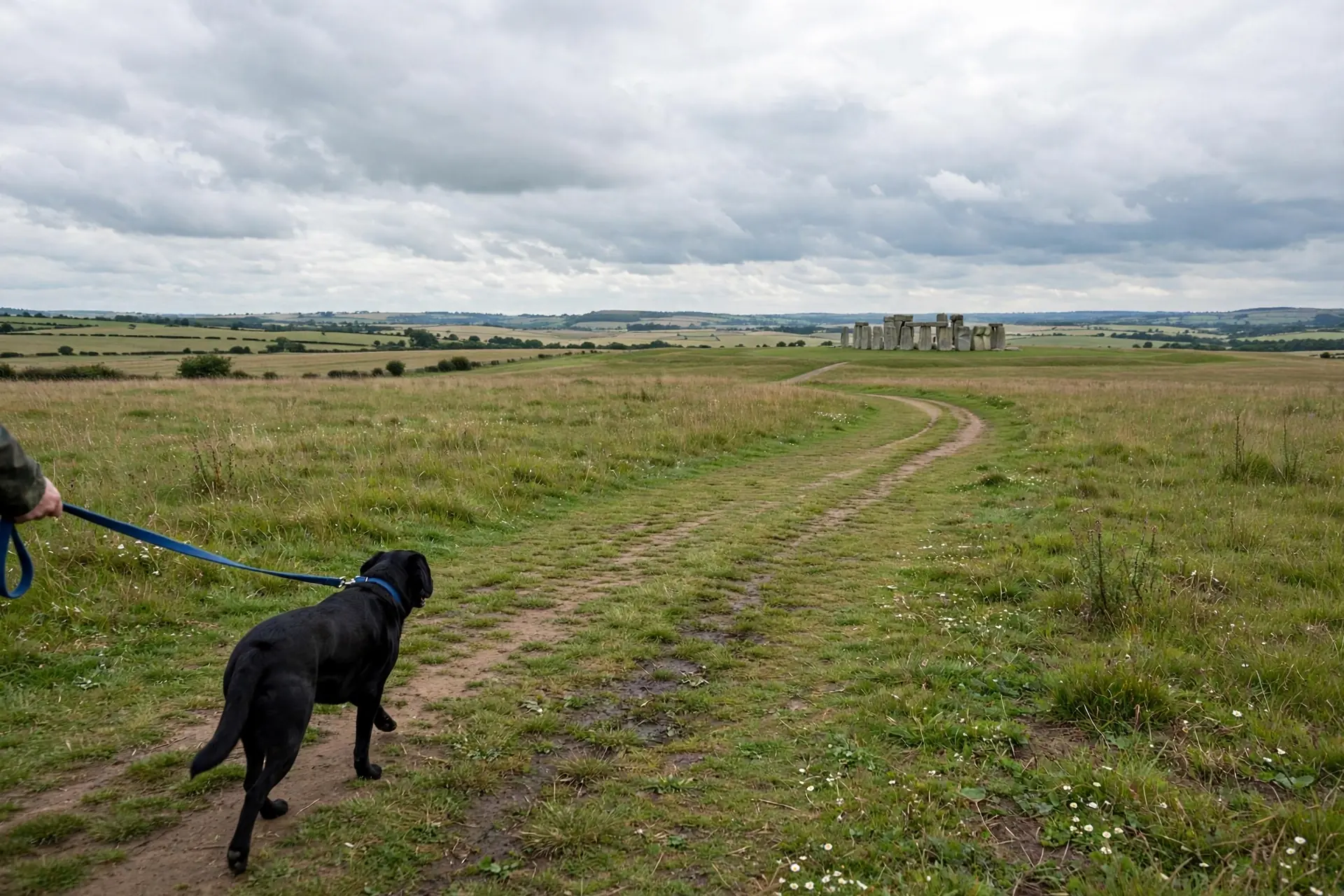
The best dog experience at Stonehenge is not the stone circle — it is the landscape walk. The National Trust owns the open access fields around the monument, and dogs on leads are allowed across them, following the signed paths. The walk from the visitor centre to the stones is about 1.2 miles, or about 2 kilometres, and it takes 30 to 40 minutes at a steady pace. It runs across open chalk downland, with views of the stones from a distance, and it passes barrows, the Avenue and the Cursus, a long Neolithic earthwork that is older than the stones themselves.
The National Trust uses a simple sign system in the landscape: green, orange and red. A green sign means dogs are welcome under effective control, which usually means off the lead if the dog has a reliable recall, but on a lead if there are sheep or other dogs nearby. An orange sign means dogs must be on a lead. A red sign means no dogs, and it is usually used for fields that are grazed by sheep. The National Trust has recently created dog-free zones in all fields that are grazed by sheep in the Stonehenge landscape, so some fields that were open before may now be closed to dogs. Follow the signs at each field entrance, and do not assume that a field you walked last year is still open this year.
Sheep are the main reason for the lead rules. The fields around Stonehenge are grazed by sheep for much of the year, and a dog that chases sheep can cause serious harm — a ewe that is chased can abort a lamb, and a farmer is legally entitled to shoot a dog that is worrying livestock. Keep dogs on a short lead around sheep, even if the dog has never chased sheep before, because a dog that has never seen a sheep can still chase one. If you see sheep in a field, keep the dog on a lead, walk calmly past them, and do not let the dog approach the flock.
The landscape walk is also a good way to see the stones without paying for a ticket. The stones are visible from the fields, and the view from the Avenue, the ancient processional route that runs from the River Avon to the stones, is one of the best in the landscape. You do not get as close as you would on the paid path, but you get a sense of the monument in its landscape, which is what makes Stonehenge interesting in the first place. Bring water for the dog, because there is no shade and no fresh water on the walk, and wear sturdy shoes, because the grass can be wet and the paths can be muddy after rain. Our guide to Dartmoor dog walks covers similar downland and moorland walking, with livestock rules and river safety, if you are planning a longer walking holiday in the south-west.
Parking and the visitor bus
Parking at Stonehenge is in the car park outside the visitor centre, and it is free for English Heritage members and for visitors who have booked a ticket in advance. The car park is large, but it fills up on summer weekends and during school holidays, so book a timed ticket in advance and arrive at the time on your ticket. The car park has no shade, which is why dogs must not be left in a vehicle — a car in full sun heats up quickly, even with the windows open, and a dog left in a car can overheat in minutes.
The visitor bus runs frequently from the visitor centre to the stones, and the journey takes about 10 minutes. Dogs are not permitted on the visitor bus, except registered assistance dogs, so if you are travelling with a pet dog and you want to see the stones, you will need to walk the 1.2-mile route instead. That is not a hardship — the walk is the best part of the visit for a dog — but it does mean you should allow an extra hour for the round trip, and you should wear comfortable shoes. The bus is useful for visitors who cannot walk the distance, but it is not an option for a pet dog.
If you arrive by public transport, the nearest railway station is Salisbury, about 10 miles away, and there is a bus service from Salisbury to Stonehenge. Dogs are usually allowed on the bus, but check with the operator before you travel, because the rules vary by company. The bus drops you at the visitor centre, and you can walk the landscape route from there. If you are cycling, there is a cycle rack at the visitor centre, and the roads around Stonehenge are quiet, although the A303 is busy and should be avoided on foot or by bike.
Book tickets in advance, especially in summer and during school holidays. Stonehenge uses timed entry, and the most popular times sell out days in advance. If you arrive without a ticket, you may have to wait or you may not get in at all. The ticket includes the visitor centre, the exhibition and the bus to the stones, but it does not include the dog — the dog stays outside, on the landscape walk, with one member of your party. Plan the day so that the ticket holder and the dog walker swap roles, and nobody is left waiting for too long.
Planning a visit with a dog
Start by deciding what the day is for. If the day is about seeing the stone circle, and you are travelling alone with a dog, Stonehenge is not the right choice — you will not be able to see the stones, and the dog will spend the day waiting outside. If the day is about a walk in a remarkable landscape, with a view of the stones and a visit to Avebury or Salisbury afterwards, Stonehenge is a good choice, and the dog will have a proper walk. Be honest about which day you are planning, because that decides whether to go at all.
If you are travelling as a couple or a family, plan to take it in turns. One person visits the stone circle and the exhibition, while the other walks the dog on the landscape route, and then you swap. Allow at least three hours for the whole visit: an hour for the stone circle and the bus, an hour for the exhibition, and an hour for the landscape walk. That is a long day for a dog, so bring water, a lead, poo bags and a snack, and give the dog a rest in the shade — there is little shade on the site, so bring a parasol or a light blanket for the dog to lie on.
Time your visit for the quieter parts of the day. Early morning and late afternoon are cooler for the dog, quieter for the walk, and better for photographs, because the light is softer and the stones cast long shadows. Midday in summer is hot, crowded and hard on a dog, especially a thick-coated or short-nosed breed. If you visit in summer, arrive early, walk the landscape first, and then visit the stones when the light is better. In winter, the site is quieter, the car park is emptier and the walk is cooler, but the grass can be muddy and the wind can be cold, so bring a coat for the dog if they chill easily.
Pack for a downland walk, not just a monument visit. Bring fresh water and a bowl, a lead and a long line, poo bags, a towel, and a first-aid kit with a tick remover, because the grassland around Stonehenge has ticks in summer. Check the dog for ticks after the walk, especially around the ears, the neck and the belly, and remove any tick with a tick remover, twisting gently until it comes out. Check the official guidance before you travel, because the opening times, the ticket prices and the dog rules can change with the season and with any conservation work.
Avebury and other alternatives
Avebury, about 25 miles north of Stonehenge, is the best alternative for a dog owner who wants to walk among the stones. The great stone circle at Avebury is the largest in Britain, and it stands in and around a village, with a pub, a church and houses inside the circle. Dogs on leads can walk among the stones, along the Avenue and up to the Sanctuary, and the surrounding downland offers long, open walks. Avebury is managed by the National Trust, and dogs are welcome in the landscape, on the paths and in the village, although they are not allowed inside the museum or the manor house. The pub in the village welcomes dogs, and the car park is close to the stones.
Woodhenge and Durrington Walls, near Stonehenge, are smaller and quieter, and they are worth a visit if you are already in the area. Woodhenge is a timber circle, marked by concrete posts, with a car park and a short walk from the road. Durrington Walls is a large henge earthwork, with a view across the Avon valley, and it is a good place for a dog walk on a lead. Both sites are free to visit, and they are much quieter than Stonehenge, which makes them a good choice for a nervous dog or a dog that needs space.
Old Sarum, on the edge of Salisbury, is another English Heritage site that is more dog-friendly than Stonehenge. The Iron Age hill fort and the Norman castle stand on a chalk hill with views across the city, and dogs on leads are welcome in the outdoor areas. The site is a good walk, with a car park close to the entrance and a cafe that welcomes dogs in the outdoor area. Our guide to dog-friendly castles in Wales covers similar historic sites, with lead rules and zone-by-zone access, if you are planning a castle trip with a dog.
The Wiltshire downs around Stonehenge and Avebury offer long, open walks that suit a fit dog. The Ridgeway, the ancient trackway that runs across the downs, is a good choice, with a firm, grassy surface and views across the countryside. Keep dogs on a lead near sheep and cattle, and carry water, because there is no fresh water on the downs. The downs are also home to ground-nesting birds in spring and summer, so keep dogs on a lead near nesting areas and do not let them chase birds.
Salisbury and the rest of the day
Salisbury, the nearest city to Stonehenge, is a good place to spend the rest of the day with a dog. The city has a cathedral with the tallest spire in Britain, a medieval market square, and riverside walks along the Avon and the Nadder. Dogs are not allowed inside the cathedral, except assistance dogs, but they are welcome in the cathedral close, on the riverside walks and in many of the pubs and cafes around the market square. The city is compact and walkable, and the streets are mostly flat, which suits older dogs.
The riverside walk from Salisbury to Harnham, across the water meadows, is a good dog walk, with views of the cathedral and a pub at the end. The water meadows are a Site of Special Scientific Interest, so keep dogs on a lead near the grazing cattle and do not let them swim in the river where the current is strong. The walk takes about an hour, and it is flat and surfaced, which suits a dog that struggles with steps or steep paths. In summer the water meadows are busy with walkers, so visit early in the morning or in the evening for a quieter walk.
If you have time, the New Forest, about 30 miles south of Salisbury, is a good place for a longer dog walk. The forest has open heathland, woodland and streams, with free-roaming ponies, cattle and pigs, and dogs must be kept on a lead near livestock and in the car parks. The forest is a popular place for dog owners, with many car parks, cafes and pubs that welcome dogs, and it is a good wet-day alternative to Stonehenge, because the woodland gives shelter from the rain. Our guide to the Brecon Beacons with a dog covers similar upland walking, with lead rules and safety advice, if you are heading west after Wiltshire.
End the day with a plan for the dog. A dog that has walked the Stonehenge landscape, visited Avebury and walked around Salisbury will be tired, and they will need water, food and a rest. Feed the dog at the usual time, give them a comfortable bed, and let them sleep. Do not plan a long drive home immediately after a long walk — give the dog an hour to rest, and stop for a break on the journey home if it is a long one. A tired, happy dog is the sign of a good day, and Stonehenge, planned properly, can be that day.
Practical questions
Before you go
Can I take my dog to Stonehenge?
Yes, but only in some areas. Dogs on leads are allowed around the outside of the visitor centre and across the National Trust open access fields, including the 1.2-mile walk to the stones. Dogs are not permitted in the stone circle, the monument field, the exhibition, the cafe, the shop or on the visitor bus. Check the official guidance before you travel, because the rules can change.
Are dogs allowed inside the Stonehenge stone circle?
No, pet dogs are not allowed inside the stone circle or in the monument field around it. The site is protected under the Stonehenge Regulations 1997, and bringing an animal onto the monument without consent is prohibited. Registered assistance dogs are permitted in all areas, including the stone circle.
Can my dog go on the Stonehenge visitor bus?
No, dogs are not permitted on the visitor bus that runs between the visitor centre and the stones, except registered assistance dogs. If you want to see the stones with a pet dog, walk the 1.2-mile route across the fields instead, keeping to the signed paths and following the green, orange and red signs.
Can I leave my dog in the car at Stonehenge?
No, do not leave a dog in the car at Stonehenge. The car park has no shade, and a car heats up quickly even on a mild day. Plan your visit so one person stays with the dog outside, or walk the landscape trails together, and use the visitor centre area in turns if one of you wants to see the exhibition.
Where can I walk my dog near Stonehenge?
The National Trust open access fields around Stonehenge offer a 1.2-mile walk from the visitor centre towards the stones, with views of the monument from the landscape. The National Trust uses green, orange and red signs: green means dogs under effective control, orange means on a lead, and red means no dogs. Some fields grazed by sheep are dog-free, so follow the signs and keep dogs on a short lead near sheep.
What is the best alternative to Stonehenge with a dog?
Avebury, about 25 miles north, is the best alternative. Its great stone circle stands in and around a village, dogs on leads can walk among the stones, and the surrounding downland offers long, open walks. Woodhenge, Durrington Walls and the Wiltshire downs are also good options, and Salisbury has dog-friendly pubs and riverside walks for the rest of the day.