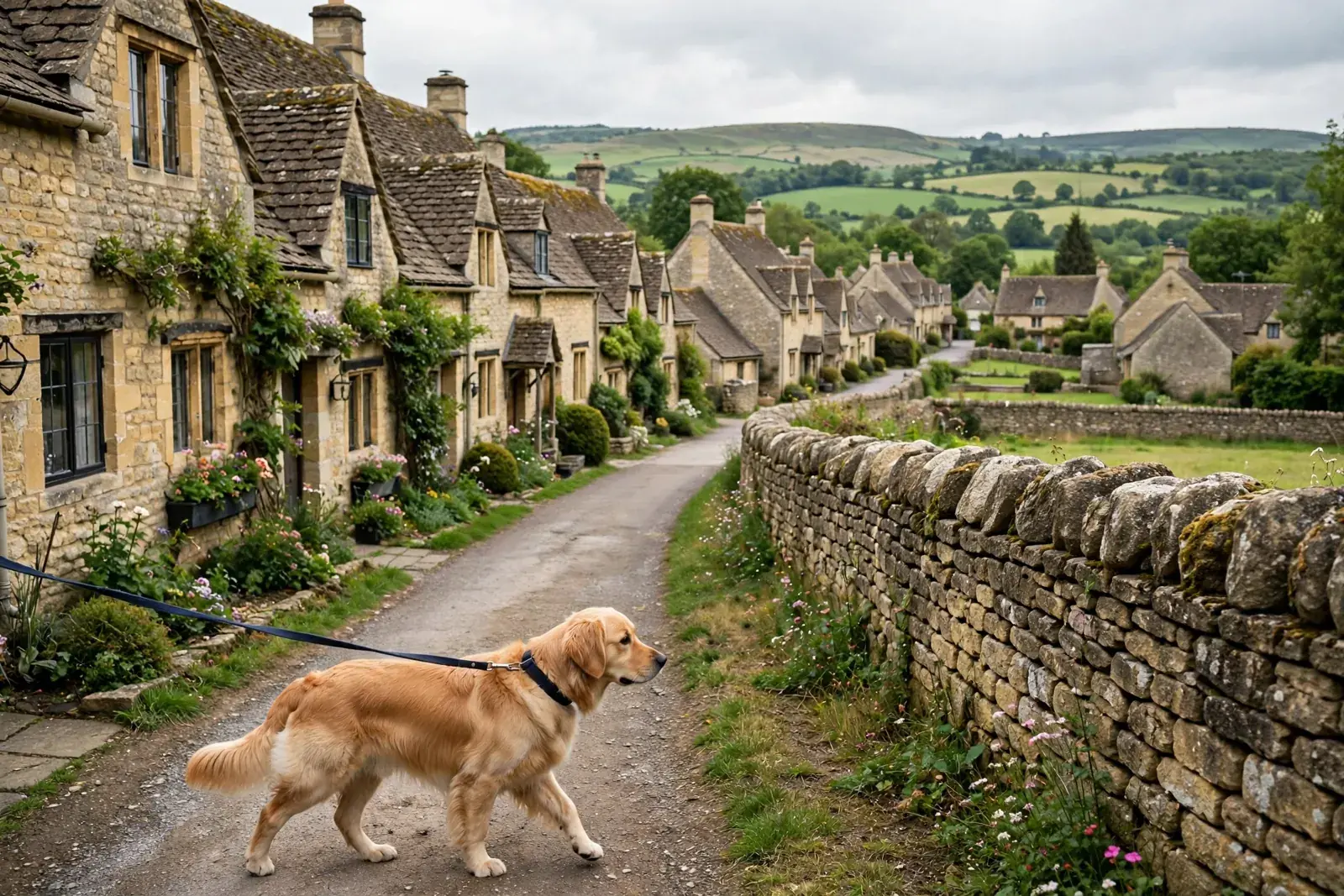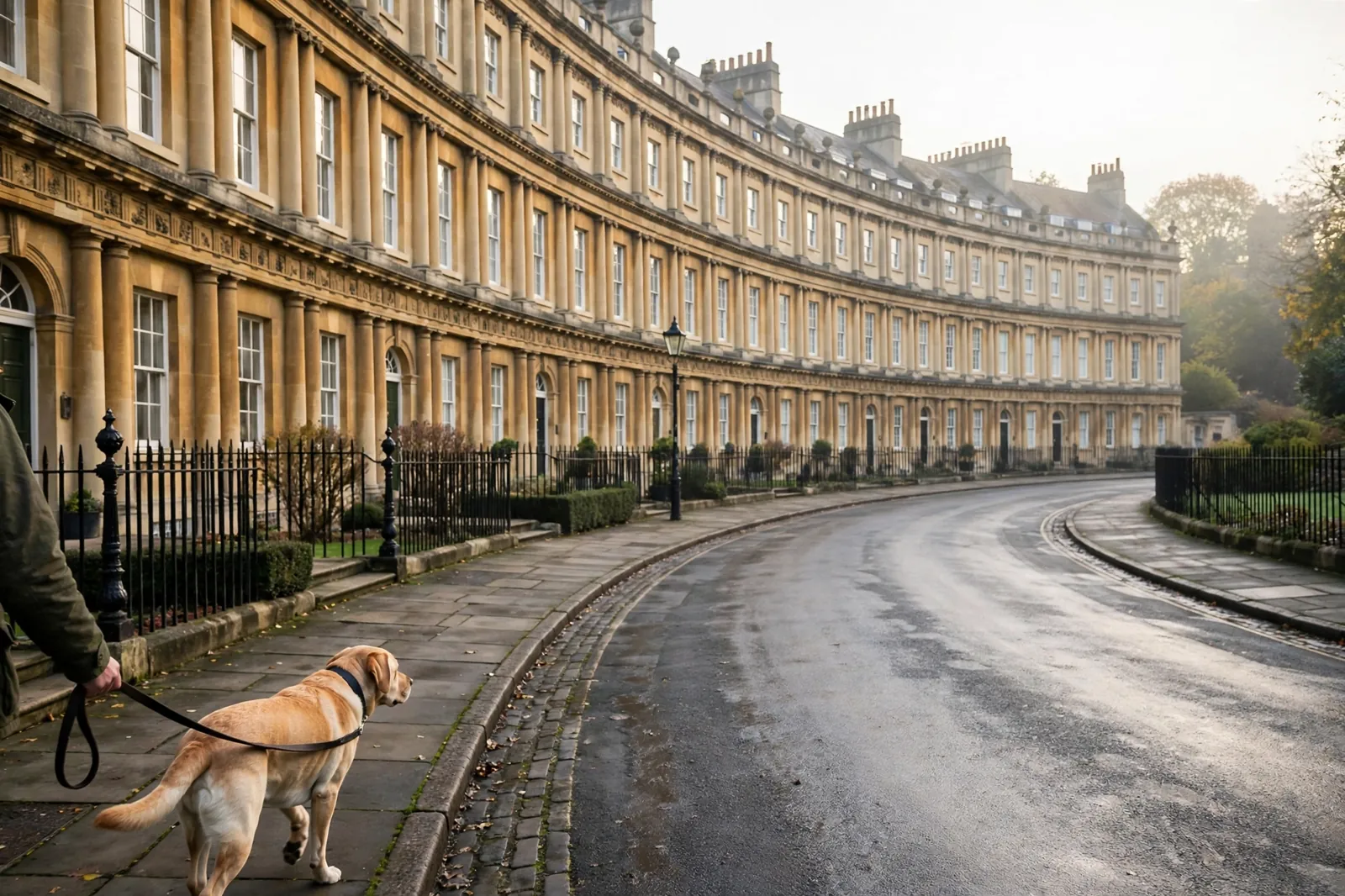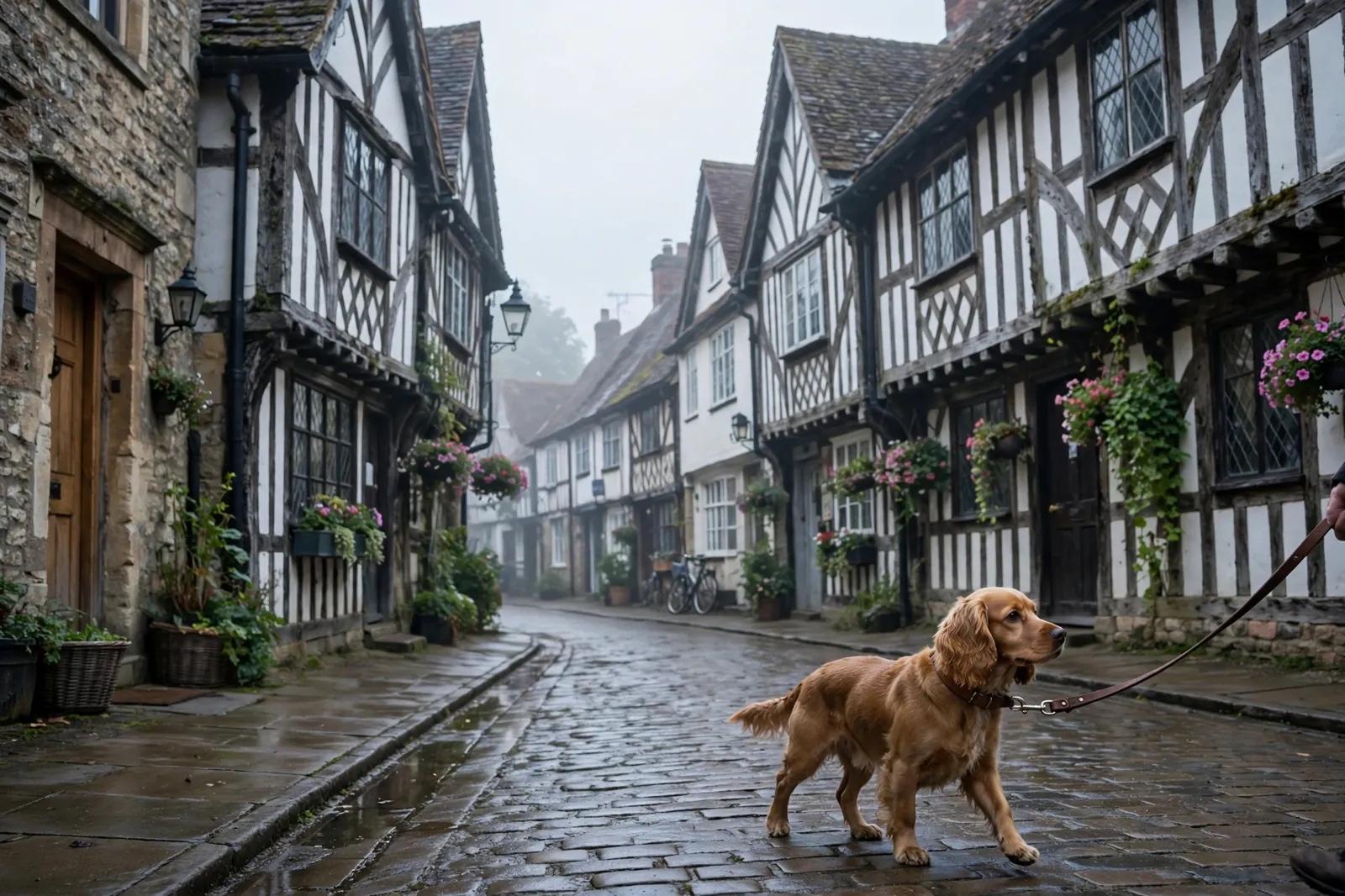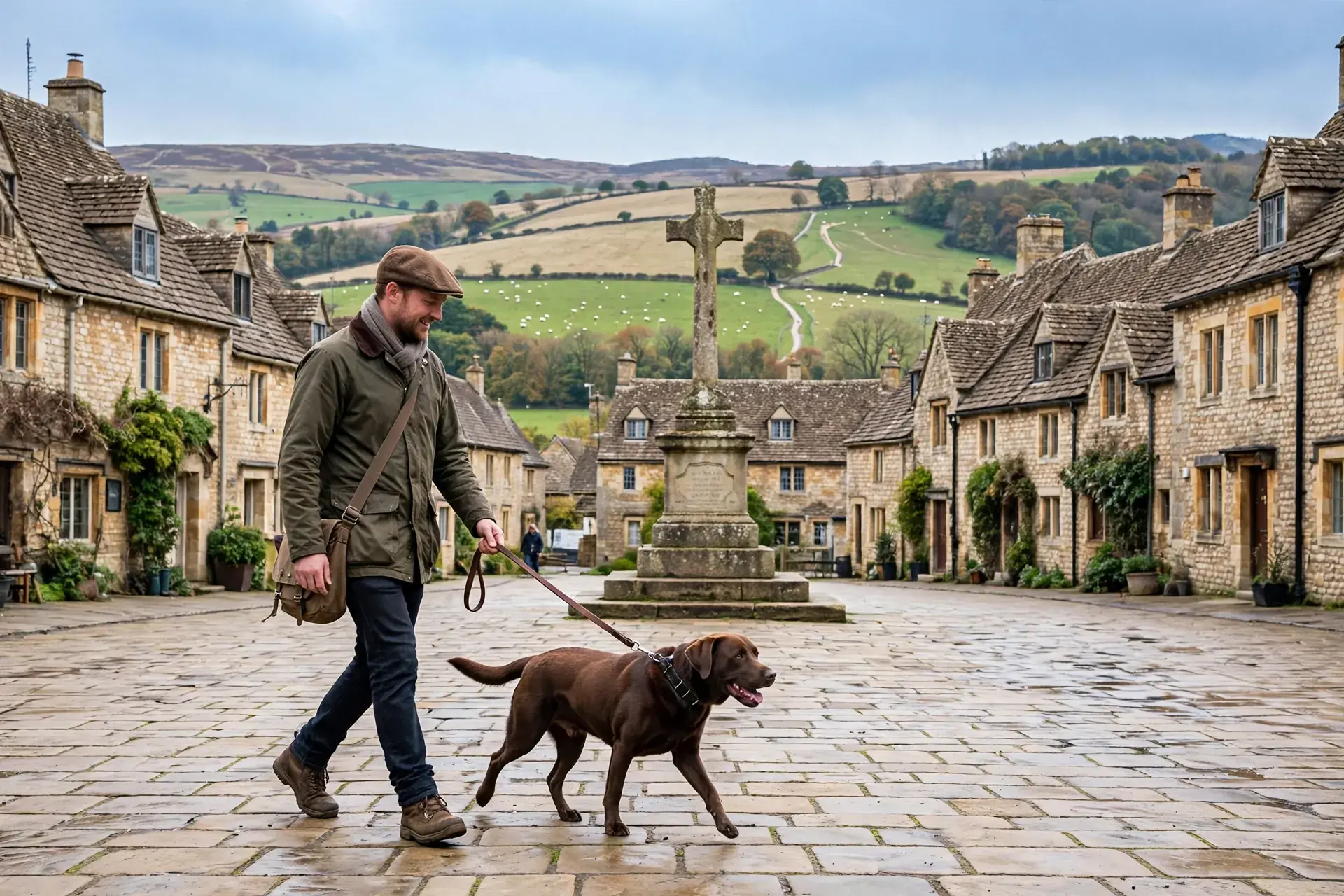
This guide is independent and contains no paid placement. Dog rules for individual shops, churches, pubs and places to stay can change, so check the official guidance before you travel and confirm the current rule for the exact place you plan to visit.
Stow-on-the-Wold suits dogs best as a high, walkable market town rather than a drive-through photo stop. Park once, explore the market square and St Edward's Church on foot, browse the antique shops at a dog-friendly pace, then take a lane or field-path loop towards Maugersbury or Donnington. On a wet or windy day, shorten the walk, keep the dog on a lead near livestock and roads, and let the town itself carry the day.
Arriving and parking with a dog
Stow-on-the-Wold earns its character from its height. The town stands on high ground in the Cotswolds in Gloucestershire, and that single fact shapes almost everything about a visit with a dog. The air feels more open than in the valley villages below, the light reaches further across the wolds, and the wind finds you sooner. It also means that the approach roads climb, the town centre sits exposed on a plateau, and a walk that looks short on a map can feel longer when it crosses open, rising ground. Plan for height from the start: arrive with time in hand, let the dog settle after the drive, and do not try to squeeze Stow into the last twenty minutes of a longer Cotswolds route.
The practical order of arrival matters more here than in a flat village. Before you head for the market square, give the dog water, a toilet break and a few minutes to sniff somewhere calm. A dog that has travelled well and emptied its bladder is far easier in a busy square than one that steps straight from a car into crowds, smells, traffic and other dogs. If you are travelling with two dogs, or with a dog that reacts to other dogs, this settling period is not optional polish; it is the difference between a relaxed wander and a tense one. Keep the first lead walk short and boring: a quiet stretch of pavement, a sniff around a grass verge, then into town at a steady pace.
For parking, use the signed public car parks rather than circling the market square hoping for a space beside the shops. Read the signs for time limits, charges and any restrictions before you walk away, because rules and charges can change and a ticket is a poor souvenir of a market town. Choose a space that lets you open the doors fully and load or unload the dog without stepping into traffic. On a busy day, a slightly longer walk in from a quieter spot is usually calmer for the dog than a tight manoeuvre in the centre, and it gives you a natural warm-up walk before the square. Never leave a dog alone in a car on a warm day, and on a cold day remember that a car cools quickly once the engine is off.
Think about the return journey before you set off around town. Note where you parked in relation to the square, and keep the car key, phone and water in the same place throughout the visit so you are not hunting through bags with a lead in one hand. If rain is forecast, leave a towel and a drying coat in the car rather than carrying everything all day; you can collect them after the walk. If you plan a longer wold loop, check the route, the light and the weather together: high ground in poor visibility is no place to improvise a new path, and a loop that is easy in sunshine can become a slog in wind and driving rain. A good Stow day starts with a calm arrival, not a rushed one.
The market square and St Edward's Church
The market square is the natural centre of a Stow visit, and it is worth slowing down for it. The square is broad, built of honey-coloured Cotswold stone, and framed by stone buildings that give the town its distinctive market-town feel. At its heart stands the market cross, a reminder that this was a working trading place long before it became a stopping point on a touring route. For a dog, the square is a sensory place: stone underfoot, people coming and going, cafe tables, shop doorways and the sound of traffic at the edges. Keep the dog on a short lead here, walk at the dog's pace rather than dragging it past every doorway, and step to a quieter edge if the centre feels crowded. Dogs that are unsure in busy places do better with a slow circuit of the square than with a long stand in the middle of it.
St Edward's Church, close to the square, is the town's best-known sight, and its churchyard is famous for the ancient yew trees that flank the north doorway. The trees have grown into tall, arching shapes that frame the entrance like a green doorway, and they are photographed constantly. For a dog walk, the churchyard offers a different pace from the square: quieter, greener and easier to take slowly. Keep the dog on a lead in the churchyard, respect graves and memorials, and do not let the dog dig, chew or toilet among the stones. If other visitors are photographing the yew doorway, wait for a gap rather than walking the dog straight through the frame; a few seconds of patience keeps the place pleasant for everyone.
Whether dogs can go inside the church is a question to settle before you assume anything. Churches balance worship, visitors, events and building work, and the rule for a particular day can differ from the general practice. Check the official guidance before you travel, look for notices at the door, and if a service is in progress, stay near the back or step outside rather than settling in for a long visit. Even when dogs are welcome indoors, a church is a quiet, echoing space: a short lead, a settled dog and a quick exit if the dog whines or paces are the courteous basics. If the interior is not open to dogs on the day, the exterior, the yew trees and the churchyard still give you the essential Stow experience without any disappointment.
Use the square and church as a pair, not as two separate ticks on a list. Walk the square first, then step into the churchyard for a calmer few minutes, then return to the square with a better sense of the town's layout. Notice how the streets run off the square, where the quieter lanes begin, and which direction feels most sheltered from the wind. That orientation pays off later: when you leave for a wold walk, you will already know which way is uphill, which way is into the wind, and where to come back for shelter, water and a rest. A market town rewards this kind of slow reading far more than a fast circuit.
Antique shops and market-town atmosphere
Stow's reputation as an antiques town is part of what sets it apart from the prettier, quieter Cotswolds villages. The streets around the square hold a concentration of antique shops, galleries and specialist dealers, and browsing them is the town's signature indoor pleasure. For dog owners, this raises a practical question that no guide can answer once for every shop: each business sets its own rule, and the rule can depend on the day, the stock on the floor and whether the shop is staffed by one person. Do not assume that a dog is welcome inside every antique shop just because the town feels dog-friendly. Check the official guidance before you travel where a shop publishes it, look for a sign at the door, and ask politely before entering with the dog. If the answer is no, one person can browse while the other waits outside with the dog, or you can enjoy the shopfronts and return later.
Antique shops also need a different kind of dog manners from a pub garden or a field path. Floors may be polished, displays may stand at tail height, and a single wagging tail can do real damage to a low table of ceramics. Keep the dog on a short lead, close to your leg, and do not let it sniff stock, lean on furniture or wander between displays. A dog that can settle beside you for a few minutes is a good shop dog; a dog that pulls towards every doorway, barks at reflections or lunges at other shoppers is not having a good time in a small, breakable room, and neither are you. There is no shame in keeping shop visits short, choosing one or two shops that genuinely interest you, and spending the rest of the time outdoors. A calm ten minutes in one shop beats a stressed hour in five.
Beyond the antiques trade, the wider market-town atmosphere is worth noticing. Stow has the services of a small town rather than a single-street village: places to eat and drink, shops for provisions, and streets that stay lively outside the peak tourist hours. That liveliness is useful on a dog trip, because it means shelter, water, toilets and a warm stop are rarely far away, but it also means traffic, delivery vehicles and pavements shared with other walkers. Walk on the inside of the pavement where you can, keep the lead short at corners and crossings, and teach or remind the dog to wait at kerbs. Older dogs and puppies tire faster on stone pavements than on grass, so build in sitting breaks on a bench or a low wall rather than marching from shop to shop without pause.
The best way to enjoy the town's atmosphere with a dog is to treat browsing as wandering, not as an errand. Choose a street, walk it slowly, look up at the stonework and the rooflines, and let the dog sniff the corners that interest it. Stop for a drink where dogs are welcome after checking the current rule, sit for a while, and watch the town go about its business. Market towns were built for this kind of unhurried use, and dogs are good at it when their owners are. If you find yourself rushing to cover every shop, you have slipped back into checklist tourism, and the dog will usually tell you first by pulling, panting or simply refusing to enjoy the next doorway. Slow down, and Stow slows down with you.
High wold walks: Maugersbury and Donnington
Once you leave the square, Stow quickly turns into open country, and that is where the town's height becomes an advantage. Footpaths and quiet lanes run out towards the neighbouring settlements of Maugersbury and Donnington, across the high, rolling ground that gives the wolds their name. These are not manicured park walks. They are working countryside paths: field edges, farm tracks, stiles and gates, stretches of open grass and, in places, long views back towards the town. The right mindset is that of a countryside walker, not a town stroller. Wear proper footwear, carry water for both of you, and accept that the walk may be muddier, windier and more exposed than the square suggested.
Route choice should follow the dog, not the map's longest loop. A lane-based out-and-back towards Maugersbury can be an excellent walk for an older dog, a puppy or a dog that is unsure around livestock, because lanes give you a firm surface, clear sightlines and an easy decision to turn back at any point. A field-path loop towards Donnington offers more open running and sniffing, but it also brings more variables: gates to manage, livestock to pass, uneven ground and fewer places to shelter if the weather turns. Whichever you choose, check the official guidance before you travel for any path closures, diversions or seasonal restrictions, and carry a map or a charged phone with an offline map, because waymarking in open country can be sparse and a missed turn on high ground adds distance quickly.
Livestock deserves specific attention on these walks. The wolds are farmed country, and sheep and cattle are a normal part of the landscape rather than an exception. Keep the dog on a lead around livestock, and on a short lead where the Countryside Code requires it, even if the dog is normally reliable off lead. A dog that chases or worries sheep can cause serious harm and can put the farmer, the dog and you in a difficult position. If you meet cattle, give them a wide berth, keep the dog close, and do not walk between cows and calves. If a path crosses a field with animals in it and you are unsure, choose another route rather than hoping the animals will move. Farmers and other walkers will thank you, and so will the dog, which does not need a frightening encounter to learn that fields are stressful places.
Practical details make the difference between a good wold walk and a tiring one. Pack poo bags and take them home with you, because there are no bins on open paths. Bring more water than you think you need on a warm day, and a collapsible bowl, since streams and troughs are not reliable drinking sources and may not be safe. Watch the dog's paws on stony tracks and in mud, and check for ticks after walking through long grass or bracken, especially in spring and summer. In strong wind, keep the dog on a lead near exposed edges and gates, and be ready to shorten the walk: a dog that is coping well on a sheltered lane may struggle on an open ridge in a gusting wind. The reward for this care is real. On a clear day, the high paths around Stow give you space, quiet and a sense of the Cotswolds as working high country, not just as a collection of pretty villages. That contrast is exactly why Stow is worth walking from, and it is the part of the town that many day visitors miss entirely. For a wider sense of how the Cotswolds fit together, our Cotswolds dog guide sets Stow in context among the region's villages, commons and pub walks, and helps you judge whether to base yourself here or pass through on a wider tour.
Eating and staying with a dog
Eating out with a dog in Stow works best when you treat every venue as a separate check, not as a blanket assumption. Pubs, cafes and restaurants around the square and the surrounding streets vary in what they allow: some welcome dogs in a bar area or garden, some allow dogs only outside, and some do not allow dogs indoors at all. The rule can also change between lunch and dinner, between weekdays and weekends, and between a quiet afternoon and a busy evening. Check the official guidance before you travel, or ask at the door before you sit down, and be ready with a plan B if the first choice does not work. A dog that has just walked will usually settle far better than one that has been waiting in a car, so time your meal after the walk rather than before it.
When you do eat with the dog, small courtesies carry the whole visit. Choose a table at the edge of the room or garden rather than in the middle of the traffic, keep the dog on a lead under the table, and bring a mat or blanket for the dog to lie on if the floor is hard or cold. Order water for the dog if it is offered, but do not let the dog beg from neighbouring tables or wander to greet other diners. If the dog barks, paces or cannot settle after a few minutes, it is kinder to finish quickly, take the dog outside for a break, or move to an outdoor table than to persist in the hope that it will calm down on its own. Staff and other customers remember a calm dog far longer than they remember a long menu, and a good experience in one place makes the next place easier.
Staying overnight in or near Stow needs the same careful checking, and earlier is better than later. Dog-friendly rooms and cottages in a small market town are limited, and the most suitable ones for a particular dog, for example a ground-floor room, a secure garden or a place close to a morning toilet walk, can book out well ahead. When you enquire, give the honest details: how many dogs, their size, whether they are left alone, and whether they bark when left. Ask for the dog rule in writing, including any charge, cleaning fee, restricted areas and what happens if the dog is left unattended. A place that answers clearly is almost always a better stay than one that answers vaguely, however attractive the photographs look.
Think about the overnight routine as part of the booking, not as an afterthought. Where will the dog toilet first thing in the morning and last thing at night? Is there a lit, safe route, or will you be crossing a busy road in the dark? Where will the dog sleep, and what will you do with muddy paws after a wold walk? Pack a familiar bed or blanket, the dog's usual food, any medication, a spare lead and towels, because a market town's shops may not stock your dog's exact food or a replacement lead at short notice. If you are combining Stow with a wider trip, a night here makes a calm base for the northern Cotswolds, and a day trip to a historic town such as Stratford-upon-Avon is a natural contrast: our Stratford-upon-Avon dog guide covers Shakespeare property rules, Avon towpath walks and theatre evenings, which pair well with Stow's quieter, higher ground.
Rain, wind and the seasons on high ground
Stow's height makes weather a bigger part of the plan than it is in a sheltered valley town. Wind reaches the square and the open paths sooner, rain arrives with less warning, and a forecast that promises a dry afternoon in the valleys can still mean a wet, blustery hour on the wold. Check the forecast for the town itself, not just for the county, and check it again on the morning of the visit. Pack a waterproof for yourself and a drying coat for the dog even when the morning looks fine, because high ground punishes optimism. If the forecast is genuinely poor, plan a town day with one short walk rather than a long loop, and treat any dry window as a bonus rather than a promise.
Each season changes the town in a useful way. Spring brings lambs in the fields, longer days and paths that can still be muddy after winter rain; keep dogs on leads near lambing ewes and be extra careful around young livestock. Summer brings the busiest square, the most visitors photographing the yew doorway, and the warmest stone underfoot, which can be hard on paws at midday; walk early or late, carry water, and seek shade. Autumn is often the best walking season on the wolds: cooler air, clearer light, quieter paths and firm ground after a dry spell, though fallen leaves can hide uneven ground and mud. Winter brings short days, cold wind on the open ground and the risk of icy lanes; walk in daylight, keep the route short, and make sure the dog is visible if you are out near dusk.
Wet weather also changes the town experience itself. Stone pavements become slippery, shop doorways fill with wet coats and umbrellas, and a wet dog in a small shop is a different proposition from a dry one. Pack two towels if you plan a long day, one for the walk and one for the town, and use a drying coat between the two. If the dog is wet and cold, cut the town browsing short and find a warm, sheltered stop where the dog can dry and settle. Dogs do not enjoy being dragged through rain for the sake of an itinerary, and a short, dry, happy visit will leave you wanting to return, while a long, sodden one may put you off the town entirely. Let the weather set the length of the day, not the other way round.
Finally, remember that high ground and livestock, traffic and other dogs all interact. A windy day makes dogs more alert and more reactive, because sounds and smells carry further and other dogs appear suddenly around corners. A rainy day makes pavements and field paths slippery for older dogs and for dogs recovering from injury. A hot day makes the square's stone radiate heat long after the sun has moved. None of this means avoiding Stow in anything but perfect weather; it means matching the walk to the day. A sheltered lane on a windy day, a short square wander on a wet day, and a full wold loop on a calm, dry day will each feel like the right Stow, because each one respects the town's height.
Before you go: a Stow checklist
A short checklist prevents most Stow problems before they start. Run through it the evening before, not in the car park. First, the dog: water, a bowl, poo bags, a lead and a spare, a drying coat or towels, food and any medication if you are staying over, and a familiar bed or blanket for an overnight stop. Second, the route: a map or offline map, a chosen loop with a shorter alternative, and a note of where you parked and how to get back to the square. Third, the rules: the current dog rules for any church, shop, pub, cafe or place to stay you actually plan to use, checked from official guidance rather than assumed from a previous visit or a general reputation.
Then add the town-specific checks. Footwear that can handle stone pavements, muddy field edges and a stile or two is more useful than smart shoes that look right in the square but fail on the first field path. A lead that you can shorten quickly for the square, livestock and road crossings is more useful than a long line that tangles in a shop doorway. A phone charged enough for maps and for finding a vet if needed is essential, and saving the number of a nearby veterinary practice before you travel is a five-minute job that matters only when it matters a lot. If your dog is nervous around other dogs, plan your square circuit for a quieter time of day, and have a calm exit route in mind if the centre feels too busy.
Also plan for the dog's comfort, not just its control. Older dogs may need a ramp or a lift into a higher car, a joint-friendly walk on lanes rather than steep field paths, and more frequent rests. Puppies need shorter walks, more toilet breaks and protection from over-tiredness, however keen they seem. Dogs with thick coats overheat faster on a warm, still day in the square, while short-coated dogs chill faster in wind on the open wold; adjust the walk length and the clothing accordingly. A dog that is comfortable, watered and rested is a dog that can enjoy a market town, and Stow, with its square, its churchyard and its open paths, gives a comfortable dog plenty to enjoy.
- Park once, walk everywhere: use a signed car park, settle the dog first, then explore the square on foot.
- Square, then churchyard: take the busy square slowly, then use the quieter churchyard and yew doorway as a calmer pause.
- Ask before entering: antique shops, churches, pubs and stays each set their own dog rule; check before you travel.
- Lead near livestock and roads: keep the dog close on field paths, lanes and at every kerb and gate.
- Carry water and bags: there are no reliable water points or bins on open wold paths, so bring both and take bags home.
- Have a short route ready: a lane out-and-back is a good fallback on wet, windy or tiring days.
- Pack for high ground: a waterproof, a drying coat and towels, even when the morning forecast looks kind.
Stow-on-the-Wold rewards visitors who arrive slowly and leave the car behind. The town's height, its stone square, its church and its antique streets are not a backdrop for a quick photograph; they are a working market town that happens to sit on some of the finest open walking ground in the Cotswolds. Give the dog time in the square, time in the churchyard, and time on a wold path, and the town will make sense as a whole. Rush it, and you will leave with photographs of a square and no sense of why the town was built up here in the first place. The difference is rarely more than an hour, and it is the hour that makes the trip.
Practical questions
Before you go
Is Stow-on-the-Wold a good base for a dog walk, or just a short stop?
It works well as both. The market square, church and antique shops make a satisfying short visit, and the footpaths and quiet lanes around Maugersbury and Donnington give you a proper walk without moving the car. If you want a full day, pair a morning walk with lunch in town and an afternoon loop, rather than trying to rush several Cotswolds towns in one day.
Can dogs go inside St Edward's Church in Stow-on-the-Wold?
Rules for churches can change with services, events and restoration work, so check the official guidance before you travel and look for notices at the door. Even when a church welcomes dogs, keep the dog on a short lead, stay near the back if a service is in progress, and be ready to step outside if the dog becomes restless. The famous yew trees and the churchyard can still be enjoyed from outside.
Where should we park in Stow-on-the-Wold with a dog?
Use the signed public car parks rather than circling the market square, and read the signs for time limits and charges before you leave the car. Park with space to open the doors safely, give the dog water and a short toilet walk before heading into the square, and avoid leaving the dog in a car on a warm day. If the centre is busy, a short walk in from a quieter spot is usually calmer than a tight manoeuvre beside the square.
Are the walks from Stow-on-the-Wold suitable for older or smaller dogs?
Shorter loops on lanes and field-edge paths can suit older and smaller dogs well, but the high wold ground is open and exposed, and some field paths are uneven or muddy after rain. Choose a route you can shorten, carry water, watch for livestock, and keep the dog on a lead where the Countryside Code requires it. A flat wander around the square and a lane out and back is a perfectly good walk on a day when a long loop would be too much.
What should we do in Stow-on-the-Wold with a dog on a rainy day?
Slow the day down. Browse the square at an unhurried pace, look for covered spots and indoor places that welcome dogs after you have checked their current rules, and save the open wold walk for a drier window. Pack a drying coat and towels, plan a shorter loop on surfaced lanes rather than a muddy field crossing, and finish with a warm stop where the dog can settle. A wet day in Stow works best as a town day with one short walk, not a forced long hike.