This guide is independent and contains no paid placement. If affiliate links are added later, they will be clearly marked and will not change our editorial checks.
Stranraer is a working ferry town, not a resort, and that is exactly why it works for dogs: a flat loch-side promenade for the first walk off the boat, a compact town centre you can cross on foot, and the Rhins of Galloway on your doorstep. Arrive, walk the shore, see the castle, then decide whether to stay or drive on.
The first hour after the ferry docks
The ferry from Northern Ireland does not dock in Stranraer itself any more. The crossings now sail from Cairnryan, about six miles north of the town up the eastern shore of Loch Ryan, and that single fact shapes the first hour of every dog trip here. If you are driving, you will be off the boat, through the port and on the A77 towards Stranraer within minutes of disembarking, and the temptation is to press straight on towards the Galloway Forest Park or the A75 east. Resist it for one hour. Your dog has just spent two hours or more in a car on a car deck, or in a kennel, and the best thing you can do for the rest of the day is give them a proper leg-stretch before the next stretch of driving.
Drive into Stranraer and head for the waterfront. The town sits at the southern end of Loch Ryan, where the loch narrows towards the harbour, and the promenade along the shore gives you a flat, open walk with the water on one side and the town on the other. Park near the Marine Lake or the harbour area, get the dog out, offer water, and walk for twenty to thirty minutes along the shore. The ground is mostly level, the views open out across the loch towards the hills of the Rhins, and there is enough space for a dog to sniff and decompress after the crossing without you having to navigate traffic. Keep the lead on for this first stretch: the promenade runs close to roads in places, and a dog fresh off a ferry is often more excitable and less attentive than usual.
Use the first hour to do the small jobs that make the rest of the trip easier. Let the dog toilet properly on the grassy areas by the shore rather than in a lay-by on the A77. Check the lead, the collar and the ID tag after the crossing, because tags and clips get knocked about in car boots and kennels. Offer a small snack rather than a full meal, especially if the crossing was rough, and watch for signs of travel sickness before you feed properly. If the dog was sick on the boat, keep the next hour quiet and the next meal light, and do not be surprised if they drink a lot of water and then need another toilet stop ten minutes later. A calm first hour in Stranraer saves you a restless dog and a soiled car seat somewhere between here and Castle Douglas.
Foot passengers have a slightly different first hour. The ferry terminals at Cairnryan are served by buses and taxis into Stranraer, and the town's railway station connects south to the town centre on foot. If you arrive without a car, the waterfront walk is still the right first move, because it is a short, flat stroll from the centre and it gives a dog that has been in a kennel a chance to move freely. Pack a collapsible water bowl and a small bag of treats in your hand luggage rather than in a case stowed below deck, so you can sort the dog out the moment you are off the boat. If you are waiting for a connecting train, the station is close enough to the shore that you can fit a short walk in between the bus arriving and the train leaving, provided you check the timetable first and leave a generous margin.
One more thing to settle in the first hour is the plan for the night. Stranraer has a small number of dog-friendly places to stay, and they fill up on nights when ferries are busy, so do not assume you can sort accommodation at 6pm on a Friday in August. If you have not booked, check availability before you drive on to somewhere more remote, because the next towns with a good choice of dog-friendly rooms are a fair drive away. If you have booked, confirm the check-in time by phone before you leave the waterfront, especially if your ferry was delayed, so that nobody is waiting for a key while the dog waits in the car.
Loch Ryan: the shoreline walk
Loch Ryan is a long, narrow sea loch that runs roughly north to south for about eight miles, and Stranraer sits at its southern end. The loch is sheltered compared with the open sea around the Mull of Galloway, which is why it became a ferry route in the first place, and the shoreline walk from the town gives you the loch at its calmest and most accessible. The promenade and the shore path together make the easiest walk in the area: flat, close to the car, and short enough to fit into an arrival day or a morning before a ferry.
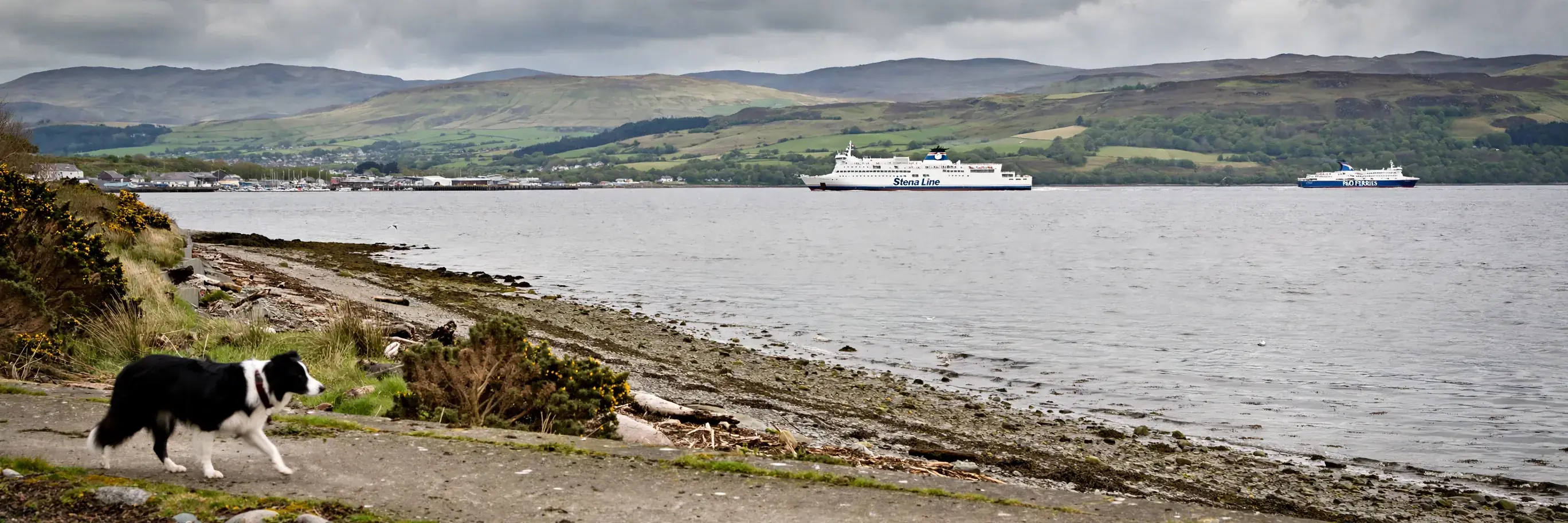
Start at the harbour end of the town and walk north along the shore. The path follows the water past the Marine Lake, a sheltered stretch of water that is popular with local walkers, and continues towards the wider loch. On a clear day you can see across to the far shore and watch the ferries moving between Cairnryan and Northern Ireland, which gives the walk a working-harbour character that is quite different from a resort beach. The ground underfoot is a mix of paved promenade, grass and shingle, so most dogs will be comfortable, but bring a towel in the car if your dog likes to paddle: the shore is stony in places and a dog that has been in the water will bring half the loch back with them.
The practical details matter more than the scenery. There is no seasonal dog ban on this shore of the kind that closes many English resort beaches in summer, which makes Stranraer a useful stop in July and August, but that does not mean the shore is a free-for-all. Keep your dog under control near the harbour, where lorries and ferry traffic use the roads, and near any areas where birds are nesting or feeding on the mudflats. The loch is an important place for wildfowl, especially in winter, and a dog chasing birds across the flats is a problem for the birds and a fast way to lose a dog in soft mud. If your dog is a keen swimmer, check the water before you let them in: the loch is tidal, the water is cold even in summer, and the shore shelves away in places. A long line is a sensible compromise for a first visit, giving the dog freedom to explore without the risk of them swimming out after a ferry.
Time the walk to the light if you can. The shore faces roughly north-west, and the evening light across the loch towards the Rhins can be very good, with the ferries lit up as they come in. Early morning is the quietest time, when the promenade belongs to local dog walkers and the only traffic is the first ferry of the day. Midday in summer is the busiest, and the paved sections can get warm underfoot, so walk on the grass where you can and carry water for the dog. In winter the wind off the loch is the thing to respect: it cuts across the promenade with nothing to stop it, and a short-coated dog will feel it. A dog coat and a shorter loop are the right answer on a wild day, with the sheltered streets of the town centre as the fallback.
Combine the shore walk with the practical jobs. There are places to buy dog food, water and supplies in the town centre, a short walk from the waterfront, which is worth knowing if you have just arrived from Northern Ireland and your supplies are running low. Use the walk to check the dog over after the crossing: paws, ears and coat for salt and grit, and any stiffness from standing in a car for two hours. A dog that is limping slightly after a ferry crossing usually just needs a gentle walk and a rest, but if the limp persists into the next day, the town has veterinary cover, and it is better to get it checked in Stranraer than to discover a problem on a remote forest trail.
Castle of St John and the old town
The Castle of St John stands in the middle of Stranraer, a tall stone tower house built in the early sixteenth century, and it is the one building in the town that every visitor should look at, even if they do not go inside. The castle was built as a fortified house, later used as a prison and a courthouse, and it now operates as a small museum telling the story of the town and the surrounding area. From the outside it is an imposing, plain stone tower with small windows and a steep roof, and it gives the town centre a focal point that is easy to find and easy to photograph with a dog sitting in the foreground.
Dogs are not normally admitted inside the castle, which is the usual rule for small historic house museums, so plan the visit as a pair. One person goes inside while the other walks the dog around the streets nearby, then swap. The interior is compact, so a visit does not take long, and the museum covers the castle's history as a home, a prison and a court, along with displays about the town's past. Opening days and hours vary by season, and the castle is sometimes closed on particular weekdays, so check the official guidance before you travel rather than assuming it will be open on the day you arrive. If it is closed, the outside of the building is still worth a look, and the streets around it give you a sense of the old town that the waterfront does not.
The old town around the castle repays a slow walk with the dog. Stranraer grew as a market town and a port, and the centre still has the shape of that history: a main street running through the town, side streets with older stone buildings, and the Town Hall and other civic buildings within a short walk of the castle. The pavements are generally wide enough for a dog on a lead, and the traffic is lighter than in a city, but keep the dog close on the main street, where buses and delivery vehicles pass regularly. The town centre is compact enough to cross on foot in ten minutes, which makes it a good place to do the arrival-day errands: a pharmacy, a supermarket, a bank and places to eat are all within a short walk of each other.
Stranraer Museum, a short walk from the castle, is another small stop worth knowing about, although the same rule applies: dogs are not normally admitted inside, so treat it as a one-person visit while the other walks the dog. The museum covers local history, including the town's role in the Second World War, when Loch Ryan was an important flying-boat base, and the area's archaeology. If you are interested in that history, the loch-side walk takes on a different character once you know that the calm water you are looking at was once busy with military flying boats. The town's wartime story is one of those details that makes Stranraer more interesting than its first impression as a ferry town suggests.
Photograph the castle in the morning, when the light is on the front of the tower, and keep the dog on a short lead for the photo: the castle stands on a street corner with traffic on two sides, and a dog that steps backwards for a better view can step into the road. If your dog is nervous in towns, do the castle visit early, before the shops open and the streets fill up, and then head back to the quiet of the shore. The castle is a twenty-minute stop, not a day out, and that is the right way to treat it: see it, enjoy it, and then get back to the walking, which is what the dog actually cares about.
Staying over: making Stranraer your base
Stranraer is at its best as an overnight stop or a two-night base, rather than as a full week's destination. That is not a criticism: the town's job is to be the practical place at the end of the ferry, with beds, food, fuel and a vet, and it does that job well. The accommodation on offer is a mix of hotels, guest houses, bed and breakfasts and self-catering cottages, and the dog-friendly share of it is smaller than the total, so the first rule is to book early and to confirm the dog arrangement in writing. A listing that says "dogs welcome" can still mean one dog only, a small dog only, a ground-floor room only, or a charge per dog per night, and the difference between those versions matters when you arrive with two large dogs after a ferry crossing.
Ask the specific questions before you pay. How many dogs are allowed, and is there a size or breed condition? Is there a pet fee, and is it per dog, per night or per stay? Are dogs allowed in the bedroom only, or also in the bar and the dining room? Is there a garden or a nearby patch of grass for a last-night toilet trip, and is it enclosed? Can the dog be left alone in the room, even briefly, while you eat, and what happens if the dog barks? The answers to those questions tell you whether the place genuinely welcomes dogs or merely tolerates them for a fee, and the distinction is worth more than a star rating. Our guide to dog friendly hotels in the UK covers the same questions in more detail, and the checklist works just as well for a one-night ferry stop as for a week in the country.
Self-catering is often the easier option in Stranraer, especially for a multi-dog household or a dog that settles badly in a hotel corridor. A cottage or flat with its own door, a small garden and a kitchen means you control the feeding times, the noise and the comings and goings, and nobody minds if the dog sleeps on the sofa. The trade-off is that you do your own cooking and cleaning, and you need to check the garden boundary before you let the dog out unsupervised: a low wall or a gap under a gate is enough for a determined terrier. Hotels have the opposite profile: someone else cooks, but you are sharing corridors, stairs and a breakfast room with strangers, and a dog that barks at every footstep in the corridor will not have a good night, and neither will the neighbours.
Location within the town matters more than the view. A place near the waterfront gives you the shore walk on your doorstep, which is the single most useful thing for a morning and evening toilet routine, while a place on the edge of town near the main roads gives you a faster getaway in the morning but a longer walk to the shore. If you are catching an early ferry, staying in Stranraer the night before is far more sensible than driving up from Dumfries at dawn, and it turns a stressful early start into a short drive to Cairnryan. Check the check-in and check-out times against your ferry times: a late ferry arrival can mean a late check-in, and an early ferry can mean a very early check-out, so tell the host your ferry times when you book rather than assuming a standard 3pm arrival.
One practical point that catches people out is the car. If you are staying in Stranraer without a car, because you came as a foot passenger, make sure your accommodation is within walking distance of the station or the bus stop, and that the host knows you are arriving on foot with a dog. Taxis in the town will usually take a dog, but it is worth asking when you book the taxi rather than assuming, and carrying a blanket for the seat is good manners. If you do have a car, check whether parking is included and where it is: on-street parking near the waterfront is convenient, but a hotel car park a few streets away means a longer walk with luggage and a dog on arrival.
Eating out with a dog in Stranraer
Stranraer has a reasonable choice of places to eat for a town of its size: cafes, pubs, takeaways and a few restaurants, concentrated in the town centre and along the main streets. The dog rules vary from place to place, and they vary within a single place too: a pub that welcomes dogs in the bar may not allow them in the restaurant, and a cafe that welcomes dogs on the pavement terrace in summer may not have room for them inside in winter. The safest approach is to ask before you sit down, and to have a takeaway fallback in mind so that a refusal does not become a hungry evening.
Pubs are usually the best bet for a dog owner in Stranraer. Many pubs in the town welcome dogs in the bar area, especially outside the main meal service, and a dog that settles under a table with a chew is a familiar sight. Go early if you can, before the evening crowd, and choose a table in a corner rather than in the middle of the room, where every passing person and every dropped chip becomes an event. Bring a mat or a blanket for the dog to lie on, which signals to staff that you have done this before, and order at the bar rather than expecting table service in the dog area. If the pub serves food in the bar, you can eat properly without leaving the dog; if it does not, eat first and then take the dog for a drink afterwards, or order a takeaway and eat it back at your accommodation.
Cafes are more variable. Some welcome dogs inside, some only outside, and some not at all, and the policy can depend on the day, the staff on duty and how busy the cafe is. A pavement table in good weather is the easiest arrangement, and Stranraer's town centre has enough pavement space for that to work in summer. In rain or cold, a cafe that allows dogs inside is worth its weight in gold, so it is worth asking at two or three places rather than giving up after the first refusal. Carry a towel to dry the dog before you go in, and keep the lead short and the dog under the table: a wet dog shaking itself over a neighbouring table's scones is the sort of incident that changes a cafe's policy for everyone.
Takeaways are the reliable fallback, and there is no shame in using them. Fish and chips, pizza and other takeaway food eaten back at a self-catering cottage or a hotel room with a dog on the bed is a perfectly good ferry-night supper, and it avoids the whole question of whether the dog is welcome in the dining room. If you are eating in your room, check the hotel's rules about food in rooms and about leaving a dog alone while you collect the order: a five-minute walk to the chip shop is fine for most dogs, but a dog that panics when left alone in a strange room needs to come with you, and that means a lead, a torch and a pocket for the change.
Breakfast deserves a thought too. If your hotel serves breakfast in a dining room that does not allow dogs, you have three options: eat early and quickly while the dog waits in the room, ask whether breakfast can be served in the bar or in your room, or skip the hotel breakfast and walk to a dog-friendly cafe. The third option is often the nicest, because it combines the dog's morning walk with your breakfast, and the town centre is small enough that a cafe breakfast does not add a long detour to the day. Whatever you choose, do not leave a dog alone in a hotel room for a long breakfast if the dog is not used to it: the barking that follows will be heard by everyone on the corridor, and the staff will remember it.
Longer walks: Agnew Park, the coast and Portpatrick
Once the arrival walk is done, Stranraer offers three longer options that suit different dogs and different weather. The first is Agnew Park, the town's main park, a short walk from the centre. It is a green, open space with paths, trees and lawns, and it works as a morning exercise loop or as a place to let a dog stretch its legs before a drive. Keep the dog on a lead unless there is a clearly designated off-lead area, because the park is shared with families, sports and other walkers, and a dog charging across a football game is not the introduction to Stranraer you want. The park is at its best in the morning, when it is quiet, and it is a useful wet-weather fallback because the paths are surfaced and the trees give some shelter.
The second option is to extend the shore walk north along Loch Ryan. The coastal path runs up the eastern side of the loch towards Cairnryan, and the full length is a long walk rather than a stroll, so treat it as a there-and-back of whatever length suits your dog rather than a route to complete. The path gives you the loch at its widest, with views across to the Rhins and the ferries coming and going, and the ground is a mix of path, grass and shore. Check the tide before you set out, because parts of the shore are cut off or soft at high water, and carry water: there are no shops along the path, and the only facilities are back in Stranraer. This is a walk for a fit dog in good weather; on a wet and windy day, the exposed shore is hard work for both of you, and the sheltered park is the better choice.
The third option, and the best day trip from Stranraer, is Portpatrick, about eight miles south-west along the A77. Portpatrick is a small harbour village with a very different character from Stranraer: a crescent of whitewashed houses around a tiny harbour, cliffs, a coastal path and a much more holiday feel. The drive takes about twenty minutes, and there is parking near the harbour, from where you can walk the dog along the cliff-top path in either direction. The Southern Upland Way starts, or ends, at Portpatrick, depending on which way you walk it, and the first stretch of the path gives you a proper coastal walk with the sea below and the hills behind. Keep the dog on a lead on the cliff sections, because the drops are real and the path is narrow in places, and do not let a dog scramble down to the rocks at the harbour unless you are sure of the tide.
Portpatrick also has places to eat and drink that welcome dogs, and the harbour is a good place to sit with a coffee while the dog rests after the cliff walk. The village is small enough to explore on foot in an hour, and the combination of a cliff walk, a harbour and a pub lunch makes it a complete half-day out. If you want a longer day, continue south from Portpatrick towards the Mull of Galloway, the southernmost point of Scotland, where there is a lighthouse, a visitor centre and a wild, open landscape that feels a long way from the ferry port. Check the official guidance before you travel for the Mull, because the lighthouse and the visitor facilities have seasonal hours, and the road to the Mull is narrow in places.
Whichever walk you choose, the ground rules for Galloway apply. Much of the land around Stranraer is farmland, so keep dogs on leads near livestock, especially sheep and lambs in spring, and close gates behind you. The weather changes fast on this coast: a sunny morning can turn into a wet and windy afternoon, so carry a waterproof for yourself and a coat for a short-coated dog, and have a dry towel in the car. Midges are a factor in the Galloway hills in summer, particularly in the early evening near water and woodland, so a midge repellent for you and a quick check of the dog's ears afterwards are worth the effort. And always tell someone where you are walking if you are heading out alone on a remote coastal path, because phone signal is patchy in the hollows of the Rhins.
Ferries from Cairnryan: what dog owners need to know
The ferry port at Cairnryan handles the crossings to Northern Ireland: Belfast and Larne, operated by different companies with different pet rules, different terminals and different check-in procedures. The port is about six miles north of Stranraer on the A77, and the drive takes roughly ten to fifteen minutes, but you should allow more than that on a busy sailing day, because the approach road carries lorries, coaches and cars all heading for the same check-in lanes. Arrive with time to spare rather than racing the closing time: a dog that has been rushed from the car to the check-in desk is a dog that will be unsettled for the whole crossing.
The key decision is where your dog spends the crossing. Dogs travelling in a car usually stay in the vehicle on the car deck for the whole sailing, which lasts around two hours depending on the route and the weather. That is the simplest arrangement and the one most dog owners choose, but it has conditions worth knowing: you cannot visit the car deck during the crossing, so the dog is on its own for two hours, and the car deck can be warm in summer and noisy throughout. Before you board, make sure the dog has had a toilet break, water is available in the car, the windows are left slightly open if the operator allows it, and the handbrake is on and the car is locked. Leave something familiar in the car, such as the dog's blanket, and do not leave food that the dog could choke on while unsupervised.
Foot passengers have different options. Some sailings offer kennels on board, which must be booked in advance and are limited in number, and some offer pet-friendly cabins where the dog stays with you in the cabin for the crossing. Kennels are the cheaper option and they suit a dog that is comfortable in a confined space, but you need to check whether you can visit the kennel during the crossing, because the rules vary by operator and by ship. Pet cabins are more comfortable and more expensive, and they sell out early in school holidays, so book them as soon as you know your dates. If you are travelling as a foot passenger with a dog and you have not booked a kennel or a cabin, check the official guidance before you travel, because the dog may not be allowed in the passenger lounges and you could be refused boarding. Our guide to dogs on UK ferries compares the operators, the costs and the kennel and cabin rules route by route, and it is worth reading before you book rather than after.
Booking is where most mistakes happen. The pet arrangement is not always included in the standard online booking flow, and it is easy to book a car and a passenger ticket and forget to add the dog, only to discover at check-in that the kennel is full or the pet cabin is taken. Book the dog at the same time as the ticket, by phone if the website does not offer the option clearly, and get a written confirmation that includes the dog. Check the fee too: some operators charge per dog per crossing, some include the dog in the car fare, and the difference can be significant on a return trip. If your plans change, check the amendment rules for the pet booking as well as for the passenger ticket, because the two can have different conditions.
On the day, the routine is straightforward. Arrive at the port with the dog already exercised and toileted, and use the time in the check-in queue to let the dog settle rather than winding them up with excitement. Follow the marshalling staff's instructions at the car deck, and once you have parked, sort the dog out before you leave the car: water, ventilation, a familiar blanket, and a calm goodbye. Then go up to the passenger decks and stay there until the ship docks; do not try to return to the car deck during the crossing, because access is restricted for safety reasons. On arrival, collect the car promptly and drive to Stranraer for the first-hour routine described at the start of this guide, rather than heading straight for a long onward drive. The crossing is the stressful part of the day for the dog; the shore walk afterwards is the recovery.
Practical kit: parking, vets, weather and transport
Parking in Stranraer is straightforward by the standards of a port town. There are car parks in the town centre and around the harbour and the Marine Lake, and on-street parking on the main streets, so you can usually park close to the waterfront and walk the dog straight onto the shore path. Charges and time limits vary by car park, so check the signs when you arrive rather than assuming a whole-day stay is free. On a busy ferry day, the car parks near the centre fill up earlier than usual, and it is worth having a second choice in mind. Never leave a dog in a parked car on a warm day, even for a few minutes and even with the windows open: a car heats up far faster than most people expect, and the waterfront car parks have little shade. In cold weather, the same rule applies in reverse: do not leave a dog alone in a cold car while you visit the castle or a museum, because a small car loses heat quickly and a dog that cannot move around will get cold.
Veterinary cover is one of the practical advantages of staying in Stranraer rather than in a smaller village. The town has its own veterinary practice, and there are further practices in the surrounding area, including towards Newton Stewart and Girvan. Before you travel, save the number of the nearest practice and its out-of-hours arrangements in your phone, and carry your dog's vaccination record and any regular medication in the car rather than in a bag buried in the boot. If your dog is injured or unwell, call ahead so the practice can prepare, and describe the problem clearly: a limp after a ferry crossing is different from a cut paw on the shore, and the advice will be different. If you are travelling from Northern Ireland, remember that the veterinary rules and the paperwork for travelling with a dog between Northern Ireland and Great Britain can change, so check the official guidance before you travel and carry the documents you need.
The weather in south-west Scotland is the single biggest variable in a Stranraer trip, and it deserves more respect than the forecast suggests. The town sits on an exposed coast, and the wind off Loch Ryan can be strong even on a day that looks calm inland. Rain is frequent and can arrive quickly, so pack a waterproof jacket, waterproof trousers if you plan a long coastal walk, and a drying coat and towels for the dog. In summer, the same coast can be warm and still, and the paved promenade can get hot underfoot, so walk on the grass and carry water. In winter, the short days matter: it gets dark early, and the shore path and the coastal walks are not lit, so plan to be back at the car before dusk, and carry a torch and a reflective lead if you are walking in low light. Check the forecast the night before and again in the morning, and have a wet-weather plan that does not depend on the sun coming out.
Public transport is workable but limited, and it is worth planning around. Stranraer railway station is in the town, with services south and east, and the bus station connects the town with the surrounding villages and with Dumfries. Dogs are generally allowed on trains and buses in Britain, usually on a lead and at the discretion of the driver or the guard, but the rules vary by operator, so check before you travel, especially if your dog is large. If you are travelling without a car, the town centre, the waterfront and the station are all within walking distance of each other, which makes Stranraer one of the easier Galloway towns to visit car-free. For Portpatrick and the Mull of Galloway, a car is much more convenient, because the bus services to the smaller villages are infrequent, and a taxi for the day can be expensive. If you do use a taxi, book it in advance, tell the company you have a dog, and bring a blanket for the seat.
Finally, pack for a port town rather than a resort. The kit list for Stranraer is a long lead and a short lead, a harness that fits properly, a collapsible water bowl, a bottle of water, poo bags, a towel, a drying coat in winter, a torch, and a spare lead in case the first one breaks. Add a copy of the dog's vaccination record, the vet's number, the ferry booking confirmation with the pet arrangement on it, and the accommodation confirmation with the dog's name on it. That list fits in a small bag and it covers almost everything that can go wrong between the ferry and the cottage. The one thing it does not cover is a dog that is too tired or too stressed to enjoy the trip, and the answer to that is the first-hour routine: walk, water, rest, and then decide what comes next.
Onward routes: Galloway, Ayrshire and the Rhins
Stranraer's real value is as a gateway, and the onward routes from the town are the reason most dog owners pass through it. To the east, the A75 runs across Dumfries and Galloway towards Dumfries and the border, passing Castle Douglas, the gateway to the Galloway Forest Park, and the Solway coast. That is the route to take if you want forests, dark skies, lochs and the long, quiet beaches of the Solway, and our guide to Dumfries and Galloway with a dog covers the region in detail, including the forest trails, the dark-sky park and the coastal villages that suit a dog. Allow a full day for the drive east if you plan to stop: the A75 is a single carriageway for much of its length, and the journey from Stranraer to Dumfries takes about an hour and a half without stops, longer with a dog that needs a break.
To the north, the A77 runs up the Ayrshire coast towards Girvan and Ayr, and that is the route to take if you are heading for the Ayrshire coast, Culzean Castle and the country parks, or the ferry connections further north. The coastal road is scenic, with views across the Firth of Clyde to Arran on a clear day, but it is also narrow and winding in places, and it carries lorries heading for the ferry, so drive carefully and plan a stop for the dog rather than pushing through in one go. Girvan has a beach and a harbour that suit a short stop, and Ayr has a larger choice of dog-friendly places to eat and stay, although the town itself is busier than Stranraer and the dog needs a steadier temperament for the pavements.
To the south, the Rhins of Galloway is the peninsula that runs down from Stranraer to the Mull of Galloway, and it is the most rewarding part of the area for a dog owner who likes coastal walking. The peninsula is narrow, so you are never far from the sea, and the villages of Portpatrick, Port Logan and the Mull itself each have a different character. Port Logan has a beach and a garden with a fish pond that is worth a look, although dogs are not admitted to all parts of the garden, so check before you go. The Mull of Galloway is the wild end of the peninsula, with cliffs, a lighthouse and a feeling of remoteness that is rare this far south in Scotland. The roads on the Rhins are narrow and single-track in places, so drive slowly, use the passing places, and keep the dog on a lead near the unfenced cliff edges.
Whichever direction you take, the same planning rules apply. Fuel up in Stranraer before you head into the more remote parts of Galloway, because filling stations are sparse on the Rhins and in the Forest Park, and a low tank with a dog in the car is a needless worry. Buy dog food and supplies in the town too, because the village shops on the peninsula stock a limited range and may not have your dog's usual food. Check the accommodation for the next night before you leave Stranraer, especially if you are heading into the Forest Park, where the choice of dog-friendly places is small and the distances between them are long. And give the dog a proper walk before a long drive: a tired dog sleeps in the car, and a fresh dog fidgets, whines and needs a stop twenty minutes down the road.
Stranraer is not a town that tries to impress you, and that is part of its charm for a dog owner. It is a working port with a castle, a loch, a promenade and a straightforward welcome, and it does the practical things well: a flat walk off the ferry, a place to eat with the dog, a bed for the night and a road onwards to some of the best coastal walking in Scotland. Use it properly and it turns a ferry crossing into a holiday; rush through it and you miss the one hour that makes the rest of the trip work. Walk the shore, see the castle, feed the dog, and then choose your direction. The Galloway hills will still be there in the morning.
Practical questions
Before you go
Can dogs travel on the ferry from Cairnryan to Northern Ireland?
Yes, dogs can travel on the Cairnryan to Belfast and Cairnryan to Larne crossings, but the arrangements differ by operator and by how you travel. Dogs travelling in a car usually stay in the vehicle on the car deck, while foot passengers may be able to book a kennel or, on some sailings, a pet-friendly cabin. Check the operator's current pet policy before you book, because kennel numbers are limited and pet cabins sell out early in peak season.
Is Stranraer beach dog-friendly all year?
The shore along Loch Ryan and the Marine Lake area is generally open to dogs throughout the year, and there is no seasonal dog ban of the kind that applies to many resort beaches further south. Keep your dog on a lead near the harbour, the ferry roads and any areas with livestock, and pick up after them. Local rules can change, so check the official guidance before you travel if you plan to let your dog off the lead.
Can dogs go inside the Castle of St John?
Dogs are not normally admitted inside the Castle of St John, which is a small historic tower house now run as a museum. The castle sits in the middle of the town, so one person can visit inside while the other walks the dog around the surrounding streets and the nearby waterfront. Assistance dogs are the exception and should be admitted.
Where can I park in Stranraer with a dog in the car?
There is parking around the harbour and the town centre, including car parks close to the waterfront and the Marine Lake, which makes it easy to park and walk the dog straight onto the shore path. On a hot day never leave a dog in a parked car, even with the windows open, and on a cold day do not leave a dog unattended in the car while you visit the castle or the museum. If you are catching a ferry, follow the port's check-in signs at Cairnryan rather than parking in Stranraer itself.
Where is the nearest vet to Stranraer?
Stranraer has its own veterinary practice in the town, and there are further practices in the surrounding area, including towards Newton Stewart and Girvan. Save the number of the nearest practice and its out-of-hours cover before you travel, and carry your dog's vaccination record and any regular medication. If your dog needs urgent care, call ahead so the practice can prepare, and check the official guidance before you travel for the latest opening hours.
Is Stranraer a good base for exploring Galloway with a dog?
Yes, Stranraer works well as a base for the Rhins of Galloway and the western edge of Dumfries and Galloway. Portpatrick, the Mull of Galloway, the Galloway Forest Park and the Solway coast are all within a comfortable drive, and the town has the shops, fuel and veterinary cover that smaller villages lack. Book accommodation that genuinely accepts dogs and confirm the pet fee in writing, because the number of dog-friendly rooms in the town is limited in peak season.