This guide is independent and contains no paid placement. Beach rules, business policies and park arrangements change, so check the latest official guidance before you travel and follow signs on the day.
Swansea works best with a dog when you treat the bay as several beaches rather than one. Use the promenade as your all-season backbone, check the sign at the exact access point before stepping onto sand in summer, give Clyne Gardens and Singleton Park proper time rather than treating them as toilet stops, eat outdoors around the marina and Mumbles, and save your biggest beach ambitions for Gower day trips planned around the tide.
Swansea Bay rules by section: one bay, several different beaches
The most common mistake in Swansea is talking about “the beach” as if a single rule covered the whole curve from the city centre to Mumbles. Swansea Bay is long — roughly five miles of promenade-backed sand — and the dog rules are applied by section. The busiest central stretches, closest to the city and the main leisure facilities, are the ones most likely to carry seasonal restrictions during the warmer part of the year. Quieter stretches further along the bay towards Blackpill, West Cross and Mumbles have historically been treated differently, but “historically” is doing a lot of work in that sentence: boundaries, dates and enforcement change, and the only version that matters is the one on the sign at the access point you are actually using.
Build your day around that reality. If you are visiting between spring and early autumn, assume the central sand may be restricted during the day and plan two versions of every beach outing: a promenade-and-parks version that works whatever the signs say, and a sand version you use only once you have read the local notice and confirmed dogs are allowed on that section at that time. Outside the main season the bay is generally far more straightforward, but even then, signed exceptions around events, bathing areas and wildlife protection can apply. Our wider explainer on UK beach dog rules, bans and fines sets out how seasonal restrictions and public spaces protection orders work across Britain, and it is worth reading before any summer trip, because Swansea follows the same national pattern even though its local dates and boundaries are its own.
Three habits prevent almost every problem. First, read the sign at eye level before you unclip anything — look for dates, hours, a map of the restricted length and any lead requirement, not just a headline symbol. Second, keep the lead on until you are clearly on an unrestricted section and well away from the access steps; most confrontations happen in the grey area within a few metres of the promenade. Third, treat other people’s space as part of the rulebook even where no rule is written: a dog that charges through a family’s picnic on an unrestricted beach in October will still colour how the next dog owner is received. Swansea Bay is shared with swimmers, paddleboarders, anglers, runners and a great many children, and the sections exist precisely because that sharing needs managing in summer.
Also plan for the practical differences between sections. The city end gives you the shortest distance to cafés, toilets and car parks, and the hardest summer restrictions. The middle of the bay, around Brynmill and Blackpill, feels more local and spacious, with the lido, parkland and wide grass softening the transition between promenade and sand. The Mumbles end is a destination in its own right, with its own small beaches, rocky coves and pier-side crowds. A dog that copes well in the middle of the bay on a breezy Tuesday may be overwhelmed at Mumbles on a sunny Saturday, so “which section” is a welfare question as well as a legal one. Choose the stretch that suits your dog’s confidence, not just the stretch nearest your accommodation.
Reading tides and the promenade: the walk that holds the whole trip together
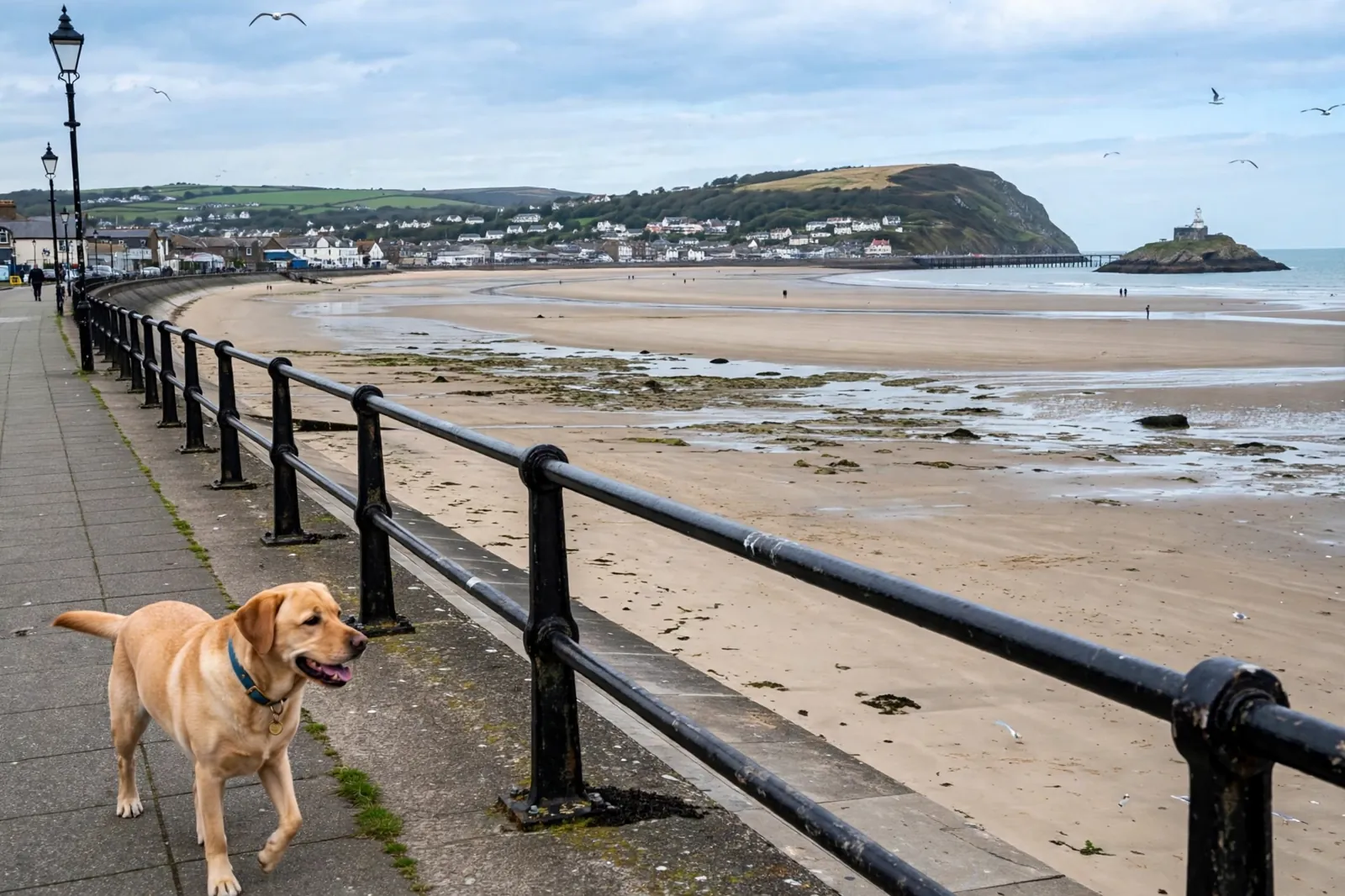
If the sand is Swansea’s headline, the promenade is its guarantee. The flat, surfaced path that follows the bay from the marina quarter round to Mumbles is usable in almost any weather, at almost any hour, and it is what makes Swansea such a reliable base with a dog. You can walk a short out-and-back before breakfast, a longer leg-stretch after lunch, or the full sweep in stages across a weekend, all without needing the car. Keep dogs on a lead on the promenade itself: it is shared with cyclists on the adjoining cycle track, runners, mobility scooters and other dogs, and a long line trailing across the path is a trip hazard however friendly the dog at the end of it is.
Tides transform the bay more dramatically here than on many British beaches. At low water the sea retreats a very long way, leaving an enormous flat expanse that tempts people — and dogs — to wander far out. Resist the temptation to treat that distance casually. Soft mud, channels that fill quickly and the sheer distance back to the promenade make the outer bay a poor place for casual off-lead wandering. Stay on firm sand reasonably close to the promenade, keep an eye on the time, and remember that a dog chasing a gull covers ground much faster than a person can follow. At the other extreme, a high tide combined with onshore wind can push water and spray towards the promenade wall in places, narrowing any remaining sand to nothing. The comfortable middle — a falling tide with plenty of firm sand still close to shore — is the window to aim for, and checking a tide table the night before takes less than a minute.
Pace the promenade walk by landmarks rather than distance. From the city and marina end, the bay curves gently past the university area and Brynmill towards Blackpill, where Clyne Gardens sits just inland and the character turns greener and quieter. Beyond Blackpill the path continues towards West Cross and into Mumbles, with the headland and lighthouse drawing gradually closer. Breaking the route at Blackpill or West Cross for water, shade and a sit-down makes the full walk achievable for older dogs, while younger dogs that need a bigger outlet can add a park loop or a permitted sand section rather than simply walking faster along the same path. Carry water even on cool days — the bay is exposed, drinking fountains are not spaced for a dog’s needs, and a dog that has been trotting on tarmac and sand will drink more than you expect. In summer, check pavement temperature with the back of your hand before a midday promenade walk; if it is too hot for your hand, it is too hot for paws, so shift the long walk to early morning or evening and use shaded park paths in between.
Mumbles and the pier area: go early, keep it unhurried
Mumbles rewards an early start. The village at the western end of the bay mixes a working seafront, independent shops, ice-cream queues, a pier, a lifeboat station and two distinctive headlands, and on a fine weekend it fills quickly. With a dog, the winning pattern is simple: arrive before the crowds, walk first while the promenade and shore are quiet, then settle for coffee or lunch in a spot where your dog can lie down out of the main flow of feet. Trying to do Mumbles the other way round — shopping first with a fresh, restless dog, then looking for a walk when the pavements are busiest — makes everything harder than it needs to be.
Around the pier, keep expectations precise. The area around the pier entrance, amusements and lifeboat station is a place for a dog on a short lead moving purposefully through, not a place for lingering off lead or assuming access. Whether dogs may go onto the pier itself, into amusement areas or onto any boat trip depends on the operator and can change, so ask on the day rather than relying on another visitor’s report. The same caution applies to the small beaches and coves near Mumbles, including the rocky shores around the headland: surfaces are uneven, rock pools and algae make footing slippery, and some coves effectively disappear at high tide. Admire them on a lead, from stable ground, and retreat well before the water returns — a dog scrambling over wet rock is an injury waiting to happen, and carrying an injured medium-sized dog back over that terrain is nobody’s idea of a holiday.
For a calmer Mumbles experience, use the village as a bookend rather than the main event. Walk in along the bay path from West Cross, have your coffee, browse with the dog waiting calmly outside shops in turn rather than being taken into every doorway, and walk back before the afternoon peak. Dogs that struggle with crowds, dropped food and close encounters with other dogs will cope far better with that shape of visit. Puppies in particular need protecting from Mumbles at its busiest: the combination of children with ice creams at dog height, skateboards, and a dozen unfamiliar dogs in a narrow space is advanced socialisation, not a gentle introduction. If your dog is young or nervous, enjoy Mumbles on a weekday morning and spend the weekend in the parks and on Gower instead.
Clyne Gardens: Swansea’s shaded, sniff-rich reset button
Every seaside city needs an inland counterweight, and in Swansea that place is Clyne Gardens, on the Blackpill side of the bay. A former estate garden now managed as a public park, Clyne layers mature trees, winding paths, streams and ponds, colourful planting and quiet lawns into a walk that feels a world away from the open bay, despite being only minutes from the promenade. For dogs, its value is variety at low intensity: new smells under trees, gentle gradients, plenty of shade on warm days and enough corners that a dog can be given space from other visitors without leaving the park altogether.
Use Clyne deliberately. It is the ideal second walk of the day after a breezy bay outing, the best option when the promenade is baking or windswept, and a kind first walk for a dog recovering confidence. Keep leads on around the ponds, planting and any signed areas, and be especially careful near water features and wildlife — a dog in a pond may be funny in a photograph and deeply unwelcome in reality, disturbing birds and damaging planting in one splash. The paths can be muddy after rain and leaf-fall makes some slopes slippery in autumn, so choose footwear for a woodland garden rather than a beach promenade, and expect to wash paws afterwards. Spring, when the garden’s collections are at their most colourful, and early autumn are arguably its finest seasons, but Clyne earns its place in every month: in winter it offers shelter when the bay wind is at its most punishing.
Combine Clyne with the Blackpill stretch of the bay for a satisfying half day that needs no driving. Arrive at Blackpill, walk the gardens first while your dog is fresh enough to behave well on narrower paths, then finish with an open promenade stretch where everyone can relax. Bring a towel and a small bottle of water for muddy paws before getting back into a car, and note that facilities around a historic garden are more limited than in the city centre — use cafés and toilets on the seafront side rather than assuming they exist deep inside the grounds. Check the latest official guidance before you travel for any restoration work, path closures or events that change access, because gardens of this kind periodically close sections for tree work and replanting.
Singleton Park: the big, easy green lung near the university
If Clyne is intimate, Singleton Park is expansive. Spread across a large site near the university and hospital side of the city, Singleton mixes broad grass, mature trees, a botanical element, a lake and long paths into the kind of park where a dog can have a proper walk without anyone needing to think about tides at all. That independence from the sea is its superpower in a Swansea itinerary: whatever the beach signs say, whatever the tide is doing, Singleton gives you a substantial, interesting walk in the city itself.
Plan Singleton as a destination walk, not a quick loop between other plans. The scale means you can tailor the outing to your dog: a short, flat circuit near the entrances for an older dog, or a longer exploration linking the park’s different areas for a dog that needs to cover ground. Keep dogs under close control near the lake and its birds, around any children’s play and sports areas, and during events — Singleton hosts gatherings and activities that can temporarily change which areas are open and how busy the paths feel. A lead is the right default near water, wildlife and other people, with any off-lead freedom reserved for open grass well away from those features and only where your dog’s recall is genuinely reliable around swans, squirrels and picnics. That last clause matters: park wildlife does not exist as a recall test for visiting dogs.
Singleton also solves a logistical problem for anyone staying centrally without a car. Combined with the bay promenade, it means a Swansea weekend can deliver real variety — sea air and sand one day, parkland and shade the next — entirely on foot. In wet weather its surfaced paths hold up better than many alternatives, although grass areas waterlog quickly in a Welsh winter, so keep to the paths and accept muddy edges as part of the bargain. As with Clyne, check ahead for events: a festival or race day transforms parking, crowd levels and your dog’s experience, and a dog that dislikes loudspeakers and dense crowds should be walked early or elsewhere on event days. On an ordinary morning, though, Singleton at a gentle pace, with time to sit on a bench while your dog watches the world, is exactly the kind of unremarkable, repeatable pleasure that makes a dog holiday actually restful.
Marina and waterfront eating with a dog: terraces first, assumptions last
Swansea’s regenerated marina and waterfront quarter, around the Maritime Quarter, Sail Bridge and the river Tawe, gives the city a second waterside personality quite distinct from the bay: moored boats, converted dock buildings, museums, apartments and places to eat and drink within a compact, walkable area. With a dog it works well as an evening or lunchtime base — flat, interesting to wander, and close to the start of the bay promenade if you want to walk off a meal in either direction.
The eating rule for the whole waterfront, and for Mumbles too, can be stated in one line: plan for outdoor seating, treat indoor access as a bonus you confirm at the door. Many cafés, pubs and restaurants around the marina and along the seafront welcome dogs on terraces and in garden areas, and a growing number allow them in bar areas, but policies differ between neighbouring businesses and between a quiet Tuesday and a fully booked Saturday service. Water bowls by a door are a good sign, not a guarantee. The most reliable routine is to choose two or three candidate places in advance, arrive slightly before peak time, and ask a simple question — “Are dogs welcome, and if so, where should we sit?” — before anyone is seated and ordering. Staff answer that question happily all day; what they cannot do is rearrange a dining room around a large, wet dog discovered halfway through service.
Think about your dog’s restaurant manners as honestly as you think about the menu. A dog that settles under a table for an hour makes almost every terrace in Swansea viable. A dog that barks at every passing pushchair, lunges for dropped chips or cannot tolerate another dog two tables away needs a different plan: a takeaway eaten on a bench along the promenade, a pub garden at a quiet hour, or self-catering with one person collecting food while the other walks the dog. None of those is a lesser holiday. Marina pavements and pontoons also deserve respect: keep the lead short near water edges, boats and cyclists, never let a dog jump onto a vessel or pontoon uninvited, and keep clear of anglers’ lines along the river. End the evening with a short, familiar toilet walk on a route your dog already knows rather than a long exploratory wander — full, tired dogs settle best when the last walk of the day is boring.
Swansea as the Gower gateway: city comforts, wilder beaches
For many visitors the real reason to stay in Swansea with a dog is what lies just beyond it. The Gower Peninsula, designated for its outstanding landscape and famous for beaches such as Rhossili and Three Cliffs Bay, begins a short drive west of the city, and Swansea makes an unusually sensible base for exploring it: you keep city advantages — a choice of places to stay and eat, veterinary cover, shops for forgotten kit, and the bay and parks for easy days — while the peninsula’s bigger, wilder outings remain within comfortable day-trip range. Our dedicated guide to the Gower Peninsula with a dog covers its beaches, restriction calendar and coast walks in detail, and should be read alongside this one before you plan those days.
Use the gateway well by alternating effort. A demanding Gower day — a long coast-path section, a big beach at low tide, a drive home with a sandy, exhausted dog — pairs naturally with a gentle Swansea day of promenade, Singleton Park and an early night. Trying to stack Rhossili-scale outings on consecutive days leaves most dogs (and owners) footsore and fractious by day three. Set off early for Gower in busy periods, because car parks at the best-known beaches fill and narrow lanes punish late starts; carry cash or a payment app backup where signal is patchy, pack water, a towel, poo bags and a basic first-aid kit in the car, and download maps and tide times before leaving the city’s reliable signal behind. Check each Gower beach’s own seasonal dog rules individually — they are not uniform, and a beach famous in a photograph may be restricted on the exact dates of your stay.
Finally, respect the difference in character. Swansea Bay is a managed, urban shore where help, facilities and an exit are always close. Gower adds cliffs, livestock on common land, adders in warm months, strong tides and stretches of coast path where a turned ankle or a dog that has run itself into exhaustion becomes a serious problem. Keep dogs on leads around livestock and cliff edges, carry more water than you think you need, and be willing to shorten a Gower plan without treating it as failure. The gateway idea only works if city and peninsula are used for what each does best — Swansea for ease and recovery, Gower for the big days — rather than trying to force one to substitute for the other.
Practicalities: getting around, parking, vets and wet-weather fallbacks
Swansea is an easy city to operate in with a dog, provided you think in zones. The centre and marina suit visitors arriving by train who want to walk everywhere; the bayfront suits anyone prioritising the promenade; and Mumbles suits those who prefer a village feel and accept a busier, more parking-sensitive base. Drivers should expect the usual seafront pattern — plentiful parking on a grey weekday, competition for spaces near Blackpill, the marina and Mumbles on fine weekends — so arrive early, have a second car park in mind, and never leave a dog in a car on a warm day while you “just check” a café queue. Public transport policies for dogs vary by operator and can change, so check the latest official guidance before you travel if buses or trains form part of your plan, and always travel with a plan for a dog that is muddy, wet or unsettled around other passengers.
Before you need one, identify a veterinary practice near where you are staying and save the number, including the out-of-hours arrangement. Seaside holidays generate a recognisable set of dog emergencies — cut pads on rock and shell, salt-water stomach upsets, a dog that has eaten something from a barbecue or a fishing line — and the time to discover where to go is not at 9pm with a limping dog. Pack accordingly: spare lead, towel and drying coat, paw balm or boots if your dog is prone to sore pads, any regular medication with a margin for delays, and familiar food, because an abrupt diet change plus sea water plus excitement is a reliable recipe for a ruined night. Swansea’s shops make restocking easy, which is another quiet advantage of a city base over a remote cottage.
Wet weather deserves a plan rather than an apology. Swansea in the rain still offers the promenade in proper waterproofs (dogs rarely object as much as owners do), short Clyne and Singleton loops on surfaced paths, a marina wander between showers and cafés with covered outdoor seating — but it does not offer a full day of indoor dog attractions, and honesty about that helps you pack and schedule realistically. Bring a board game, a book and a dog that has been well walked in the morning, and the rainy day becomes a rest day. In that spirit, build every Swansea itinerary with one movable indoor-ish pause and one walk that can shrink without spoiling the day. Trips built that way survive British weather; trips built as a rigid list of beaches do not.
Practical questions
Before you go
When are dogs restricted on Swansea Bay beach?
Swansea Bay operates seasonal restrictions on its most central, busiest sections during the warmer months, while other stretches of the long bay remain more flexible. Signs at each beach access point show the exact dates, times and boundaries for that section, and they can change between years. Read the sign where you enter the sand rather than relying on memory, and check the latest official guidance before you travel.
Can dogs go on the promenade and in Clyne Gardens and Singleton Park?
Dogs on leads are the sensible default on the Swansea Bay promenade, which is shared with walkers, runners and cyclists. Clyne Gardens and Singleton Park are both useful dog walks, but keep dogs on a lead near planting, play areas, lakes and other visitors, follow any signed lead zones, and clear up promptly. Individual areas inside the parks may have their own rules, so follow signs on the day.
Are dogs welcome around Mumbles pier and the marina?
The streets, promenade and many outdoor terraces around Mumbles and the Swansea marina are practical with a dog on a lead, but access to the pier itself, indoor venues, boats and individual businesses varies. Assume outdoor seating is the realistic option, ask at the door before entering anywhere indoors, and never assume a dog can board a boat or enter a marina building without checking first.
Is Swansea a good base for visiting Gower with a dog?
Yes. Swansea gives you city facilities, a long bay walk on your doorstep and straightforward road access to Gower beaches and coast paths. That combination suits dogs that need a mix of easy promenade days and bigger beach days. Plan Gower trips around tides, parking and seasonal beach restrictions, set off early in busy periods, and keep a Swansea-based fallback walk for wet or windy weather.
What should I check about tides before a Swansea Bay walk?
Check the tide times and height before you set off, especially at low and high extremes. At low tide the bay exposes a vast flat area that can look inviting but is a long way from the promenade, while a rising tide narrows the usable sand quickly near some access points. Keep to firm sand near the promenade, avoid soft mud, tell someone your plan for longer walks, and turn back well before the water returns.