This guide is independent and contains no paid placement. If affiliate links are added later, they will be clearly marked and will not change our editorial checks.
Gower Peninsula with a dog works brilliantly if you plan around two clocks: the seasonal restriction calendar and the tide. From roughly 1 May to 30 September, dogs are restricted on the busiest bathing beaches around Mumbles, Langland, Caswell and part of Port Eynon, while large beaches such as Rhossili, Oxwich and Three Cliffs Bay generally remain welcoming — always verify the exact signs and latest council information before you travel. Keep leads on for cliffs, livestock and lanes, check tide times for every beach and headland, and base yourself in Mumbles for facilities or further west for walking.
Start with the calendar: when Gower beaches restrict dogs
Most dog-friendly beach guides start with a photograph. This one starts with a calendar, because on the Gower Peninsula the date decides the holiday more than the weather does. Gower was designated Britain's first Area of Outstanding Natural Beauty — now a National Landscape — and its southern beaches sit close together along a compact coastline west of Swansea. That compactness is a gift: if one beach is restricted, another, very different beach is often a short drive away. It is also a trap for the unprepared, because the restricted beaches are precisely the famous, serviced bathing bays that appear first in holiday brochures.
The pattern to understand is seasonal restriction, not a year-round ban. In the Swansea and Gower area, restrictions usually run from 1 May to 30 September and apply during that period to the busiest bathing beaches and to defined sections of larger bays. The list commonly includes sections of Swansea Bay, Bracelet Bay, Limeslade Bay, Rotherslade Bay, Langland Bay, Caswell Bay and the main bathing section of Port Eynon Bay. The exact boundaries matter: a restriction may cover the central, lifeguarded or most serviced part of a bay while a different section, a promenade or a neighbouring cove follows different rules. Signs at slipways, steps and car parks show the mapped boundary, and those signs — not a screenshot saved last year — are the authority on the day.
Treat every date and boundary in this guide as a planning aid, not a guarantee. Councils review public spaces protection orders, bathing-water designations and local signage, and a beach that was unrestricted on a previous visit may have new signs, a new lifeguard zone or a wildlife closure for nesting birds or resting seals. Before you travel, check the latest Swansea Council information on dog restrictions, read the sign at the access point when you arrive, and if the picture is unclear, choose another beach rather than arguing the interpretation on the sand. Our wider explainer, the dog-friendly beaches UK rules guide, sets out how seasonal bans and fines work across Britain and why assistance dogs are treated differently.
Once the calendar is clear, a simple strategy emerges. Visit in October to April and Gower opens up almost completely: the Mumbles bays, Langland and Caswell become available again in the off-season subject to local signs, car parks quieten, and the coast path belongs largely to walkers. Visit in high summer and plan the opposite way round — build the trip around the large, generally dog-welcoming beaches and the coast path, and treat the pretty bathing bays as places to pass through on a lead, swim without the dog in tow if your party splits, or enjoy from the promenade. Neither season is better in the abstract. Winter Gower is wilder, muddier and more tidal in feel; summer Gower is warmer, busier and more dependent on early starts. The calendar simply tells you which version you are booking.
There is one more calendar layered over the first: wildlife. Grey seals pup in quieter coves in autumn, birds nest on cliffs and in dune grass in spring and early summer, and livestock graze the coastal commons for much of the year. A beach may be legally open to dogs and still be the wrong place to let a dog run on a particular morning. Reading the calendar, the tide table and the landscape together is the whole skill of a good Gower dog trip — and, usefully, it is a skill that transfers to every other Welsh peninsula you visit afterwards.
Rhossili and Three Cliffs: the headline beaches, honestly
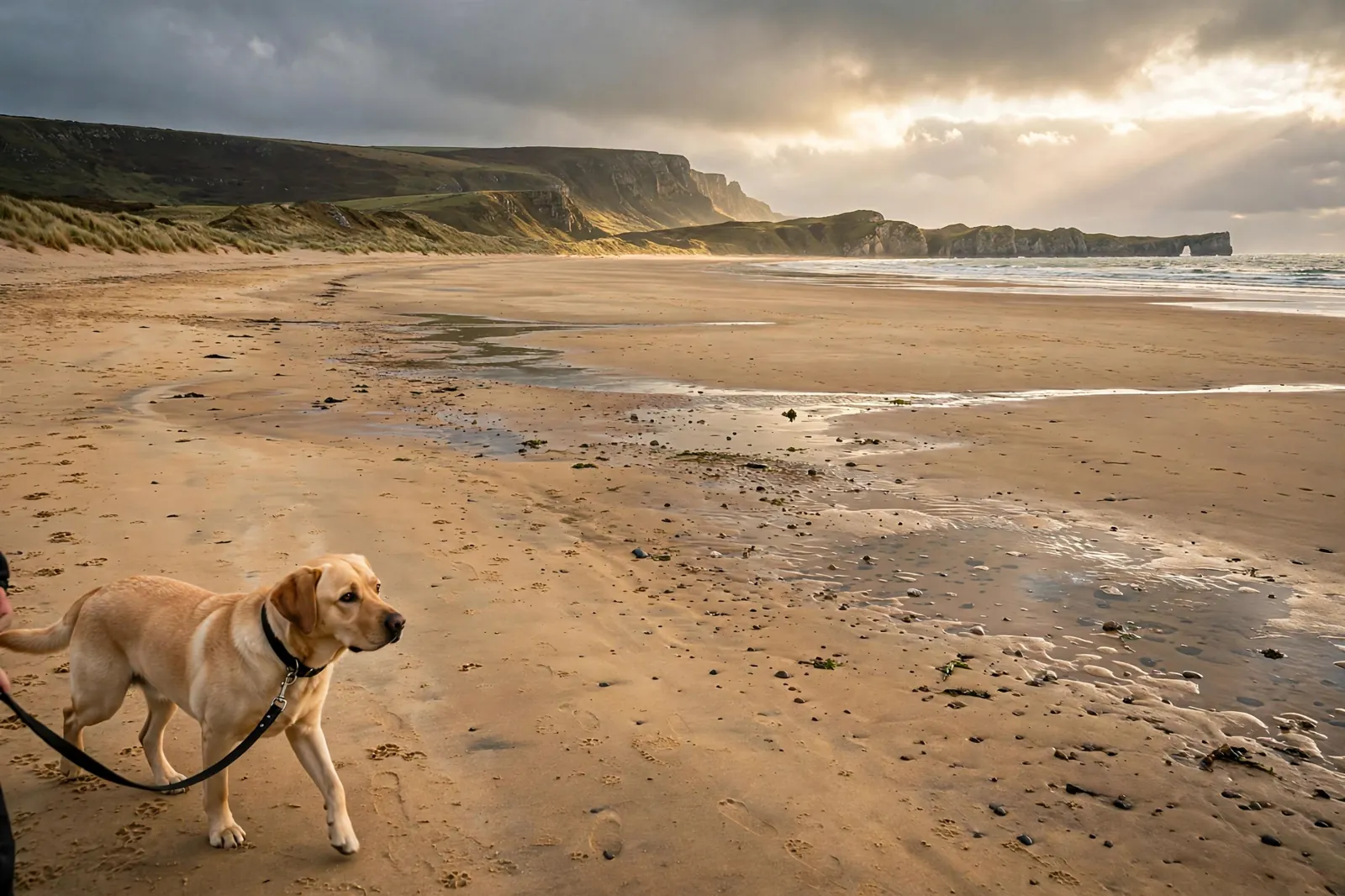
Rhossili Bay, at the far western tip of Gower, is the beach that justifies the drive on its own: around three miles of golden sand beneath Rhossili Down, facing west into the Atlantic and ending at the tidal island of Worm's Head. For dogs it is close to ideal in scale. There is room to walk for an hour without retracing your steps, room to give other beach users generous space, and a headland walk above it that delivers the famous view even on a day when the tide has covered much of the sand. Access involves a steep path and steps from the village, so factor the climb back up into an older dog's energy budget, and note that the beach offers little natural shade and no fresh water — carry both shade thinking and drinking water with you.
Worm's Head deserves respect rather than a tick-box. The rocky causeway is passable only for a limited window around low tide, commonly described as roughly two hours either side of low water, and the surface is sharp, uneven and slippery in places. Being cut off means waiting for hours or needing rescue, and neither is a fair plan for a dog. Many parties will have a better day staying on the mainland: the coast path west from Rhossili village, past the old Coastguard lookout, gives superb views of the Head, the bay and, on clear days, across to Pembrokeshire, without any tide deadline ticking. If the crossing is attempted at all, it should be on verified tide times, in suitable footwear, with margins built in at both ends — and a willingness to abandon it at the first doubt.
Three Cliffs Bay, on the south coast near Parkmill and Pennard, is Gower's other postcard: three peaked limestone cliffs, a river — Pennard Pill — winding across the sand, salt marsh behind and the ruins of Pennard Castle on the hill above. For dogs, the important details are the approaches. The walk in from Parkmill follows the valley and river, is beautiful and can be muddy; access from the clifftop involves steep paths. The river shifts its channel, can be deeper and faster than it looks, and at high tide the beach layout changes significantly, with sections cut off. Go at low to mid tide, keep dogs out of fast or deep water, watch for livestock grazing the marsh and valley, and give the bay more time than the map suggests — the walk in is part of the experience, not an inconvenience before it.
Both headline beaches share a practical truth: facilities concentrate at the car parks and villages, not on the sand. Toilets, cafés, water and bins are a climb or a walk away, so arrive with a poo-bag plan that involves carrying out, a bowl and water for the dog, and a towel for the inevitable sandy, salty return to the car. Photographs of Rhossili and Three Cliffs tend to omit the wind. On an exposed Atlantic coast, wind changes how a beach feels for a small, old or thin-coated dog long before it troubles a human in a jacket, so pack a dog coat outside high summer and choose the lee of the cliffs for picnic stops.
Quieter and year-round options: building a plan B
A good Gower itinerary never depends on a single beach. Oxwich Bay, on the south coast, is a long, sweeping bay with dunes, a nature reserve of woodland and marsh behind it, parking close to the sand and a gentler, more sheltered feel than Rhossili on some winds. It is popular with families in summer for good reason, so arrive early, walk towards the quieter ends of the bay, and keep dogs under close control around the reserve edges where birds and other wildlife need space. The contrast between open sand, dune paths and woodland shade in one outing makes Oxwich especially useful for hot days, provided you still avoid the midday peak with a dog.
Port Eynon and neighbouring Horton, near the southern tip, offer a village base, a wide bay and coast path in both directions. In summer the main bathing section of Port Eynon is among the restricted areas, so read the boundary signs with particular care here and be ready to use permitted sections or walk the coast path instead. Outside the restriction season, or on its permitted ground, the bay gives easy, level beach walking and a sociable village atmosphere that suits dogs who enjoy a busier scene. Mewslade Bay and Fall Bay, west of Rhossili village along the coast path, are smaller, wilder coves reached on foot, with limited or no facilities and access that depends on tide and path conditions — rewarding for fit walkers, poor choices as a casual plan B with a tired dog.
On the northern, estuary side of Gower the landscape changes completely. The Burry Estuary, Whiteford Sands and the salt marshes around Penclawdd and Crofty offer huge skies, wild ponies grazing the marsh, cockle beds at low tide and long, quiet walking that feels a world away from the south-coast bays. This coast demands its own caution: tides move fast over flat estuary ground, channels fill behind walkers, mud and sand can be treacherous, and grazing animals — including semi-feral ponies — must be given wide, calm space with dogs on leads. Treat the north coast as a specialist outing with tide times checked twice, not as a spontaneous substitute when a south-coast car park is full.
Building a plan B, then, is simple Gower craft. Pair every headline beach with an alternative in a different category: a coast path section if the beach is restricted, a woodland or valley walk if the wind is brutal on the sand, an early start if the car park is the constraint. The peninsula is small enough that switching plans costs half an hour, and interesting enough that the substitute regularly becomes the day's highlight. Dogs do not read reviews; a quiet estuary path with superb smells will outrank a famous bay in any honest canine assessment.
Coast path walks in sections: pick distance by headland
The Wales Coast Path runs the length of Gower, and for dog walkers it is best used as a string of headland-to-headland sections rather than a single challenge. The Mumbles to Langland and Caswell stretch gives a serviced, surfaced introduction: promenade and cliff path, cafés at intervals, beaches below and Swansea Bay views behind — ideal for a first afternoon, a senior dog or a pushchair-in-the-party day, with leads on throughout because the path is busy and the cliffs are real despite the suburban feel. West of Caswell, the path quietens through Brandy Cove and Pwlldu Bay, where a wooded valley meets a remote-feeling beach, and the walking becomes more committing: fewer exits, fewer facilities, more reward per mile.
From Pwlldu the path continues to Three Cliffs, Pennard and then a long, magnificent run of cliff walking through Oxwich to Port Eynon. This middle section is Gower coast path at its best for fit dogs: limestone cliffs, small coves below, grazing land beside the path and villages spaced for a two-day linear plan with baggage moved by car or taxi. Take water seriously — there are long dry stretches — and treat every unfenced cliff edge as a lead moment, however reliable a dog's recall usually is. A rabbit, a gull or a gust carrying an interesting smell can move a dog faster than any owner; the lead on cliff sections is not a judgement on the dog, it is respect for physics.
Port Eynon to Rhossili is the wildest southern stretch, passing Mewslade and Fall Bay with repeated climbs and descents that add up to a demanding day. Many parties will prefer to split it, or to walk out-and-back sections from Rhossili itself, finishing with the Worm's Head viewpoint walk described earlier. North-coast sections, by contrast, are flat, open and estuarine: distance there is limited less by hills than by tide windows and the simple remoteness of the ground. Whichever sections you choose, plan transport honestly. Linear coast path days fail at the logistics, not the walking — check bus timetables in advance, noting that services are seasonal and infrequent in places, or pre-book a dog-accepting taxi and confirm the dog is expected.
If Gower is one chapter of a longer Welsh coastal trip, the walking connects naturally in spirit — if not in a single line — with the routes in our Pembrokeshire Coast Path with a dog guide to the west and the island walking in our Anglesey with a dog guide to the north. The same three disciplines serve on all three coasts: check the seasonal beach rules, work with the tide rather than against it, and keep the lead ready for livestock and cliff edges. Master them on Gower's compact peninsula and the rest of the Welsh coast becomes noticeably easier to plan.
Tides, cliffs and livestock: the safety layer
Gower has a large tidal range, among the biggest in the world in the wider Severn and Swansea Bay system, and that single fact shapes dog safety more than any other. Beaches that are vast at low water shrink to a strip — or disappear against cliffs — at high tide; causeways, coves and estuary paths become cut off; and currents around headlands and in estuary channels are powerful and cold. The routine is non-negotiable: check tide times and heights from a reliable official or coastguard-recognised source for the specific day and place, plan beach walks on a falling or low tide where possible, note the time by which you must leave a cove, and set that time where you can see it — a phone alarm beats good intentions. If a sign or a lifeguard gives local timing advice, it overrides any general guidance, including this guide.
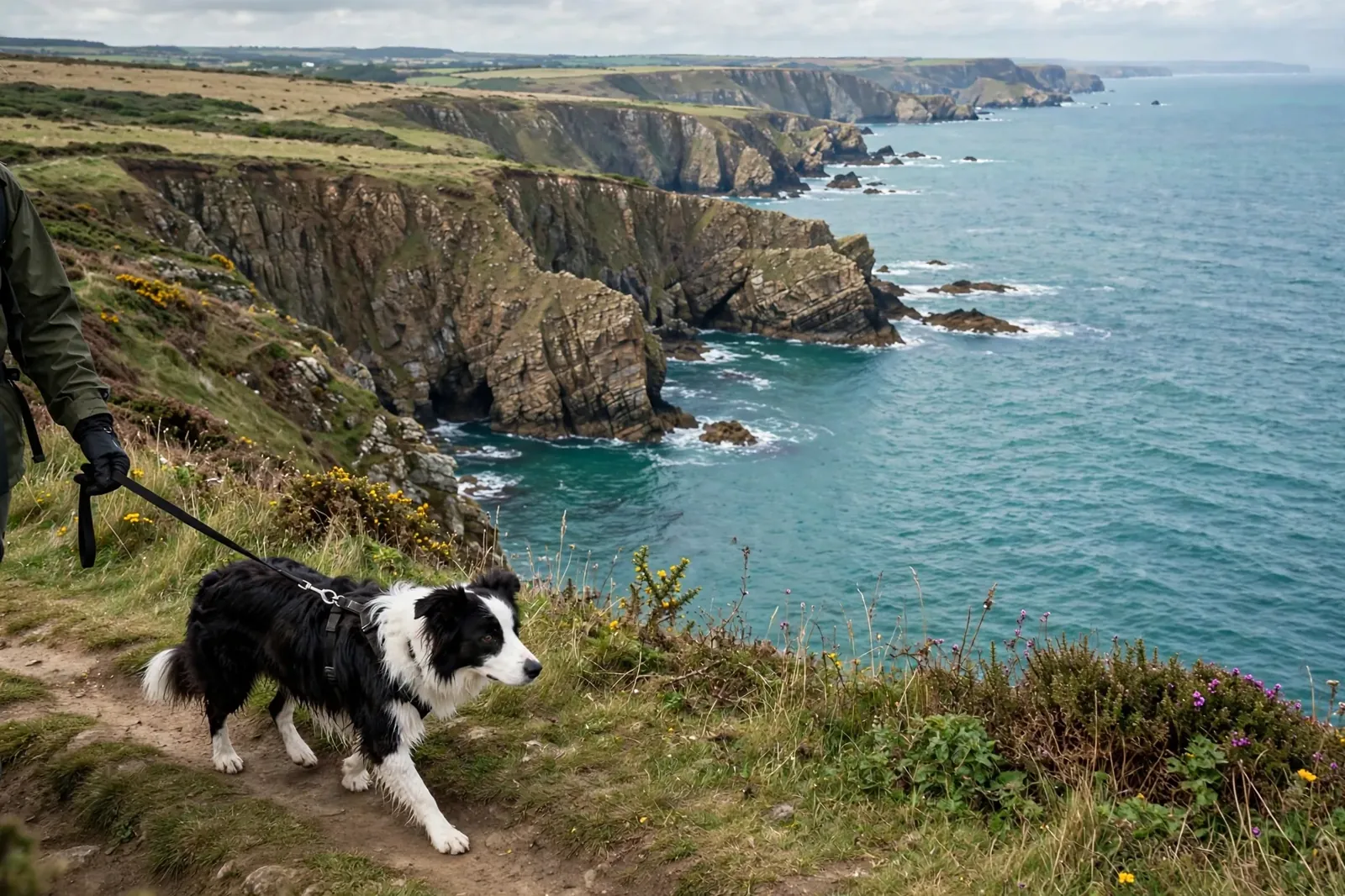
Cliff and coast path safety is the second layer. Much of Gower's limestone coast is unfenced, path edges can be undercut or slippery after rain, and dogs have no instinctive understanding of a sheer drop hidden by gorse or bracken at a path's edge. Use a short lead on cliff sections, keep dogs away from the edge even for photographs, and be especially careful where a path narrows, where other walkers are passing, and where a dog is excited at the start of a walk. Rockfall happens on limestone and sandstone coasts alike; avoid sheltering, picnicking or letting a dog settle directly beneath cliff faces, particularly after heavy rain or freeze-thaw weather.
Livestock completes the layer. Sheep graze many coastal fields and commons, cattle — sometimes with calves — graze others, and ponies roam parts of the commons and northern marshes. Dogs should be on a lead around all grazing animals, given the widest possible berth, and never allowed to approach ponies, however placid they look. If cattle approach you, the standard countryside advice is to stay calm, move quietly around or away, and let go of the dog's lead if you are genuinely pursued, so the dog can run to safety and you are not pulled between animals — then recover the dog once the situation has calmed. Seal encounters need the same philosophy at greater distance: a resting seal on a quiet beach should be given a very wide berth, with the dog on a lead and moved away promptly; seals are protected, easily stressed and capable of a serious bite if cornered.
Water safety is more selective than visitors expect. The sea at Gower's beaches can have rip currents, especially around headlands and river mouths, and a dog swimming is a dog an owner may feel compelled to follow — the most dangerous sequence in British coastal safety. Let dogs paddle and play at the water's edge in calm conditions on gently shelving sand, keep them out of rough surf, estuary channels and fast rivers such as a swollen Pennard Pill, and rinse salt water off coats and paws afterwards, offering fresh water to drink so a thirsty dog drinks less sea. Blue-green algae is mainly a freshwater risk in still lakes and reservoirs in warm weather; heed any warning signs at ponds and avoid letting dogs drink from or swim in discoloured, scummy water anywhere.
Bases, food and parking: Mumbles to Rhossili
Where you sleep on Gower decides how much driving each day contains. Mumbles, at the eastern gateway, offers the widest choice of places to stay, eat and shop, a promenade for easy evening dog walks, and Swansea immediately behind it for supermarkets, fuel and veterinary services. It suits first visits, mixed parties where not everyone walks all day, and winter trips when a village's lights and choices matter. Its cost is distance: Rhossili is a substantial drive west along lanes that are slow in summer traffic, so Mumbles-based visitors should cluster western outings into full days rather than popping back and forth.
Mid-peninsula bases around Parkmill, Oxwich, Port Eynon and Horton put the south-coast beaches and coast path within short drives or walks, trade restaurant choice for immediate landscape, and suit walkers content with a pub, a village shop and a well-stocked cottage kitchen. Far-west stays in and around Rhossili and Llangennith — the latter on the north-west coast, known for its long surfing beach — deliver dawn and dusk at the famous places, with the fewest facilities of all. Wherever you book, ask the dog-specific questions before paying: nightly dog charge, number and size of dogs genuinely accepted, enclosed garden or only a shared yard, whether dogs may join you where food is served, and where the nearest safe after-dark walk is that is not an unlit lane or a cliff path.
Parking is the daily friction point in summer. The main beach and village car parks — National Trust, council and privately operated among them — fill by mid-morning on fine weekends, charges and payment methods vary, some machines are app- or card-only, and signal can be patchy exactly where you need to download an app. Carry a payment backup, arrive before ten for headline beaches in high season, and have the plan B beach chosen in advance rather than in a queue. Overnight and motorhome rules differ by car park and are enforced; check the terms on arrival rather than assuming a quiet corner is permitted.
Food with a dog follows the familiar British pattern, with a Gower accent. Many cafés and pubs welcome dogs in bars, gardens or marked areas, some beach kiosks are walk-up only and therefore perfectly dog-compatible, and picnic food from village shops eaten above a bay — dog settled on a mat, human food kept firmly human — is often the best lunch on the peninsula. Book evening meals in summer, mention the dog when booking, and ask about the quietest table if your dog settles better away from a bar's traffic. A wet-dog contingency matters here more than in most places: a dog towel and a change of footwear in the car protect both the cottage and the pub's goodwill.
A two-day Gower pattern that respects the tides
Day one belongs to the west. Start early at Rhossili, walk the headland towards Worm's Head as the tide state allows, descend to the bay for a long low-tide walk, and climb back to the village for lunch with the big view still in front of you. In the afternoon, let the dog rest while the party chooses between a gentle Llangennith outing, a visit to a quieter cove on foot, or simply a second, shorter headland stroll as the light improves. The day's shape — one big walk, one small one, facilities at both ends — suits most fit dogs and leaves nobody negotiating a strange car park at dusk.
Day two moves to the middle coast. Walk in to Three Cliffs Bay from Parkmill on a falling tide, spend the beach time while the bay is open and interesting, and return before the tide reorganises the river crossings. Then drive the short distance to Oxwich for a contrasting afternoon: dunes, woodland edge and a gentler bay, finishing with a village supper where dogs are welcome. If the tide times run the other way on your dates, swap the days' internal order rather than forcing the plan — Gower rewards visitors who let the tide table hold the pen, and punishes, politely but firmly, those who treat it as a suggestion.
A third day, if you have it, is for the east or the north, not for repeating a favourite. Walk the Mumbles cliff path to Langland and Caswell outside the restriction season — or enjoy the path and promenade with beach time at a permitted alternative in summer — or, with double-checked tides and a lead throughout, explore the estuary atmosphere of the north coast for a complete change of texture. Leave whichever coast you did not reach for the return visit that Gower reliably inspires; a peninsula this varied is not meant to be completed in a weekend, and a dog that leaves with energy unspent leaves as a dog that travelled well.
Shorter legs and steadier paws: Gower at an easier pace
Gower's drama can look like a fit-dog-only destination, but its structure — villages spaced along the coast, viewpoints near car parks, promenades at the eastern end — makes it workable at a gentler pace too. A senior dog can have a complete Gower day built from the Mumbles promenade, a café stop, a short cliff-path section to a single viewpoint and, outside restriction season or at a permitted beach, twenty minutes of sand under careful supervision. The ingredients of the peninsula — sea air, big views, good food, a settled dog — are all present at that scale; only the mileage is missing, and mileage was never the point.
Puppies and dogs rebuilding fitness benefit from Gower's out-and-back paths. Set a time limit rather than a destination, turn round while the dog is still cheerful, and use the varied surfaces — promenade, path, sand — in short doses so young joints and paws are not asked for a long day on any one of them. Sand is harder work than it looks, soft dune sand especially, and a puppy that has raced around a beach for an hour has done far more exercise than the same hour on grass. Carry water from the start, plan shade stops, and treat the steep accesses at Rhossili and Three Cliffs as destinations to grow into on later visits rather than first-holiday tests.
Owners with limited mobility should check current access information for each specific car park, promenade and beach access before relying on it, because gradients, steps and surfaces vary sharply between neighbouring bays and can change after storms or path works. The eastern, Swansea Bay and Mumbles end of the peninsula generally offers the most level, serviced walking, while the western and cove beaches involve the steepest approaches. However your party moves, Gower's small scale is the accessibility asset: no viewpoint, beach or base is far from a car, a café or a change of plan, and a day can be rebuilt around energy and weather without losing its holiday feeling.
Practical questions
Before you go
Which Gower beaches restrict dogs in summer?
Seasonal restrictions, usually from 1 May to 30 September, apply on the busiest bathing beaches in Swansea and Gower, including sections of Swansea Bay, Bracelet Bay, Limeslade Bay, Rotherslade Bay, Langland Bay, Caswell Bay and the main section of Port Eynon Bay. Signs at each access point show the exact boundaries and dates. Always check the latest Swansea Council information before you travel, because boundaries and enforcement can change.
Is Rhossili Bay dog-friendly all year?
Rhossili Bay is generally one of the more dog-welcoming large beaches on Gower throughout the year, which is why it works so well outside the summer restriction season as well as during it. Keep dogs under close control, on a lead near livestock on the cliffs and dunes, and away from other beach users who are picnicking or sunbathing. Check local signs on arrival and the latest official guidance before you travel.
Can dogs walk out to Worm's Head?
The causeway to Worm's Head is only exposed for a limited window around low tide, roughly two hours either side of low water, and the crossing is rocky and uneven. Many dogs are better kept on the mainland headland walk, where the views are excellent without the tide pressure. If you do consider the crossing, check tide times from an official source, allow generous margins, wear suitable footwear and turn back early. Never risk being cut off.
Do dogs need to be on a lead on the Gower Peninsula?
On cliff paths, around livestock, on roads and lanes, in car parks and in busy villages, yes — use a short lead. Sheep and cattle graze much of the coastal land, and ground-nesting birds and seals need undisturbed space in season. On wide, quiet beaches away from other users a dog under reliable close control may be exercised more freely where local rules allow, but follow every sign on the day.
Where is the best base on Gower for a holiday with a dog?
Mumbles suits visitors who want shops, places to eat and Swansea Bay walks on the doorstep. Villages further west such as Rhossili, Port Eynon, Oxwich and Parkmill suit walkers who want beaches and coast path sections with less driving. Wherever you book, confirm dog charges, enclosed outdoor space, drying space for wet kit and the nearest safe walk after dark before you pay a deposit.