This guide is independent and contains no paid placement. If affiliate links are added later, they will be clearly marked and will not change our editorial checks.
Do not assume a dog-friendly venue means your dog is invited. Ask the couple exactly where the dog is welcome, appoint a handler who is not in the wedding party, plan an exit route for the ceremony, and decide before the day when the dog goes home. Most wedding dogs have their best day in the first few hours, then rest at home while the party carries on.
The invitation and asking the couple
Before you say yes to anything, ask one question, in plain words: is my dog actually invited to this wedding, and if so, to which parts of the day? That single question prevents almost every awkward wedding-dog problem, because a dog can be welcome at the photographs but not in the church, welcome on the lawn but not in the marquee, or welcome only if somebody else looks after the dog while you are seated for the ceremony. An invitation that says dogs are welcome in general, a venue website that describes itself as dog-friendly, and a photograph of another couple's dog at the same venue are three different things, and none of them is a personal invitation for your dog.
Ask the couple directly, not through a group chat, a parent, or a best man who is guessing on their behalf. Couples are juggling seating plans, catering numbers, venue restrictions and family sensitivities, and a vague second-hand answer can unravel on the day. A short, low-pressure message works best: say you would love to bring the dog if it genuinely helps the day, that you are equally happy to leave the dog at home if that is easier, and ask which parts of the day, if any, the dog is invited to. That wording matters. It gives the couple a graceful way to say no, and it makes a yes much more likely to be a considered yes rather than a polite one they later regret.
Listen carefully to the answer, including what is not said. A couple who immediately suggest a role for the dog, name a place for the dog to sit, and ask about the dog's temperament has probably thought it through. A couple who hesitate, say they will check with the venue, or add that it should be fine as long as the dog behaves, may not yet have checked the details that matter. In that case, offer to wait for a confirmed answer, and do not book travel, accommodation or a dog sitter around an unconfirmed yes. If the answer is no, accept it without negotiation. Weddings involve guests with allergies, phobias, small children, and elderly relatives, and a couple may have reasons they do not want to explain in detail.
Once you have a yes, pin down the specifics in the same conversation. Ask whether the dog is invited to the ceremony, the drinks reception, the wedding breakfast, the evening party, or only some of those stages. Ask whether there is a limit on the number of dogs, whether the dog must stay on a lead at all times, and whether any part of the venue is off limits, such as a formal garden, a dance floor, or a room with historic flooring. Ask who is in charge of the decision if something changes on the day, because the couple will be busy and will not want to be pulled aside to adjudicate a dog question during their photographs. If the wedding involves a church, a registry office, a hotel, a barn, or a marquee, the rules may differ for each space, so ask about each space separately rather than accepting one blanket answer.
Also ask about the other guests. A wedding is not a dog walk with extra chairs. Some guests may be nervous around dogs, allergic, or bringing a child who runs straight at animals. A well-behaved dog can still cause a problem if it jumps up on a guest in formal clothes, steals food from a low table, or blocks a wheelchair route while greeting someone. Ask whether any guest has a relevant allergy or fear that the couple is already managing, and agree how you will handle introductions. A good default is that the dog greets nobody unless the person approaches and you invite the greeting, which protects smart outfits, small children, and guests who would rather admire the dog from a distance.
Finally, be honest about your own dog in this conversation. Describe the dog as other people will experience the dog, not as you experience the dog at home. Mention barking at unfamiliar noises, excitement around other dogs, a tendency to pull on the lead, difficulty settling in new rooms, or anxiety when left with strangers. A couple who knows the real dog can plan a realistic role, such as a brief appearance for photographs, whereas a couple sold an idealised version may plan a full-day attendance that the dog cannot sustain. Honesty at the invitation stage is kinder to the couple, to the guests, and above all to the dog, who should never be set up to fail on somebody else's happiest day.
The week before: venue rules, rehearsal and handler plan
The week before the wedding is when a vague yes becomes a workable plan. Start with the venue, in writing if possible. Contact the venue coordinator, the church warden, or the registrar, depending on the setting, and confirm the dog rules for each room and outdoor area. Ask whether dogs are allowed inside the ceremony room at all, whether they must remain on a lead, whether a crate or settle mat is acceptable, and whether there are any areas where dogs are banned outright, such as kitchens, food preparation areas, or rooms with animals, livestock, or protected flooring. Some historic churches and stately homes have rules that are not on their wedding brochure, and some hotels apply different rules to the ceremony room, the restaurant, and the garden. Written confirmation protects you if a different member of staff is on duty on the day, so keep the email or message with your wedding paperwork.
Check the legal and practical details that venues sometimes assume you already know. Assistance dogs have different rights from pet dogs, and the rules that apply to one do not automatically apply to the other, so check the official guidance before you travel if your situation involves an assistance dog, a venue licence, or a public building with its own access policy. For pet dogs, the venue's own policy is usually the deciding factor, along with any conditions imposed by the couple, the caterer, or the registrar. Also confirm practical matters that rarely appear on a wedding website: where the dog can toilet, whether there is a bin for waste, whether water bowls are provided or you must bring your own, and whether the car park or grounds have a safe, shaded waiting area if the dog needs a break between stages of the day.
Next, settle the handler plan, because this is the decision that most often decides whether the day works. The handler should be a named adult who is not in the wedding party, not giving a reading, not seated in the front row, and not expected to dance, drink, or socialise for long stretches while holding a lead. Ideal handlers are a trusted friend who is attending as a guest, a family member who is happy to step out, or a professional dog walker or pet sitter booked specifically for the day. Agree exactly when the handler takes over, where they sit, and when they hand the dog back. If you are in the wedding party yourself, you cannot also be the dog's handler during the ceremony, however well the dog behaves at home, because your attention will rightly be on the couple.
Talk through the handler's authority in advance. The handler needs permission to leave the ceremony early, to skip the drinks reception, to take the dog home, or to decline photographs if the dog is tired, without checking with you first. A handler who has to text you for permission while a dog is barking in a quiet church is a handler who cannot act in time. Agree a simple signal or code word if needed, and make sure the handler has your phone number, the venue address, the car keys or taxi details, and a backup contact in case their phone fails. If the handler is not the dog's usual carer, arrange at least one practice session in the week before the wedding: a walk together, a settle exercise in a new room, and a handover where you step away for twenty minutes so the dog learns that the handler is a safe person, not just a stranger holding a lead.
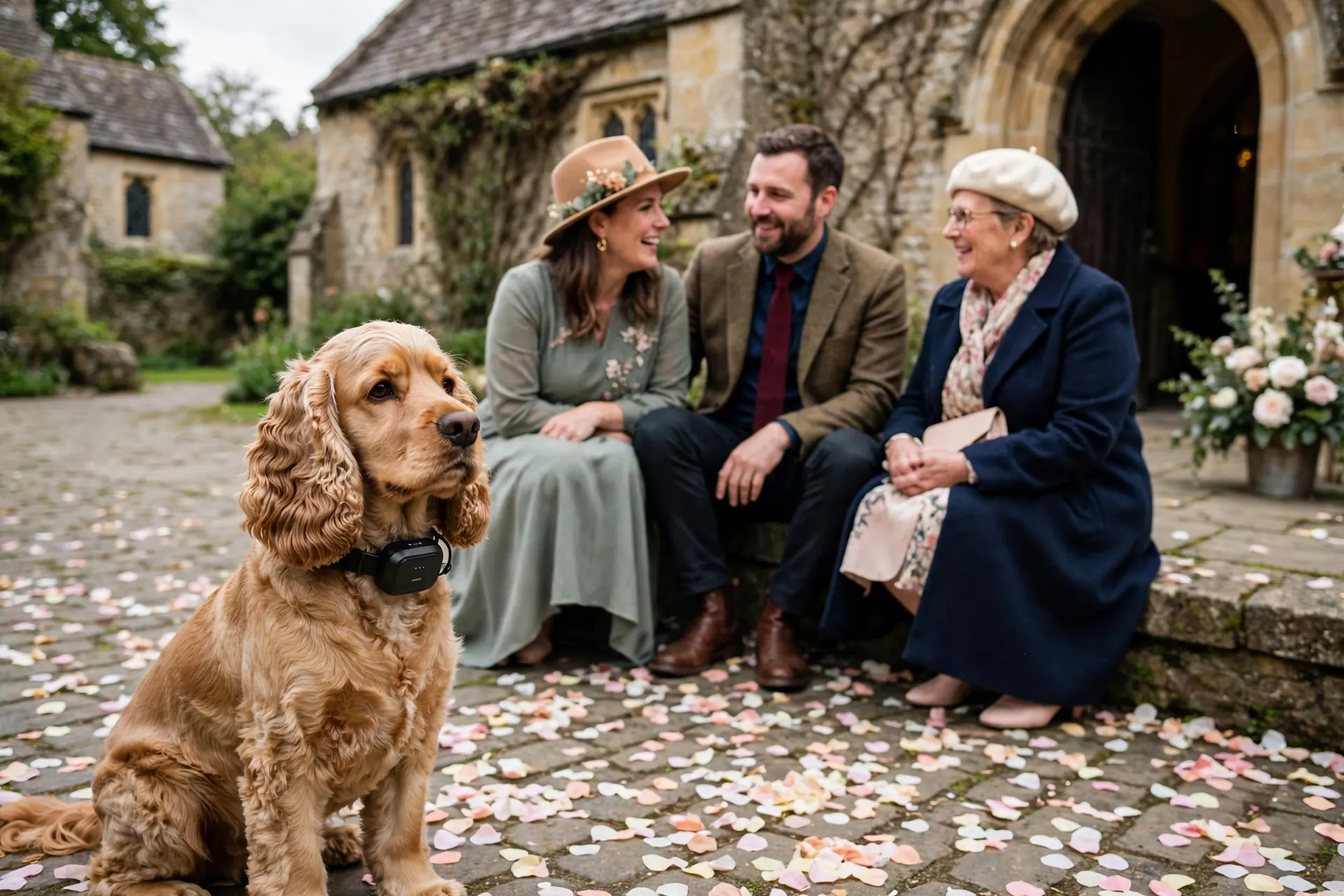
Use the same week to rehearse the specific skills the wedding will demand, in short, calm sessions rather than one long drilling session. Practise walking calmly on a short lead past people in unusual clothes, sitting on a mat while other people talk, waiting while a door opens and closes, and leaving a room quietly on cue. Practise with the actual outfit the dog will wear, whether that is a smart collar, a harness, a bow tie, or a flower collar, because a new accessory can distract a dog for the first hour if it is only introduced on the morning. Practise toileting on a lead in unfamiliar places too, since many wedding venues have gravel, formal lawns, or car parks where a dog accustomed to a garden may hesitate. Keep rehearsals short, reward calm behaviour generously, and stop while the dog is still succeeding rather than pushing until the dog fails.
Finally, assemble the wedding-day kit and check it the week before, not on the morning. Pack a lead and a spare, a harness or collar that fits over a smart outfit, a settle mat or blanket that smells of home, a water bowl and a bottle of water, poo bags, a towel for muddy paws, a chew or long-lasting enrichment item for waiting periods, any medication the dog needs, and a change of clothes for yourself in case of muddy paws or wet fur. Add the venue address, the handler's number, the nearest veterinary practice, and the accommodation address to your phone, and tell one other guest where the kit is kept. A wedding day already has enough moving parts; the dog's equipment should be the part that is ready a week early.
The morning: grooming, toileting and travel
Wedding mornings reward an early start and a boring routine. Give the dog a proper toilet walk first, before any grooming, dressing, or car loading, because a dog that has already emptied its bladder and bowels, sniffed, and stretched is far more likely to settle than a dog taken straight from a car to a ceremony. Choose a familiar, low-excitement route rather than a new adventure walk, and allow enough time for sniffing, because sniffing is calming work for a dog, not wasted time. If the journey to the venue is long, plan a toilet stop partway, ideally somewhere quiet and away from traffic, and keep the dog's breakfast at its usual time and usual amount. A wedding is not the day to try a new food, a rich treat, or a larger-than-usual meal that could unsettle a stomach.
Grooming should be finished the day before if possible, with only a light brush, a paw check, and a final tidy on the morning itself. A bath on the morning can leave a dog damp, cold, or over-stimulated, and a full groom in an unfamiliar place can add stress at exactly the wrong moment. Check the coat for burrs, mud, or tangles, trim any hair that will fall into the eyes if the dog is used to that, and clean the paws after the morning walk. If the dog is wearing a smart collar, bow tie, or flower accessory, fit it at home, check that it does not rub, slip, or catch on a lead clip, and remove anything with small parts that could be chewed off or swallowed. A dog that looks slightly less polished but is comfortable will behave far better than a dog in a perfect outfit that itches, slips, or restricts movement.
Travel to the venue deserves the same care as travel to any unfamiliar place, and the rules are the same whether the journey is ten minutes or two hours. The dog must be suitably restrained so it cannot distract the driver or injure itself if the car stops suddenly, and the car should be cool, ventilated, and free of loose items that could fall on the dog. For a detailed comparison of restraints, see our guide to dog car safety, which explains harnesses, crates, and boot setups for different cars and dogs. Arrive early enough that the dog is not rushed from a hot car into a crowded room, and never leave a dog alone in a parked car on a warm day, even for a short errand, because temperatures inside a car can rise dangerously quickly. If you are travelling by train, taxi, or another form of transport, check that operator's dog policy in advance, since rules vary and a wedding timetable leaves little room for a refused boarding.
On arrival, give the dog a second, short toilet opportunity and a calm walk around the venue grounds before the ceremony begins. This is not a social tour: keep the dog on a short lead, let it sniff the boundaries, the entrance, and the area where it will later wait, and avoid letting it greet every early guest. Introduce the dog to the handler in a quiet spot, hand over the lead, the settle mat, the water bowl, and the kit bag, and agree the plan one last time in two sentences: where the handler will sit, and when the dog will leave. Then step away. A long, emotional goodbye can unsettle a dog far more than a calm handover, and guests arriving for a wedding do not need a farewell scene at the door.
Build slack into the morning timetable, because wedding mornings rarely run to the minute. Hair, transport, photographs, and venue access can all slip by fifteen minutes, and a dog plan with no slack becomes a rushed toilet walk, a hot car, and a stressed handler. Aim to arrive at least thirty minutes before the ceremony, and keep the dog's morning walk, grooming, and travel in that order, with a buffer between each stage. If you are staying overnight, confirm the accommodation's dog rules the night before, including whether the dog can be left briefly in the room, where the nearest toilet area is after dark, and whether breakfast can be taken with the dog or must be taken in shifts. A calm morning is not luck; it is a timetable with room for the dog in it.
The ceremony: where the dog sits and the barking plan
The ceremony is the quietest, most formal, and most unforgiving part of the day for a dog, so plan it as if the dog will be restless, even if the dog is usually calm. The best seat is almost always an aisle-end seat near an exit, with the dog on a short lead beside the handler, on a familiar settle mat, and with a clear route out that does not require crossing the front of the room, squeezing past seated guests, or opening a heavy door. Agree this seat with the couple or the venue coordinator in advance, rather than hoping a suitable seat is free when you arrive, because the seats near exits are also popular with parents, photographers, and guests who need step-free access. If the ceremony is outdoors, choose a spot at the edge of the seating, away from the music speakers, the confetti area, and the main guest flow, and check the ground surface, since gravel, wet grass, and hot paving all affect how long a dog can settle.
Settle the dog before the ceremony starts, not during it. Arrive early, let the dog sniff the settle mat, drink a little water, and lie down while guests are still arriving and talking, so the start of the music and the hush of the ceremony are not the first new experiences of the day. Keep the lead short but not tight, keep your own body relaxed, and avoid constantly stroking, shushing, or feeding the dog, because fussing can signal to a dog that something is wrong. A chew, a lick mat, or a stuffed enrichment toy can help some dogs during a long ceremony, but test it in advance: a noisy chew, a squeaky toy, or a treat that crumbles onto a historic floor can cause more disruption than a quiet dog. If the ceremony is long, agree in advance whether the handler will take the dog out halfway through for a toilet break, and where they will wait until the ceremony ends.
Every wedding dog needs a barking plan, and the plan should assume that barking is possible, not impossible. Dogs bark at unfamiliar music, at a sudden silence, at another dog, at a child running past, or simply because they are tired. The handler's job is to notice the early signs, such as restlessness, whining, pacing, or intense staring, and to act before the bark, not after it. Agree that the handler will stand, walk calmly to the nearest exit, and wait outside with the dog, without apologising at length, negotiating with ushers, or waiting to see if the dog settles. A quiet exit during a reading is far less disruptive than a bark during the vows, and guests will remember the graceful exit far less than they would remember a prolonged disruption. Rehearse the exit route in the week before if possible, including which door to use and where to wait, so the handler does not have to improvise under pressure.
Think about the specific triggers of the ceremony you are attending. A church organ, a string quartet, a sudden round of applause, confetti cannons, and a photographer's flash can each unsettle a different dog, and a dog that is calm in a quiet room may react to a sudden loud noise. Ask the couple or the venue whether there will be live music, bells, fireworks, or confetti, and whether the dog will be present for those moments or safely outside with the handler. For outdoor ceremonies, check the weather, the shade, and the wind, since a hot dog in direct sun, a cold dog in wind, and a wet dog in rain will all struggle to settle. If the forecast is extreme, agree in advance that the dog will attend only the photographs or the reception, because a shortened appearance is a successful appearance, whereas a miserable full ceremony helps nobody.
Also plan for the moments immediately after the ceremony, when excitement peaks. Guests stand, hug, cheer, and throw confetti, photographers call for attention, and children run. This is when a dog on a long lead, a loose lead, or a retractable lead is most likely to trip someone, jump up on formal clothes, or eat confetti from the ground. Keep the lead short, keep the dog beside the handler, and move to a quiet edge of the crowd until the initial surge has passed. If the dog has a role, such as carrying rings, walking down the aisle, or posing for a specific photograph, rehearse that role separately, keep it brief, and give the dog a clear start and finish, with the handler ready to take over the moment the role ends. A dog that does one small job well is a triumph; a dog expected to perform for an hour is a risk.
The drinks reception and photographs
The drinks reception is usually the dog's happiest stage of the day, provided it is managed as a series of short, calm encounters rather than a free-for-all. Keep the dog on a lead, keep greetings brief, and let guests come to the dog rather than taking the dog to every group. A good pattern is to stand at the edge of the reception area, allow one or two guests at a time to say hello, and then move on or pause for water and a rest. This protects the dog from being overwhelmed, protects guests' drinks and outfits from wagging tails and wet noses, and gives the photographer a chance to capture natural moments without the dog being pulled in every direction. If the reception is outdoors, watch for food on low tables, glasses left on the ground, and garden hazards such as lilies, cocoa mulch, or unsecured gates, and keep the dog away from buffet tables and passed canapés.
Photographs deserve a brief, explicit conversation with the photographer, ideally through the couple, before the day. Tell the photographer how the dog responds to cameras, whether flash bothers the dog, and whether the dog will look at the camera, at you, or at a treat. A handler holding a treat just above the lens often produces a better photograph than a crowd of guests calling the dog's name at once, and a short session of five or ten minutes usually produces better images than a long session in which the dog becomes bored, hot, or restless. Agree which photographs matter most, such as one group photograph with the couple, one portrait of the dog alone, and perhaps one candid photograph during the reception, and let the rest happen naturally. If the dog is tired, muddy, or unsettled, tell the photographer honestly and skip the photograph rather than forcing a pose that will look unhappy in print.
Use the reception to check the dog's welfare, not just its photograph potential. Offer water regularly, especially on warm days and after excitement, and watch for signs of tiredness, such as yawning, lip licking, turning away, or lying down flat. A dog that has been travelling, greeting, and settling since the morning may already be tired by the middle of the reception, even if it still wags when approached. Give the dog a quiet break in a shaded, low-traffic spot, on its settle mat, away from music speakers and crowds, and do not feel obliged to keep the dog on display for the whole reception. Guests who genuinely love dogs will understand a resting dog, and guests who do not will appreciate not having a tired dog underfoot.
Food and drink safety matters throughout the reception. Wedding food is rich, unfamiliar, and often within reach, and well-meaning guests may offer the dog chocolate, cake, grapes, onions, or alcohol without realising the danger. Tell the handler, the couple, and any nearby guests clearly that the dog must not be fed by anyone except the handler, and keep the dog away from tables where food is left unattended. If the dog does eat something it should not have, note what it ate and how much, and contact a veterinary practice promptly rather than waiting to see if the dog seems unwell. A calm, consistent rule, repeated politely at the start of the reception, prevents most incidents and avoids an awkward correction later in front of other guests.
Finally, use the reception to confirm the next stage of the plan. Check with the handler whether the dog is staying for the wedding breakfast, leaving after the photographs, or going home with a sitter. Check whether the car, taxi, or accommodation is ready, and whether the dog's kit, lead, and settle mat are together in one place. A reception that drifts without a decision often ends with a tired dog still present at the start of the evening party, because nobody wanted to be the person who suggested leaving. Decide the departure point now, while everyone is still calm, and treat it as part of the plan, not as a failure of the day.
The wedding breakfast and evening party: when to take the dog home
The wedding breakfast is a long, seated, food-centred event, and it is the stage where most dogs, however welcome, become a practical problem. Speeches, courses, toasts, and table service can last two hours or more, and a dog must lie quietly under or beside a table, in a busy room, with food smells, moving waiters, and guests coming and going. Some venues allow dogs in the breakfast room, some allow dogs only on a terrace or in a separate room, and some do not allow dogs at all during food service, so confirm the rule for this specific meal rather than assuming the reception rule carries over. If the dog is allowed, agree a place for the dog that is not a thoroughfare, not beside a kitchen door, and not under a table where food may drop, and keep the handler with the dog for the whole meal, not just the first course.
For many dogs, the kindest and most practical choice is to leave after the photographs and before the wedding breakfast. This gives the dog a successful, memorable appearance, a calm journey home, and a rest in familiar surroundings, while the guests enjoy a long meal without a restless animal under the table. It also frees the handler to enjoy the meal as a guest, rather than spending two hours managing a lead, a water bowl, and a dog that wants to greet every waiter. If you choose this option, arrange the departure in advance: a pre-booked taxi, a friend who is not staying for the meal, or a pet sitter who can collect the dog from the venue. Tell the couple your plan, so they do not worry when the dog disappears, and say goodbye to the dog before the meal begins, not in the middle of the speeches.
If the dog does stay for the breakfast, plan for boredom and tiredness. Bring a long-lasting chew or enrichment item that the dog has used before, a settle mat, and water, and agree that the handler will take the dog out for a toilet break between courses if needed. Keep the dog's own food separate from the wedding food, and do not feed the dog from the table, however tempting it is to share a celebration. Watch for the signs that the meal has gone on long enough for the dog: restlessness, whining, repeated standing, or attempts to greet neighbouring tables. Leaving halfway through the breakfast, quietly and without fuss, is far better than staying until the dog barks, steals food, or has an accident in a formal room.
The evening party is almost never a good place for a pet dog, and planning for the dog to leave before it starts is the default that most experienced wedding guests recommend. Loud music, dancing, flashing lights, late finishes, tired and merry guests, and a dark room with moving feet are a difficult combination for even a confident dog, and a frightening combination for a nervous one. Fireworks, sparklers, and confetti cannons, if planned, add further noise and risk. If the dog is still at the venue when the evening party begins, take it home, to its accommodation, or to a sitter before the music starts, and do not bring it back for a brief appearance later in the evening when it is already tired. A dog that has had a good day and a good night's sleep is a success story; a dog kept up until midnight in a noisy room is not.
Leaving also needs a practical plan, not just a time. Confirm who is driving, whether that person has had alcohol, where the dog will sleep, and whether the accommodation allows a late return with a dog. If you are staying overnight, check whether the dog can be left briefly in the room while you return to the party, or whether a sitter must stay with the dog, and check the after-dark toilet route, lighting, and any curfew on the grounds. If you are travelling home the same night, factor in the dog's toilet needs, water, and comfort on the journey, and allow extra time, because a tired driver and a tired dog are a poor combination. For advice on finding places where a dog can genuinely settle, our guide to dog friendly cafes in the UK explains how to judge whether a venue truly welcomes dogs rather than merely tolerating them, a skill that is just as useful for wedding venues as it is for cafes. The same judgement applies to overnight stays: choose accommodation where the dog's routine, not just its presence, has been considered.
The next morning and thank-yous
The morning after a wedding is a good time to check the dog, not just the photographs. Give the dog a familiar walk, a normal breakfast, and a quiet day, because a wedding day is stimulating even for a confident dog, and tiredness can show the next day as restlessness, a sensitive stomach, or a reluctance to settle. Check the paws for soreness from gravel or long standing, check the coat for confetti, burrs, or food, and watch for any sign that the dog ate something unusual during the reception. If the dog seems unwell, contact a veterinary practice promptly and mention the wedding food, drink, and environment, since that detail can help a vet narrow down the cause. Most dogs bounce back quickly with rest, water, and routine, but a quiet recovery day is a kindness, not an overreaction.
Thank the people who made the dog's attendance possible, starting with the couple. A short message the next day, thanking them for including the dog and mentioning a specific happy moment, such as a photograph or a calm ceremony appearance, means far more than a generic thank-you. Thank the handler separately, and properly, because a good handler has given up parts of their own day to look after your dog, and that generosity deserves recognition, whether that is a gift, a meal, or a clear offer to return the favour. If a venue coordinator, photographer, or sitter helped, thank them too, and mention anything that worked well, such as a quiet waiting area or a helpful exit route, because positive feedback makes venues more likely to welcome dogs again.
Also thank the guests who were kind to the dog, especially anyone who kept a respectful distance, asked before stroking, or helped the handler without being asked. Weddings bring together people with different feelings about dogs, and a guest who is nervous around animals but still treated your dog with patience has done you a favour. A brief, warm message, rather than a long explanation of the dog's behaviour, keeps the tone right. If anything went wrong, such as a bark during the ceremony or a jumped-up greeting, acknowledge it briefly and without over-apologising, and note what you would do differently next time, such as a shorter appearance or a different seat. Couples remember grace under pressure far longer than they remember a perfect performance.
Use the next morning to record what worked, while the details are fresh. Note the venue rules that mattered, the seat that worked, the handler plan, the departure time, and the kit that proved useful, and note what you would change, such as arriving earlier, bringing a second settle mat, or leaving before the breakfast rather than after it. This short note becomes a personal checklist for the next wedding, christening, or family celebration, and it saves you from relearning the same lessons. If you are attending another wedding in the same season, the note is also useful for friends who ask how you managed it, because practical details travel better than general advice.
Finally, look after the photographs and the memories with the same care as the day itself. Ask the couple or the photographer for the dog photographs you would like to keep, back them up, and share them with the handler and anyone else who helped. If the dog's appearance was brief, that is not a disappointment: a calm ceremony, a happy reception, a good photograph, and a rested dog at home is exactly what a successful wedding-dog day looks like. The goal was never to keep the dog present for every hour of the celebration; it was to include the dog in the parts of the day where the dog could genuinely enjoy itself, and to let the couple enjoy the rest of their wedding knowing the dog was safe, settled, and well looked after. That is a day worth thanking everyone for, and a standard worth repeating.
Practical questions
Before you go
Should I ask the couple before bringing my dog to a wedding?
Yes, always ask the couple directly, even if the invitation says dogs are welcome. Confirm whether the dog is invited to the ceremony, the reception, or both, and whether a particular person is expected to look after the dog during the formal parts of the day.
What if the venue allows dogs but the couple has not mentioned it?
A dog-friendly venue does not automatically mean your dog is invited. The couple may have chosen to keep the guest list dog-free, or may have limited places for dogs. Treat silence as a no until the couple confirms otherwise in their own words.
Where should my dog sit during the ceremony?
Plan for an aisle-end seat near an exit, with the dog on a short lead beside a designated handler. Agree the spot with the couple or venue in advance, practise sitting quietly there if possible, and keep an exit route clear so a restless dog can leave without crossing the whole room.
How do I stop my dog barking during the vows?
You cannot guarantee silence, so plan for noise instead of hoping it will not happen. Tire the dog out beforehand, keep the handler calm and close, use a familiar settle mat, and agree in advance that the handler will step outside at the first sign of restlessness rather than waiting for a bark.
When should I take my dog home from a wedding?
Most dogs are happiest leaving after the photographs and before the wedding breakfast, or at the latest once the evening party starts. Loud music, dancing, late finishes and tired guests are a poor combination for a dog, so set a departure time before the day and stick to it.