This guide is independent and contains no paid placement. If affiliate links are added later, they will be clearly marked and will not change our editorial checks.
Thurso is a practical, unpretentious base for a dog trip to the far north of Scotland: a wide beach in town, clifftop walks in both directions, dog-friendly places to eat and stay, and the ferry to Orkney a ten-minute drive away. Come for the beach and the headlands, stay for the day trips, and plan around the weather rather than fighting it.
Why Thurso works for dogs
Thurso is the most northerly town on the British mainland, a working harbour town on the north coast of Caithness, and it is the kind of place that rewards dog owners who like their holidays practical rather than polished. There is no single famous attraction to queue for, no crowded promenade to negotiate, and no need to drive everywhere: the beach, the harbour, the shops, the cafes and the railway station are all within a short walk of one another, and the dog can be part of almost all of it. That matters more than it sounds. In many Highland towns the dog-friendly part of the trip is a single beach ten minutes' drive away; in Thurso the dog-friendly part is the town itself.
The town's position is the other half of the appeal. Thurso sits on the North Coast 500 route, roughly at the north-western corner of the loop, and it is the natural overnight stop for travellers heading to Dunnet Head, the most northerly point of mainland Britain, or to John o' Groats, or on to Orkney on the ferry from Scrabster. If you are driving the route with a dog, Thurso lets you do all three without repacking the car every morning. It also has something the smaller villages on the route do not: a proper supermarket, a vet, fuel stations, a railway station and a choice of places to stay, which means a wet day or a minor problem does not become a crisis.
Thurso's character is worth understanding before you arrive, because it shapes the trip. This is a working town rather than a resort. The harbour at Scrabster, a couple of miles west, is a busy fishing and ferry port. The town centre is a grid of stone buildings, many of them built from the local Caithness flagstone, with a high street that serves residents first and visitors second. That is good news for dog owners: prices are ordinary, nobody minds a muddy dog in the places where dogs are welcome, and the town does not shut down outside the summer season. It is also worth knowing that Thurso can feel quiet, especially in winter, and that some cafes and attractions reduce their hours outside the summer months. Plan your days around the walks and the coast, and treat the town as a comfortable base rather than the main event.
The light and the landscape are the real draw. Caithness is famously flat and open compared with the mountains of the west Highlands, and the horizon here is enormous: big skies, long views across the Pentland Firth to Orkney, and a coastline of cliffs, stacks and wide sandy bays. Dogs that love open space will be in their element, and owners who enjoy a long, empty beach walk will find Thurso Beach hard to beat. The trade-off is exposure. The north coast takes the full force of Atlantic and North Sea weather, and the wind can be fierce even on a day that looks calm from the car window. A dog that is happy on a sheltered Cornish beach can still find a Caithness winter day hard work, so build in warm-up stops and sheltered alternatives, and read the section on seasons and safety before you set off.
Finally, Thurso suits a slower kind of trip. The best days here are not the ones with the longest itinerary but the ones with a long beach walk in the morning, a cafe stop at lunchtime, a clifftop wander in the afternoon and an early evening by the harbour. If your dog is older, reactive or simply not a fan of long car journeys, Thurso rewards a stay-put approach: pick one base, walk from the door, and let the day trips be optional rather than obligatory. The rest of this guide follows that logic, starting with the beaches and walks that make the town worth visiting, then the practical details of eating, sleeping, parking and onward travel.
Beaches and bays: Thurso Beach and beyond
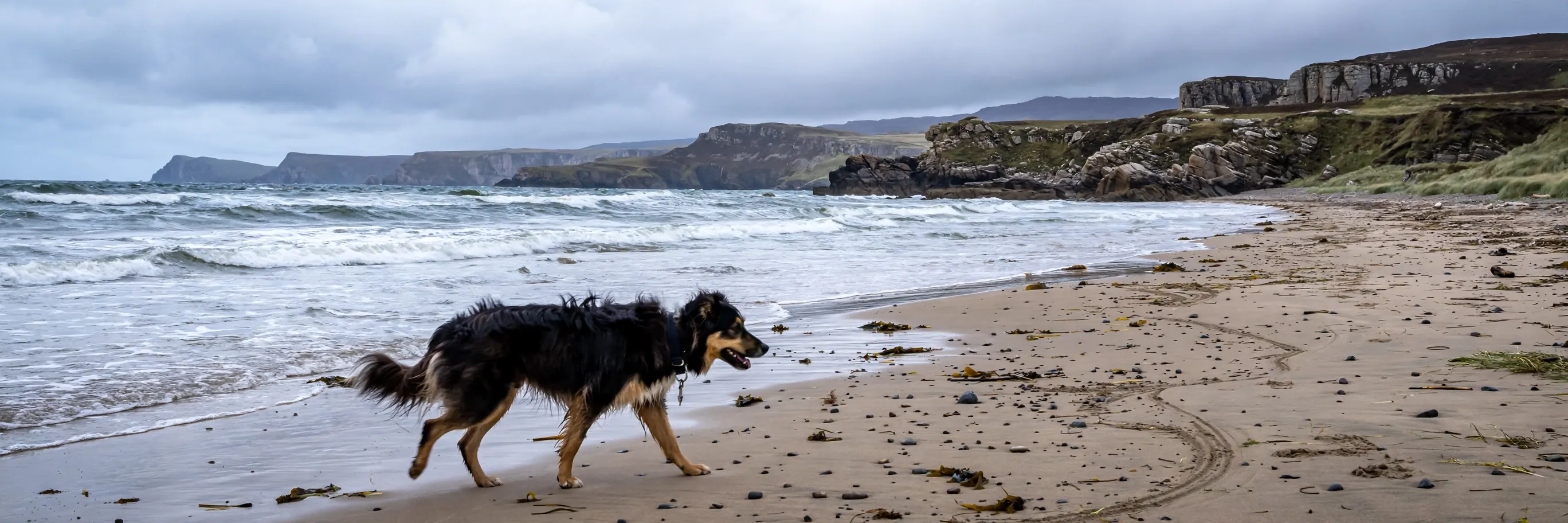
Thurso Beach is the town's front garden and the single best reason to bring a dog here. It is a broad, curving bay of pale sand at the eastern end of the town, backed by grassy dunes and an esplanade, and at low tide it opens up into a huge expanse of firm sand that is ideal for a proper off-lead run. The beach is popular with surfers — Thurso East, at the far end of the bay, is one of Scotland's best-known surf breaks — but the bay is large enough that walkers, surfers and dogs rarely get in each other's way. On a weekday morning outside the summer holidays you may have a long stretch of sand almost to yourselves.
Dog access on Thurso Beach is generally good all year round, and there is no seasonal dog ban of the kind that closes many English beaches in summer. That said, the rules that apply are the ordinary ones: keep your dog under control, keep them on a lead near the car park, the esplanade and other beach users, and always pick up after them. The beach is used by families, surfers and other dog walkers, so recall matters more here than on a remote Highland shore. If your dog's recall is unreliable around other dogs or around people carrying food, use a long line until you have seen how the beach is behaving that day. Check the official guidance before you travel, as local rules can change.
Tides shape the beach more than anything else. At high tide the sand narrows considerably and the walk becomes a short stroll along the esplanade rather than a run; at low tide you can walk for a long way along firm sand, and rock pools appear at the edges of the bay. Check the tide times before you go, and time your main walk for a falling or low tide if you want the full expanse. Also watch the river mouth at the eastern end of the beach, where the River Thurso meets the sea: currents there can be strong, and it is not a place to let a dog swim. The same caution applies to the surf at Thurso East, which is a serious surf break with powerful waves; enjoy it from the sand and keep dogs out of the water there.
Beyond the town beach, the coast in both directions offers more sand. Dunnet Bay, about ten minutes' drive east, is a long, sweeping beach backed by dunes, with a car park and a gentler feel than Thurso Beach; it is a good choice for a longer walk when the wind is coming off the sea at Thurso. To the west, the coast towards Scrabster and Holborn Head is rockier, with small coves and shore walks rather than big beaches, and it suits dogs that prefer sniffing around rock pools to running on open sand. A little further west, the beach at Melvich and the sands around Bettyhill are worth the drive on a calm day, though they are day-trip territory rather than a quick walk from town.
Practical beach kit for Thurso is simple but worth getting right. Bring a towel and a drying coat, because even a dry-looking day can end with a wet dog: the sand is fine and gets everywhere, and the wind drives spray across the bay. Bring drinking water, because the sea is not a substitute and there is no guarantee of a fresh-water tap on the beach itself. Bring poo bags and a way to carry them back to a bin, since bins are concentrated near the car park and esplanade rather than spread along the shore. And bring a lead even if you plan to let your dog off: the esplanade, the car park and the road behind the beach all need a lead, and you will want one in your pocket for the walk back through town.
One more thing about the beach: the surf community is part of the town, and Thurso East in particular is a working surf spot rather than a dog beach. Surfers arrive early, change in the car park and carry boards across the sand, and the car park at the eastern end can be busy on a good swell day. That is not a problem — it is part of the place — but it is worth knowing so you are not surprised, and so you keep your dog clear of boards and wetsuits on the sand. If you want the quietest stretch of beach, walk west from the main access point rather than east towards the surf break, and go early in the morning when the town is still waking up.
Clifftop walks and headlands
The walking around Thurso is the reason many dog owners come back. The coast here is a mix of high cliffs, grassy headlands, sea stacks and wide bays, and the paths are generally good, well-used and easy to follow. The most important rule is also the simplest: keep your dog on a lead near cliff edges. The cliffs around Thurso and Dunnet Head are high, the grass can be slippery after rain, and a dog chasing a seabird or a rabbit can be over the edge before you have time to react. A long lead gives a keen dog room to explore while keeping the cliff edge out of reach, and it is the single most useful piece of kit you will bring to Caithness.
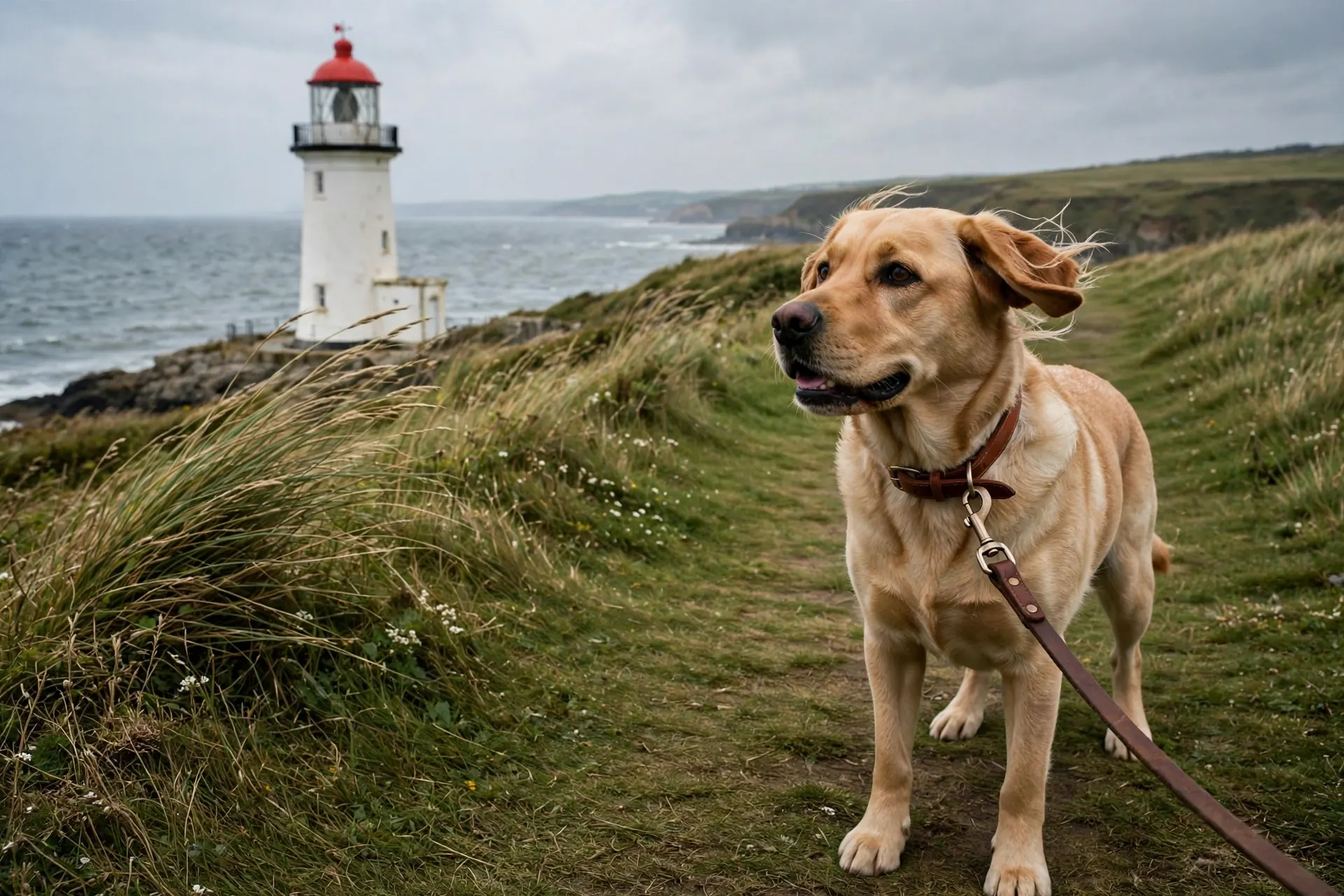
The walk from Thurso to Scrabster and Holborn Head is the classic local route. From the town centre, head west along the harbour and the coast road towards Scrabster, then follow the path out to Holborn Head, the headland that shelters the harbour. The views back across the bay to Thurso and out to Orkney are superb, and the grassy top of the headland is good open walking for a dog on a lead. The lighthouse at Holborn Head is a working light rather than a visitor attraction, and the headland itself is the draw. Our guide to dogs at lighthouses in the UK covers tower rules and cliff safety in more detail, and the same principles apply here: admire the light from the path, keep dogs away from the edge, and do not expect to go inside.
East of the town, the coast path towards Dunnet Head is longer and wilder. Dunnet Head itself is the most northerly point of mainland Britain, a few miles east of Thurso, and the walk out to the lighthouse is one of the great short walks in the north of Scotland. The headland is a nature reserve, and in spring and summer it is full of seabirds — puffins, guillemots, razorbills and fulmars nest on the cliffs — which makes it a wonderful place to visit and a place where dogs need to be kept firmly on a lead and away from the cliff edge. The RSPB reserve at Dunnet Head is managed for the birds, so follow the signs, keep to the paths and keep your dog under close control. The views from the headland, across the Pentland Firth to Orkney and Hoy, are the reward, and on a clear day they are among the best in Britain.
For a gentler walk, the esplanade and the riverside path through Thurso itself are ideal for older dogs, puppies and dogs that are still building up their fitness. The esplanade runs along the front of the beach and is flat, surfaced and easy underfoot. The riverside walk follows the River Thurso upstream from the town, through green space and woodland, and it is a good sheltered alternative when the wind is coming hard off the sea. Combine the two for a loop that takes an hour or so and gives the dog a mix of sand, grass and pavement without ever needing the car.
Further afield, the walk to the Castle of Old Wick, about twenty minutes' drive south-east near Wick, is a short clifftop walk to a ruined castle on a headland, and it is a good half-day outing with a dog on a lead. The castle itself is a ruin, the path is straightforward, and the views along the coast are excellent. Similarly, the coast around John o' Groats, a short drive east, offers clifftop paths and a famous signpost, though the village itself is small and the main attraction is the landscape rather than the settlement. Both are worth doing once, and both are easy to fit into a Thurso-based stay.
Walking safety in Caithness deserves a paragraph of its own, because the landscape is deceptively gentle. The ground is often boggy away from the paths, especially after rain, and the grass on clifftops can hide holes and sudden drops. Livestock is common: sheep graze on many of the coastal fields, and cattle appear on some of the inland walks, so keep your dog on a lead wherever livestock is present and be ready to shorten it quickly. Adders are present in parts of the Highlands, including Caithness, though encounters are uncommon; if your dog is a keen sniffer in long grass in warm weather, keep them on the path. Finally, check the weather forecast and the tide times before any coastal walk, and turn back if the wind is rising or the light is going. The coast will still be there tomorrow.
Cafes, pubs and the town: eating and drinking with a dog
Thurso's town centre is compact and walkable, and it is the kind of place where a dog is a normal part of daily life rather than a special occasion. The high street has a supermarket, a butcher, a bakery, a pharmacy, a post office and a handful of independent shops, so you can stock up for a self-catering stay or a beach picnic without a long drive. The town also has a leisure centre with a swimming pool, a library and a museum, the Caithness Horizons museum in the town centre, which covers the history of the area including the Dounreay nuclear site and the local geology. Check the official guidance before you travel for opening times, as these can change with the season.
Dog-friendly eating in Thurso is good by Highland standards, though it works on the usual pattern: dogs are welcome in many cafes and pubs, most reliably in outdoor seating areas and in the more informal venues, and less reliably in formal restaurants. The esplanade and the streets around the harbour have cafes with outdoor seating in the warmer months, and several of the town's pubs welcome dogs inside, particularly in the bar area. Policies vary by venue and can change with the season or with a change of management, so the practical approach is to check the sign on the door, ask the staff when you arrive, and have a back-up plan. A blanket for your dog to lie on, a chew to keep them settled and a lead short enough to keep them out of the walkway will make you welcome in almost any dog-friendly venue.
A few habits make cafe and pub stops work smoothly in Thurso. Go at quieter times if your dog is nervous or reactive: late morning and mid-afternoon are usually calmer than the lunch rush, and a weekday is calmer than a Saturday. Choose a table at the edge of the room rather than in the middle of the traffic, and settle your dog before you order. Bring water for the dog if you are sitting outside, since not every venue provides a bowl. And remember that the weather can change fast: an outdoor table that is pleasant at noon can be windswept by one o'clock, so have a plan to move inside or take the food away. Takeaway is a good fallback in Thurso — a fish supper or a sandwich eaten on the esplanade with the dog beside you is a perfectly good lunch, and often a better one than a stressed indoor meal.
Shopping with a dog in Thurso is straightforward. The supermarket is the main stop, and dogs wait outside or in the car — never leave a dog alone in a car, even briefly, and especially not in summer. The smaller independent shops on the high street are generally relaxed about a well-behaved dog on a lead, but ask before you go in. The town has a pet shop and a vet, which is reassuring if you run out of food or need advice, and the vet's details are worth saving in your phone before you arrive. If your dog needs medication, bring a spare supply: the nearest out-of-hours vet may be some distance away, and a rural practice may not stock your dog's exact prescription.
The harbour at Scrabster, two miles west of the town centre, is worth a visit in its own right. It is a working harbour with fishing boats, the ferry terminal and a fish market, and the walk along the harbour wall with a dog on a lead is a pleasant short outing. There is a cafe at the harbour in season, and the views across the Pentland Firth to Orkney are excellent. Keep your dog on a lead around the harbour, as there is traffic, moving machinery and open water, and do not let them drink from harbour puddles or eat fish waste on the quayside.
Evenings in Thurso are quiet, and that suits most dogs. A short evening walk along the esplanade, a drink in a dog-friendly pub, and an early night is the rhythm of the town, and it is a good one. If you are staying in the town centre, the evening walk is also a practical matter: the last toilet walk of the day should be somewhere familiar and well-lit, and the esplanade and the streets around it fit that description. Bring a torch in winter, when it is dark by late afternoon, and a reflective lead or a light on the dog's collar so that drivers can see you both.
Where to stay with a dog in Thurso
Thurso has a good range of dog-friendly accommodation for a town of its size, and the choice you make shapes the trip. The main options are hotels and guesthouses in the town, bed and breakfasts, self-catering cottages and flats, and caravan and camping sites on the edge of town and along the coast. Each suits a different kind of dog. A hotel or guesthouse works well if your dog is settled, quiet and happy to be left for a short time while you eat; a self-catering cottage works better if your dog is noisy, needs a garden, or eats at odd hours; and a caravan or campsite works best if your dog needs outdoor space and you do not mind the weather.
Whatever you choose, book early, especially in summer. Thurso is on the North Coast 500, and the town's dog-friendly rooms and cottages are limited. The busiest weeks are the school summer holidays and the long weekends in May and June, and the most popular places can be booked months ahead. If you are travelling in the shoulder seasons — April, May, September and October — you will have more choice and better prices, and the walking is often at its best. Winter is the quietest time, and some smaller places close or reduce their opening, so confirm that your chosen accommodation is open on your dates and that the heating is reliable. Our guide to dog-friendly holiday parks in the UK explains the questions to ask about fees, boundaries and house rules, and those same questions apply to a cottage or a caravan in Caithness.
Pet fees and house rules vary widely, so read the small print before you pay. Some hotels charge a flat fee per dog per stay, others charge per night, and some charge nothing at all. Common conditions include a limit of one or two dogs per room, a requirement that dogs are not left alone in the room, and a rule that dogs are not allowed on beds or furniture. Ask for the full terms in writing, including the cleaning charge and the cancellation policy, and be honest about your dog: a large dog, a puppy, or a dog that barks when left alone needs to be declared, not discovered. If your dog is a breed that some insurers restrict, check the policy before you book rather than after you arrive.
The room or cottage itself matters as much as the policy. Ask for a ground-floor room if your dog is older or struggles with stairs, and ask whether the room has hard floors that are easy to clean after a wet walk. A room near an exit is worth requesting, since it shortens the midnight toilet trip, and a room away from the main road is quieter for a nervous dog. In a self-catering cottage, check whether the garden is enclosed and how high the fence is, where the nearest practical toilet walk is after dark, and whether there is an outdoor tap or a place to wash a muddy dog. Photograph any existing damage on arrival, as you would anywhere, and keep the accommodation's phone number in your phone.
For campers and caravanners, the sites around Thurso and along the north coast offer hard standings, hook-ups and toilet facilities, and several welcome dogs. The same seasonal pattern applies: sites are busiest in summer and may be closed or on reduced facilities in winter, so check before you travel. Awnings and windbreaks are useful on this coast, where the wind can be strong even on a sunny day, and a long lead and a stake or a tether point give a dog some freedom on the pitch without letting them wander. Keep dogs on a lead around the site, especially near the road and the play areas, and follow the site's rules about barking and fouling.
If you are using Thurso as a base for a longer tour of the north, consider the rhythm of your stays. A common pattern is two or three nights in Thurso, then on to the west coast or to Orkney, and it works well because it gives the dog time to settle. Moving every night is tiring for a dog, and the north coast roads are slow: the drive from Thurso to Durness, for example, is a long one with few places to stop. A longer stay in one place, with day trips out and back, is usually a happier trip for the dog and a more relaxed one for the owner.
Parking and getting around town
Parking in Thurso is straightforward, and the town is small enough that you can usually park once and walk everywhere. There are car parks in the town centre, at the harbour, and by the beach, plus on-street parking on the esplanade and the streets around the centre. Most are a short walk from the shore, which means the dog can be out of the car and on the sand within minutes of arriving. Check the signs at each car park for charges and time limits, as these can change, and pay attention to any seasonal restrictions. Never leave a dog alone in a parked car, even for a short stop: cars heat up quickly in sun and cool down fast in winter, and a dog left alone in a car in an unfamiliar town is a welfare and safety risk.
The beach car park is the most useful for a morning walk, and it is also the busiest on a good surf day, when surfers arrive early and stay for hours. If it is full, the town centre car parks are a short walk away along the esplanade, and they are a better bet at the weekend. The harbour car park at Scrabster is useful for the ferry and for the walk to Holborn Head, but it is a working harbour, so expect lorries and ferry traffic at peak times and keep your dog on a lead. For the walk to Dunnet Head, there is a car park at the headland itself, and for Dunnet Bay there is a car park by the beach; both are small, so arrive early in summer.
Motorhomes and campervans are a common sight on the North Coast 500, and Thurso has places to stop, but the town is not a free-for-all. Use designated motorhome parking and campsites rather than parking overnight in beach or town car parks unless the signs clearly allow it, and follow the local rules on waste disposal and water. The roads around Thurso are generally good, but some of the single-track roads further west and the narrow lanes to the smaller beaches are tight for a large motorhome, so plan your route and check the official guidance before you travel.
Getting around town on foot is the easiest option, and it is part of the charm. The town centre, the beach, the harbour and the station are all within a twenty-minute walk of one another, and the pavements are generally good. The esplanade is flat and surfaced, and the riverside path is a pleasant alternative to the road. For dogs that struggle with distance, a dog pushchair or a carrier for a small dog can be useful on the longer walks, though the clifftop paths are not suitable for wheels. If you need a taxi, book ahead and tell the company you have a dog: some local firms welcome dogs, others do not, and it is better to know before you are standing on the pavement with a wet dog and a suitcase.
Cycling is another option for the fit and the brave: the roads around Thurso are quiet by mainland standards, and the route east towards Dunnet Head and John o' Groats is a popular cycle. Dogs and bikes do not mix well on busy roads, however, and the wind on the north coast can make cycling hard work, so this is a trip for the dog to stay at the accommodation rather than to join. If you do bring bikes, the town has a bike shop and the accommodation may have secure storage; ask when you book.
Getting to Thurso with a dog
Getting to Thurso is part of the adventure, and the journey needs as much planning as the stay. The town is at the end of the Far North Line, the railway from Inverness, and the train journey is one of the most scenic in Britain, running through the Highlands and along the coast. Dogs travel free on trains in the UK, and they are welcome on board provided they are kept on a lead and under control; they are not allowed on seats, and a dog that is likely to be a nuisance to other passengers should be kept on the floor by your feet. Our guide to dog-friendly train stations in the UK covers waiting rooms, platforms and changing trains, and the advice applies at Thurso station, which is a small, quiet terminus a short walk from the town centre.
The train from Inverness to Thurso takes around four hours, and it is a long journey for a dog, so plan accordingly. Bring water, a blanket for the dog to lie on, and something to keep them settled, and use the longer stops to stretch legs and offer a toilet break. The line is a single track for much of its length, and services are infrequent — typically a handful of trains a day — so check the timetable and book ahead, especially in summer when the trains can be busy with walkers and cyclists. If you are travelling with a large dog, a seat near the door and an off-peak train will make the journey easier for everyone.
Driving to Thurso is the most flexible option, and it is the choice most dog owners make. From Inverness, the A9 runs north to the far north coast, and the drive takes around three hours without stops, longer with a dog that needs regular breaks. The road is mostly single carriageway, with passing places and stretches of dual carriageway near Inverness, and it can be slow in summer when the route is busy with caravans and motorhomes. Plan a stop every couple of hours for water, a toilet break and a short walk, and keep the car cool and ventilated. The route passes through some beautiful country, and there are plenty of lay-bys and small villages where you can stop safely.
Buses also serve Thurso, including the long-distance services from Inverness, but dogs on buses are at the driver's discretion in the UK, and a large dog may not be accepted. If you are relying on the bus, check with the operator before you travel and have a back-up plan. Local buses around Caithness are infrequent, and the area is not well served by public transport outside the main routes, so a car is a real advantage if you want to explore beyond the town. If you do not have a car, base yourself in the town centre and walk, and use taxis for the day trips.
Flying is possible but indirect. The nearest airports are Inverness and Wick, and Wick Airport has had limited scheduled services in recent years, so check the official guidance before you travel. Inverness Airport is the practical choice, with car hire available, and the drive from Inverness to Thurso is the same A9 route described above. If you are hiring a car, tell the hire company you have a dog and bring a seat cover or a blanket to protect the seats.
However you travel, the journey home deserves the same planning as the journey out. A tired dog after a week of beach walks will sleep most of the way, but a dog that has had a long day on the cliffs may be stiff or sore, so keep the last day light and give the dog a short walk before you set off. Pack the car the night before if you can, so the morning is calm, and leave enough time for a final beach walk and a toilet stop before the long drive south.
The Orkney ferry from Scrabster
One of the best things about staying in Thurso is how easy it is to visit Orkney. The ferry from Scrabster, two miles west of Thurso, crosses the Pentland Firth to Stromness in Orkney in about ninety minutes, and it is one of the great short sea crossings in Britain. On a clear day the views from the deck — the cliffs of Hoy, the Old Man of Hoy sea stack, and the islands scattered across the Firth — are spectacular, and on a rough day the crossing is a proper North Sea adventure. Dogs can travel on the ferry, and the crossing is a practical day trip rather than a major expedition.
Dogs on the NorthLink ferry from Scrabster usually travel in the vehicle or in designated kennels on board, and foot passengers should confirm the arrangements when booking. The kennels are on the car deck and are available to book, and they are the best option if you are travelling as a foot passenger. Check the official guidance before you travel, as kennel availability, booking rules and charges can change, and book the kennel at the same time as your ticket rather than hoping there will be one free on the day. Bring water, a blanket and a familiar-smelling item for the kennel, and give your dog a good walk and a toilet break before boarding.
The crossing itself needs a little planning. The Pentland Firth is one of the fastest-flowing stretches of water in Britain, and the sea can be rough even when the weather in Thurso looks fine. If your dog is prone to travel sickness, ask your vet about medication before the trip, and avoid feeding them a large meal just before sailing. Foot passengers should arrive in good time, as check-in closes before departure, and drivers should follow the marshalling instructions at the terminal. The ferry has passenger lounges, a cafe and outdoor deck space, and dogs are not generally allowed in the passenger lounges, so plan for the dog to be in the vehicle or the kennel for the crossing.
Once in Orkney, Stromness is a charming stone-built town with narrow streets, a harbour and a museum, and it is a good base for a day trip. Orkney's main attractions — the Neolithic sites of Skara Brae and the Ring of Brodgar, the cliffs at Yesnaby, and the beaches of the islands — are a short drive from Stromness, and many of the outdoor sites welcome dogs on a lead. A day trip gives you time for Stromness, one or two of the big sites, and a beach walk before the return ferry. If you want to see more, stay overnight in Orkney: there are dog-friendly places to stay in Stromness and Kirkwall, and an overnight stay turns a rushed day into a relaxed two-day trip.
The return crossing is usually in the evening, and the drive back to Thurso is short, so a day trip to Orkney is very doable from a Thurso base. Check the ferry timetable carefully, as sailings are less frequent in winter and can be affected by the weather, and have a back-up plan in case the evening sailing is cancelled. The ferry company will advise on rebooking, but a cancelled sailing can mean an unplanned night in Orkney, so keep a change of clothes and the dog's food and medication in the car rather than in the accommodation.
If the ferry is not for you, the alternative route to Orkney is from Gills Bay, near John o' Groats, to St Margaret's Hope on South Ronaldsay. That crossing is shorter, around an hour, and it lands you on a different part of Orkney. It is a useful alternative if the Scrabster sailing is full or if you are already heading east towards John o' Groats. Check the official guidance before you travel, as the operator and the timetable can change, and the same kennel and booking rules apply.
Day trips from Thurso
Thurso's greatest strength as a base is the number of day trips within an easy drive, and most of them are better with a dog than without one. The closest is Dunnet Head, the most northerly point of mainland Britain, a fifteen-minute drive east. The headland is a nature reserve with a lighthouse, a viewpoint and a short walk to the cliff edge, and the views across the Pentland Firth to Orkney are the best in the area. Keep your dog on a lead, keep to the paths, and give the seabirds their space in the breeding season. The car park is small, so arrive early in summer, and bring a windproof jacket: the headland is exposed, and the wind can be fierce even on a sunny day.
John o' Groats is the next stop east, about thirty minutes' drive from Thurso. The village is famous as the start or finish of the Land's End to John o' Groats journey, and it has a signpost, a harbour, a craft village and a cafe. Dogs are welcome on a lead around the village and on the coastal paths, and the walk along the cliffs towards Duncansby Head is the real attraction: sea stacks, seabird colonies and a lighthouse, with a path that is straightforward for a fit dog on a lead. The village itself can be busy in summer, so go early or late in the day, and treat the signpost as a photo stop rather than a destination in itself.
Wick, the other big town in Caithness, is about twenty minutes' drive south-east, and it is worth a half-day. The town has a harbour, a heritage museum, shops and cafes, and the coastal walk to the Castle of Old Wick is a short, rewarding outing with a dog on a lead. Wick is also the base for the Castle Sinclair Girnigoe, a dramatic ruined castle on a headland a few miles north of the town, which is accessible by a short clifftop path. The castle is a ruin with no facilities, so bring water and keep your dog on a lead near the cliff edge.
West of Thurso, the coast road towards Bettyhill and Tongue is one of the great drives in Scotland, and it is a full-day trip with a dog. The road runs along the coast through small villages, past wide beaches and over the moor, and there are plenty of places to stop for a short walk. Melvich Beach, about twenty minutes west, is a long sandy beach that is quiet even in summer. Bettyhill, further west, has a beach and a heritage centre, and the road beyond climbs over the moor to Tongue and the Kyle of Tongue, one of the most beautiful sea lochs in the north. The drive is slow and the roads are narrow in places, so allow a full day and do not try to do it in a rush.
For a different kind of day, the Flow Country, the vast peatland south of Thurso, is a UNESCO World Heritage Site and one of the largest areas of blanket bog in Europe. The RSPB reserve at Forsinard, about forty minutes south, has a visitor centre, a boardwalk trail and a viewing tower, and it is a wonderful place to see the open moorland and its birds. Dogs are welcome on a lead on the trails, and the boardwalk is an easy walk for most dogs. The Flow Country is a landscape that takes time to appreciate — it is subtle rather than dramatic — but it is unlike anywhere else in Britain, and it is a good choice for a calm, quiet day.
Finally, the far north-west, around Durness and Cape Wrath, is a longer day trip, around two hours' drive each way, and it is best saved for a day when the weather is settled. Durness has a wide sandy beach, Sango Bay, and a famous sea cave, Smoo Cave, which is accessible by a short path. Cape Wrath, the north-western tip of the mainland, is reached by a ferry and a minibus, and dogs are welcome on the ferry, though the minibus has limited space — check the official guidance before you travel. It is a long day, but it is one of the great journeys in Britain, and it is a fitting end to a Thurso-based holiday.
Seasons, weather and safety
The seasons change Thurso more than they change most British towns, and the time of year you visit will shape the trip. Summer, from June to August, is the warmest and the busiest time, with long daylight hours — it is light until late in the evening in June — and the best chance of dry weather. It is also the time when the town is fullest, the accommodation is most expensive, and the midges appear. Midges are small biting flies that are a nuisance in the Highlands in summer, especially in calm, damp conditions at dawn and dusk. They are less of a problem on the exposed coast than in sheltered glens, but they can still be troublesome on a still evening. A midge net for yourself, a repellent, and a willingness to keep moving will help, and dogs are generally less bothered by midges than people are, though they can still be irritated around the ears and eyes.
Spring and autumn are often the best times for a dog trip to Thurso. April and May bring longer days, fewer visitors, and the seabirds returning to the cliffs, and the walking is excellent. September and October are quieter still, with autumn colours on the moor, the chance of a settled spell of weather, and the beaches empty. The trade-off is shorter days and a higher chance of wind and rain, and some cafes and attractions reduce their hours after the summer season. Check opening times before you travel, and plan your walks for the middle of the day when the light is best.
Winter in Thurso is a different experience, and it is not for everyone. The days are short — in December it is light for only around six hours — and the weather can be wild, with gales, rain and occasional snow. But winter also has its rewards: the town is quiet, the accommodation is cheap, the light on a clear winter day is extraordinary, and the Northern Lights, the aurora borealis, are sometimes visible from the north coast on a dark, clear night. If you come in winter, plan short walks in the middle of the day, bring a torch, a waterproof coat for the dog if they feel the cold, and a drying coat and extra towels. Check the official guidance before you travel, as some attractions and ferry sailings are reduced in winter.
Weather safety on the north coast deserves respect. The wind can change quickly, and a calm morning can become a gale by the afternoon. Check the forecast before every walk, and do not walk on exposed clifftops in high winds. Rain is a fact of life in Caithness, and a waterproof coat for you and a drying system for the dog are essential rather than optional. The sea is cold all year round, and the currents in the Pentland Firth are strong, so do not let your dog swim in the sea unless you are sure of the conditions and the dog is a confident swimmer. If your dog does go in the sea, rinse them with fresh water afterwards, as salt water can irritate the skin and the stomach.
Tides and cliff safety are the two hazards that catch people out most often. Check the tide times before any beach walk, and do not let your dog explore caves or rock pools at the base of cliffs when the tide is coming in. Keep your dog on a lead near cliff edges, and keep them away from the edge even when the grass looks safe: the ground can be undercut, and a dog that chases a bird or a rabbit can be over the edge in seconds. If your dog does fall or get into difficulty, do not climb down after them — call the coastguard on 999 and ask for the coastguard. The same number applies if you see someone else in difficulty on the coast.
Finally, a word about the dog's health. Bring a first-aid kit with tick removers, antiseptic, bandages and any medication your dog needs, and save the number of the Thurso vet in your phone before you arrive. Ticks are present in the Highlands, especially in long grass and bracken in spring and summer, so check your dog after every walk and remove any ticks promptly. Adders are present but uncommon, and the risk is low if you keep your dog on the path. Sheep and cattle are common on the coastal fields, so keep your dog on a lead near livestock, and remember that a farmer is entitled to shoot a dog that is worrying livestock. A little care keeps the trip safe for everyone.
Practical questions
Before you go
Can dogs go on Thurso Beach all year round?
Thurso Beach is generally open to dogs all year, and the wide sandy bay is one of the best places in Caithness for an off-lead run when the tide is out. Keep your dog on a lead near the car park, the esplanade and other beach users, watch the tide times, and pick up after your dog. Seasonal local rules can change, so check the official guidance before you travel.
Is Thurso a good base for the North Coast 500 with a dog?
Yes. Thurso sits on the North Coast 500 route and works well as a base for the far north, with supermarkets, a vet, fuel and dog-friendly places to stay. It is close to Dunnet Head, John o' Groats and the Scrabster ferry to Orkney, so you can do day trips without moving accommodation every night. Book ahead in summer, when the town fills up with route travellers.
Can I take my dog on the ferry from Scrabster to Orkney?
Yes, dogs can travel on the NorthLink ferry from Scrabster to Stromness in Orkney. Dogs usually travel in the vehicle or in designated kennels on board, and foot passengers should confirm the arrangements when booking. Check the official guidance before you travel, as kennel availability and booking rules can change.
Are there dog-friendly cafes and pubs in Thurso?
Thurso has several cafes and pubs that welcome dogs, particularly in outdoor seating areas and on the esplanade. Policies vary by venue and can change with the season, so check the door sign or ask staff before settling in, keep your dog on a lead, and bring a blanket for your dog to lie on. The town also has takeaways and a supermarket if you prefer a picnic on the beach.
Where can I park in Thurso with a dog?
Thurso has car parks in the town centre, at the harbour and by the beach, plus on-street parking on the esplanade. Most are a short walk from the shore, so you can park once and walk everywhere in town. Check the signs for charges and time limits, as these can change, and never leave a dog alone in a parked car.
What should I pack for a dog trip to Thurso in winter?
Pack for wind, rain and short daylight hours: a waterproof coat for your dog if they feel the cold, a drying coat and extra towels, a long lead for clifftop paths, a torch for dark mornings and evenings, and a blanket for cafes and the car. Winter days in Caithness are short, so plan walks for the middle of the day and check the official guidance before you travel.