This guide is independent and contains no paid placement. Venue dog rules, beach rules and opening arrangements change, so where this guide flags a check, please confirm the latest official information before you travel.
Tintagel with a dog is a genuinely good day out, with one honest caveat: the castle welcomes dogs on leads, including across its famous footbridge, but the site is steep, stepped and edged by unfenced cliffs, so it suits a fit, steady dog far better than an elderly or cliff-oblivious one. Build the rest of the day around the tide — the Haven and Merlin's Cave below the castle, Bossiney Cove to the north and Trebarwith Strand to the south all appear and disappear with the sea — keep the coast path on a short lead throughout, and treat the village's Old Post Office as a people-only stop, because it admits assistance dogs only.
The castle, honestly: what a dog can and cannot do
Most castle guides for dog owners begin with the legend, so this one begins with the access rules instead, because at Tintagel the legend is the easy part. The ruins stand on Tintagel Head, a dark slate island headland joined to the mainland by a narrow neck of rock and, since 2019, by a slender footbridge. The site layers an early medieval settlement, a thirteenth-century castle built by Richard, Earl of Cornwall, and the Arthurian stories attached to the place ever since Geoffrey of Monmouth linked it to King Arthur. Your dog will be unimpressed by all three layers. What matters to the dog — and therefore to you — is the terrain, the rules and the exits.
The headline rule is better than many visitors expect. Under English Heritage's current published guidance, dogs are welcome at Tintagel Castle on leads. The same official guidance carries the warning that explains the whole site: there are lots of steps, cliff edges and nesting birds, so dogs need to be kept safe on leads. Read those two sentences together and you have the honest summary of a castle visit with a dog. This is not a flat lawn with a ruin in the middle. It is a working piece of Cornish cliff, with grassed ruins, exposed edges, sudden drops beyond low walls and paths that climb and descend between levels of the island. A calm dog on a short lead, handled by someone watching the ground rather than the view, will manage it well. A strong dog who lunges at gulls will make it a miserable hour for everyone attached to the other end of the lead.
Be equally clear about the limits. The castle's facilities are split between the mainland side and the island, and the practical details matter: English Heritage states that there are no toilets on the island, with toilets by the visitor centre on the mainland side, and there is no parking on site at all. Accounts differ in older round-ups about exactly which indoor spaces — exhibition, shop and café interiors — admit pet dogs at any given time, and those arrangements are precisely the kind that change with season and staffing. So do not build your day on a blog's promise about any indoor area. Assume the outdoor site is your dog's territory, plan toilet and café stops accordingly, and check the official latest guidance before you go for anything more specific. Our wider guide to English Heritage sites with dogs explains how much the pattern varies from property to property, and Tintagel is a good example of why the site-by-site check always wins.
One more piece of honesty concerns suitability rather than permission. Permission to bring a dog is not the same as a recommendation for every dog. Puppies whose joints are still developing, elderly dogs, dogs recovering from injury and very small dogs who would need carrying on long flights of uneven steps may all be legally welcome and practically miserable. For those dogs, the mainland viewpoints, the valley, the beach café area and the coast path sections described below deliver most of the Tintagel experience without the island's staircases. Choosing that version is not a failed visit. It is good handling.
The bridge and the steps: a fitness test for both of you
The footbridge is the photograph everyone comes for, and it deserves its fame. Opened in 2019 on the line of the castle's lost land bridge, it is built as two independent cantilevers that reach out from mainland and island and almost — but not quite — meet in the middle, with a small gap at the centre that reminds you exactly how high above the gorge you are. For a dog, the bridge itself is usually the least of the day's problems: the deck is solid and the crossing is short. Dogs who are worried by heights tend to be more worried by the wind, the movement of other visitors and the echo of paws and boots than by the structure itself, so cross steadily, keep to one side, keep the lead short without dragging, and do not stop for a photograph in the middle with a nervous dog pressed against your legs while a queue forms behind you.
The steps are the real test, and they come in two instalments. The first is the walk in: the castle sits about half a mile from Tintagel village along an uneven valley track, a pleasant downhill stroll on the way there that becomes an honest climb on the way back, and English Heritage notes that there are at least a hundred steep steps involved in reaching the castle itself. The second instalment is the island, where moving between the courtyard, the upper ruins and the far end of the headland involves more flights, some of them worn, narrow and exposed. Add wet slate, which is one of the most slippery walking surfaces in Britain, and the advice writes itself: footwear with real grip for you, a lead rather than a harness-only arrangement you cannot shorten quickly, and a decision made in advance about which dog in your life this climb is actually for.
Timing softens all of it. The site is at its most pressured in the middle of the day in summer, when the bridge, the entrance and the narrowest paths carry the most people, and a dog has the least room to pause, pass or turn around. Earlier and later visits give you space, which on a site like this is a safety feature, not a luxury. If your dog is reactive to close-passing strangers or other dogs, that timing matters even more: a narrow cliff path is the worst possible place to discover that two dogs cannot pass each other politely. Go at the quiet ends of the day, let faster walkers pass at the wide points, and treat turning back down a staircase to let a group through as normal Tintagel manners rather than defeat.
Water and rest need planning too, because the island has limited resting points and no facilities. Carry water for the dog as well as yourself, offer it at the top of climbs rather than waiting for obvious thirst, and use the grassed areas for proper pauses. A dog who has been allowed to stop, drink and watch the sea for ten minutes will walk down far more carefully than one who has been marched around the ruins at sightseeing pace. The castle rewards slowness in any case: the views along the coast in both directions, and down to the Haven beach and cave below, are the actual exhibit.
The Haven and Merlin's Cave: the tide decides, not you
Below the castle, at the bottom of the valley, lies Tintagel Haven, the small cove that was once the landing place for the settlement above and is now the beach most visitors see only from the bridge. A stream crosses it, a waterfall spills onto the shore, and at low tide a stretch of sand and rock appears between the cliffs. This is the part of Tintagel where a dog can have the most conventional seaside pleasure — wet paws, rockpool sniffs, space to move — but it comes with the strictest condition in this whole guide: the Haven is a low-tide place. As the tide rises the sand disappears, the cove narrows to rocks and shingle, and a beach that felt generous at eleven o'clock can be effectively gone by early afternoon. Check tide times before you descend, not after, and build your castle and beach order around them. Many good Tintagel days do the beach first on a falling morning tide and the castle after, rather than discovering the sequence the sea preferred.
Merlin's Cave is the cove's famous feature, a tall sea cave that passes right through the island headland beneath the castle. At low tide it can be entered from the beach, and a dog on a lead can explore its entrance with you, which is as atmospheric a ten minutes as Cornish dog walking offers: dripping slate, green light, the sea breathing at both ends. It is also a place that punishes carelessness precisely. The cave floods as the tide turns, the rocks around its mouth are slick with algae, and swell can push water further and faster than the tide table alone suggests. Treat it as a look-in at low water on a calm day, never as a through-route, keep your dog close on the wet rock, and leave the moment the water starts reclaiming the floor. No photograph is worth a cut-off cove, and the coastguard's statistics for this coast are full of people who were only going to be five more minutes.
Practical notes for the Haven: access is by the valley path and steps from the castle entrance area, so the descent and climb are part of the price, and the beach has no facilities of its own. The café and toilets are back at the visitor centre end of the valley, where English Heritage's facilities information even mentions dog ice cream among the café's offerings — a detail worth knowing on a hot day, though menus change and it is another small thing to check on the day rather than promise a dog in advance. Because the cove is enclosed and popular, keep dogs under close control around families and rockpoolers, and take particular care near the stream and waterfall after rain, when flows strengthen and banks soften. On a rough day, admire the Haven from the bridge and the mainland cliffs instead; the view loses very little, and the dog loses nothing at all.
Coast path north: Bossiney, Rocky Valley and the way to Boscastle
Walk out of the castle valley in the other direction and the South West Coast Path takes over, running north along some of the most dramatic slate coastline in Cornwall. The first headland, Barras Nose, just east of the castle entrance, holds a distinction worth pausing for: it was the first piece of coastal land the National Trust ever bought, acquired in the 1890s to protect it from development. It makes an excellent short objective with a dog — a grassy headland with the castle island on one side and Willapark and the open Atlantic on the other — provided the dog is on a lead, because the edges are exactly as unfenced as they look. Just inland of the path here stands the church of St Materiana on Glebe Cliff, a Norman church in a spectacularly exposed position, whose churchyard the coast path passes; dogs on leads in a churchyard, gates closed behind you, is the whole rule and it should not need elaborating.
About a mile north of the village, Bossiney Cove is the local beach that rewards effort. A steep path and steps drop to a sheltered cove where, at low tide, a fine arc of sand appears, rock pools form and the cliff feature known as Elephant Rock can be picked out in the headland. At high tide the sand is largely covered and the cove shrinks dramatically, so Bossiney obeys the same law as the Haven: tide first, enthusiasm second. The descent is genuinely steep and can be slippery, which rules it out for some dogs and some knees, and there are no facilities at the bottom. For a fit dog and a falling tide, though, it is quieter than the castle cove and feels properly discovered rather than visited. Keep dogs close on the path down, where passing places are few, and carry out everything you carried in.
Continue north and the path leads towards Rocky Valley, where the River Trevillet cuts a deep slate gorge to the sea between Tintagel and Boscastle. The valley floor path passes ruined mills and, carved into the rock near one of them, labyrinth patterns believed to date from the Bronze Age, half hidden and easily missed if you are watching a dog instead of the walls — which, for once, is a reason to slow down rather than a failure of attention. The full walk on to Boscastle, with its long, narrow harbour inlet and village, is a substantial half day rather than a stroll, with climbs and exposed sections throughout. It is best treated as a one-way walk with a bus or a second car solving the return, or as an out-and-back with an honest turnaround time. South-west coast path distances lie flatteringly on the map and tell the truth on the legs, and a dog cannot tell you it has had enough until it has had too much. For a gentler harbour-town day further down the coast to compare, see our guide to Padstow with a dog, where the cliff discipline is replaced by harbour crowds and a very different set of temptations.
Coast path south: Willapark and Trebarwith Strand
Heading south from the castle, the coast path climbs towards Willapark, the bold headland topped by a whitewashed former coastguard lookout that acts as Tintagel's southern full stop. The walking here is classic north Cornwall: short turf, slate outcrops, kittiwakes and fulmars on the cliffs in season, and gradients that arrive in sharp bursts rather than long slogs. It is superb dog-walking country for a dog who stays close, and entirely unsuitable for off-lead walking near the edges, however reliable the recall, because the path repeatedly runs within a stride or two of drops that no dog can read. Put the dog on a lead before the first headland, not after the first moment that frightens you, and keep it there for the whole cliff section. The views do not require a loose dog to be enjoyed.
About two miles south of Tintagel, the path descends to Trebarwith Strand, the area's main event beach. At low tide Trebarwith opens into a long, handsome stretch of sand backed by cliffs, with rock pools, surf and the offshore stack of Gull Rock completing one of the great Cornish beach scenes. At high tide the sand is completely covered and the sea reaches the rocks and the slipway, which is why every local conversation about Trebarwith starts with the tide. The beach is widely known as dog welcoming through the year, and it is lifeguarded in season, but seasonal arrangements and local signage are the authority on the day, so read the signs at the top of the slipway rather than relying on any guide, including this one. Surf and shorebreak here are powerful even on moderate days: a dog who swims should be kept out of heavy surf entirely, and all dogs should be kept clear of the rocks at the tide's edge as it turns, because Trebarwith's tide comes in across flat sand at a pace that surprises visitors every season.
The hamlet above the beach completes the stop, with a pub, the Port William, set on the cliffs above the Strand with coastal views, alongside cafés and a surf shop in season. Pub dog policies, like café ones, are set house by house and change, so ask at the door and expect outdoor seating to be the surest option. The walk back to Tintagel can retrace the coast path or use inland lanes and footpaths for variety; either way, allow more time than the outward leg took, because tired legs, a rising wind and a dog who has spent an hour investigating rock pools all travel more slowly than the morning version of the same party. Trebarwith and the castle in one day is a full and satisfying programme. Adding Boscastle as well is how good days turn into rescues of morale at the car park, so choose one direction and do it properly.
St Nectan's Glen: Tintagel's green other half
Not everything at Tintagel is slate and salt. A short distance inland, near Trethevy on the road towards Boscastle, the River Trevillet runs through St Nectan's Glen, a wooded valley designated for its wildlife value and as different from the castle headland as anywhere in Cornwall manages to be. The glen's centrepiece is its waterfall, where the river drops around sixty feet through a natural hole worn in the slate of the kieve, the basin above, into the pool and valley below. The venue welcomes dogs on leads, according to its current visitor information, on the woodland paths and to the waterfall, which makes it the natural second half of a Tintagel stay: cliffs in the morning, temperate rainforest shade in the afternoon, and a dog who has experienced two entirely different Cornish landscapes in one day.
Go prepared for the ground, because the glen's beauty and its difficulties come from the same water. Paths are uneven, roots and slate show through, and after rain — which is also when the waterfall is at its most powerful — everything is muddy and the rocks near the water are treacherous. Footwear with grip is essential for humans, and dogs should stay on a short lead near the river, the falls and the pool edges, where a slip becomes a current problem rather than a wet-paw problem. Some dogs will want to paddle wherever paddling is possible; keep that to the shallow, slow edges your judgement actually approves, and not at all in spate conditions after heavy rain. There is a charge for access to the waterfall area, while the site also offers free woodland walking, a café and a gift shop in its current arrangements — another set of details to confirm against the official latest guidance before you go, since pricing and what is included do change.
The glen links naturally with Rocky Valley, since the same River Trevillet runs through both, and walkers can combine the coast path, the valley and the waterfall into a longer circular day. That full combination is a serious walk with real climbs at the coastal end, so grade it honestly against your dog's fitness and the daylight available, particularly outside summer. As a standalone visit by car, the glen is the best bad-weather-adjacent option in the Tintagel area — though adjacent is doing some work there, because the woodland is wet by design and a downpour turns paths into streams. Take a towel for the dog whatever the forecast says. A dog who has done the glen properly will bring a meaningful percentage of it back into your car, your cottage and eventually your home, and that is best treated as a souvenir rather than a surprise.
The village itself: Arthur, pasties and one firm no
Tintagel village sits a short walk inland from the headland, strung along the main road with the car parks, pubs, cafés and shops that serve the castle's visitors. It leans into its Arthurian identity with enthusiasm — expect swords, wizards and more than one business trading under the King's name, including the large King Arthur's Arms pub on the main street — and beneath the theme there is a working village with the everyday shops, pasty bakeries and tea rooms a dog owner actually needs. Village pavements are the easiest dog walking in this guide: flat, fenced by buildings rather than cliffs, and well supplied with bins. What they are not is quiet in season, and they narrow where visitors bunch around shop windows, so the short lead and the step-aside habits from the castle paths apply here in gentler form.
The village's second historic building deserves its own honest paragraph, because it is the firmest dog no in Tintagel. Tintagel Old Post Office, run by the National Trust, is a remarkably complete medieval manor house dating from the fourteenth century, later used as the village post office, with a cottage garden behind it. Under the National Trust's current visitor information for the property, only assistance dogs are allowed in the house and garden; pet dogs cannot go in at all, not even the garden. That is not a criticism — the building is small, dark, fragile and easily crowded — but it does need planning around. Two adults can split it easily, one touring the house while the other takes the dog for a village circuit and a coffee at an outdoor table, then swapping. A solo traveller should view the building's extraordinary wavy slate roof and stone frontage from the street, read the story on the property's official pages, and spend the admission money on a pasty instead. On no account is the answer a dog left in a car on the village car park opposite, whatever the weather appears to be doing.
For eating and drinking with the dog at your feet, the reliable village pattern is the one that works across Cornwall: pubs and cafés set their own rules, some welcome dogs inside, many welcome them in gardens and on terraces, and food shops are usually takeaway with a bench outside. Ask at each door, keep the dog on the floor and out of walkways, and remember that a wet coast-path dog carries half the Atlantic in its coat — a towel-down before entering anywhere is the courtesy that keeps village doors open to the next dog. If you are basing a longer Cornish stay around Tintagel, our round-up of dog-friendly holiday parks in Cornwall is a useful comparison alongside the village inns and cottages covered below, because the north coast's park sites put you within reach of several different beaches rather than one.
Cliffs, birds, weather and lead discipline
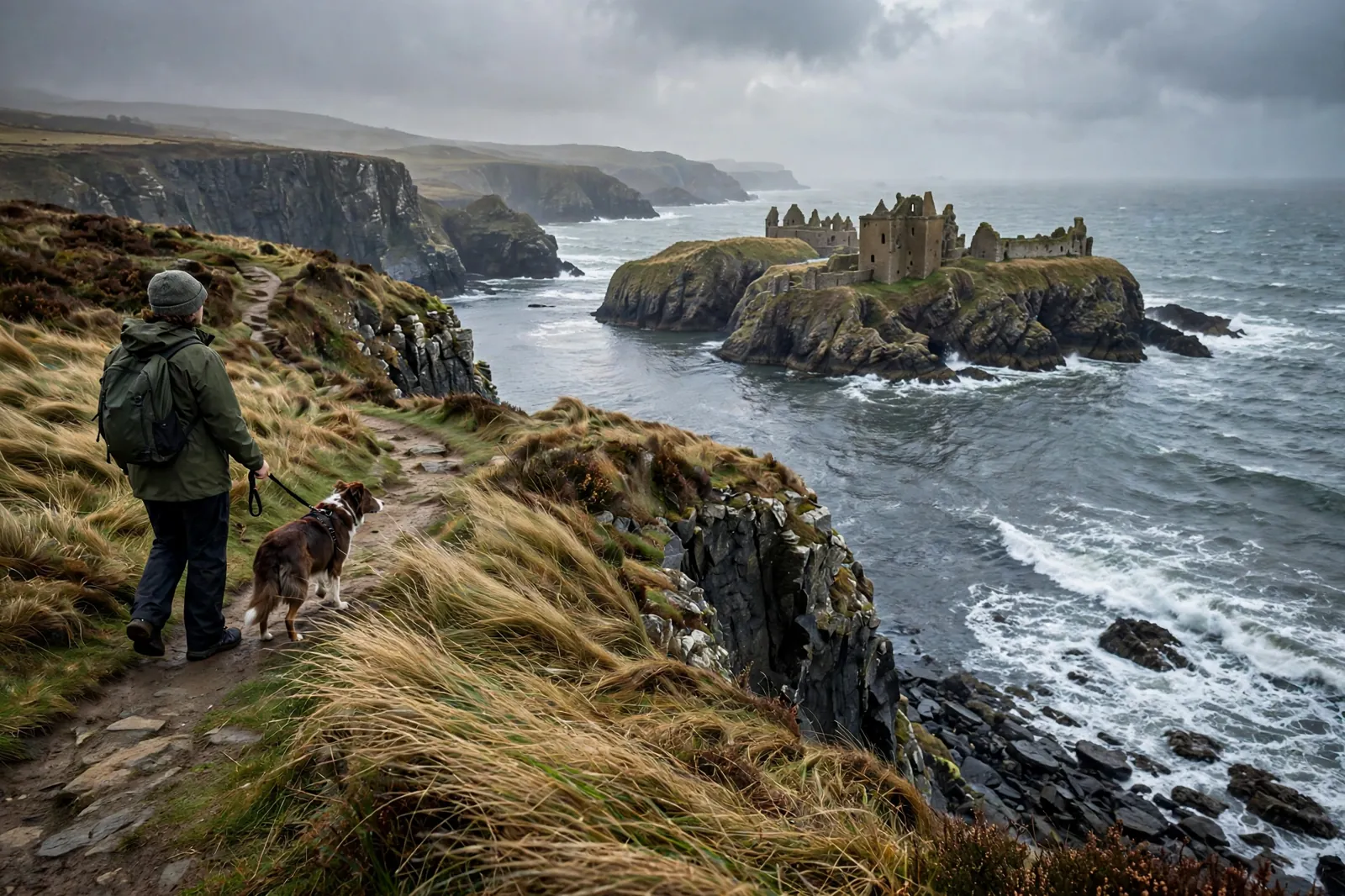
Every section of this guide has circled back to the same theme, so here it is stated plainly, once, in full. The Tintagel coastline is high, slate-built and largely unfenced, and the coast path, the castle island and the headlands all place a walker within a few steps of serious drops for long stretches. Dogs must be kept on leads on the cliffs — not as a courtesy, but as the basic condition of being there. The dangers are specific rather than theoretical. Dogs chase birds, and this coast is full of them: fulmars, kittiwakes and other seabirds nest on the ledges in spring and summer, gulls patrol every picnic spot, and a dog who follows a bird over an edge, or pulls a handler off balance reaching for one, creates an emergency that the inshore lifeboat and coastguard teams along this coast know far too well. Add sudden gusts on exposed headlands, which catch dogs and humans alike, and the lead stops being a rule and becomes the point of the whole visit.
Season by season, the details shift but the discipline does not. In spring and early summer, give nesting birds a wide berth, keep dogs out of the cliff-edge vegetation where nests and chicks may be hidden, and follow any temporary signs or requests around the castle and farmland without argument. In high summer, the risks add heat and crowds: slate and rock hold warmth, shade is scarce on the headlands, and a black-coated dog on an exposed path at midday needs water, pauses and possibly a change of plan to the glen's woodland instead. In warm months adders are present in sunny, sheltered spots along this coast, favouring banks and long grass; keep dogs on the path and out of bracken edges, and know where the nearest veterinary practice is before you need one, because mobile signal on the cliffs and in the valleys is unreliable. In autumn and winter, the Atlantic makes the decisions: storm swell closes beaches in effect if not in law, paths turn to mud and slate to ice-rink, and daylight for a Boscastle-and-back walk simply is not there. Check the forecast for wind as carefully as for rain, because at Tintagel the wind is the weather that matters.
The pastoral rules apply inland of the cliff edge as well. The fields behind the coast path are grazed, gates should be closed behind you, and dogs should be on leads around livestock and on farmland paths, full stop. Take all litter and bagged waste to a bin — bins exist in the village, at the castle valley and at Trebarwith, but stretches of coast path have none, which is a reason to carry a bag for the bag, not a reason to decorate a gatepost. None of this is meant to dampen the place. Tintagel's drama is the reason to come. It is simply drama that has to be watched from the correct side of a short lead, by a handler whose eyes spend more time on the path and the tide than on a phone screen.
Stays, parking and practicalities
There is no parking at the castle itself, and that single fact shapes a Tintagel arrival. Visitors park in the pay-and-display car parks in the village — English Heritage puts the castle around 600 metres from them — and walk down the valley track, which means your day starts with a downhill stroll and ends with the climb back, a detail worth saving energy for. Village car parks fill quickly in summer, on bank holidays and on fine weekends at any season, so arrive early, and read the current charges, time limits and payment methods on the signs when you arrive rather than trusting any figure in any guide. Coaches and day-trip traffic compress the village further at peak times. Dogs, needless to say, never wait in a parked car here or anywhere: not for the castle, not for the Old Post Office, not for a quick pasty.
Staying in or near the village changes Tintagel for the better, because it lets you use the quiet ends of the day that day visitors miss — the castle valley in early light, the coast path with the dog before breakfast, Trebarwith on an evening tide. The village and its surrounding hamlets offer inns and pubs with rooms, bed and breakfasts, self-catering cottages and small sites, with holiday parks in the wider north Cornwall area for those who want them. As always with a dog, the label dog friendly is the start of the conversation, not the end: confirm how many dogs are accepted, any per-dog charge, whether dogs may be left alone in the accommodation and on what terms, and what the nearest safe after-dark walk actually is. In Tintagel the answer to that last question is usually village lanes and pavements rather than anything coastal, because unlit cliff paths after dark are nobody's idea of a toilet walk, however short. Ask, too, about floors and drying space: slate-country walks plus Atlantic weather produce a reliably muddy dog, and hosts here are used to the question.
For supplies and backup, the village covers daily basics, with larger shops in Camelford and the surrounding towns, and buses link Tintagel with its neighbouring coastal villages and towns for one-way coast path walks — check current timetables before relying on one for a return leg, because rural services are infrequent and seasonal. Veterinary cover is in the wider area rather than on the headland, so save the nearest practice's details, including out-of-hours arrangements, in your phone before a long walk, and download maps for offline use while you still have signal. Carry the unglamorous kit that suits this specific coastline: water for the dog, bags, a spare lead, a towel, a small torch outside summer, and a printed or saved note of the day's tide times. At Tintagel, the tide table is not background information. It is the itinerary.
A plan that works: one full day, honestly paced
A good Tintagel day is built backwards from the tide table. Find the day's low tide first and place the Haven and Merlin's Cave around it, because that is the one appointment the sea will not move. On a classic pattern, park in the village early, walk down the valley on a falling tide and give the dog the beach and a careful look into the cave while the water is low, then climb to the castle late morning as the beach closes itself, taking the ruins slowly with water breaks and letting the bridge be crossed once, calmly, in each direction. Lunch belongs back at the valley's café end or in the village, at an outdoor table your dog is welcome at, with the Old Post Office fitted in as a split visit for pairs who want it.
The afternoon offers a genuine choice, and the honest advice is to pick one rather than stack both. Choose the coast path north for Barras Nose, the church on Glebe Cliff and Bossiney Cove on the next low water, with Rocky Valley as the turnaround for stronger walkers; choose the glen instead if the wind is up, the day is hot or the dog has done enough climbing, and take the woodland, the waterfall and the shade of the Trevillet valley as the day's second act. Trebarwith Strand belongs to a second day or a longer stay, paired with the southern path over Willapark, and timed to its own low tide rather than squeezed into an evening because it was on a list. Cornwall's north coast repays that kind of restraint everywhere: the travellers who enjoy it most are the ones who do fewer places at the right state of the tide.
Finish in the village as the day visitors leave, with a last flat pavement circuit, water for the dog and an early supper somewhere that has confirmed it welcomes you both. What Tintagel asks of a dog owner is not complicated, but it is non-negotiable: a short lead on cliffs and castle alike, a tide table consulted before breakfast, a fit dog or an honestly adjusted plan, and the willingness to let one famous building — the Old Post Office — be admired from the street. In return it gives you an island castle your dog can actually enter, a bridge neither of you will forget crossing, and a coastline that looks like the stories people have been telling about it for eight hundred years. For the next base along this coast, compare St Ives with a dog, where the beaches operate on seasonal rules of a very different kind.
Practical questions
Before you go
Can dogs cross the Tintagel Castle bridge?
Yes, under English Heritage's current published guidance dogs are welcome at Tintagel Castle on leads, including on the footbridge to the island, but there are lots of steep steps, exposed cliff edges and nesting birds, so a short lead and a steady pace are essential. Indoor areas, opening arrangements and any temporary restrictions can change, so check the official latest guidance before you go.
Are dogs allowed on the beaches near Tintagel?
The small beach at Tintagel Haven below the castle and nearby Bossiney Cove are generally used by dog walkers, and Trebarwith Strand, about two miles south, is known as a dog-welcoming beach, but all of these beaches change completely with the tide and local seasonal rules can change. Check tide times and the signs at each beach before you go, keep dogs under close control around other beach users, and never let a dog be cut off by a rising tide.
Can dogs go inside Tintagel Old Post Office?
No. Tintagel Old Post Office, the National Trust's medieval house in the village, admits assistance dogs only in the house and garden, so a pet dog cannot join a tour. Plan it as a short split visit between two adults, or view the building from the street, and do not leave a dog unattended in a car while you go inside.
Is St Nectan's Glen dog friendly?
Yes, St Nectan's Glen, a short distance inland from Tintagel near Trethevy, welcomes dogs on leads on its woodland paths and to the waterfall area, according to the venue's current visitor information. The paths are uneven, muddy after rain and slippery near the water, and there is a charge for the waterfall, so wear footwear with grip, keep your dog close and check the official latest guidance before you go.
Where can I park in Tintagel with a dog?
There is no parking at Tintagel Castle itself. Visitors use the pay-and-display car parks in Tintagel village, around 600 metres from the castle entrance, and walk down the valley track from there. Village car parks fill quickly in summer and at weekends, so arrive early, check current charges and time limits on the signs when you arrive, and never leave a dog alone in a parked car.