This guide is independent and contains no paid placement. If affiliate links are added later, they will be clearly marked and will not change our editorial checks.
Check the seasonal dog restrictions for each St Ives beach before you go, because they differ by beach and change by date; use the South West Coast Path, the harbour and the branch-line villages when a beach is closed to dogs, treat Tate St Ives and the galleries as split visits, and arrive by train if you possibly can.
Plan around tides and beach rules, not around sights
Every successful dog trip to St Ives starts with two documents, neither of them a sightseeing list: the current seasonal beach restrictions and the tide times. Cornwall's beaches operate a patchwork of dog rules — some welcome dogs all year, some ban them for the whole summer season, some restrict them only during the middle of the day — and St Ives, with several distinct beaches in a very small town, contains almost every variety within ten minutes' walk. An owner who checks the rules beach by beach, for the exact dates of the trip, can plan each day with confidence. An owner who assumes will spend the holiday being turned away from sand they had promised the dog.
Our national explainer on UK dog-friendly beach rules sets out how these seasonal restrictions usually work and how to read the signs, and the habit it teaches matters more than any memorised list: check the official site before you go, then check the sign at the beach entrance on the day, because local orders change and the sign is the final word. Tide matters almost as much. St Ives' harbour beach all but disappears at high water, the gaps between beaches close off as the tide rises, and coast path walks that are easy at low tide need different timing around cliff sections. A tide table in your pocket is not pedantry here; it is the timetable the town runs on.
The good news is what the restrictions do not close. The harbour quays, the coast path in both directions, the lanes and galleries of the town, the beaches out at Carbis Bay and Lelant reached by path or train, and the year-round walking in the countryside behind the town together make a full holiday in any month. St Ives simply asks you to hold the plan lightly and swap the order of the days to suit the calendar and the water — flexibility that, once adopted, most owners find oddly relaxing.
The St Ives beaches, one by one
Porthmeor, the big surf beach on the Atlantic side beneath Tate St Ives, is the town's sporting beach: lifeguarded in season, popular with surfers and bodyboarders, and subject to seasonal dog restrictions during the main holiday period — typically a summer ban during daytime hours or the full season, so check the official site before you go for the current dates and hours. Out of season it is a magnificent dog beach, all space and weather. Porthminster, the sheltered, palm-fringed beach on the bay side below the station, is the gentle alternative for swimming and sand time, and it too operates seasonal dog restrictions in the busiest months. Treat both beaches' rules as date-specific facts to verify, never as folklore.
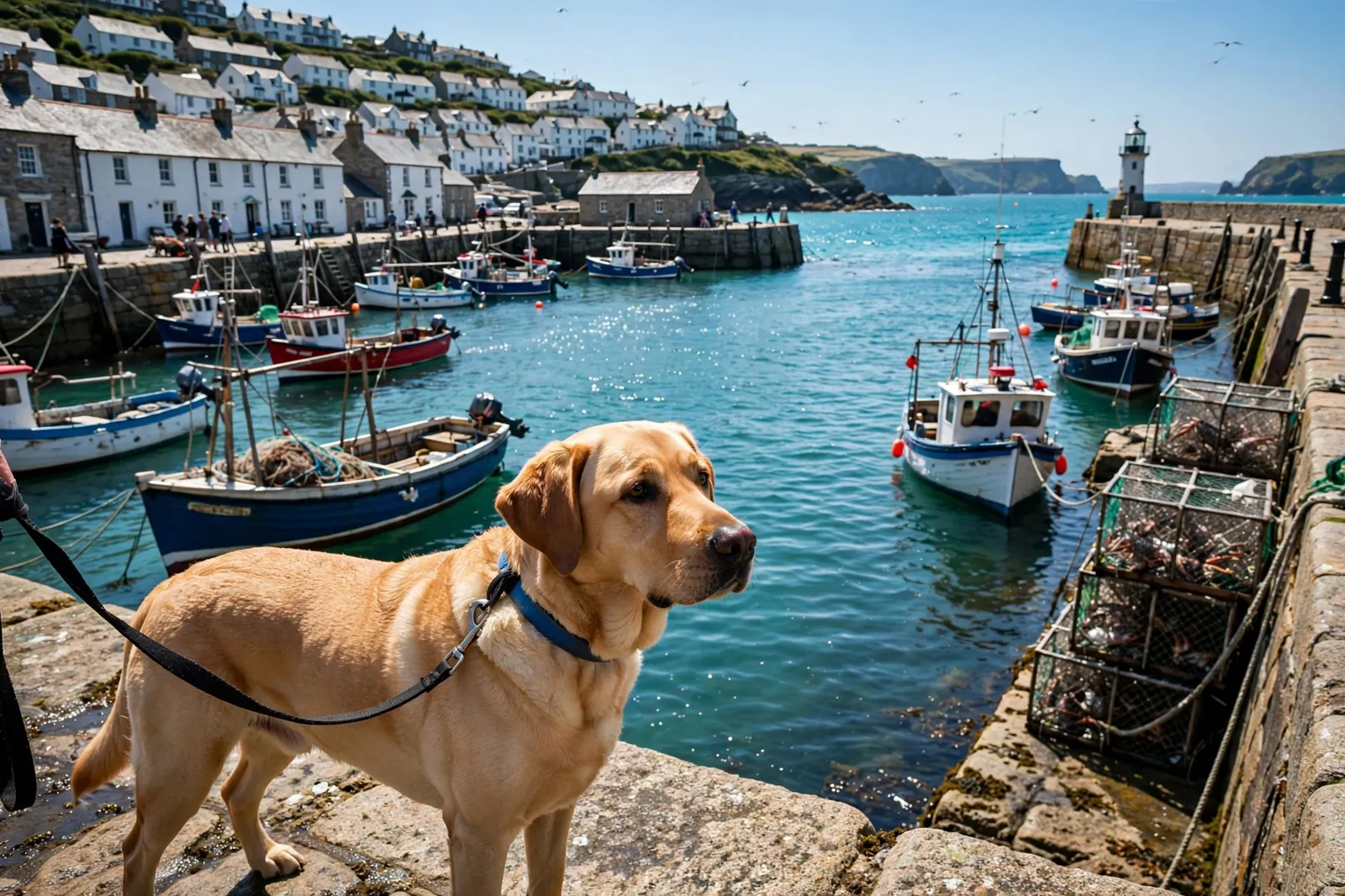
The smaller beaches reward local knowledge. The harbour beach, inside the piers, is working harbour as much as beach: it appears at low and mid tide, sits among boats and lobster pots, and its dog position follows the harbour and seasonal rules — verify before relying on it, and keep dogs on leads among the working gear whatever the beach rule says. Porthgwidden, the little cove below the Island car park side, and Bamaluz, the small beach tucked by the harbour wall that locals favour, each have their own arrangements and their own loyal followings; both are at their best outside peak hours. The Island itself — the grassy headland between Porthmeor and the harbour — is open, breezy dog-walking ground with views in every direction, ideal when the sand is out of bounds.
Beyond the town, the choice widens. Carbis Bay, one stop or one coast-path mile east, has its own seasonal restrictions. Further east, the long sands toward Hayle and Gwithian open into miles of beach where dog rules vary by section and season — some stretches welcome dogs year-round — and this is where many St Ives-based owners head for a guaranteed big beach run in summer. Westward the coast path grows wilder and the coves smaller. Wherever you swim, respect the Cornish sea: rip currents at surf beaches, slippery rocks and weed at low tide, and no official lifeguards outside the main season. Dogs should swim only where you would, and harbour water, with its boats and fuel, is for nobody.
The South West Coast Path in both directions
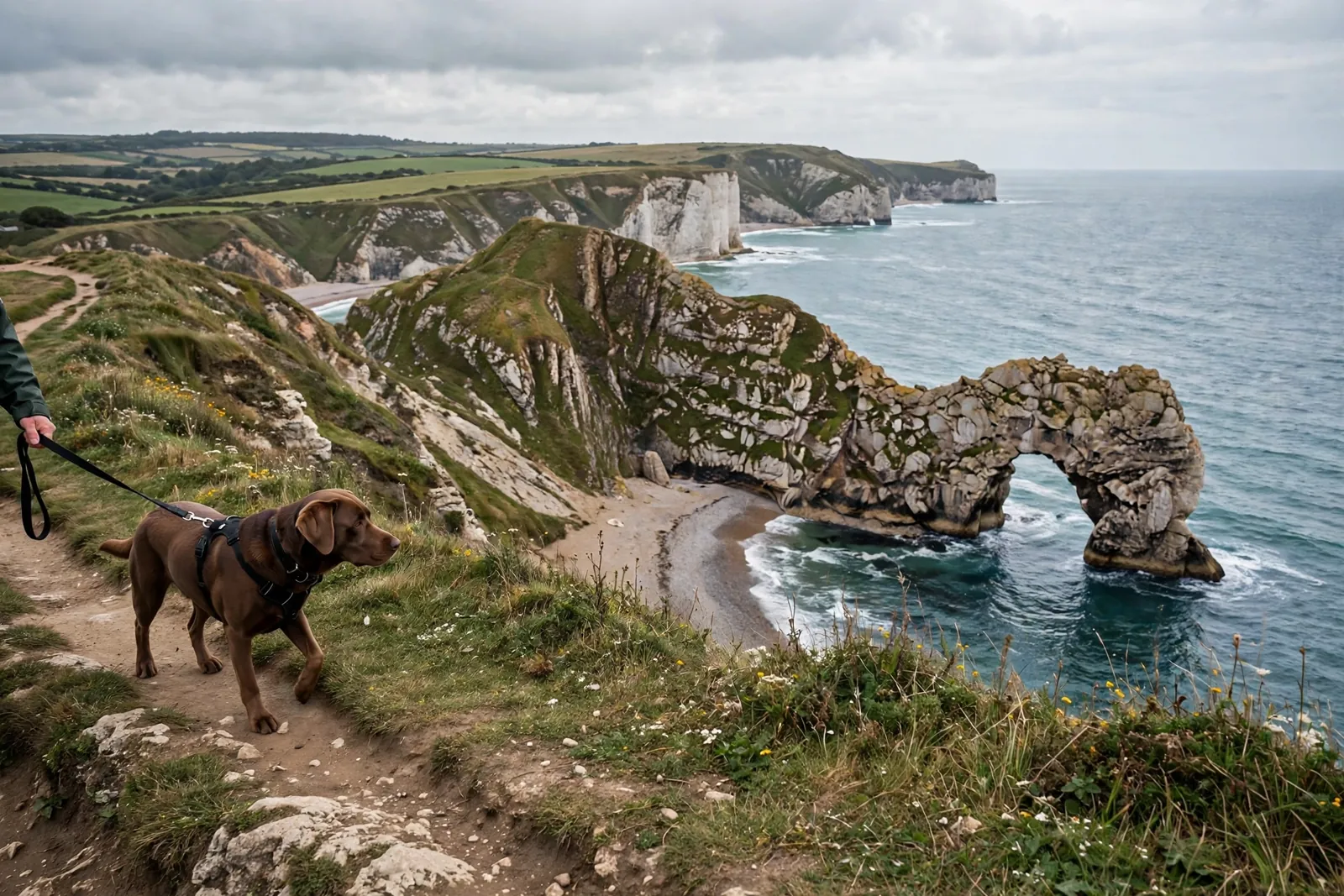
When the beaches say no, the coast path says yes, and from St Ives it is superb in both directions. East, the path runs to Carbis Bay and on to Lelant, where the church, the saltings and the long Hayle estuary sands begin: a half day of headlands, coves and railway-adjacent walking that can be turned into a one-way trip by returning on the branch line. The path is well waymarked and mostly well surfaced, but it is a cliff path — narrow in places, unfenced in others — so dogs belong on a lead or a long line under close control near edges, whatever their usual freedom, and extending leads have no place on it.
West, the path sets off toward Zennor and becomes some of the wildest walking in lowland England: granite cliffs, Iron Age field patterns, hidden coves and very little company after the first mile. It is glorious and it is serious — no water, no facilities, no shortcuts back to the road for long stretches, and phone signal that comes and goes. Carry water for the dog as well as yourself, start early in summer heat, and be honest about distance: Zennor is a full expedition for most dogs, and turning back at a chosen headland with energy in reserve is the mark of a good day, not a failed one. Seals rest in some coves along this coast; a dog off a lead near a hauled-out seal is a wildlife incident, so leads on whenever you drop toward the water.
Shorter path sections serve daily needs too. The walk out to Clodgy Point, west of Porthmeor, gives a proper breezy hour without committing to Zennor. The harbour-to-Carbis Bay stretch gives an easy scenic leg-stretch that combines with the train. And the countryside paths behind the town — up toward Knill's Monument and into the lanes and fields inland — provide the grass, shade and quiet that pure coastal walking sometimes lacks, particularly on hot or stormy days when the cliffs are best admired from a distance.
Harbour, lanes and the gallery split visit
St Ives town itself is a pleasure with a dog at the right tempo. The harbour front, the lifeboat station area and the piers are made for lead walking and people-watching, and the web of lanes behind — the Fore Street shops, the artists' quarter around the Island, the fishermen's cottages of the Downalong — rewards slow exploring. Two cautions come with the territory. The lanes are steep, cobbled in places and extremely full at peak times, so early and late visits suit dogs best. And the town's gulls are bold, practised food thieves: a pasty or ice cream held at dog height, or a dog left tied outside a food shop in gull territory, invites a dive-bombing incident that is comic only in retrospect. Eat with your back protected, keep food high, and never feed the birds.
The art that made St Ives famous lives mostly indoors, and its flagship venues follow the familiar pattern: Tate St Ives, in its striking building above Porthmeor, and the Barbara Hepworth Museum and Sculpture Garden in the town are ticketed interiors where pet dogs should be expected to stay outside — check the official site before you go for the current policy at each, as arrangements can change. The split visit works gracefully here: one person takes the gallery while the other walks the Island, Porthmeor's promenade at permitted times, or the harbour with the dog, then swap or reunite for lunch. Smaller commercial galleries vary; many welcome a quiet dog, but asking at the door is both polite and necessary in spaces full of fragile work.
For more on planning around heritage and gallery rules in this county, our guide to dog-friendly holiday parks in Cornwall covers bases across the area, and the wider lesson of St Ives applies everywhere in it: the indoor list is the flexible part of the day, and the dog's walks, tides and meals are the fixed points to build around. Owners who accept that order rarely have a bad day here.
Where to stay with a dog in St Ives
St Ives accommodation divides into three broad kinds, each with a dog trade-off. Hotels and guest houses in the town put the harbour and beaches at your feet but often involve steep lanes, limited parking and rooms up stairs. Self-catering cottages in the old town are atmospheric and give you a routine of your own, yet many have no outside space beyond a courtyard and sit on gradients that test older dogs several times a day. Bases in Carbis Bay, Lelant or the villages just inland trade a short walk or train ride for space, quieter nights, easier parking and often a proper garden — for many dogs, especially reactive or elderly ones, that trade is the making of the holiday.
Wherever you choose, ask the dog questions precisely and in writing: which rooms or properties accept dogs, the fee and any size or number limit, whether dogs may join you in dining areas, whether a dog may be left alone and under what conditions, and what the nearest practical grass is for the first and last walks of the day. Steep-site honesty matters here more than almost anywhere: a beautiful cottage up a 1-in-4 lane is a poor match for a dog with arthritis, however good the sea view. Our national guide to dog-friendly hotels in the UK lists the full checklist that applies to guest houses and hotels alike.
Book earlier than feels necessary. St Ives is one of the most in-demand small towns in Britain, its dog-welcoming rooms and cottages are a subset of a small stock, and school-holiday and summer dates go first — the owners who secure the well-located, genuinely dog-suitable places are the ones who booked in winter for summer. Bring the settling kit that makes any base work: familiar bedding, a chew for the first evening, a towel and paw-wiping routine for sand — sand will get everywhere, in the car, the bed and the dog's ears, and planning for it beats fighting it — and bags in every coat for a town that takes its cleanliness seriously.
Seafood, pasties and pubs with a dog
Eating is one of St Ives' great pleasures, and a good share of it is available with a dog if you choose your formats well. Harbourside pubs and cafes with outdoor seating are the natural dog venues: a walked dog settled under a table on the quay, seafood for the humans, a bowl of water arriving without being asked for at the best places. Indoor welcomes vary — small seafood restaurants with tight seating are the least likely to take dogs, traditional pubs the most likely — so confirm each venue's current policy before you build an evening around it, and favour early sittings, when staff have time and dogs have space. Our UK dog-friendly cafes guide covers the etiquette that keeps these welcomes warm, from mats on floors to leads out of walkways.
Cornwall's portable food culture is the dog owner's friend. Pasties, crab sandwiches, fish and chips and ice cream all travel, and the town picnics wonderfully: the Island's grass, the harbour wall at quieter moments, Porthminster's surroundings outside restricted hours, or a coast path bench with the bay below. This is gull country, though, so picnic defensively — eat in the open rather than under gull perches, keep food covered between bites, clear every scrap, and never leave a dog guarding food. A dog who learns that St Ives means snatched chips is a dog who will lunge at every wrapper for the rest of the week.
Carry the small kit that makes eating out smooth — portable bowl, water, a chew for waits, and a lightweight mat, because harbour quays and pub yards are hard, draughty places for a dog to lie for an hour. If your dog cannot settle around food smells and other diners, lean into the takeaway-and-viewpoint pattern without a hint of apology: many regulars consider a pasty above the harbour, with the dog asleep in the sea air, the finest table in town.
Arriving by train, and the parking truth
The single best decision most St Ives visitors make is not to drive into St Ives. The town's streets were built for feet and carts, its car parks are few, small and famously contested in season, and the approach roads queue on changeover days. The alternative is one of Britain's prettiest railway journeys: the branch line from St Erth, on the main line, hugs the coast past Lelant and Carbis Bay into St Ives station above Porthminster beach. Dogs travel on trains under the usual national conditions — see our guide to taking a dog on UK trains — and the branch line turns arrival into the first scenic walk of the holiday. Park at St Erth or arrive by mainline train, and let the car question disappear.
If you do bring a car — for a cottage base outside the town, or for day trips along the coast — plan its life honestly. Expect to park once, in your accommodation's space or a booked arrangement, and walk or ride for the rest of the stay; moving a car around St Ives in season is a hobby nobody enjoys. Check the official site before you go for current parking arrangements, park-and-ride options and charges, as these change. For exploring, the open-top and local bus routes along the coast are popular, and dogs are generally carried at the driver's discretion on leads and off seats; the coast path plus branch line combination covers the St Ives to Lelant stretch more beautifully than any road.
Within the town, your legs and the dog's set the rhythm. Distances are tiny but gradients are not: the drop from the station and upper town to the harbour, and the climbs back up to Carbis Bay side or the Island, add up across a day, especially for older dogs. Build the day downhill-out, uphill-home only if the dog is fit for it, and use the town's benches and harbour walls as the rest stops they naturally are. St Ives on foot, at dog pace, is not a compromise — it is how the town was designed to be seen.
Seasons, weather and a working kit list
St Ives changes character completely with the calendar, and choosing your season is choosing your holiday. Late spring and early autumn are the connoisseur's choice for dogs: the sea is warming or still warm, the light that made the town famous is at its best, crowds are present but breathable, and — the decisive fact — many seasonal beach restrictions have not started or have just ended, reopening the town's sand to dogs. High summer brings the full festival atmosphere, the busiest lanes and the strictest beach rules; it can still work beautifully with coast path mornings, harbour evenings and day trips to year-round beaches, but it must be planned, not improvised. Winter is the locals' St Ives — storm-watching from the harbour, empty beaches fully open to dogs, galleries and pubs at their cosiest — with short days and Atlantic weather as the price.
Atlantic weather deserves respect in every season. Conditions on the coast path change fast, cliff edges in high wind are no place for a dog at all, and the sea around St Ives is powerful even when it looks inviting; dogs should swim only in calm conditions at suitable beaches, never in surf or near harbour entrances, and should be kept clear of cliff edges and slippery rocks in all weathers. After storms, paths can be damaged or diverted — follow local signs and check the official site before you go for coast path notices if you are planning the longer western sections.
Pack for a working coastal holiday: a lead you trust on cliffs plus a long line for safe open ground, a harness for path scrambling, towels in quantity, a drying coat, fresh water and a bowl on every walk, and paw checks after rock and shingle. Save the number of a local veterinary practice before you need it, and note the out-of-hours arrangement, because coastal Cornwall's services are spread out. Finally, hold the itinerary loosely. The owners who love St Ives with a dog are the ones who let the tide and the beach calendar shuffle their days — and discover that the shuffled version was better than the plan.
Practical questions
Before you go
When are dogs banned on St Ives beaches?
The main St Ives beaches, including Porthmeor and Porthminster, operate seasonal dog restrictions during the busiest months, and the exact dates and hours vary by beach and can change. Some smaller beaches and nearby stretches have different rules. Check the official site before you go for the dates of your trip, and always follow the sign at each beach entrance.
Are dogs allowed in Tate St Ives and the galleries?
Pet dogs should be expected to stay outside Tate St Ives and the Barbara Hepworth Museum, which are ticketed indoor venues; check the official site before you go for each venue's current policy. Many smaller commercial galleries welcome a quiet dog, but ask at the door. Travelling pairs usually split the visit while the other person walks the dog around the Island or harbour.
Can dogs travel on the St Ives branch line train?
Yes, dogs can travel on the branch line from St Erth to St Ives under the usual national rail conditions, on a lead and off the seats. It is one of the most scenic short rail journeys in Britain and the easiest way to arrive without a car. Travel outside the busiest services where you can, and keep aisles clear for other passengers.
Where can I exercise my dog in St Ives in summer?
The South West Coast Path in both directions, the grassy Island headland, the harbour quays on a lead, and the countryside paths behind the town all work in summer when the main beaches are restricted. For a big beach run, head east toward the Hayle and Gwithian sands, where some stretches welcome dogs year-round — check the rules for the specific stretch before you go.
Are the seagulls in St Ives really a problem with dogs?
St Ives gulls are bold and practised at snatching food, so eat outdoors with care: keep food high and covered, never leave a dog tied up with food nearby, clear every scrap, and never feed the gulls. Dogs generally ignore the birds, but a dog lunging at gulls around harbour edges and food areas needs a short lead and a watchful handler.