This guide is independent and contains no paid placement. If affiliate links are added later, they will be clearly marked and will not change our editorial checks.
Tobermory is one of the most dog-friendly towns on the Isle of Mull: the harbour front is a short, flat, lead-friendly stroll past painted houses and fishing boats, the distillery and many cafes welcome dogs in at least some areas, and wildlife boat trips, woodland walks and quiet beaches are all within easy reach. Arrive by ferry, keep the dog on a lead around the harbour and livestock, and check the official guidance before you travel for current tour, boat and distillery policies.
Getting to Tobermory with a dog
The first thing to understand about Tobermory is that you cannot drive to it without crossing water. The town sits at the northern end of the Isle of Mull, in the Inner Hebrides off the west coast of Scotland, and every route in involves a ferry. That sounds like a complication, but for most dog owners it is the easiest part of the trip: the crossings are short, the ferries are used to dogs, and the island roads beyond the port are quiet enough that the drive itself becomes part of the holiday.
The main crossing is from Oban on the mainland to Craignure on Mull, operated by CalMac. The sailing takes around 45 minutes, and from Craignure it is roughly a 50-minute drive north to Tobermory along the A848, a single-carriageway road that winds past Loch na Keal and through Glen Aros. Book the ferry in advance, especially if you are travelling with a car in summer, school holidays or over a bank holiday weekend, because sailings do fill up. Dogs travelling in cars usually stay in the vehicle for the crossing, while foot passengers can keep a dog on a lead in the passenger areas; check the official guidance before you travel, because the exact rules differ by vessel and can change.
Two shorter crossings are worth knowing about. The Fishnish to Lochaline ferry crosses the Sound of Mull in about 15 minutes and suits drivers coming from the north or from the Ardnamurchan peninsula, while the Tobermory to Kilchoan ferry links the town directly with the Ardnamurchan mainland, which is handy if you are combining Mull with a wider Highland trip. Both are smaller, more frequent services, and both are straightforward with a dog. Our guide to dogs on UK ferries explains how crossings work in practice, including where dogs spend the journey, what operators charge and how to settle a nervous dog before boarding.
If you are travelling without a car, buses run from Craignure to Tobermory and connect with the main ferry sailings, but services are infrequent and timetables change with the season, so check the official guidance before you travel and allow plenty of time. Tobermory itself is compact and walkable, so once you arrive you will barely need transport within the town. The practical point for dog owners is to plan the journey as a single relaxed chain: a calm morning drive to Oban, a short crossing, then a slow drive north with a stop or two for the dog to stretch its legs. Mull's roads are mostly single track with passing places once you leave the main route, so drive slowly, expect sheep and oncoming vehicles around blind bends, and never let a dog out of the car beside a road without a lead.
Timing matters too. Mull's weather changes fast, and a calm, bright morning can turn wet and windy by afternoon. That is not a reason to avoid the island — it is a reason to build slack into the day. Arrive early, give the dog a proper walk before the ferry, and treat the crossing as a rest break rather than a race. If the dog is a poor traveller, a short practice run on a local ferry or a car journey of similar length before the holiday will tell you more than any amount of reading.
The colourful harbour walk
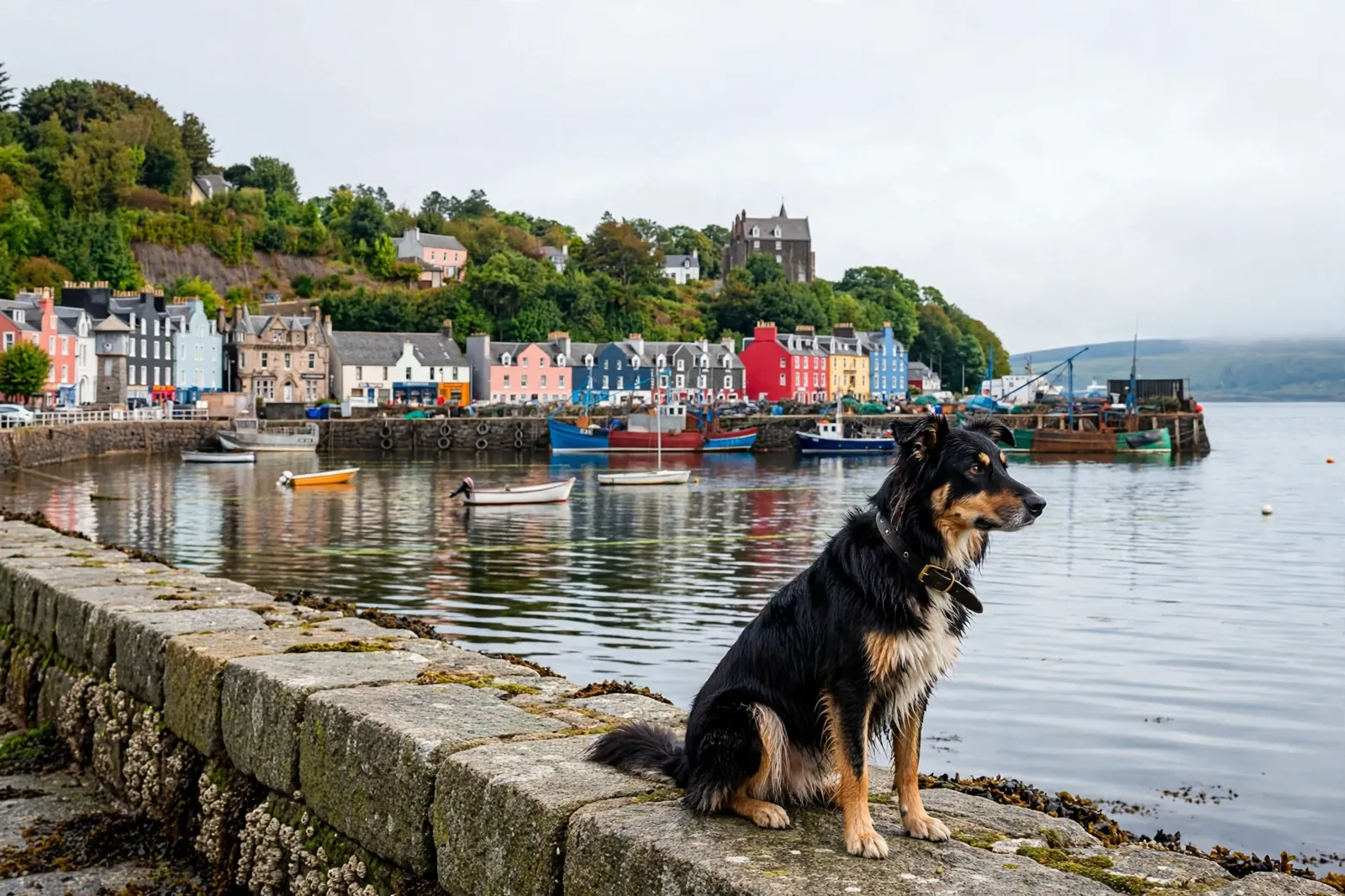
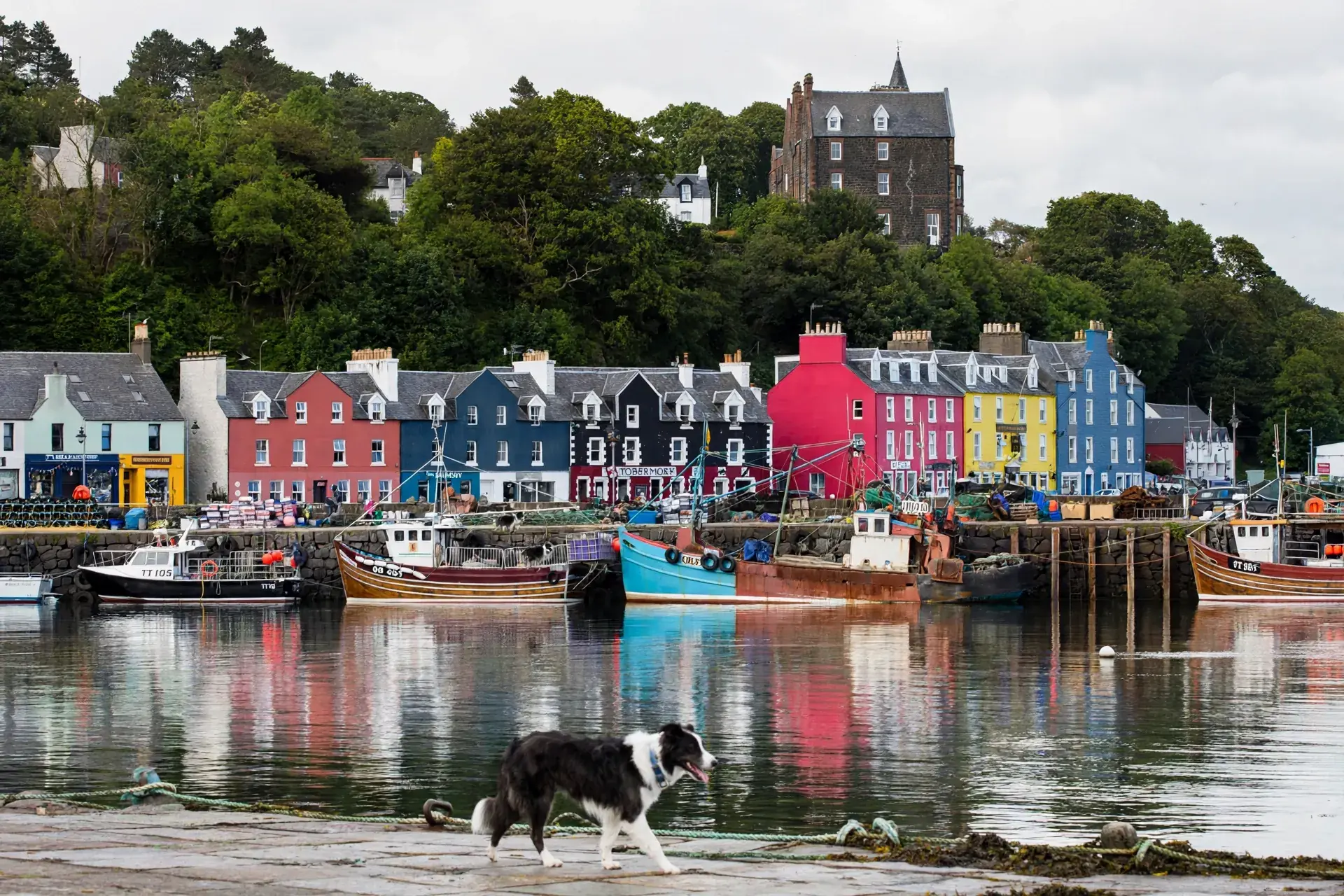
Tobermory's famous view is the row of brightly painted houses along the waterfront, their colours reflected in the still water of the harbour on a calm day. The houses are painted in reds, yellows, blues and greens, and the effect is strongest in the early morning, when the light is low and the harbour is quiet, or in the late afternoon, when the fishing boats come in. It is the view that appears on postcards and television — the town was the setting for the children's programme Balamory — but in person it is smaller, quieter and more working than the pictures suggest. Fishing boats still use the harbour, creels are stacked on the pier, and gulls work the water alongside the pleasure craft.
The harbour front is the best first walk with a dog in Tobermory. Start at the pier and follow the waterfront along Main Street, where the painted houses face the water, then continue past the shops and cafes towards the northern end of the bay. The route is flat, paved and short enough for an older dog, and it gives you a proper sense of the town in about twenty minutes. Keep the dog on a lead throughout: the harbour edge is unfenced in places, the road runs close to the water, and delivery vans and fishing vehicles use the pier. A dog that lunges at gulls or tries to drink from the harbour will need a firm hold, and the water itself is not safe for swimming.
Look out for the details that make the walk more than a photo stop. The Tobermory Distillery sits at the southern end of the harbour, the clock tower stands above Main Street, and the small beach at the northern end of the bay is a good place to let a dog paddle on a long line when the tide is out, provided you check for broken glass and fishing debris first. The harbour is also a good place to watch for wildlife without leaving town: seals sometimes haul out on the rocks or follow fishing boats in, and otters have been seen along the shore at dawn. Binoculars are worth carrying even on a short walk, and a quiet dog that can settle and watch is more likely to be rewarded than one that barks at every boat.
Practical points are simple but worth stating. There is no dedicated dog exercise area on the harbour front, so treat it as a lead walk rather than a run. Pick up after your dog — the town is small and the pavements are narrow, and locals notice. Water is available from cafes and shops if you ask, but carry your own bottle and a collapsible bowl on warm days. In summer the harbour front can be busy with day visitors, so walk early or late if your dog is reactive, and be ready to step aside for pushchairs, wheelchairs and other dogs on the narrow pavement.
Whisky in Tobermory: visiting the distillery with a dog
Tobermory Distillery has been making whisky on the harbour since 1798, which makes it one of Scotland's oldest commercial distilleries, and it produces two distinct single malts: the unpeated Tobermory and the peated Ledaig. The distillery building is a landmark in its own right, a tall white building with a chimney that dominates the southern end of the waterfront, and a visit here is the natural counterpart to the harbour walk — the town's two most famous sights face each other across the same stretch of water.
For dog owners, the honest position is that a distillery is a working industrial building, and dogs are not part of the production tour. The visitor centre and shop welcome dogs in some areas, but dogs are not usually allowed inside the production areas or on the guided tour itself, and that is unlikely to change. Check the official guidance before you travel for the current policy, because opening hours, tour times and dog rules can vary with the season, and the distillery sometimes closes for maintenance or private events.
That does not mean you have to skip it. The simplest approach for a couple or a group is to take turns: one person takes the tour while the other walks the dog along the harbour or settles in a nearby cafe, then swap notes over a tasting in the shop, where you can buy a bottle to take home. If you are travelling alone with a dog, plan the visit around the shop and the waterfront rather than the full tour, and ask the staff what is possible on the day — they deal with dog owners constantly and will tell you plainly what is and is not allowed. A well-behaved dog on a lead is generally welcome in the outdoor areas, and the distillery's position at the end of the harbour makes it an easy stop on a longer walk.
Buying whisky as a souvenir is straightforward, but think about the journey home. Bottles are heavy and breakable, so pack them in the middle of your luggage, wrapped in clothing, or ask the shop about packaging for travel. If you are flying home from Scotland rather than driving, check your airline's liquid rules before you buy. And remember that the ferry crossing back to the mainland is short, so a bottle bought in Tobermory will be home long before you have finished telling people about the trip.
Beyond the distillery itself, Tobermory's whisky connection runs through the town's pubs and restaurants, several of which stock local malts and can talk knowledgeably about them. Asking a bartender for a recommendation is a better education than any label, and a dog settled under the table is usually welcome company. If you want to learn more about the island's whisky before you go, our wider guide to the Isle of Mull with a dog covers how to plan a longer stay that takes in the distillery alongside beaches, walks and wildlife.
Wildlife watching from Tobermory
Mull is one of the best places in Britain to see wildlife, and Tobermory is a good base for it. The island is famous for its white-tailed eagles, the largest birds of prey in the UK, which were reintroduced to Scotland and now breed on Mull. Golden eagles, hen harriers, short-eared owls and divers are also regularly seen, and the sea around the island holds seals, porpoises, dolphins and, in summer, minke whales and basking sharks. Otters are the animal most visitors hope for and least often see: they are present around the island's shores, but they are shy, mostly active at dawn and dusk, and they reward patience and stillness more than enthusiasm.
Boat trips from Tobermory are the most reliable way to see marine wildlife. Operators run trips to the Treshnish Isles, to Staffa and Fingal's Cave, and dedicated whale-watching and wildlife cruises around the island's coast. A trip to Staffa is the classic day out: the basalt columns of Fingal's Cave are extraordinary, and puffins nest on the Treshnish Isles in summer. Whether your dog can come along depends on the operator, the vessel and the season. Some operators welcome well-behaved dogs on board, others do not, and policies can change between years, so ask directly when you book and mention your dog's size, temperament and experience with boats. Bring a lead, water, a towel and something for the dog to lie on, and be honest with yourself about whether your dog will cope with several hours on a boat in open water. A seasick or frightened dog is miserable company, and there is no way off a boat mid-trip.
Land-based wildlife watching is just as rewarding and much easier with a dog. The shores around Tobermory, the lochs of central Mull and the cliffs of the west coast all repay slow, quiet walking with binoculars. White-tailed eagles are most often seen over the lochs and along the coast, and the Mull Eagle Watch hide at Loch Frisa, run in partnership with the RSPB, offers guided viewing in season — check the official guidance before you travel for opening times and booking, as the hide operates only at certain times of year. Seals are common around the harbour and along rocky shores, and they are best watched from a distance: a dog that barks at seals will scare them off and may put itself at risk on slippery rocks.
The rules for wildlife watching with a dog are straightforward but non-negotiable. Keep the dog on a lead near nesting birds, seals and otters, and never let it chase or approach wildlife. During the breeding season, roughly spring and early summer, ground-nesting birds are especially vulnerable on moorland and coastal grass, so stick to paths and keep the dog close. Clean up after your dog, carry water, and remember that a dog that has spent the morning watching otters from a hide has had a better day than one that has spent it barking at every bird. Mull rewards the patient, and Tobermory is the right place to learn that lesson.
Walks from the town
Tobermory is small enough to walk across in minutes, but the walks that start from the town are among the best on Mull. The most popular is the trail through Aros Park, a wooded area just south of the town with waymarked paths, a waterfall and views back across the bay to Tobermory. The paths are well maintained, the woodland is sheltered on windy days, and the waterfall at the head of the park is a good destination for a dog that likes water. Allow an hour to ninety minutes for a relaxed loop, longer if you stop to watch for red squirrels and woodland birds, and wear proper footwear: the paths can be muddy and slippery after rain, and the steps down to the waterfall are steep in places.
North of the town, the coastal path to Rubha nan Gall lighthouse is a longer and wilder walk. The lighthouse stands on a rocky point about two miles from Tobermory, and the path follows the shore through woodland and open ground with views across the Sound of Mull to the Ardnamurchan peninsula. It is a beautiful walk on a clear day and a testing one in wind and rain, so check the forecast, wear layers and carry water for the dog. The lighthouse itself is not open to visitors, but the point is a good place to watch for seabirds, seals and porpoises, and the return journey along the same path feels different as the light changes. Keep the dog on a lead for the sections that pass through farmland and near livestock, and be careful on the rocky shore, where wet rock is slippery and the tide can cut off sections of the beach.
For a shorter option, the walk to Ardmore Point, south of the town past the distillery, follows the shore to a quiet headland with views back to Tobermory and across to the mainland. It is an easy, level walk that suits an older dog or a morning stretch before breakfast, and it is a good place to let a dog paddle on a long line when the tide is right. Further afield, the island's best-known beaches are a drive away: Calgary Bay on the west coast is a wide sweep of white sand with a car park, toilets and a cafe, and it is popular with dog owners outside the busiest summer weeks. Check local signs and seasonal restrictions before letting your dog off lead on any beach, and remember that Mull's beaches are working shores as well as playgrounds — fishing gear, ropes and driftwood are common, and livestock graze the dunes behind several of them.
Whatever walk you choose, the same practical rules apply. Carry a lead, a long line for safe off-lead time, water and a bowl, poo bags and a towel. Mull's weather changes quickly, so pack a waterproof layer for yourself and a drying coat for the dog, and be ready to cut a walk short if the wind picks up or the rain sets in. Tell someone where you are going if you are walking alone in a remote area, and keep your phone charged: mobile signal is patchy on parts of the island, and you cannot rely on it in every glen. The island rewards walkers who plan for the weather they might get, not just the weather they can see.
Eating and drinking with a dog
Tobermory's food scene is small but good, and it works well for dog owners. The town has cafes, a bakery, fish and chip shops, restaurants and pubs, most of them clustered around the harbour front, and several welcome dogs indoors as well as on outdoor seating. The general pattern is that cafes and pubs are more dog-friendly than formal restaurants, and that a dog settled quietly under a table is welcome in far more places than a dog wandering between tables. Look for the dog-friendly sign on the door, ask before you settle in, and keep the dog on a lead with its bed or blanket so it has a defined place to lie down.
Breakfast and lunch are the easiest meals. Cafes around the harbour serve breakfast, coffee, cakes and light lunches, and many of them put out a water bowl for dogs without being asked. The town's bakery is a good stop for a takeaway picnic, and fish and chips eaten on the harbour wall is a Tobermory tradition — just keep the dog well away from hot food and from other people's meals, and do not feed it chips or battered fish, which are too salty and fatty for most dogs. For a fuller meal, the pubs and restaurants around the harbour serve local seafood, including langoustines, scallops and locally caught fish, and several of them welcome dogs in the bar area even when the dining room is dog-free. Check the official guidance before you travel for current opening hours, because many places reduce their hours outside the summer season, and some close entirely in the depths of winter.
Picnics are the dog owner's secret weapon in Tobermory. The town has a small supermarket and a handful of delicatessens and food shops, so you can stock up on bread, cheese, fruit and cold meats and eat on the harbour, in Aros Park or on a beach, with the dog beside you and no booking required. A picnic also solves the problem of a dog that cannot settle in a busy restaurant: the dog gets a walk, a swim and a share of the sandwich crusts, and you get the view without the noise. Pack a blanket, a water bottle and a bowl, and take all your rubbish home — Mull's beaches and parks have limited bins, and food waste attracts gulls and rats.
One more practical point: Tobermory is a small town on an island, and its food supply depends on the ferry. If a sailing is cancelled in bad weather, the supermarket shelves can empty quickly and restaurants may run out of popular dishes. That is not a disaster — it is a reminder to shop early, keep a spare meal in the car or the cottage, and carry emergency dog food and treats even on a short trip. Our guide to dog friendly cafes in the UK has more general advice on cafe etiquette, including how to ask about dog policies and how to help a nervous dog settle indoors.
Where to stay with a dog
Tobermory has a good range of dog-friendly accommodation for a town of its size: self-catering cottages, bed and breakfasts, a hotel, a hostel and a campsite, with more options in the villages around the island. Self-catering cottages are usually the best choice for dog owners, because they give you a kitchen, a private space for the dog and a garden or yard where the dog can go out last thing at night without a walk through shared corridors. Look for cottages with an enclosed garden or a fenced yard, a hard floor in the living area that is easy to clean, and a washing machine for muddy towels. Ask about the garden boundary before you book: a low wall or a hedge with gaps is not secure for a small or determined dog, and a cottage advertised as having a garden may in practice have a shared lawn.
Bed and breakfasts and hotels in Tobermory vary in their dog policies. Some welcome dogs in all rooms, others allow dogs only in selected rooms or only in the bar and lounge, and a few do not accept dogs at all. Always confirm the policy for your specific room and dates, and get it in writing with any pet charge itemised. A typical pet charge for a hotel or bed and breakfast is a flat fee per night or per stay, and you should also ask about the rules: whether the dog can be left alone in the room, whether dogs are allowed at breakfast, and where the nearest toilet area is at night. A hotel that welcomes dogs at breakfast is worth more than a slightly cheaper one that does not, because it means the whole family eats together.
Camping and caravanning are popular on Mull, and the campsite near Tobermory is a good base for a dog-owning family. The advantages are obvious: the dog sleeps beside you, there are no neighbours to disturb through a wall, and the morning walk starts at the tent door. The disadvantages are equally obvious: Mull's weather is unpredictable, midges can be fierce in still summer evenings, and a wet dog in a small tent is a test of any relationship. If you camp, bring a drying coat, a raised bed to keep the dog off the groundsheet, and a long line and a stake or a secure tie-out point for meal times. Check the campsite's dog rules before you book — most allow dogs on leads, some charge a small fee, and a few restrict dogs from certain areas.
Booking early is essential, especially for summer. Tobermory is small and its best dog-friendly cottages and rooms are booked months ahead for July and August, and the ferry booking and the accommodation booking need to be planned together: there is no point in a ferry ticket if there is nowhere to sleep. Book the accommodation first, then the ferry to match, and keep both confirmations in one place. If your dates are flexible, May, June and September offer the best balance of weather, availability and price, with quieter roads, fewer midges than high summer and beaches that are free of the summer crowds.
Practical details: parking, vets, weather and tides
Parking in Tobermory is limited, and it is worth understanding before you arrive. There is a car park in the town and on-street parking around the harbour, but spaces fill up quickly on a sunny summer day, and the streets are narrow, so a large car or a car with a roof box needs care. Park considerately, never block a passing place, a driveway or a loading bay, and do not leave a dog in a parked car in warm weather — even on a cloudy day, a car in direct sun can heat up dangerously fast, and Mull's summer sun is stronger than visitors expect. If you cannot take the dog with you, leave the car in shade with the windows open, or better still, rearrange the plan so the dog comes along.
Veterinary cover on Mull is limited to a small number of practices, with the nearest in Tobermory itself. Save the practice number and opening hours in your phone before you travel, and carry your dog's medication, vaccination record and a basic first-aid kit, including a tick remover, bandages and any regular medicine. Ticks are common on Mull, especially in bracken and long grass from spring to autumn, so check your dog after every walk and remove any ticks promptly. Out-of-hours cover on an island can mean a longer wait or a journey to the mainland, so a minor problem dealt with early is always better than a major one dealt with late. If your dog has a chronic condition, talk to your own vet before the trip about what to do if it flares up on the island.
Weather and tides deserve a paragraph of their own, because both shape a Tobermory day more than the calendar does. Mull's weather is changeable at any time of year: sunshine, rain and wind can all appear in a single afternoon, and the wind off the Atlantic can be strong even on a day that looks calm from the harbour. Pack waterproofs for yourself and the dog, check the forecast each morning, and treat it as a guide rather than a promise. Tides matter for beach walks and for boat trips: a beach that is wide and sandy at low tide can be narrow and rocky at high tide, and a dog that swims at low water can be caught by a fast-rising tide. Check tide times before a beach walk, keep the dog in sight, and never let it swim in strong currents, near harbour walls or around fishing boats.
Finally, a note on island etiquette. Mull is a small, close-knit community, and visitors who treat it with respect are welcomed back. Drive slowly through villages, give way at passing places, pick up after your dog, and do not let the dog worry livestock: sheep are everywhere on Mull, and a dog chasing sheep can be shot by a farmer under UK law, as well as causing genuine harm to the animals. Keep the dog on a lead near sheep at all times, even a dog that has never shown interest before. The island's roads, shores and hills are shared with farmers, fishermen and other visitors, and a well-behaved dog is the best advertisement for the next dog owner who comes along.
A relaxed two-day plan
A good Tobermory trip does not need to be packed. The town rewards a slow pace, and the dog will enjoy two unhurried days far more than a single frantic one. On the first day, arrive on an early ferry, drive north to Tobermory and start with the harbour walk, letting the dog sniff the pier, the boats and the painted houses at its own pace. Stop for coffee and cake at a dog-friendly cafe, then walk south to the distillery and browse the shop. In the afternoon, take the Aros Park loop, with its waterfall and woodland, and finish the day with fish and chips on the harbour wall and an early night.
On the second day, book a wildlife boat trip if the weather is fair and the dog is a good sailor, or drive west to Calgary Bay for a beach morning instead. Either way, allow a long, unhurried lunch in town, then take the coastal path towards Rubha nan Gall lighthouse in the afternoon, turning back whenever the dog tires or the weather turns. The point of the second day is not to tick off sights but to let the island set the pace: watch for eagles over the loch, seals in the bay and otters along the shore, and accept that the best wildlife moments are the ones you did not plan.
If you have a third day, use it for the wider island. The road west from Tobermory to Dervaig and Calgary passes through some of Mull's prettiest country, and the drive south to Craignure and the castles of Duart and Torosay is worth a day on its own. Our wider guide to the Isle of Mull with a dog covers the full island in detail, including beaches, single-track driving and rainy-day options, and it pairs well with this town guide. Whatever you do, build in a buffer before the ferry home: a last walk, a last coffee and a calm drive to the port beat a rushed departure every time.
Practical questions
Before you go
Can dogs go on the ferry to the Isle of Mull?
Yes. CalMac ferries to Mull accept dogs, and on the main Oban to Craignure crossing foot passengers can keep a dog on a lead in the passenger areas, while dogs travelling in cars usually stay in the vehicle. Check the official guidance before you travel, because rules differ by route and by vessel, and sailings can be busy in summer.
Is Tobermory Distillery dog-friendly?
The distillery shop and visitor centre welcome dogs in some areas, but dogs are not usually allowed inside the production areas or on the guided tour itself. Check the official guidance before you travel for the current policy, and plan so one person can stay with the dog while the other takes the tour if needed.
Can I take my dog on a wildlife boat trip from Tobermory?
Some boat operators from Tobermory welcome well-behaved dogs on wildlife and island trips, while others do not, and policies can change with the season or the vessel. Ask the operator directly when you book, mention your dog's size and temperament, and bring a lead, water and something for the dog to lie on.
Where can my dog walk off lead near Tobermory?
The woodland trails of Aros Park and the quieter beaches around Mull offer good off-lead opportunities when no livestock or wildlife is nearby, but there is no single designated off-lead area in the town itself. Keep your dog on a lead along the harbour front, near roads and around sheep, and check local signs before letting your dog off.
Are dogs welcome in Tobermory cafes and pubs?
Many cafes and pubs in Tobermory welcome dogs, often indoors as well as on outdoor seating, but policies vary from place to place and can change with the season. Look for the dog-friendly sign on the door, ask before settling in, and keep your dog on a lead and under the table so staff and other guests are comfortable.
What should I do if my dog needs a vet on Mull?
The nearest veterinary practice is in Tobermory itself, with further practices on the island and on the mainland at Oban. Save the practice number in your phone before you travel, note its opening hours, and remember that out-of-hours cover on an island can mean a longer wait, so carry a basic first-aid kit and your dog's medication.