This guide is independent and contains no paid placement. If affiliate links are added later, they will be clearly marked and will not change our editorial checks.
Work out whether your dog is motion sick, anxious, or both, get veterinary advice, then rebuild car travel in tiny successful steps: short drives to pleasant places, a calm car setup, light pre-travel feeding, and a cleaning kit that makes a bad trip a nuisance rather than a disaster.
Reading the signs: sickness or anxiety
Car sickness is not one condition, and treating it as one is why many plans fail. True motion sickness comes from the inner ear's response to movement, and it produces drooling, lip licking, nausea, yawning, restlessness and vomiting, often even on a short, smooth journey. Anxiety produces a different cluster: panting, shaking, whining, pacing, drooling from stress, reluctance to get into the car, and distress that starts before the engine starts. Many dogs have both, because a dog that has vomited in a car several times learns to dread the car, and that dread then makes nausea worse. The first job is not to fix the car; it is to read the dog.
Keep a simple diary for two weeks, even if you are not travelling far. For each car interaction, note the time, the journey length, the road type, what the dog ate and when, the signs you saw and when they started, and whether the dog vomited. A diary that shows vomiting after five minutes on a straight road points towards motion sickness. A diary that shows distress at the sight of car keys, panting in a stationary car, and no vomiting on a very short drive points towards anxiety. A diary that shows both, with distress first and vomiting later, points towards a mixed picture, which is the most common picture and the one that needs both training and veterinary advice. Take the diary to your vet; it turns a vague report into a plan.
Age matters. Puppies are more prone to motion sickness because their inner ear is still maturing, and many puppies improve significantly between six and twelve months, especially with gentle, positive exposure. Adult dogs that have always been sick in cars are less likely to outgrow the problem without help, but they can still improve with training, car setup and, where appropriate, medication. Older dogs that become sick suddenly, after years of happy travel, need a veterinary check first, because a new problem such as ear disease, pain, or a change in medication could be involved. Sudden change is information, not just bad luck, and it deserves a vet visit before a training plan.
Talk to your vet first
Before you buy calming products, change the car, or start a training programme, talk to your vet. A vet can check ears, mouth, balance and general health, review medicines, and rule out conditions that mimic car sickness, such as gastrointestinal disease, pain, or anxiety disorders that need a broader plan. Bring your diary, note the dog's weight, age, breed and any medicines, and be honest about how often the dog vomits and how distressed it becomes. A vet who hears that a dog vomits on every journey will give different advice from a vet who hears that a dog is merely restless on long motorway drives.
Medication is a tool, not a failure, and it is best discussed openly. Some medicines target nausea and motion sickness, others target anxiety, and some dogs need a combination, especially while training is underway. A vet may suggest a trial on a short journey, with a plan to review the effect and adjust the dose or timing. Never give a human travel sickness tablet, an antihistamine, or a calming supplement to a dog without veterinary advice, because doses, safety and interactions differ, and some human products are harmful to dogs. If a product is sold as natural or calming, it still deserves a vet's view, especially for puppies, elderly dogs, dogs with liver or kidney disease, and dogs on other medicines.
Ask your vet specific questions, and write down the answers. What does the vet think is the main cause: motion, anxiety, or both? What feeding window should you use before travel? Is medication appropriate for a trial, and if so, when should it be given, how long does it last, and what side effects should you watch for? When should you return for a review, and what would count as progress? A vet plan that answers those questions is a plan you can follow confidently, and it gives you a clear point to return to if training stalls. Keep the vet's advice with your travel kit, so that a pet sitter, a family member or a holiday vet can follow the same plan.
A desensitisation ladder that works
Desensitisation is the slow, deliberate process of teaching a dog that the car predicts good things, in steps so small that the dog never needs to panic. The classic mistake is to jump from a dog that dreads the car to a long drive to the vet, which teaches the dog that its dread was justified. A better ladder has many rungs, and you only move to the next rung when the current rung is easy. The ladder below is a template, not a timetable: some dogs move through it in weeks, others need months, and a dog that stalls on one rung needs more practice on that rung, not pressure to move on.
Start where the dog is already comfortable. For many dogs, that is simply being near the car with treats and praise, without getting in. Next, practice getting in and out of a stationary car, with the engine off, for a treat and a calm exit. Then, sit in the car with the engine on, without moving, and reward calm behaviour. Then, drive a few metres down the drive or around the block, and return home. Then, drive to a pleasant place five minutes away, such as a quiet park or a friend's garden, and let the dog enjoy the destination. Gradually increase distance, duration and road complexity, always ending at a pleasant place and always ending before the dog becomes sick or distressed. If a rung causes vomiting or panic, go back one rung and stay there until it is easy.
Keep sessions short, frequent and positive, rather than long, rare and stressful. Three five-minute sessions in a week teach more than one hour-long session that ends in sickness. Use high-value treats that the dog only gets in the car, a familiar blanket, and a calm, unhurried manner from everyone in the car. Do not train when you are rushed, frustrated or late for an appointment, because dogs read human tension and associate it with the car. If you must travel for a necessary appointment during training, use the vet's advice, the shortest route, and the best car setup you can, and treat that journey as a necessary exception, not as a training failure.
Setting up the car for a sick dog
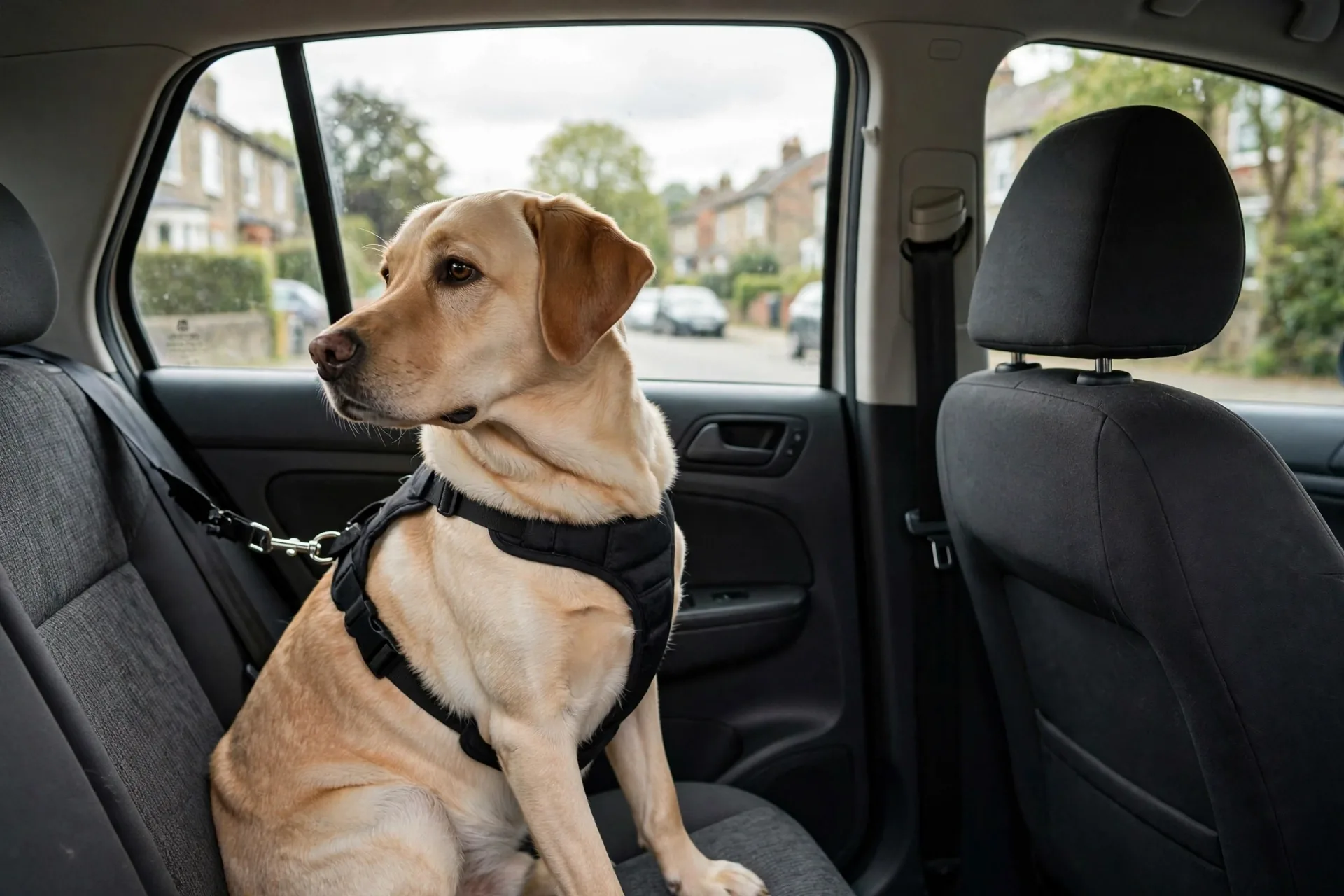
Car setup can reduce nausea, anxiety and mess, but it cannot fix a training problem on its own. Start with restraint and position, which are both safety and comfort issues. A dog should travel restrained, by harness or crate, as required by the Highway Code, and the restraint should be fitted so that the dog can lie down, turn and settle, without sliding around on bends. Our guides to dog car law and Rule 57 and to harness versus crate choice explain the legal and safety details, and they are worth reading before you change a setup for a sick dog. A dog that can see forward, or that travels in the boot where movement is less visible, may feel less sick than a dog that travels sideways on a back seat; experiment gently, with short drives, to find what suits your dog.
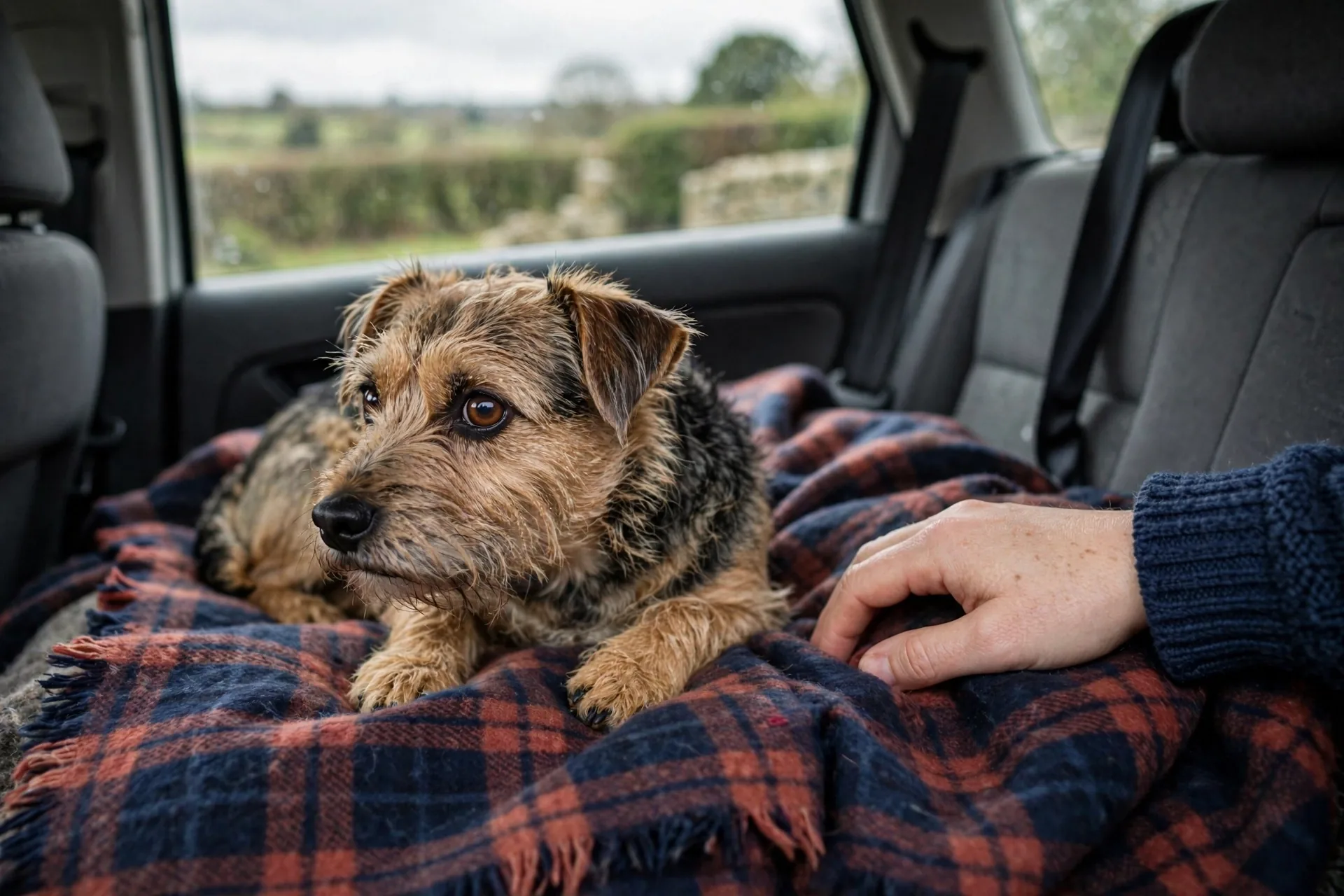
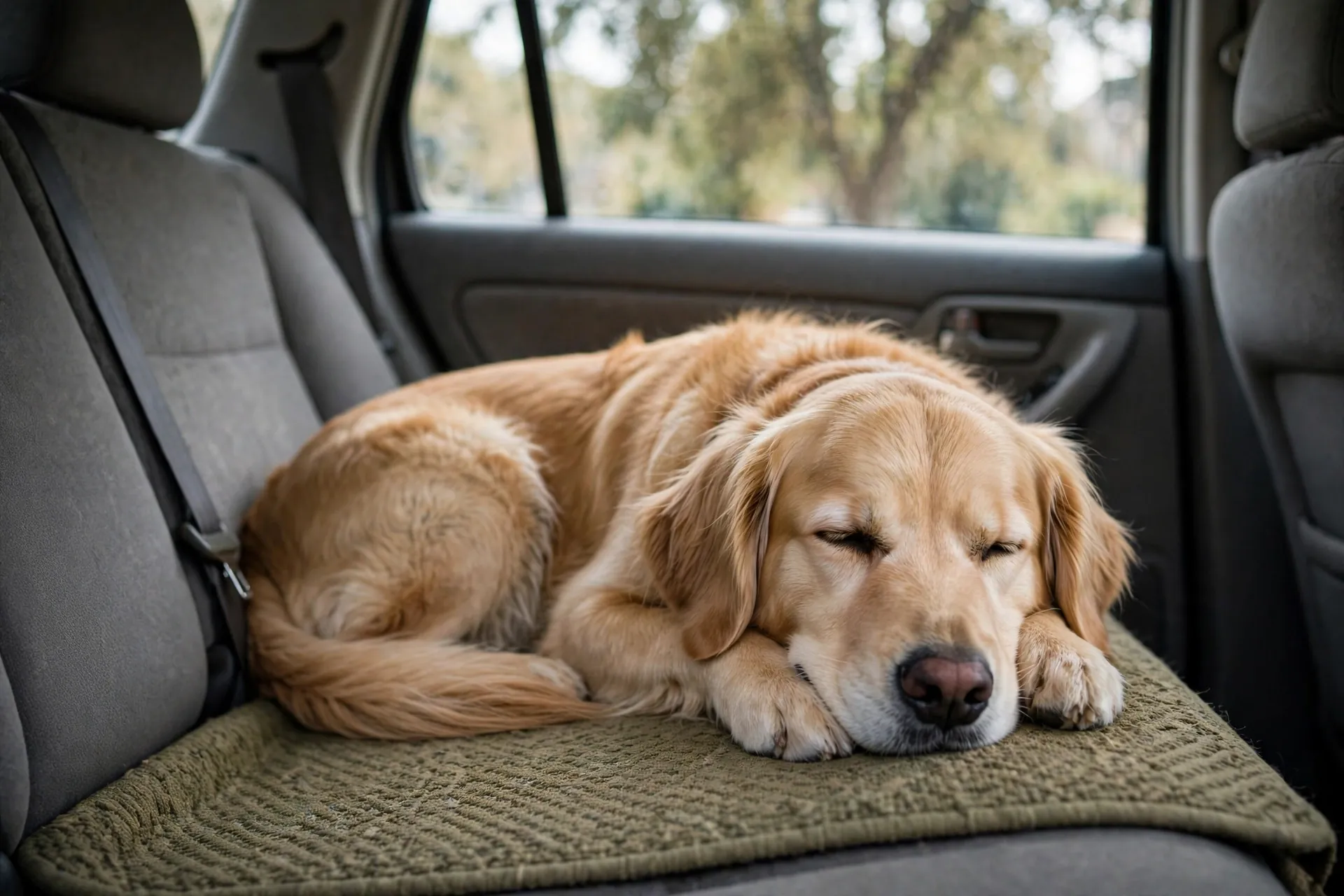
Ventilation, temperature and smoothness matter more than owners expect. Keep the car cool, with fresh air but without a strong draught directly on the dog, and avoid strong air fresheners, smoke and food smells in the car, which can worsen nausea. Drive smoothly, with gentle acceleration, braking and cornering, and choose a smoother route over a faster, twistier one when you can. A familiar blanket, a non-slip mat, and a seat cover that does not slide will help a dog settle, while a dog that is sliding, hot or buffeted by wind will feel worse. For a nervous dog, a familiar scent, a calm voice, and a person sitting nearby can help, provided that person is safely restrained and does not distract the driver.
For anxious dogs, the car itself can be a training tool. Practice settling in a stationary car, with the dog on its mat, a chew or a lick mat, and no journey at all. Our calming anxious dog travel guide covers stress signals, staged confidence building and kit that genuinely helps, and its advice on familiar bedding, quiet cars and no rush applies directly to car-sick dogs. A dog that can settle in a parked car is a dog that is learning that the car is a safe place, not just a place where sickness happens. That lesson is worth more than any single product.
Planning the journey: routes, breaks and food
Journey planning for a car-sick dog is different from journey planning for a confident traveller. Choose the smoother, straighter route over the shorter, twistier one, even if it adds a few minutes, because bends, hills and stop-start traffic worsen nausea. Plan breaks every 45 to 60 minutes on a long journey, at places where the dog can toilet, drink, walk calmly and recover, rather than at a busy service station where the dog must cross a car park. On a short journey, a single calm break halfway can be enough, provided it does not turn a five-minute drive into a stressful outing. Always allow extra time, so that a break, a clean-up or a slower drive does not create pressure.
Food timing is a practical detail that deserves veterinary advice for your dog. As a general guide, avoid a large meal in the three to four hours before travel, offer water, and use only small, familiar treats during training drives. On a long journey, offer a small amount of food at a break, rather than a full meal in the car, and wait a little after eating before driving again. Puppies, diabetic dogs, dogs on medication and dogs that must eat regularly need individual advice, so do not apply a general fasting rule without checking with your vet. Keep a note of what the dog ate, when, and whether it was sick, because that note will help you and your vet refine the plan.
Time of day and weather also matter. Cooler parts of the day suit most car-sick dogs better than hot afternoons, and a journey in heavy rain, strong wind or bright sun can add stress for both dog and driver. If you can choose, travel when the dog is normally calm, after a gentle walk and a toilet break, rather than when the dog is already excited, tired or hungry. A dog that starts a journey settled, with an empty bladder, a familiar blanket and a calm driver, has a better chance of staying settled than a dog that starts a journey already aroused.
When sickness happens on the road
Even with the best plan, sickness will sometimes happen, and how you respond in that moment matters. If a dog shows signs of nausea, such as drooling, lip licking, restlessness or retching, pull over safely as soon as you can, without rushing or panicking. Let the dog out on a lead in a safe place, offer water, and give it time to recover, rather than trying to continue and hoping the sickness passes. Do not scold a dog for vomiting; the dog is not being naughty, and punishment will only increase anxiety about the car. Clean up calmly, comfort the dog briefly, and decide whether to continue, shorten the journey, or abandon it, based on how the dog recovers.
If a dog vomits repeatedly, becomes lethargic, has diarrhoea, or shows signs of distress that do not settle after a break, seek veterinary advice, especially if the dog is a puppy, elderly, or has a medical condition. Do not offer food immediately after vomiting; offer small amounts of water, wait, and follow your vet's advice on when to feed again. On a motorway or a busy road, safety comes first: pull onto the hard shoulder or into a service area only when it is safe to do so, keep the dog on a lead at all times, and do not let a sick dog loose near traffic. A sick dog near a road is a dangerous combination, and a lead is non-negotiable.
After a bad journey, do not immediately repeat the same journey to prove a point. Give the dog a day or two of calm, car-free time, then return to a shorter, easier rung of the desensitisation ladder. A single bad journey does not erase weeks of progress, but a series of bad journeys in quick succession can undo it. Treat a bad journey as information: what was different about the route, the food, the timing, the weather, or the dog's state? Note it in your diary, adjust the plan, and move on. Owners who treat setbacks calmly teach their dogs that the car is not a place where bad things always happen.
The cleaning kit and the car
A good cleaning kit turns a sick journey from a disaster into a nuisance, and it protects both the car and the owner's patience. Pack a waterproof seat cover or boot liner, several old towels, poo bags, wipes, a plastic bag for soiled towels, a spare lead, and a change of clothes for yourself on a long trip. Keep the kit where you can reach it without unpacking the whole car, and keep a small kit in the front of the car as well as a larger kit in the boot. A dog that vomits on a waterproof cover that can be removed and washed is a different problem from a dog that vomits on upholstery that cannot be cleaned.
Cleaning itself should be calm and quick. Remove the dog from the car on a lead, remove soiled covers and towels into a bag, wipe the surface, and offer the dog water and a calm walk. Do not use strong-smelling cleaning products in the car while the dog is present, because the smell can worsen nausea and anxiety. At home, wash covers and towels promptly, air the car, and check for any damage to seat belts, harnesses or crates. A car that smells of sickness will remind a dog of sickness, so cleaning is not just about hygiene; it is part of training. A clean, fresh-smelling car with a familiar blanket is a better training environment than a car that still smells of a previous bad journey.
Restraint and cleaning interact in a useful way. A crate with a removable, washable base is easier to clean than a back seat, and a harness with a washable cover is easier to maintain than a harness that cannot be washed. Choose kit that can be cleaned, and keep a spare cover or blanket so that a soiled item does not mean a cancelled trip. If you travel with a car-sick dog regularly, consider a dedicated travel blanket that is only used in the car, washed after each trip, and kept in the car between trips. Familiarity and cleanliness together help a dog settle.
Long trips, holidays and ferries
Long trips need a different plan from short training drives, and they should not be attempted until a dog can manage a medium journey calmly. Break a long journey into stages, with a planned overnight stop if necessary, rather than pushing through a six-hour drive with a sick dog. Choose accommodation that welcomes dogs, has a secure garden or a nearby toilet walk, and allows a calm arrival, because a dog that arrives exhausted, sick and over-stimulated will not enjoy the holiday. On arrival, give the dog water, a familiar bed, a short calm walk, and a quiet evening, rather than an immediate long walk or a busy meal out.
Ferries and trains add their own challenges. Check the operator's pet rules before you book: some ferries require dogs to stay in the vehicle, some have kennels or pet lounges, and some allow dogs on deck. Plan toilet breaks before boarding, bring water, a familiar blanket and any prescribed medicine, and allow recovery time after landing. A dog that is car-sick and then faces a long, rough ferry crossing needs extra care, and a vet may advise on medication or timing for the combined journey. Do not assume that a dog that tolerates a car will tolerate a ferry, or vice versa; each mode of transport is a separate training challenge.
For holidays, pack a travel folder with the vet's plan, the diary, the medicine list, the nearest vet at the destination, and the cleaning kit. Tell the accommodation host that the dog is car-sick, so that they can advise on the best arrival route, parking and drying area. If a holiday involves a long drive that the dog cannot yet manage, consider an alternative: a nearer destination, a train journey, a pet sitter, or a delayed holiday until training has progressed. A holiday that starts with a traumatic journey will not be a holiday for the dog, however beautiful the destination is.
Tracking progress without pressure
Progress with a car-sick dog is rarely linear, and measuring it badly can create pressure that makes things worse. Instead of asking whether the dog is cured, ask smaller questions over a longer period. Can the dog get into the car calmly? Can it sit in a stationary car without distress? Can it manage a five-minute drive without vomiting? Can it manage a ten-minute drive to a pleasant place? Can it recover quickly after a bad journey? Each yes is progress, even if a longer journey still causes sickness. Record these milestones in your diary, and review them monthly, not after every trip.
Share progress with your vet, your trainer, and anyone else who travels with the dog, so that everyone follows the same plan. If a dog improves with medication, do not stop the medication suddenly without veterinary advice, and do not assume that a few good journeys mean the dog no longer needs it. If a dog stalls, ask your vet or a behaviourist for a review, rather than pushing harder on the same rung. Sometimes a change in car setup, route, timing or medication is enough to restart progress, and sometimes a dog simply needs more time. Patience is not a lack of ambition; it is the method that works for car-sick dogs.
Celebrate small wins in a way that helps the dog. A calm five-minute drive that ends at a park, with treats and a play, teaches a dog more than a forced hour-long drive that ends in sickness. End every training session on a success, even if that success is simply getting into the car and getting out again calmly. A dog that ends a session feeling good is a dog that will be willing to try again tomorrow, and willingness to try again is the foundation of all progress with car sickness.
When not to travel, and alternatives
There are times when the kindest choice is not to travel. If a dog is acutely unwell, has vomited repeatedly, is dehydrated, or is in significant distress, do not travel unless a vet advises it, and then travel only for veterinary care, with the shortest route and the best setup you can manage. If a journey is not essential, postpone it until the dog has recovered and training has progressed. If a dog is in season, has just had surgery, or is recovering from illness, check with your vet before travelling, because car sickness can complicate recovery.
Alternatives to a long car journey are worth considering, especially for holidays. A nearer destination, a train journey where the dog can travel with you, a stay with a trusted pet sitter, or a house sitter can all be better than a traumatic drive. If you must travel, consider breaking the journey, using a professional pet transporter who is experienced with sick dogs, or asking your vet about a trial journey with medication. The goal is not to avoid travel forever; it is to avoid a journey that undoes months of training and damages a dog's confidence in cars.
Finally, be kind to yourself as an owner. Travelling with a car-sick dog is tiring, messy and sometimes embarrassing, and it is normal to feel frustrated. That frustration does not make you a bad owner, and it does not mean the dog will never improve. Keep the plan simple, keep sessions short, keep the car clean, and keep returning to your vet for advice. Many dogs that once vomited on every journey learn to travel calmly, and many owners who once dreaded car trips learn to enjoy them again. The path is slow, but it is a path that works.
Practical questions
Before you go
Why does my dog vomit in the car?
Most car sickness in dogs comes from motion affecting the inner ear, from anxiety about travel, or from both together. Puppies often outgrow true motion sickness as their inner ear matures, while anxiety needs gradual training. A vet can help you tell the difference and choose a plan.
Is car sickness in dogs anxiety or motion sickness?
Motion sickness usually brings drooling, nausea and vomiting even on short, calm journeys, while anxiety brings panting, shaking, whining and distress before the car moves. Many dogs have both, because repeated sickness teaches them to dread the car. Keep a simple diary of signs, timing and journey length to show your vet.
Can a vet help a car-sick dog?
Yes, a vet can check for other causes, advise on feeding and journey timing, and discuss medication for nausea or anxiety when training alone is not enough. Never give a human travel sickness medicine to a dog without veterinary advice, and tell your vet about all other medicines your dog takes.
How long does it take to cure car sickness in a dog?
There is no fixed timescale. Some puppies improve in weeks as they mature, while other dogs need months of short, positive practice. Progress is rarely a straight line, and a bad journey does not erase earlier gains. Judge progress over weeks, not over one trip, and keep sessions short and successful.
Should I feed my dog before a car journey?
Most vets advise a light meal or no large meal in the three to four hours before travel, with water available. A small, familiar treat during training is different from a full meal before a long journey. Ask your vet for advice for your dog, especially for puppies, diabetic dogs and dogs on medication.
What should I pack for a car-sick dog?
Pack a waterproof seat cover, towels, poo bags, wipes, a spare lead, fresh water and a bowl, a familiar blanket, and any vet-prescribed medicine. Keep the cleaning kit where you can reach it without unpacking the whole car, and keep a change of clothes for yourself on a long trip.