This guide is independent and contains no paid placement. Seasonal opening hours, events and services change, so check the official latest guidance before you travel.
Valentine's Day with a dog works when the dog is part of the design: a real walk first, a restaurant or hotel that welcomes dogs in the room you actually want, and home hazards — lilies, chocolate, candles — managed like any other February evening. Decide the alone-time honestly; a dog left too long in the dark is not a romantic gesture to anyone.
The myth: what the marketing leaves out
Valentine's marketing aimed at dog owners sells a particular picture: a cottage glowing in dusk, a couple in matching knitwear, and between them a dog so serene it might be employed by the cottage company. What the picture omits is everything that determines whether the evening actually works. It omits the weather, which in mid-February Britain is reliably the weather described in our winter guides — dark by half past five, pavements wet, the romantic stroll requiring waterproofs. It omits the venue's small print, where dog friendly turns out to mean dogs in the bar area, dogs not in the restaurant, dogs in three specified bedrooms, or dogs that weigh less than the handbag of the person reading the terms. And it omits the dog itself, an animal who did not ask for a tasting menu and whose perfect evening is a long walk, a full bowl and its people sitting still in one warm place.
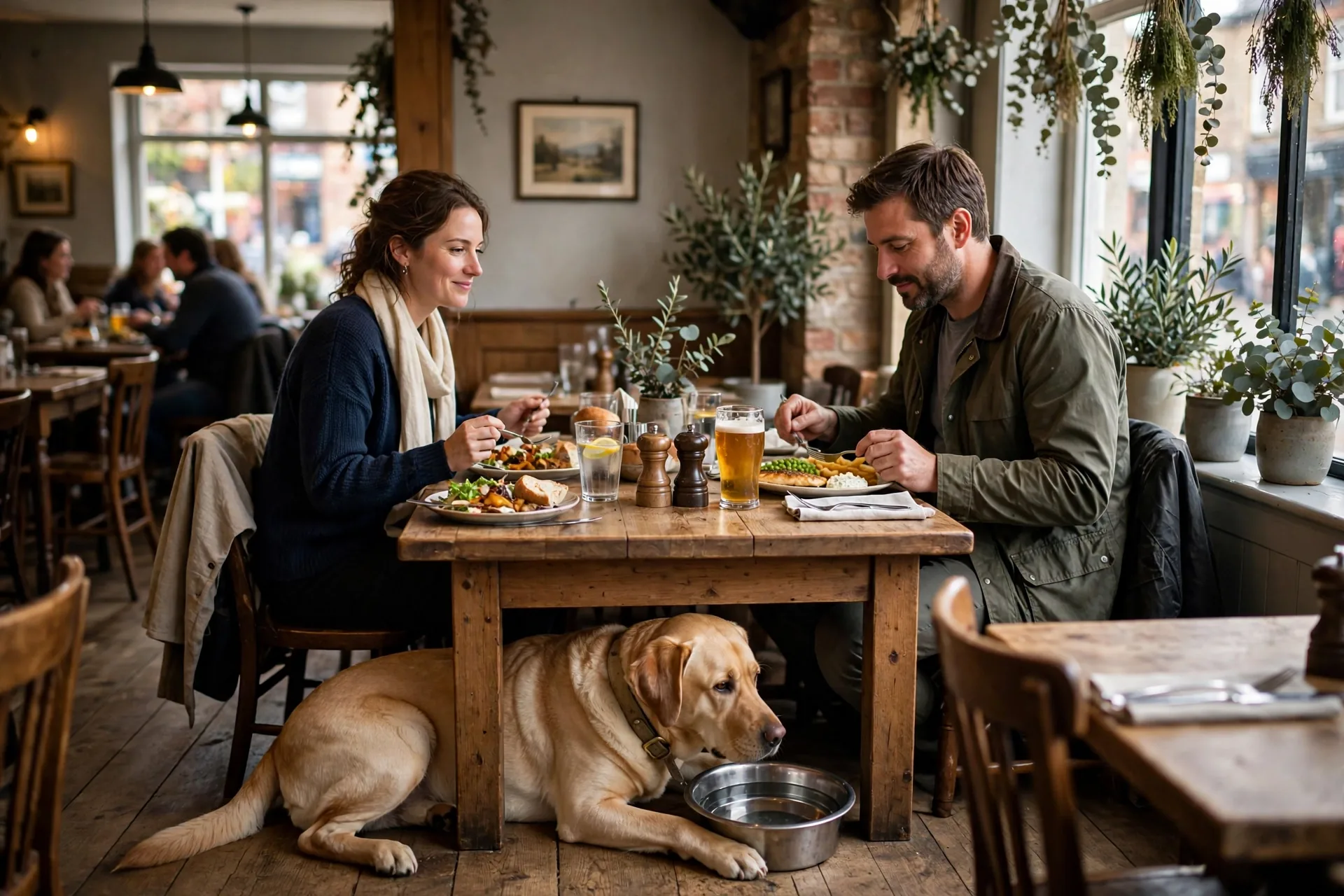
None of this is an argument against marking the day with the dog included. It is an argument for designing the occasion from the dog outward rather than from the brochure inward. The couples who report the best Valentine's evenings with a dog share a pattern: modest ambitions, genuinely welcoming venues, a walk long enough to count as the main event, and food — human and canine — that does not require anybody to perform enjoyment. The dog under the pub table while two people eat well and talk properly is not a compromise version of romance. For many households it is the thing itself, and the photographs, muddy boots and all, improve with keeping.
So treat this guide as a translation exercise. Every Valentine's product — the romantic break, the candlelit dinner, the flowers, the chocolates — can be translated into a version that survives contact with a real dog on a real February night, and most translations are cheaper than the original. What cannot be translated should be declined without regret: the eight-course dinner in a dogs-free dining room an hour's drive away, with the dog home alone until midnight, is a plan that serves nobody in the household, and the dog least of all.
Restaurants that welcome couples — and the dog
The central booking skill is separating welcome from tolerance, because Valentine's night is the worst evening of the year to discover the difference. A restaurant that welcomes dogs will tell you precisely where the dog sits — which room, which tables, whether booking a dog in is expected — and will sound pleased rather than resigned when you ask. A restaurant that tolerates dogs will use words like usually and probably, seat you by the door or the toilets, and treat the dog's water bowl as a special favour. On a quiet Tuesday, tolerance is survivable. On the busiest service of the winter, with a set menu, a full room and staff at full stretch, tolerance collapses into a bad table and a stressed dog, and both of you will remember the evening for the wrong reasons.
Book in person or by phone if you possibly can, and ask the questions that reveal the truth: Is the dog welcome in the dining room itself or only the bar? Do we need to book the dog in, and is there a quieter table — a corner, a banquette — where a dog can settle out of the walking route? What time is the calmest service? An early sitting, around six, is the connoisseur's choice for a Valentine's meal with a dog: the room is quieter, the staff have time, the dog has not waited hungry through its own dinner hour, and you are home at a civilised time having eaten the same food as the nine o'clock romantics. Our guide to dog friendly restaurants in the UK covers booking, table etiquette and feeding rules in full, and every word of it applies double on 14 February.
On the night, set the dog up to succeed. Walk first — properly, not a token circuit — feed the dog its ordinary dinner before you leave home or bring its meal if the venue and timing suit, and bring the settle equipment your dog already trusts: a mat or blanket that means lie here, a long-lasting chew for the gaps between courses, and water offered at intervals rather than a bowl placed where waiters' feet need to be. A dog that has a job, a place and a routine will melt into the evening. A dog brought in cold, hungry and mat-less will spend the meal auditioning for the couple's shared memory of the night the dog stole a stranger's bread roll — funny by next Valentine's Day, not during this one.
Hotels and stays for two humans and one dog
A Valentine's night away adds a room to the equation, and hotel dog policies reward the same forensic reading as restaurant ones. The questions, in order: Is the dog allowed in a room you would choose anyway — not only in the two rooms by the service lift — and is there a per-stay or per-night dog charge, and what does it actually buy? Where may the dog go in the building: bar, lounge, terrace, gardens, and crucially, may the dog be left alone in the room at all? Many hotels prohibit it outright, which transforms dinner planning entirely — the dog comes to the dog-welcoming bar for supper, or room service becomes the romantic option, which, with a dog asleep on the rug and no driving home afterwards, a good many couples would choose anyway. Our guide to dog friendly hotels in the UK lists the booking checks that prevent each of these surprises.
February specifics matter more than the brochure suggests. A ground-floor room with a door to a garden or terrace is worth more on a wet February night than a sea view, because the last toilet break happens at eleven in the rain and the dog that can step out and back settles again in minutes. Ask about the walk from the door: a hotel surrounded by lanes and a lit garden loop is a different product from one marooned on a dual carriageway, however beautiful its spa. And pack the dog's normal bedding rather than relying on hotel provision; the dog that sleeps on its own blanket in a strange room sleeps, and the couple in the bed above it sleep too, which is the entire foundation of the following day's romance.
One night is, for most dogs, the honest length of a Valentine's stay. It is long enough to feel like an event and short enough that routines bend without breaking, feeding stays normal and nobody needs a sitter for the cat, the plants or the dog's own dignity. If the plan grows to a weekend, arrange it as a proper short break — researched walks, a second dog-welcoming meal option, a lazy morning — rather than as a dinner with two nights attached. The dog experiences duration as a series of walks and sleeps, and a weekend planned at dog speed beats a weekend planned at brochure speed on every measure the household will remember.
Chocolate, lilies and the other Valentine hazards
Valentine's Day delivers two classic dog hazards through the front door in ribbon. The first is chocolate, arriving in larger, darker, more concentrated forms than at any time except Easter: gift boxes of high-cocoa truffles are considerably more dangerous, gram for gram, than the milk chocolate of everyday life, and they are placed, by the logic of romance, on beds, sofas and low tables rather than in kitchen cuppers. Treat every box as you would during the festive season — out of reach, behind a closed door, never on the floor in its gift bag — and if a dog does get into chocolate, phone the vet promptly with the packaging to hand rather than waiting to see how the evening develops.
The second hazard is quieter and less widely known: lilies. True lilies and daylilies are a particular danger to cats, for whom they can be life-threatening, and while the risk profile for dogs is lower, lilies and several other common bouquet flowers and bulbs are still capable of causing real harm if eaten, and the stems, leaves and fallen petals of a large arrangement end up at dog height on tables and floors. The practical household rule needs no toxicology degree: bouquets live somewhere the dog cannot reach, fallen petals get swept the day they fall, bulbs and plants given as gifts are planted or potted promptly out of browsing range, and any dog that eats an unknown plant earns a call to the vet for advice, with a photograph of the plant to help identification. A bouquet on a high shelf loses nothing of its romance.
Complete the sweep with the evening's minor cast. Candles and tealights at floor or coffee-table height combine open flame with wagging tails and trailing fur; place them high, stable and supervised, or use the good flameless kind and keep the real ones for the table centre. Alcohol, again, sits at dog height during exactly the evenings when attention is elsewhere, and a glass of something sweet left by a chair leg is an invitation. Rose thorns in paws and mouths, rich restaurant leftovers brought home in a bag and shared generously at midnight, small gift items — jewellery, batteries from cards that sing, the silica packet in every box — each is trivial alone and together they make the case for one five-minute hazard pass before the evening begins, the same discipline applied to any celebration in a house with a dog.
Left alone: the honest limits
Some Valentine's plans cannot include the dog — the theatre, the tiny restaurant that is honestly too small, the dinner at friends whose own cat has voted. Then the question is not whether the dog can be left, but for how long, and the answer must come from the dog's established reality rather than the evening's ambitions. A dog accustomed to four settled hours alone, with a walk beforehand, a radio on and a routine it trusts, can usually do its normal four hours on Valentine's night. What it cannot fairly be asked to do is eight, because the humans' evening acquired a second venue — nor to do its four hours for the first time in months because February has been sociable. Alone-time is a fitness that fades, and the middle of winter, with dark evenings and disrupted routines, is when many dogs have quietly lost it.
If the evening genuinely outlasts the dog's comfortable limit, the solutions in descending order of kindness are a sitter the dog knows, in your home; the dog staying with family or a trusted boarder it has used before; or reshaping the evening — earlier, nearer, shorter — until it fits inside the limit. What does not appear on the list is leaving the dog and hoping, because a distressed dog alone in the dark can injure itself, damage the home it is panicking in, and learn an association between evenings out and abandonment that the next six months of evenings will have to unpick. Two hours of a shorter celebration with a settled dog at home is a better Valentine's than five hours of the full production shadowed by a phone photograph of a dog crying at the door, sent by a neighbour at nine.
Plan the departure like a professional. Walk and feed before you go, at the usual times rather than in a rushed pre-show scramble; leave without ceremony and return without a festival; and leave the house safe — hazards from the previous section out of reach, doors to interesting rooms shut, nothing on counters that rewards a counter-surfer's best evening ever. If your dog is young, new to you or recently unsettled, be more conservative still, and consider that the most romantic sentence available to a dog owner on 14 February is often we will do the big evening next year, and this year we are having the good one with the dog in it.
Date ideas where the dog is part of the plan
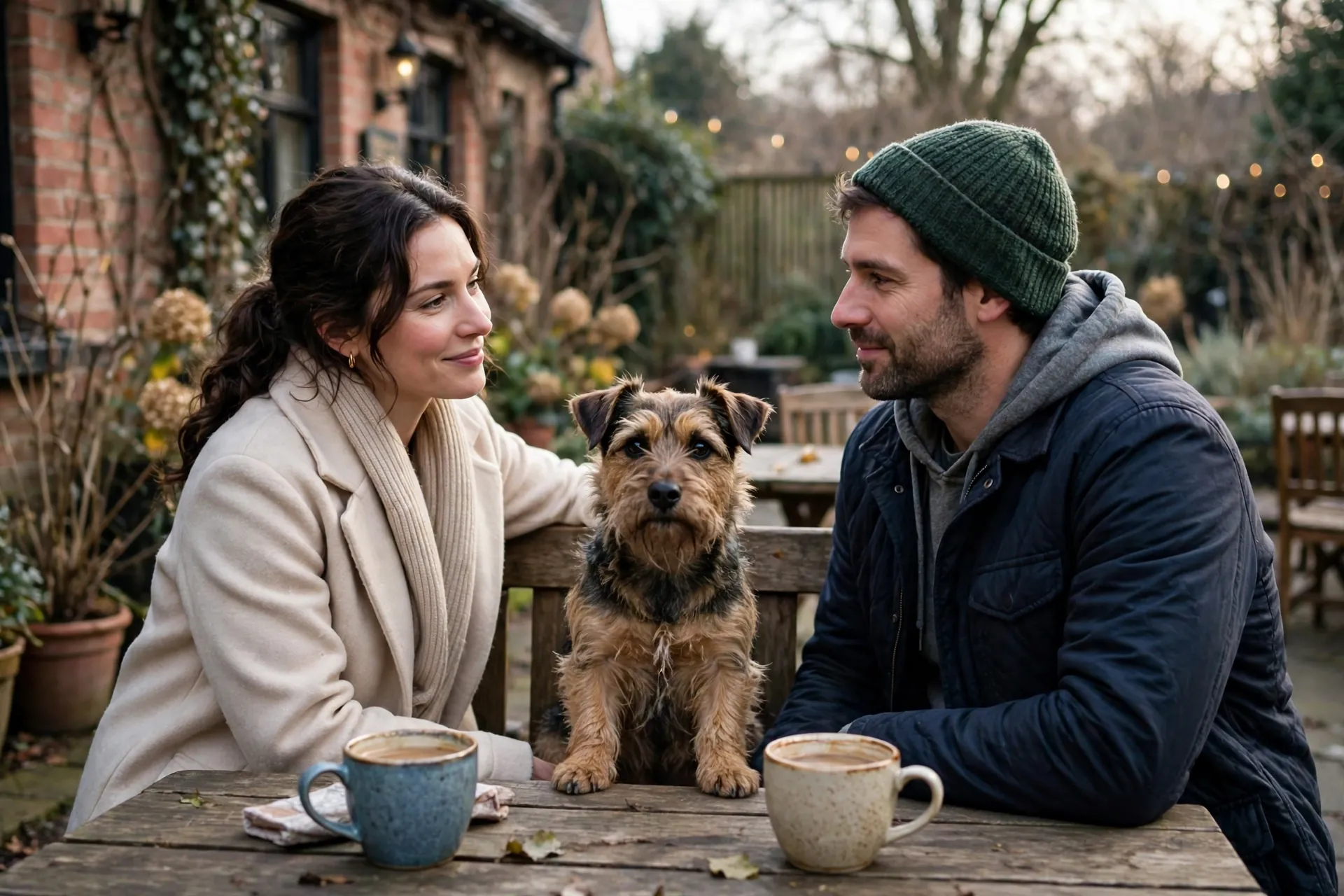
Begin with the format that has never once disappointed a dog: the long walk that ends at a table. Choose a route with genuine pleasure in it — a river path, a coastal stretch if you are near one, a woodland loop — timed for the last of the February light, and book the dog-welcoming pub or cafe at its end for the early sitting. Arrive with a dog that has earned its settle, hang the wet coats up, and eat by a fire while the dog dries underneath the table. It is inexpensive, it is weatherproof in spirit if not in fact, and it uses the strongest card dog owners hold: their celebrations happen at walking pace, outdoors, in places money cannot improve much.
At home, the dog-inclusive date is a design problem with pleasant solutions. Cook something deliberately good rather than elaborate — the meal you both actually like, eaten at the table with the candles high and the dog settled on its mat with a chew that lasts the length of a main course. Build the evening in the dog's rhythm rather than against it: walk together at dusk, cook together with music on, eat, then a film with the dog asleep in its chosen place and the chocolates, pointedly, on the mantelpiece. Households that imagine this is a lesser evening have usually not costed the greater one honestly — the taxi, the set menu, the dog's sitter, the low-grade guilt — against the thing itself, which is two people and a dog, warm and fed and unhurried, in their own house.
For a daytime version, several formats translate beautifully. A market or garden centre that welcomes dogs, browsed slowly with coffee involved; a beach walk in February's empty, dramatic light followed by fish and chips eaten in the car with the windows steaming while the dog processes the day's smells from the back seat; a bookshop or record shop in a town that lets dogs in, followed by tea somewhere with sofas. And for couples whose Valentine to each other is partly the dog: a new walk neither of you has done, chosen from a map the night before, with a pub at the end of it, is a gift the whole household uses. The theme underneath every one of these is the same — the dog is not the obstacle to the date or the mascot of it, but one of the three parties having a good day on purpose.
Gifts, deliveries and the front door problem
Valentine's Day stresses one household system in particular: the front door. Flower deliveries, food deliveries, neighbours, and in some streets a cheerful procession of couriers arrive across the day, and each arrival is announced by the dog at a volume that can curdle romance by the third repetition. Manage the door rather than the dog. Deliveries go to a safe place or a neighbour where possible; the dog is behind the kitchen door or on its lead with a chew for the two minutes a handover takes; and nobody — this is the rule that protects fingers and bouquets alike — opens the door while holding both a dog's collar and a conversation. A dog that has had its proper walk before the delivery window is a dog that reports arrivals at half volume, which on this of all days counts as a love language.
Gift-giving itself needs one dog-aware adjustment: presentation. Gifts left under chairs, on beds or inside bags on the floor are, from a dog's perspective, items placed at dog height wrapped in interesting materials at exactly the moment the humans are distracted by each other. Present gifts at the table, keep the wrapping in a bag as it comes off — ribbon and tape are swallow hazards and February vets know them well — and put edible gifts away as part of the giving, not as an afterthought at bedtime. Plants and flowers follow the previous section's rule to a high, swept surface. None of this dims the occasion; it merely moves the occasion up by about a metre, out of the dog's jurisdiction.
If the day involves sending the dog's humans out and bringing a sitter in, brief the sitter in writing on the three things that matter: feeding and hazard rules, the door routine, and the vet's number. A sitter working from a note on the fridge will run the evening you designed. A sitter working from a shouted summary in a hallway will run a different, more experimental evening, and Valentine's Day has enough variables already.
Putting together a Valentine's Day that works
Assemble the day in the order the dog experiences it. Morning: ordinary routine, unhurried, with the hazard pass done while the kettle boils — bouquets up, chocolate away, candles placed. Afternoon: the main walk, timed for the light, long enough to matter. Early evening: the dog fed at its normal time, the humans' plan — restaurant early sitting, pub at the end of a walk, or the good dinner at home — running at dog speed rather than against it. Late evening: a last garden break, the house swept once for glasses, wrappers and petals, and everyone to bed with the dog in its usual place, having missed nothing at all.
Budget honestly, because February romance has a way of billing twice: the set menu at peak price and the dog's arrangements on top. The dog-inclusive versions in this guide — the walk and the fireside table, the excellent home dinner, the one-night stay with ground-floor garden access — are not economy substitutes; they are the formats in which the dog's presence adds to the day rather than taxing it, and they routinely cost less than the formats that have to pay to exclude the dog. Spend the difference on quality inside the format: the better room, the good bottle, the taxi home so nobody watches the evening through a driver's restraint.
Above all, measure the day by the right standard in the days afterwards. A successful Valentine's with a dog is not the one that most resembled a brochure. It is the one after which the dog is its ordinary self, the couple are glad they did it that way, and the plan is worth repeating next February without modification. Dogs are, in the end, connoisseurs of exactly the things romance is supposed to be about: time given fully, company kept properly, small rituals observed. Build the day out of those, and the lead on the hook by the door stops looking like a limitation and starts looking like what it is — the household's way of life, celebrated.
Practical questions
Before you go
Can I take my dog to a restaurant on Valentine's Day?
Yes, if the restaurant genuinely welcomes dogs in the room you want to eat in. Book by phone, ask whether the dog will be in the dining room or only the bar, request a quiet corner table, and choose an early sitting. Walk and feed the dog beforehand and bring a settle mat and a long-lasting chew.
Are lilies and Valentine's flowers dangerous for dogs?
Lilies are a serious danger to cats and can also harm dogs if eaten, and several common bouquet flowers and bulbs cause problems when chewed. Keep arrangements out of reach, sweep fallen petals promptly, plant gift bulbs out of browsing range, and phone your vet for advice if your dog eats an unknown plant.
How long can I leave my dog alone on Valentine's evening?
Only for as long as your dog is already accustomed to being left comfortably — alone-time is a habit that fades if it is not used. If the evening will outlast that limit, use a known sitter in your home, a trusted boarder, or reshape the evening to be earlier and shorter rather than stretching the dog.
What should I look for in a Valentine's hotel with a dog?
Check that dogs are allowed in a room you would choose anyway, what the dog charge covers, where dogs may go in the building, and whether the dog may be left alone in the room — many hotels say no. In February, a ground-floor room with garden access is worth more than a view.
What are some dog friendly Valentine's date ideas?
A long walk in the last of the light ending at a dog-welcoming pub, an excellent dinner cooked at home with the dog settled beside you, a daytime beach or market outing, or one night in a hotel chosen for its garden access and walking from the door. The formats that include the dog by design work better than formats that squeeze it in.